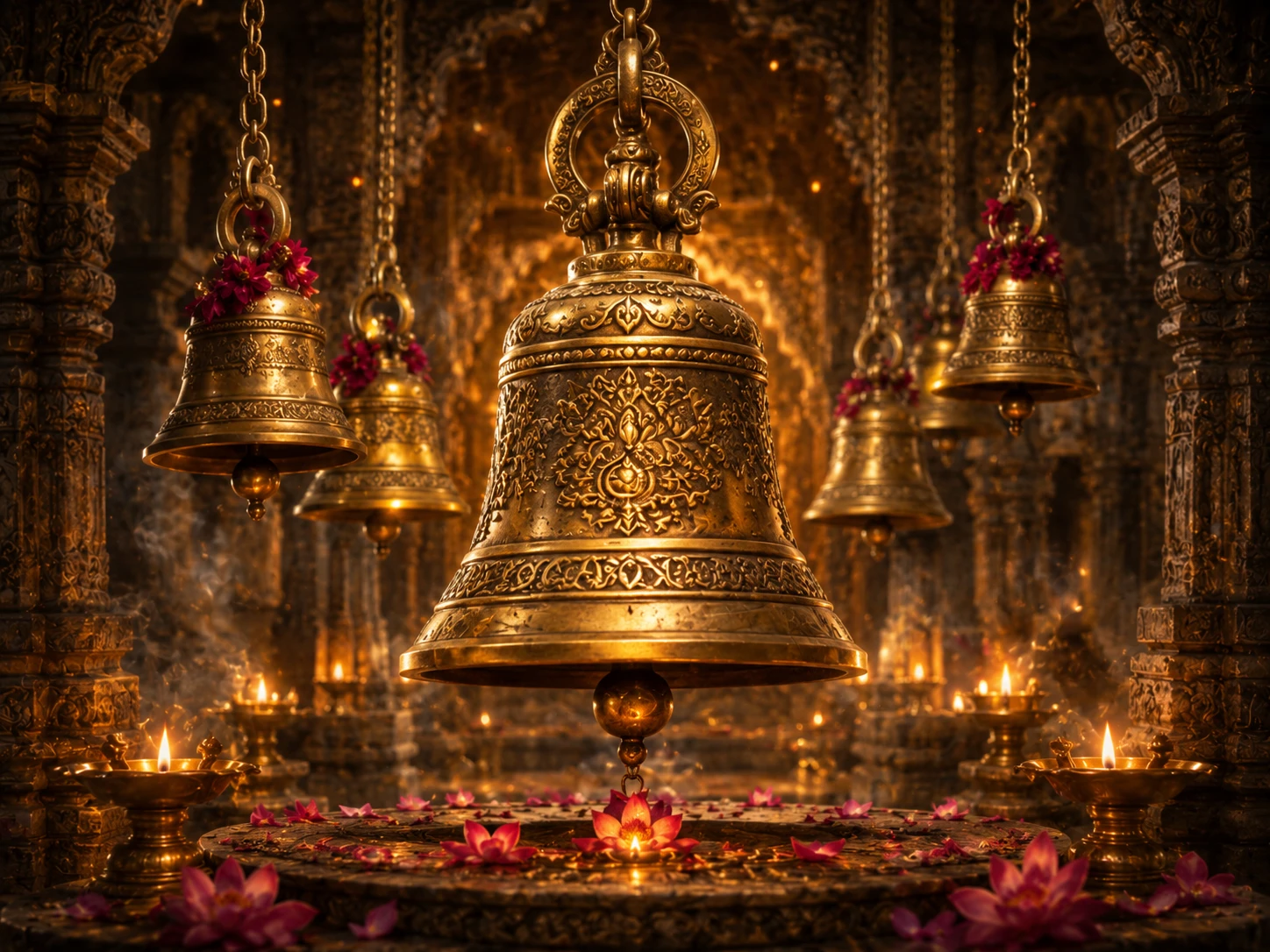
Temple Bells -- Sound as Purification
मन्दिर की घण्टियाँ -- नाद ही शुद्धि है
Watch what happens at the entrance of any active Hindu temple. Kashi Vishwanath at dawn, Meenakshi at midday, your neighbourhood Hanuman mandir in a Delhi colony at seven in the evening. Every devotee, without exception, reaches up and strikes the bell before entering. Children who can barely reach it stand on tiptoe. Elderly pilgrims pause, tilt the clapper, and wait for the resonance. Many will ring the bell a second time on their way out. No one is supervising this. No sign instructs them. The gesture is automatic, learned in childhood, repeated by generations. The temple bell is the one sound every Hindu knows before they know why.
The technical name for this bell is ghanta. Its ritual name is ghantanada, the sound of the bell. The Sanskrit verse that the priest chants inside the sanctum while ringing the smaller hand-bell during arati and abhishekam is known to every agama-trained priest across India. That verse explains the logic of the bell in four lines. Before we break it down, notice what it is asking. Not for forgiveness. Not for a boon. The verse asks that the sound itself accomplish two specific things: invoke the presence of the deity, and dispel the presence of forces that should not be there. Purification through sound is an older idea in Indian religion than perhaps any other.
This article takes the temple bell as an object of study in its own right. Not only as the metal object hanging at the door, but as the ritual category that organises sound in Hindu worship. The large brass bell at the entrance, the smaller hand-bell in the priest's left hand during arati, the tiny bells on the cow's collar at the temple gate, the ankle-bells on a Bharatanatyam dancer offering abhinaya to the deity, and the giant temple drums of Kerala's chenda-melam, all belong to the same grammar. They all say the same thing. They say: a boundary has been crossed. Whatever is ordinary has just become sacred.
आगमार्थं तु देवानां गमनार्थं तु रक्षसाम् । कुर्वे घण्टारवं तत्र देवताह्वान लाञ्छनम् ॥
āgamārthaṃ tu devānāṃ gamanārthaṃ tu rakṣasām | kurve ghaṇṭāravaṃ tatra devatāhvāna lāñchanam ||
For the coming of the devas, for the departure of the rakshasas, I sound the bell here. This is the mark of invoking the deity.
— Ghanta Mantra, traditional verse from puja-paddhati literature; recited in household and temple puja across South and North India
The ghanta-mantra is not from a single Vedic or Puranic source; it circulates through the puja-paddhati tradition, the practical manuals used by priests and taught in household ritual. Every regional puja manual, whether the Kerala Tantrasamuchchaya of Chennas Narayanan Nambudiripad or the Varanasi Karmakanda tradition or the Maharashtra Brahmakarma guides used in Chitpavan homes, includes a version of this verse. The phrasing shifts slightly. The idea does not. Sound invokes. Sound dispels. Both happen in the same stroke.
The theological basis for this is older than the verse. The Chandogya Upanishad, possibly the oldest Upanishad we have, describes the primordial sound Om as the syllable from which all things emerge and into which all things subside. The Mandukya Upanishad analyses Om into its three phonemes A, U, M and a silent fourth. Indian philosophy's concept of shabda-brahman, the absolute as sound, runs through tantric and mantric traditions from the Agamas onwards. When the temple bell rings, what the agama-trained priest hears is not noise. It is a physical instance of shabda-brahman, Om in miniature. The technical Sanskrit for this is pranava-dhwani, the primordial resonance.
This is not a mystical claim that cannot be checked. A well-made temple bell of the correct panchaloha alloy produces, when struck, a fundamental tone followed by overtones that decay over four to six seconds. Acoustic analysis shows the overtones cluster near frequencies that Vedic texts associate with the syllable Om. The Indian Institute of Technology at Kanpur ran such an analysis in the mid-2000s on bells from several South Indian temples, and the result was published in a paper by the institute's music cognition group. The bell's sound, acoustically, contains an Om-like harmonic signature. Whether this is accident, craft-intuition over generations, or encoded design, the signature is there. The priest's assertion that ringing the bell 'produces Om' is not metaphor. It is an acoustic statement.
The metallurgy is where craft and theology meet. A traditional temple bell is not cast in pure bronze or pure brass. It is cast in panchaloha, the five-metal alloy whose specific ratios are preserved in shilpa-shastra manuals and in the hereditary practice of temple-bell foundries in places like Kumbakonam, Pithapuram, and Nachiarkoil in South India, and Navsari in Gujarat. The five metals are copper (the dominant ingredient, usually around 78%), tin (around 16%, which gives hardness), zinc (small amount, improves casting), silver (trace), and gold (trace). Iron is excluded, because iron is considered rakshasa-metal, associated with weapons and violence and therefore unsuitable for the sacred object. The Vicharavedike tradition explicitly states that a bell cast with iron or of bronze with incorrect ratios causes rakshasas and pishachas to dwell in the location rather than flee from it. The rule is categorical.
This is not superstition in any loose sense. The specific ratios determine the acoustic signature. Too much tin, and the bell becomes brittle and produces a short, sharp ping that decays in under two seconds. Too much copper, and the bell produces a dull thud without overtones. The classical ratio produces a fundamental around 220 to 440 hertz (roughly the note A of Indian classical music, the shadja of a mid-range octave), with overtones that extend upward and decay smoothly for five or six seconds. This is the sound that the acoustic tests at IIT Kanpur matched to the Om-harmonic profile. The craftsman who understands these ratios does not need to read the Chandogya Upanishad to produce the correct sound. His grandfather's practice has encoded the theology into the metal.
Each part of the bell has a specific ritual identification. The Vicharavedike and similar puja-paddhati texts name them. The curved outer body is identified with Ananta, the infinite serpent, or more generally with the endlessness of time. The clapper (lolaka) is identified with Saraswati, the goddess of sound and speech. The handle (handi) is identified with Hanuman, Garuda, or Nandi, depending on the temple tradition, or more abstractly with prana-shakti, the life-force. The three parts, therefore, belong to three dimensions: time, speech, and breath. When the devotee strikes the bell, all three are invoked at once. No Hindu temple-goer articulates this, but the tradition is taught without words, through repetition.
Hindu Ritual Bells -- Types, Use, and Ritual Role
| Bell Type | Size | Where Used | Material | Ritual Role |
|---|---|---|---|---|
| Dwara-ghanta (door bell) | Large, hanging | Entrance of temple, over main doorway | Panchaloha or heavy brass, often engraved with Garuda, Nandi, or lion on handle | Marks the boundary between ordinary and sacred; rung by every devotee entering |
| Arati ghanta (hand bell) | Small, held in left hand | Inside sanctum during daily arati and abhishekam | Panchaloha, handle shaped as deity's vahana | Priest rings continuously during the arati flame's circumambulation of the deity |
| Jagarana ghanta (watch bell) | Medium, mounted | In temple courtyard, struck hourly | Heavy bronze or copper | Announces ritual times (muhurta); historically kept temple precincts aware of ritual schedule |
| Ghungroo (ankle bells) | Tiny, strung on cord | Worn by dancers, processional bearers | Small brass bells, clustered | Turn bodily movement into sacred sound; Bharatanatyam, Kathak, Mohiniattam use these |
| Cow-bell / calf-bell | Medium brass | Around the neck of temple cattle, or at temple gate | Brass or copper | Sanctifies the animal's presence; also used to summon the temple cow for morning milk-offering |
| Chenda-melam drums | Large cylindrical drums | Kerala temple processions | Jackfruit wood body, stretched hide | Accompany processional deities; thirty-six percussion patterns codified in Kerala's Panchari melam tradition |
The bell's continuous sound during arati is specifically to cover the moments of the priest's mantra so that the deity hears the mantra but the devotee does not catch it in fragments. The sound becomes a privacy curtain. This is one reason ghantanada must continue unbroken through the arati. Stopping the bell in mid-ritual is considered dosha (ritual defect).
The regulation around bell-ringing is specific. Temple agamas specify at least five moments in the daily puja cycle when the bell must sound. At abhishekam (ritual bath), the priest rings the small hand-bell continuously throughout. At arati (flame-offering), the bell accompanies every rotation of the lamp. At dhoopa-deepa (incense and lamp offering), the bell accompanies the offering. At naivedya (food offering), the bell rings before and after. At shayanotsava (the deity's night rest), a longer bell-stroke marks the moment the sanctum closes. The Madhva tradition's Padyamala, a widely-used puja manual in Karnataka and coastal Maharashtra, spells out each of these moments with the exact number of strokes.
The restrictions are equally specific. The bell should never be rung aimlessly; it is not a toy or a signal for random events. It should never be rung by someone ritually impure at that moment (during menstruation in traditional Brahminical households, the woman of the house does not ring the puja bell, though she may continue all other household functions, and this is a point where modern practice increasingly differs from textual rule). The bell should never be rung loudly during pradakshina (circumambulation) because circumambulation has its own sound grammar, the mantras being recited quietly. The bell should never be rung during shradh (ancestor ritual), because the purpose of shradh is the opposite of temple puja: it invokes ancestral spirits, not devas.
This last point tells you something. If the ghanta-mantra says the bell brings devas and dispels rakshasas, it also brings specific categories of presence. The ancestral spirits invoked at shradh are different from devas; they require silence and specific mantras, not bells. A bell rung during shradh is said to scatter the ancestors along with everyone else, making the ritual ineffective. This is why old Hindu households, even today, are careful about when the bell sounds. A Kolkata Bengali family performing their father's shradh on a specific tithi will cover or remove the puja bell from the kitchen altar for those hours. The bell is a summoning device. What it summons depends on context.
The bell also organises sacred time in ways that modern Indians rarely notice explicitly. Before the arrival of mechanical clocks in India in the sixteenth and seventeenth centuries, the temple bell was the town's timekeeper. Large temple complexes like Srirangam, Tirumala, Madurai Meenakshi, Udupi Krishna, and Kashi Vishwanath rang a deep bronze bell at each of the six daily ritual times: brahma muhurta (before dawn), usha kala (dawn), pratar sandhya (morning puja), madhyahna (noon), aparahna (afternoon), and sayam sandhya (sunset). The farmer in the fields, the housewife in the kitchen, the student at the pathshala, and the merchant at the bazaar regulated their day by these strokes. The bell was not only an instrument of worship; it was the infrastructure of civic time.
The Chola inscriptions at Thanjavur's Brihadisvara temple, commissioned by Rajaraja Chola in the early eleventh century, explicitly record the endowment of multiple bells for specific ritual times. A tenth-century copper-plate grant to the Tiruvaiyaru temple names the bell-caster, the bronze weight, the donor (a merchant named Nambi), and the specific puja times the bell would mark. These bells are still used today in modified form. When the Kumbakonam Mahamaham festival happens once every twelve years at the Mahamaham tank, the processional bells ringing through the old streets are, in many cases, late descendants of these Chola-period originals.
A Jeevaraj from a Tamil Nadu temple trust explained during a Navaratri festival in 2024 that the bell-casters his temple uses for replacements are the fifth generation of the same family his grandfather's trust used in the 1920s. Each new bell is cast in the same mold-shape, tested for pitch against an older surviving bell at the temple, and adjusted by hand-filing until the two bells ring in consonance when struck together. This is why a visitor to an old Tamil Nadu temple in 2026 hears essentially the same bell-sound that a visitor in 1920, or in 1420, would have heard. The craft has drifted very little. It has not needed to. The sound works. What works, persists.
The largest working temple bell in India hangs at the Shri Shaneshwar temple at Shingnapur in Maharashtra. It weighs over a ton and was cast at the historic foundry town of Nasik in the late nineteenth century. The second-largest is at the Tilabhandeshwar temple in Varanasi. Neither comes close to the Great Bell of Dhammazedi that once stood in Myanmar (at 297 tons, it would have been the largest in the world, but it sank in the Yangon river in 1608 during a Portuguese theft attempt and has never been recovered). Indian temple bells, even when large, are sized to be struck by a single priest using a wooden or leather beater. The point is never scale. The point is that the sound produced be rich enough to carry throughout the temple complex and remain identifiable as temple sound to every devotee within earshot.
Regional bell-making traditions are distinct. The Nachiarkoil bell-casters in Tamil Nadu have been producing temple bells using the same lost-wax panchaloha technique since at least the eleventh century, with a documented lineage traceable to the Chola period. Their bells ring with a specific pitch that devotees trained in the region can distinguish from Kerala or Karnataka bells. The Nadavaramba foundries in Kerala, clustered near Thrissur, produce bells tuned slightly differently to complement the chenda-melam percussion used in Kerala temple processions; their bells are designed to ring in the same octave as the edakka, the hourglass drum played during Kerala arati. Gujarat's Navsari foundry tradition, catering historically to Jain and Vaishnava temples, produces lighter, higher-pitched bells. Uttarakhand's Almora copper-work tradition makes smaller household puja bells that sell throughout north India.
The Himachal Pradesh hill temples have a specific sub-tradition: bells donated by pilgrims accumulate over generations, until some temples like the Jwalamukhi, Kangra Chintpurni, and Mansa Devi temples have thousands of small bells hanging from ceilings, beams, and tree branches. A pilgrim fulfilling a vow ties a bell. Another bell joins the cluster. Wind passes through the temple, and all the bells ring together, producing a continuous ambient ghantanada throughout the day. This is a folk variation on the formal agamic logic. No single priest is ringing them. The wind itself does the work. The devas are invited, the rakshasas are dispelled, and the vow is remembered by the sound each pilgrim left behind.
In Kashmir, before the 1990 exodus of the Pandits, temple bells were distinct in shape, often bulbous and shorter, with engraved Sharada-script inscriptions. Many of these bells survived the exodus and are now in the collections of Pandit families in Jammu and Delhi, waiting for the day they return to Kashmir temples. A handful have already been reinstalled at restored Shivalayas in the Valley during the 2010s. Each bell carries a date and a donor name. Each is a small, portable archive of a moment of faith.
Contemporary Indian life has quietly extended the bell's domain beyond temple walls. Almost every Hindu household keeps a small brass puja bell on the home altar. The young IT professional in Bengaluru who sets aside seven minutes every morning for a truncated puja before starting his 9 AM standup reaches for that bell exactly when his grandmother does at her Hyderabad home, at precisely the moment the flame is offered to the laminated photograph of the family deity. An online shopping search for 'puja bell brass' in 2026 returns thousands of listings from Amazon, Flipkart, and small-scale manufacturers in Moradabad. The forms are standardised. Dimensions are uniform within the limits of what mass-manufacturing allows. The sound is close enough to the traditional panchaloha bell that no devotee's daily ritual is disrupted by using the cheaper version.
A Bharatanatyam dancer in her arangetram ceremony at a Chennai sabha in 2026 ties her ghungroo (ankle bells) over her ankles with a specific knot her guru has taught her. Before the performance, the gungroo are placed on a silk cloth and dotted with kumkum and turmeric. They are blessed. Only then are they worn. The dancer knows, whether or not she has read the agama, that her feet are about to produce ritual sound for the deity being invoked by the dance. Her feet become a portable temple bell for the hour of the performance. When she retires to the green room, she places the gungroo back on the silk cloth. The ritual is complete.
And at a Mumbai apartment griha pravesh in 2026, the first act of the priest is to ring a small bell over the threshold. Before the kalash, before the swastika at the door, before the rice and the coconut, the bell sounds once, twice, three times. Devas invited. Rakshasas dispelled. Threshold crossed. The new house becomes a potential temple. Whatever follows, follows from that first bell-stroke. The entire apparatus of agama, panchaloha, shabda-brahman, and the twelve-hundred-year craft of the Nachiarkoil bell-makers stands quietly behind a twenty-second gesture no one bothers to explain to the young couple who just signed a home loan.
There is one more piece of ritual detail worth pointing out. The bell is the only ritual instrument in Hindu puja that never speaks a mantra of its own. Every other object carries a mantra: the lamp has the deepa mantra, the incense has the dhoopa mantra, the flower has the pushpa mantra, the food has the naivedya mantra. The bell has a mantra said about it (the ghanta-mantra itself), but the bell's sound is the mantra. When it rings, nothing else needs to be said. This is why priests often strike the bell at the exact moment they complete a difficult mantra or conclude a long sankalpa. The bell seals the mantra, carrying it into the domain where it will be heard.
Indian classical music theorists like Bharata in the Natya Shastra (second century BCE to second century CE, depending on dating) recognised this. The Natya Shastra divides musical instruments into four classes: tata (stringed), sushira (wind), avanaddha (percussion with membrane), and ghana (solid-metal percussion, including bells, cymbals, and gongs). The ghana class is considered foundational because its sound does not require a reed, a string, or a drum-head; it is pure vibration from the struck material. The bell is the paradigmatic ghana instrument. When the Natya Shastra discusses ghana, it is simultaneously discussing what makes the temple bell an acoustically pure ritual sound. The framework is coherent. Indian classical music, temple ritual, and agamic theology were never separate domains. A priest, a Carnatic vocalist, and a bell-caster in eleventh-century Tanjavur would have shared a vocabulary. They still do, if you know how to look.
Recite the Ghanta Mantra
Before ringing the bell in puja, recite the ghanta mantra: 'Agamartham tu devanam, gamanartham tu rakshasam' -- I ring this bell to welcome the gods and send away what is unholy. Then listen as the sound fades; the Fading of a Sound dharana on Eternal Raga turns that listening into meditation.
Tags
Eternal Raga · शाश्वत राग
Institutional voice — scholarly articles on Sanatan Dharma
Deepen Your Understanding
अपनी समझ और गहरी करें
sacred artefacts
Utsava Murti -- The Processional Deity
The stone god in the sanctum never leaves. The metal god on the palanquin walks every street. This is the utsava murti, the deity that comes out to meet you. Every Chola bronze in a museum was once carried in procession. Every Brahmotsavam at Tirumala, every Rath Yatra at Puri, every temple car at Madurai, runs on the same principle: the god moves so the devotee need not travel to the sanctum to be seen.
sacred artefacts
Temple Lamps -- Vilakku, Nilavilakku, and Deepa
A Hindu temple without light is unthinkable. The brass lamps that flank every sanctum, the tall standing nilavilakku in Kerala temple courtyards, the thousand-wick deepasthamba that rises at Karthigai Deepam at Tiruvannamalai, and the small clay diya at a Varanasi ghat during Dev Deepawali all do the same work. They make the invisible visible, and they say it in lamp-light.
sacred artefacts
Sacred Vessels -- Akshaya Patra, Kamandalu, and Amrit Kalash
Three vessels define Hindu ritual. The Akshaya Patra fed the Pandavas through twelve years of exile. The kamandalu sits beside every ascetic from Vyasa to the sadhu at Prayagraj. The amrit kalash rose from the churned ocean and reshaped cosmic order. Each vessel teaches a different lesson about what it means to hold the sacred.
sacred artefacts
The Kalasha Across Temple and Household Ritual
A brass pot filled with water, topped with five mango leaves and a coconut, tied with red thread and marked with turmeric. Every Hindu wedding sets one up. Every griha pravesh, every puja, every temple consecration. The same object appears at the top of every Hindu temple spire as the crowning kalasha. From the Rig Veda to a Bengaluru flat-warming in 2026, one pot carries the tradition.
sacred artefacts
Divine Musical Instruments -- Veena, Damaru, Murali
Saraswati's Veena created knowledge. Shiva's Damaru created language. Krishna's Murali created longing. Three instruments, three cosmic functions -- and the foundation of one of the world's oldest musical traditions. From the 14 Maheshwara Sutras that birthed Sanskrit grammar to the raga system that maps human emotion, Hindu mythology placed music at the centre of creation itself.
tantra mantra yantra
The Science of Mantra -- How Sacred Sound Rewires Consciousness
A mantra is not a prayer. It is not a wish. It is a precision instrument of consciousness -- a vibrational key engineered in Sanskrit thousands of years ago to unlock specific states of mind. Modern neuroscience is only now catching up.
The largest working temple bell in India hangs at the Shri Shaneshwar temple at Shingnapur in Maharashtra. It weighs over a ton and was cast at the historic foundry town of Nasik in the late nineteenth century. The secon…
More in Sacred Artefacts
Ashtadhatu -- The Sacred Eight-Metal Alloy of Indian Temples
12 min read
Banalinga -- The Stone God Made Himself in a River Over Millions of Years
13 min read
Celestial Trees -- Kalpavriksha and Parijata
12 min readThe same translation error that turned '33 Koti' into '33 crore' in Hinduism also happened in Buddhism. The Chinese translation of Buddhist texts rendered 'Sapta Koti Buddha' (7 Supreme Buddhas) as '7 Crore Buddhas.' The…
Deities AvatarsCommunity Reflections
🕉️
Be the first to share your reflection.