The Kalasha Across Temple and Household Ritual
मन्दिर और घर की पूजा में कलश
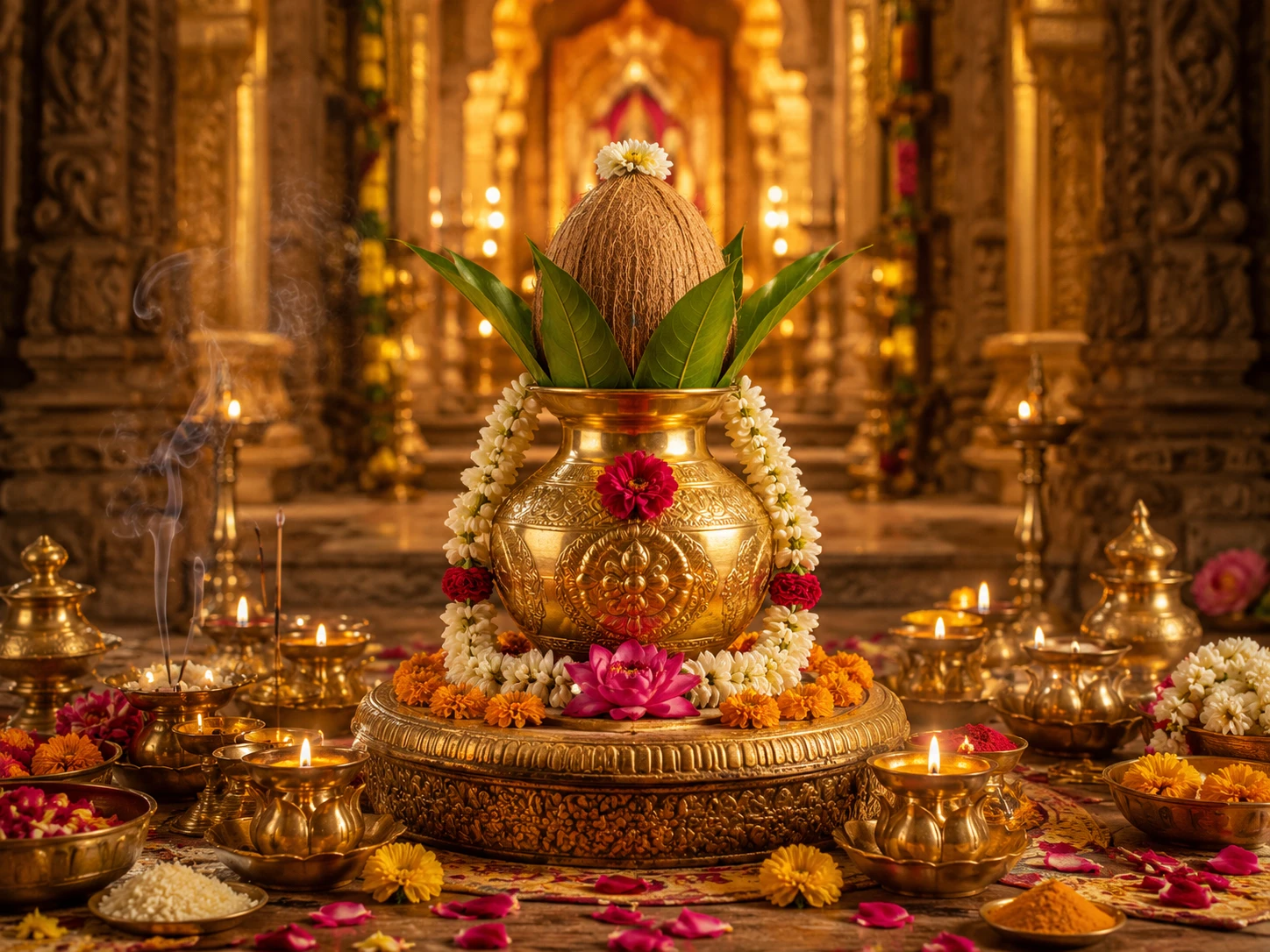
At a griha pravesh ceremony in a Bengaluru apartment complex in 2026, the priest places a single object at the centre of the new home before anything else. A brass pot. Water inside. Five mango leaves arranged around the mouth with tips pointing outward. A coconut balanced on top, wrapped in a small piece of red cloth with the shira (the coconut's tufted end) pointing upward. A red cotton thread wound around the body of the pot in a diamond pattern. Turmeric paste and kumkum dots mark the front of the pot. This single object, the kalasha, is the ritual anchor for the next forty minutes of ceremony. Every mantra the priest recites, every ladle of ghee poured into the small havan kunda, every rice grain offered, refers back to the kalasha at the centre of the room.
The kalasha is not a decorative pot. It is, in Hindu ritual logic, a portable temple. The Rig Veda refers to it as purno'sya kalashah, 'the pot that overflows'. The Skanda Purana identifies it with the amrit-kalash that emerged from the Samudra Manthan. The Puranic encyclopaedic tradition calls it by several names: Purna-kumbha, Purna-ghata, Mangala-ghata (auspicious pot), Bhadra-ghata (good pot), Soma-kalasha, Chandra-kalasha, Indra-kumbha. Each name emphasises a different aspect. Purna means 'full' or 'complete'. Mangala means 'auspicious'. Bhadra means 'of good omen'. The kalasha is all of these at once, because its full ritual function combines all of these meanings.
This article traces the kalasha through its three major domains of use. The household kalasha, set up for weddings, griha pravesh, Satyanarayana puja, Diwali, and many other household rituals. The temple kalasha, placed during every major temple consecration (prana pratishtha), and reappearing at every Kumbhabhishekam. And the architectural kalasha, the small round pot-shaped finial that crowns every Hindu temple spire in India, visible from a distance before the temple itself is reached. One object. Three domains. One continuous grammar across three thousand years.
कलशस्य मुखे विष्णुः कण्ठे रुद्रः समाश्रितः । मूले तत्र स्थितो ब्रह्मा मध्ये मातृगणाः स्मृताः ॥ कुक्षौ तु सागराः सर्वे सप्तद्वीपा वसुन्धरा । ऋग्वेदोऽथ यजुर्वेदः सामवेदो ह्यथर्वणः ॥ अङ्गैश्च सहिताः सर्वे कलशाम्बुसमाश्रिताः ।
kalaśasya mukhe viṣṇuḥ kaṇṭhe rudraḥ samāśritaḥ | mūle tatra sthito brahmā madhye mātṛ-gaṇāḥ smṛtāḥ || kukṣau tu sāgarāḥ sarve sapta-dvīpā vasundharā | ṛgvedo 'tha yajurvedaḥ sāmavedo hy atharvaṇaḥ || aṅgaiś ca sahitāḥ sarve kalaśāmbu-samāśritāḥ |
At the mouth of the kalasha, Vishnu is seated. In its throat, Rudra. At its base, Brahma. In the middle, the host of mother-goddesses. Within its belly, all oceans and the seven continents of the earth. The Rig Veda, Yajur Veda, Sama Veda, and Atharva Veda, together with all their limbs, are held in the water of the kalasha.
— Kalasha Dhyana Mantra, recited while invoking the kalasha in puja-paddhati; preserved in Agama-Kalpadruma and similar compilations; traditionally attributed to the Devi Bhagavata Purana commentary tradition
This dhyana verse is what the priest silently recites, or murmurs aloud, when he first sets up the kalasha at the beginning of a puja. The verse is doing something specific: it is performing a mental installation of the entire cosmos inside the small pot. Vishnu at the mouth. Rudra at the throat. Brahma at the base. The seven oceans and seven continents inside the belly. All four Vedas with all their ancillary branches, held in the water. This is not metaphor. In Hindu ritual logic, an object becomes what the mantra declares it to be, for the duration of the ritual. After this verse is recited, the water in the pot is not H2O. The water is the seven oceans. The mango leaves are not botanical specimens. They are the manifestation of Kama, the god of desire-and-creation. The coconut is not a coconut. It is the seat of the deity who is about to be invoked.
This explains why the substitution of substitutes is so strictly disallowed. A priest may not use a decorative artificial coconut instead of a real one. He may not use plastic mango leaves. He may not use tap water that has not been blessed with the specific jalashuddhi mantras. Each physical component is the material condition for the dhyana to work; if the physical object is wrong, the mental installation does not take place. This is not superstition; it is the internal logic of a ritual grammar in which physical and mental acts are equally necessary.
The five or seven or eleven mango leaves are also not arbitrary. Five mango leaves correspond to the five elements (earth, water, fire, air, ether), the five senses, or the five pranas depending on the tradition. Seven leaves correspond to the seven rivers, the seven sages, or the seven chakras. Eleven leaves are specific to certain Devi pujas and correspond to the eleven Rudras. The number is chosen based on the ritual. In most household pujas, five is default. A wedding kalasha almost always uses five. A Navaratri Durga puja kalasha may use seven. A Shaiva abhisheka kalasha for Rudrabhishekam uses eleven. Different numbers signify different deific presences.
The coconut sitting on top of the kalasha deserves its own paragraph. It is called shriphala, 'the fruit of Shri (Lakshmi)', because the three dots on the coconut's head are said to be the eyes of the Goddess. The coconut is specifically a shree-sucha, a marker of divine presence. In the ritual, the priest invokes the deity (Vishnu, Lakshmi, Ganesha, depending on the puja) into the coconut. The coconut, in that moment, becomes the temporary avahana-sthana, the place-of-invocation, for that deity. When the priest later offers flowers or ghee or fruit, the offering is made 'to the coconut', understood as the substitute body of the deity for the duration of the ritual.
At the end of the puja, the coconut is handled with great care. In some traditions, it is broken and distributed as prasada, the meaning being that the deity's energy is now dispersed among the devotees who consume it. In other traditions, it is kept whole and carried to a river or temple for visarjana (immersion). In a home-puja context, the coconut is often kept on the family altar until the next major puja, at which point a fresh coconut is used and the old one is respectfully disposed of. A coconut used in a kalasha ritual is never thrown in the regular trash. The worst failure of ritual attention in a traditional Hindu home is letting the post-puja coconut end up in the garbage bin.
The red thread wound around the pot is called kautuka. The term kautuka has a specific meaning: it is the protective tying that secures the ritual presence. A kalasha without the red thread is considered incomplete. The knot at the end of the winding is tied at the front, over the turmeric dot. The winding pattern varies slightly by region; Tamil Brahmin tradition uses a simple spiral, while Maharashtrian and Bengali traditions prefer a diamond cross-pattern. The thread is not decorative. It is ritual closure. When the puja ends, the priest formally unties the thread in a brief concluding rite, releasing the deity's presence from the pot back to the cosmos.
The kalasha's Vedic origin is the first place to look. The Rig Veda mentions purno'sya kalashah, 'the overflowing pot', in Mandala 3 and Mandala 10 among others. The Vedic kalasha was associated with the soma ritual and with the divine offering of soma-juice to the gods; the pot held the pressed soma before it was poured into the fire. By the time of the Shatapatha Brahmana, written probably in the eighth century BCE, the kalasha has become a fully independent ritual object, used in contexts unrelated to soma. The pot is explicitly identified with the womb-of-abundance and associated with Lakshmi-like goddesses even before Lakshmi by that name enters the mainstream.
The Skanda Purana provides the story that most Hindus today associate with the kalasha. During the Samudra Manthan, when the devas and asuras churned the cosmic ocean for the amrit of immortality, Dhanvantari emerged from the waters holding a kalasha. That kalasha contained amrita. The entire narrative tradition that links the kalasha to amrit-kalash, to the Kumbh Mela sites, to immortality, traces back to this Puranic account. Every kalasha placed at a modern puja is, via this narrative, a ritual replica of the original amrit-kalash. The water in the pot is not just water; it is, ritually speaking, a drop of amrita.
The Kumbh Mela that happens at Prayagraj, Haridwar, Nashik, and Ujjain every twelve years is the largest possible public enactment of the kalasha concept. When the priests at the Sangam at Prayagraj invoke the tirtha during the mela, they are technically treating the entire Sangam as a vast purna-kumbha, a giant kalasha filled with the waters of immortality. Pilgrims who bathe in the river at the auspicious muhurta are, in ritual sense, stepping into a cosmic kalasha. The small brass kalasha on a Bengaluru griha-pravesh altar and the sixty-six-crore-person Kumbh Mela at Prayagraj in 2025 are performing the same ritual action at dramatically different scales.
The Kalasha Across Major Hindu Rituals
| Ritual Context | Kalasha Role | Leaves / Filling | Deity Invoked | Regional Variation |
|---|---|---|---|---|
| Wedding (vivaha) | Set up at the four corners of the mandap; central kalasha as agni-sakshi | 5 mango leaves + coconut; water inside | Gauri-Ganesha; also Vishnu-Lakshmi in Vaishnava weddings | Tamil uses 5 kalashas at corners; Bengali uses a single ghot with banana stem |
| Griha pravesh | Central kalasha at entrance; ghee-lamp placed beside | 5 leaves + coconut; coins sometimes inside | Ganesha, then the family's ishta-devata | North Indian uses red thread; South Indian uses turmeric-dyed cotton |
| Satyanarayana puja | Kalasha represents Vishnu-Satyanarayana; prasad distribution after | 5 leaves + coconut; rice grain and turmeric inside | Vishnu as Satyanarayana | Observed across India with minor scriptural variations |
| Navaratri / Durga Puja | Ghatasthapana: kalasha placed on first day, grain sown at base | 7 or 11 leaves + coconut; barley or wheat grain inside | Durga / Devi in her nine forms | Bengali Puja elaborates around a Mahishasuramardini image; North India more kalasha-centric |
| Temple prana pratishtha | Multiple kalashas (9, 108, or 1008) for consecration of new deity | Leaves and coconut; specific water from tirthas mixed in | The temple's ishta-devata being consecrated | Kumbhabhishekam in Tamil Nadu is the most elaborate form |
| Kumbhabhishekam (12-yearly) | Hundreds of kalashas carried up temple, their water poured over the shikhara | 5 leaves + coconut; tirtha-waters inside | The presiding deity's presence is renewed | Specific to South Indian Agamic temples |
| Temple shikhara (architecture) | Stone or metal kalasha placed at the top of every Hindu temple spire | Symbolic; not water-filled | The deity of the temple below; marks the cosmic-axis apex | Universal across North and South India |
| Shashthi / Sixth-day childbirth | Kalasha on mother's bed-side; new mother and infant blessed | 5 leaves + coconut; sindoor and rice inside | Shashthi Devi or Sathi Mata; regional goddesses | Bengali, Odia, and Assamese traditions most elaborate |
The kalasha is ritually considered 'alive' for the duration of the puja, meaning it is treated as a deity rather than an object. It cannot be touched carelessly, walked around from behind (priests approach from in front), or left unattended during the ritual. After the puja, the kalasha is formally 'dismissed' through a visarjana mantra that releases the deity's presence, and only then may the coconut be broken and the water be given out as tirtha.
The architectural kalasha, perched on top of every Hindu temple shikhara, is the same ritual object translated into stone, metal, and permanent form. Go to any temple in India, from the Kailasa temple at Ellora to the Khajuraho Lakshmana temple to the Konark Surya to the Meenakshi Madurai to the smallest village shrine in Bihar or Andhra Pradesh, and you will find a stone or gilded metal kalasha crowning the highest point. The architectural kalasha is usually fluted like the body of a ritual pot, with a conical finial rising from the top (the shira, corresponding to the coconut's tuft on the household version). Larger temples have multiple kalashas: one on each of the sub-shrines, plus the main shikhara.
The Kumbhabhishekam ritual, performed every twelve years at most major South Indian temples, renews the ritual life of the temple by treating its shikhara kalasha as the primary recipient of sacred waters. Hundreds of small brass kalashas filled with tirtha-waters from rivers and other temples are carried up ladders and scaffolding to the top of the shikhara, where their water is poured over the stone kalasha. The ceremony is the temple's equivalent of a twelve-year spiritual recharge. At Madurai Meenakshi's 2022 Kumbhabhishekam, over nine hundred smaller kalashas were processed up the temple towers; the event drew over ten lakh devotees and was livestreamed for Tamil audiences worldwide. At Thiruvanaikaval's Jambukeshwarar temple, the 2024 Kumbhabhishekam required more specialised arrangements because of the temple's water-element association. Each site adapts the ritual, but the architectural kalasha remains the fixed point at the top.
The Jain and Buddhist traditions adopted the kalasha concept with their own variations. Jain temples place the kalasha at the top of their shikharas, often more ornately decorated. The eight auspicious symbols of Jainism (ashta-mangala) include the kalasha as one of its eight. Buddhist stupas replace the pot-finial with the harmika and chhatra (umbrellas), but the underlying idea, a crowning container marking divine presence, is recognisable. The Hindu kalasha on the temple is not an isolated invention; it is part of a broader Indian ritual vocabulary in which pot-shaped finials mark the axis-mundi of every sacred structure.
The Kumbhabhishekam procession deserves to be seen in detail at least once in a lifetime. At Madurai Meenakshi's 2022 renewal, preparations began over a year in advance. The temple's sacred water was drawn from seven different tirthas across South India: the Ganga at Varanasi, the Yamuna at Prayagraj, the Godavari at Nashik, the Kaveri at Tiruchirappalli, the Krishna at Srisailam, and two local Madurai tanks. The collected waters were combined in a single pedestal kalasha, then ladled into hundreds of smaller brass kalashas. Each small kalasha was handed to a priest or to a donor-family that had sponsored the filling. A garland was placed around the kalasha, a red thread tied around its neck, and a fresh coconut placed on top. The whole array, nine hundred and eight kalashas in total, stood on decorated tables in the temple's mandapa overnight, each one consecrated with individual mantras before morning.
At dawn on the Kumbhabhishekam day, the procession began. Priests in traditional white veshtis, bare-chested with the sacred thread visible, carried the kalashas in pairs up the steep flights of steps to the shikhara. Devotees below chanted mantras in unison. At the shikhara level, a team of priests working under the tantri (the temple's chief agama-officiant) received the kalashas and poured their water over the stone shikhara kalasha, one after another. The pouring takes about two hours. During the pouring, conch shells are blown continuously, drums beat in specific rhythms, and the gathered crowd of ten lakh or more chants out responses. Live drone footage of the 2022 event shows a tower gleaming wet in the morning sun, with water cascading down the shikhara onto the gopuram tiers below, while the entire square is a sea of devotees looking upward. The temple's ritual life is understood to be renewed for the next twelve years. The next Kumbhabhishekam is scheduled for 2034.
At each smaller-scale Kumbhabhishekam across India, the pattern repeats with local variations. The Thiruvanaikaval Jambukeshwarar temple in 2024 required special arrangements because of its jala-lingam (water-element Shiva linga), which traditionally cannot be exposed to direct poured water; the priests worked out a specific protocol that touched the shikhara kalasha above while sparing the interior linga. The Chidambaram Nataraja temple's Kumbhabhishekam cycle is tied to the specific mathematical calendar of the Chitrai Thiruvizha festival. Every temple has its own rhythm, its own protocols, and its own memories of prior Kumbhabhishekams going back centuries. A Madurai family whose grandparents attended the 1974 Kumbhabhishekam still tells the story of how many kalashas were carried that year; their grandchildren, attending the 2022 ceremony, now have their own number to remember and pass on.
The Andhra Pradesh state emblem features a Purna Kumbha at its centre. The specific design is derived from the Purna Ghataka motif found at the Amaravati archaeological site, dating to the second-century BCE Satavahana period. The pot in the emblem holds coins and jewels, representing the traditional Purna Kumbha as a symbol of prosperity and abundance. This makes Andhra Pradesh the only Indian state whose official government emblem features a Hindu ritual object at its centre, a continuity between ancient Buddhist-Hindu iconography and modern administrative identity. The emblem appears on every Andhra Pradesh government document, police insignia, and state-issued vehicle licence plate. The kalasha, a three-thousand-year-old ritual object, is therefore also a working twenty-first-century bureaucratic symbol, recognised across 53 districts and by 50 million citizens of Andhra Pradesh daily.
The wedding kalasha deserves its own treatment because it is the most frequently encountered kalasha in Indian life. Every traditional Hindu wedding in India places at least one kalasha at the mandap; larger ceremonies place four, one at each corner of the canopy, with the fifth (the main one) at the centre. The four corner kalashas correspond to the four directions and their dik-palakas (Indra in the east, Yama in the south, Varuna in the west, Kubera in the north). The central kalasha corresponds to the axis-point where the couple meets under the witness of Agni. When the bride and groom walk around the fire, they are circumambulating this central kalasha as much as the fire itself. The fire consumes. The kalasha contains. Both are needed to complete the wedding.
Bengali weddings have an additional kalasha-object called the mangal-ghot, a small earthenware pot placed near the bride's head during specific ceremonies like gaye-holud (turmeric application). A banana stem is placed in the mangal-ghot to signify fertility and life-force. Tamil weddings use a specific arrangement called the aekshana, a kalasha filled with turmeric water used for the bride's purification. Kerala Nair weddings use a brass kindi kalasha for the pani-grahana (hand-taking) mantra recitation. Punjabi Sikh weddings (Anand Karaj) have a simplified kalasha-equivalent with slightly different ritual content. Every regional variation acknowledges the kalasha's centrality while adapting the form to regional aesthetic and ritual grammar.
Modern diaspora weddings have their own kalasha story. A Gujarati Kayastha family organising a wedding in New Jersey in 2026 still sends for authentic brass kalashas from Indian wedding-supply companies, often shipped through Amazon or Flipkart's international arm. The mango leaves are the biggest logistical challenge; fresh mango leaves are hard to source in cold climates, so many diaspora weddings use banana leaves or artificial mango leaves printed on cardstock. Traditional priests differ on whether this counts as a valid kalasha; most accept the compromise for practical reasons but note that the ritual's efficacy is reduced. The real solution is often to grow a mango tree in a diaspora backyard for weddings over several decades. Some Indian-origin families in California and Florida have done exactly this, ensuring that fresh mango leaves are available for family ceremonies whenever needed.
There is one more domain where the kalasha plays an outsize role: the everyday household altar. Across India, millions of Hindu families keep a small kalasha (usually brass, sometimes copper or silver) on their puja shelf. The kalasha is refilled with fresh water daily or weekly, and fresh flowers are placed beside it. A small coconut may or may not be kept permanently on top; many families rotate coconuts every few weeks to keep them fresh. On special days (Ekadashi, Purnima, Amavasya, family festivals), the kalasha gets special treatment: fresh mango leaves, a new coconut, a fresh turmeric-vermilion dot. Between special days, the household kalasha is a background presence, part of the altar's visual field but not the focus of any specific ritual.
This background presence matters. A Kerala Syrian Christian family visiting their Tamil Brahmin neighbour's home for a wedding reception notices the kalasha on the corner altar without needing to know its specific ritual function. A Muslim neighbour who has lived next to a Hindu household for twenty years has seen the kalasha being filled with water and garlanded many times; she may not know the Kalasha Dhyana Mantra, but she recognises the object as ritually significant and does not disturb it when she visits. The kalasha, through sheer persistence of presence, becomes a signal that this is a ritually observant household. Not every family keeps one; those who do are announcing something about how their home relates to the tradition.
And this is the final thing to say about the kalasha. It is not showy. A kalasha is a small, unobtrusive, brass-coloured pot. It does not have the visual drama of a Nataraja or the colourful appeal of a Krishna painting. It sits quietly in its corner. But it is, in the deepest sense, the ritual anchor of every major moment in a Hindu life: birth, upanayana, marriage, griha-pravesh, puja for a family festival, shraddha for an ancestor, and finally the kalasha that holds the ashes during immersion. One object, held in hands across the life cycle, across generations, across diaspora, across regions. The kalasha is simple. It is everywhere. It is ancient. And it is still working, in exactly the same way, three thousand years after the Rig Veda first called it purno'sya, the one that overflows.
Install a Household Kalasha
The household kalasha follows a set order: fill it with water, place the mango leaves, set the coconut on top, tie the kautuka thread around its neck, and chant the kalasha mantra, 'Kalashasya mukhe Vishnuh...'. Eternal Raga's article on the kalash explains the symbolism behind each element.
Tags
Eternal Raga · शाश्वत राग
Institutional voice — scholarly articles on Sanatan Dharma
Deepen Your Understanding
अपनी समझ और गहरी करें
sacred artefacts
Sacred Vessels -- Akshaya Patra, Kamandalu, and Amrit Kalash
Three vessels define Hindu ritual. The Akshaya Patra fed the Pandavas through twelve years of exile. The kamandalu sits beside every ascetic from Vyasa to the sadhu at Prayagraj. The amrit kalash rose from the churned ocean and reshaped cosmic order. Each vessel teaches a different lesson about what it means to hold the sacred.
sacred artefacts
Yajna Kunda -- The Sacred Fire Pit
At the centre of the oldest Indian ritual sits a brick-lined pit. Agni is lit. Ghee is poured in. Mantras rise with the smoke. Every yajna kunda is built to a specific shape, calculated to a specific geometry, oriented to specific cardinal directions. The Shulba Sutras, three thousand years old, give the instructions. Indian geometry did not begin in the classroom. It began at the fire-altar.
sacred artefacts
Temple Bells -- Sound as Purification
You never enter a Hindu temple in silence. Your first act at the threshold is to reach up and strike the bell. There is a verse for why. There is an alloy-ratio for the metal. There is an agamic rule for when to ring it, and who may. The temple bell is not decoration. It is the audible signal that ordinary space has just become sacred.
sacred artefacts
Temple Lamps -- Vilakku, Nilavilakku, and Deepa
A Hindu temple without light is unthinkable. The brass lamps that flank every sanctum, the tall standing nilavilakku in Kerala temple courtyards, the thousand-wick deepasthamba that rises at Karthigai Deepam at Tiruvannamalai, and the small clay diya at a Varanasi ghat during Dev Deepawali all do the same work. They make the invisible visible, and they say it in lamp-light.
sacred artefacts
Samudra Manthan Treasures -- The 14 Things That Came Out When Gods and Demons Churned the Ocean Together
Poison came first. Immortality came last. In between: a goddess, a gem, a cow, a horse, a tree, a physician, a bow, a moon, and an elephant. The Samudra Manthan is not just a myth -- it is a startup pitch deck for the universe. Two rival teams. One impossible project. Fourteen deliverables. And a hostile takeover at the end.
sacred artefacts
Utsava Murti -- The Processional Deity
The stone god in the sanctum never leaves. The metal god on the palanquin walks every street. This is the utsava murti, the deity that comes out to meet you. Every Chola bronze in a museum was once carried in procession. Every Brahmotsavam at Tirumala, every Rath Yatra at Puri, every temple car at Madurai, runs on the same principle: the god moves so the devotee need not travel to the sanctum to be seen.
The Andhra Pradesh state emblem features a Purna Kumbha at its centre. The specific design is derived from the Purna Ghataka motif found at the Amaravati archaeological site, dating to the second-century BCE Satavahana p…
More in Sacred Artefacts
Ashtadhatu -- The Sacred Eight-Metal Alloy of Indian Temples
12 min read
Banalinga -- The Stone God Made Himself in a River Over Millions of Years
13 min read
Celestial Trees -- Kalpavriksha and Parijata
12 min readThe same translation error that turned '33 Koti' into '33 crore' in Hinduism also happened in Buddhism. The Chinese translation of Buddhist texts rendered 'Sapta Koti Buddha' (7 Supreme Buddhas) as '7 Crore Buddhas.' The…
Deities AvatarsCommunity Reflections
🕉️
Be the first to share your reflection.