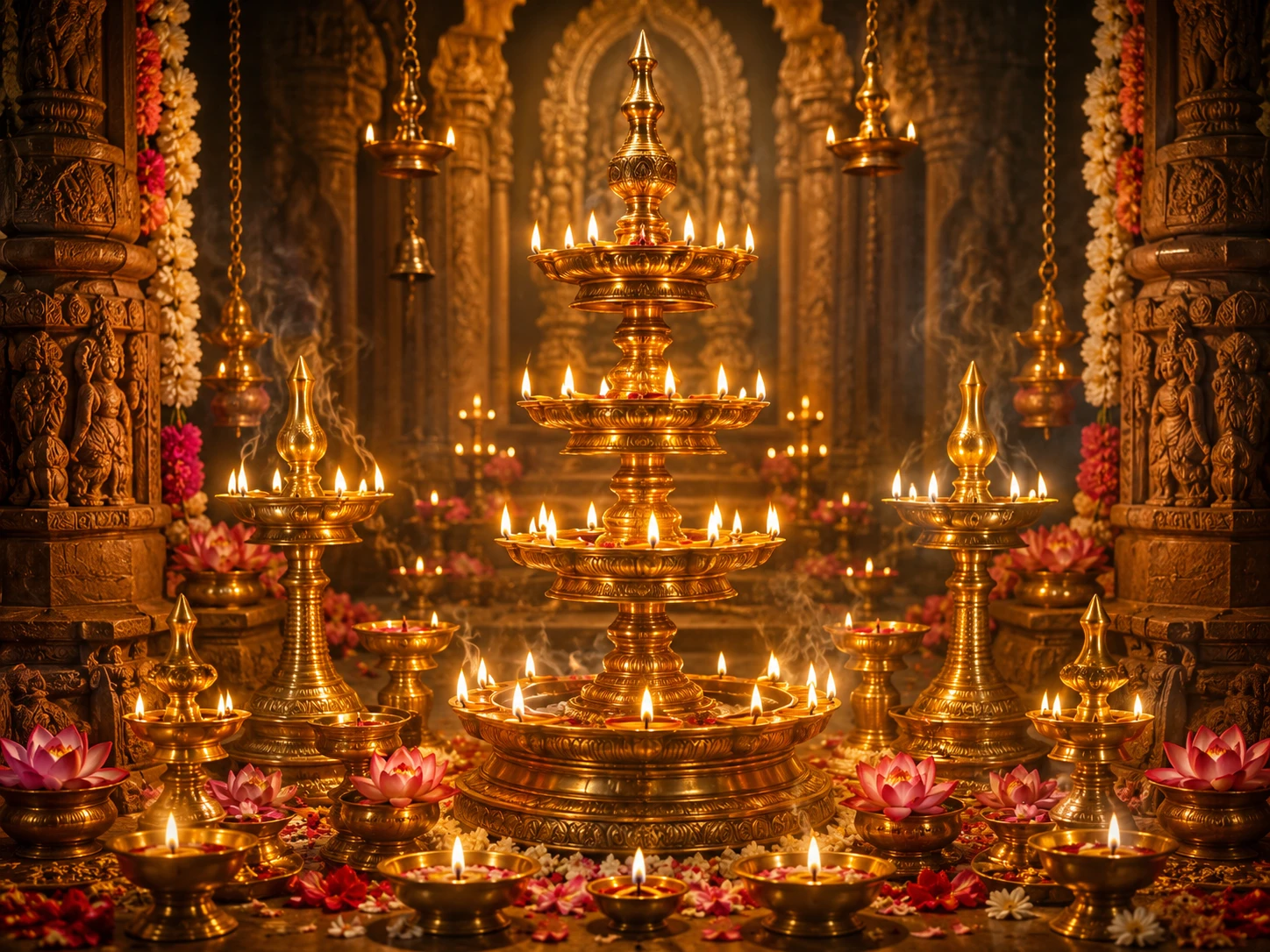
Temple Lamps -- Vilakku, Nilavilakku, and Deepa
मन्दिर के दीप -- विलक्कु, निलविलक्कु, और दीप
No Hindu ritual begins in the dark. The lamp is lit before anything else. Before the flower is placed, before the water is poured, before the mantra is chanted, the priest or householder strikes a match and touches the wick. The small ghee flame wobbles into life, steadies, and the puja has begun. A Hindu temple without burning oil lamps is not a temple even when the sanctum is intact. The lamp is part of the definition. The flame is what makes the space sacred.
The generic Sanskrit word for lamp is deepa, still used in every North Indian ritual manual. In Tamil, Malayalam, and the southern Dravidian languages, the word is vilakku. The tall standing brass lamps of Kerala are nilavilakku. The hanging ceiling lamps of Kerala are thukkuvilakku. The elaborate multi-wick lamps on tall stone or brass pillars seen at Tiruvannamalai and other Shaiva temples are deepasthambha. The simple earthenware oil lamp that millions of households light during Diwali is diya in Hindi, chirag in Urdu-Hindi, agal vilakku in Tamil. The names vary across languages. The object varies in scale and material. The function is one thing: to produce a flame specifically for ritual use.
This article takes the major lamp-types of Hindu ritual and traces their logic. The brass arati lamp held by the priest during daily worship, the tall nilavilakku placed at the entrance of a Kerala temple, the thousand-wick vilakku of a Tamil festival, the deepasthambha column at a Shaiva temple, the akhand jyoti (ever-burning flame) kept lit for specific vratas, and the diya multitude of Diwali, Karthigai, and Dev Deepawali. Each one teaches a different relationship between light, time, and intent. Every lamp is a small declaration: something is being done here that requires the presence of flame.
दीपज्योतिः परब्रह्म दीपज्योतिर्जनार्दनः । दीपो हरतु मे पापं सन्ध्यादीप नमोऽस्तु ते ॥
dīpa-jyotiḥ parabrahma dīpa-jyotir janārdanaḥ | dīpo haratu me pāpaṃ sandhyā-dīpa namo'stu te ||
The light of the lamp is the supreme Brahman; the light of the lamp is Janardana (Vishnu). May this lamp remove my sins. Salutations to you, O lamp of the sandhya.
— Deepa Prajwalana Mantra, traditional verse recited while lighting the lamp at the start of puja; preserved across Smarta and Vaishnava puja-paddhati traditions
Read the first line again slowly. Deepa-jyotih parabrahma. The light of the lamp is the supreme Brahman. This is not metaphor. The mantra is asserting an identity. The lamp's flame and the ultimate reality are being equated, as if the flame is a small, local, visible instance of what the Upanishads call the formless absolute. Indian ritual logic does this repeatedly. The abstract is made concrete through a physical object whose specific qualities point toward the abstract thing. For the flame, the qualities that matter are three: it is upward-reaching (flames always point up, toward sky and transcendence), it is self-burning (the ghee or oil converts itself into light without external intervention once lit), and it dispels darkness without itself becoming dark (the flame gives light but does not lose its own shape in the process). These three qualities, Indian philosophy argues, map to the three qualities of the supreme. Upward, self-illuminating, and darkness-dispelling.
The Chandogya Upanishad, in its discussion of the atman, uses the flame as a recurring teaching device. Tat tvam asi, that thou art, is introduced in the context of the son seeing that sparks rising from a fire are still fire. Each spark is a distinct flame, but it is not a different kind of fire. Each jiva is a distinct being, but it is not a different kind of self. The flame, which can be held in a pot but not contained by the pot, is the physical teaching aid for a philosophical truth the Upanishads are trying to make graspable. When a temple priest lights the arati lamp and rotates it before the deity, he is not just illuminating the sanctum. He is enacting, visually, the Upanishadic claim about the relationship between the local and the absolute.
This is why the lamp is not interchangeable with the electric bulb, even in temples that have had electricity for decades. Every major temple in India, from Kashi Vishwanath to Meenakshi to Tirumala, uses electric lighting for general illumination but continues to perform the sanctum puja with traditional oil and ghee lamps. The electric bulb and the oil lamp do not perform the same function ritually, even if both produce light. The oil lamp requires a wick, a fuel, and a flame that has to be started by hand and tended. That manual process is the point. The devotee's labour of lighting the lamp is part of the ritual. The bulb's switch is not.
The most visible lamp in the Indian ritual landscape is the nilavilakku, Kerala's tall standing brass lamp. It is a single vertical column, usually four to six feet high, with a wide bowl at the top holding five wicks arranged at the cardinal directions plus one in the centre. The column rests on a tiered base that mirrors a shrunken karanda-mukuta in profile. Every major Kerala temple has at least one nilavilakku burning at the entrance; larger temples like Guruvayur, Padmanabhaswamy, and Sabarimala may have dozens in continuous service. The oil used is traditionally pure coconut oil, sourced from specific suppliers to the temple. The wicks are hand-made from cotton and replaced daily.
The five wicks are not arbitrary. Kerala tradition identifies them with the pancha-bhutas, the five elements: earth, water, fire, air, and ether. When all five wicks burn together, the lamp becomes a miniature model of the universe. The priest lighting the lamp addresses each wick with a specific bija-mantra as he touches the flame to it. The sequence matters. East first, for surya. South next, for yama. West, for varuna. North, for kubera. Centre last, for akasha. Only after all five are lit is the main puja begun.
The nilavilakku has crossed from temple into household in Kerala in a way that is unusual. Every traditional Nair, Namboodiri, and Thiyya home keeps a smaller household version of the nilavilakku, typically two to three feet tall, and lights it at dusk regardless of whether any formal puja is being performed. The household lamp marks the transition from day to evening. Children grow up seeing their grandmother light it, their mother light it, and then themselves, in turn, light it. In a diaspora context, Kerala families in the Gulf, the UK, and the US still keep nilavilakku lamps in their apartments. Shipping them was routine before mass online stores; now a Malayali family in Singapore can order a proper nilavilakku from Aranmula or Mannar online and have it delivered in two weeks.
A different lamp category altogether is the deepasthambha, the lamp-pillar, found most dramatically at Shaiva temples. The Arunachaleswarar temple at Tiruvannamalai in Tamil Nadu has a towering deepasthambha installation, and on the full-moon night of Kartik (the month-long Karthigai Deepam festival in November-December), a massive cauldron of ghee is lit at the summit of Mount Arunachala itself. The flame is visible for thirty kilometres. Villagers on surrounding farmland set their own smaller fires on their terraces at the same hour, so that the Arunachala flame at the top is answered by hundreds of small flames radiating across the plain. The festival enacts the Puranic story in which Shiva manifested as a column of endless light (jyotirlinga) that neither Brahma nor Vishnu could reach the end of. The flame is the visible trace of that story.
The deepasthambha concept also appears at Kerala's Sabarimala temple, where a specific deepasthambha lights up when the Makaravilakku, the Makara-month flame, appears on the distant hillside of Ponnambalamedu on the night of January 14 each year. The flame is seen by lakhs of pilgrims gathered in the valley below. There is a contested secular debate about whether this flame is fully natural or whether temple administrators light it as a ritual re-enactment; the practising devotee does not typically enter this debate, because the ritual meaning is independent of the mechanism. What matters to the pilgrim is that at a specific instant on a specific night, light appears on a specific hill, and the thousands of vilakkus in the temple valley respond with their own smaller flames.
The deepasthambha also has a domestic echo in the thousand-wick lamp known as the sahasra-deepa or aayiram-vilakku. On Karthigai Deepam in Tamil homes, on Tulsi Vivah in Maharashtrian homes, on Kartik Purnima at Banaras and Mathura, large brass lamps holding dozens or hundreds of wicks are lit at the puja room or on the terrace. A household thousand-wick lamp is rarely literally a thousand; it is usually one hundred or one hundred eight wicks. But the name persists. A thousand lamps is what the festival is after, and the household version makes the festival's scale available at a smaller, practical size.
Major Hindu Ritual Lamps -- Types, Material, and Use
| Lamp Type | Size and Location | Fuel and Wicks | Occasion of Use | Regional Origin |
|---|---|---|---|---|
| Arati deepa / deepa | Small, held in priest's hand during arati | Ghee or oil, single or multiple wicks | Every daily arati in every Hindu temple and home shrine | Pan-Indian |
| Nilavilakku | Tall standing, 2-6 feet, at temple entrance or home | Coconut oil, 5 wicks at cardinal directions plus centre | Continuous evening illumination; most major Kerala pujas | Kerala |
| Thukkuvilakku | Hanging from ceiling, brass and bell-metal | Sesame or coconut oil, multiple wicks | Kerala temple mandapas, some Kerala homes | Kerala |
| Kuthuvilakku (Tamil) | Medium standing, 2-4 feet, with deity figure at top | Sesame oil or ghee, 1-5 wicks | Tamil Brahmin homes and Tamil temples; daily sandhya | Tamil Nadu |
| Deepasthambha | Monumental pillar with dozens or hundreds of lamp positions | Ghee, bulk oil | Karthigai Deepam, Sabarimala Makaravilakku, specific Shaiva festivals | Tamil Nadu, Kerala, Karnataka |
| Agal vilakku / Diya | Small clay bowl | Oil or ghee, single cotton wick | Diwali, Dev Deepawali, Karthigai, household daily use | Pan-Indian |
| Akhand jyoti | Continuously burning lamp, protected in glass enclosure | Ghee, replenished hourly | Navaratri vrat; specific Devi shrines; shraddha observances | Pan-Indian |
| Panchamukhi deepa | Five-faced lamp with a central well and five spouts | Ghee, 5 wicks | Deepavali, Tulasi Vivah, installation of murti | South India predominantly |
The Shilpa Shastra of Vishvakarma specifies proportions for the height, bowl-size, spout-angle, and base-width of every major lamp type. A nilavilakku whose bowl is more than one-eighth of the total height is considered malformed; it may be used as a generic vessel but not as a ritual lamp. Traditional foundries in Kerala (Mannar, Aranmula, Kasaragod) and Tamil Nadu (Kumbakonam, Nachiarkoil) continue to make lamps to these specifications in 2026.
The relationship between the lamp and the deity during arati is worth understanding carefully. The arati ceremony rotates a lit lamp (usually five or seven-flamed) in a circular motion in front of the deity. The priest holds the lamp in his right hand; his left hand rings the bell. The rotation follows a specific pattern, three or four circles at the level of the deity's face, then the lamp is lowered to the deity's chest and heart, then returned to the face, then offered to the devotees. Devotees cup their palms around the flame and touch the fingertips briefly to their eyes, absorbing the deity's light-grace. This gesture, the touching of flame-warmed palms to the eyes, is one of the most universal motions in Indian religion. It survives in secular settings: when a new car or new home is blessed, the owner does the same gesture.
The theological logic is straightforward. The deity is made of divine consciousness, which Indian philosophy associates with chit-prakasha, light-of-awareness. The arati flame is a physical instance of that light. When the flame is rotated in front of the deity, the flame is 'touched' by the deity's consciousness and infused with it. When the priest then offers the flame-warmed palms to the devotee, the devotee is receiving a transfer of chit from the deity via the mediating object of the flame. This is why the practice is called arati-grahana, 'receiving the arati'. The devotee is not just seeing; she is taking.
Some regional traditions take this further. The Tulabharam ritual at certain Kerala and Karnataka temples weighs the devotee against an equivalent amount of ghee, which is then offered to the temple lamps, literally fuelling the deity's illumination for days or weeks. A Tulabharam offering at Guruvayur in 2026 costs several lakhs of rupees for a heavier devotee, and the ghee offered continues to feed the temple's flames long after the devotee has departed. The devotee becomes, via this substance-offering, materially present in the lamp's continuing illumination. The flame the next pilgrim sees will partly be burning on ghee funded by a previous devotee's Tulabharam. The community of devotees across time is connected by the substance of the flame.
The Dev Deepawali at Varanasi on Kartik Purnima (usually November) is the single largest lamp-lighting ritual in the world. On that night, all eighty-four ghats along the Ganges are lined with lakhs of oil diyas, each lit by a pilgrim or a ghat-priest and set floating on leaf-boats or placed on stone steps. In 2024, photographs from ISRO satellites showed the glow of Varanasi's ghats visible from low-Earth orbit. Estimates from Varanasi tourism and the Kashi Vishwanath Temple Trust put the total number of diyas lit that night between one and two crore, consuming several thousand tons of oil and millions of cotton wicks sourced from Varanasi's handloom industry. The festival has pre-British origins but has grown dramatically in scale since the 1990s with better lighting-logistics and government support.
A few specific flames in India lay claim to being among the oldest continuously-burning ritual fires in the world. The akhand jyoti at the Jwalamukhi temple in Kangra, Himachal Pradesh, is one of these. The flame there is not lit from ghee; it rises naturally from a rock fissure through which subterranean methane gas escapes, and has been burning for as long as local memory and temple inscriptions record. Devotees believe it to be the manifested tongue of Sati, one of the fifty-one Shakti-peethas. The Mughal emperor Akbar, in a well-known episode recorded in regional chronicles, attempted to extinguish the flame in the late sixteenth century by covering it with an iron canopy and diverting a canal of water over it; the flame re-emerged through the water and melted the canopy. Whether one reads this story as miracle or as a naturally explainable event (methane gas will find its outlet under almost any pressure), the flame itself is undeniably still burning in 2026.
At Vaishno Devi in Katra, Jammu and Kashmir, an akhand jyoti is kept continuously fuelled inside the cave sanctum. Tradition claims unbroken continuity for centuries, though the practical fuelling arrangements have naturally evolved. The Devasthanam Board that administers the temple coordinates a team of pujaris whose only task, on rotating shifts, is to ensure the flame never goes out. The Shakti-peetha at Kalighat in Kolkata maintains its own akhand jyoti. So does the Kamakhya temple at Guwahati, the Chintpurni temple in Himachal, and the Naina Devi temple in the Sivaliks. A pilgrim doing the full Shakti-peetha tour would cross from akhand jyoti to akhand jyoti without any temple in between having seen a ritual extinction.
In household practice, keeping an akhand jyoti is a heavy commitment that most families undertake only rarely. A Maharashtrian household performing a week-long Satyanarayana Puja will light an akhand jyoti and assign family members to four-hour tending shifts. A Gujarati family observing a Navagraha Puja may light a smaller akhand jyoti for the nine-day duration. Setting up the jyoti correctly matters: the vessel should be brass or silver, the wicks should be cotton, the ghee must be cow-ghee (not buffalo or vegetable oil). A vegetable oil akhand jyoti does not count, even if it burns for the same duration. The substance of the fuel is part of the vow.
The physics of the oil lamp is worth a paragraph because it clarifies why the lamp has never been replaced. A cotton wick immersed in ghee or oil carries the fuel upward by capillary action. At the tip, heat converts the fuel into a gas, which combines with oxygen and burns. The flame is not the fuel itself but the reaction zone where fuel meets oxygen. A well-trimmed wick in pure ghee burns at about 1200 Kelvin, producing a steady yellow-orange light with very little soot. Cotton wicks with impurities or low-grade oil smoke; the soot is a sign of incomplete combustion. This is why Tirumala and other major temples specify the oil and wick sources with extreme care. The wicks are hand-spun from long-staple cotton. The ghee is from specific hereditary suppliers whose cattle are fed on temple-approved grazing lands.
The flame's stability matters because an unsteady flame is ritually inauspicious. A flickering wick during puja is read as a sign that the space has some disturbance, that the spirits are unsettled, that the deity is not pleased. Priests pay close attention to the lamp's behaviour during arati; if a flame goes out suddenly, the ritual is briefly paused while the priest relights it and performs a short shanti-mantra before resuming. Regular flame-watching over decades has given temple priests an informal expertise in understanding airflow, draught, wick-quality, and oil-freshness. What looks like superstition, the careful attention to whether the flame is behaving well, is in fact pattern-recognition over thousands of years of observation.
The Kerala tradition adds an unexpected dimension. At the Koodalmanikyam temple in Irinjalakuda, the only major temple to Bharata (Rama's brother), the thukkuvilakku (hanging lamps) are never extinguished during the temple's opening hours; if a lamp burns out, a replacement is lit from the flame of its neighbour. The continuity of flame is understood as the continuity of ritual presence. In this sense, the lamps at Koodalmanikyam have been burning without interruption for several centuries, with each current flame being the direct descendant, via wick-to-wick transmission, of a flame lit long ago. The fire is not just a substance. It is, in this tradition, a living lineage.
The household diya is where the temple lamp tradition most thoroughly meets ordinary Indian life. On Diwali, every Hindu household, from Bengaluru apartments to Bihari village huts, lights at least a handful of diyas at dusk. The minimum is one on the doorstep, facing the street, to invite Lakshmi to enter the home. Many families light five at the five cardinal points of the house, or thirteen arranged around the puja altar, or one hundred and eight on a threshold for a special wish. The commercial economy of diyas is substantial: Uttar Pradesh potters in the Kumhar caste produce several crore diyas for the Diwali market each year; Rajasthan has its own tradition of decorative diyas; Gujarat makes brass lamps alongside clay ones. An average urban Indian household might spend between one hundred and five thousand rupees on diyas and oil for a single Diwali evening, and the total Diwali diya economy crosses hundreds of crores annually.
The Dev Deepawali at Varanasi and the Karthigai Deepam in Tamil Nadu extend the same logic on a public scale. In a traditional Tamil Iyer home, Karthigai Deepam on the full moon of Kartik month means lighting a small diya in every niche, every corner, every windowsill of the house. The lamps remain lit until they burn down naturally. A family with four children will light at least sixty diyas that night. Over an eighty-year lifetime, an observant Tamil household will have lit between ten and twelve thousand diyas on Karthigai Deepam alone. The grandmother teaching her eight-year-old granddaughter to set the wicks properly is training the next generation in one of the oldest forms of ritual action humans practise. The girl's hands, learning the exact angle at which the wick should be folded, are replicating the hands of her great-great-grandmother in 1920 and of an ancestress in the thirteenth century.
And there is one more function the lamp performs that is easy to miss. During long vratas (vows) like Navaratri or Mahashivaratri, an akhand jyoti (unbroken flame) is kept burning for the entire duration, often nine days or twenty-four hours. Household members rotate the duty of refilling the ghee, trimming the wick, ensuring the flame does not go out. The akhand jyoti is a living marker of the vow's continuity. As long as it burns, the vow is being kept. If it goes out, the vow is considered broken, and a prayashchitta (expiation) is required. The lamp is, in this context, more than a ritual object. It is a witness. It is a scorekeeper. It is an embodied commitment that requires tending for hours or days, and in that tending the devotee and the lamp become partners.
Recite the Deepa Mantra as You Light the Lamp
As you light the lamp, recite 'Shubham karoti kalyanam arogyam dhana-sampadam, shatru-buddhi-vinashaya deepa-jyotir namo'stu te.' Then sit with the flame for a few minutes; the When the Flame Is All There Is dharana on Eternal Raga guides that practice.
Tags
Eternal Raga · शाश्वत राग
Institutional voice — scholarly articles on Sanatan Dharma
Deepen Your Understanding
अपनी समझ और गहरी करें
sacred artefacts
Temple Bells -- Sound as Purification
You never enter a Hindu temple in silence. Your first act at the threshold is to reach up and strike the bell. There is a verse for why. There is an alloy-ratio for the metal. There is an agamic rule for when to ring it, and who may. The temple bell is not decoration. It is the audible signal that ordinary space has just become sacred.
sacred artefacts
Yajna Kunda -- The Sacred Fire Pit
At the centre of the oldest Indian ritual sits a brick-lined pit. Agni is lit. Ghee is poured in. Mantras rise with the smoke. Every yajna kunda is built to a specific shape, calculated to a specific geometry, oriented to specific cardinal directions. The Shulba Sutras, three thousand years old, give the instructions. Indian geometry did not begin in the classroom. It began at the fire-altar.
sacred artefacts
The Kalasha Across Temple and Household Ritual
A brass pot filled with water, topped with five mango leaves and a coconut, tied with red thread and marked with turmeric. Every Hindu wedding sets one up. Every griha pravesh, every puja, every temple consecration. The same object appears at the top of every Hindu temple spire as the crowning kalasha. From the Rig Veda to a Bengaluru flat-warming in 2026, one pot carries the tradition.
sacred artefacts
Utsava Murti -- The Processional Deity
The stone god in the sanctum never leaves. The metal god on the palanquin walks every street. This is the utsava murti, the deity that comes out to meet you. Every Chola bronze in a museum was once carried in procession. Every Brahmotsavam at Tirumala, every Rath Yatra at Puri, every temple car at Madurai, runs on the same principle: the god moves so the devotee need not travel to the sanctum to be seen.
sacred artefacts
Sacred Vessels -- Akshaya Patra, Kamandalu, and Amrit Kalash
Three vessels define Hindu ritual. The Akshaya Patra fed the Pandavas through twelve years of exile. The kamandalu sits beside every ascetic from Vyasa to the sadhu at Prayagraj. The amrit kalash rose from the churned ocean and reshaped cosmic order. Each vessel teaches a different lesson about what it means to hold the sacred.
sacred artefacts
Panchamrita -- The Five-Nectar Offering That Is Simultaneously Puja and Pharmacy
Milk, yogurt, ghee, honey, sugar. Five ingredients. Mixed in a specific order, offered to the deity, poured over the murti, and then distributed as prasadam. Every Hindu has tasted Panchamrita. Almost none know that each ingredient represents a cosmic element and that the mixture is also a clinically documented Ayurvedic formulation for immunity and digestion.
The Dev Deepawali at Varanasi on Kartik Purnima (usually November) is the single largest lamp-lighting ritual in the world. On that night, all eighty-four ghats along the Ganges are lined with lakhs of oil diyas, each li…
More in Sacred Artefacts
Ashtadhatu -- The Sacred Eight-Metal Alloy of Indian Temples
12 min read
Banalinga -- The Stone God Made Himself in a River Over Millions of Years
13 min read
Celestial Trees -- Kalpavriksha and Parijata
12 min readThe same translation error that turned '33 Koti' into '33 crore' in Hinduism also happened in Buddhism. The Chinese translation of Buddhist texts rendered 'Sapta Koti Buddha' (7 Supreme Buddhas) as '7 Crore Buddhas.' The…
Deities AvatarsCommunity Reflections
🕉️
Be the first to share your reflection.