Yajna Kunda -- The Sacred Fire Pit
यज्ञ कुण्ड -- पवित्र अग्निस्थल
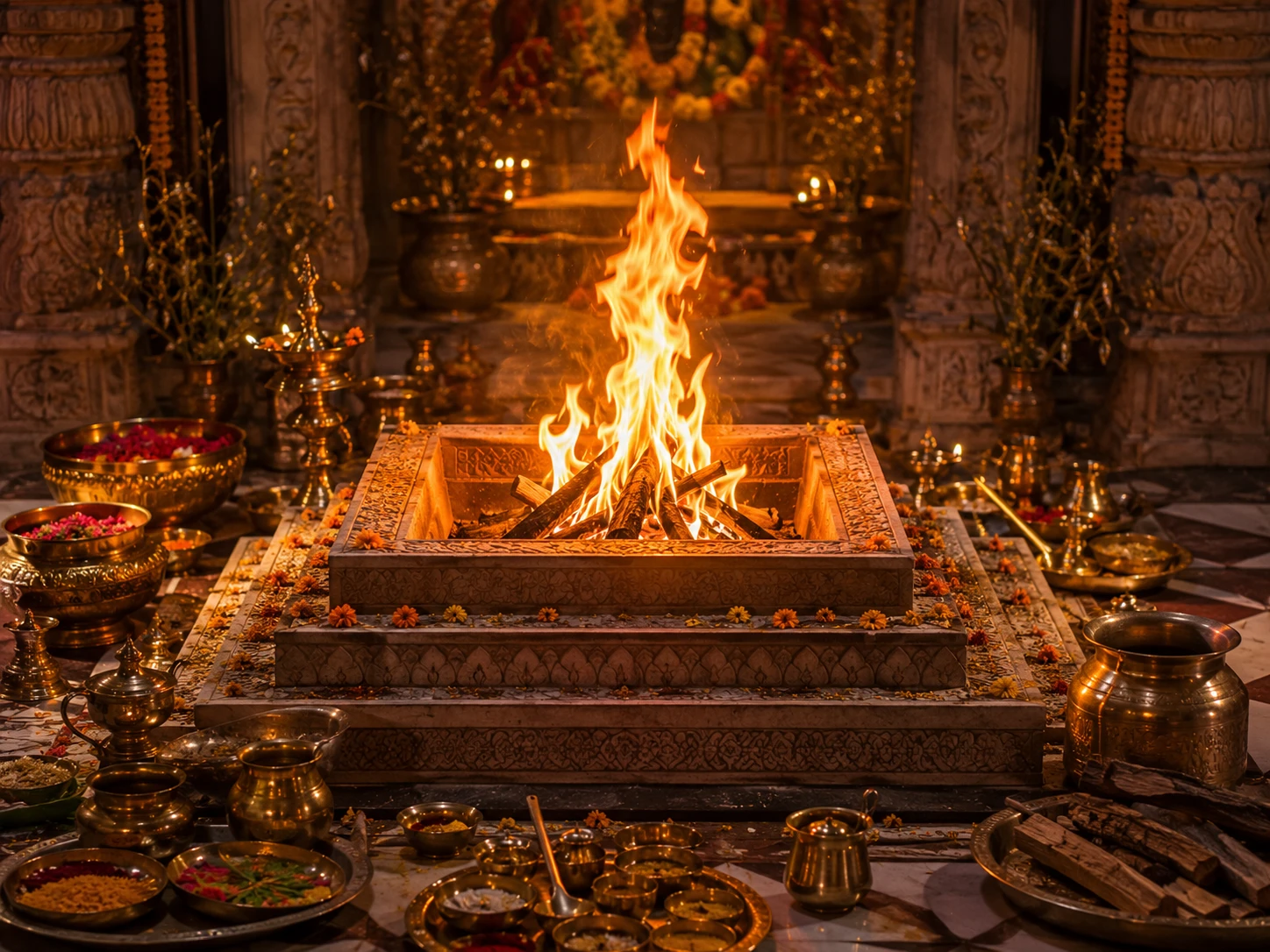
A house-warming puja in Noida in 2026 looks nearly the same as a house-warming puja in Noida in 1426. At the centre of the mandap, a small brick-lined pit is dug or constructed. A priest arrives carrying a brass ladle, a bundle of dry twigs, a pot of ghee, a packet of mixed herbs called samagri, a stack of kusha grass, and a laminated card with the mantras. The family gathers around. The priest ignites the twigs with a match, feeds in a few drops of ghee, chants a Vedic mantra, and the yajna kunda is alive. For the next two hours, the fire burns, the mantras are recited, ghee and samagri are poured in by the hundreds of handfuls, and the smoke rises through a skylight or open window to the sky. At the end the priest sprinkles a little water, declares the ritual complete, and the family steps back into the twenty-first century.
What most attendees do not realise is that the brick-lined pit in front of them is part of the oldest continuously-practised ritual technology in the world. The Rig Veda, composed between approximately 1500 and 1000 BCE, repeatedly mentions the kunda and the vedi (altar) in its most ancient mandalas. The Yajur Veda describes the exact mantras to be chanted while placing each brick. The Shatapatha Brahmana, probably eighth to sixth century BCE, specifies the proportions and the sequence. The Shulba Sutras, compiled between 800 and 200 BCE, formalise the geometry. A Hindu priest in 2026 setting up a havan kunda is, in the most literal sense, repeating steps that a Vedic priest in 1000 BCE would recognise. The brick sizes, the layout, the mantras, the offering substances, even the order in which the kunda is consecrated, are almost unchanged.
This article examines the yajna kunda as both ritual object and geometrical construction. It traces the canonical shapes (square, circle, semicircle, triangle, lotus, yoni, falcon), their intended purposes according to the Grihya and Shrauta Sutras, the astonishing geometry the Shulba Sutras used to construct them, and the continuity of this technology into modern Hindu life. The kunda has never been replaced because no replacement exists. The physical fire, the ghee offering, the mantras rising with the smoke, these are not symbolic substitutes. They are the ritual itself.
The canonical kunda shapes are eight, each with a specific ritual purpose. The Chaturasra (square) is the default for all-purpose oblation. It is what almost every household havan uses for griha pravesh, upanayana, or a Satyanarayana puja. The Yoni (heart-shaped, technically an isosceles triangle with a rounded base) is for specific desires such as progeny or marriage. The Ardha-Chandra (semicircle) is for peace, reconciliation, and family harmony. The Trikona (triangle) is for forceful or protective rituals such as shatrunashana (enemy-dispelling) or rog-nashana (disease-dispelling). The Vrittakara (circle) is for all-accomplishment, especially in Shakta traditions. The Shadasra (hexagon) is specific to certain tantric rituals. The Ashtasra (octagon) is reserved for special srouta rites. And the Padma (lotus, usually eight-petaled) is for exalted purposes like establishing abundance or divine blessings. A priest chooses the shape based on the sankalpa, the stated intent of the yajna.
These are not arbitrary. The Grihya Sutras and Manu Smriti link specific shapes to specific phala (fruits or desired outcomes), and the link is preserved across almost all Hindu regional traditions, though minor variations exist. The square is universal; it shows up for any normal household ritual. The more specialised shapes appear less frequently but never arbitrarily. A Brahmin priest in Udaipur performing a Dhanvantari-yajna for a seriously ill family member will build a triangular kunda. A Marathi family performing a mahamrityunjaya-yajna for an elder will build a circular one. A Tamil couple performing a santana-prapti vrata for a child will build the yoni kunda. The shape is part of the communication with the deity. It is the geometry of intent.
The Shrauta tradition adds a further layer. The large public yajnas of Vedic antiquity built their agnis not in a pit but above the ground, piled from bricks into complex shapes. The Agnichayana, the most elaborate of these rituals, requires building a fire-altar in the shape of a falcon with outstretched wings (shyenaciti). The complete altar, laid out with 10,800 bricks in exactly five layers and specific orientations, takes about a year to prepare and three days to perform. The Shrauta Sutras specify brick dimensions down to the millimeter. The Chidambaram Nambudiri Brahmins still perform Agnichayana rituals in Kerala every few years. The 2011 Athirathram at Panjal in Kerala, documented by scholars and filmed by NASA researchers interested in the Vedic ritual's acoustic and geometrical precision, is the most extensively recorded modern instance. The 10,800 bricks were laid by hand over weeks. The four-thousand-year continuity of the form was measurably preserved.
अग्निमीळे पुरोहितं यज्ञस्य देवमृत्विजम् । होतारं रत्नधातमम् ॥
agnim īḷe purohitaṃ yajñasya devam ṛtvijam | hotāraṃ ratna-dhātamam ||
I praise Agni, the purohita of the yajna, the divine officiant, the hotri who brings the greatest treasures.
— Rig Veda 1.1.1, the opening verse of the Rig Veda
This is the first verse of the Rig Veda. The first word of the oldest Indian scripture is agnim, Agni. Before the gods are named, before the universe is described, before the sages are praised, Agni is invoked as the purohita, the one-placed-before-all, the chief priest of every yajna. The Vedic universe begins with fire. This is not incidental. The Indian ritual imagination never recovered from the centrality of fire. Every subsequent ritual innovation, from the Grihya sutras to the Puranic pujas to the domestic arati, preserved a subordinate but essential role for Agni. Even the smallest household puja lights a small ghee lamp, which is Agni in condensed form.
The yajna kunda is, therefore, the place where Agni is hosted. The mantras spoken during kunda preparation, called agnyadhana (the establishment of fire), formally invoke Agni to come and reside in the kunda for the duration of the ritual. The specific fuel used is selected according to text. For most yajnas, the samidhas (kindling sticks) must be from specific plants: ashvattha (peepal), palasha (flame of the forest), shami, khadira, and bilva are preferred. Mango wood is acceptable. Teak and pine are avoided. The logic is not only practical (these woods produce specific burning characteristics) but also mantric (each wood is associated with a specific deity and intent, and burning it offers that association to Agni).
The ritualist then produces the flame itself. In the oldest tradition, the flame is produced by araṇi (friction), where two wooden sticks are rubbed together, specifically from the pippala tree. The upper stick is called uttararani and the lower adhararani. The friction motion is mantra-coordinated. When the smoke rises, a small pile of dry kusha grass is dropped into the nascent fire, and Agni is born. Modern priests use matches for convenience, but at Agnichayana and other major srouta rituals, araṇi fire-starting is still performed. The act of generating fire from wood through friction, rather than from a manufactured tool, re-enacts the primordial gift of Agni as described in the Rig Veda: a fire that emerges from the earth's own substance, not imposed from outside.
The geometry of the kunda is where Indian mathematics began. The Shulba Sutras, attributed principally to Baudhayana, Manava, Apastamba, and Katyayana, were not written as mathematics textbooks. They were written as manuals for priests who needed to lay out fire-altars correctly. The problem the priests faced was this: some rituals required an altar of a given area but a specific shape (for instance, a circular altar whose area equals that of a given square, or a square altar whose area equals a given rectangle). Solving these problems required what we now call the Pythagorean theorem, accurate approximations for pi and square root of two, and methods for constructing squares, rectangles, circles, and transformations between them. The Shulba Sutras contain all of these, between roughly 800 and 200 BCE, in some cases centuries before the corresponding results appeared in Greek geometry.
Baudhayana's Shulba Sutra states what we now call the Pythagorean theorem in this form: 'The diagonal of a rectangle produces by itself both the areas which the sides produce separately'. The statement is precise. It is the Pythagorean theorem, written approximately 200 to 600 years before Pythagoras. The reason it appears in a ritual manual is that the priest laying out a rectangular altar needs to verify that his corners are genuinely right angles, and the diagonal-test is how this is done. The theorem is discovered not as abstract mathematics but as a construction-checking tool. The same sutras give the square root of two as 1 + 1/3 + 1/(3·4) − 1/(3·4·34), which works out to 1.4142156, an approximation accurate to one part in 100,000. The priest who needed to double the area of a square altar (doubling area means multiplying the side by square root of two) had to have this approximation. The altitude of the fire-altar depended on it.
The transformation of shapes matters most. The Shulba Sutras give procedures for converting a square into a circle of equal area (using pi with good approximation) and vice versa, a rectangle into a square, a square of given area into a larger square, and several others. These procedures are rigorous constructions: given a starting shape and a target, the priest would use strings (sulba means string), pegs, and geometric operations described precisely, step by step. A falcon-shaped altar for Agnichayana requires combining squares, trapezoids, and triangles in a complex pattern that preserves a specific total area equal to seven-and-a-half purusha-units (a purusha is the height of a standing man). The Kausambi falcon-altar excavated by G. R. Sharma in 1957-59, dating to the second century BCE, corresponds precisely to the shape Katyayana's Shulba Sutra describes. Archaeology confirms what the text asserts.
Major Kunda Shapes and Their Ritual Purposes
| Shape | Sanskrit Name | Typical Purpose | Common Occasions | Textual Source |
|---|---|---|---|---|
| Square | Chaturasra | General-purpose, all accomplishments | Griha pravesh, upanayana, Satyanarayana puja, daily havan | Baudhayana Shulba Sutra; Grihya Sutras |
| Circle | Vrittakara | All-accomplishment; peace, harmony, Shakta rituals | Mahamrityunjaya havan, Shakta pujas, universal benefit | Apastamba Shulba Sutra; Tantric texts |
| Semicircle | Ardha-Chandra | Peace and reconciliation, family harmony | Post-conflict ritual, Lakshmi-narayana puja, reconciliation between spouses | Grihya Sutras; regional puja paddhati |
| Triangle | Trikona | Protection, enemy-dispelling, disease-removal | Shatrughna-yajna, Dhanvantari-yajna, rog-nashana for the ill | Shrauta Sutras; Tantric texts |
| Heart / Yoni | Yoni-kunda | Fertility, childbirth, marriage-desires | Santana-prapti-vrata, Putrameshti-yajna, pre-marriage rituals | Manu Smriti; Tantric tradition |
| Hexagon | Shadasra | Shiva-Shakti unity, tantric siddhi | Specific Sri Vidya rituals, Shiva-Shakti pujas, tantric initiations | Kaula tantra texts |
| Octagon | Ashtasra | Eight-directional balance, major srouta rites | Vedic royal consecration (rajasuya), large public yajnas | Shatapatha Brahmana; Katyayana Shulba Sutra |
| Lotus (8-petaled) | Ashta-dala-padma | Divine abundance, Lakshmi-prapti, spiritual attainment | Lakshmi-havan, Devi pujas for abundance, diksha rituals | Shaiva and Vaishnava Agamas |
| Falcon | Shyenaciti | Specifically for Agnichayana; 'attainment of heaven' | Only in Agnichayana srouta ritual, performed every few years in Kerala | Katyayana Shulba Sutra 4.2; Shatapatha Brahmana 10.1 |
The Shulba Sutras are explicit that a fire-altar built with incorrect measurements is ritually ineffective and may produce opposite results. Baudhayana warns that a kunda whose side-length is one-angula too short will not please the deity, and one one-angula too long may invite asuras rather than devas. The measurements are therefore verified at multiple stages, by multiple priests, using consecrated rope measurements that are themselves purified before use. Precision is a form of devotion.
The offerings made into the kunda are called ahuti, and every ahuti has its own rule. Most common is the ghee-offering, made with a specific wooden ladle called sruva (small, for minor mantras) or sruk (larger, for main mantras). The priest lifts the ladle, pours a precise measure of ghee into the flame while reciting a mantra ending in the word svaha ('well-offered'). The ghee hits the fire, flares up in an orange column, and the mantra is considered delivered. This delivery is called svahakara. No mantra offering is complete without the final svaha.
The ahuti substance varies by ritual. For a general havan, ghee is sufficient. For a Mahamrityunjaya havan, specific herbs (mahamrityunjaya samagri, typically a mixture of dashamula and other protective herbs) are added. For a Sudarshana homa (Vishnu's discus), specific ingredients including sesame seeds and yellow flowers. For a Chandi homa, red hibiscus, kumkum, and panch-dhanya (five grains). Some ahutis are purnahuti, the final full-ladle offering that concludes the yajna. The purnahuti is poured in with all remaining ghee and samagri, and the priest and yajamana together recite a final mantra. At this moment the kunda becomes fully saturated and the flame rises high. The ritual is complete.
The smoke from a properly-performed yajna is considered a vehicle of blessing. In the Vedic worldview, Agni is the messenger to the gods; what is poured into the fire travels upward with the smoke. The mantras rise with the smoke. The intent of the yajamana rises with the smoke. The ghee and herbs, transformed into gas and particulate matter, rise into the atmosphere and, according to classical belief, carry the devotion to the devas. This is why a well-ventilated space is important for yajnas, so the smoke can rise freely. When a household havan is performed in an apartment in Bengaluru or Pune, the window is always opened. The smoke is not smoke; it is the courier of prayers.
The priests and yajamana are not interchangeable roles. The yajamana (the one on whose behalf the yajna is performed) commissions the yajna, recites the sankalpa naming his or her intent, and receives the phala (fruit) of the ritual. The priests perform the technical work. A large srouta yajna requires sixteen or seventeen ritvijas (officiants), each with a specialised role. The hota recites Rig Veda mantras. The adhvaryu handles physical actions and Yajur Veda mantras. The udgata sings Sama Veda chants. The brahman supervises the whole and corrects errors. A smaller household havan simplifies this to one priest, who takes on all four roles by turns. But even in the simplest setting, the yajamana-priest distinction is preserved. The yajamana does not touch the flame. The yajamana does not pour the offering. The yajamana's role is intent and sponsorship; the priest's role is execution.
This division of labour has a deep logic. The yajamana provides the desire; the priest provides the technique. Without either, the yajna is incomplete. A Delhi IIM graduate who commissions a Ganesh havan before starting his new company is the yajamana; the Vidisha Brahmin priest he hires is the ritvij. The priest alone performing the havan without a yajamana's sankalpa has performed an empty action. The yajamana alone attempting the ritual without priestly technique would have no idea how to proceed. The Vedic model of work-division that the yajna enshrines has, in fact, shaped much of subsequent Indian professional life. Expertise and intent are separate functions. Both are needed. Neither replaces the other.
The dakshina (gift to the priest) at the end of a yajna is not a salary. It is a completion of the ritual. Without dakshina, the yajna is textually considered incomplete, and the phala does not reach the yajamana. The amount is specified only loosely in most traditions; what matters is that something of value is given, that the yajamana freely relinquishes a portion of his wealth to the priestly functionary. This is why, even today, the fees for a priest are not negotiated in advance in traditional households; they are given at the end, in an envelope, with gratitude, and the priest accepts whatever is offered. The transaction is not commercial. The transaction completes the yajna.
The 2011 Athirathram at Panjal in Kerala was one of the largest modern performances of the Agnichayana srouta ritual. It was organised by the Chidambaram Nambudiri community, performed across twelve days with seventeen principal priests, witnessed by thousands, and scientifically monitored by researchers from the Indian Institute of Management Kozhikode and the Vedic Research Foundation. The bird-shaped fire altar (shyenaciti) measured approximately 7.5 purusha-units in total area as specified by Katyayana's Shulba Sutra. Ten thousand eight hundred bricks of different sizes, some as large as 24x24 angulas, were hand-pressed from specific river-bank clay, fired in traditional kilns, and ritually consecrated before placement. Researchers monitoring the local air recorded reductions in bacterial counts around the yajna site, attributed to the combined effects of burning medicinal herbs and the specific chemistry of Agnichayana's samagri. The ritual has since been repeated in 2014, 2019, and 2023, each time drawing researchers from fields as varied as environmental microbiology, architectural acoustics, and the mathematics of the Shulba Sutras.
The daily domestic fire, the aupasana-agni, is the oldest and simplest continuation of the yajna tradition. The three-fire system came with specific duties: the householder was to make two daily offerings, one at sunrise and one at sunset, into the gharhapatya. Every Vedic ritual later in life was performed from this fire. When the householder died, his funeral pyre was lit from the same gharhapatya he had maintained for decades. The fire, in a sense, was his companion across his adult life.
The three-fire system has largely disappeared from modern Hindu practice, though a few Vaidika families in Karnataka, Tamil Nadu, Kerala, and Maharashtra still maintain it. What has survived is a streamlined descendant: the small household fire lit at special occasions. When a modern Indian middle-class family performs a Satyanarayana puja, the ghee-lamp before the photograph of Vishnu is in fact a condensed, symbolic version of the old gharhapatya. The samagri-offering into a small kunda (often a shallow copper or earthenware vessel, twelve inches across) is the old offering compressed into an evening rite. The priest's mantras are the same mantras the Vedic priest used three thousand years ago.
The wedding pheras, the seven rounds the bride and groom take around the fire, are the most visibly preserved yajna ritual in India. The agni-sakshi (fire-witness) concept comes directly from the Vedic wedding. The specific mantras chanted during each phera are from the Rig Veda's tenth mandala, particularly hymn 10.85 (the Surya-Savitri wedding hymn). When a bride and groom circumambulate the kunda in a Bengaluru wedding hall in 2026, they are reciting, through the priest, words that were already three thousand years old when Panini codified Sanskrit grammar in the fifth century BCE. The fire in front of them is lit to the same specifications the Grihya Sutras describe. The marriage is witnessed by Agni in exactly the sense the Vedic wedding formula intended.
The modern context adds some new dimensions to the old practice. Electric havan kundas, with artificial LED flames, are marketed by some modern puja-supply stores, though traditionalists reject them as ritually invalid. A proper yajna requires physical fire, physical smoke, and physical offering. The compromise position that some Mumbai and Delhi priests have taken is to use smaller kundas, specific low-smoke wood (like mango), and strict ventilation, so that the full ritual can be performed indoors without public-health impact.
The scientific study of yajna has grown as a small but real field. Researchers at the Indian Institute of Technology at Delhi, BHU at Varanasi, and Gujarat Ayurved University have published papers on the atmospheric effects of specific havan samagri. The mixture of cow-ghee, medicinal herbs (including tulsi, neem, and guggulu), rice, and barley produces particulate emissions that, in controlled tests, show some antimicrobial properties at short range. Whether this constitutes scientific validation of ancient claims is contested, but the tests themselves are honest work. The yajna is now one of the few Indian rituals that is being measured, quantified, and assessed alongside the ongoing ritual practice. Neither the priests nor the researchers consider this a conflict.
And the kunda continues to serve what it has always served. A family in a Pune flat performing a Ganesh havan on Ganesh Chaturthi in 2026 is not performing it because modern science has validated the antimicrobial properties of havan smoke. The family is performing it because Ganesha is the remover of obstacles, because the daughter's college entrance exam is three months away, because the grandmother insisted, because that is how griha-dharma works. The priest sets up the kunda. The mantras rise. The ghee is poured. And three thousand years of ritual continuity hold inside a small square brick-lined pit in a two-bedroom apartment overlooking the Pune Katraj Highway. The form is the same. The fire is the same. Only the building around it has changed.
Read the Shulba Sutra Behind the Fire Altar
The geometry of the yajna altar comes from the Shulba Sutras, part of the Kalpa Vedanga. The Baudhayana Shulba Sutra, the oldest of them, is on Eternal Raga with Sanskrit and translation -- including its rules for constructing altars of exact area.
Tags
Eternal Raga · शाश्वत राग
Institutional voice — scholarly articles on Sanatan Dharma
Deepen Your Understanding
अपनी समझ और गहरी करें
sacred artefacts
Temple Lamps -- Vilakku, Nilavilakku, and Deepa
A Hindu temple without light is unthinkable. The brass lamps that flank every sanctum, the tall standing nilavilakku in Kerala temple courtyards, the thousand-wick deepasthamba that rises at Karthigai Deepam at Tiruvannamalai, and the small clay diya at a Varanasi ghat during Dev Deepawali all do the same work. They make the invisible visible, and they say it in lamp-light.
sacred artefacts
The Kalasha Across Temple and Household Ritual
A brass pot filled with water, topped with five mango leaves and a coconut, tied with red thread and marked with turmeric. Every Hindu wedding sets one up. Every griha pravesh, every puja, every temple consecration. The same object appears at the top of every Hindu temple spire as the crowning kalasha. From the Rig Veda to a Bengaluru flat-warming in 2026, one pot carries the tradition.
sacred artefacts
Kusha Grass -- The Blade That Doubles as a Spiritual Conductor
It looks like ordinary grass. It is not. Kusha -- also called Darbha or Pavitram -- is a sharp-edged, razor-bladed grass that appears in virtually every Hindu ritual from birth to death. The Bhagavad Gita prescribes it as the ideal meditation seat. The Garuda Purana says it grew from Vishnu's hair. The Rig Veda mentions it alongside soma. It is worn as a ring by priests, laid under the dead, spread around sacrificial fires, and placed on food during eclipses. No other grass on Earth has this resume.
sacred artefacts
Panchamrita -- The Five-Nectar Offering That Is Simultaneously Puja and Pharmacy
Milk, yogurt, ghee, honey, sugar. Five ingredients. Mixed in a specific order, offered to the deity, poured over the murti, and then distributed as prasadam. Every Hindu has tasted Panchamrita. Almost none know that each ingredient represents a cosmic element and that the mixture is also a clinically documented Ayurvedic formulation for immunity and digestion.
sacred artefacts
Sacred Vessels -- Akshaya Patra, Kamandalu, and Amrit Kalash
Three vessels define Hindu ritual. The Akshaya Patra fed the Pandavas through twelve years of exile. The kamandalu sits beside every ascetic from Vyasa to the sadhu at Prayagraj. The amrit kalash rose from the churned ocean and reshaped cosmic order. Each vessel teaches a different lesson about what it means to hold the sacred.
sacred artefacts
Temple Bells -- Sound as Purification
You never enter a Hindu temple in silence. Your first act at the threshold is to reach up and strike the bell. There is a verse for why. There is an alloy-ratio for the metal. There is an agamic rule for when to ring it, and who may. The temple bell is not decoration. It is the audible signal that ordinary space has just become sacred.
The 2011 Athirathram at Panjal in Kerala was one of the largest modern performances of the Agnichayana srouta ritual. It was organised by the Chidambaram Nambudiri community, performed across twelve days with seventeen p…
More in Sacred Artefacts
Ashtadhatu -- The Sacred Eight-Metal Alloy of Indian Temples
12 min read
Banalinga -- The Stone God Made Himself in a River Over Millions of Years
13 min read
Celestial Trees -- Kalpavriksha and Parijata
12 min readThe same translation error that turned '33 Koti' into '33 crore' in Hinduism also happened in Buddhism. The Chinese translation of Buddhist texts rendered 'Sapta Koti Buddha' (7 Supreme Buddhas) as '7 Crore Buddhas.' The…
Deities AvatarsCommunity Reflections
🕉️
Be the first to share your reflection.