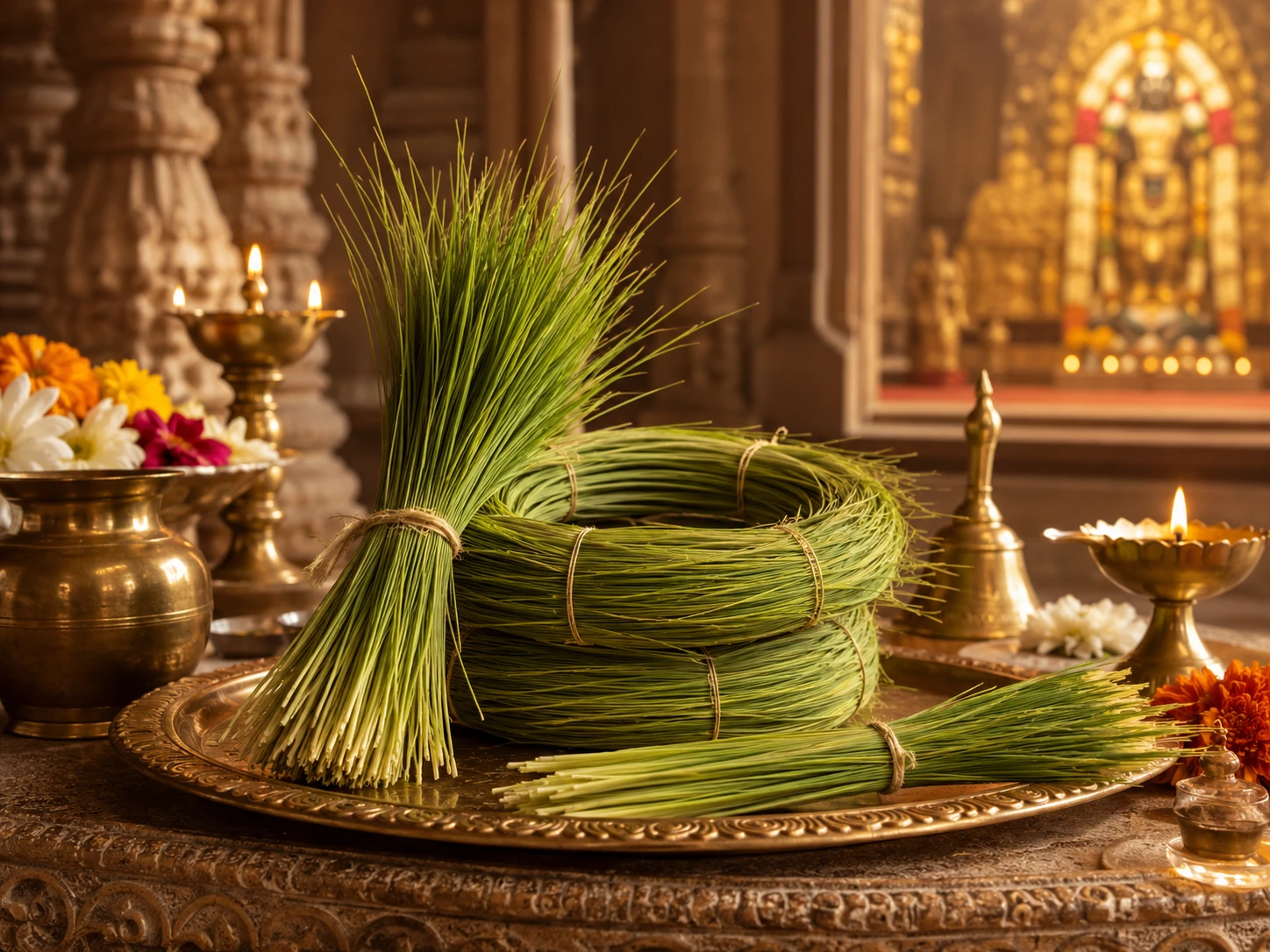
Kusha Grass -- The Blade That Doubles as a Spiritual Conductor
कुश तृण -- वो घास की पत्ती जो आध्यात्मिक सुचालक का काम करती है
If you have ever attended a Hindu puja, a homa, a shraddha ceremony, or a Satyanarayan Katha, you have seen a priest wearing a ring made of grass on his right ring finger. You may have noticed bundles of sharp-tipped grass laid around the fire altar, dipped in water and sprinkled over the congregation, or spread as a mat beneath offerings. That grass is Kusha -- botanically Desmostachya bipinnata -- and it is arguably the single most indispensable material in Hindu worship after water and fire.
The English names -- Halfa grass, Big cordgrass, Salt reed-grass -- give no hint of its significance. In the Vedic tradition, Kusha is not a plant. It is a technology. It is believed to function as a spiritual conductor -- absorbing, channelling, and directing the subtle energies generated during prayer, meditation, and fire rituals. The priest wears it as a ring (called Pavitram) to insulate himself from energy loss during chanting. It is spread around the homa kunda (fire altar) to contain the ritual's energy within a bounded sacred space. It is placed beneath the body of the dying to purify their passage.
The word 'Kusha' itself is the etymological root of 'Kushala' -- meaning skilled or expert. The logic: only a truly deft person can pluck this razor-edged blade without cutting their fingers. In Sanskrit, competence is literally named after the ability to handle sacred grass. That is how deeply embedded this plant is in the civilisational vocabulary of India.
शुचौ देशे प्रतिष्ठाप्य स्थिरमासनमात्मनः। नात्युच्छ्रितं नातिनीचं चैलाजिनकुशोत्तरम्॥
śucau deśe pratiṣṭhāpya sthiram āsanam ātmanaḥ | nātyucchritaṃ nātinīcaṃ cailājinakuśottaram ||
In a clean place, having established a firm seat for oneself -- neither too high nor too low -- made of cloth, deerskin, and Kusha grass, one upon the other.
— Bhagavad Gita, Chapter 6, Verse 11 (Dhyana Yoga -- Krishna's prescription for the ideal meditation seat)
ORIGIN STORIES -- VISHNU'S HAIR, GARUDA'S QUEST, AND THE COSMIC TORTOISE
The Puranas offer multiple origin stories for Kusha grass, and the tradition holds them simultaneously rather than choosing one. The most widely cited is from the Garuda Purana: Kusha grass was born from the hair (roma) of Lord Vishnu. This is why it is considered to carry Vishnu's potency within it and why Vaishnava traditions revere it alongside Shaiva traditions.
A second origin connects Kusha to the Samudra Manthana -- the churning of the cosmic ocean. When Vishnu assumed the Kurma (Tortoise) avatar to support Mount Mandara as the churning rod, the rotation of the mountain against his shell rubbed off several hairs. These washed ashore and became Kusha grass. Later, when the pot of Amrita (nectar of immortality) was obtained, some drops fell on the Kusha, imbuing it with healing properties and immortal sanctity.
A third variant from the Skanda Purana and other texts connects Kusha to Vishnu's Varaha (Boar) avatar. When Vishnu in boar form lifted the earth from the cosmic waters, he shook his body, and the hairs that fell became Kusha. This is why some traditions say Kusha grass represents the Trimurti: Brahma resides at its root, Vishnu in its middle, and Shiva at its tip.
The Buddhist tradition adds another layer: Gautama Buddha sat on a mat of Kusha grass under the Bodhi tree when he attained enlightenment. The city where Buddha was cremated is Kushinagar -- literally 'city of Kusha.' This cross-traditional significance suggests that Kusha was venerated in Indian spiritual culture long before sectarian boundaries formed.
THE PAVITRAM -- A GRASS RING THAT TURNS YOUR FINGER INTO A SPIRITUAL ANTENNA
The most ubiquitous ritual use of Kusha is the Pavitram -- a ring made of two or more blades of Kusha grass tied with a special knot called Brahma Mudi (the Knot of Brahma). The priest wears it on the ring finger of the right hand during virtually all Vedic rituals. The number of blades varies by occasion: one blade for death rites (symbolising the singularity of the soul's departure), two for auspicious daily rituals, three for Pitri-related ceremonies (like Amavasya Tarpana), and four for temple consecration.
The underlying concept is that the Kusha tip functions as an antenna for cosmic energy, and the Brahma Mudi stores and regulates this energy, preventing it from dissipating through the body into the ground. Whether you view this as metaphor or mechanism, the architectural logic is consistent: the ritual creates a closed circuit of sacred energy between the priest, the fire, the mantra, and the divine -- and the Pavitram is the component that seals the circuit at the human end.
For Tarpana (water offerings to ancestors), the Kusha ring is essential. The water poured through fingers wearing the Pavitram is believed to reach the Pitris (ancestors) directly. Without the Kusha, the offering is considered incomplete. During Shraddha ceremonies -- one of Hinduism's most fundamental duties -- Brahmins invited to represent the ancestors are seated on Kusha mats, further reinforcing the grass as a conduit between the living and the dead.
The wife's connection during rituals is also mediated through Kusha. In many Vedic karmas, when a couple performs a ritual together, the wife touches her husband with a blade of Kusha grass during the Sankalpa (ritual resolve). This creates a symbolic and energetic link between the two participants, making the ritual a shared act even when only one person is physically performing it.
ECLIPSE PROTECTION AND THE SCIENCE QUESTION
One of the most distinctive uses of Kusha grass is during solar and lunar eclipses (Grahan). In traditional Hindu households, Kusha blades are placed on cooked food, water vessels, and pickles during the eclipse period. The belief is that the grass protects food from the harmful radiation or subtle contamination that eclipses are thought to bring.
Modern science has not validated the claim that eclipses contaminate food. However, recent research has noted that Darbha grass (Desmostachya bipinnata) possesses antimicrobial properties and, in some experimental settings, has been observed to attenuate certain types of radiation -- including a noted study suggesting X-ray attenuation properties. The science is preliminary and should not be overclaimed, but it is notable that the grass chosen by Vedic priests thousands of years ago for 'purification' does in fact have measurable antimicrobial and radiation-related properties that were unknown to the ancients.
In Ayurveda, Kusha grass (or the closely related Durva) is used medicinally as a diuretic and to treat dysentery and menorrhagia. The deep root system of the plant prevents soil erosion in arid regions, making it ecologically valuable. It grows naturally in northeast Africa, the Middle East, and across South and Southeast Asia -- essentially the same belt of ancient civilisations that independently developed sophisticated agricultural and spiritual practices.
For the UPSC aspirant memorising India's sacred geography, or the NEET student studying plant taxonomy, Kusha grass sits at a fascinating intersection: a plant that is simultaneously a Vedic ritual essential, a Buddhist meditation artefact, an Ayurvedic medicine, an ecological stabiliser, and a candidate for modern antimicrobial research. The JEE student might add: its sharp edges could teach you about biomechanics and structural engineering at the micro-scale.
Kusha Grass in Hindu Rituals -- A Usage Map
| Ritual Context | Use of Kusha | Number of Blades | Symbolism | प्रतीकात्मकता (हिन्दी) |
|---|---|---|---|---|
| Homa (Fire Ritual) | Paristarana -- spread around fire altar in 4 directions (E/S/W/N) | Multiple bundles | Contains ritual energy within sacred boundary | पवित्र सीमा में अनुष्ठान ऊर्जा समेटता है |
| Priest's Pavitram Ring | Worn on right ring finger with Brahma Mudi knot | 2 (auspicious) / 3 (Pitri) / 4 (temple) | Seals the energetic circuit at the human end | मानव छोर पर ऊर्जा परिपथ बन्द करता है |
| Tarpana (Ancestral Offering) | Water poured through Kusha-ringed fingers | 3 blades (for Pitri rites) | Conducts offering to ancestors | पूर्वजों तक अर्पण पहुँचाता है |
| Shraddha Ceremony | Kusha mat as seat for Brahmins representing Pitris | Full mat | Purifies the conduit between living and dead | जीवित और मृत के बीच माध्यम शुद्ध करता है |
| Eclipse (Grahan) | Placed on cooked food and water vessels | Individual blades | Protects food from subtle contamination | भोजन को सूक्ष्म संदूषण से बचाता है |
| Meditation Seat (Gita 6.11) | Kusha mat as base layer under deerskin and cloth | Full mat | Insulates meditator from ground energy loss | ध्यानी को ज़मीन में ऊर्जा-क्षय से बचाता है |
| Death Rites (Antyeshti) | Placed beneath the dying / deceased | 1 blade (singularity of soul) | Purifies the departing soul's passage | प्रस्थान करती आत्मा का मार्ग शुद्ध करता है |
| Couple's Sankalpa | Wife touches husband with Kusha blade | 1 blade | Creates energetic link between participants | सहभागियों के बीच ऊर्जा सम्बन्ध बनाता है |
Usage details vary by Vedic shakha (branch), regional tradition, and family custom. South Indian traditions use Darbha (Desmostachya bipinnata) specifically; North Indian traditions sometimes use the closely related Kusha (Poa cynosuroides). Both are considered sacred.
KUSHA IN THE RIG VEDA -- THE OLDEST REFERENCE
The Rig Veda, the oldest of the four Vedas (composed approximately 1500-1200 BCE), mentions Kusha grass in Mandala 1, Sukta 191, Verse 3. The verse lists 'Kushara' and 'Darbha' alongside other grasses in the context of protecting against venomous creatures -- an early indication that the grass was understood to have protective, purifying properties even in the earliest Vedic period. The hymn instructs that these grasses, along with Munja and others, 'anoint' (protect) the devotee from unseen harm.
In later Vedic literature, the Yajurveda and Samaveda prescribe Kusha as the material for strewing the sacrificial ground (Vedi) and for the seats of priests and deities during yajnas. The Grihya Sutras -- the householder's manuals for domestic rituals -- codify its use in the Upanayana (sacred thread ceremony), Vivaha (marriage), Antyeshti (funeral), and seasonal rites.
The special day for uprooting Kusha is Kusha Amavasya -- the new moon day of the Bhadrapada month (August-September). On this day, devotees ceremonially pluck fresh Kusha grass for the coming year's rituals. The timing is significant: Bhadrapada is also the month of Pitru Paksha (the fortnight of ancestors), and fresh Kusha is needed precisely because the most intensive ancestral rites of the year are about to begin.
For those studying Indian civilisational continuity, consider this: a grass mentioned in a hymn composed over three thousand years ago is still plucked on the same calendar date, still tied into the same Pavitram ring, still used in the same Tarpana offering, by millions of people across the Indian subcontinent. That is not superstition. That is a three-thousand-year-old unbroken standard operating procedure.
KUSHA IN THE RAMAYANA -- THE GRASS THAT NAMED A PRINCE
The connection between Kusha grass and the Ramayana is intimate and often overlooked. When Sita, pregnant and exiled, takes refuge in Valmiki's ashram, she gives birth to twin boys. Valmiki names the elder Luv and the younger Kush. According to the Uttara Kanda tradition, the name comes directly from the act of purification: Valmiki used Kusha grass tips to sprinkle holy water (Kusha-udaka) on the newborn, and the child was named after the sacred grass used in his birth ritual.
This is not a random naming convention. In the Vedic world, names encode identity and destiny. To be named after the grass that connects humans to the divine, that conducts spiritual energy, that purifies the space between the living and the dead -- is to carry an enormous symbolic weight. Kush, the son of Rama, inherits a name that marks him as a vessel of sacred continuity, a living bridge between the exiled divine king and the future of the Suryavansha dynasty.
The twins Luv and Kush grow up in Valmiki's ashram learning the Ramayana itself -- they are the first audience of the epic, taught to sing it as a narrative poem. When they perform it at Ashvamedha Yajna of Rama, their singing is so powerful that Rama recognises them as his sons. The entire arc -- from Kusha-water purification at birth to the singing of a civilisational epic -- is set in motion by a blade of grass.
For the mythology-obsessed Instagram generation, here is a detail that often goes viral: India's two great epic traditions -- Ramayana and Mahabharata -- both have their origins transmitted through specific acts of memory. Valmiki teaches Luv-Kush. Vyasa dictates to Ganesha. In both cases, the mechanism of civilisational memory involves a sacred setting, a divine intermediary, and a specific material context. Kusha grass, through its role in naming and purifying one of those intermediaries, is woven into the origin myth of Indian literature itself.
THE ECOLOGY AND BOTANY OF DESMOSTACHYA BIPINNATA
Beyond its spiritual significance, Kusha grass (Desmostachya bipinnata) is an ecologically important species. It is a perennial tussock grass that grows in clumps, reaching heights of up to 60 centimetres. Its root system is extraordinarily deep and tenacious -- once established, the plant is extremely difficult to uproot, which is why it has been traditionally used for soil conservation in arid and semi-arid regions across North Africa, the Middle East, and South Asia.
The leaf edges are serrated with silica-based micro-teeth -- the same mineral that makes glass -- which is why they cut like razors. This is not a defensive mechanism against herbivores (cattle generally avoid Kusha). It is a structural adaptation for water conservation in dry environments: the silica-reinforced edges reduce transpiration and protect the leaf from wind damage. For a biology student, Kusha is a textbook example of xerophytic adaptation.
The geographical distribution of Kusha spans a remarkable swathe of ancient civilisation: it grows naturally in India, Pakistan, Afghanistan, Iran, Iraq, Egypt, Ethiopia, and across the Sahel. This distribution map overlaps almost perfectly with the belt of earliest human agriculture and urban civilisation -- from the Nile to the Indus. It is tempting to speculate that the grass's ritual significance emerged precisely because it was ubiquitous in the landscapes where Vedic and pre-Vedic cultures developed.
In modern ecological contexts, Kusha grass is being studied for phytoremediation -- using plants to clean contaminated soil. Its deep root system can absorb heavy metals and stabilise soil in areas damaged by mining or industrial pollution. The Indian government's desert afforestation programmes in Rajasthan and Gujarat include Desmostachya bipinnata as a key species for dune stabilisation. The grass that was sacred to the Rig Vedic priest is now useful to the environmental engineer -- a continuity of utility across millennia that would probably not surprise the Rig Vedic priest at all.
KUSHA IN DAILY LIFE -- FROM YOUR GRANDMOTHER'S KITCHEN TO THE MODERN WELLNESS INDUSTRY
In traditional Indian households, the presence of Kusha grass was as routine as turmeric or ghee. Grandmothers kept dried bundles in the puja room, refreshed annually on Kusha Amavasya. During eclipses -- which happen with predictable regularity -- Kusha blades were placed on every food container, every water vessel, every pot of pickle. The reasoning was simple and non-negotiable: eclipse energy corrupts food, Kusha protects it. The science may be debatable, but the cultural practice created a systematic food-safety protocol that activated with clockwork precision across millions of households, centuries before government food safety agencies existed.
In South Indian Brahmin households, the connection is even more granular. The daily Sandhyavandana (twilight prayer performed three times a day) requires the performer to sip water purified with Kusha. The Pavitram ring is worn during every prayer, every ritual, every significant domestic ceremony. A Brahmin household without a supply of Darbha grass is considered ritually incomplete -- like a kitchen without salt.
The modern wellness industry has begun to notice. Kusha grass mats are marketed as 'yoga mats with Vedic heritage,' priced at premium rates on Amazon and Flipkart. Kusha-infused water is sold as a 'detox' product in Ayurvedic wellness stores in Rishikesh and Haridwar. Whether these modern products carry genuine spiritual or medicinal efficacy is an open question -- but the marketing instinct is not wrong. A grass with Rig Vedic provenance, Gita endorsement, and emerging antimicrobial research credentials is genuinely hard to compete with in the wellness space.
For the environmentally conscious urban Indian -- the Pune or Bengaluru professional who composts, cycles to work, and reads about permaculture -- Kusha grass offers something else entirely. It is an indigenous, drought-resistant, soil-stabilising perennial that grows without irrigation, pesticide, or fertiliser. In a country grappling with desertification in Rajasthan, soil degradation in the Indo-Gangetic plain, and water stress across peninsular India, the humble Kusha is a climate-resilient crop hiding in plain sight. The fact that it has been cultivated, venerated, and maintained for over three millennia is perhaps the longest-running permaculture success story in human history.
KUSHA ACROSS INDIA'S REGIONS -- VARIATIONS IN PRACTICE
The use of Kusha grass is pan-Indian, but regional traditions add distinctive layers. In Tamil Nadu and Kerala, the grass is called 'Darbhai' or 'Dharba,' and its use in Shraddha and Tarpana follows the Apastamba and Baudhayana Grihya Sutras. South Indian Vaishnavites celebrate Darbhashtami in the Bhadrapada month -- a day exclusively dedicated to the worship and ceremonial cutting of Darbha, with special prayers to Vishnu acknowledging the grass as born from his body.
In Maharashtra and Gujarat, Kusha appears prominently during Ganesh Chaturthi preparations and the Shravan month rituals. In Bengal, during Durga Puja, Kusha tips are used for the Nabapatrika ritual -- the 'nine plants' representing the goddess, where each plant carries specific divine attributes. In Odisha, the Kusha-Amavasya tradition includes tying Kusha bundles to the doorposts of homes as protection for the coming Pitru Paksha fortnight.
The Himalayan traditions add altitude-specific variations. In Uttarakhand and parts of Nepal, where Desmostachya bipinnata does not grow naturally due to the cold, priests use locally available substitutes -- but purists insist on imported Darbha from the plains for major ceremonies, creating a small but steady trade in sacred grass bundles that travels up mountain trails to temples at 3,000 metres.
The Lingayat tradition of Karnataka, while famously iconoclastic in its rejection of many Vedic rituals, retains Kusha in specific ceremonies -- a testament to the grass's cultural gravity. Even reformist movements that questioned Brahminical ritual hegemony did not discard the grass itself. The material outlasted the theology that tried to abandon it.
For competitive exam aspirants, here is a pattern worth noting: Kusha grass connects Vedic ritual (UPSC Ancient India syllabus), Buddhist pilgrimage sites like Kushinagar (Medieval India), ecological conservation (Environment and Ecology paper), and traditional knowledge systems (Essay paper). A single blade of grass covers four UPSC subjects. If that is not efficiency, nothing is.
The Sanskrit word 'Kushala' (meaning expert, skilful, or competent) is the etymological parent of the common Hindi greeting 'Kushal-Mangal' -- 'all well and auspicious.' The connection: only a skilled person can pluck Kusha grass without its razor-sharp edges cutting their fingers. Meanwhile, the Buddhist holy city Kushinagar -- where Gautama Buddha was cremated around 483 BCE -- takes its name directly from Kusha grass. The city is in modern-day Uttar Pradesh and receives over a million pilgrims annually. Kusha also appears in Rama's story: his twin sons are named Luv and Kush. According to Uttara Kanda traditions, Valmiki named the younger son Kush because he used Kusha grass to sprinkle holy water on the newborn. So the grass connects to the Rig Veda, the Bhagavad Gita, the Ramayana, the Buddhist canon, and your grandmother's kitchen during a lunar eclipse -- possibly the most cross-referenced plant in Indian civilisation.
Learn the Rituals That Use Kusha
Homa, tarpana and daily sandhyavandana are the rituals where kusha grass is central -- as a seat, as the pavitra ring on the finger, and as a sprinkler for water. Eternal Raga's Eternal Gyan articles explain each, beginning with the sandhyavandana guide.
Tags
Eternal Raga · शाश्वत राग
Institutional voice — scholarly articles on Sanatan Dharma
Deepen Your Understanding
अपनी समझ और गहरी करें
sacred artefacts
Banalinga -- The Stone God Made Himself in a River Over Millions of Years
No sculptor shaped it. No temple priest consecrated it. The Banalinga is a smooth, egg-shaped stone that emerges from the bed of the Narmada River in central India -- formed by millions of years of water erosion into a shape that Hindus recognise as Shiva's aniconic emblem. It is called Svayambhu: self-born. It needs no prana pratishtha because divinity is already inside. In a tradition that fills temples with carved murtis and elaborate rituals, the Banalinga is a radical statement: God does not need human hands to manifest.
rituals traditions
Tirtha Yatra -- Why Hindus Travel to Get Closer to God
The word 'Tirtha' does not mean 'holy place.' It means 'crossing point' -- a ford where the river of worldly existence can be crossed to reach the far shore of liberation. Hindu pilgrimage is not tourism with a spiritual label. It is the deliberate journey to locations where the boundary between the material and the divine is believed to be thinnest -- where the crossing is easiest. From Kashi to Kailash, from Char Dham to Kumbh Mela, the tradition maps a sacred geography onto the physical landscape of the subcontinent, turning the act of travel itself into a spiritual practice.
rituals traditions
Shraddha and Pitru Paksha -- Why Hindus Feed the Dead
For sixteen days every September, millions of Hindus stop celebrating, avoid new ventures, and turn their attention to the dead. Pitru Paksha is not morbid -- it is the tradition's most concentrated expression of a radical idea: you owe your existence to people who are no longer alive, and the debt does not expire with their death. Shraddha (faith-offerings), Tarpana (water libations), and Pinda Daan (rice-ball offerings) are the currency of this trans-generational debt system. The story that inaugurated it? Karna -- the greatest giver in the Mahabharata -- who discovered that even infinite gold is worthless if you never fed your ancestors.
scriptural exegesis
Samudra Manthan -- When Gods and Demons Ran a Joint Venture and the Universe Almost Died
A cosmic ocean. A mountain for a churning rod. A serpent king for a rope. Gods on one end, demons on the other. And out came 14 treasures -- including wealth, beauty, medicine, immortality, and one poison so lethal it could end creation itself. The Samudra Manthan is not mythology. It is the original playbook for collaboration, crisis management, and how to handle it when your joint venture partner tries to cheat you.
deities avatars
Varaha Avatar -- The Boar Who Lifted the Earth
When the earth sank to the bottom of the cosmic ocean, Vishnu came out of Brahma's nostril as a boar the size of a thumb, grew to the size of a mountain, and dived to bring her back on his tusks. The story of the third avatar, the demon Hiranyaksha, and why the boar is also the sacrifice itself.
sacred artefacts
Divine Musical Instruments -- Veena, Damaru, Murali
Saraswati's Veena created knowledge. Shiva's Damaru created language. Krishna's Murali created longing. Three instruments, three cosmic functions -- and the foundation of one of the world's oldest musical traditions. From the 14 Maheshwara Sutras that birthed Sanskrit grammar to the raga system that maps human emotion, Hindu mythology placed music at the centre of creation itself.
vedic sciences
Rahu, Ketu and the Science of Eclipses -- Svarbhanu's Two Stories
Every eclipse carries two truths at once. The Purana says Rahu swallowed the sun. The Surya Siddhanta says the moon crossed its node. Both were recorded in Sanskrit, in the same period, with no contradiction. Trace the mythology of Svarbhanu from Rigveda 5.40 to the geometry of lunar nodes, and understand why the Panchang your grandmother consults still gets eclipse timings right within seconds.
The Sanskrit word 'Kushala' (meaning expert, skilful, or competent) is the etymological parent of the common Hindi greeting 'Kushal-Mangal' -- 'all well and auspicious.' The connection: only a skilled person can pluck Ku…
More in Sacred Artefacts
Ashtadhatu -- The Sacred Eight-Metal Alloy of Indian Temples
12 min read
Banalinga -- The Stone God Made Himself in a River Over Millions of Years
13 min read
Celestial Trees -- Kalpavriksha and Parijata
12 min readThe same translation error that turned '33 Koti' into '33 crore' in Hinduism also happened in Buddhism. The Chinese translation of Buddhist texts rendered 'Sapta Koti Buddha' (7 Supreme Buddhas) as '7 Crore Buddhas.' The…
Deities AvatarsCommunity Reflections
🕉️
Be the first to share your reflection.