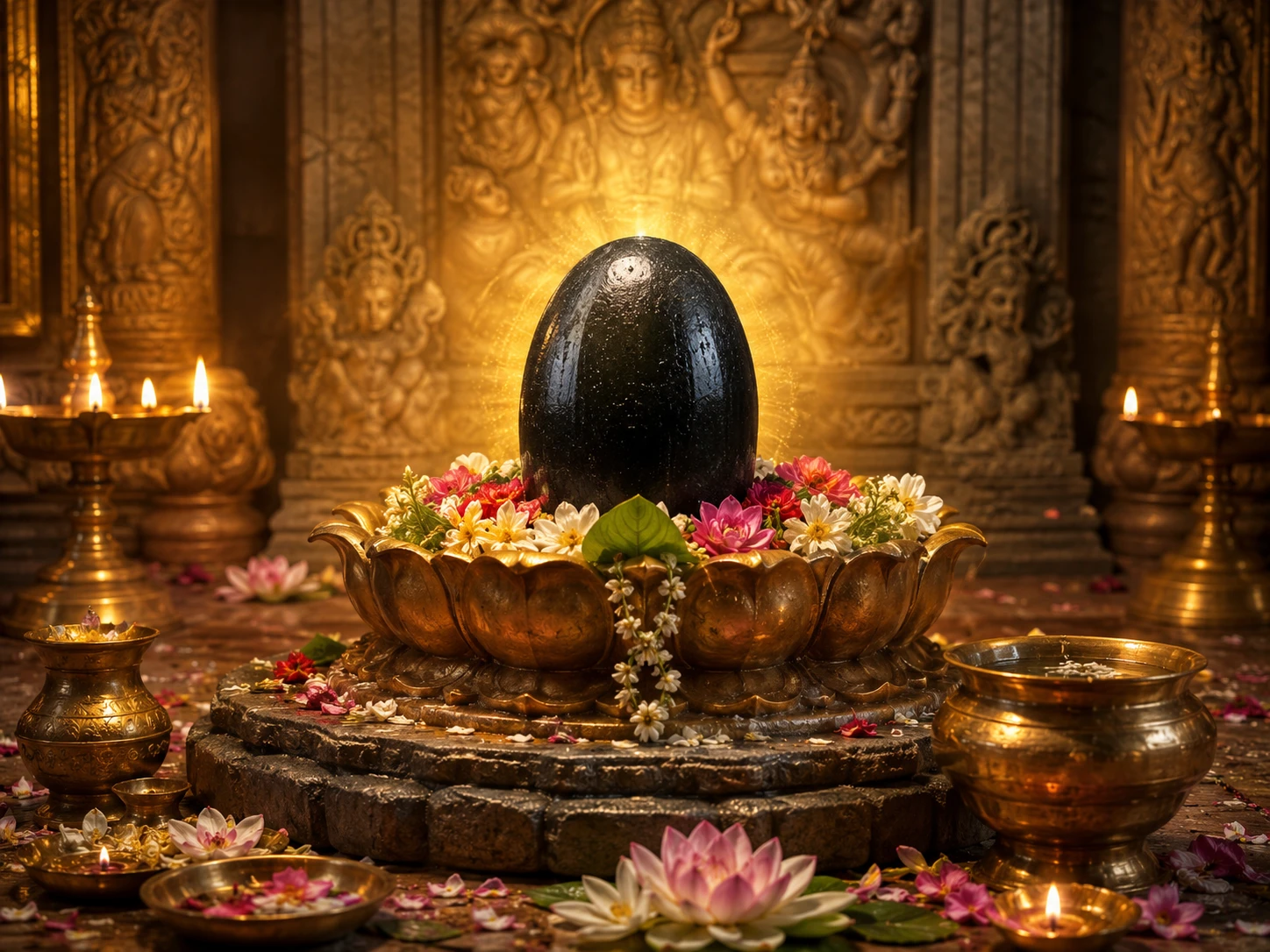
Banalinga -- The Stone God Made Himself in a River Over Millions of Years
बाणलिंग -- वो शिला जिसे भगवान ने स्वयं एक नदी में करोड़ों वर्षों में गढ़ा
In most Hindu temples, the main deity goes through an elaborate installation ceremony called prana pratishtha -- literally 'establishment of life-breath.' A priest invokes the divine presence into the murti through Vedic mantras, transforming carved stone into a living embodiment of the deity. Without this ritual, the stone remains stone.
The Banalinga skips this entirely. It does not need prana pratishtha because, according to Shaiva scripture and millennia of tradition, the divine is already present within it. The stone was not shaped by human hands. It was shaped by the Narmada River over geological timescales -- millions of years of water flowing over cryptocrystalline quartz, smoothing it into an ellipsoid form that Hindu tradition recognises as the linga, the aniconic symbol of Shiva. The Narmada did not intend to make a religious icon. It made one anyway. That is the entire theological point.
The word 'Banalinga' has two etymologies that coexist in the tradition. The first connects 'Bana' to Banasura, a demon-devotee of Shiva who received these sacred stones as a divine boon. The second connects 'Bana' to 'arrow' (bana in Sanskrit), linking the stones to the Tripurantaka legend in which Shiva's fiery arrow destroyed the three flying cities of the asuras, and the fragments scattered across the Narmada's banks, becoming crores of self-manifested lingas. Both stories arrive at the same conclusion: these stones are not human artefacts. They are geological evidence of Shiva's presence, written in quartz and erosion rather than ink and paper.
नर्मदायाः समुत्पन्नं लिङ्गं स्वयम्भुवं शुभम्। दर्शनात् स्पर्शनात् तस्य मुच्यते सर्वकिल्बिषैः॥
narmadāyāḥ samutpannaṃ liṅgaṃ svayambhuvaṃ śubham | darśanāt sparśanāt tasya mucyate sarvakilbiṣaiḥ ||
The auspicious, self-born Linga that has emerged from the Narmada -- by merely seeing it or touching it, one is freed from all sins.
— Attributed to Skanda Purana, Rewa Khanda (the section entirely devoted to the Narmada's sacred geography; verse paraphrased from traditional recitation)
THE NARMADA -- INDIA'S MOST UNDERRATED SACRED RIVER
The Ganges gets the fame. The Yamuna gets the poetry. But the Narmada -- flowing 1,312 kilometres from Amarkantak in Madhya Pradesh to the Gulf of Khambhat in Gujarat -- holds a unique theological position: she is considered Shiva's daughter (Shankari), born from Shiva's body itself. While the Ganges purifies through bathing, the Narmada purifies through mere darshana -- sight alone. The popular Hindi saying captures this: 'Narmada ke har kankar Shankar' -- every pebble of the Narmada is Shiva.
The Narmada Parikrama is one of the most demanding pilgrimages in Hinduism -- walking approximately 2,600 kilometres along the southern bank from source to mouth, then returning along the northern bank. It takes three to four years on foot. Pilgrims who complete it say the river transforms them. Geologically, the Narmada valley is one of the oldest geological formations on the Indian subcontinent, running through the rift between the Vindhya and Satpura ranges. The river's bed contains Precambrian rock -- stone that predates complex life on Earth. The Banalinga stones formed in this bed are composed of cryptocrystalline quartz with a Mohs hardness of 7, making them harder than steel.
The two major pilgrimage sites associated with Banalinga collection are Omkareshwar and Maheshwar, both in Madhya Pradesh. Omkareshwar is an Om-shaped island in the Narmada that houses one of the twelve Jyotirlingas. Adi Shankaracharya composed the Narmada Ashtakam on its banks in the 8th century CE, a Sanskrit hymn that describes the river's shores as 'resounding with the cries of lakhs of birds.' The Sardar Sarovar Dam project, one of India's most controversial infrastructure projects that sparked the Narmada Bachao Andolan led by Medha Patkar, has altered the river's flow and raised questions about the future availability of naturally formed Banalingas.
THREE TYPES OF LINGA -- A THEOLOGICAL FRAMEWORK
The Brihat Vaivarta Purana classifies lingas into three categories that reveal a theology of divine manifestation. The Svayambhuva Linga is self-existing -- it includes the Banalinga and the twelve Jyotirlingas. It is called Vyakta (manifest) and bestows moksha. The Banalinga proper, formed in the Narmada, is classified as Avyakta (unmanifest) and bestows worldly happiness (aishvarya). The Shaila Linga is carved from stone by human hands. It is called Vyaktavyakta (manifest-unmanifest) and bestows both happiness and moksha. This three-tier classification is not a hierarchy of value but a spectrum of divine accessibility -- from the entirely God-made to the entirely human-made, with the Banalinga occupying the mysterious middle.
The Banalinga also holds a central position in the Panchayatana Puja system attributed to Adi Shankaracharya. In this worship, five formless stones represent the five principal deities: the Banalinga for Shiva, the Shaligrama for Vishnu, a crystal for Surya, a gold-coloured stone for Ambika (Devi), and a red stone for Ganesha. The five stones are arranged with the devotee's primary deity at the centre and the other four around it. This system -- worshipping the divine through uncarved natural forms -- is perhaps the most philosophically sophisticated worship model in Hinduism, and the Banalinga anchors it.
For the Virashaiva (Lingayat) community, the connection is even more intimate. Lingayat devotees wear a small linga in a silver capsule (ishtalinga) around their necks at all times. While the ishtalinga is not always a Banalinga, the theological principle is identical: the divine is not in a distant temple. It is on your body, with you always, personal and immediate.
GEOLOGY MEETS THEOLOGY -- THE SCIENCE OF BANALINGA FORMATION
Strip away the mythology for a moment and look at what geologists see. The Narmada flows through one of the oldest geological rifts on Earth -- the Narmada-Son Lineament, a fault zone dating to the Precambrian era, over 540 million years ago. The riverbed contains sedimentary and metamorphic rocks, including jasper, agate, and cryptocrystalline quartz. Over millions of years, the river's current tumbles these stones against each other and against the bedrock, eroding them into smooth ellipsoid shapes.
The resulting stones have a Mohs hardness of 7 -- for context, a steel knife blade is about 5.5, and a diamond is 10. Banalingas are extraordinarily hard, resistant to weathering, and smooth to the touch. Their composition is primarily silicon dioxide (SiO2), the same mineral family as amethyst, citrine, and smoky quartz. Some specimens are translucent white and glow when backlit, which adds to their veneration. The markings and colour bands on many Banalingas are natural inclusion patterns formed by iron oxide and manganese deposits during crystallisation.
Here is the part that bridges science and faith: no human process can replicate what the Narmada does. You can polish a stone to smoothness, but the specific ellipsoid geometry, the internal crystalline structure, the millennia of mineral deposition -- these are unreproducible. When the tradition says these stones are svayambhu (self-born), the geological evidence agrees in its own language. The Narmada made them. The question of who made the Narmada is where science and theology part ways -- and also where the conversation gets interesting.
The Sardar Sarovar Dam and other modern interventions have altered the Narmada's flow patterns. Many traditional collection sites near Omkareshwar and Maheshwar now produce fewer naturally formed specimens. This has led to a thriving market in artificially polished stones sold as 'Banalingas' -- a reality the Shaiva community is increasingly aware of. For a JEE or NEET student in Kota studying fluid dynamics or mineralogy, the Banalinga is an accidental case study sitting in your puja room: erosion, quartz formation, river geomorphology -- all in one stone.
Three Types of Linga -- A Puranic Classification
| Type | Hindi Name | Origin | Classification | Bestows | Consecration Needed? |
|---|---|---|---|---|---|
| Svayambhuva Linga | स्वयम्भूव लिंग | Self-manifested (Jyotirlingas, certain Banalingas) | Vyakta (Manifest) | Moksha (Liberation) | No -- divinity inherent |
| Banalinga | बाणलिंग | Naturally formed in sacred rivers (primarily Narmada) | Avyakta (Unmanifest) | Aishvarya (Worldly prosperity) | No -- Svayambhu sanctity |
| Shaila Linga | शैल लिंग | Carved from stone by human artisans | Vyaktavyakta (Manifest-Unmanifest) | Sukha + Moksha (Both) | Yes -- requires Prana Pratishtha |
Classification based on Brihat Vaivarta Purana. Some scholars note overlap between the first two categories. The Shiva Purana and Linga Purana offer variant but complementary frameworks.
HOW TO WORSHIP A BANALINGA -- TRADITION AND PRACTICE
The beauty of Banalinga worship is its simplicity. Since the stone is already consecrated by its nature, the worship protocol is remarkably accessible. The stone is typically placed on a yoni-shaped base made of copper, brass, or silver -- the yoni representing Shakti, the feminine principle, and the linga representing Shiva, the masculine principle. Together they symbolise the union of consciousness and energy from which the universe arises.
Daily worship involves Abhishekam (ritual bathing) with water, milk, yoghurt, honey, and ghee -- collectively called Panchamrit. The Banalinga is then adorned with bilva (bael) leaves, which are sacred to Shiva, and offered incense and a lamp. No special mantras beyond the basic Panchakshari mantra ('Om Namah Shivaya') are required, though the Rudram and Chamakam from the Yajurveda are considered ideal accompaniments.
For home worship, the Banalinga is particularly important. Most Hindu households that maintain a Shiva shrine use either a Banalinga or a small stone linga. The Banalinga's advantage is that it can be moved, transported, and even worshipped during travel without any loss of sanctity -- unlike temple murtis that are permanently installed. NRI families who have moved abroad often carry a Banalinga from India, maintaining their Shiva worship connection across continents. It is portable divinity -- and in a globalised world where the Indian diaspora spans 40 million people across 150 countries, that portability is not incidental. It is architecturally brilliant.
THE BANALINGA IN MAJOR TEMPLES
The most famous Banalinga in India is the massive specimen in the Thanjavur Brihadeeswarar Temple in Tamil Nadu -- one of the Great Living Chola Temples and a UNESCO World Heritage Site. This Banalinga is among the largest in any temple in India and stands as evidence of the deep South Indian reverence for Narmada stones despite the geographical distance between Tamil Nadu and Madhya Pradesh. The logistics of transporting a stone of that size from central India to the Kaveri delta in the 11th century CE, during the reign of Raja Raja Chola I, speaks to the extraordinary value placed on these natural formations.
Omkareshwar itself, the Om-shaped island, houses Banalingas that are worshipped alongside the Jyotirlinga. At Maheshwar, the ancient capital of Queen Ahilyabai Holkar (one of India's most celebrated woman rulers), Banalinga worship is integrated into the daily temple routine. Ahilyabai Holkar, who ruled Indore from 1767 to 1795, was legendary for her temple-building programme across India -- she renovated temples from Kashi to Somnath -- and her personal devotion centred on the Banalinga.
In the startup world of modern India, the Banalinga has found an unexpected cultural niche. Several tech founders in Bengaluru and Hyderabad keep Banalingas in their office spaces -- not as decoration but as daily worship objects. The appeal is theological: a self-manifested object that embodies divine energy without institutional mediation. For a generation that builds decentralised products and distrusts gatekeepers, the Banalinga's svayambhu philosophy resonates on more levels than one.
THE TRIPURANTAKA LEGEND -- HOW SHIVA'S ARROW SEEDED A RIVER WITH DIVINITY
The Aparajita-Pariprchchha (a temple architecture text, 205.1-26) preserves one of the most vivid origin accounts of the Banalinga. The demon Banasura, through severe tapasya, obtained three flying cities -- one of gold, one of silver, one of iron -- collectively called Tripura. These cities orbited the earth, and from them Banasura's armies terrorised the devas and sages. The cities could only be destroyed when they aligned in a single line, which happened once every thousand years.
When the alignment came, Shiva mounted a chariot made of the cosmos itself -- the earth as the body, the sun and moon as wheels, Brahma as the charioteer, Mount Meru as the bow, Vasuki (the serpent) as the bowstring, and Vishnu as the arrow. With a single shot from his bow Pinaka, Shiva incinerated the three cities. The debris of this cosmic destruction scattered across three locations: the hills of Sri-Kshetra, the peaks of Amarkantak in the Vindhya range, and the banks of the Narmada. These fragments, infused with the divine energy of Shiva's arrow (bana), multiplied into crores of self-manifested lingas -- the Banalingas.
The story is not merely mythological decoration. It encodes a theological principle: the Banalinga is the residue of divine action, not divine intention. Shiva did not set out to create objects of worship. He set out to destroy evil. The worship objects were a byproduct -- fragments of a cosmic battle that happened to land in a river and become sacred. This is a profoundly different theology from traditions where God deliberately creates sacred objects for human use. In the Banalinga tradition, sacredness is an accident of divine violence, which makes it, paradoxically, more authentic.
The Banasura connection adds a devotional layer. In some Puranic accounts, Banasura was himself a fervent Shiva-bhakta who performed penance so intense that Shiva granted him these natural lingas as a permanent form of his presence. Banasura later appears in Krishna's narrative -- his daughter Usha falls in love with Krishna's grandson Aniruddha, leading to a famous battle between Krishna and Shiva. The theological threads are tangled, which is exactly how Puranic literature works: every artefact connects to every other story.
AUTHENTICATING A BANALINGA -- THE MODERN MARKETPLACE CHALLENGE
The surge in demand for Banalingas -- driven by both genuine devotion and Instagram-era spiritual aesthetics -- has created a significant authentication problem. The natural supply of genuinely river-formed Banalingas has diminished due to dam construction, sand mining, and increased collection pressure. The market has responded with artificially smoothed stones, machine-polished quartz, and in some cases, completely synthetic products labelled as 'Banalingas.'
Traditional methods of authentication rely on several characteristics. A genuine Narmada Banalinga has a distinctive weight-to-size ratio -- it is noticeably heavier than it looks, owing to the dense cryptocrystalline quartz composition. The surface, when examined closely, shows natural erosion patterns rather than the uniform smoothness of machine polishing. Genuine specimens often have subtle colour banding from iron oxide inclusions that formed over geological timescales. When tapped lightly, a real Banalinga produces a clear, resonant sound rather than a dull thud.
The translucent variety -- sometimes called the 'true' Banalinga as opposed to the more common opaque Narmada Linga -- is rarer and more prized. When backlit, it glows with an internal luminosity. These specimens come from the deepest parts of the riverbed and surface only during major floods or unusually low water periods. Some traditional accounts say they appear once every ten years.
For the consumer, the safest approach is purchasing from established temple trusts near Omkareshwar, Maheshwar, or Amarkantak, or from lineages of traditional collectors (called 'Lingavants') who have gathered these stones for generations. The Omkareshwar Temple Trust and the Narmada Conservation Mission maintain some quality control over sanctioned collection. Like the Rudraksha bead market, the Banalinga market is one where provenance matters enormously -- a reality that any e-commerce entrepreneur in India's growing spiritual marketplace should note.
THE SPIRITUAL PHILOSOPHY OF SVAYAMBHU -- WHY 'SELF-BORN' MATTERS
The concept of Svayambhu -- self-born, self-manifest, arising without external cause -- is one of the most philosophically radical ideas in Hinduism. It appears in the Nasadiya Sukta (Rig Veda 10.129), the famous hymn of creation that asks: 'Who really knows? Who will here proclaim it? Whence was it produced? Whence is this creation?' The hymn suggests that even the gods may not know the origin of the universe -- that creation itself may be svayambhu, self-arising.
The Banalinga inherits this philosophy in material form. When a priest says a Banalinga is svayambhu, he is not making a geological claim (though the geology supports it). He is making a metaphysical one: this object participates in the same self-arising nature as the universe itself. It was not designed. It was not planned. It emerged -- the way consciousness emerges, the way the first note of Om emerged before the universe had ears to hear it.
This has practical implications for worship. A carved murti carries the intention of the sculptor -- it is shaped by human aesthetics, human skill, human limitation. The Banalinga carries no human intention. Its shape is the result of physics -- water, gravity, time, mineral composition. To worship it is to worship a form that nature produced without reference to human categories. In Shaiva Siddhanta philosophy, this is precisely why the Banalinga is considered superior to carved forms: it is untouched by human ego.
For the IIT student studying thermodynamics, here is a parallel that works: a crystal that forms naturally in a cave carries information about temperature, pressure, and chemical composition that no artificial crystal can replicate. The natural crystal is a record of geological truth. The Banalinga, similarly, is a record of the Narmada's truth -- its flow patterns, its mineral deposits, its geological history. To hold a Banalinga is to hold compressed geological time in your palm. Whether you call that physics or divinity depends on your framework, but the object does not change.
The Lingayat (Virashaiva) tradition takes this further. For Basavanna, the 12th-century social reformer and poet-saint from Karnataka who founded the Lingayat movement, the portable Ishtalinga worn on the body was a revolution against temple-centric worship. Why should divinity require a building, a priest, a caste hierarchy? If God is svayambhu, then worship should be equally self-sufficient -- personal, portable, independent of institutional gatekeeping. The Banalinga, as the original svayambhu object, is the ancestor of this theological revolution. Basavanna's Vachana poetry repeatedly returns to the theme: 'The rich will build temples for Shiva. What shall I, a poor man, do? My legs are pillars, the body the shrine, the head a cupola of gold.' The Banalinga is the physical anchor for that poem -- the proof that Shiva does not need temples, only attention.
The word 'Kushala' (meaning 'expert' or 'skilful' in Sanskrit, and the root of the common Hindi greeting 'Kushal-Mangal') is etymologically connected to Kusha grass. The idea is that only a truly skilled person can pluck the razor-sharp Kusha blade without cutting their fingers -- so 'Kushala' came to mean 'one who handles difficult things deftly.' Meanwhile, Banalinga stones have a Mohs hardness of 7 -- the same as topaz and harder than steel. ISRO's Chandrayaan-3 landing site near the lunar south pole is named 'Shiv Shakti Point,' and the geological concept behind that naming -- a natural formation embodying cosmic principles -- is essentially the same philosophy that makes the Banalinga sacred. India's space programme and its most ancient riverbed worship share a common intuition: the universe manifests divinity through natural processes, and science is the language in which you read it.
Begin Your Shiva Practice with Panchakshari Japa
The Banalinga needs nothing but devotion, and the simplest offering is the Panchakshari mantra, Om Namah Shivaya. Build a daily practice of 108 repetitions on a mala, the traditional one-mala cycle. The mantra's page on Eternal Raga gives its meaning and how to chant it.
Tags
Eternal Raga · शाश्वत राग
Institutional voice — scholarly articles on Sanatan Dharma
Deepen Your Understanding
अपनी समझ और गहरी करें
sacred artefacts
Divine Musical Instruments -- Veena, Damaru, Murali
Saraswati's Veena created knowledge. Shiva's Damaru created language. Krishna's Murali created longing. Three instruments, three cosmic functions -- and the foundation of one of the world's oldest musical traditions. From the 14 Maheshwara Sutras that birthed Sanskrit grammar to the raga system that maps human emotion, Hindu mythology placed music at the centre of creation itself.
tantra mantra yantra
Tantra, Mantra and Yantra -- The Three Pillars of Spiritual Practice
Tantra is the loom, Mantra is the thread, Yantra is the pattern. Together they form the complete technology of spiritual transformation that India gifted to the world -- and they are far more profound than popular culture imagines.
deities avatars
Nataraja -- The Cosmic Dancer
One foot crushes a dwarf. The other is raised in liberation. A ring of fire frames the dance. A drum beats creation into existence. An open palm says 'do not fear.' This is Nataraja -- Shiva as the Lord of Dance -- and it is the single most replicated Indian bronze in the history of art. The physicists at CERN chose it to stand outside the world's largest particle accelerator. The Chola bronzesmiths of Tamil Nadu perfected it a thousand years ago. And every time a subatomic particle appears and disappears, the cosmic dance continues.
sacred symbols
Shiva Linga -- Symbol, Form, and Misunderstanding
The most searched, most misunderstood, and most deliberately distorted symbol in Hinduism. The word 'Linga' means 'sign' or 'mark' in Sanskrit -- the same word Panini uses in grammar for 'gender marker' and the Nyaya school uses for 'evidence in logical inference.' The Shvetashvatara Upanishad says Shiva has no linga -- meaning He is beyond all characteristics, including gender. The Linga Purana says the Linga is the formless Brahman made graspable. Colonial-era mistranslation turned this into something else entirely. Here is what the texts actually say.
rituals traditions
Tirtha Yatra -- Why Hindus Travel to Get Closer to God
The word 'Tirtha' does not mean 'holy place.' It means 'crossing point' -- a ford where the river of worldly existence can be crossed to reach the far shore of liberation. Hindu pilgrimage is not tourism with a spiritual label. It is the deliberate journey to locations where the boundary between the material and the divine is believed to be thinnest -- where the crossing is easiest. From Kashi to Kailash, from Char Dham to Kumbh Mela, the tradition maps a sacred geography onto the physical landscape of the subcontinent, turning the act of travel itself into a spiritual practice.
rituals traditions
Panchayatana Puja -- Worshipping Five Deities as One
Shiva, Vishnu, the Goddess, Surya and Ganesha, worshipped together in five small stones with one at the centre. What Panchayatana puja is, how it is arranged, its link with Adi Shankaracharya and the Smarta tradition, and the idea behind it.
rituals traditions
The Twelve Jyotirlingas -- Shiva's Pillars of Light
From Somnath on the western sea to Rameshwaram at the southern tip and Kedarnath in the Himalayas, twelve shrines are held to be places where Shiva appeared as an endless column of light. Where the Jyotirlingas are, the story behind them, and the hymn that names all twelve.
The word 'Kushala' (meaning 'expert' or 'skilful' in Sanskrit, and the root of the common Hindi greeting 'Kushal-Mangal') is etymologically connected to Kusha grass. The idea is that only a truly skilled person can pluck…
More in Sacred Artefacts
Ashtadhatu -- The Sacred Eight-Metal Alloy of Indian Temples
12 min read
Celestial Trees -- Kalpavriksha and Parijata
12 min read
The Sacred Conch (Shankha) -- The Sound That Opens Temples and Closes Battles
13 min readThe same translation error that turned '33 Koti' into '33 crore' in Hinduism also happened in Buddhism. The Chinese translation of Buddhist texts rendered 'Sapta Koti Buddha' (7 Supreme Buddhas) as '7 Crore Buddhas.' The…
Deities AvatarsCommunity Reflections
🕉️
Be the first to share your reflection.