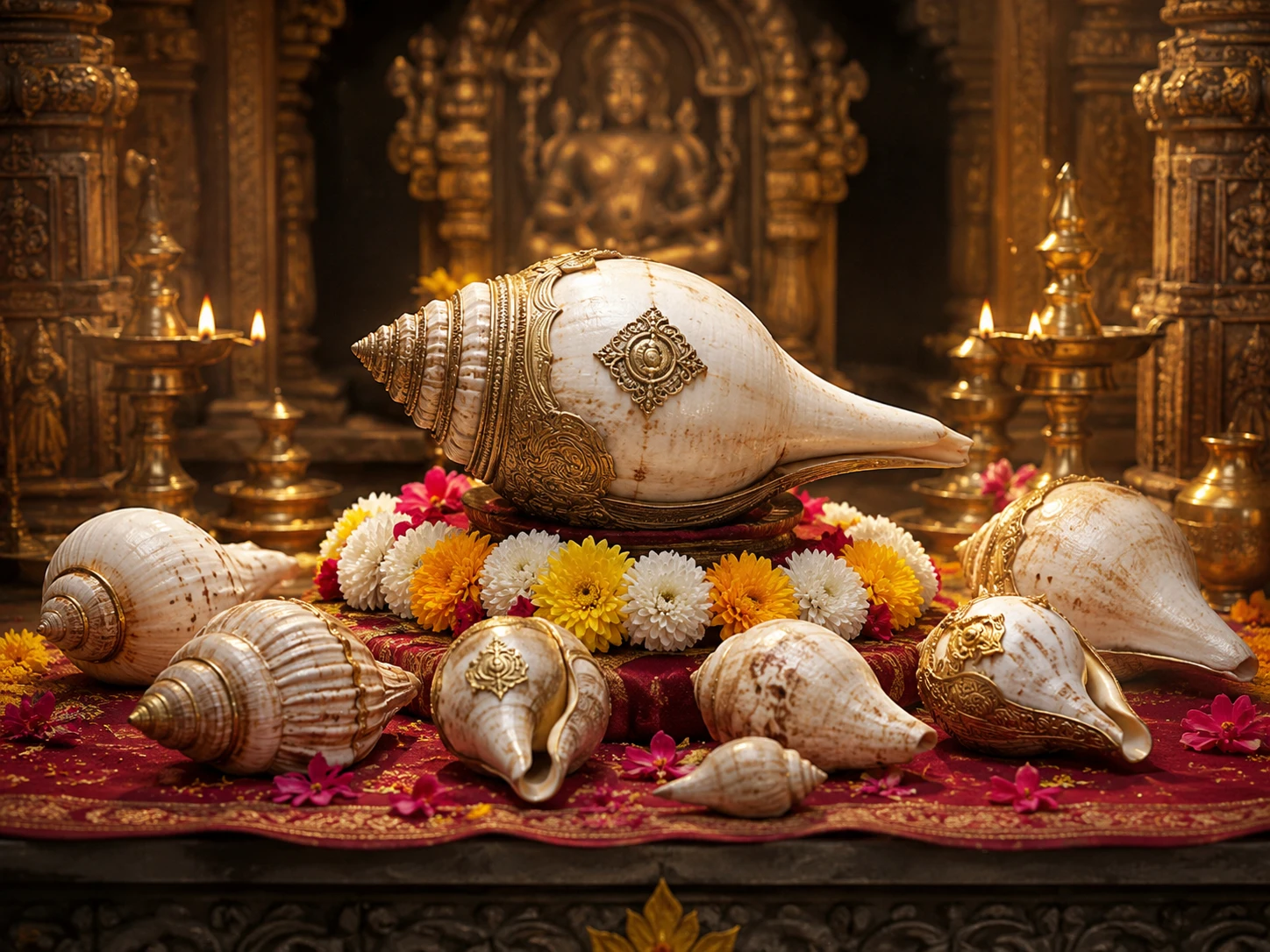
The Sacred Conch (Shankha) -- The Sound That Opens Temples and Closes Battles
पवित्र शंख -- वह ध्वनि जो मंदिर खोलती है और युद्ध समाप्त करती है
The sound hits you before the visuals do. If you have ever attended the Ganga Aarti at Dashashwamedh Ghat in Varanasi, or the evening aarti at the Somnath temple on the Gujarat coast, or the morning abhishekam at Tirupati -- the first thing that pierces the noise of the crowd is the blast of the conch shell. It is a sound that cannot be ignored. It does not blend into the background. It tears through ambient noise like a lighthouse beam tears through fog. And that, the tradition says, is precisely the point.
The Shankha (conch shell) is one of the oldest, most universal, and most continuously used sacred objects in Hindu civilisation. It appears in the hands of Vishnu as one of his four iconic attributes -- alongside the Sudarshana Chakra (discus), the Gada (mace), and the Padma (lotus). It was blown to announce the beginning of the Mahabharata war. It is blown to open every temple service. It is blown at the birth of a child. It is blown when a soul departs the body. The conch marks every threshold -- between peace and war, between silence and prayer, between the ordinary and the sacred.
But here is what most people do not know: the conch shell is also a water purifier, an acoustic instrument with measurable effects on air quality, and a marine specimen that the Indian government has legally protected. The humble Shankha sits at the intersection of mythology, acoustics, marine biology, environmental law, and living religious practice. This article explores all five dimensions.
पाञ्चजन्यं हृषीकेशो देवदत्तं धनञ्जयः। पौण्ड्रं दध्मौ महाशङ्खं भीमकर्मा वृकोदरः॥
pāñcajanyaṃ hṛṣīkeśo devadattaṃ dhanañjayaḥ pauṇḍraṃ dadhmau mahāśaṅkhaṃ bhīmakarmā vṛkodaraḥ
Hrishikesha (Krishna) blew the Panchajanya, Dhananjaya (Arjuna) blew the Devadatta, and Vrikodara (Bhima) of mighty deeds blew the great conch Paundra.
— Bhagavad Gita, Chapter 1, Verse 15
The Five Conches of Kurukshetra
The Bhagavad Gita opens not with philosophy but with sound. Before Krishna speaks a single word of wisdom, five conch shells roar across the battlefield. This is not incidental staging -- it is the tradition's way of declaring that what follows will shake the foundations of reality.
Krishna's conch is the Panchajanya -- born from the body of the demon Panchajana whom Krishna slew in the underwater kingdom. The Panchajanya's sound is described as the sound that dispels illusion (moha). It is the cosmic alarm clock -- the sound that wakes consciousness from the stupor of attachment and delusion. When Krishna blows Panchajanya at Kurukshetra, He is not merely signalling the start of battle. He is signalling the beginning of the greatest philosophical discourse in Indian civilisation.
Arjuna's conch is Devadatta -- 'god-given.' It was gifted to Arjuna by Indra during his time in heaven. Bhima's is Paundra -- 'the tremendous.' Yudhishthira's is Anantavijaya -- 'endless victory.' Nakula's is Sughosha -- 'sweet-sounding.' Sahadeva's is Manipushpaka -- 'jewel-flowered.' Each name is not arbitrary -- it reflects the character of the warrior who blows it.
The Gita describes the combined sound of these five conches as piercing heaven and earth, shaking the hearts of the Kauravas. In narrative terms, the conch-blowing scene (Gita 1.12-19) serves as the sonic overture before the philosophical symphony that follows. For Indian filmmakers who understand this tradition, the conch sound in a film score signals cosmic significance. For every school student who has recited this shloka in a Sanskrit exam, the verse is among the first encounters with the Gita's text.
The Kaurava side had its own conches, but the Gita does not name them individually. The asymmetry is deliberate -- dharma has named instruments; adharma blows unnamed horns. Even the sound design of the epic carries moral architecture.
Types of Sacred Conch Shells
| Type | Sanskrit Name | Direction of Spiral | Rarity | Primary Use | Associated Deity |
|---|---|---|---|---|---|
| Right-turning conch | Dakshinavarti Shankha | Clockwise (opens to the right) | Extremely rare (1 in millions) | Lakshmi puja, wealth, prosperity rituals | Lakshmi, Vishnu |
| Left-turning conch | Vamavarti Shankha | Counter-clockwise (opens to the left) | Common (most natural conches) | Daily temple aarti, general puja, water purification | Vishnu, general worship |
| Male conch | Purusha Shankha | Thicker walls, deeper sound | Common | Temple announcements, outdoor rituals | Shiva, martial contexts |
| Female conch | Shankhini | Thinner walls, higher pitch | Common | Indoor puja, softer ceremonies | Lakshmi, Devi worship |
| Ganesha conch | Ganesha Shankha | Unusually shaped, bulbous | Rare | Ganesh puja, new beginnings | Ganesha |
| Blowing conch (trumpet) | Vaadya Shankha | Tip cut for mouthpiece | Prepared by craftsmen | Blown instrument for aarti, processions | All deities, ceremonial |
The Dakshinavarti (right-turning) conch is considered the most sacred and can command prices exceeding Rs 1 lakh for genuine specimens. Its rarity is biological -- the species Turbinella pyrum almost exclusively produces left-turning shells. A right-turning specimen is a natural mutation occurring approximately once in every million shells.
The Science of Shankha-Naad -- What the Sound Does
The conch shell is a natural acoustic amplifier. Its internal spiral chamber functions as a resonating cavity that amplifies and enriches sound -- the same principle used in the bell of a French horn or the body of a guitar.
When blown correctly, a conch produces a fundamental frequency in the range of 100-500 Hz, depending on the shell's size and the player's embouchure. But the spiral structure generates a rich harmonic series -- overtones at 2x, 3x, 4x, and higher multiples of the fundamental frequency. This harmonic richness is what gives the conch its distinctive, penetrating, 'otherworldly' quality. The sound is physically felt in the chest cavity before it is cognitively processed by the ear -- which is why it produces an immediate visceral response.
Research published in the Indian Journal of Traditional Knowledge examined the acoustic properties of conch shells used in temple rituals. The study found that the sound waves produced by conch blowing have frequencies that fall within the range known to suppress certain airborne bacteria. The claim is preliminary but aligns with the traditional practice of blowing the conch to 'purify' the atmosphere before worship.
The water purification claim has stronger support. Conch shells are composed primarily of calcium carbonate (CaCO3) -- the same compound used in water treatment for pH balancing. When water is stored in a conch shell or poured through one (as in the practice of offering Shankha-jala to deities), it becomes mildly alkaline. Traditional medicine systems prescribe Shankha-bhasma (conch ash) as an antacid, which Ayurvedic pharmacopoeia has validated as effective for hyperacidity.
The sound also has neurological effects. Low-frequency vibrations in the 100-200 Hz range stimulate the vagus nerve when produced in proximity to the body. This is the same mechanism that makes Om chanting effective for parasympathetic activation. Blowing a conch shell provides both the acoustic stimulus to the environment and the vibrational stimulus to the blower's own respiratory and nervous systems. Temple priests who blow the Shankha daily are, in physiological terms, performing a form of pranayama combined with vagal nerve stimulation.
The Indian Wildlife Protection Act of 1972 classifies the Sacred Chank (Turbinella pyrum) -- the species from which Shankha are made -- as a protected marine species in Schedule IV. Commercial harvesting is regulated, and export of raw conch shells is restricted. The Gulf of Mannar Biosphere Reserve off the Tamil Nadu coast is one of the primary habitats. India's environmental law thus directly protects one of Hinduism's most ancient ritual objects -- making conservation of the marine ecosystem a matter of both ecology and dharma.
Shankha in Daily Ritual -- How the Conch Is Used
The Shankha serves multiple ritual functions, each with specific rules.
As a blowing instrument (vaadya): The tip of the conch is cut to create a mouthpiece. The blower places lips against this opening and produces sound through a controlled buzzing of the lips -- identical in technique to playing a brass instrument. The conch is blown at the beginning and end of puja, during aarti, at temple openings, during processions (ratha yatra), and at the commencement of sacred events (thread ceremony, housewarming, wedding). The blowing direction matters -- the conch should be blown facing the deity or toward the east. Three blasts is the standard temple protocol: one long, one medium, one short.
As a water vessel (abhisheka): Water poured through or stored in a conch shell becomes 'Shankha Tirtha.' This water is used in abhisheka (ritual bathing of the deity), offered as charanamrita to devotees, and sprinkled in homes for purification. The calcium carbonate of the shell mineralises the water and raises its pH slightly.
As a ceremonial offering holder: During special pujas, the conch holds sacred substances -- water, milk, or panchamrita -- that are poured over the deity. The Shankha is itself considered a form of Lakshmi (born from the same Samudra Manthan that produced the goddess), so offering water through the Shankha is offering through Lakshmi herself.
As a household protective symbol: A Shankha placed at the entrance of a home or in the puja room is believed to ward off negative energies. This is connected to the acoustic principle -- the conch's spiral form is a natural resonator that responds to ambient sound vibrations, and the tradition holds that its presence 'tunes' the energetic environment of the space.
For the urban household in a Noida high-rise or a Pune IT park apartment, the Shankha offers a remarkably practical entry into ritual: a single conch, blown once at morning puja, connects the practitioner to a tradition that runs from Vishnu's own hand through five thousand years of unbroken practice to this moment in their living room.
The Panchajanya -- Krishna's Conch and Its Story
Krishna's personal conch, the Panchajanya, has its own origin narrative that doubles as an adventure story. The Bhagavata Purana and the Harivamsha narrate how the young Krishna and Balarama were sent to study under Guru Sandipani in Ujjain. When their education was complete, Sandipani asked for guru dakshina -- he requested that Krishna bring back his son, who had drowned in the ocean at Prabhasa (near modern-day Somnath, Gujarat).
Krishna and Balarama travelled to Prabhasa and entered the ocean. There, they encountered the demon Panchajana, who had swallowed Sandipani's son and lived inside a massive conch shell in the depths of the sea. Krishna slew the demon, but found the boy already dead inside. He carried the conch shell -- fashioned from or identical to the demon's body -- and then descended to Yamaloka (the realm of the dead) to retrieve the boy's soul from Yama himself.
The narrative establishes the Panchajanya's dual nature: it is an instrument born from the destruction of a demon (adharma defeated) and from a mission of devotion to a guru (dharma fulfilled). When Krishna blows the Panchajanya at Kurukshetra, both dimensions are active -- the sound announces both the defeat of evil and the triumph of righteous duty.
In ISKCON temples worldwide, the Panchajanya is represented in every murti of Krishna in His Vishvarupa or Chaturbhuja (four-armed) form. At the ISKCON temple in Vrindavan, Juhu in Mumbai, or Bengaluru's Rajajinagar, the conch in Krishna's upper left hand is always the Panchajanya -- carrying within its spiral the memory of an ocean adventure, a guru's grief, and a god's willingness to enter the underworld for the sake of a teacher's love.
The Indian Navy's official motto is 'Sham No Varunah' (May the Lord of the Waters be auspicious to us) -- from the Taittiriya Upanishad. And the Navy's official emblem features an anchor flanked by the national emblem. But at the naval dockyard in Visakhapatnam and the naval base in Kochi, conch shells are traditionally blown during the commissioning of new warships. The oldest tradition of maritime sound-signalling in India -- the Shankha-naad -- lives on in the country's modern naval fleet.
शङ्खं चक्रं च चापं च खड्गं गदां च पाञ्चजन्यम्। श्रीवत्सं कौस्तुभं माला वनमाला बिभर्ति यः॥
śaṅkhaṃ cakraṃ ca cāpaṃ ca khaḍgaṃ gadāṃ ca pāñcajanyam śrīvatsaṃ kaustubhaṃ mālā vanamālā bibharti yaḥ
He who bears the conch, the discus, the bow, the sword, the mace, the Panchajanya, the Srivatsa mark, the Kaustubha gem, and the Vanamala garland -- (that is Vishnu).
— Vishnu Dhyana Shloka (traditional, recited in Vishnu puja)
Buying and Caring for Your Shankha
For daily household puja, a standard Vamavarti (left-turning) blowing conch of 4-6 inches is sufficient and costs between Rs 200-2,000 depending on quality and source. Conches from Rameshwaram (Tamil Nadu), Dwarka (Gujarat), and the Gulf of Mannar are considered the most sacred. Online sellers on platforms like Amazon and Flipkart sell conches, but quality varies -- look for natural shells without artificial polish or bleaching.
For abhisheka (water offering), a small non-blowing conch without the tip cut is used. This type is placed on the altar and filled with water that is then poured over the deity.
A Dakshinavarti Shankha (right-turning) is extremely rare and expensive. Genuine specimens are identified by the clockwise spiral when viewed from the aperture. Fakes are common -- some are artificially reshaped or are actually shells of different species. If purchasing a Dakshinavarti, buy only from established dealers with authentication and a return policy.
Care: Wash the conch weekly with clean water. Never use soap or chemicals. Apply a thin coat of coconut oil inside the blowing chamber to prevent drying and cracking. Store on a clean red or white cloth. Do not place directly on the floor.
Learning to blow: YouTube has excellent tutorials. The technique requires buzzing the lips (like playing a trumpet) into the cut tip. It takes practice -- most beginners produce no sound for the first few attempts. Consistent practice for a week usually produces a clear, sustained note. Children often find it easier than adults because their lip muscles are more flexible.
The Shankha is perhaps the most accessible sacred artefact in Hinduism. It requires no initiation, no expensive investment, no elaborate setup. A single conch, a single blow at dawn, and you join a chain of sound that stretches from Vishnu's hand at the beginning of creation to this morning in your home.
Begin Your Practice with Shankha-Naad
If you have a conch, blow it once to open your morning meditation or puja, and listen as the sound fades completely. The Fading of a Sound dharana on Eternal Raga turns that listening into a meditation.
Tags
Eternal Raga · शाश्वत राग
Institutional voice — scholarly articles on Sanatan Dharma
Deepen Your Understanding
अपनी समझ और गहरी करें
sacred artefacts
Divine Gems -- Syamantaka, Kaustubha, and Chintamani
Hindu mythology's most precious stones are not mere ornaments -- they are plot devices, moral tests, and cosmic forces. The Syamantaka Mani turned Krishna into a detective. The Kaustubha emerged from the Ocean of Milk to sit forever on Vishnu's chest. The Chintamani fulfils every wish -- and teaches why that might be the worst thing that could happen to you.
sacred artefacts
Shalagrama Shila -- The 140-Million-Year-Old Face of Vishnu
A black river stone from a Himalayan gorge in Nepal. A fossil of a creature that swam in an ocean that no longer exists. And yet, for over two thousand years, Hindus have recognised this stone as a direct, living manifestation of Vishnu -- not a symbol, not a representation, but the deity Himself. Science calls it an ammonite. Faith calls it God.
scriptural exegesis
Samudra Manthan -- When Gods and Demons Ran a Joint Venture and the Universe Almost Died
A cosmic ocean. A mountain for a churning rod. A serpent king for a rope. Gods on one end, demons on the other. And out came 14 treasures -- including wealth, beauty, medicine, immortality, and one poison so lethal it could end creation itself. The Samudra Manthan is not mythology. It is the original playbook for collaboration, crisis management, and how to handle it when your joint venture partner tries to cheat you.
divine arsenal
10 Weapons That Changed the War
Across the Ramayana and Mahabharata, certain weapons did not merely kill -- they altered the course of history. From Rama shattering Shiva's bow to win Sita, to the Shakti that saved the Pandavas by killing the one person it should not have, these ten weapon-moments are the pivot points on which two epics turn.
deities avatars
Dashavatara -- Why Vishnu Comes Back Ten Times
Fish, tortoise, boar, half-lion, dwarf, axe-warrior, prince, cowherd, enlightened teacher, future horseman. The ten avatars of Vishnu are not random folklore. Read them in sequence and you get something startling -- a narrative that mirrors evolutionary biology, tracks the rise and fall of political systems, and argues that God does not sit above history but enters it, gets dirty, and does the work. The Dashavatara is Hinduism's answer to the question every civilisation asks: why does the world keep breaking, and who fixes it?
sacred artefacts
Rudraksha Mala -- Shiva's Tears That Became Seeds of Power
Legend says Shiva meditated for a thousand years, and when his eyes opened, tears of compassion fell to earth and became the Rudraksha tree. Science says the seeds of Elaeocarpus ganitrus contain electromagnetic properties measurable in a laboratory. Between the legend and the lab lies the most worn sacred object in India.
sacred artefacts
Navaratna -- Nine Gems That Map the Cosmos to Your Finger
Nine planets. Nine gems. Nine frequencies of cosmic light captured in crystalline matter and worn on the human body. The Navaratna system is not superstition -- it is the oldest surviving framework of planetary gemology, codified in the Garuda Purana, the Brihat Samhita, and still followed by jewellers from Jaipur to Jakarta.
The Indian Wildlife Protection Act of 1972 classifies the Sacred Chank (Turbinella pyrum) -- the species from which Shankha are made -- as a protected marine species in Schedule IV. Commercial harvesting is regulated, an…
More in Sacred Artefacts
Ashtadhatu -- The Sacred Eight-Metal Alloy of Indian Temples
12 min read
Banalinga -- The Stone God Made Himself in a River Over Millions of Years
13 min read
Celestial Trees -- Kalpavriksha and Parijata
12 min readThe same translation error that turned '33 Koti' into '33 crore' in Hinduism also happened in Buddhism. The Chinese translation of Buddhist texts rendered 'Sapta Koti Buddha' (7 Supreme Buddhas) as '7 Crore Buddhas.' The…
Deities AvatarsCommunity Reflections
🕉️
Be the first to share your reflection.