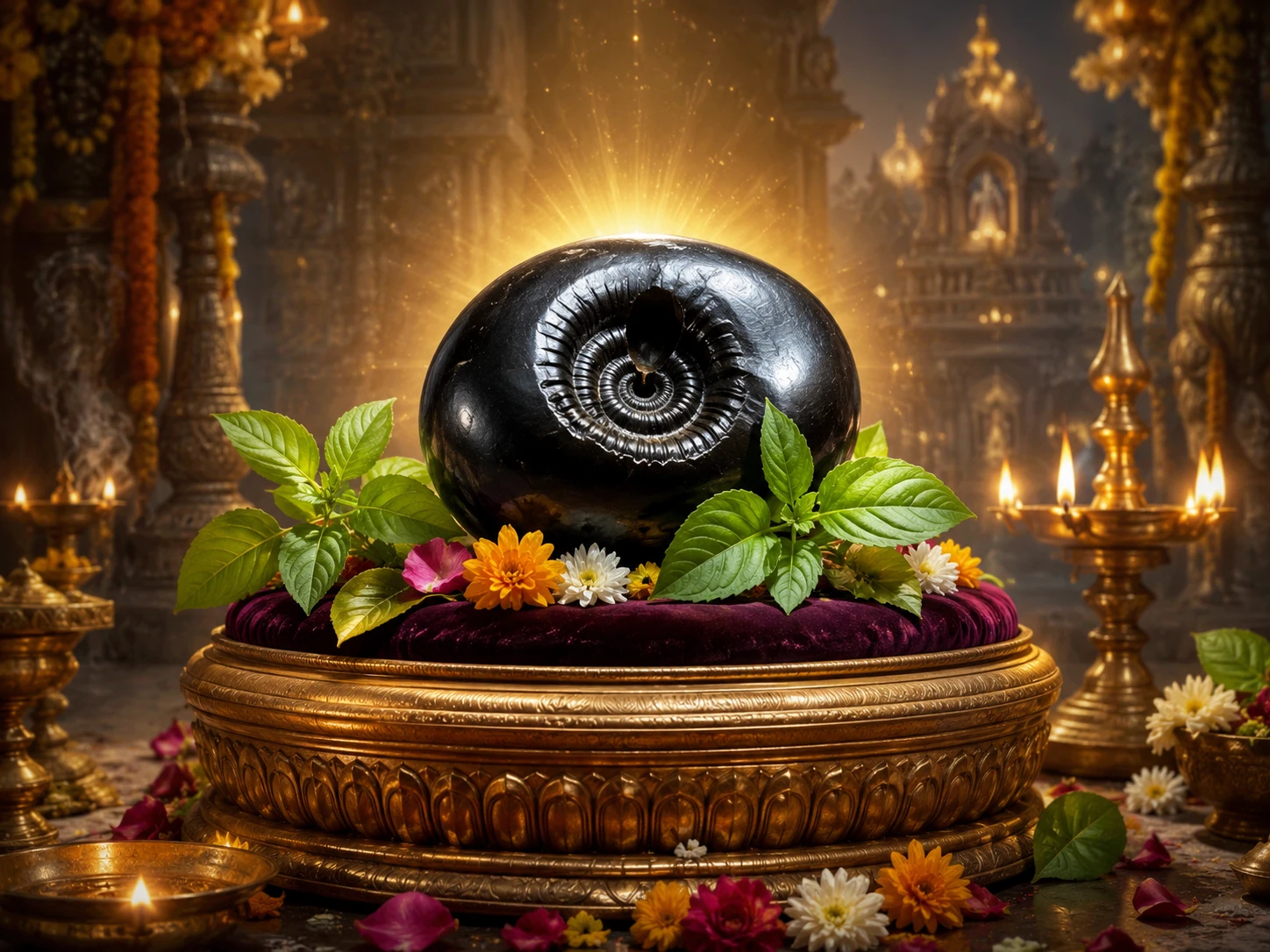
Shalagrama Shila -- The 140-Million-Year-Old Face of Vishnu
शालग्राम शिला -- विष्णु का 14 करोड़ वर्ष पुराना रूप
In every traditional Vaishnava household in South India -- from the agraharams of Srirangam to the Brahmin lanes of Kumbakonam -- there is a small copper plate in the puja room holding a black, round stone. No chisel has touched it. No artisan has carved it. It has no face, no limbs, no recognisable form. And yet the family treats it with more reverence than any sculpted murti in the room. Water poured over it becomes tirtha -- holy water that heals. Tulsi leaves placed upon it become prasadam. The stone itself is not worshipped as a representation of God. It IS God.
This is the Shalagrama Shila -- a fossilised ammonite stone found exclusively in the Kali Gandaki River gorge in the Mustang district of Nepal, approximately 140 million years old, and venerated as a svayambhu (self-manifest) form of Vishnu for over two thousand years.
The Shalagrama tradition presents what may be the most extraordinary convergence of geology, palaeontology, mythology, and living devotional practice on earth. The stone is a fossil of an extinct marine creature from the Jurassic and Cretaceous periods -- a time when the Himalayan region was the floor of the Tethys Sea. Tectonic collision pushed that sea floor five kilometres into the sky, creating the Himalayas. The fossils of creatures that once swam in that ancient ocean now tumble down Himalayan rivers. Science and scripture are looking at the same object and seeing parallel truths.
For the geology student at IIT Roorkee, the Shalagrama is a Cephalopod fossil. For the grandmother in Mylapore, it is Narayana Himself sitting in her puja room. Both are correct. The Shalagrama holds both truths simultaneously, and that is precisely what makes it one of the most remarkable sacred objects in any religious tradition.
शालग्रामशिलायां तु विष्णुसान्निध्यमुच्यते। तस्मात् सर्वप्रयत्नेन पूजयेच्छालग्रामशिलाम्॥
śālagrāma-śilāyāṃ tu viṣṇu-sānnidhyam ucyate tasmāt sarva-prayatnena pūjayec chālagrāma-śilām
In the Shalagrama Shila, the presence (sannidhya) of Vishnu is declared. Therefore, with every effort, one should worship the Shalagrama Shila.
— Garuda Purana, Preta Khanda
The Origin Story -- Tulsi, Vishnu, and the River of Tears
The Puranic origin of the Shalagrama is one of the most emotionally complex stories in Hindu mythology -- a tale of divine deception, a woman's righteous anger, and a curse that became a blessing.
The demon Jalandhara was born from Shiva's third eye and had acquired a boon from Brahma: as long as his wife Vrinda (also called Tulsi) remained chaste, he would be invincible in battle. Even Shiva could not defeat him. To break the boon, Vishnu disguised himself as Jalandhara and approached Vrinda. When she discovered the deception -- after Shiva had already killed the now-vulnerable Jalandhara -- her grief turned to fury.
Vrinda cursed Vishnu: 'You used deceit against a devoted wife. You shall become a stone.' Vishnu, rather than resisting the curse, accepted it. He declared that He would become the Shalagrama stone on the banks of the Gandaki River. Vrinda herself, in her transformation, became the Tulsi plant -- the sacred basil that is inseparable from Vishnu worship to this day. And the Gandaki River emerged from her body.
This origin story explains three interlocked traditions: why Shalagrama stones are found only in the Gandaki, why Tulsi leaves are mandatory in Shalagrama worship (the wife reunited with the husband she cursed), and why the Tulsi Vivah ceremony -- the ritual marriage of Tulsi to Shalagrama performed every Kartik Ekadashi -- is one of the most widely observed festivals in Vaishnava households across India.
The story is uncomfortable by modern standards -- it involves divine deception and the violation of a woman's agency. The tradition does not flinch from this discomfort. Vrinda's curse is righteous and Vishnu accepts it without protest. The stone form is not a punishment imposed by a wrathful deity but a consequence accepted by a deity who recognises that even divine ends do not justify unjust means. The Shalagrama, in this reading, is not just a form of Vishnu -- it is Vishnu bearing the consequence of His own moral compromise. This makes the Shalagrama arguably the most ethically complex sacred object in Hinduism.
The Geology -- 140 Million Years in a River Stone
The Shalagrama Shila is an ammonite fossil -- the preserved remains of an extinct marine cephalopod that lived in the Tethys Sea during the Jurassic and Cretaceous periods (roughly 200 to 65 million years ago). Ammonites were relatives of modern nautilus and squid, characterised by their distinctive spiral shells.
When the Indian tectonic plate collided with the Eurasian plate approximately 50 million years ago, the Tethys Sea floor was pushed upward, eventually forming the Himalayan mountain range. The fossils of Tethys Sea creatures -- including ammonites -- were carried upward with the rock. As Himalayan rivers cut through these ancient marine sedimentary layers, ammonite fossils are released and carried downstream.
The Kali Gandaki River, flowing through the deepest gorge on earth (deeper than the Grand Canyon), cuts through particularly rich fossil-bearing black shale layers. The ammonite fossils emerge as smooth, rounded black stones -- shaped by millions of years of geological pressure and river erosion. The characteristic spiral patterns visible on many Shalagrama stones are the fossilised chambers of the ammonite's shell, and the small worm-like channels are trace fossils left by ancient boring organisms.
Dr. Holly Waters, an ethnographer at Wellesley College who has conducted the most extensive field research on Shalagrama traditions, documents a remarkable response from local devotees when asked about the scientific explanation. One informant told her: 'This is what science tells us. You think that we reject this, but we do not. Science is right. Vishnu comes in the form that is needed most, so this one comes in the form of science.'
The Geological Survey of India has catalogued the Kali Gandaki fossil beds. The ammonite species most commonly found as Shalagrama include Dactylioceras, Hildoceras, and Harpoceras. The black coloration comes from the iron-rich shale matrix in which they are preserved. The distinctively smooth, spherical shape results from millennia of river tumbling. No two Shalagrama are identical -- each has a unique pattern of chakra (spiral markings), which determines which form of Vishnu it represents.
Types of Shalagrama Shila and Their Vishnu Forms
| Shalagrama Type | Identifying Feature | Vishnu Form | Special Significance | Colour |
|---|---|---|---|---|
| Lakshmi Narasimha | Two chakras with golden streaks | Narasimha (Man-Lion) | Fierce protection, obstacle destruction | Dark black with gold lines |
| Sudarshana | Single perfect chakra, round | Vishnu with Sudarshana Chakra | Protection from enemies, legal victory | Jet black, perfectly spherical |
| Damodara | Bound by a line around the middle | Krishna as Damodara (rope-bound) | Parental love, family bonding | Black with visible band |
| Vasudeva | Four chakras | Vasudeva (father-form of Krishna) | Peace, prosperity, all-round blessings | Black, medium-sized |
| Ananta | Multiple (14+) tiny chakras | Shesha Naga / Ananta | Infinite protection, longevity | Very dark, heavy |
| Matsya | Fish-like elongated shape | Matsya (Fish Avatar) | Travel protection, water-related safety | Dark grey to black, oval |
Classification follows the Shalagrama Pariksha texts. Identification requires expertise -- a family priest or traditional Shalagrama specialist from Varanasi or Srirangam should be consulted. Commercial sellers frequently misidentify types.
Climate Change and the Disappearing Shalagrama
The Shalagrama tradition faces an unprecedented modern threat: climate change. Dr. Holly Waters' field research documents that Shalagrama stones are becoming significantly rarer in the Kali Gandaki. The river is fed by glacial meltwater from the Southern Tibetan Plateau. As Himalayan glaciers retreat -- the Gangotri glacier has receded over 600 metres in the last two decades -- the Kali Gandaki's flow is changing. The river is shifting away from the fossil-bearing shale layers that release ammonite fossils.
Additionally, gravel mining operations in the lower Gandaki are disrupting the river's natural erosion patterns. Fossils that would have been carried downstream to traditional collection sites are being buried under mining sediment or crushed by heavy machinery.
For a sacred tradition that depends on a specific geological phenomenon in a specific river in a specific valley, climate change is not an abstract policy discussion -- it is an existential threat. If the Kali Gandaki stops producing Shalagrama stones, a two-thousand-year-old living tradition faces its end.
This gives Shalagrama worship an environmental dimension that resonates powerfully with contemporary India. The same climate change that threatens Mumbai's coastline and Sundarbans' mangroves is threatening the sacred stones of Muktinath. For a young Indian who cares about both dharma and ecology, the Shalagrama tradition offers a point of convergence: protecting the Himalayan ecosystem is not just environmental policy -- it is, quite literally, protecting the body of God.
The Muktinath Area Conservation Project and several Nepali and Indian NGOs are working to preserve both the geological access and the pilgrimage infrastructure. The Geological Survey of Nepal has designated the upper Kali Gandaki fossil beds as a protected geological heritage site.
The Sri Padmanabhaswamy Temple in Thiruvananthapuram, Kerala -- the richest temple in the world -- has a reclining Vishnu deity made entirely of over 12,000 Shalagrama Shilas cemented together with a special compound of herbs. The deity was installed centuries ago using stones brought from the Gandaki River, over 3,000 kilometres away. It represents one of the largest assemblages of Shalagrama Shilas anywhere on earth.
How Shalagrama Worship Works -- A Practical Guide
Shalagrama worship is remarkably simple compared to murti worship. No elaborate prana pratishtha (deity consecration ceremony) is required because the Shalagrama is already considered a living manifestation of Vishnu. No specific sculptor or artisan has shaped it -- it arrives from nature in its sacred form.
Daily worship involves: bathing the Shalagrama in water (or panchamrita -- a mixture of milk, curd, honey, ghee, and sugar), placing fresh Tulsi leaves on it, offering a simple naivedya (food offering), and chanting Vishnu mantras -- typically Om Namo Narayanaya or the Vishnu Sahasranama. The water that has touched the Shalagrama (charanamrita) is collected and distributed to family members as sacred tirtha.
The Shalagrama should never be placed directly on the ground -- always on a copper or silver plate, on a clean cloth. It should never be bought or sold; Puranic texts specifically state that commercial transaction of Shalagrama Shilas brings spiritual consequences. Traditionally, a Shalagrama is received as a gift, inherited within a family, or personally collected from the Gandaki during pilgrimage.
For NRI families maintaining puja traditions abroad -- in Houston, Toronto, or Singapore -- the Shalagrama offers a uniquely portable form of worship. Unlike large murtis that require elaborate setups, a Shalagrama fits in the palm of the hand. It travels with the family. Many Indian diaspora families carry their family Shalagrama across continents and generations, maintaining an unbroken chain of worship that connects a three-bedroom apartment in New Jersey to a Himalayan riverbed in Nepal.
Modern families who find the complete Shalagrama worship protocol demanding can adopt a simplified daily practice: morning bath of the stone with clean water, placement of one Tulsi leaf, a brief offering, and the chanting of Om Namo Narayanaya eleven times. This takes under five minutes and maintains the devotional connection.
The Vrindavan temple of Radha Raman -- one of the most revered shrines in Vaishnavism -- has as its presiding deity a Shalagrama Shila that reportedly self-manifested into the form of Krishna in 1542 CE. Gopal Bhatta Goswami, a direct disciple of Chaitanya Mahaprabhu, was performing worship of his Shalagrama collection when one stone spontaneously developed the visible form of Krishna playing the flute. This Shalagrama-turned-murti is worshipped to this day without any external sculpting or modification.
गौतमीयतन्त्रे उक्तं शालग्रामशिलास्पर्शात् जन्मकोटिकृतं पापं विलयं याति तत्क्षणात्।
gautamīya-tantre uktaṃ śālagrāma-śilā-sparśāt janma-koṭi-kṛtaṃ pāpaṃ vilayaṃ yāti tat-kṣaṇāt
As stated in the Gautamiya Tantra: by merely touching the Shalagrama Shila, the sins accumulated over ten million births are destroyed in that very instant.
— Gautamiya Tantra (cited in Hari Bhakti Vilasa)
Shalagrama in Modern India -- Living Tradition, Living Tension
The Shalagrama tradition carries unresolved tensions that deserve honest acknowledgment.
Historically, Shalagrama worship was restricted. Several Dharmashastra texts limited touch-access to initiated dvija males. The Padma Purana explicitly prohibited women from touching the Shalagrama. The Pranatoshani Tantra restricted access to initiated Brahmins, Kshatriyas, and Vaishyas.
Modern reform movements have challenged these restrictions. The Ramakrishna Mission, ISKCON, and multiple Vaishnava organisations actively encourage Shalagrama worship by all devotees regardless of caste or gender. Many contemporary acharyas argue that the Puranic restrictions reflected social conditions of their era, not the inherent nature of the Shalagrama's sacredness, which the texts themselves declare to be universal and unconditional.
The commercial dimension is another tension. Despite Puranic prohibitions on buying and selling Shalagrama, a thriving market exists -- online and in temple towns -- where stones are sold for prices ranging from a few hundred to several lakh rupees depending on type and markings. Traditionalists view this commercialisation with deep concern. The counter-argument is that making Shalagrama accessible to devotees who cannot undertake the Muktinath pilgrimage serves dharma, even if the mechanism is imperfect.
For young Indians navigating these tensions, the Shalagrama offers an unusual invitation: to hold two truths simultaneously. It is a fossil and it is God. It has been restricted and it should be universal. It cannot be bought, and yet it is sold. The Shalagrama does not resolve these contradictions. It embodies them. And in that embodiment, it teaches the most sophisticated lesson in the Vaishnava tradition: that the divine is not separate from the messy, complicated, imperfect world -- it is embedded in the middle of it, waiting to be recognised.
Chant Vishnu Sahasranama -- The Complete 1,000 Names
The complete Vishnu Sahasranama is on Eternal Raga with the meaning of each name -- the ideal accompaniment to shalagrama worship. Recite at your own pace, a section a day if the whole is too long.
Tags
Eternal Raga · शाश्वत राग
Institutional voice — scholarly articles on Sanatan Dharma
Deepen Your Understanding
अपनी समझ और गहरी करें
sacred artefacts
Divine Gems -- Syamantaka, Kaustubha, and Chintamani
Hindu mythology's most precious stones are not mere ornaments -- they are plot devices, moral tests, and cosmic forces. The Syamantaka Mani turned Krishna into a detective. The Kaustubha emerged from the Ocean of Milk to sit forever on Vishnu's chest. The Chintamani fulfils every wish -- and teaches why that might be the worst thing that could happen to you.
sacred artefacts
Rudraksha Mala -- Shiva's Tears That Became Seeds of Power
Legend says Shiva meditated for a thousand years, and when his eyes opened, tears of compassion fell to earth and became the Rudraksha tree. Science says the seeds of Elaeocarpus ganitrus contain electromagnetic properties measurable in a laboratory. Between the legend and the lab lies the most worn sacred object in India.
scriptural exegesis
Samudra Manthan -- When Gods and Demons Ran a Joint Venture and the Universe Almost Died
A cosmic ocean. A mountain for a churning rod. A serpent king for a rope. Gods on one end, demons on the other. And out came 14 treasures -- including wealth, beauty, medicine, immortality, and one poison so lethal it could end creation itself. The Samudra Manthan is not mythology. It is the original playbook for collaboration, crisis management, and how to handle it when your joint venture partner tries to cheat you.
deities avatars
Dashavatara -- Why Vishnu Comes Back Ten Times
Fish, tortoise, boar, half-lion, dwarf, axe-warrior, prince, cowherd, enlightened teacher, future horseman. The ten avatars of Vishnu are not random folklore. Read them in sequence and you get something startling -- a narrative that mirrors evolutionary biology, tracks the rise and fall of political systems, and argues that God does not sit above history but enters it, gets dirty, and does the work. The Dashavatara is Hinduism's answer to the question every civilisation asks: why does the world keep breaking, and who fixes it?
sacred symbols
Tulasi -- The Only Plant in Hinduism That Gets Married to God
She has eight names. She gets a wedding ceremony. Vishnu refuses prasadam without her leaf. And she sits in the courtyard of 100 million Indian homes -- not as decoration but as a living deity. Tulasi is not a plant you worship. She is a goddess who chose to become a plant.
sacred artefacts
The Sacred Conch (Shankha) -- The Sound That Opens Temples and Closes Battles
Before every temple aarti, a conch is blown. Before the Mahabharata war began, five conch shells roared across Kurukshetra. In Vishnu's four hands, the Shankha sits alongside the Sudarshana Chakra, the Gada, and the Padma. The conch is not a decorative horn -- it is the primordial announcement that the divine is present.
sacred artefacts
Navaratna -- Nine Gems That Map the Cosmos to Your Finger
Nine planets. Nine gems. Nine frequencies of cosmic light captured in crystalline matter and worn on the human body. The Navaratna system is not superstition -- it is the oldest surviving framework of planetary gemology, codified in the Garuda Purana, the Brihat Samhita, and still followed by jewellers from Jaipur to Jakarta.
The Sri Padmanabhaswamy Temple in Thiruvananthapuram, Kerala -- the richest temple in the world -- has a reclining Vishnu deity made entirely of over 12,000 Shalagrama Shilas cemented together with a special compound of …
More in Sacred Artefacts
Ashtadhatu -- The Sacred Eight-Metal Alloy of Indian Temples
12 min read
Banalinga -- The Stone God Made Himself in a River Over Millions of Years
13 min read
Celestial Trees -- Kalpavriksha and Parijata
12 min readThe same translation error that turned '33 Koti' into '33 crore' in Hinduism also happened in Buddhism. The Chinese translation of Buddhist texts rendered 'Sapta Koti Buddha' (7 Supreme Buddhas) as '7 Crore Buddhas.' The…
Deities AvatarsCommunity Reflections
🕉️
Be the first to share your reflection.