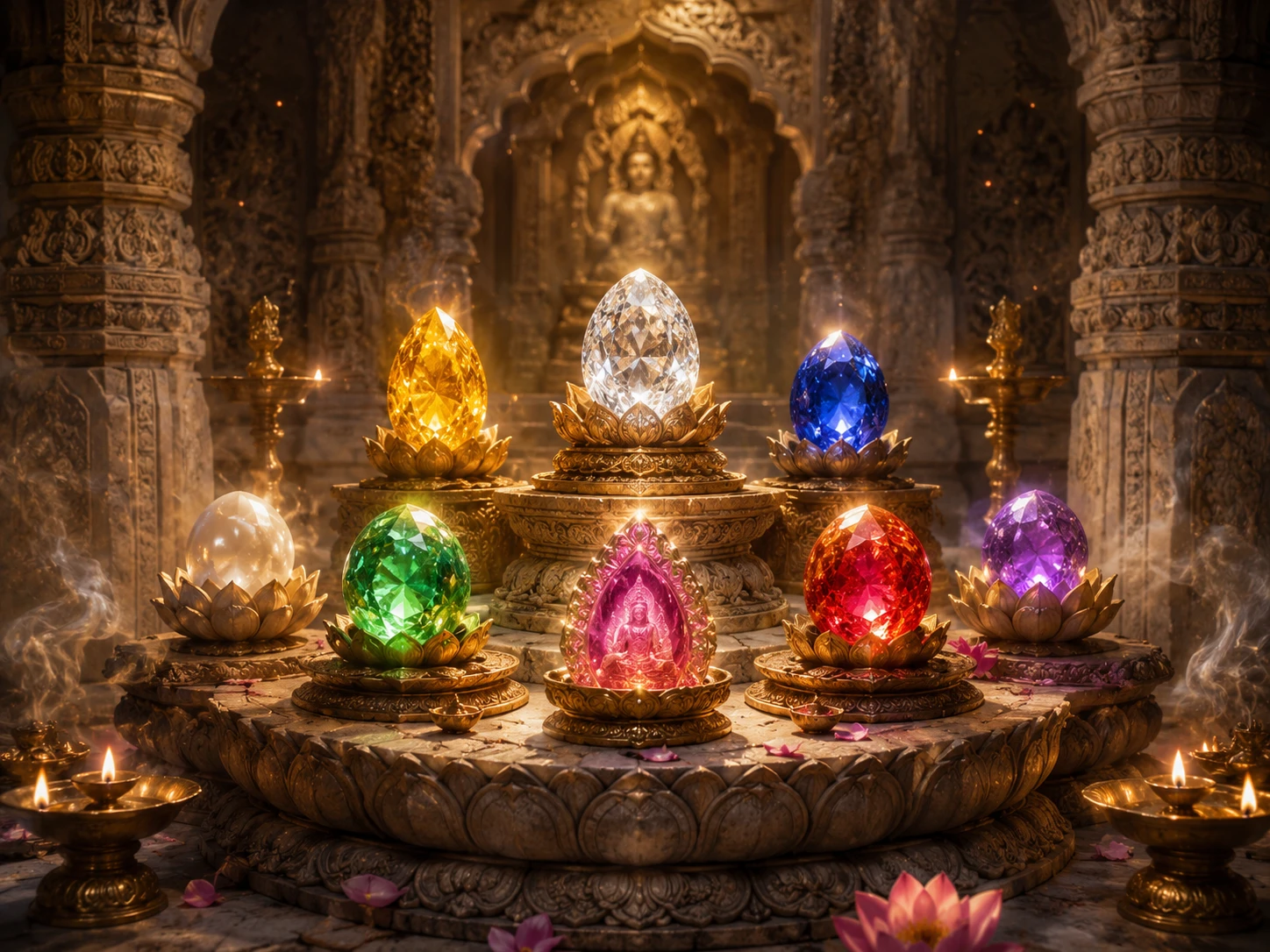
Divine Gems -- Syamantaka, Kaustubha, and Chintamani
दिव्य रत्न -- स्यमन्तक, कौस्तुभ और चिन्तामणि
Gems in Hindu mythology are never merely decorative. They are tests of character disguised as treasure. Every divine gem in the tradition comes with a catch -- a condition, a curse, or a moral weight that transforms the owner as much as it enriches them. The Syamantaka Mani produces gold daily but attracts murder and false accusation. The Kaustubha embodies supreme truth but sits on the chest of the god who must sustain the entire universe. The Chintamani grants every wish but forces the question: what happens when desire has no limit?
In a culture that invented the concepts of Maya (illusion) and Vairagya (detachment), it makes perfect sense that its most powerful objects of desire would come with built-in warnings about the nature of desire itself.
तस्माच्च सागरोत्पन्नं कौस्तुभाख्यं महामणिम्। उरसा धारयामास हरिर्नारायणो हरिः॥
tasmaacca saagarotpannam kaustubhaakhyam mahaamanim | urasaa dhaarayaamaasa harirnaraayanao harih ||
And the great gem named Kaustubha, born of the ocean, was worn upon his chest by Hari, by Narayana, by the Lord who takes away all suffering.
— Vishnu Purana, Amsha 1, Adhyaya 9
The Kaustubha Mani is the first great gem of Hindu tradition, and its origin is the Samudra Manthan -- the Churning of the Ocean of Milk. When the Devas and Asuras churned the cosmic ocean using Mount Mandara as the churning rod and Vasuki the serpent as the rope, fourteen treasures (chaturdasha ratnas) emerged. Among these were the goddess Lakshmi, the divine physician Dhanvantari, the wish-fulfilling cow Kamadhenu, the celestial tree Parijata, the moon, the poison Halahala (consumed by Shiva), and the Kaustubha gem.
The Kaustubha is not simply a jewel. In Vaishnava theology, it represents the jiva-atma -- the individual soul -- resting on the chest of the Paramatma (supreme soul). This is not metaphor at the margins of the tradition; it is central iconographic doctrine. Every murti of Vishnu in every temple, from the Padmanabhaswamy Temple in Thiruvananthapuram to the Badrinath shrine in Uttarakhand, depicts the Kaustubha on his chest. If you have ever done darshan of Vishnu or any of his avatars, you have seen the Kaustubha -- whether you knew it or not.
The gem is said to contain within it all consciousness of the universe. It glows with its own light, is indestructible, and cannot be separated from Vishnu. When Vishnu incarnates as Rama, the Kaustubha is not visible in its gem form but is present as an aspect of his divine nature. When he incarnates as Krishna, some Puranic traditions place it as the central gem in his Vaijayanti garland.
If the Kaustubha is a theological statement, the Syamantaka Mani is a crime thriller. The Bhagavata Purana devotes an entire chapter to what is essentially a detective story -- complete with theft, false accusation, a missing person investigation, and a dramatic reveal. It is Krishna at his most humanly relatable.
The gem originally belongs to Surya, the Sun God, who gives it to his devotee Satrajit, a Yadava nobleman in Dwaraka. The Syamantaka has a specific power: if worshipped properly by a righteous owner, it produces eight bharas (roughly 160 kilograms) of gold daily. If the owner is unrighteous, it brings death.
Krishna asks Satrajit to give the gem to King Ugrasena for the public treasury. Satrajit refuses. He gives it instead to his brother Prasena, who wears it on a hunting trip. Prasena is killed by a lion. The lion is killed by Jambavan, the bear-king from Ramayana-era legend, who takes the gem to his cave and gives it to his daughter Jambavati as a toy.
When Prasena fails to return, the Yadava court suspects Krishna of murdering him for the gem. This is a remarkable narrative moment -- God himself, falsely accused of theft and murder by his own people. Krishna, to clear his name, tracks the gem's trail through the forest, finds the dead Prasena, follows the lion's tracks to Jambavan's cave, and fights Jambavan for twenty-one days before the ancient bear recognises him as Rama.
Jambavan returns the gem and offers Jambavati in marriage. Krishna returns the Syamantaka to Satrajit publicly, clearing his name. Later, Satrajit is murdered by Shatadhanva for the gem, and Krishna pursues the killer on horseback through the night -- one of the most cinematic chase sequences in Puranic literature.
The Three Great Gems of Hindu Mythology
| Gem | Origin | Power | Moral Lesson | Current Status in Tradition |
|---|---|---|---|---|
| Kaustubha | Samudra Manthan (Ocean of Milk) | Contains all universal consciousness; self-luminous | The soul belongs to the divine -- it rests on God's chest, not in human hands | Permanently on Vishnu's chest in every temple murti |
| Syamantaka Mani | Gift from Surya to Satrajit | Produces 160 kg gold daily for a righteous owner; brings death to the unrighteous | Wealth without virtue is a curse; false accusation is a test even for God | Lost to history in the Bhagavata narrative; some traditions say it rests in Puri |
| Chintamani | Various Puranic origins; some link it to Samudra Manthan | Grants any wish the possessor desires | Unlimited desire leads to unlimited suffering; the wish-granter is the ultimate test of character | Believed to be in the possession of Indra or in the higher lokas |
Each gem maps to a core Hindu philosophical concept: Kaustubha to Atman-Paramatma, Syamantaka to Karma-Phala, Chintamani to Kama-Moha.
The Padmanabhaswamy Temple in Thiruvananthapuram, Kerala -- one of the richest religious institutions on earth -- contains vault treasures estimated at over $20 billion (Rs 1.5 lakh crore). The discovery in 2011 included gold coins, gem-studded crowns, and a gold chain weighing 3.5 kg. Vault B remains unopened, reportedly sealed with a 'Naga Bandham' (serpent lock) that some believe requires specific mantras to open. Whether or not the Kaustubha is a real gem, the tradition of temple gem-hoarding in South India has produced treasures that rival anything in mythology.
The Chintamani -- the wish-fulfilling gem -- appears across Hindu, Buddhist, and Jain traditions, making it one of the most pan-Indian mythological objects. In Hindu tradition, it is associated with both Vishnu and Ganesha. The Chintamani temple in Theur, Pune (one of the Ashtavinayaka temples) is specifically named after this gem, and its legend claims Ganesha recovered the Chintamani from the demon Guna and installed it there.
But the deeper philosophy of the Chintamani is cautionary. In the Yoga Vasishtha, the idea of a wish-fulfilling gem is used as a thought experiment: what would happen if every desire were instantly granted? The text argues that unlimited wish-fulfilment would not produce happiness but would trap the possessor in an accelerating cycle of desire -- each fulfilled wish generating three new ones. This is, in modern terms, the hedonic treadmill. The ancient Indian sages arrived at the same conclusion that positive psychologists would document in the 21st century: getting everything you want does not make you happy.
For a young professional in Mumbai chasing their next promotion, for a B-school student at IIM Ahmedabad dreaming of the perfect placement, for a family in Lucknow saving for a destination wedding -- the Chintamani asks a simple question: if you could have anything, would you know when to stop?
The Kohinoor diamond, now in the British Crown Jewels, has been claimed by India, Pakistan, Iran, and Afghanistan. Hindu tradition associates large diamonds with divine or cursed origins. The Kohinoor's documented history traces to the Kakatiya dynasty of Warangal (present-day Telangana), where it may have been the eye of a deity statue in a Shiva temple. The gem's reputation for bringing misfortune to male owners echoes the Syamantaka's curse: wealth without righteousness invites destruction. India has repeatedly requested the Kohinoor's return -- a modern-day Syamantaka narrative playing out in real geopolitics.
India's relationship with gems is not merely mythological -- it is geological and historical. The Golconda mines near Hyderabad were, for centuries, the world's only source of diamonds. The gem-cutting traditions of Surat in Gujarat handle over 90 percent of the world's diamonds even today. Jaipur's Johari Bazaar remains one of the largest gemstone markets in Asia. The Navaratna -- nine gems representing the nine planetary bodies -- is worn as a protective ring across India, from corporate boardrooms in Gurugram to farming families in Thanjavur.
The divine gems of mythology are the spiritual ancestors of this living tradition. When a newly married couple in Chennai visits the family jeweller to select a Navaratna ring, they are participating -- whether they know it or not -- in a practice that connects directly to the Kaustubha on Vishnu's chest and the Syamantaka on Satrajit's neck.
Chant the Vishnu Sahasranama
The Kaustubha sits on the chest of Vishnu, close to his heart. Connect with that divine presence through the Vishnu Sahasranama -- 1,000 names that map every aspect of the Preserver.
Tags
Eternal Raga · शाश्वत राग
Institutional voice — scholarly articles on Sanatan Dharma
Deepen Your Understanding
अपनी समझ और गहरी करें
divine arsenal
Astra vs Shastra -- The Two Classes of Weapons in Hindu Warfare
One is hurled with mantras and divine invocation. The other is wielded by hand and muscle. Understanding the fundamental difference between Astra and Shastra unlocks the entire weapons philosophy of ancient India.
divine arsenal
The Cosmic Forge -- Vishwakarma, Divine Engineer
Every divine weapon. Every celestial city. Every flying chariot. They all have the same maker. Vishwakarma -- the architect of the gods -- built Lanka for Kubera, Dwarka for Krishna, Indraprastha for the Pandavas, and forged every weapon in the divine arsenal. He is the patron deity of Indian engineers, craftsmen, and factory workers, worshipped annually on Vishwakarma Puja with the tools of modern industry laid at his feet.
sacred artefacts
Celestial Trees -- Kalpavriksha and Parijata
A wish-fulfilling tree in Indra's paradise. A night-blooming flower that triggered a domestic argument, a diplomatic crisis, and a full-scale war between Krishna and the king of heaven. Hindu mythology's celestial trees are not just botanical wonders -- they are stories about desire, entitlement, ecology, and the fine art of keeping your wife happy.
divine arsenal
The Sacred Conch Shells -- Panchajanya, Devadatta and the War Horns of Kurukshetra
The Bhagavad Gita opens not with words but with sound -- the thunderous blowing of five sacred conch shells that signalled the beginning of the greatest war in mythology. Each conch had a name, a story, and a power. Know them all.
divine arsenal
The Divine Shields and Armour -- Karna's Kavach-Kundal, Agastya's Gift, and the Spiritual Meaning of Protection
Karna was born wearing armour that made him invincible -- and gave it away to the one man who wanted him dead. Rama received divine armour from a sage moments before facing Ravana. In Hindu tradition, the greatest protection is not what you wear on your body but what you carry in your soul.
vedic sciences
Kaal Ganana -- The Hindu Measure of Time
From a single blink of the eye (Nimesha) to one Day of Brahma (4.32 billion years) -- explore the complete cosmic time hierarchy of Hindu cosmology, anchored in Vishnu Purana 1.3, with its remarkable parallels to modern science.
The Padmanabhaswamy Temple in Thiruvananthapuram, Kerala -- one of the richest religious institutions on earth -- contains vault treasures estimated at over $20 billion (Rs 1.5 lakh crore). The discovery in 2011 included…
More in Sacred Artefacts
Ashtadhatu -- The Sacred Eight-Metal Alloy of Indian Temples
12 min read
Banalinga -- The Stone God Made Himself in a River Over Millions of Years
13 min read
Celestial Trees -- Kalpavriksha and Parijata
12 min readThe same translation error that turned '33 Koti' into '33 crore' in Hinduism also happened in Buddhism. The Chinese translation of Buddhist texts rendered 'Sapta Koti Buddha' (7 Supreme Buddhas) as '7 Crore Buddhas.' The…
Deities AvatarsCommunity Reflections
🕉️
Be the first to share your reflection.