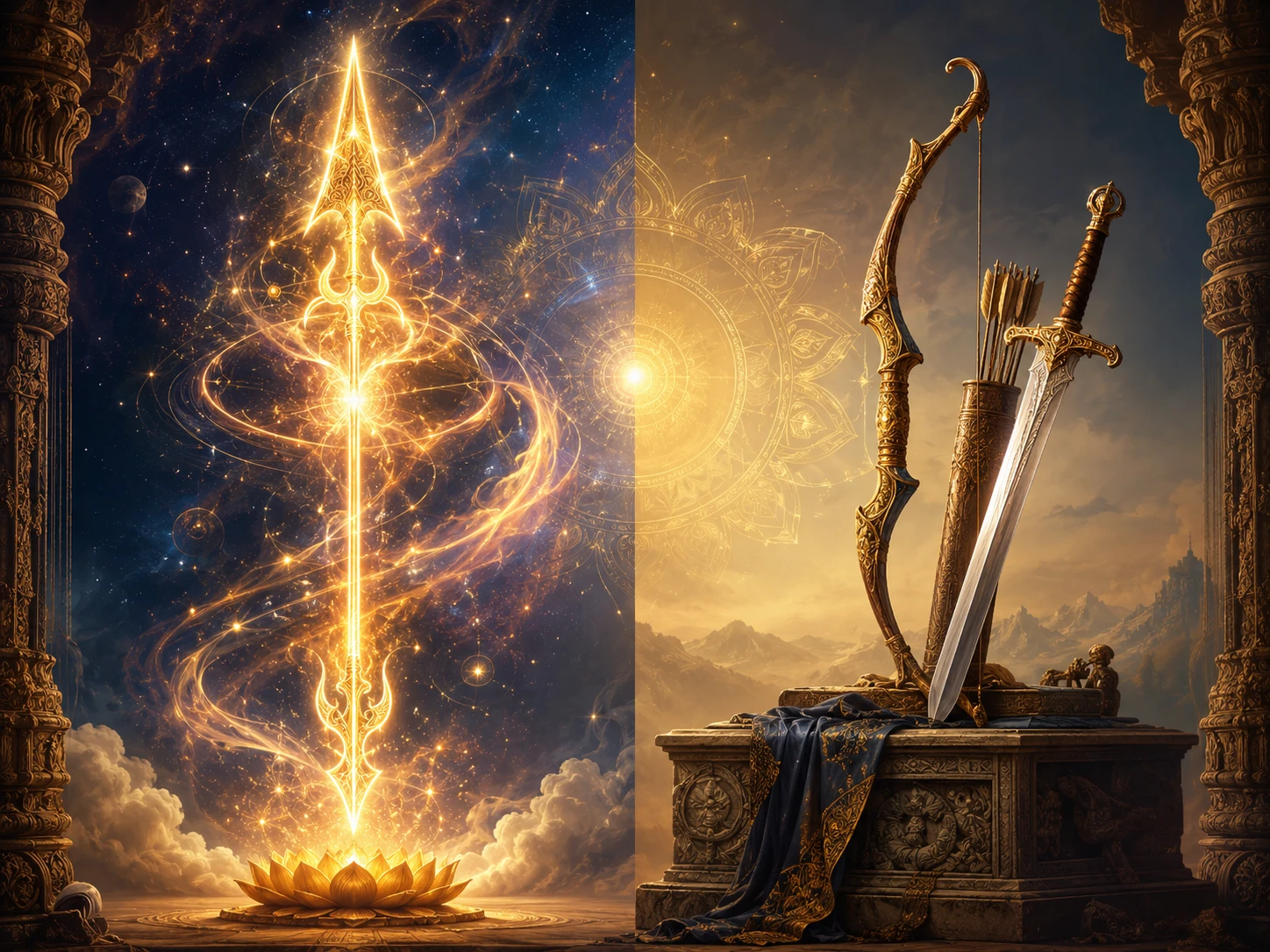
Astra vs Shastra -- The Two Classes of Weapons in Hindu Warfare
अस्त्र बनाम शस्त्र -- हिन्दू युद्धकला के दो वर्ग
In the Udyoga Parva of the Mahabharata, when the war becomes inevitable, both sides begin assembling not just armies but arsenals of a very specific kind. Arjuna has spent years collecting divine weapons from Indra, Shiva, Vayu, and Kubera. Karna carries the infallible Shakti gifted by Indra himself. Bhishma possesses the Prashwapastra that can put an entire army to sleep. These are not swords or spears. These are Astras -- weapon-systems activated by mantric invocation, each carrying the energy signature of the deity who gifted them.
Across the battlefield, the same warriors also carry Shastras: the physical weapons wielded by hand -- swords, maces, spears, bows. Bhima's gada (mace), Drona's bow, Nakula's sword -- these required no mantra, only skill, strength, and training.
The distinction between Astra and Shastra is one of the most fundamental concepts in Hindu martial philosophy, yet it is frequently confused or conflated. Understanding this distinction is essential for reading the Mahabharata, Ramayana, and Puranas with the depth they deserve.
शस्त्रं प्रहरणं प्रोक्तम् अस्त्रं मन्त्रप्रयोजितम्। शस्त्रं हस्तेन युज्यते अस्त्रं मन्त्रेण चोदितम्॥
shastram praharanam proktam astram mantra-prayojitam shastram hastena yujyate astram mantreNa coditam
Shastra is defined as a striking weapon; Astra is that which is propelled by mantra. Shastra is wielded by the hand; Astra is activated by sacred invocation.
— Agni Purana, Chapter 249
Astra vs Shastra -- The Fundamental Difference
| Aspect | Astra (अस्त्र) | Shastra (शस्त्र) |
|---|---|---|
| Etymology | From 'as' = to throw/hurl | From 'shas' = to strike/cut |
| Activation | Mantra invocation (mantropasarga) | Physical force (hand/muscle) |
| Source | Gifted by deities through tapasya or guru | Forged by smiths (Vishwakarma) or earned in training |
| Intelligence | Self-guided, can track targets, can be recalled | Depends entirely on wielder's skill |
| Recall | Many can be recalled (pratyahara) after launch | Cannot be recalled once released |
| Counter | Only neutralised by equal or superior Astra | Can be blocked by shield, armour, or skill |
| Training | Requires diksha (initiation) and mantra siddhi | Requires physical training at gurukula |
| Risk of misuse | Catastrophic (Brahmastra can destroy entire armies) | Limited to immediate combat range |
| Examples | Brahmastra, Pashupatastra, Narayanastra, Agneyastra | Gada (mace), Khadga (sword), Trishul, Chakra (when hand-thrown) |
| Modern parallel | Guided missile systems with smart targeting | Conventional firearms and melee weapons |
The same weapon can sometimes function as both. Sudarshana Chakra is a Shastra when hurled by hand but becomes an Astra when activated with Vishnu's mantra.
The Hierarchy of Astras -- From Elemental to Absolute
Astras follow a strict hierarchy based on the deity who presides over them. The most commonly referenced classification organises them into tiers.
The first tier includes elemental Astras tied to natural forces: Agneyastra (fire, from Agni), Varunastra (water, from Varuna), Vayavyastra (wind, from Vayu), Parjanyastra (rain), and Parvatarstra (mountains). These are the most widely known and most frequently used in battle. When Arjuna and Ashwatthama exchange fire and water Astras during the Mahabharata, they are operating at this tier.
The second tier includes deity-specific Astras of greater power: Aindrastra (from Indra, king of gods), Narayanastra (from Vishnu -- fires millions of projectiles, but can be countered only by complete surrender), and Maheshwarastra (from Shiva). These require greater tapasya to obtain and carry stricter rules of engagement.
The apex tier contains the Brahmastra, Brahmashirsha Astra, and Brahmanda Astra (from Brahma) and the Pashupatastra (from Shiva). These are weapons of absolute destruction. The Brahmastra never misses its target and can annihilate armies. The Brahmanda Astra is said to be capable of destroying an entire universe. And the Pashupatastra -- the supreme weapon -- can destroy all creation including the gods themselves. Only Arjuna possessed it among Mahabharata warriors, gifted directly by Shiva after Arjuna fought him in disguise as the Kirata (tribal hunter).
The rules governing these apex weapons were strict. They could not be used against ordinary soldiers or non-combatants. They could not be used in anger or for personal revenge. And some, like the Brahmanda Astra, could never be used at all -- possessing them was itself the deterrence. This is strikingly parallel to modern nuclear doctrine: the weapon exists to prevent war, not to fight it.
India's modern defence missiles are named after mythological weapons: Agni (fire -- ICBM), Prithvi (earth -- tactical), Akash (sky -- air defence), Trishul (trident -- short range), Nag (serpent -- anti-tank), Astra (beyond visual range air-to-air). DRDO explicitly chose these names to honour the Astra-Shastra tradition.
Famous Astras -- The Divine Arsenal
| Astra | अस्त्र | Presiding Deity | Power | Famous User(s) |
|---|---|---|---|---|
| Brahmastra | ब्रह्मास्त्र | Brahma | Never misses. Destroys armies. Cannot be countered except by another Brahmastra. | Drona, Arjuna, Ashwatthama, Karna, Rama |
| Pashupatastra | पाशुपतास्त्र | Shiva | Supreme weapon. Can destroy all creation including gods. | Arjuna (only Mahabharata warrior to possess it) |
| Narayanastra | नारायणास्त्र | Vishnu | Fires millions of projectiles. Only countered by complete surrender (laying down arms). | Drona, Ashwatthama |
| Brahmastra Astra | ब्रह्मशिर अस्त्र | Brahma (4 heads) | 4x power of Brahmastra. Can destroy solar system. | Drona, Arjuna, Ashwatthama |
| Vaishnavaastra | वैष्णवास्त्र | Vishnu | Unstoppable divine disc energy | Krishna, Bhagadatta |
| Agneyastra | आग्नेयास्त्र | Agni | Creates walls of fire. Burns everything in path. | Multiple warriors |
| Varunastra | वरुणास्त्र | Varuna | Unleashes torrential water. Counters Agneyastra. | Multiple warriors |
| Nagastra | नागास्त्र | Serpent deities | Transforms into venomous serpents mid-flight | Karna (used against Arjuna, deflected by Krishna) |
| Shakti | शक्ति | Indra | Infallible single-use weapon. Guaranteed kill. | Karna (used on Ghatotkacha instead of Arjuna) |
| Sammohanastra | सम्मोहनास्त्र | Gandharvas | Puts entire army into hypnotic stupor | Arjuna |
Ashwatthama's reckless use of Brahmastra on unborn Parikshit -- violating the rules of engagement -- resulted in Krishna cursing him to wander immortally with a festering wound. The message: divine weapons demand divine responsibility.
Famous Shastras -- The Warrior's Armoury
| Shastra | शस्त्र | Type | Famous Bearer | Significance |
|---|---|---|---|---|
| Gada (Mace) | गदा | Blunt force | Bhima, Hanuman, Vishnu (Kaumodaki) | Symbol of raw strength. Bhima killed Duryodhana in gada-yuddha. |
| Khadga (Sword) | खड्ग | Edged blade | Nakula (finest swordsman), Kalki (future avatar) | Represents discrimination (viveka) -- cutting truth from falsehood. |
| Trishul (Trident) | त्रिशूल | Three-pronged | Shiva, Durga | Three gunas, three times, three worlds. Ultimate symbol of Shiva. |
| Parashu (Battle Axe) | परशु | Axe | Parashurama (6th avatar of Vishnu) | Wiped out the Kshatriya class 21 times. |
| Vajra (Thunderbolt) | वज्र | Blunt/piercing | Indra | Made from Sage Dadhichi's bones. Killed Vritra demon. |
| Vel (Spear) | वेल | Piercing | Kartikeya/Murugan | Shakti Vel gifted by Devi Parvati. Killed Surapadman. |
| Chakra (when hand-thrown) | चक्र | Disc | Vishnu (Sudarshana) | Both Astra and Shastra depending on mode of use. |
The Vajra holds a special place: Sage Dadhichi voluntarily gave up his body so his bones could be fashioned into the weapon that would save the Devas. It is the ultimate example of sacrifice for dharma.
When Astra Met Astra -- The Doctrine of Proportional Response
The Mahabharata contains what may be the world's oldest documented rules of engagement for weapons of mass destruction. When Arjuna and Ashwatthama both launch Brahmastra simultaneously after the war, Vyasa and Narada intervene -- not because the weapons cannot be countered, but because two Brahmastras colliding would annihilate the Earth. Arjuna, who has the knowledge to recall his weapon, withdraws it. Ashwatthama, who was taught to launch but not recall, cannot -- and redirects it toward the womb of Uttara, targeting the Pandava lineage. This single act represents the catastrophic consequence of possessing a weapon without the full wisdom to control it.
The ancient texts prescribe a clear principle: the response must be proportional to the threat. Using a Brahmastra against a foot soldier is not heroism; it is adharma. This is why Arjuna, despite possessing the Pashupatastra (the most powerful weapon in existence), never uses it during the entire eighteen-day war. The weapon existed as the ultimate deterrent -- its power lay precisely in its non-use.
For a student at the National Defence Academy in Khadakwasla, Pune, studying modern rules of engagement and the Geneva Convention, the Mahabharata's weapon ethics feel startlingly contemporary. The principle of proportional response, the prohibition against targeting non-combatants, the concept of weapons too destructive to use -- these are not modern inventions. They were debated on the plains of Kurukshetra five thousand years ago.
Chant the Warrior's Mantra -- Arjuna's Courage
The same mantra tradition that activated Astras also empowers us today. Begin your day with the Gayatri Mantra -- the foundation of all mantric practice -- on a mala. The Gayatri's page on Eternal Raga gives its meaning and how to chant it.
Eternal Raga · शाश्वत राग
Institutional voice — scholarly articles on Sanatan Dharma
Deepen Your Understanding
अपनी समझ और गहरी करें
divine arsenal
The Celestial Bows -- Pinaka, Gandiva, Sharanga, Vijaya and the Sacred Art of Dhanurvidya
Five bows shaped the fate of two great epics. Forged by Vishwakarma and Brahma, wielded by Shiva, Rama, Arjuna, Vishnu, and Karna -- these were not mere weapons but extensions of cosmic will. Know their origins, their powers, and the warriors who earned them.
divine arsenal
The Arrows That Changed Destiny -- Famous Banas of Hindu Mythology
In Hindu mythology, a single arrow could end a war, kill an immortal, or alter the fate of an entire civilisation. From the Brahmastra arrow that killed Ravana to the Anjalikastra that felled Karna -- every arrow carried a story within its flight.
divine arsenal
The Sacred Conch Shells -- Panchajanya, Devadatta and the War Horns of Kurukshetra
The Bhagavad Gita opens not with words but with sound -- the thunderous blowing of five sacred conch shells that signalled the beginning of the greatest war in mythology. Each conch had a name, a story, and a power. Know them all.
divine arsenal
The Celestial Chariots -- Pushpaka Vimana, Arjuna's Ratha, and the Flying Machines of Hindu Mythology
Ravana's Pushpaka Vimana could fly across oceans and read its owner's mind. Arjuna's chariot bore Hanuman on its flag and was driven by God himself. These were not fairy tale carriages -- they may be literary encodings of technologies that ancient India actually possessed.
deities avatars
Dashavatara -- Why Vishnu Comes Back Ten Times
Fish, tortoise, boar, half-lion, dwarf, axe-warrior, prince, cowherd, enlightened teacher, future horseman. The ten avatars of Vishnu are not random folklore. Read them in sequence and you get something startling -- a narrative that mirrors evolutionary biology, tracks the rise and fall of political systems, and argues that God does not sit above history but enters it, gets dirty, and does the work. The Dashavatara is Hinduism's answer to the question every civilisation asks: why does the world keep breaking, and who fixes it?
tantra mantra yantra
Tantra, Mantra and Yantra -- The Three Pillars of Spiritual Practice
Tantra is the loom, Mantra is the thread, Yantra is the pattern. Together they form the complete technology of spiritual transformation that India gifted to the world -- and they are far more profound than popular culture imagines.
India's modern defence missiles are named after mythological weapons: Agni (fire -- ICBM), Prithvi (earth -- tactical), Akash (sky -- air defence), Trishul (trident -- short range), Nag (serpent -- anti-tank), Astra (bey…
More in Divine Arsenal
Akshauhini -- The Epic Army Structure Where Every Digit Sums to 18
14 min read
Ancient Indian Martial Arts -- Kalaripayattu to Malla-Yuddha
14 min read
Astra Invocation and Withdrawal -- The Ritual of Weapons
16 min readThe same translation error that turned '33 Koti' into '33 crore' in Hinduism also happened in Buddhism. The Chinese translation of Buddhist texts rendered 'Sapta Koti Buddha' (7 Supreme Buddhas) as '7 Crore Buddhas.' The…
Deities AvatarsCommunity Reflections
🕉️
Be the first to share your reflection.