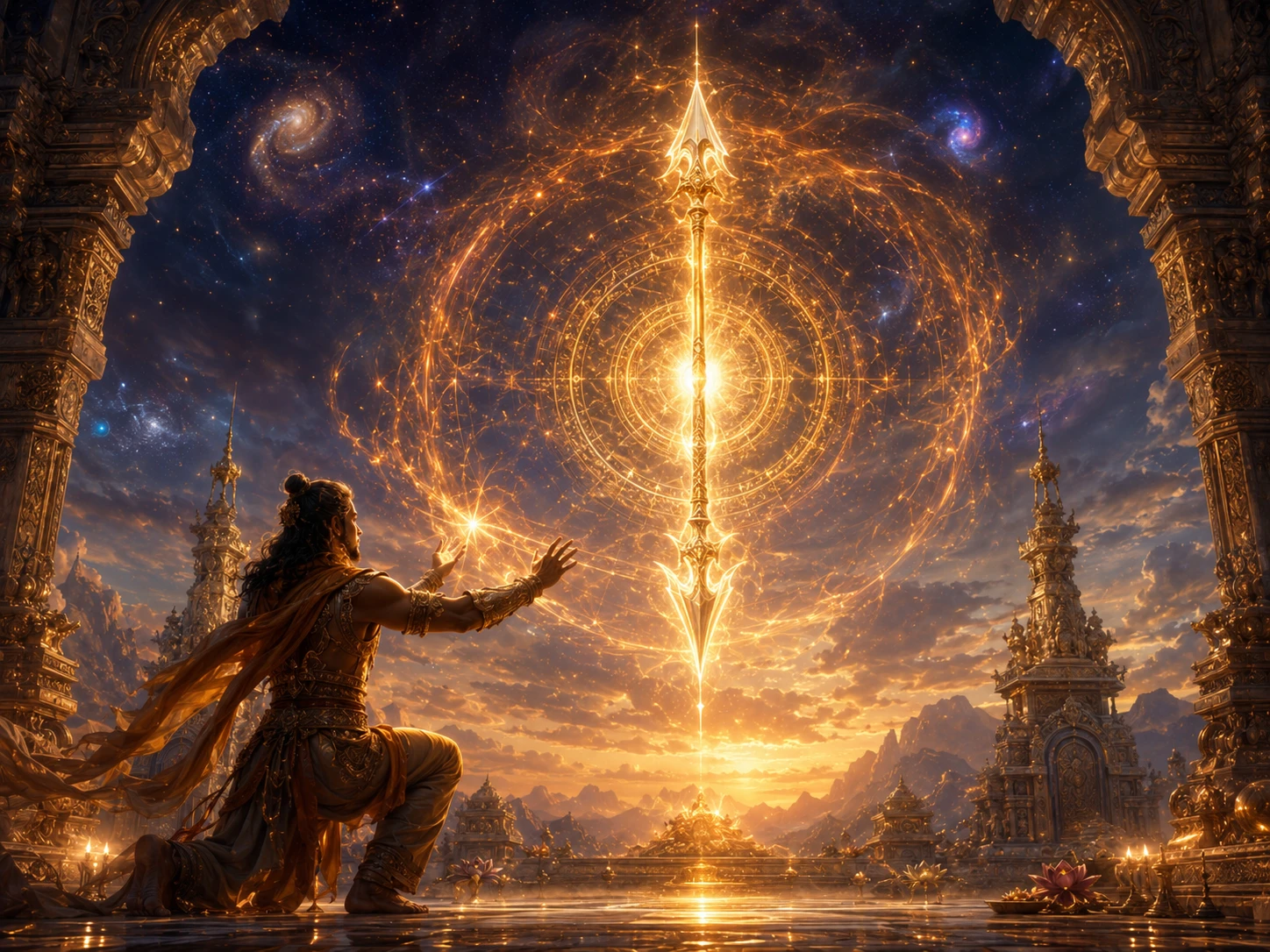
Astra Invocation and Withdrawal -- The Ritual of Weapons
अस्त्र आवाहन और प्रत्याहार -- शस्त्रों का अनुष्ठान
In the modern world, launching a nuclear missile requires a specific sequence: authentication codes verified by multiple officers, keys turned simultaneously, launch authorisation confirmed through a chain of command, and a series of fail-safe checks before the weapon is released. The entire process is designed to ensure that the most destructive weapon available is deployed only with absolute deliberation and full accountability.
The Mahabharata describes an almost identical protocol for divine Astras -- except the authentication was spiritual, the launch codes were mantras, and the fail-safe was the warrior's own dharmic character.
An Astra, in the Mahabharata's framework, is not a physical weapon. It is a mantra-activated celestial force that manifests through a physical carrier (usually an arrow, but sometimes a blade of grass, a glance, or even a thought). The arrow is the delivery vehicle; the Astra is the warhead. And just as a missile warhead must be armed before it becomes destructive, an Astra must be invoked through a precise ritual before it can function.
This ritual has four stages: Sandhana (preparation -- selecting and nocking the arrow), Avahana (invocation -- chanting the specific mantra to summon the deity whose power the Astra channels), Prayoga (release -- firing the charged weapon at the target with focused Sankalpa), and -- most critically -- Pratyahara (withdrawal -- recalling the Astra before impact if circumstances change or if the target surrenders).
The ability to perform all four stages was the mark of a complete warrior (Purna Yoddha). Many warriors in the Mahabharata could invoke Astras. Fewer could withdraw them. And this asymmetry -- the gap between the power to launch and the power to recall -- drives some of the epic's most tragic moments.
For the NDA cadet studying rules of engagement, the UPSC aspirant studying Indian polity's comparison with ancient governance, or the strategic studies student at JNU analysing escalation dynamics -- the Astra protocol is India's oldest documented doctrine on the use and control of weapons of mass destruction.
अस्त्रं प्रत्याहरेद्यस्तु स शूरो न तु योऽन्यथा। प्रत्याहारेऽसमर्थो यो मोहादस्त्रं प्रयुञ्जते॥
astraṃ pratyāhared yas tu sa śūro na tu yo'nyathā | pratyāhāre'samartho yo mohād astraṃ prayuñjate ||
He who can withdraw the Astra is a true warrior; not he who cannot. He who uses an Astra without the ability to withdraw it acts out of delusion.
— Principle stated in multiple Mahabharata passages (paraphrased; the ethic is embedded across Drona Parva and Ashvamedhika Parva)
The Four Stages -- Sandhana, Avahana, Prayoga, Pratyahara
Each stage of Astra deployment corresponds to a specific skill that had to be mastered independently before the warrior was entrusted with celestial weapons.
Sandhana (Preparation): The warrior selects the appropriate arrow (or other carrier) and places it on the bowstring. This is not mere archery -- it is the physical preparation of the delivery system. The selection of carrier matters: some Astras require specific materials (a grass blade for certain Brahma weapons, a specific type of arrow for Agneyastra). The warrior's body posture must be correct (this is where Dhanurveda's nine combat stances come into play), breathing must be regulated, and the mind must be absolutely one-pointed.
Avahana (Invocation): This is the critical stage. The warrior mentally or vocally recites the mantra specific to the Astra being invoked. Each Astra has a unique mantra, taught by the Guru during weapons training. The mantra summons the presiding deity of the Astra -- Brahma for Brahmastra, Agni for Agneyastra, Varuna for Varunastra, Vayu for Vayavyastra, and so on. The deity's Shakti descends into the carrier, transforming an ordinary arrow into a weapon of cosmic power. The warrior must hold the invocation with perfect concentration -- any lapse in focus, any break in the mantra, any wavering of intention, and the Astra fails to activate or, worse, activates incorrectly.
Prayoga (Release): The charged weapon is released toward the target. The release requires Sankalpa -- a precise mental declaration of the target and the intended effect. An Astra released without clear Sankalpa is like a missile without targeting coordinates: it may strike randomly, causing unintended devastation. The Mahabharata repeatedly emphasises that Astras released in anger, confusion, or without specific targeting are among the gravest violations of Dharma Yuddha.
Pratyahara (Withdrawal): The most difficult and most important stage. If circumstances change -- the target surrenders, an innocent enters the path, or the warrior realises the Astra is disproportionate to the threat -- a skilled warrior can recall the Astra mid-flight by chanting the withdrawal mantra. This requires even greater concentration than invocation, because the warrior must override the weapon's already-activated momentum. The Mahabharata's greatest moments of moral crisis hinge on Pratyahara: Ashwatthama could invoke the Brahmastra but could not withdraw it (resulting in mass destruction), while Arjuna could both invoke and withdraw -- making him the ethically complete warrior.
Astra Protocol -- The Four Stages Compared to Modern Weapons Systems
| Stage | Sanskrit Term | Astra Action | Modern Equivalent | Key Skill Required |
|---|---|---|---|---|
| Preparation | Sandhana | Select carrier; nock arrow; assume correct stance | Weapons system selection; loading; targeting alignment | Dhanurveda stance mastery; material knowledge |
| Invocation | Avahana | Chant deity-specific mantra to activate weapon | Arming the warhead; authentication codes; launch authorisation | Mantra Siddhi (mastery of invocation); Guru's blessing |
| Release | Prayoga | Fire with focused Sankalpa (target declaration) | Launch with confirmed targeting coordinates | One-pointed concentration (Ekagrata); clear intention |
| Withdrawal | Pratyahara | Recall weapon mid-flight via withdrawal mantra | Missile abort / self-destruct sequence | Highest skill -- rarer than invocation; mark of true mastery |
The critical difference: modern systems can self-destruct a weapon mechanically. In the Mahabharata, withdrawal required the warrior's spiritual power to override the Astra's activated deity-force. Technology cannot substitute for character -- the Astra system's deepest lesson.
Ashwatthama vs Arjuna -- The Moral Crisis of Brahmastra
The most devastating illustration of the invocation-withdrawal asymmetry occurs in the closing stages of the Mahabharata war, when Ashwatthama and Arjuna both invoke the Brahmastra -- simultaneously.
Ashwatthama, enraged and grief-stricken after the slaughter of the Kaurava army, invokes the Brahmastra Pratyahara Astra -- the most destructive weapon in his arsenal -- targeting the Pandava forces, including the unborn child in Uttara's womb. His invocation is driven by revenge, despair, and the complete collapse of his moral framework. He knows the mantra to invoke. He does not know the mantra to withdraw.
Arjuna, recognising the Brahmastra's characteristic signs (the sky darkening, the earth trembling, all beings sensing imminent annihilation), counters with his own Brahmastra -- not to attack Ashwatthama but to neutralise the incoming weapon. Two Brahmastras locked in collision would destroy the world. Vyasa himself intervenes, appearing on the battlefield and commanding both warriors to withdraw their weapons.
Arjuna withdraws his Brahmastra. This single act -- pulling back a weapon of mass destruction mid-flight through mantra and will -- is one of the most remarkable feats in the entire Mahabharata. It demonstrates that Arjuna has not merely learned to fight but has mastered the full Astra protocol: invoke, release, and recall.
Ashwatthama cannot withdraw. He confesses to Vyasa: 'I do not know the Pratyahara (withdrawal) mantra.' Drona, his father, taught him invocation but not recall -- either because Ashwatthama was not spiritually mature enough, or because Drona himself had reservations about his son's temperament. Whatever the reason, the result is catastrophic: unable to withdraw the Brahmastra, Ashwatthama redirects it at the Pandava women's wombs, killing the unborn children.
Krishna's response is the Astra tradition's ultimate moral judgement. He curses Ashwatthama: 'For 3,000 years you will wander the earth, alone, your body covered in wounds that never heal, carrying the gem that was torn from your forehead, unable to find companionship or peace.' The punishment is not for using a weapon but for using a weapon he could not control. The crime is not invocation. The crime is irresponsible invocation -- launching what you cannot recall.
This episode is the Mahabharata's most direct meditation on the ethics of weapons of mass destruction. The parallel to nuclear weapons is unmistakable: a weapon that, once launched, cannot be recalled; a weapon whose effects extend to the innocent and the unborn; a weapon whose use, even in retaliation, carries consequences that outlast the war itself. India's Nuclear Command Authority, established in 2003, formalises a chain of command designed to ensure that the power to launch is never separated from the responsibility to control -- the Arjuna principle encoded in modern statecraft.
Astra Mastery Required Diksha -- Why Not Everyone Could Invoke
The Mahabharata is clear that Astra knowledge was not freely distributed. It was transmitted through Diksha -- formal initiation by a qualified Guru -- and subject to strict conditions.
Drona did not teach all his students equally. Arjuna received more Astras than any other student because Drona judged him to have the spiritual maturity, the concentration capacity, and the dharmic character to handle them responsibly. Ekalavya, who was arguably as skilled an archer as Arjuna, was denied formal Astra training -- the tradition's most controversial moment, but one that the text frames as a judgment about readiness, not about ability.
Parashurama taught Karna the Brahmastra but cursed him to forget the invocation mantra at the moment he needed it most -- because Karna obtained the teaching through deception (claiming to be a Brahmin when he was not). The Astra responded to the moral quality of the transmission: knowledge obtained through falsehood carries within it the seed of its own failure.
The Astra Diksha tradition mirrors the broader Tantric Diksha framework: the Guru transmits not just the information (the mantra) but the Shakti (the power to activate the mantra) and the Viveka (the wisdom to use it correctly). An Astra mantra written in a book is as inert as a nuclear launch code without the authentication hardware. The Guru's transmission energises the mantra, but equally importantly, the Guru's judgment about the student's readiness serves as the human fail-safe in the system.
This is why the modern Indian defence establishment's approach to weapons access follows a parallel logic: not everyone who can operate a weapon system is authorised to launch it. Access is tiered based on rank, training, character assessment, and chain-of-command authorisation. The ancient Astra tradition encoded the same principle: power must be matched with responsibility, and the authority to activate must include the capacity to deactivate.
For the student of strategic studies or international relations: the Astra tradition anticipates the modern concept of 'responsible nuclear stewardship' -- the idea that possession of ultimate weapons creates ultimate obligations. The Mahabharata's answer to 'who should have the bomb?' was crystallised 3,000 years before Hiroshima: only the one who can withdraw it.
The implications extend beyond the battlefield. Every Astra Guru evaluated two things before transmitting knowledge: technical competence (can the student perform the mantra correctly?) and moral character (will the student use the weapon responsibly?). Bhishma, who possessed virtually every Astra in existence, never taught them indiscriminately. He reserved specific weapons for specific students based on his assessment of their temperament. Dronacharya followed the same protocol -- and his most consequential decision was teaching Ashwatthama invocation without withdrawal, a judgment call that would haunt the entire Kuru dynasty. The Mahabharata does not condemn Drona for this choice. It presents it as a tragic misjudgement by a loving father who could not see his son clearly -- a failure of character assessment that produced consequences worse than any battlefield defeat. For the HR professional conducting leadership assessments at Infosys or TCS, the Drona-Ashwatthama case is a cautionary tale: giving someone access to powerful tools without verifying their readiness is not generosity. It is negligence.
Famous Astra Deployments -- Five Case Studies in Invocation
The Mahabharata and Ramayana together document dozens of Astra deployments. Five cases illustrate the full spectrum from masterful use to catastrophic misuse.
Case One -- Rama's Brahmastra Against Ravana (Ramayana, Yuddha Kanda): The textbook deployment. After exhausting all other weapons against Ravana, Rama invokes the Brahmastra as instructed by Sage Agastya's Aditya Hridayam. The text describes Rama's invocation as calm, deliberate, performed with full ritual concentration despite the chaos of battle. The Brahmastra strikes Ravana's chest and kills him instantly. This is the Astra tradition's gold standard: the right weapon, against the right target, at the right time, deployed by a warrior in complete control of his faculties. Rama does not celebrate. He expresses sorrow that he was forced to use such a weapon at all.
Case Two -- Indrajit's Nagastra Against Rama and Lakshmana (Ramayana, Yuddha Kanda): Indrajit (Meghanada), Ravana's son and one of the most formidable Astra wielders in all of Hindu literature, deploys the Nagastra -- the Serpent Weapon -- against both Rama and Lakshmana. The weapon manifests as thousands of venomous serpents that bind both brothers unconscious. They are revived only by Garuda's intervention (serpents flee at the sight of their eternal predator). This deployment illustrates a crucial Astra principle: even divine warriors can be felled by a well-deployed Astra. Invocation skill can temporarily overcome divine destiny.
Case Three -- Arjuna's Restraint with Pashupatastra (Mahabharata, Kurukshetra War): Arjuna received the Pashupatastra directly from Shiva during the Kirata episode (Vana Parva). This is the most powerful weapon in existence -- capable of destroying all creation, including the gods. Shiva's instruction was explicit: never use it against human combatants, and never use it in anger. Arjuna carried this weapon through the entire Kurukshetra War and never deployed it. Not against Bhishma, not against Drona, not against Karna, not even against the rampaging Ashwatthama. The possession of the supreme weapon was itself the ultimate test of character: can you hold power and choose not to use it? Arjuna passed the test.
Case Four -- Karna's Shakti Astra Against Ghatotkacha (Mahabharata, Drona Parva): Karna possessed a single-use Shakti Astra gifted by Indra -- originally intended for Arjuna. Krishna, knowing this, manipulates the battlefield situation so that the Rakshasa warrior Ghatotkacha (Bhima's son) rampages through Kaurava forces at night, using his shape-shifting Mayavi powers. Duryodhana demands Karna use his secret weapon. Karna, cornered, deploys the Shakti Astra against Ghatotkacha -- killing him but expending the one weapon that could have killed Arjuna. This is the Astra tradition's lesson in strategic economics: every Astra has an opportunity cost. Using it on the wrong target means it is unavailable for the right one.
Case Five -- Ashwatthama's Narayanastra (Mahabharata, Drona Parva): Before the Brahmastra crisis, Ashwatthama deploys the Narayanastra -- Vishnu's weapon that fires millions of flaming projectiles. The Pandava army panics. Krishna alone knows the counter: complete disarmament and surrender. Anyone who resists the Narayanastra is destroyed; anyone who lays down arms is spared. The weapon responds to aggression, not presence. Bhima, characteristically, refuses to surrender and keeps fighting -- and the weapon intensifies against him until Krishna physically restrains him. The Narayanastra teaches that some threats cannot be fought -- they can only be transcended through ego-dissolution. For the management consultant at McKinsey or BCG: sometimes the strongest competitive move is disarmament.
India's nuclear weapons doctrine follows a principle that directly echoes the Mahabharata's Astra ethics: No First Use (NFU). India has publicly committed to never using nuclear weapons first in a conflict -- only in retaliation. This mirrors the Mahabharata's principle that the most powerful Astras (Brahmastra, Pashupatastra) were to be used only as last resorts and never against fleeing enemies or non-combatants. The Pashupatastra article on Eternal Raga explores how Arjuna obtained the supreme weapon from Shiva but never used it in the Kurukshetra war -- the ultimate expression of the principle that the highest power is the power not used. India's NFU policy, articulated by PM Vajpayee after the 1998 Pokhran-II tests, is framed in modern geopolitical language but resonates with a dharmic principle codified in the Mahabharata three millennia earlier.
Cultivate Arjuna's Focus -- The Mental Foundation of Astra Mastery
The Astra tradition teaches that weapon mastery begins with mind mastery. Arjuna's ability to invoke and withdraw Astras rested on his ekagrata -- one-pointed concentration developed through years of meditation and japa. Practise trataka daily: ten minutes of unbroken focus on a candle flame, building the same mental architecture the Dhanurvedic tradition demands of its warriors. The Steady Gaze dharana on Eternal Raga teaches it step by step.
Tags
Eternal Raga · शाश्वत राग
Institutional voice — scholarly articles on Sanatan Dharma
Deepen Your Understanding
अपनी समझ और गहरी करें
divine arsenal
Astra vs Shastra -- The Two Classes of Weapons in Hindu Warfare
One is hurled with mantras and divine invocation. The other is wielded by hand and muscle. Understanding the fundamental difference between Astra and Shastra unlocks the entire weapons philosophy of ancient India.
divine arsenal
Brahmastra vs Brahmashirsha -- The Escalation Ladder of Brahma's Weapons
Brahmastra was the nuclear bomb. Brahmashirsha -- with four heads of Brahma at its tip -- was the thermonuclear bomb, four times more powerful. And Brahmanda Astra could destroy the entire solar system. Three escalation tiers of the same divine weapons programme, created by the god of creation himself. The ethics of their use drives the Mahabharata's most devastating moral crisis.
divine arsenal
Pashupatastra -- The Supreme Weapon Never Used
The most fearsome weapon in the Mahabharata was never deployed on the battlefield. Shiva granted it to Arjuna after a wrestling match in the forests of Indrakila, yet Arjuna carried it through all eighteen days of Kurukshetra without ever invoking it. The Pashupatastra's true power lay not in its destruction, but in its restraint -- a philosophy that modern nuclear doctrine would independently discover thousands of years later.
divine arsenal
10 Weapons That Changed the War
Across the Ramayana and Mahabharata, certain weapons did not merely kill -- they altered the course of history. From Rama shattering Shiva's bow to win Sita, to the Shakti that saved the Pandavas by killing the one person it should not have, these ten weapon-moments are the pivot points on which two epics turn.
divine arsenal
Rules of War -- Dharmayuddha and the Geneva Conventions
Three thousand years before the Geneva Conventions, Indian warriors debated whether you could strike a man who had dropped his weapon. The Mahabharata's rules of engagement cover night fighting bans, non-combatant immunity, treatment of prisoners, proportional force, and the use of weapons of mass destruction -- and then shows what happens when every single rule is broken.
divine arsenal
The Arrows That Changed Destiny -- Famous Banas of Hindu Mythology
In Hindu mythology, a single arrow could end a war, kill an immortal, or alter the fate of an entire civilisation. From the Brahmastra arrow that killed Ravana to the Anjalikastra that felled Karna -- every arrow carried a story within its flight.
divine arsenal
Dhanurveda in the Agni Purana -- India's Ancient Science of Warfare
Long before Sun Tzu wrote The Art of War, India had the Dhanurveda -- a complete military science classified as an Upaveda of the Yajur Veda. Preserved in four chapters of the Agni Purana, it covers five warrior types, five weapon classes, nine combat stances, and a training philosophy that would make any NDA commandant nod in recognition.
India's nuclear weapons doctrine follows a principle that directly echoes the Mahabharata's Astra ethics: No First Use (NFU). India has publicly committed to never using nuclear weapons first in a conflict -- only in ret…
More in Divine Arsenal
Akshauhini -- The Epic Army Structure Where Every Digit Sums to 18
14 min read
Ancient Indian Martial Arts -- Kalaripayattu to Malla-Yuddha
14 min read
Astra vs Shastra -- The Two Classes of Weapons in Hindu Warfare
14 min readThe same translation error that turned '33 Koti' into '33 crore' in Hinduism also happened in Buddhism. The Chinese translation of Buddhist texts rendered 'Sapta Koti Buddha' (7 Supreme Buddhas) as '7 Crore Buddhas.' The…
Deities AvatarsCommunity Reflections
🕉️
Be the first to share your reflection.