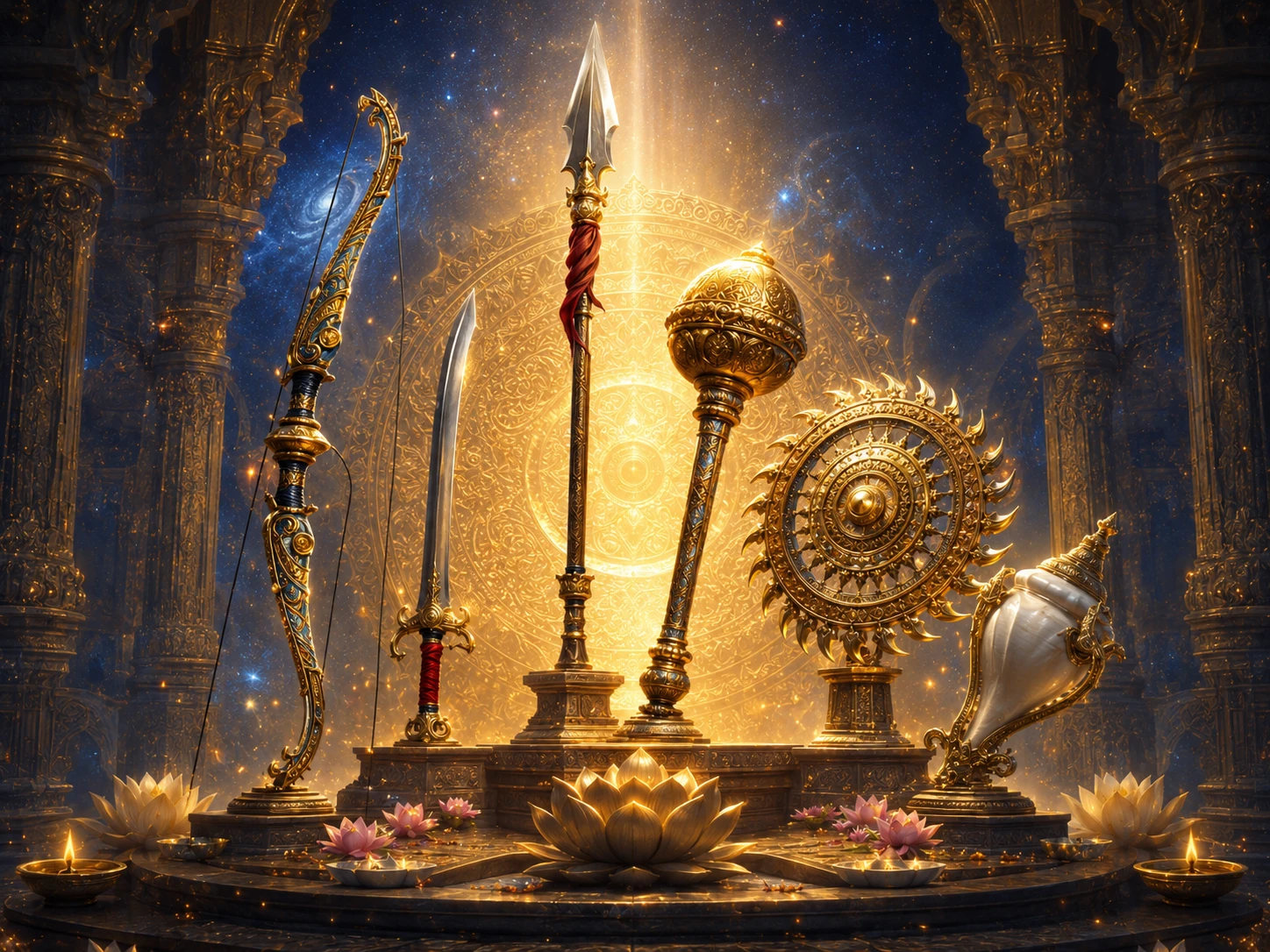
10 Weapons That Changed the War
10 शस्त्र जिन्होंने युद्ध की दिशा बदल दी
Wars are not won by the side with more soldiers, better supply lines, or superior strategy alone. They are often decided by single moments -- one weapon, one decision, one irreversible act that tilts everything. The Ramayana and Mahabharata, between them spanning thousands of pages of narrative, can be distilled into a handful of such moments. Remove any one of these ten weapon-events, and the entire story changes.
This is not a list of the 'most powerful' weapons -- that ranking belongs to the Pashupatastra and its ilk, which were never used. This is a list of weapons that were used, and in being used, changed the course of two civilisation-defining epics.
10 Weapons That Changed the War -- Decisive Moments
| # | Weapon / Act | Epic | Day / Event | Why It Changed Everything |
|---|---|---|---|---|
| 1 | Rama breaks Pinaka (Shiva's Bow) | Ramayana | Sita Swayamvara | Won Sita's hand -- triggered Parashurama confrontation and the entire Ramayana narrative |
| 2 | Brahmastra on Ravana | Ramayana | Final day of Lanka War | The Brahmastra to Ravana's navel (where amrit was stored) ended the war; all prior weapons had failed |
| 3 | Shakti on Ghatotkacha | Mahabharata | Day 14 (Night battle) | Karna used Indra's one-use Shakti on Ghatotkacha instead of saving it for Arjuna -- saved the Pandavas' chief warrior |
| 4 | Bhishma's choice to fall on arrows | Mahabharata | Day 10 | Bhishma chose Shikhandi as the trigger to stop fighting -- the arrow-bed was self-imposed; he controlled the timing of his fall |
| 5 | Chakravyuha formation vs Abhimanyu | Mahabharata | Day 13 | Six warriors broke rules to kill a sixteen-year-old -- this atrocity fuelled Arjuna's rage for the rest of the war |
| 6 | Drona's Brahmadanda | Mahabharata | Days 11-15 | Drona's unchallengeable defensive weapon forced the Pandavas to use deception (Ashwatthama lie) rather than combat |
| 7 | Karna's Vijaya bow broken | Mahabharata | Day 17 | Shalya's subtle demoralisation + wheel stuck in mud + Arjuna's Anjalika arrow = Karna's fall; the bow's curse activated |
| 8 | Bhima's mace blow below the waist | Mahabharata | Day 18 (post-war duel) | Violated mace-fight rules to fulfil Draupadi's oath -- ended the Kaurava line but earned moral censure |
| 9 | Ashwatthama's Brahmashira at Pandava camp | Mahabharata | Night after Day 18 | Post-war massacre of Pandava sons -- turned victory to ashes; led to Ashwatthama's eternal curse |
| 10 | Rama's arrow at Vali (from behind a tree) | Ramayana | Kishkindha Kanda | Most morally debated weapon act in either epic -- Rama killed Vali from concealment; established alliance with Sugriva that made Lanka war possible |
Notice the pattern: the most decisive weapon moments are not displays of power but moral turning points. Each one raises an ethical question that the tradition has debated for millennia.
The single most war-altering weapon event in the Mahabharata -- the moment the strategic balance shifted permanently -- is the Shakti that killed Ghatotkacha on the night of Day 14. Understanding why requires understanding Karna's dilemma.
Karna possessed the Shakti -- a divine javelin given by Indra in exchange for Karna's impenetrable earrings and armour (Kavach-Kundal). The Shakti could be used only once, and it would kill whoever it was aimed at, without fail. Karna was saving it for Arjuna. Everyone on both sides knew this. The existence of the one-use weapon was the single greatest threat to the Pandava war effort.
On the night of Day 14, Ghatotkacha -- Bhima's half-Rakshasa son -- went on a rampage using his demonic powers, which grew stronger at night. He was decimating the Kaurava army. Duryodhana, desperate, pressured Karna to use the Shakti. Karna resisted -- using it on Ghatotkacha meant losing his one guaranteed shot at Arjuna. But the immediate crisis was overwhelming.
Karna threw the Shakti. Ghatotkacha died. The Kaurava army was saved that night. But the Pandavas won the war -- because Karna no longer had the weapon that could have killed Arjuna.
Krishna wept that night -- but they were tears of relief. He later told Arjuna that Ghatotkacha's death was the Pandavas' greatest strategic gain. The sacrifice of one warrior consumed the enemy's ultimate weapon. It is, in strategic terms, the most expensive single kill in either epic.
ततो राघवनिर्दिष्टं तेजोमण्डलसंवृतम्। ब्रह्मास्त्रं ब्रह्मणा दत्तं रावणोरसि पातयत्॥
tato raaghavanirdishtam tejomandalasamvritam | brahmaastram brahmanaa dattam raavanorasai paatayat ||
Then the Brahmastra, given by Brahma himself, enveloped in a circle of fire, directed by Raghava (Rama), struck Ravana in the chest.
— Valmiki Ramayana, Yuddha Kanda, Sarga 108
In the Ramayana, the decisive weapon moment comes at the very end -- and it is a moment of desperation, not triumph. For the entire duration of the Lanka war, Rama has been unable to kill Ravana. He severs Ravana's heads; they regenerate. He destroys his arms; new ones grow. Ravana is not merely powerful -- he is cosmically protected by Brahma's boon.
It is Vibhishana, Ravana's own brother, who reveals the secret: the amrit (nectar of immortality) that sustains Ravana is stored in his navel. Rama must strike there. Using the Brahmastra -- the ultimate precision weapon of the Brahma lineage -- Rama targets the navel. The arrow strikes. Ravana falls. The war ends.
But consider the moral complexity. The information came from a defector -- Ravana's own brother. The target was a biological vulnerability revealed through betrayal. The weapon was a cosmic-grade armament used against a single individual's weak point. In modern military ethics, this would be the equivalent of using signals intelligence from a turncoat to guide a precision strike. The Ramayana does not shy away from this complexity -- it presents the act as both righteous and painful, as victory earned through alliance, intelligence, and the acceptance that war is never clean.
The most morally debated weapon act across both epics is Rama's killing of Vali. In the Kishkindha Kanda, Rama agrees to help Sugriva reclaim his kingdom from his brother Vali. But rather than challenge Vali openly, Rama hides behind a tree and shoots Vali while he is engaged in single combat with Sugriva.
Vali, dying, confronts Rama with one of the most powerful speeches in the Ramayana: 'You are a king's son. You follow dharma. How then did you shoot me from hiding, like a hunter shoots a deer?' Rama's response -- that Vali had wronged his brother, that a king has the duty to punish adharma, that Vali as an animal (vanara) could be hunted -- has been debated by scholars for two thousand years.
What is undebated is the strategic consequence. Vali's death secured the Vanara alliance that built Rama's bridge to Lanka, provided the army that fought Ravana's forces, and included Hanuman -- without whom the entire war would have been impossible. The single most morally questionable act in the Ramayana enabled the single greatest military campaign in the Ramayana. That tension is the point.
For every IAS officer in Mussoorie studying administrative ethics, for every law student at NLU Delhi parsing the concept of proportional response, for every citizen watching news debates about surgical strikes and covert operations -- Rama's arrow at Vali is the foundational case study. The question it asks is eternal: can a righteous end justify a questionable means?
The Indian Army's Counter Insurgency and Jungle Warfare School (CIJWS) in Vairengte, Mizoram -- considered one of the finest jungle warfare training institutions in the world -- uses case studies from the Ramayana and Mahabharata in its tactical instruction modules. The Chakravyuha formation (which trapped Abhimanyu) is studied as a historical example of encirclement tactics. The night battle of Day 14 (where conventional rules of warfare were abandoned) is analysed alongside modern examples of asymmetric conflict. India's military tradition does not draw a line between mythology and strategy -- it draws from both.
The final entry on this list -- Ashwatthama's Brahmashira unleashed on the sleeping Pandava camp -- is the darkest weapon moment in either epic. After the Kaurava defeat on Day 18, Ashwatthama, crazed with grief over his father Drona's death, enters the Pandava camp at night and slaughters the five sons of Draupadi, along with Dhrishtadyumna and other warriors, while they sleep.
When confronted, Ashwatthama invokes the Brahmashira -- a weapon four times more powerful than the Brahmastra -- and aims it at the unborn child in Uttara's womb (Parikshit, the future heir of the Pandava dynasty). Krishna intervenes, saving the child, but the attack's intent is genocide. Ashwatthama sought not just revenge but the extinction of the Pandava bloodline.
Vyasa and Krishna pronounce his punishment: the jewel (mani) on his forehead is ripped out, and he is cursed to wander the earth for 3,000 years, alone, with festering wounds that never heal. In some traditions, Ashwatthama still wanders.
This is the Mahabharata's final statement on weapons: the ultimate consequence of their misuse is not death but eternal, lonely suffering. The weapon survives. The wielder does not.
Reflect on Dharma vs Adharma
Every weapon in this list raised a moral question. Sit for fifteen minutes with the hardest one: when does restraint end and action begin? The Meditate section has practices to settle the mind first.
Tags
Eternal Raga · शाश्वत राग
Institutional voice — scholarly articles on Sanatan Dharma
Deepen Your Understanding
अपनी समझ और गहरी करें
divine arsenal
Astra vs Shastra -- The Two Classes of Weapons in Hindu Warfare
One is hurled with mantras and divine invocation. The other is wielded by hand and muscle. Understanding the fundamental difference between Astra and Shastra unlocks the entire weapons philosophy of ancient India.
divine arsenal
Pashupatastra -- The Supreme Weapon Never Used
The most fearsome weapon in the Mahabharata was never deployed on the battlefield. Shiva granted it to Arjuna after a wrestling match in the forests of Indrakila, yet Arjuna carried it through all eighteen days of Kurukshetra without ever invoking it. The Pashupatastra's true power lay not in its destruction, but in its restraint -- a philosophy that modern nuclear doctrine would independently discover thousands of years later.
divine arsenal
Sudarshana Chakra -- The Disc of Divine Will
Vishnu's spinning disc is not merely a weapon -- it is cosmic justice made manifest. With 108 serrated edges, it never misses, never falters, and returns to the hand that released it. From Shishupala's hundredth sin to the Sudarshana Homa still performed in South Indian temples, this is the story of divine precision.
divine arsenal
The Celestial Bows -- Pinaka, Gandiva, Sharanga, Vijaya and the Sacred Art of Dhanurvidya
Five bows shaped the fate of two great epics. Forged by Vishwakarma and Brahma, wielded by Shiva, Rama, Arjuna, Vishnu, and Karna -- these were not mere weapons but extensions of cosmic will. Know their origins, their powers, and the warriors who earned them.
divine arsenal
The Arrows That Changed Destiny -- Famous Banas of Hindu Mythology
In Hindu mythology, a single arrow could end a war, kill an immortal, or alter the fate of an entire civilisation. From the Brahmastra arrow that killed Ravana to the Anjalikastra that felled Karna -- every arrow carried a story within its flight.
divine arsenal
The Thundering Mace -- Kaumodaki, Bhima's Gada, and the Art of Gada-Yuddha
The mace is the weapon of raw, unapologetic power. Vishnu carries one, Hanuman wields one, Bhima ended the war with one, and Duryodhana -- the finest mace-fighter alive -- died by one. This is the story of the weapon that decided the Mahabharata's final duel.
divine arsenal
The Divine Shields and Armour -- Karna's Kavach-Kundal, Agastya's Gift, and the Spiritual Meaning of Protection
Karna was born wearing armour that made him invincible -- and gave it away to the one man who wanted him dead. Rama received divine armour from a sage moments before facing Ravana. In Hindu tradition, the greatest protection is not what you wear on your body but what you carry in your soul.
The Indian Army's Counter Insurgency and Jungle Warfare School (CIJWS) in Vairengte, Mizoram -- considered one of the finest jungle warfare training institutions in the world -- uses case studies from the Ramayana and Ma…
More in Divine Arsenal
Akshauhini -- The Epic Army Structure Where Every Digit Sums to 18
14 min read
Ancient Indian Martial Arts -- Kalaripayattu to Malla-Yuddha
14 min read
Astra Invocation and Withdrawal -- The Ritual of Weapons
16 min readThe same translation error that turned '33 Koti' into '33 crore' in Hinduism also happened in Buddhism. The Chinese translation of Buddhist texts rendered 'Sapta Koti Buddha' (7 Supreme Buddhas) as '7 Crore Buddhas.' The…
Deities AvatarsCommunity Reflections
🕉️
Be the first to share your reflection.