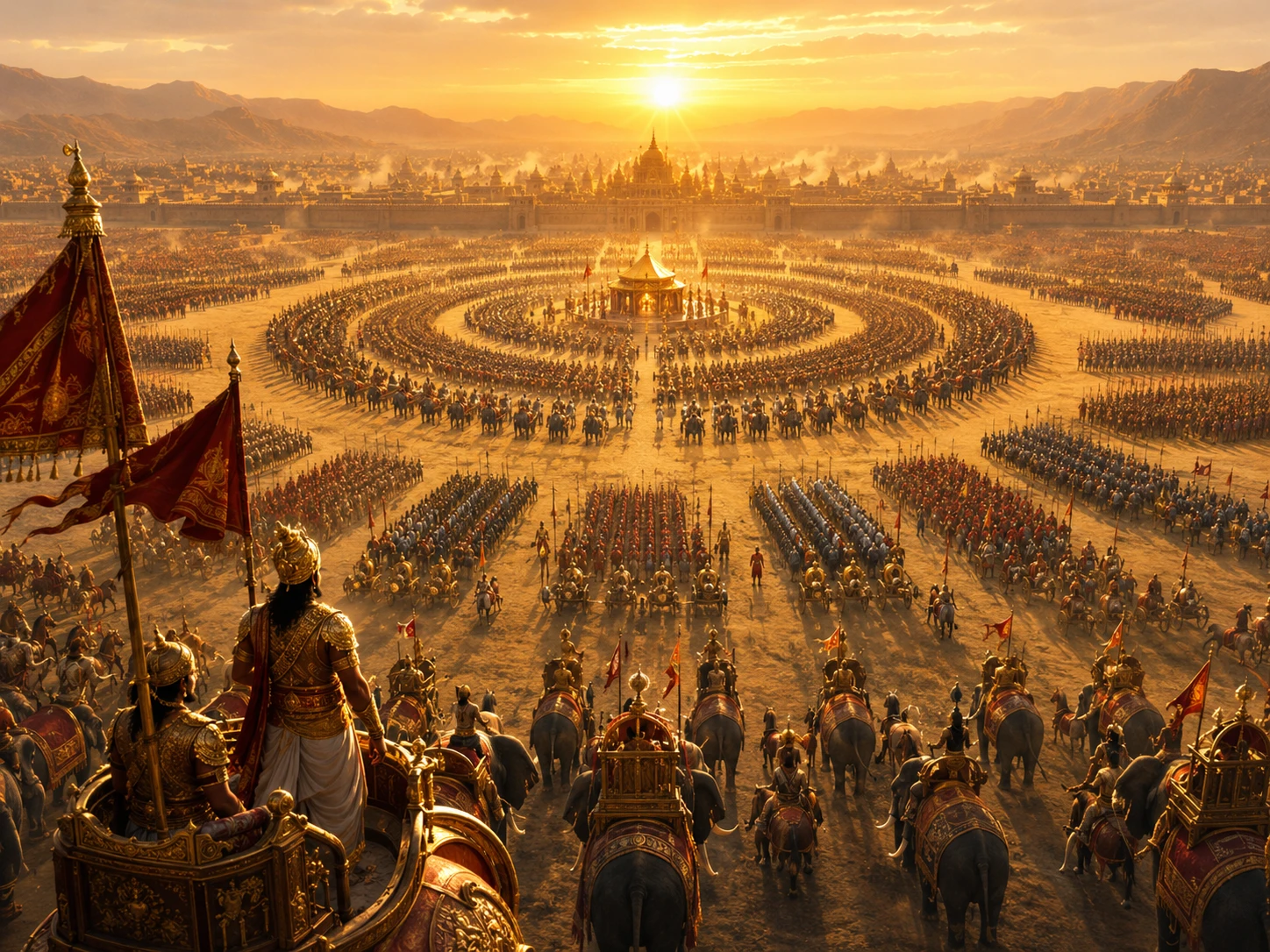
Akshauhini -- The Epic Army Structure Where Every Digit Sums to 18
अक्षौहिणी -- महाकाव्य सैन्य संरचना जहाँ हर अंक का योग 18 है
The Mahabharata does not merely describe battles. It describes the military system behind the battles -- with a precision that would satisfy any modern defence analyst.
In the Adi Parva (Book 1, Chapters 2.15-23), the sage Sruta is asked: 'What is an Akshauhini?' His answer is the most detailed description of a military hierarchy in any ancient text worldwide -- more specific than the Roman legion system, more structured than the Spartan phalanx documentation, and centuries older than Sun Tzu's organisational framework in The Art of War.
The system begins with the Patti -- the smallest tactical unit. One chariot (Ratha). One elephant (Gaja). Three horses (Ashva). Five foot soldiers (Padati). Total: 10 warriors. The ratio is 1:1:3:5. This ratio is not arbitrary. It encodes a fundamental combined-arms principle: the chariot provides mobile firepower and command elevation; the elephant provides shock force and battering capability; the cavalry provides speed and flanking; the infantry provides mass, occupation, and close combat. Every Patti is a self-contained combined-arms team -- the Bronze Age equivalent of a modern mechanised infantry squad that integrates armour, mobility, and dismounted troops.
From the Patti, the hierarchy scales through nine levels, each multiplying by three (except the final step, which multiplies by ten):
Patti (10) to Sena-Mukha (30) to Gulma (90) to Gana (270) to Vahini (810) to Prithana (2,430) to Chamu (7,290) to Anikini (21,870) to Akshauhini (218,700).
The base-3 multiplication at each level means that every commander at every level manages exactly three sub-units. This is a span of control of three -- remarkably close to the span of control recommended by modern military organisational theory (which typically recommends three to five direct reports for combat units). The Mahabharata's military architects understood intuitively what management science would formalise three millennia later: that a commander who manages more than five sub-units loses situational awareness, while one who manages fewer than three underutilises capacity.
एको रथो गजश्चैको नराः पञ्च पदातयः। त्रयश्च तुरगाः ज्ञेयं पत्तिरित्यभिधीयते॥
eko ratho gajaścaiko narāḥ pañca padātayaḥ | trayaśca turagāḥ jñeyaṃ pattir ity abhidhīyate ||
One chariot, one elephant, five foot soldiers, and three horses -- this is known as a Patti (the basic unit of an army).
— Mahabharata, Adi Parva 2.15 (Akshauhini description)
The Nine-Level Military Hierarchy -- From Patti to Akshauhini
| Level | Sanskrit Name | Chariots | Elephants | Cavalry | Infantry | Total Warriors | Modern Parallel |
|---|---|---|---|---|---|---|---|
| 1 | Patti (पत्ति) | 1 | 1 | 3 | 5 | 10 | Squad (8-12 soldiers) |
| 2 | Sena-Mukha (सेनामुख) | 3 | 3 | 9 | 15 | 30 | Section/Platoon |
| 3 | Gulma (गुल्म) | 9 | 9 | 27 | 45 | 90 | Company (~80-150) |
| 4 | Gana (गण) | 27 | 27 | 81 | 135 | 270 | Battalion (~300-800) |
| 5 | Vahini (वाहिनी) | 81 | 81 | 243 | 405 | 810 | Regiment (~800-1000) |
| 6 | Prithana (पृतना) | 243 | 243 | 729 | 1,215 | 2,430 | Brigade (~2,000-5,000) |
| 7 | Chamu (चमू) | 729 | 729 | 2,187 | 3,645 | 7,290 | Division (~10,000-15,000) |
| 8 | Anikini (अनीकिनी) | 2,187 | 2,187 | 6,561 | 10,935 | 21,870 | Corps (~20,000-40,000) |
| 9 | Akshauhini (अक्षौहिणी) | 21,870 | 21,870 | 65,610 | 109,350 | 218,700 | Field Army (~200,000+) |
The multiplication factor is x3 at each level from Patti to Anikini, then x10 from Anikini to Akshauhini. The 1:1:3:5 ratio (chariot:elephant:cavalry:infantry) is maintained at every level. Note the mathematical curiosity: 2+1+8+7+0 = 18, 6+5+6+1+0 = 18, 1+0+9+3+5+0 = 18. The number 18 -- the number of days of the Kurukshetra War, the number of Akshauhinis that fought, and the number of Parvas in the Mahabharata -- is encoded in the army's mathematics.
The Sacred Mathematics of 18 -- Coincidence or Design?
The number 18 runs through the Kurukshetra War like a cosmic watermark.
The war lasted 18 days. The total forces comprised 18 Akshauhinis (11 Kaurava + 7 Pandava). The Mahabharata has 18 Parvas (books). The Bhagavad Gita has 18 chapters. And as the Adi Parva calculation reveals, the digit sum of every component number in an Akshauhini is 18: chariots 21,870 (2+1+8+7+0 = 18), elephants 21,870 (18), cavalry 65,610 (6+5+6+1+0 = 18), infantry 109,350 (1+0+9+3+5+0 = 18).
This cannot be accidental. The architects of the Mahabharata's mathematical framework deliberately constructed the Akshauhini numbers so that the digital root of every component yields 18. This is a design decision, not a battlefield observation. It tells us that the Mahabharata's military system is not a field report transcribed by a war correspondent. It is a mathematically crafted structure in which the numbers carry symbolic weight alongside their military meaning.
18 in Hindu numerology represents completeness and the cycle of life-death-rebirth. 1+8 = 9, which is the number of Brahma (the creator), the number of Navagrahas (nine planets), and the digital root of all multiples of 9. The Mahabharata, by encoding 18 into its army structure, its narrative structure, and its philosophical structure (the Gita), creates a unified mathematical signature that binds war, philosophy, and cosmology into a single coherent framework.
For the data science student at ISI Kolkata or the mathematics student preparing for TIFR entrance: the Mahabharata's numerical architecture is a legitimate object of study. The deliberate construction of large numbers with specific digital roots, maintained across multiple independent calculations (army sizes, book counts, chapter counts, war duration), demonstrates mathematical sophistication of a high order -- whether the motivation was mystical, aesthetic, or mnemonic.
The encoding extends further. The total warriors in one Akshauhini: 218,700. 2+1+8+7+0+0 = 18. Total warriors in 11 Kaurava Akshauhinis: 2,405,700. 2+4+0+5+7+0+0 = 18. Total warriors in 7 Pandava Akshauhinis: 1,530,900. 1+5+3+0+9+0+0 = 18. The grand total of all warriors: 3,936,600. 3+9+3+6+6+0+0 = 27 = 2+7 = 9. And 9, as noted, is the digital root of 18 itself (1+8 = 9). The Mahabharata's mathematicians created a closed numerical system in which the sacred number 18 (and its root 9) permeates every level of the army's quantitative description. This is computational thinking of a sophisticated order -- predating formal number theory by centuries but demonstrating an intuitive grasp of modular arithmetic and digital root patterns that any IIT mathematics professor would recognise as non-trivial.
The 18 Akshauhinis of Kurukshetra -- Who Brought What
The Kaurava alliance assembled 11 Akshauhinis -- approximately 2,405,700 warriors. The contributing forces read like a geopolitical map of ancient India.
Bhishma commanded the entire force for the first ten days. The 11 Akshauhinis were contributed by: Hastinapura's own forces (Duryodhana and his brothers), Kripacharya's forces, Drona's forces, Shalya (King of Madra, modern Punjab), Jayadratha (King of Sindhu, modern Sindh/Rajasthan), Sudakshina of Kambhoja (with Yavana and Shaka mercenaries from Central Asia), Kritavarma (leading Krishna's Narayani Sena of Yadava warriors from Dwaraka), and the Samsaptaka and Trigarta forces. The diversity is striking: the Kaurava alliance included Indian, Central Asian, and possibly Greek (Yavana) soldiers.
The Pandava alliance assembled 7 Akshauhinis -- approximately 1,530,900 warriors. The forces were led by: Drupada and the Panchalas, Virata and the Matsyas, Kuntibhoja, Malayadhvaja Pandya (leading a combined Pandya-Chola-Chera force from deep South India), Satyaki and the Vrishni Yadavas, Abhimanyu's forces, and Ghatotkacha's Rakshasa contingent. The geographical spread is remarkable: from the Tamil South (Pandyas) to the Yadava West (Dwaraka) to the Panchala heartland.
The strategic imbalance is critical: 11 vs 7. The Kauravas had 58 percent more soldiers. In any conventional war, this numerical superiority would be decisive. That the Pandavas won despite being outnumbered nearly two-to-one is the Mahabharata's central military lesson: numerical superiority is necessary but not sufficient. Quality of leadership (Krishna's strategy), quality of individual warriors (Arjuna's matchless skill), morale (the Pandavas fought for dharma), and tactical adaptability (the vyuha counter-vyuha chess) mattered more than headcount.
For the IAS officer studying defence policy or the CAPF aspirant learning force structure: the Akshauhini system demonstrates that ancient India had formalised military logistics at a scale comparable to Roman imperial organisation. The precision of the numbers -- maintained through a consistent ratio across nine hierarchical levels -- implies a bureaucratic capacity to recruit, supply, pay, and coordinate forces of this magnitude. This is not myth. This is military administration.
The commanders-in-chief provide another layer of analysis. The Kaurava army cycled through four commanders in eighteen days: Bhishma (Days 1-10), Drona (Days 11-15), Karna (Days 16-17), and Shalya (Day 18 morning). Ashwatthama briefly commanded on the final night for the Sauptika raid. Each change of command reflected a crisis -- Bhishma was felled by Arjuna's arrows, Drona was killed after the deceptive announcement of Ashwatthama's death, Karna was killed by Arjuna on Day 17. The rapid turnover in senior leadership destabilised the Kaurava command structure and contributed significantly to their defeat.
The Pandavas, by contrast, had a single commander-in-chief for the entire war: Dhrishtadyumna. This stability of command -- combined with Krishna's strategic genius operating as an informal chief of staff -- gave the Pandava army a coherence that the numerically superior Kauravas could not match. The lesson is as relevant to corporate leadership as to military history: a smaller organisation with stable, trusted leadership will outperform a larger one plagued by leadership churn and internal politics. Every Nifty 50 boardroom power struggle, every startup co-founder breakup, every cricket team captaincy controversy is the Kaurava command crisis in miniature.
From Akshauhini to Chaturanga to Chess -- The Game That Encoded the Army
The most enduring legacy of the Akshauhini system is not military. It is recreational.
The game of Chaturanga -- invented in India during the Gupta period (4th-6th century CE) and widely considered the direct ancestor of modern chess -- takes its name from the four (chatur) divisions (anga) of the ancient Indian army: Ratha (chariot, which became the Rook), Gaja (elephant, which became the Bishop), Ashva (horse, which became the Knight), and Padati (infantry, which became the Pawn). The original Chaturanga was played on an 8x8 board called the Ashtapada, with four players representing four military divisions, and the objective was to capture the opponent's Raja (King) -- the same chain of command that placed the Raja at the centre of the Akshauhini.
Chaturanga migrated to Persia as Shatranj (from the Sanskrit Chaturanga, through Prakrit Chatrang), then to the Arab world, then to medieval Europe, where it evolved into modern chess. The Rook in chess is literally the Indian war chariot. The Knight is the Indian war horse. The checkered board is the Indian battlefield. And the fundamental logic of chess -- that different pieces have different movement capabilities and that victory depends on the coordinated deployment of heterogeneous forces -- is the Akshauhini principle compressed into a board game.
India gave the world chess. And chess is the Akshauhini -- the combined-arms military unit of the Mahabharata -- miniaturised for a table and played by 600 million people today. The next time Viswanathan Anand or D. Gukesh or Praggnanandhaa deploys a piece on the board, they are moving a soldier in a system that traces its genealogy directly to the Adi Parva's mathematical description of the Patti.
For the sports management student or the eSports professional: understanding that chess originated as a military simulation of the Akshauhini system transforms how you understand the game. It is not abstract. It is applied Dhanurvedic strategy, played at tabletop scale, with the same trade-offs between offence and defence, concentration and distribution, sacrifice and preservation that the Mahabharata's commanders faced on the fields of Kurukshetra.
The Aftermath -- When 3.9 Million Became 12
The most devastating statistic in the Mahabharata is not the army's size but its destruction.
Eighteen Akshauhinis entered the Kurukshetra War. Nearly four million warriors. At the end of eighteen days, the text records that barely a dozen survived from both sides combined. Five Pandava brothers: Yudhishthira, Bhima, Arjuna, Nakula, Sahadeva. Krishna and Satyaki from the Yadava contingent. Yuyutsu, the sole Kaurava brother who defected to the Pandava side before the war. Kripacharya, Ashwatthama, and Kritavarma from the Kaurava remnant.
The casualty mathematics are staggering. If 3,936,600 warriors fought and approximately 12 survived, the fatality rate approaches 99.9997 percent. No war in recorded human history -- not the Somme, not Stalingrad, not Hiroshima -- comes close to this proportion. The Mahabharata does not present this as triumph. It presents it as civilisational suicide. Yudhishthira's grief after the war, his refusal to celebrate, his desire to renounce the throne -- these are the responses of a man who has won everything and realised that winning has destroyed the world he was fighting to save.
The Stri Parva (Book of the Women) -- where Gandhari, Kunti, and the surviving women walk the battlefield and identify their dead husbands, sons, brothers, and fathers among the millions of corpses -- is the Mahabharata's Guernica. It is anti-war literature of the highest order, written three millennia before Wilfred Owen or Erich Maria Remarque.
The Akshauhini system, by giving the war its precise numerical scale, makes this devastation comprehensible. Without the numbers, the war is an abstraction. With them, the reader can calculate: 218,700 warriors per Akshauhini times 18 Akshauhinis = 3,936,600 human beings who woke up one morning with families, names, and futures, and did not survive the month. The mathematical precision is not decorative. It is deliberately designed to make the reader feel the weight of every single death.
For the student of conflict resolution at JNU or Ashoka University, for the IPS officer studying crowd management, for the peacekeeper deployed with the UN: the Akshauhini system's most important lesson is not how to organise an army. It is what happens when you use one. The Mahabharata is simultaneously the world's most detailed military manual and the world's most powerful anti-war text -- and the Akshauhini numbers are the bridge between the two.
The tradition says that the Kurukshetra War marked the transition from Dvapara Yuga to Kali Yuga -- from the age of duality to the age of darkness. The near-total annihilation of the Kshatriya class was not a side effect of this transition. It was the mechanism. The organised violence of the Akshauhini system, deployed to its logical extreme, destroyed the social order that created it. Every military system contains within it the seeds of its own civilisational destruction -- a truth that the Mahabharata understood and that the 20th century confirmed at Hiroshima and Nagasaki.
The total Kurukshetra War deployment was 18 Akshauhinis: 11 Kaurava + 7 Pandava = 3,936,600 warriors (not counting charioteers, attendants, and support personnel). The Mahabharata states that by the end of the 18-day war, only 12 warriors survived: 5 Pandava brothers, Krishna, Satyaki, Yuyutsu (from the Kaurava side), Kripacharya, Ashwatthama, Kritavarma, and Vrishaketu (Karna's son in some traditions). This means the casualty rate was approximately 99.9997 percent -- a figure that makes the war not just a military event but an apocalyptic one. The Mahabharata explicitly frames it this way: the Kurukshetra War marks the transition from Dvapara Yuga to Kali Yuga. The near-total destruction of the warrior class is not incidental to this transition -- it IS the transition. Meanwhile, the Indian Army's current total strength of approximately 1.4 million active personnel is roughly one-third of the Kaurava force alone. The Mahabharata's military imagination operated at a scale that modern India's army has yet to reach.
Build Your Inner Army -- The 10-Warrior Morning Practice
The Patti -- 10 warriors working as one unit -- is the foundation of the entire Akshauhini. Your morning practice is your personal Patti: 10 minutes that structure the entire day. Set a timer for a 10-minute sequence: 2 minutes of pranayama (the chariot -- breath drives everything), 3 minutes of japa (the cavalry -- mantra provides momentum), and 5 minutes of silent dhyana (the infantry -- stillness holds the ground). One Patti. Every morning. The rest of the day arranges itself. The Meditate section has the pranayama and dharana practices to fill it.
Tags
Eternal Raga · शाश्वत राग
Institutional voice — scholarly articles on Sanatan Dharma
Deepen Your Understanding
अपनी समझ और गहरी करें
divine arsenal
Vyuha Formations -- The Strategic Chess of Kurukshetra
Eighteen formations deployed across eighteen days. Every morning, the commander-in-chief chose a shape -- eagle, lotus, crescent, thunderbolt, tortoise, crocodile -- and nearly four million soldiers rearranged themselves accordingly. Each vyuha had a counter-vyuha. Each counter had a counter-counter. The Mahabharata's battle tactics are the world's oldest documented game theory -- played with real armies on a real field.
divine arsenal
Rules of War -- Dharmayuddha and the Geneva Conventions
Three thousand years before the Geneva Conventions, Indian warriors debated whether you could strike a man who had dropped his weapon. The Mahabharata's rules of engagement cover night fighting bans, non-combatant immunity, treatment of prisoners, proportional force, and the use of weapons of mass destruction -- and then shows what happens when every single rule is broken.
divine arsenal
Dhanurveda in the Agni Purana -- India's Ancient Science of Warfare
Long before Sun Tzu wrote The Art of War, India had the Dhanurveda -- a complete military science classified as an Upaveda of the Yajur Veda. Preserved in four chapters of the Agni Purana, it covers five warrior types, five weapon classes, nine combat stances, and a training philosophy that would make any NDA commandant nod in recognition.
divine arsenal
Astra vs Shastra -- The Two Classes of Weapons in Hindu Warfare
One is hurled with mantras and divine invocation. The other is wielded by hand and muscle. Understanding the fundamental difference between Astra and Shastra unlocks the entire weapons philosophy of ancient India.
scriptural exegesis
Abhimanyu and the Chakravyuha -- The Boy Who Knew How to Enter but Not How to Leave
On the 13th day of Kurukshetra, a sixteen-year-old boy broke into the deadliest military formation in the ancient world -- alone, because the adults who promised to follow him were blocked at the gate. He fought Drona, Karna, Ashwatthama, Kripa, Duryodhana, and Shalya simultaneously. He killed Duryodhana's son Lakshmana. He made Karna flee. He held an entire army at bay for hours. And then they killed him -- not in fair combat, but by surrounding him, destroying his chariot, breaking his weapons, and attacking from all sides at once. Abhimanyu's death is not a tragedy of weakness. It is a tragedy of incomplete knowledge sent to do a complete job.
divine arsenal
The Celestial Chariots -- Pushpaka Vimana, Arjuna's Ratha, and the Flying Machines of Hindu Mythology
Ravana's Pushpaka Vimana could fly across oceans and read its owner's mind. Arjuna's chariot bore Hanuman on its flag and was driven by God himself. These were not fairy tale carriages -- they may be literary encodings of technologies that ancient India actually possessed.
divine arsenal
10 Weapons That Changed the War
Across the Ramayana and Mahabharata, certain weapons did not merely kill -- they altered the course of history. From Rama shattering Shiva's bow to win Sita, to the Shakti that saved the Pandavas by killing the one person it should not have, these ten weapon-moments are the pivot points on which two epics turn.
The total Kurukshetra War deployment was 18 Akshauhinis: 11 Kaurava + 7 Pandava = 3,936,600 warriors (not counting charioteers, attendants, and support personnel). The Mahabharata states that by the end of the 18-day war…
More in Divine Arsenal
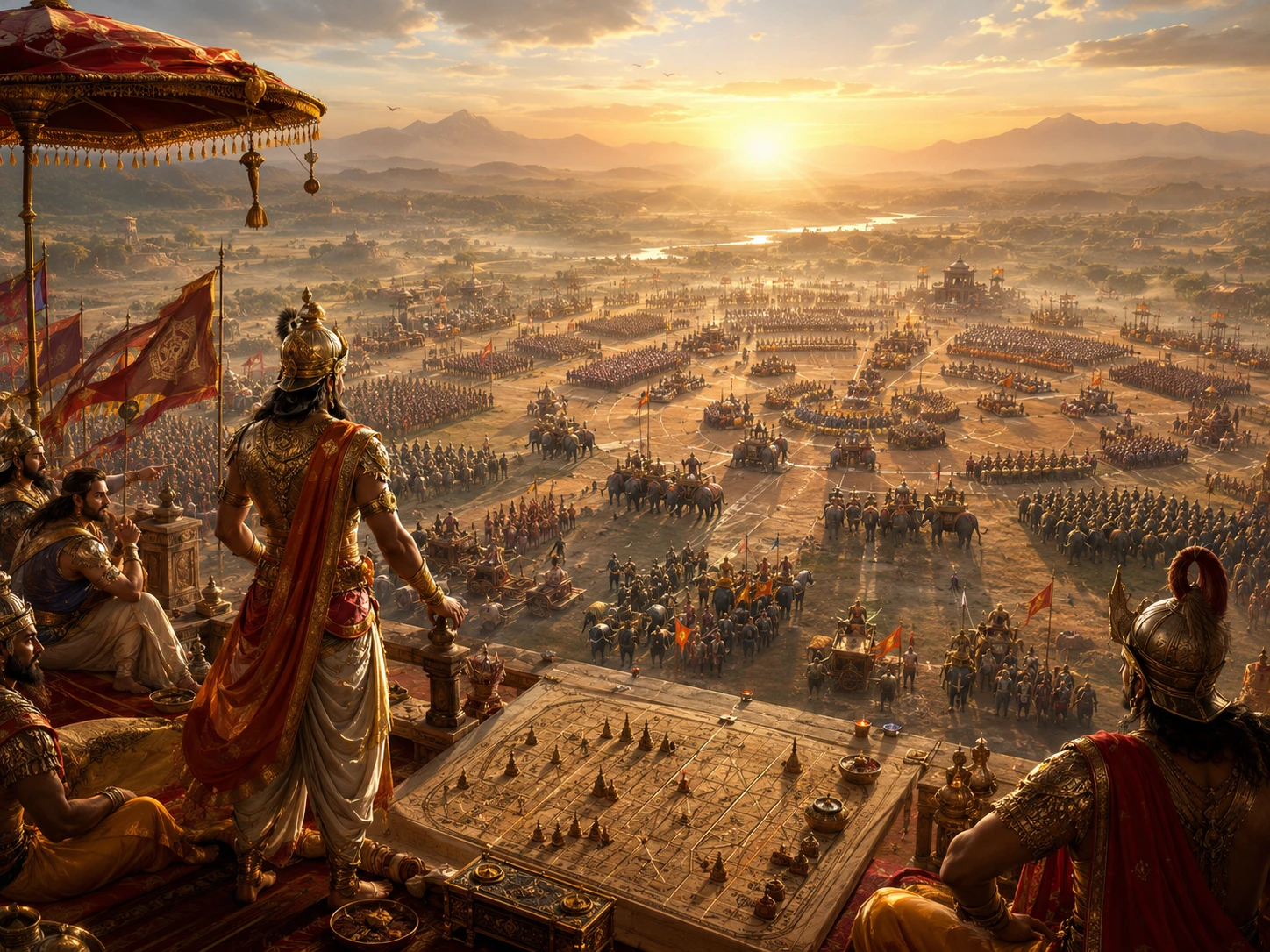
Ancient Indian Martial Arts -- Kalaripayattu to Malla-Yuddha
14 min read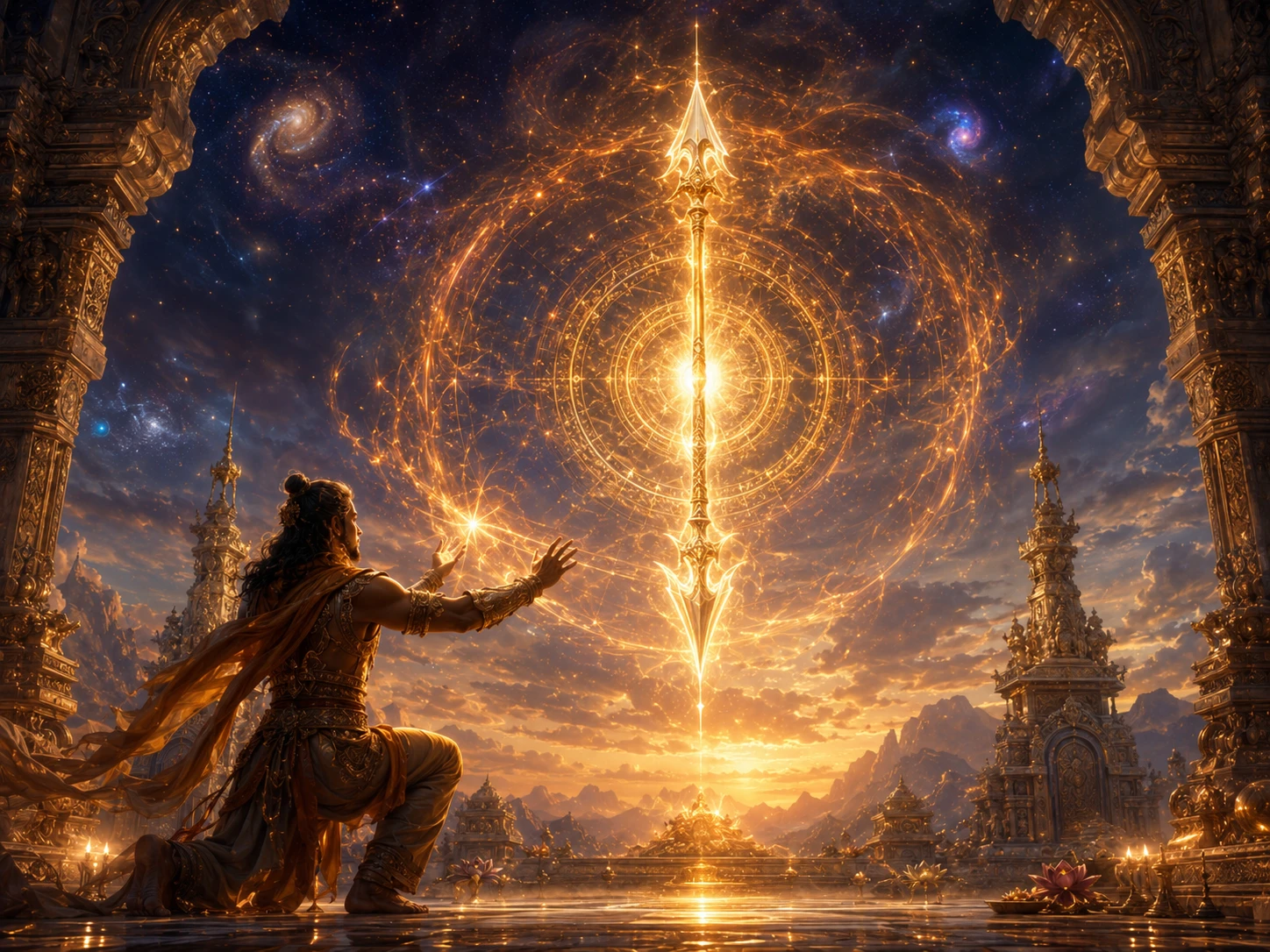
Astra Invocation and Withdrawal -- The Ritual of Weapons
16 min read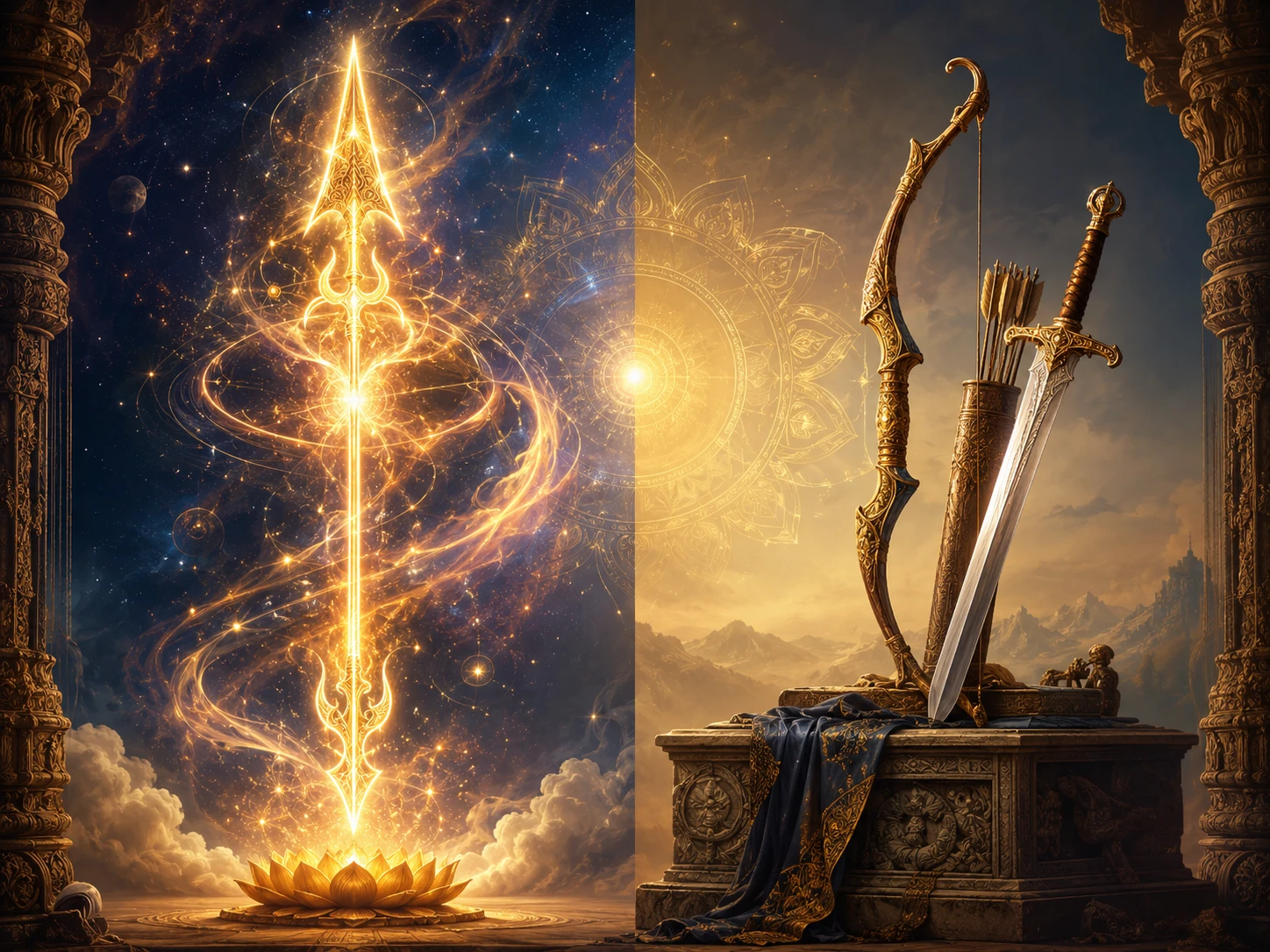
Astra vs Shastra -- The Two Classes of Weapons in Hindu Warfare
14 min readThe same translation error that turned '33 Koti' into '33 crore' in Hinduism also happened in Buddhism. The Chinese translation of Buddhist texts rendered 'Sapta Koti Buddha' (7 Supreme Buddhas) as '7 Crore Buddhas.' The…
Deities AvatarsCommunity Reflections
🕉️
Be the first to share your reflection.