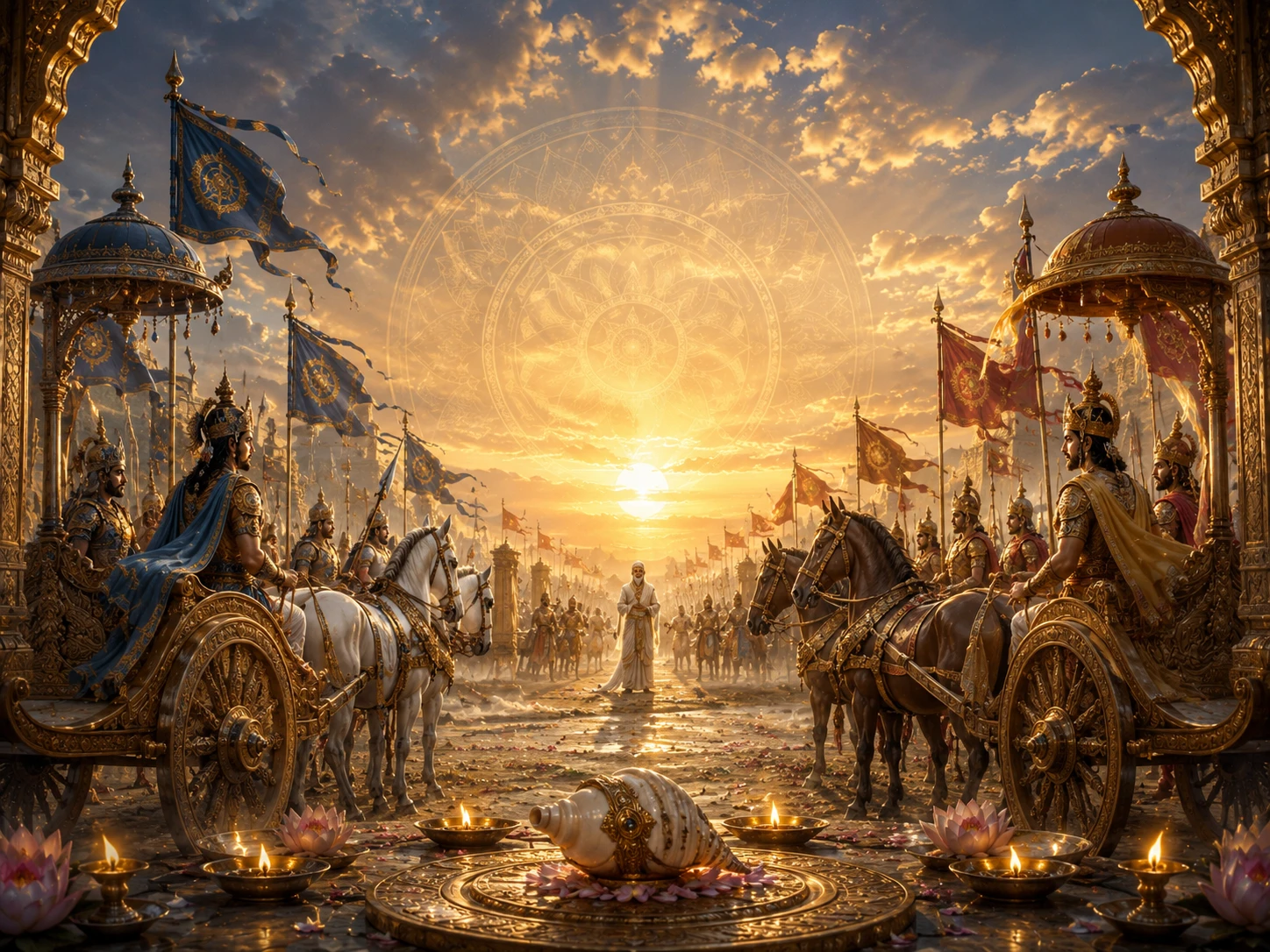
Rules of War -- Dharmayuddha and the Geneva Conventions
युद्ध के नियम -- धर्मयुद्ध और जेनेवा संधि
War, in the Hindu tradition, is never just violence. It is a moral event. Every arrow has an ethical weight. Every strategy carries a dharmic price. The Mahabharata -- the longest epic poem in human history, seven times the combined length of the Iliad and Odyssey -- is fundamentally a sustained argument about whether rules can survive the chaos of war, and what happens to civilisation when they do not.
The concept of Dharmayuddha (righteous war) is not a vague aspiration. It is a codified system of rules, debated by warriors, endorsed by kings, and refereed -- in theory -- by senior commanders. These rules predate the Geneva Conventions by approximately three thousand years. Some are strikingly similar. Others are more restrictive than anything modern international humanitarian law has produced. And the Mahabharata's most devastating insight is not that such rules existed, but that every single one of them was broken during the war -- systematically, escalatingly, and with consequences that haunt the victors more than the defeated.
न विषेण न बाणैश्च कूटैर्नास्त्रैः सुतीक्ष्णकैः। न ज्वलद्भिर्न दिग्धैश्च युध्येत धर्मविच्छुचिः॥
na vishena na baanaishca kuutairnaastraih sutiikshnakaih | na jvaladbhirna digdhaishca yudhyeta dharmavicchucih ||
A warrior who knows dharma and is pure should not fight with poisoned weapons, barbed arrows, deceptive devices, excessively sharp weapons, flaming projectiles, or arrows smeared with toxic substances.
— Mahabharata, Shanti Parva, Adhyaya 95 (Rajadharma Section)
The codified rules of Dharmayuddha, as described across the Mahabharata (primarily Udyoga Parva and Shanti Parva) and Kautilya's Arthashastra (4th century BCE), form a remarkably comprehensive framework. The core prohibitions cluster into several categories that map directly onto modern international humanitarian law.
The first and most fundamental: fight only equals. A horseman must not attack a foot soldier. A charioteer must not attack a horseman. An armed warrior must not attack an unarmed one. A warrior engaged with another opponent must not be attacked from behind. This principle of proportional engagement has no direct modern equivalent at the individual level -- even the Geneva Conventions do not require combatants to match each other in equipment.
The second: temporal restrictions. Fighting must cease at sunset and resume at sunrise. Night attacks are prohibited. During the night, opposing warriors may socialise, share water, and even tend each other's wounds. The Mahabharata records instances of Kaurava and Pandava warriors eating together at night during the 18-day war. This is not idealism; it is recorded practice.
The third: non-combatant immunity. Women, children, the aged, Brahmins, farmers tilling fields, merchants transporting goods, and anyone not bearing arms must not be attacked. Animals not serving a military function (particularly cows and elephants not in war formation) are protected. Medical personnel tending to the wounded are immune. Supply carriers providing food and water are immune.
Dharmayuddha Rules vs Geneva Conventions -- Direct Comparison
| Rule Domain | Dharmayuddha (Mahabharata / Arthashastra) | Geneva Conventions (1949) / IHL | Verdict |
|---|---|---|---|
| Non-combatant immunity | Women, children, aged, Brahmins, farmers, merchants protected | Civilians protected under Fourth Geneva Convention (1949) | Near identical. Dharmayuddha 3,000 years earlier. |
| Night fighting | Strictly prohibited. Fighting ceases at sunset. | No prohibition. Night operations routine in modern warfare. | Dharmayuddha MORE restrictive. |
| Proportional engagement | Fight only equals: horse vs horse, chariot vs chariot | Proportionality principle applies to attacks, not individual matchups | Dharmayuddha MORE restrictive at individual level. |
| Poisoned weapons | Explicitly banned (Shanti Parva verse above) | Chemical Weapons Convention (1993) bans chemical/biological agents | Similar scope. Dharmayuddha ~3,000 years earlier. |
| Wounded/surrendered | Must not be struck. Must receive treatment. | Third Geneva Convention protects prisoners of war | Near identical. |
| Weapons of mass destruction | Brahmastra restricted to single-target use; mass-kill Astras carry karmic curse | Nuclear Non-Proliferation Treaty (1968); no universal ban on nuclear use | Dharmayuddha imposed spiritual consequences; modern law relies on treaties. |
| Retreating enemy | Must not be pursued beyond the battlefield | No equivalent prohibition in modern IHL | Dharmayuddha MORE restrictive. |
| Environmental destruction | Forests, water sources, agricultural land must not be targeted | Protocol I (1977) Article 55 protects natural environment | Similar. Dharmayuddha codified earlier. |
| Medical personnel | Vaids treating wounded are immune from attack | First Geneva Convention (1864) protects medical personnel | Near identical. |
| Truth in combat | Deception in strategy allowed; lying about identity or surrender forbidden | Perfidy (feigning surrender/civilian status) banned under Protocol I | Near identical. |
Of 10 compared domains, Dharmayuddha is more restrictive in 3, nearly identical in 6, and comparable in 1. The ancient Indian framework achieved moral sophistication that modern international law reached only in the 19th-20th centuries.
The Mahabharata's true genius is not that it presents these rules as aspirational ideals. It presents them as rules that were broken -- and then it forces you to watch the consequences.
The first major violation occurs on Day 10 when Arjuna uses Shikhandi as a human shield against Bhishma. Bhishma had vowed never to fight someone born female, and Shikhandi was born as Amba in a previous life. The Pandavas exploit this vow. Technically, Arjuna fires the arrows. Morally, the entire tactic is a deception that violates the spirit of equal combat.
On Day 13, Abhimanyu -- a sixteen-year-old boy -- is trapped in the Chakravyuha formation and killed by seven warriors simultaneously. This violates the one-on-one combat rule, the prohibition on attacking a minor, and the ban on ganging up on a single warrior. The Kaurava commander Drona sanctions it. The moral damage is irreversible.
Day 14 brings the death of Jayadratha, which Arjuna accomplishes only because Krishna creates a false sunset using his Sudarshana Chakra. The Kauravas, believing the day has ended and the fighting rules apply, lower their guard. Arjuna strikes. This violates the temporal restriction on combat and involves divine-level deception.
Day 15 sees the death of Drona himself through a direct lie. Yudhishthira -- known as Dharmaraja, the king of righteousness -- tells Drona that 'Ashwatthama is dead' (referring to an elephant, not Drona's son). Krishna instructs him to mumble the clarification. Drona, grief-stricken, lays down his weapons and is killed. The most righteous man on the Pandava side has committed the most unrighteous act of the war.
By Day 18, when Duryodhana is struck below the waist by Bhima in their mace duel -- violating the explicit rules of Gadayuddha -- the moral framework has completely collapsed. Both sides have committed war crimes. The victory is hollow. Gandhari, mother of the Kauravas, curses Krishna and the entire Yadava clan to destruction. The curse is fulfilled. The Mahabharata does not allow its heroes to escape the consequences of broken rules.
India's National Defence Academy (NDA) in Khadakwasla, Pune includes Mahabharata war ethics in its military ethics curriculum. The Defence Services Staff College (DSSC) in Wellington, Tamil Nadu uses the Kurukshetra war as a case study in strategic decision-making. In 2017, the Indian Army's Counter Insurgency and Jungle Warfare School (CIJWS) in Mizoram introduced a module comparing Dharmayuddha principles with the Laws of Armed Conflict (LOAC). Indian military doctrine explicitly draws on the principle that 'victory without dharma is defeat' -- a direct Mahabharata teaching.
Kautilya's Arthashastra, composed roughly in the 4th century BCE, takes a harder line than the Mahabharata. Kautilya distinguishes between Dharmayuddha (open battle with declared rules), Kutayuddha (covert warfare involving espionage, assassination, and economic sabotage), and Mantrayuddha (diplomatic warfare waged through alliances and propaganda). He considers all three legitimate tools of statecraft.
Yet even Kautilya imposes constraints. Conquered territories must be administered justly. Prisoners who surrender must be spared. Religious institutions must not be targeted. Agricultural land must be preserved because it feeds the very population the conqueror now governs. This is not morality for its own sake -- it is strategic morality. Kautilya understands that a ruler who destroys what he conquers rules over nothing.
For any UPSC aspirant preparing for General Studies Paper IV (Ethics) in Old Rajinder Nagar, the Dharmayuddha framework is not a footnote. It is a primary source for Indian ethical tradition in governance and warfare. The Indian Armed Forces' own doctrine of 'minimum force' in counter-insurgency operations traces its philosophical lineage to these texts. When the Indian Army operates under the Armed Forces Special Powers Act (AFSPA) in disturbed areas, the internal debate about proportionality and civilian protection echoes arguments that Bhishma and Arjuna had on the fields of Kurukshetra.
The International Committee of the Red Cross (ICRC) published a 2003 study titled 'The Roots of Restraint in War' that examined ancient Indian, Chinese, Islamic, and African traditions of warfare. The study found that Mahabharata-era rules of engagement were among the most detailed pre-modern codes of armed conflict in any civilisation. The Indian chapter cited the prohibition on attacking the wounded, the immunity of non-combatants, and the ban on poisoned weapons as being 'functionally equivalent' to provisions of the 1949 Geneva Conventions -- predating them by approximately 2,500 years.
Chant the Bhishma Stuti
Bhishma, the grandsire who taught the rules of dharmayuddha, sang his hymn to Krishna from the bed of arrows, as the Bhagavata Purana tells it. The Bhishma Stuti is on Eternal Raga with its meaning; the Vishnu Sahasranama, which tradition holds Bhishma taught Yudhishthira from that same bed, is on the site too.
Tags
Eternal Raga · शाश्वत राग
Institutional voice — scholarly articles on Sanatan Dharma
Deepen Your Understanding
अपनी समझ और गहरी करें
divine arsenal
Astra vs Shastra -- The Two Classes of Weapons in Hindu Warfare
One is hurled with mantras and divine invocation. The other is wielded by hand and muscle. Understanding the fundamental difference between Astra and Shastra unlocks the entire weapons philosophy of ancient India.
divine arsenal
10 Weapons That Changed the War
Across the Ramayana and Mahabharata, certain weapons did not merely kill -- they altered the course of history. From Rama shattering Shiva's bow to win Sita, to the Shakti that saved the Pandavas by killing the one person it should not have, these ten weapon-moments are the pivot points on which two epics turn.
divine arsenal
Pashupatastra -- The Supreme Weapon Never Used
The most fearsome weapon in the Mahabharata was never deployed on the battlefield. Shiva granted it to Arjuna after a wrestling match in the forests of Indrakila, yet Arjuna carried it through all eighteen days of Kurukshetra without ever invoking it. The Pashupatastra's true power lay not in its destruction, but in its restraint -- a philosophy that modern nuclear doctrine would independently discover thousands of years later.
divine arsenal
The Celestial Chariots -- Pushpaka Vimana, Arjuna's Ratha, and the Flying Machines of Hindu Mythology
Ravana's Pushpaka Vimana could fly across oceans and read its owner's mind. Arjuna's chariot bore Hanuman on its flag and was driven by God himself. These were not fairy tale carriages -- they may be literary encodings of technologies that ancient India actually possessed.
divine arsenal
The Cosmic Forge -- Vishwakarma, Divine Engineer
Every divine weapon. Every celestial city. Every flying chariot. They all have the same maker. Vishwakarma -- the architect of the gods -- built Lanka for Kubera, Dwarka for Krishna, Indraprastha for the Pandavas, and forged every weapon in the divine arsenal. He is the patron deity of Indian engineers, craftsmen, and factory workers, worshipped annually on Vishwakarma Puja with the tools of modern industry laid at his feet.
philosophy darshana
Karma Explained -- Not Punishment, Not Reward, but the Physics of Action
Karma is not cosmic revenge. It is not 'what goes around comes around.' It is India's most sophisticated theory of causation -- a framework that explains why your choices matter, why consequences are inescapable, and why freedom is still possible. The Gita's karma teaching changed Oppenheimer's life. It might change yours.
scriptural exegesis
Gita Chapter 2 -- Sankhya Yoga: The Chapter That Changed Indian Philosophy Forever
Arjuna drops his bow. His hands shake. He tells Krishna he would rather beg for food than kill his teachers and cousins. Krishna's response in Chapter 2 is the philosophical backbone of the entire Gita -- covering the immortality of the soul, the ethics of action without attachment, and the portrait of the Sthitaprajna (the person of steady wisdom). This single chapter contains more quotable verses than most entire scriptures. 'Karmanye vadhikaraste' lives on WhatsApp statuses for a reason.
India's National Defence Academy (NDA) in Khadakwasla, Pune includes Mahabharata war ethics in its military ethics curriculum. The Defence Services Staff College (DSSC) in Wellington, Tamil Nadu uses the Kurukshetra war …
More in Divine Arsenal
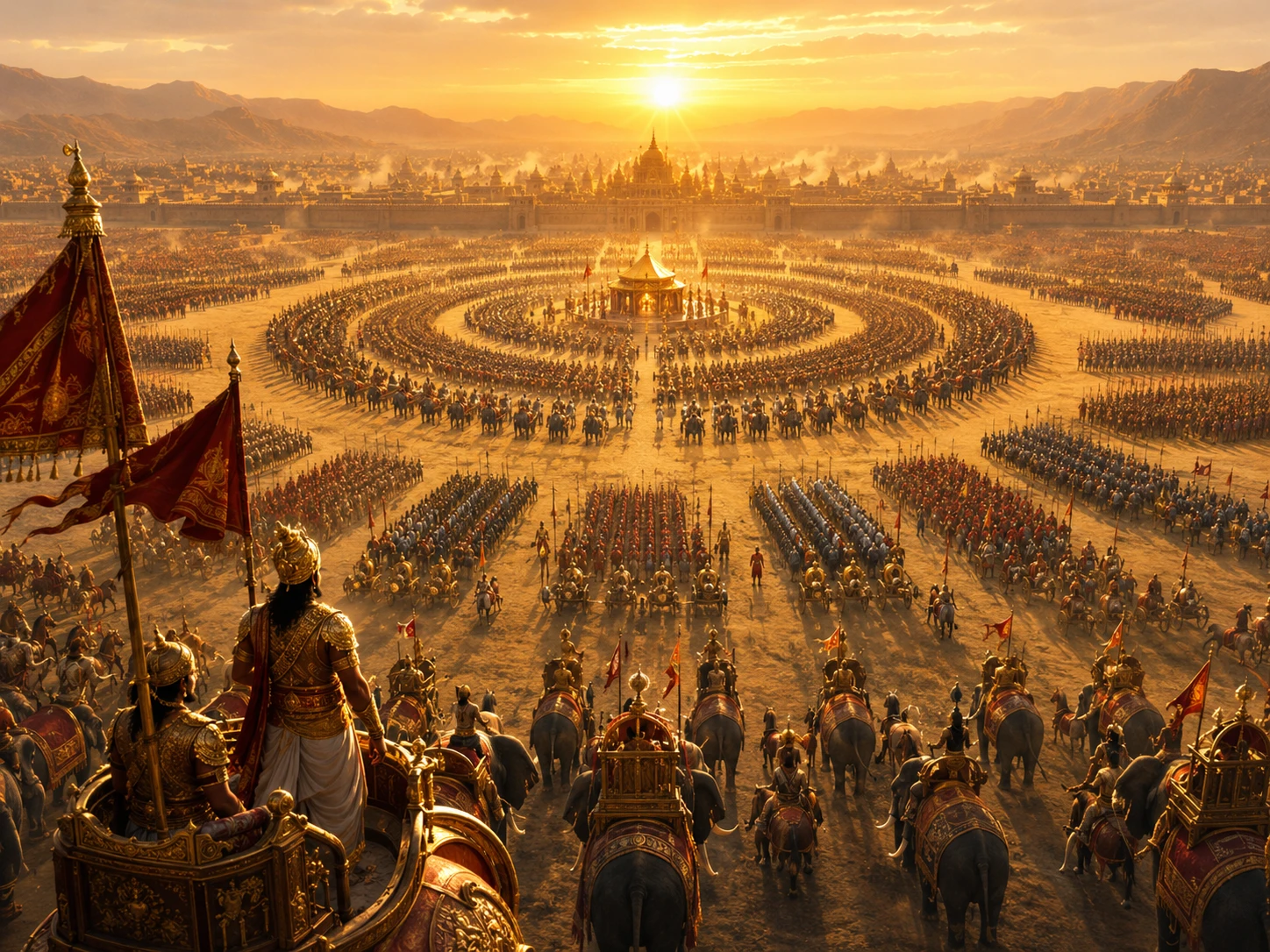
Akshauhini -- The Epic Army Structure Where Every Digit Sums to 18
14 min read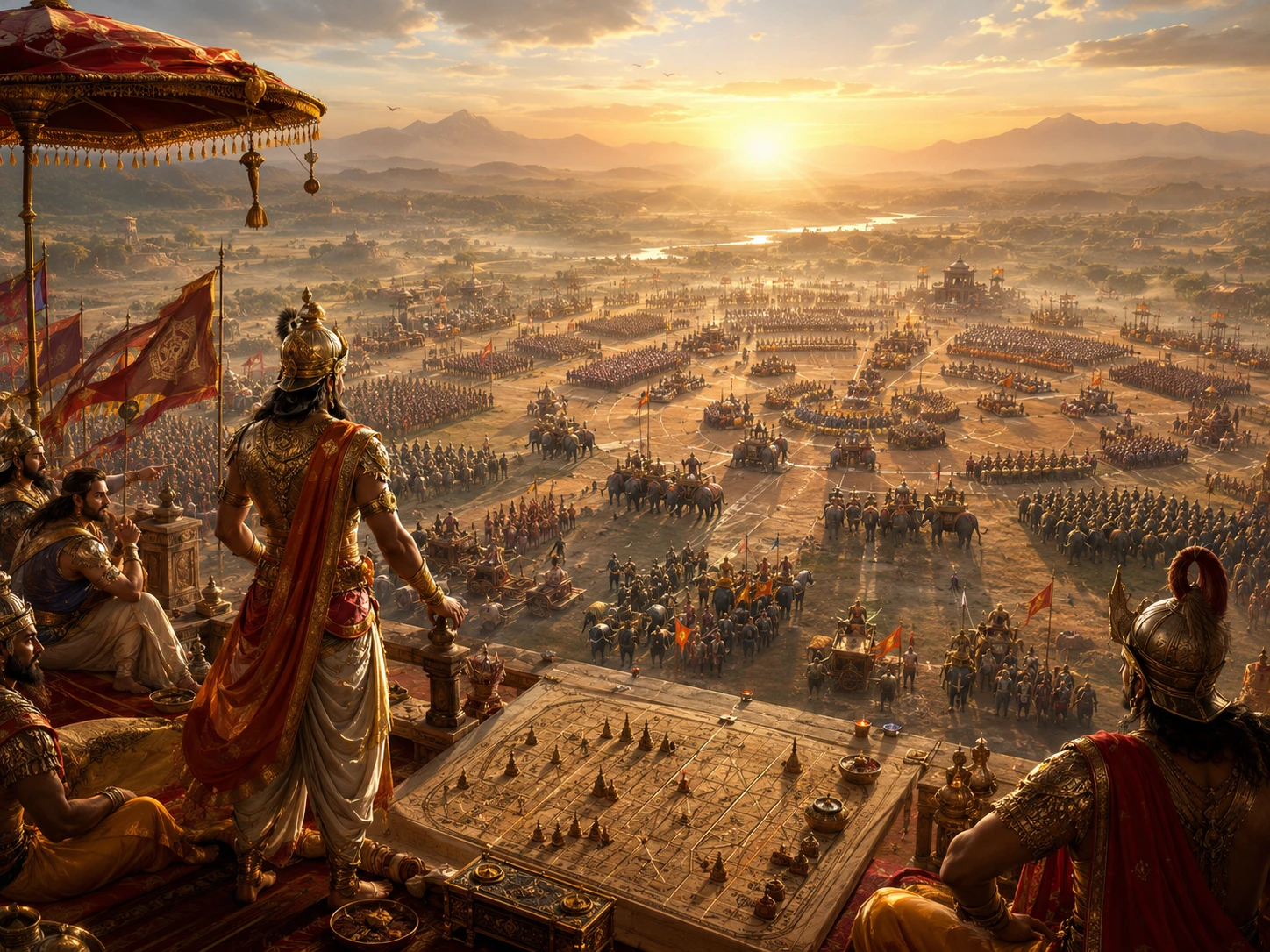
Ancient Indian Martial Arts -- Kalaripayattu to Malla-Yuddha
14 min read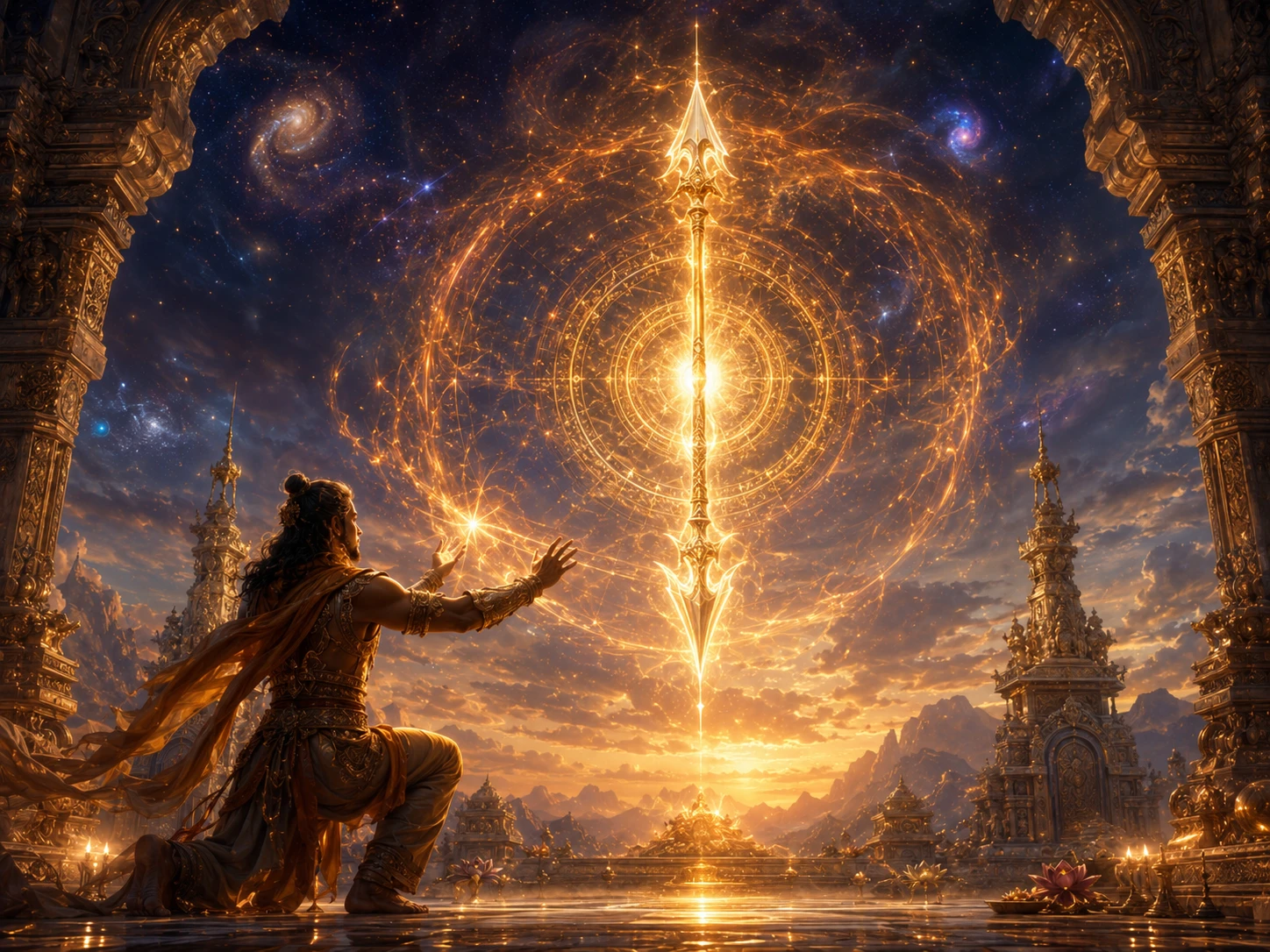
Astra Invocation and Withdrawal -- The Ritual of Weapons
16 min readThe same translation error that turned '33 Koti' into '33 crore' in Hinduism also happened in Buddhism. The Chinese translation of Buddhist texts rendered 'Sapta Koti Buddha' (7 Supreme Buddhas) as '7 Crore Buddhas.' The…
Deities AvatarsCommunity Reflections
🕉️
Be the first to share your reflection.