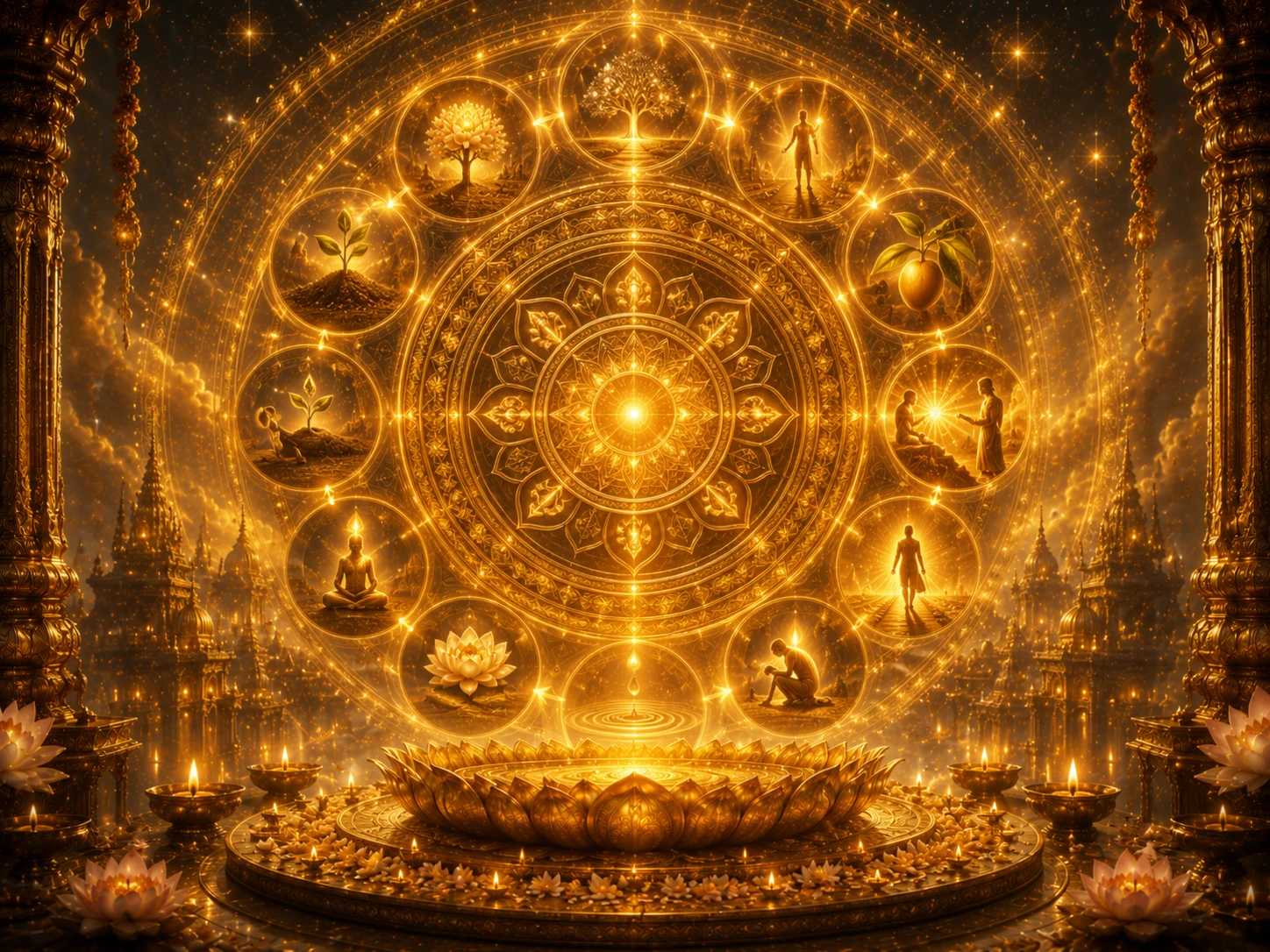
Karma Explained -- Not Punishment, Not Reward, but the Physics of Action
कर्म विस्तार से -- न दण्ड, न पुरस्कार, बल्कि क्रिया का भौतिकशास्त्र
The most misused word in the English-speaking world might be 'karma.' It is slapped onto Instagram captions about ex-boyfriends getting flat tires. It is invoked when a rude colleague gets passed over for promotion. It shows up in Hollywood dialogue as cosmic revenge: 'Karma's a ___.' This version of karma is satisfying, simple, and almost entirely wrong.
Karma -- from the Sanskrit root 'kri,' meaning 'to do' or 'to act' -- is not a system of cosmic punishment and reward. It is a theory of causation. Every action (karma) produces an impression (samskara) on the doer's consciousness. That impression shapes future tendencies (vasanas), which influence future actions, which create new impressions. This is not a cycle of punishment. It is a cycle of conditioning -- and the entire point of Indian philosophy is to show you how to step out of it.
The earliest concept of karma appears in the Brihadaranyaka Upanishad (roughly 8th-7th century BCE), where Yajnavalkya tells Artabhaga in a whispered conversation -- because the teaching was considered dangerous -- that a person becomes good by good action and bad by bad action. But even here, 'good' and 'bad' do not mean what a Western reader might assume. They refer not to moral judgement by an external authority but to the quality of conditioning produced in the doer's own consciousness.
The Bhagavad Gita transformed karma theory from a mechanism of bondage into a path of liberation. Krishna does not tell Arjuna to stop acting -- that would be impossible for a living being. He tells Arjuna to act without attachment to results. This is nishkama karma -- desireless action -- and it is one of the most psychologically sophisticated concepts any civilisation has produced.
Consider what it means practically. A surgeon performing an operation cannot control whether the patient lives or dies -- too many variables are beyond her control. But she can control the quality, skill, and intention she brings to the surgery. Nishkama karma says: put your entire being into the action and release the outcome. This is not passivity. This is the most intense engagement possible -- because you are fully present in the action without the distraction of anxiety about results.
Every JEE aspirant in Kota intuitively understands this when they are in flow during a mock test -- the moment when the math problems absorb complete attention and the question of 'will I get into IIT?' temporarily vanishes. That absorption, that union of doer and action, is what the Gita means by karma yoga.
कर्मण्येवाधिकारस्ते मा फलेषु कदाचन। मा कर्मफलहेतुर्भूर्मा ते सङ्गोऽस्त्वकर्मणि॥
karmanyevaadhikaaraste maa phaleshu kadaachana | maa karmaphalaheturbhuurmaa te sango'stvakarmaṇi ||
Your right is to action alone, never to its fruits. Do not let the fruit of action be your motive, nor let your attachment be to inaction.
— Bhagavad Gita, Chapter 2, Verse 47
The Indian philosophical tradition classifies karma into three types, and understanding this classification is essential to grasping the system's sophistication.
Sanchita Karma is the accumulated storehouse -- the total sum of all actions from all past lives. Think of it as your cosmic bank account, containing every deposit and withdrawal from every lifetime. This storehouse is vast beyond comprehension. It contains the seeds of tendencies, talents, fears, attractions, and aversions that you carry into each new life without conscious memory of their origin.
Prarabdha Karma is the portion of Sanchita that has 'ripened' and is currently bearing fruit in this lifetime. It determines the circumstances of your birth -- family, body, country, era, and certain broad life conditions. Prarabdha is what you cannot change. Being born in Pune rather than Paris, into a particular family, with a particular body -- these are prarabdha. Even a jnani (enlightened person), the tradition says, must live out prarabdha karma. Ramana Maharshi had cancer. Ramakrishna had throat cancer. Their enlightenment did not cancel the body's prarabdha.
Kriyamana Karma (also called Agami) is the karma you are creating right now, through present actions and choices. This is the domain of free will. Prarabdha determines the field of play; Kriyamana determines how you play. You did not choose your JEE coaching centre (prarabdha, set by family circumstances). But how you study, how much effort you invest, whether you cheat or stay honest -- that is Kriyamana, and it is entirely yours.
This three-part classification is what saves karma theory from fatalism. The popular misconception -- 'everything is karma, so nothing can be changed' -- ignores the crucial distinction between prarabdha (fixed) and kriyamana (free). The tradition insists that present action matters enormously. You are not merely experiencing past karma; you are creating future karma with every choice. The past constrains; the present creates.
This is why the Gita emphasises action over passivity. Krishna does not tell Arjuna to sit down and accept his fate. He tells him to fight -- but to fight without attachment to victory or defeat. The action is mandatory; the attachment is optional. This is not a philosophy for quitters. It is a philosophy for people who want to act with maximum effectiveness and minimum anxiety.
The question every philosophy class asks -- 'If karma is inescapable, where is free will?' -- has a precise Indian answer: you are free in the kriyamana dimension. You cannot rewrite yesterday, but you can write today. The weight of sanchita and prarabdha is real, but it does not eliminate choice. It provides the context within which choice operates. A cricket analogy works here: you do not choose the pitch (prarabdha), but you absolutely choose how you bat (kriyamana).
न हि कश्चित्क्षणमपि जातु तिष्ठत्यकर्मकृत्। कार्यते ह्यवशः कर्म सर्वः प्रकृतिजैर्गुणैः॥
na hi kashchitkshanamaapi jaatu tishthatyakarmakrt | kaaryate hyavashah karma sarvah prakrtijairgunaih ||
No one can remain even for a moment without performing action; everyone is helplessly driven to act by the qualities born of Prakriti (nature).
— Bhagavad Gita, Chapter 3, Verse 5
Karma operates differently across the six darshanas, and these differences matter.
In Purva Mimamsa, karma is literal ritual action. Perform the prescribed yajna correctly, and a metaphysical potency called 'apurva' is generated that guarantees the result -- rain, prosperity, progeny, or heaven. There is no God distributing results. The universe itself is an impersonal karmic mechanism.
In Samkhya and Yoga, karma creates impressions (samskaras) on the chitta (mind-stuff). These samskaras form patterns (vasanas) that drive future behaviour. Liberation is achieved when all samskaras are 'burnt' through discriminative knowledge (Samkhya) or yogic practice (Yoga). The metaphor is agricultural: karma plants seeds, vasanas are the stored seeds, and life experiences are the harvest.
In Advaita Vedanta, karma is ultimately sublated by knowledge. Once you realise your identity as Brahman, the question 'whose karma?' loses meaning because the individual self that accumulated karma is revealed to be illusory. Sanchita karma is destroyed at the moment of realisation. Prarabdha continues until the body falls (like a potter's wheel that keeps spinning after the potter lifts his hand). Kriyamana ceases because the enlightened being no longer identifies with the doer.
In Vishishtadvaita and Dvaita, karma is administered by Ishvara (God). God is the karmic accountant who ensures that every being receives exactly what their karma warrants. Surrender to God (prapatti/sharanagati) can neutralise even accumulated karma -- this is the theological basis for the bhakti movement's insistence that divine grace transcends karmic law.
These are not minor theological quibbles. They represent fundamentally different models of how the universe works, how liberation happens, and what role God (if any) plays in human destiny. A Mimamsaka lives in a godless universe of pure action-reaction. A Vishishtadvaitin lives in a universe governed by a loving God who adjusts karma with grace. Both claim Vedic authority. Both have rigorous arguments. The tradition preserves both.
Modern India inherits all these models simultaneously, often without realising it. When your grandmother says 'it was written in your karma,' she is expressing a Mimamsa-flavoured determinism. When she also says 'pray to Hanuman and things will get better,' she is expressing Vishishtadvaita-flavoured grace theology. These are technically contradictory -- yet both coexist comfortably in Indian households because Indian civilisation has always been comfortable holding multiple frameworks at once.
Three Types of Karma
| Type / प्रकार | Sanskrit / संस्कृत | Nature / स्वरूप | Can Be Changed? / परिवर्तनीय? | Modern Analogy / आधुनिक उपमा |
|---|---|---|---|---|
| Accumulated / संचित | Sanchita / संचित | Total storehouse from all past lives / समस्त पूर्वजन्मों का कुल भण्डार | Destroyed by Brahma-jnana / ब्रह्मज्ञान से नष्ट | Hard drive -- total stored data / हार्ड ड्राइव -- कुल संग्रहीत डेटा |
| Current / वर्तमान | Prarabdha / प्रारब्ध | Portion ripened for this life / इस जन्म के लिए पका भाग | Must be experienced / भोगना अनिवार्य | Currently running app / वर्तमान में चल रहा app |
| Being Created / रचा जा रहा | Kriyamana / क्रियमाण | Karma being created now / अभी रचा जा रहा कर्म | Fully in your control / पूर्णतः तुम्हारे नियन्त्रण में | Code you are writing now / अभी लिखा जा रहा code |
The crucial insight: prarabdha constrains but kriyamana liberates. You are never merely a victim of past karma -- you are always also a creator of future karma.
Robert Oppenheimer, the physicist who led the Manhattan Project, was a devoted reader of the Bhagavad Gita in Sanskrit. His famous quote after the first nuclear test -- 'Now I am become Death, the destroyer of worlds' -- is from Gita Chapter 11, Verse 32 (kalo'smi lokakshayakrt pravrddho). But the Gita verse that shaped his daily life was the karma yoga teaching of Chapter 2, Verse 47. He kept the Gita on his office shelf at Los Alamos and reportedly said it was the most influential book he had ever read. Today, the Indian Army's Officer Training Academy in Chennai includes karma yoga concepts in its leadership curriculum, and IIM Ahmedabad's Post-Graduate Programme includes sessions on the Gita's management philosophy -- recognition that karma theory is not just spiritual wisdom but a practical framework for decision-making under uncertainty.
There are common objections to karma theory that deserve honest engagement.
The first is the social justice objection: 'Karma is used to justify caste oppression. If someone is born into a lower caste, is that their karma? Does that mean they deserve it?' This objection has genuine historical weight. Karma theory has been misused to naturalise social hierarchy -- to tell the oppressed that their suffering is deserved. This misuse is real, and any intellectually honest treatment of karma must acknowledge it.
But the misuse does not invalidate the concept itself. The Gita explicitly says (Chapter 4, Verses 13-14) that the four varnas were created by guna (quality) and karma (action), not by birth. 'Chaturvarnyam maya srishtam gunakarmavibhagashah' -- I created the four-fold order according to the division of qualities and actions. This is a meritocratic claim, not a hereditary one. The later conflation of varna with jati (birth-caste) is a social distortion, not a philosophical necessity.
The second objection is the evidence problem: 'How do you verify past-life karma? It is unfalsifiable.' This is a legitimate scientific critique. Karma theory, in its past-life dimension, cannot be empirically tested. The tradition's answer is that certain knowledge comes through yogic perception (yogipratyaksha) that is unavailable to ordinary consciousness. Whether you accept this depends on your epistemological commitments -- what counts as a valid source of knowledge.
The third objection is emotional: 'It blames the victim.' A child born with a disability, a woman assaulted -- did their karma cause this? The tradition's nuanced answer is that prarabdha creates circumstances but does not constitute moral judgement. Being born into difficult circumstances is not a punishment; it is a condition. What you do within those circumstances -- the kriyamana dimension -- is what defines you. The tradition also emphasises karuna (compassion) and dana (giving) as duties precisely because others' suffering is not to be dismissed as 'their karma.'
None of these answers will satisfy everyone. But they demonstrate that karma theory is not the simplistic 'you deserve what you get' system that its critics (and many of its lazy popularisers) present it as. It is a sophisticated attempt to explain why a universe that contains both suffering and moral agency might work the way it does.
The deepest teaching of karma is not about past lives or cosmic justice. It is about this moment. Right now, you are choosing. That choice has consequences -- not as punishment from an angry God, but as the natural unfolding of cause and effect. The question karma asks is not 'what did you do wrong?' but 'what will you do next?'
Practice Nishkama Karma -- Mindful Action Meditation
Bring the Gita's karma yoga into daily life. Give one task today -- studying, cooking, working -- your whole attention, and when it is done, consciously release your hold on how it turns out. The Quiet Offering dharana on Eternal Raga practises the same letting-go in a single act of worship.
Tags
Eternal Raga · शाश्वत राग
Institutional voice — scholarly articles on Sanatan Dharma
Deepen Your Understanding
अपनी समझ और गहरी करें
philosophy darshana
Dharma, Artha, Kama, Moksha -- The Four Goals That Make a Complete Life
Hinduism does not ask you to choose between God and money. Between spirituality and pleasure. Between duty and desire. Its four Purusharthas -- Dharma, Artha, Kama, Moksha -- are the most holistic life-framework any civilisation has designed. The catch? Each must be pursued in the right order, at the right time, under the right constraints.
philosophy darshana
Advaita Vedanta Explained -- Shankara's Radical Philosophy of Non-Duality
You are not your job title. You are not your Instagram bio. According to Adi Shankaracharya, you are not even your body or mind -- you are Brahman itself, the infinite consciousness wearing a temporary costume. Advaita Vedanta is the most radical philosophical claim in Indian history: that the entire universe is one undivided reality, and separation is the grandest illusion.
philosophy darshana
The Six Darshanas -- India's Original Intellectual Operating Systems
Long before Greek philosophy had its first argument, India had six complete philosophical systems -- each with its own logic, metaphysics, epistemology, and liberation path. Nyaya built formal logic. Vaisheshika invented atomic theory. Samkhya mapped consciousness. Yoga engineered the mind. Mimamsa decoded ritual. Vedanta asked the final question. Together, they are the most comprehensive intellectual framework any civilisation has produced.
philosophy darshana
Yoga Darshana -- Patanjali's Science of the Mind
Before yoga became a global fitness trend worth $80 billion, it was India's most rigorous system of psychology. Patanjali's 196 sutras are not about touching your toes -- they are about rewiring your mind. Here is the philosophy the world forgot when it turned yoga into exercise.
philosophy darshana
Atman and Brahman -- The Self and the Absolute
The Upanishads make a claim so radical that 3,000 years have not dulled its edge: the individual self (Atman) and the ultimate reality of the universe (Brahman) are not two different things. They are one. Every school of Hindu philosophy is essentially an argument about what this identity means.
philosophy darshana
Vishishtadvaita -- Ramanuja's Philosophy of Qualified Non-Dualism
Shankaracharya said the world is an illusion. Ramanuja said: try telling that to a mother holding her sick child. Vishishtadvaita is the philosophy that insists both God and the world are real, that love is the highest spiritual method, and that liberation means eternal union with the divine -- not dissolution into emptiness.
Robert Oppenheimer, the physicist who led the Manhattan Project, was a devoted reader of the Bhagavad Gita in Sanskrit. His famous quote after the first nuclear test -- 'Now I am become Death, the destroyer of worlds' --…
More in Philosophy & Darshana
The 14 Lokas -- Hindu Cosmology as a Map of Consciousness
14 min read
Achintya Bhedabheda -- Chaitanya's Theology of Inconceivable Difference-and-Unity
13 min read
Adhyasa -- Superimposition and the Foundational Error of the Self
13 min readThe same translation error that turned '33 Koti' into '33 crore' in Hinduism also happened in Buddhism. The Chinese translation of Buddhist texts rendered 'Sapta Koti Buddha' (7 Supreme Buddhas) as '7 Crore Buddhas.' The…
Deities AvatarsCommunity Reflections
🕉️
Be the first to share your reflection.