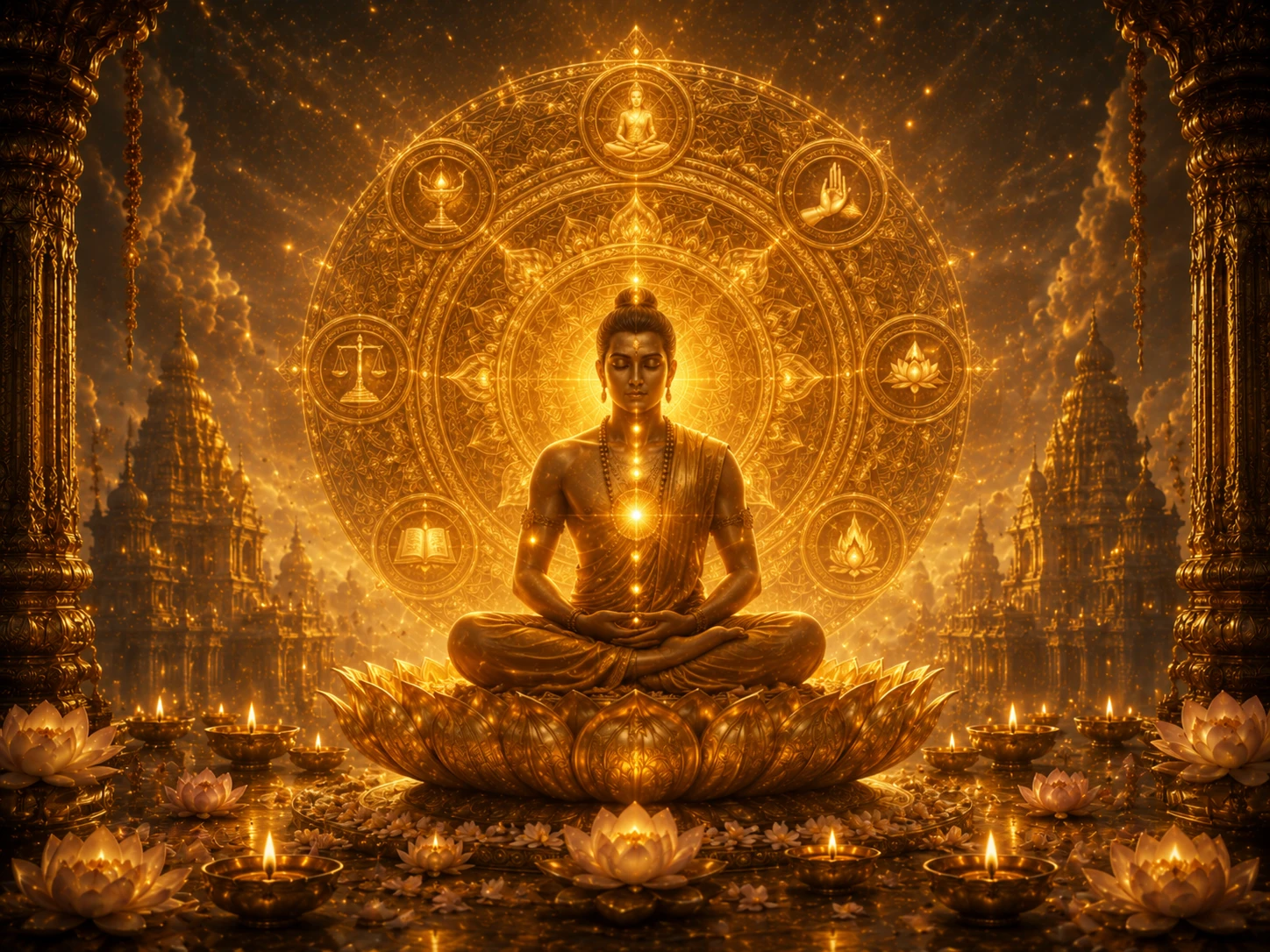
Yoga Darshana -- Patanjali's Science of the Mind
योग दर्शन -- पतञ्जलि का मन-विज्ञान
Walk into any yoga studio in Koramangala, Manhattan, or Bali and you will find people bending, stretching, and sweating through sequences of physical postures. Ask them what yoga is and they will point to their mat. Now open Patanjali's Yoga Sutras -- the foundational text of Yoga Darshana -- and search for the word 'asana.' It appears exactly once. In one sutra out of 196. And it says: your seat should be steady and comfortable. That is the entire instruction on physical posture in the most authoritative yoga text ever written.
This gap between what yoga has become globally and what Patanjali actually taught is one of the great intellectual robberies of the modern world. The $80 billion global yoga industry sells the body. Patanjali was engineering the mind. Yoga Darshana -- literally 'the philosophical vision through yoga' -- is one of the six orthodox schools (Shad Darshana) of Hindu philosophy. It accepts Vedic authority, works within the metaphysical framework of Sankhya philosophy, and offers the most systematic map of human consciousness ever created before modern neuroscience.
Patanjali likely compiled the Yoga Sutras between 200 BCE and 200 CE, though the practices he codified are far older, traceable to the Upanishads and even to the Indus Valley Civilization's famous Pashupati seal. The text contains 196 aphorisms (sutras) organized into four chapters (padas): Samadhi Pada (what yoga is), Sadhana Pada (how to practice), Vibhuti Pada (the powers that arise), and Kaivalya Pada (the final liberation). Each sutra is compressed to a few words -- dense, precise, and requiring a teacher to unpack. Think of them as the source code of consciousness. The compiled binary is your life.
योगश्चित्तवृत्तिनिरोधः
yogaś citta-vṛtti-nirodhaḥ
Yoga is the cessation (nirodha) of the fluctuations (vritti) of the mind-stuff (chitta).
— Yoga Sutra 1.2, Patanjali
This single sutra is the entire definition of yoga. Not flexibility. Not strength. Not Instagram-worthy inversions. Yoga is what happens when the mind stops generating its constant noise. Patanjali's word 'chitta' encompasses everything from subconscious impressions (samskaras) to active thoughts, emotions, and memories. 'Vritti' means a whirlpool or turning -- the mind's habitual tendency to spin stories, judgements, and projections. 'Nirodha' is not suppression but cessation -- the whirlpools simply stop when the conditions that create them are removed.
This definition places Patanjali closer to a cognitive scientist than to a gym instructor. He is asking: What is the mind doing when you are not deliberately directing it? Answer: generating vrittis -- correct knowledge, error, imagination, sleep, and memory. These five categories (Sutra 1.6) cover every possible mental event. Modern cognitive psychology arrived at remarkably similar taxonomies 2,200 years later.
The philosophical foundation beneath Yoga Darshana is borrowed from Sankhya -- the dualist school that posits two fundamental realities: Purusha (pure consciousness, the witness) and Prakriti (matter-energy, everything that moves and changes). Your body, mind, emotions, intellect, and ego are all Prakriti. They are not you. You are the Purusha watching the whole show. Suffering arises because you have forgotten this. You think you ARE your thoughts. You think you ARE your job title, your Instagram bio, your JEE rank, your salary. Yoga is the systematic process of remembering that you are none of these things.
Where Sankhya offers the diagnosis, Yoga offers the treatment. Sankhya says: you are confused about who you are. Yoga says: here are the exact steps to end that confusion.
Ashtanga Yoga -- The Eight Limbs
Patanjali's treatment plan is the Ashtanga (eight-limbed) path, described in Sadhana Pada. These are not eight sequential steps like a staircase. They are eight limbs of one body -- all interdependent, all necessary, all practiced simultaneously as capacity grows.
The first two limbs -- Yama and Niyama -- are ethical foundations. Yama comprises five social restraints: Ahimsa (non-violence), Satya (truthfulness), Asteya (non-stealing), Brahmacharya (conservation of vital energy), and Aparigraha (non-possessiveness). Niyama comprises five personal observances: Shaucha (cleanliness), Santosha (contentment), Tapas (disciplined effort), Svadhyaya (self-study and scripture study), and Ishvara Pranidhana (surrender to a higher reality). Notice: before Patanjali lets you touch a yoga mat, he wants you to stop lying, stop stealing, and practice contentment. The modern yoga industry skipped these two limbs entirely.
The third limb is Asana -- physical posture. Patanjali's only instruction: 'sthira sukham asanam' (Sutra 2.46). The posture should be steady and comfortable. That is it. The 84 lakh asanas that the Hatha Yoga tradition elaborated came centuries later, primarily through texts like the Hatha Yoga Pradipika (15th century CE) and the Gheranda Samhita (17th century CE). Patanjali's concern was not the body's shape but the body's stillness -- because a restless body creates a restless mind.
Pranayama (breath regulation) is the fourth limb. Prana is not merely oxygen -- it is the vital force that links body and mind. Patanjali prescribes regulation of inhalation, exhalation, and the pause between them. Modern research at NIMHANS Bangalore and AIIMS Delhi has validated what Patanjali intuited: controlled breathing directly modulates the autonomic nervous system, reducing cortisol and activating the parasympathetic response.
Pratyahara (sensory withdrawal) is the fifth limb and the crucial bridge between outer and inner practice. It is the ability to disconnect the senses from their objects at will -- like a turtle withdrawing its limbs. In a world of infinite scroll, push notifications, and algorithmically optimised dopamine triggers, Pratyahara may be the most urgently needed practice of the 21st century.
Dharana (concentration), Dhyana (meditation), and Samadhi (absorption) are the final three limbs, collectively called Samyama. Dharana is fixing the mind on a single point. Dhyana is when that fixation becomes effortless and continuous. Samadhi is when the boundary between the meditator and the object of meditation dissolves entirely. Patanjali describes multiple levels of Samadhi -- Samprajnata (with cognitive content) and Asamprajnata (beyond cognition) -- mapping states of consciousness that Western psychology only began investigating in the 1960s through studies on experienced meditators.
स्थिरसुखमासनम्
sthira-sukham āsanam
The posture (asana) should be steady (sthira) and comfortable (sukha).
— Yoga Sutra 2.46, Patanjali
The Eight Limbs of Patanjali's Yoga
| Limb | अंग | Sanskrit | Domain | Modern Parallel |
|---|---|---|---|---|
| 1. Yama | यम | Social ethics | Outer conduct | Constitution / Rule of Law |
| 2. Niyama | नियम | Personal discipline | Inner conduct | Daily habits / Self-care routine |
| 3. Asana | आसन | Steady posture | Physical body | Ergonomics / Body awareness |
| 4. Pranayama | प्राणायाम | Breath regulation | Energy body | HRV biofeedback / Breathwork apps |
| 5. Pratyahara | प्रत्याहार | Sensory withdrawal | Sense organs | Digital detox / Screen time limits |
| 6. Dharana | धारणा | Single-point focus | Mind | Deep work / Flow state entry |
| 7. Dhyana | ध्यान | Continuous meditation | Awareness | Mindfulness meditation / Vipassana |
| 8. Samadhi | समाधि | Total absorption | Consciousness | Peak experience / Transcendence |
The first five limbs (Yama through Pratyahara) are called Bahiranga (external) yoga. The final three (Dharana, Dhyana, Samadhi) are called Antaranga (internal) yoga or collectively Samyama.
The Kleshas -- Five Causes of Suffering
Patanjali does not just describe the goal. He diagnoses why we are stuck. In Sadhana Pada, he identifies five Kleshas (afflictions) that keep human beings trapped in suffering:
Avidya (ignorance) is the root klesha -- mistaking the impermanent for permanent, the impure for pure, pain for pleasure, and the non-self for the self. This is not lack of information. A Kota coaching student scoring 99 percentile in JEE Advanced can have perfect knowledge of physics and total Avidya about his own nature. Asmita (ego-identification) is the error of confusing Purusha (the seer) with the instrument of seeing. It is the mistake of thinking 'I am my mind' rather than 'I have a mind.' Raga (attachment) is the gravitational pull toward pleasant experiences. Dvesha (aversion) is the repulsive force away from painful ones. Abhinivesha (clinging to life) is the deepest, most instinctual fear -- the fear of death that persists even in the wise.
These five kleshas operate like an operating system running beneath all conscious thought. You do not choose them. They choose your reactions for you. The entire Ashtanga path is designed to progressively weaken these kleshas until they become 'burnt seeds' -- still present in latent form but incapable of sprouting into action. Patanjali's term for this is 'Kriya Yoga' -- the yoga of action, comprising Tapas (heat/discipline), Svadhyaya (self-study), and Ishvara Pranidhana (surrender). This is the practical starting point for anyone who cannot yet sit still for an hour. Start with discipline, study, and humility. The rest will follow.
What makes Yoga Darshana remarkable among the six schools is its pragmatism. Nyaya gives you logic. Vaisheshika gives you atomic theory. Sankhya gives you cosmological categories. Mimamsa gives you ritual precision. Vedanta gives you the nature of ultimate reality. Yoga says: all that is wonderful, but here is what you actually DO about it, Monday through Sunday, sitting on a cushion, watching your breath, fighting your demons one vritti at a time.
Vibhuti Pada -- The Dangerous Chapter
The third chapter of the Yoga Sutras is the one most people find sensational and most teachers avoid. Patanjali describes Siddhis -- supernormal powers that arise from Samyama (the combined practice of Dharana, Dhyana, and Samadhi) on various objects. These include knowledge of past lives, telepathy, invisibility, supernatural strength, and knowledge of the solar system's structure.
Modern readers tend to do one of two things: dismiss these claims as fantasy, or get excited about acquiring powers. Patanjali anticipated both reactions. In Sutra 3.37, he warns that these Siddhis are obstacles (upasarga) to Samadhi. They are distractions that arise on the path -- temptations to stop short of the final goal. The analogy in Indian tradition is striking: a businessman on the highway to Delhi who stops at every roadside dhaba will never reach Delhi. The Siddhis are dhabas. Kaivalya (liberation) is Delhi.
The DRDO named its ballistic missile programme after Agni, Prithvi, and Trishul. India's space programme at ISRO routinely invokes Vedic nomenclature. But the real 'Vibhuti' -- the real power -- that Patanjali offers is not levitation or telepathy. It is Viveka Khyati -- the unwavering discriminative knowledge that separates the eternal (Purusha) from the transient (Prakriti). This knowledge, once established, cannot be shaken by any experience, any loss, any success, or any failure. It is the ultimate antifragility.
The word 'asana' appears only ONCE in Patanjali's 196 Yoga Sutras (Sutra 2.46). The entire global yoga posture industry -- from hot yoga to aerial yoga to goat yoga -- is built on elaborations of a tradition that Patanjali addressed in exactly 3 Sanskrit words: sthira sukham asanam. Meanwhile, the word 'chitta' (mind) appears over 20 times. Patanjali's yoga was always about the mind, not the mat.
Yoga Darshana vs. Modern Yoga
The transformation of yoga from a mind-science into a body-practice has a specific history. In the early 20th century, Indian teachers like Krishnamacharya in Mysore synthesized Patanjali's framework with Indian wrestling exercises, British military calisthenics, and Scandinavian gymnastics to create the dynamic vinyasa and asana sequences that became 'modern yoga.' His students -- B.K.S. Iyengar, Pattabhi Jois, T.K.V. Desikachar, and Indra Devi -- took these physical practices to the West, where they were enthusiastically adopted as fitness routines.
This is not inherently wrong. A gateway is still a gate. Many people come to yoga for the body and stay for the mind. The problem arises when the gate is mistaken for the destination. When the International Day of Yoga (June 21, established by the United Nations in 2014 following Prime Minister Modi's advocacy) showcases mass asana sessions but rarely discusses Yama, Niyama, or Samadhi, it perpetuates a half-truth. When a Lululemon-wearing influencer in LA teaches 'yoga' without mentioning Patanjali, Sankhya, or Kaivalya, something essential has been lost.
The reclamation project is underway in India itself. IIT Kanpur, IIT Kharagpur, and SVYASA University in Bangalore offer academic programmes in yoga studies that treat the Yoga Sutras as philosophy, not merchandise. AIIMS has integrated yoga protocols into its cardiac rehabilitation and mental health departments. The Yoga Certification Board under AYUSH Ministry ensures that yoga teachers in India actually study the texts, not just the postures. This is the real yoga renaissance -- not the Instagram version.
For the UPSC aspirant studying in Old Rajinder Nagar: Yoga Darshana is asked in GS Paper-1 (Indian Heritage and Culture) and in Philosophy Optional. Know the Ashtanga path, the Kleshas, the Sankhya-Yoga relationship, and the difference between Patanjali's Yoga and Hatha Yoga. For the startup founder burning out in HSR Layout: Patanjali's Kriya Yoga (Tapas, Svadhyaya, Ishvara Pranidhana) is the oldest documented anti-burnout protocol. For the NRI parent in New Jersey trying to explain yoga to their American-born child: start with Sutra 1.2. Yoga is not what you do with your body. It is what you do with your mind.
NIMHANS Bangalore published research in 2019 showing that a Yoga Sutra-based meditation protocol (combining Dharana and Dhyana techniques) reduced anxiety scores by 44% in IT professionals suffering from burnout -- outperforming both pharmacological intervention alone and generic mindfulness programmes. Patanjali's 2,200-year-old mind science is being validated in 21st-century clinical trials.
Practice Patanjali's Dharana
Begin with single-point concentration on the breath -- the first step of Patanjali's inner journey from Dharana to Dhyana to Samadhi.
Tags
Eternal Raga · शाश्वत राग
Institutional voice — scholarly articles on Sanatan Dharma
Deepen Your Understanding
अपनी समझ और गहरी करें
philosophy darshana
The Six Darshanas -- India's Original Intellectual Operating Systems
Long before Greek philosophy had its first argument, India had six complete philosophical systems -- each with its own logic, metaphysics, epistemology, and liberation path. Nyaya built formal logic. Vaisheshika invented atomic theory. Samkhya mapped consciousness. Yoga engineered the mind. Mimamsa decoded ritual. Vedanta asked the final question. Together, they are the most comprehensive intellectual framework any civilisation has produced.
philosophy darshana
Advaita Vedanta Explained -- Shankara's Radical Philosophy of Non-Duality
You are not your job title. You are not your Instagram bio. According to Adi Shankaracharya, you are not even your body or mind -- you are Brahman itself, the infinite consciousness wearing a temporary costume. Advaita Vedanta is the most radical philosophical claim in Indian history: that the entire universe is one undivided reality, and separation is the grandest illusion.
philosophy darshana
Atman and Brahman -- The Self and the Absolute
The Upanishads make a claim so radical that 3,000 years have not dulled its edge: the individual self (Atman) and the ultimate reality of the universe (Brahman) are not two different things. They are one. Every school of Hindu philosophy is essentially an argument about what this identity means.
philosophy darshana
Karma Explained -- Not Punishment, Not Reward, but the Physics of Action
Karma is not cosmic revenge. It is not 'what goes around comes around.' It is India's most sophisticated theory of causation -- a framework that explains why your choices matter, why consequences are inescapable, and why freedom is still possible. The Gita's karma teaching changed Oppenheimer's life. It might change yours.
tantra mantra yantra
Tantra, Mantra and Yantra -- The Three Pillars of Spiritual Practice
Tantra is the loom, Mantra is the thread, Yantra is the pattern. Together they form the complete technology of spiritual transformation that India gifted to the world -- and they are far more profound than popular culture imagines.
philosophy darshana
Kashmir Shaivism -- The Philosophy of Divine Recognition
What if liberation is not about gaining something new but recognising what you already are? Kashmir Shaivism says you are already Shiva -- infinite, free, blissful consciousness. You have simply forgotten. The entire universe is Shiva's dance of self-concealment and self-recognition. Your job is to remember.
philosophy darshana
The Four Mahavakyas -- Upanishadic Sentences That Changed Civilisation
Four sentences. Twelve words of Sanskrit. Three thousand years of commentary. The Mahavakyas are the most compressed, most powerful, and most debated statements in all of Indian philosophy. Each one claims that the individual self and the ultimate reality of the universe are not two different things. And each one has been interpreted to mean something completely different by every major school of Vedanta.
The word 'asana' appears only ONCE in Patanjali's 196 Yoga Sutras (Sutra 2.46). The entire global yoga posture industry -- from hot yoga to aerial yoga to goat yoga -- is built on elaborations of a tradition that Patanja…
More in Philosophy & Darshana
The 14 Lokas -- Hindu Cosmology as a Map of Consciousness
14 min read
Achintya Bhedabheda -- Chaitanya's Theology of Inconceivable Difference-and-Unity
13 min read
Adhyasa -- Superimposition and the Foundational Error of the Self
13 min readThe same translation error that turned '33 Koti' into '33 crore' in Hinduism also happened in Buddhism. The Chinese translation of Buddhist texts rendered 'Sapta Koti Buddha' (7 Supreme Buddhas) as '7 Crore Buddhas.' The…
Deities AvatarsCommunity Reflections
🕉️
Be the first to share your reflection.