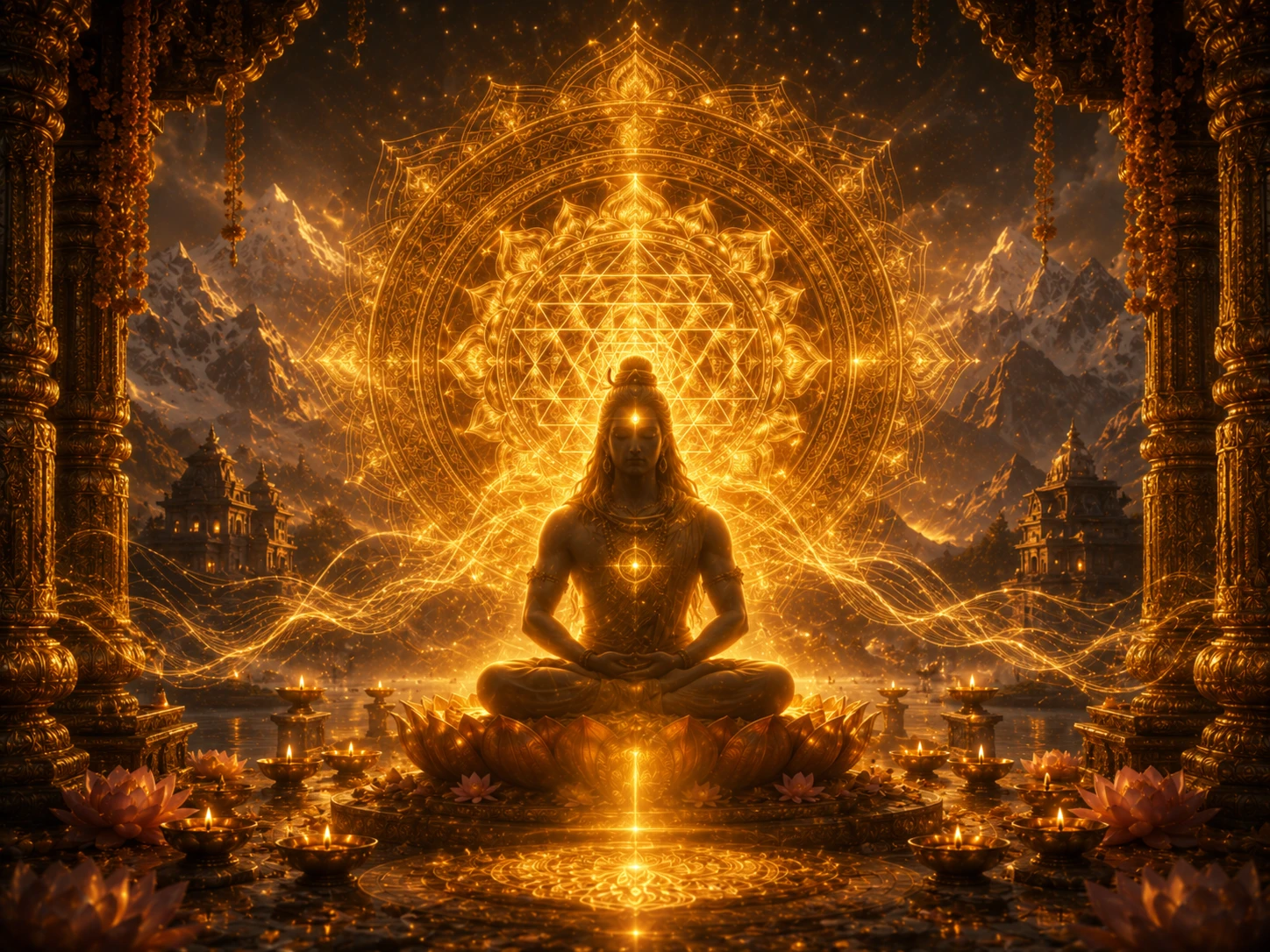
Kashmir Shaivism -- The Philosophy of Divine Recognition
काश्मीर शैवदर्शन -- दिव्य प्रत्यभिज्ञा का दर्शन
In the valley of Kashmir, between the 9th and 12th centuries CE, a group of philosopher-mystics produced what may be the most dazzling synthesis of philosophy, mysticism, aesthetics, and spiritual practice in Indian history. They called their tradition Trika -- the philosophy of triads. The world knows it as Kashmir Shaivism. And it begins with a rock.
According to tradition, the sage Vasugupta (c. 800-850 CE), living near Mahadeva Mountain behind what is now the Shalimar Gardens outside Srinagar, received a vision in his dream. Shiva himself appeared and told him to go to a specific rock on the mountainside. There, inscribed on the stone, Vasugupta found 77 aphorisms that would become the Shiva Sutras -- the foundational scripture of the entire tradition.
The very first sutra announces the core thesis of Kashmir Shaivism in two words: Caitanyam Atma -- Consciousness is the Self. Not 'the Self has consciousness' but 'Consciousness IS the Self.' And this Consciousness is not merely aware -- it is omniscient, omnipotent, and absolutely free. It is Shiva. The second sutra delivers the diagnosis of human suffering: Jnanam Bandhah -- limited knowledge is bondage. You are already infinite consciousness, but you experience yourself as limited, separate, and bound. This is not because some external force has imprisoned you. Shiva has freely chosen to forget his own nature -- and that forgetting is what creates individual beings, the world, and the drama of existence.
This is the most radical idea in Kashmir Shaivism: the universe is not an illusion (as Advaita Vedanta says) or a real creation by a separate God (as Dvaita says). The universe is Shiva playing hide-and-seek with himself. He conceals his infinite nature to become the finite world, and then -- through the practices taught in this tradition -- he recognises himself again. This is Pratyabhijna -- recognition. Not learning something new. Remembering what you always were.
The intellectual firepower of this tradition is staggering. Abhinavagupta (c. 975-1025 CE), its greatest philosopher, wrote the Tantraloka (Light on Tantra) -- a 37-chapter, encyclopaedic work that synthesises ritual, philosophy, aesthetics, yoga, and mysticism into a unified vision. He also wrote commentaries on the Shiva Sutras, the Bhagavad Gita (Gitartha Sangraha), and on aesthetic theory (Abhinavabharati). No other Indian philosopher of any school -- not Shankara, not Ramanuja, not Nagarjuna -- produced a body of work matching Abhinavagupta's range.
चैतन्यमात्मा
caitanyam ātmā
Consciousness (which is omniscient and omnipotent) is the Self -- the true nature of all reality.
— Shiva Sutra 1.1, Vasugupta
The Three Systems -- Spanda, Pratyabhijna, and Trika
Kashmir Shaivism developed through three interconnected philosophical systems, each approaching the same non-dual truth from a different angle.
The Spanda system, rooted in Vasugupta's Shiva Sutras and elaborated by his student Bhatta Kallata in the Spanda Karikas (53 verses), focuses on Spanda -- the divine vibration or cosmic pulsation. Shiva is not static consciousness. He is dynamic, pulsating awareness. Every heartbeat, every breath, every thought is a ripple of Spanda -- Shiva vibrating. The universe is not created once and left alone. It is being pulsed into existence every moment by the Spanda of universal consciousness. Modern physics has arrived at a remarkably similar picture: matter is not solid stuff but vibrating energy fields. The Spanda tradition said this 1,200 years ago, not as physics but as direct meditative experience.
The Pratyabhijna (Recognition) system was founded by Somananda (9th century) and developed by his student Utpaladeva (c. 925-975 CE) in the Ishvara Pratyabhijna Karikas. This system provides the philosophical logic: if the Self is already Shiva, why do we not recognise this? Because of three impurities (Malas): Anava Mala (the sense of being small, limited, incomplete), Mayiya Mala (the experience of difference -- seeing the world as separate from yourself), and Karma Mala (the sense of being a doer of limited actions). These three Malas are not external chains. They are Shiva's own power of self-concealment (Tirodhana Shakti). Liberation is not breaking chains. It is Shiva removing his own blindfold.
Kshemaraja (c. 1000-1050 CE), Abhinavagupta's direct disciple, wrote the Pratyabhijnahridayam (Heart of Recognition) -- a concise 20-sutra text that is often the entry point for students of this philosophy. Its first sutra declares: 'Chiti Svatantra Vishva Siddhi Hetuh' -- Free-willed Consciousness is the cause of the manifestation of the universe. The universe is not accident, not illusion, not punishment. It is Consciousness freely creating out of joy.
The Trika system is the overarching framework that synthesises both Spanda and Pratyabhijna into a complete tradition of philosophy and practice. 'Trika' means 'the triad,' and the tradition is organised around several triads: the three goddesses (Para, Parapara, Apara representing supreme, intermediate, and limited consciousness), the three energies of Shiva (Iccha/will, Jnana/knowledge, Kriya/action), and the three states that a yogi transcends (waking, dreaming, deep sleep) to reach Turiya (the fourth state) and Turyatita (beyond the fourth).
36 Tattvas -- The Complete Map of Reality
Where Sankhya philosophy maps reality into 25 categories (Tattvas), Kashmir Shaivism extends the map to 36 -- adding 11 categories above Sankhya's Purusha to chart the territory between individual consciousness and absolute Shiva-consciousness.
The 36 Tattvas descend from Shiva (pure consciousness) through progressive stages of self-limitation to the earth element. The first five are the 'Pure Tattvas' (Shiva, Shakti, Sadashiva, Ishvara, Shuddhavidya) where consciousness is dominant and the universe appears as inseparable from the Self. The next seven are the 'Impure-Pure Tattvas' including Maya and its five Kanchukas (coverings) -- Kala (limited agency), Vidya (limited knowledge), Raga (desire born from incompleteness), Niyati (spatial limitation), and Kala (temporal limitation). These five Kanchukas are like filters placed over infinite consciousness that make it appear finite. Below these are the 24 Tattvas familiar from Sankhya -- from Purusha and Prakriti down through the elements to Earth.
The practical power of this map is that it tells the yogi exactly where they are stuck and what they need to dissolve next. A person overwhelmed by sensory desire is operating at the level of the lower Tattvas. A meditator experiencing expanded awareness but still feeling separate from the universe is at the level of the Kanchukas. A yogi in Turiya (the fourth state beyond waking, dream, and sleep) has dissolved Maya but may not yet have reached Shiva-Shakti unity.
For the IIT student familiar with physics: the 36 Tattvas function like energy levels in quantum mechanics -- discrete states through which consciousness 'descends' into matter and 'ascends' back to its source. For the startup founder: think of the Kanchukas as the limiting beliefs that prevent a team from seeing the full scope of what they can build. Remove the Kanchukas and the team's creative potential expands dramatically.
Kashmir Shaivism vs. Advaita Vedanta vs. Shaiva Siddhanta
| Aspect | Kashmir Shaivism | Advaita Vedanta | Shaiva Siddhanta |
|---|---|---|---|
| Ultimate Reality | Shiva-Shakti (dynamic consciousness) | Nirguna Brahman (static consciousness) | Shiva (distinct from souls) |
| Status of the world | Real -- Shiva's self-expression (Abhasa) | Mithya (apparent, not independently real) | Real but created by Shiva |
| Cause of bondage | Self-forgetting (Malas as Shiva's own play) | Avidya (cosmic ignorance) | Anava Mala (innate impurity of soul) |
| Liberation method | Recognition (Pratyabhijna) -- remembering you are Shiva | Knowledge (Jnana) -- realising Atman is Brahman | Shiva's grace removes Malas |
| Approach | Non-dual monism (Shiva is everything) | Non-dual monism (Brahman alone is real) | Dualism (Shiva and souls eternally distinct) |
| Key thinker | Abhinavagupta (c. 975-1025 CE) | Shankaracharya (c. 788-820 CE) | Meykandar (13th century CE) |
Kashmir Shaivism and Advaita Vedanta are both non-dual, but differ fundamentally: Advaita says consciousness is passive and the world is appearance; Kashmir Shaivism says consciousness is dynamic and the world is Shiva's real self-expression.
Abhinavagupta -- The Polymath Who Unified Everything
Abhinavagupta (c. 975-1025 CE) is, by any measure, one of the greatest intellectual figures India has produced. Born into a learned Brahmin family in Kashmir, he studied under more than 15 teachers across different traditions and synthesised their teachings into a unified philosophical vision of extraordinary depth.
His magnum opus, the Tantraloka (Light on Tantra), is a 37-chapter encyclopaedia covering metaphysics, epistemology, ritual, mantra science, cosmology, aesthetics, yoga, and mystical practice. No other single text in Indian philosophy attempts such comprehensive scope. His shorter work Tantrasara (Essence of Tantra) distils the same material for practical application.
What sets Abhinavagupta apart is his theory of aesthetics. In his commentary on Bharata's Natyashastra (the Abhinavabharati), he developed the concept of Rasa (aesthetic experience) into a philosophical theory of consciousness. The experience of beauty in art -- the shiver you feel hearing a perfect raaga, the tears that come watching a great performance -- is, for Abhinavagupta, a momentary glimpse of your own Shiva-nature. Aesthetic rapture (Chamatkara) is a microdose of Samadhi. This insight connects art to liberation in a way no other philosophical tradition has achieved.
Abhinavagupta also developed the theory of Vimarsha -- self-reflective awareness. Shiva is not just Prakasha (luminous consciousness). He is Prakasha-Vimarsha -- consciousness that is aware of itself being conscious. This self-reflective loop is Shakti -- Shiva's own power of self-awareness. Without Vimarsha, Prakasha would be inert light illuminating nothing. Shakti is what makes consciousness alive, creative, and free.
The Vijnana Bhairava Tantra, a key text of this tradition, provides 112 meditation techniques (Dharanas) for directly experiencing Shiva-consciousness. These range from contemplating the pause between breaths, to meditating on the moment of sneezing, to experiencing the void at the top of a yawn. Every moment of daily life becomes a doorway to recognition. This is perhaps the most accessible and practical mystical manual ever written.
For the film student at FTII Pune: Abhinavagupta's Rasa theory directly informs the emotional architecture of Indian cinema. The 'interval block' in a Bollywood film, the cathartic climax in a Mani Ratnam movie, the silence in a Satyajit Ray shot -- all these deploy Rasa principles that Abhinavagupta codified a thousand years ago.
The Vijnana Bhairava Tantra's 112 meditation techniques include methods that modern mindfulness programmes have independently 'discovered.' Technique 24 asks you to focus on the gap between two breaths. Technique 65 asks you to feel the pure 'I am' sensation before any thought arises. Technique 88 asks you to meditate on the moment just before sleep takes over. These are being taught in Silicon Valley wellness retreats and NIMHANS clinical programmes as cutting-edge mindfulness -- they are 1,200-year-old Kashmir Shaivism.
Swami Lakshman Joo (1907-1991), the last great living master of Kashmir Shaivism, preserved this entire tradition almost single-handedly through the turmoil of the 20th century. He taught from his small ashram in Srinagar, training both Indian and Western scholars. His recordings and teachings are now being digitised by the Lakshmanjoo Academy, ensuring this 1,200-year-old wisdom tradition survives into the digital age.
Experience Spanda -- The Divine Vibration
Sit quietly and bring attention to the pause between two breaths. In that gap, the Spanda -- the pulsation of universal consciousness -- can be directly felt. This is Vijnana Bhairava Tantra technique 24.
Tags
Eternal Raga · शाश्वत राग
Institutional voice — scholarly articles on Sanatan Dharma
Deepen Your Understanding
अपनी समझ और गहरी करें
philosophy darshana
Advaita Vedanta Explained -- Shankara's Radical Philosophy of Non-Duality
You are not your job title. You are not your Instagram bio. According to Adi Shankaracharya, you are not even your body or mind -- you are Brahman itself, the infinite consciousness wearing a temporary costume. Advaita Vedanta is the most radical philosophical claim in Indian history: that the entire universe is one undivided reality, and separation is the grandest illusion.
tantra mantra yantra
Tantra, Mantra and Yantra -- The Three Pillars of Spiritual Practice
Tantra is the loom, Mantra is the thread, Yantra is the pattern. Together they form the complete technology of spiritual transformation that India gifted to the world -- and they are far more profound than popular culture imagines.
philosophy darshana
The Six Darshanas -- India's Original Intellectual Operating Systems
Long before Greek philosophy had its first argument, India had six complete philosophical systems -- each with its own logic, metaphysics, epistemology, and liberation path. Nyaya built formal logic. Vaisheshika invented atomic theory. Samkhya mapped consciousness. Yoga engineered the mind. Mimamsa decoded ritual. Vedanta asked the final question. Together, they are the most comprehensive intellectual framework any civilisation has produced.
philosophy darshana
Atman and Brahman -- The Self and the Absolute
The Upanishads make a claim so radical that 3,000 years have not dulled its edge: the individual self (Atman) and the ultimate reality of the universe (Brahman) are not two different things. They are one. Every school of Hindu philosophy is essentially an argument about what this identity means.
philosophy darshana
Yoga Darshana -- Patanjali's Science of the Mind
Before yoga became a global fitness trend worth $80 billion, it was India's most rigorous system of psychology. Patanjali's 196 sutras are not about touching your toes -- they are about rewiring your mind. Here is the philosophy the world forgot when it turned yoga into exercise.
philosophy darshana
The Four Mahavakyas -- Upanishadic Sentences That Changed Civilisation
Four sentences. Twelve words of Sanskrit. Three thousand years of commentary. The Mahavakyas are the most compressed, most powerful, and most debated statements in all of Indian philosophy. Each one claims that the individual self and the ultimate reality of the universe are not two different things. And each one has been interpreted to mean something completely different by every major school of Vedanta.
deities avatars
Nataraja -- The Cosmic Dancer
One foot crushes a dwarf. The other is raised in liberation. A ring of fire frames the dance. A drum beats creation into existence. An open palm says 'do not fear.' This is Nataraja -- Shiva as the Lord of Dance -- and it is the single most replicated Indian bronze in the history of art. The physicists at CERN chose it to stand outside the world's largest particle accelerator. The Chola bronzesmiths of Tamil Nadu perfected it a thousand years ago. And every time a subatomic particle appears and disappears, the cosmic dance continues.
The Vijnana Bhairava Tantra's 112 meditation techniques include methods that modern mindfulness programmes have independently 'discovered.' Technique 24 asks you to focus on the gap between two breaths. Technique 65 asks…
More in Philosophy & Darshana
The 14 Lokas -- Hindu Cosmology as a Map of Consciousness
14 min read
Achintya Bhedabheda -- Chaitanya's Theology of Inconceivable Difference-and-Unity
13 min read
Adhyasa -- Superimposition and the Foundational Error of the Self
13 min readThe same translation error that turned '33 Koti' into '33 crore' in Hinduism also happened in Buddhism. The Chinese translation of Buddhist texts rendered 'Sapta Koti Buddha' (7 Supreme Buddhas) as '7 Crore Buddhas.' The…
Deities AvatarsCommunity Reflections
🕉️
Be the first to share your reflection.