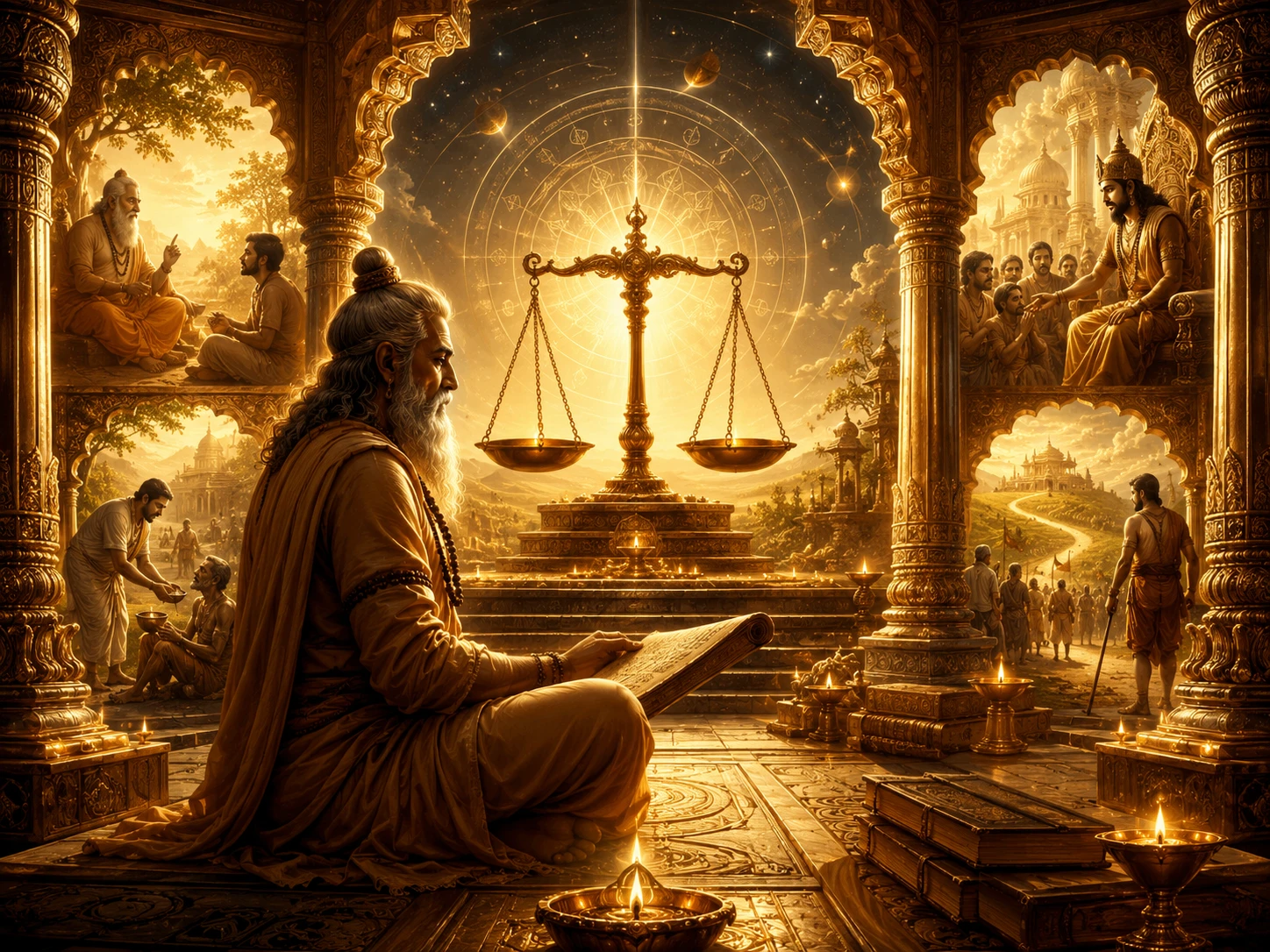
The Four Mahavakyas -- Upanishadic Sentences That Changed Civilisation
चार महावाक्य -- उपनिषदीय वचन जिन्होंने सभ्यता बदल दी
In the entire library of human philosophy -- from Plato's dialogues to Kant's critiques to Confucian analects -- there may be no set of statements more condensed, more consequential, and more fought over than the four Mahavakyas of the Upanishads. Each Mahavakya (Great Saying) comes from one of the four Vedas. Each declares, in its own way, the fundamental identity between the individual self (Atman) and the ultimate reality (Brahman). And each has generated enough commentary, debate, and counter-commentary to fill libraries.
The word 'Mahavakya' literally means 'great sentence.' In the Shankarite Advaita tradition, these four sentences are treated as the distilled essence of each Veda -- the final, definitive teaching that the Guru whispers into the disciple's ear at the moment of initiation (Sannyasa Diksha). In the Vishishtadvaita and Dvaita traditions, the same sentences are read very differently -- not as declarations of identity but as descriptions of relationship, dependence, or divine immanence.
The four Mahavakyas are not random selections. They are traditionally mapped one-to-one with the four Vedas, four stages of spiritual understanding, and four moments in the teacher-student relationship:
Prajnanam Brahma (Consciousness is Brahman) from the Rig Veda -- the definition. Tat Tvam Asi (Thou Art That) from the Sama Veda -- the instruction from Guru to disciple. Ayam Atma Brahma (This Atman is Brahman) from the Atharva Veda -- the contemplation by the student. Aham Brahmasmi (I am Brahman) from the Yajur Veda -- the direct realisation by the seeker.
Together, they form a complete pedagogical sequence: what is Brahman? (Consciousness.) What is your relationship to it? (You are it.) How should you contemplate this? (This self IS that.) What is the final realisation? (I am Brahman.)
These are not mantras for mechanical repetition. They are what the tradition calls 'Vakya Sravanam' -- sentences to be heard, deeply reflected upon (Mananam), and meditated upon until they transform from intellectual understanding into direct experience (Nididhyasanam). A UPSC aspirant might memorise these for GS-1. A genuine seeker internalises them until the boundary between self and universe dissolves.
प्रज्ञानं ब्रह्म
prajñānaṃ brahma
Consciousness (Prajnana -- pure, unqualified awareness) is Brahman (the ultimate reality).
— Aitareya Upanishad 3.3, Rig Veda
तत् त्वम् असि
tat tvam asi
That (Brahman, the ultimate reality) thou (the individual self) art (are identical with).
— Chandogya Upanishad 6.8.7, Sama Veda
अयमात्मा ब्रह्म
ayam ātmā brahma
This Atman (Self) is Brahman (the Absolute).
— Mandukya Upanishad 1.2, Atharva Veda
अहं ब्रह्मास्मि
ahaṃ brahmāsmi
I am Brahman -- the direct first-person realisation of identity with the Absolute.
— Brihadaranyaka Upanishad 1.4.10, Yajur Veda
Tat Tvam Asi -- The Most Famous and Most Debated
The most celebrated Mahavakya is 'Tat Tvam Asi' -- Thou Art That -- spoken nine times by the sage Uddalaka Aruni to his son Shvetaketu in the Chandogya Upanishad (Chapter 6). The context is crucial.
Shvetaketu returns from twelve years of Vedic schooling, proud and learned but ignorant of the one essential truth. His father asks: did your teachers teach you that knowledge by which the unheard becomes heard, the unthought becomes thought, the unknown becomes known? Shvetaketu is baffled. Uddalaka then teaches through a series of analogies: just as by knowing one lump of clay all clay products are known, by knowing one nugget of gold all gold ornaments are known -- so by knowing the one fundamental reality, everything in the universe is known. That reality is Sat (Pure Being). And at the end of each teaching, the father repeats: 'Tat Tvam Asi, Shvetaketu' -- That (Sat, the ultimate reality) Thou (Shvetaketu, the individual) Art.
Now the war of interpretation begins.
Shankara reads this as literal identity: 'Tat' (Brahman) and 'Tvam' (the individual self) refer to the same reality when stripped of their limiting adjuncts (Upadhis). The Brahman stripped of cosmic Maya, and the Jiva stripped of individual Avidya, are one and the same -- pure consciousness. This is called Samanadhikaranya (co-reference) -- two words pointing to the same thing, like 'morning star' and 'evening star' both pointing to Venus.
Ramanuja reads this as qualified identity: 'Tat' is Brahman (Narayana) who has the universe as his body. 'Tvam' is the individual self who is part of that body. The sentence means: you (as a part) are inseparable from That (the whole). It does NOT mean you are identical with the whole. Your finger is you, but your finger is not ALL of you.
Madhva reads this as complete difference: he parses the sentence as 'Tat Tvam Asi' meaning 'Tat Atvam Asi' -- you are NOT That. By a grammatical manoeuvre (reading 'a-tvam' instead of 'tvam'), Madhva turns the sentence into its own negation. The self is eternally dependent on Brahman but never identical with Brahman.
The fact that a single three-word sentence generates three mutually exclusive philosophical systems tells you everything about the power of Sanskrit, the depth of the Upanishads, and the seriousness with which India takes its intellectual traditions.
The Four Mahavakyas -- Complete Reference
| Mahavakya | महावाक्य | Veda | Upanishad | Function |
|---|---|---|---|---|
| Prajnanam Brahma | प्रज्ञानं ब्रह्म | Rig Veda | Aitareya Upanishad 3.3 | Lakshana Vakya (Definition) -- defines what Brahman is |
| Tat Tvam Asi | तत् त्वम् असि | Sama Veda | Chandogya Upanishad 6.8.7 | Upadesa Vakya (Instruction) -- Guru tells the student |
| Ayam Atma Brahma | अयम् आत्मा ब्रह्म | Atharva Veda | Mandukya Upanishad 1.2 | Anusandhana Vakya (Contemplation) -- student reflects |
| Aham Brahmasmi | अहं ब्रह्मास्मि | Yajur Veda | Brihadaranyaka Upanishad 1.4.10 | Anubhava Vakya (Experience) -- seeker realises directly |
Each Mahavakya is traditionally associated with one of the four monastic orders (Amnaya Mathas) established by Shankaracharya: Govardhana Pitha (East/Puri), Sharada Pitha (South/Sringeri), Dvaraka Pitha (West/Dwarka), and Jyotir Matha (North/Badrinath).
How Three Schools Read the Same Sentences Differently
The philosophical genius of the Mahavakyas lies in their deliberate compression. They say just enough to generate insight and not enough to prevent reinterpretation. This is not a flaw. It is a design feature.
For Advaita (Shankara): The Mahavakyas are 'identity statements' (Abheda Vakyas). They use the method of Jahad-Ajahad Lakshana (partial indication) -- where both 'Tat' and 'Tvam' drop their superficial meanings (Brahman as cosmic creator, Jiva as limited being) and retain their essential meaning (pure consciousness). When the superficial is removed, what remains is one undivided consciousness. The Mahavakyas are the verbal trigger for Aparoksha Anubhuti -- direct, immediate, non-mediated realisation.
For Vishishtadvaita (Ramanuja): The Mahavakyas are 'qualified identity statements' (Vishishta Abheda Vakyas). 'Tat Tvam Asi' means: the Brahman who has the universe as His body is the same reality as the innermost self of you, the individual. It is a statement of inseparable connection, not of absolute identity. Just as when you say 'this person is the CEO,' you do not mean the person's body IS the company -- you mean the person has a special relationship to the company.
For Dvaita (Madhva): The Mahavakyas are 'statements of dependence' (Bheda Vakyas reinterpreted). 'Aham Brahmasmi' does not mean 'I am Brahman.' It means 'I exist because of Brahman' -- Brahman is the cause and sustainer of my existence. The grammatical case is read differently. The identity is functional (dependence), not ontological (sameness).
For the UPSC Philosophy Optional: this three-way interpretation is a perennial question. Master the Jahad-Ajahad Lakshana for Advaita, the Samanadhikaranya for Vishishtadvaita, and Madhva's grammatical reparse. For the corporate world: the Mahavakyas teach a meta-lesson about communication. The same memo from the CEO will be read differently by the finance team, the engineering team, and the marketing team. Shared text does not guarantee shared meaning. The Mahavakyas are the ultimate case study.
Why the Mahavakyas Still Matter
In an age of information overload, the Mahavakyas offer the opposite: radical compression. Four sentences that contain an entire civilisation's deepest insights about consciousness, identity, and reality.
For the GenZ student scrolling through existential anxiety on Reddit: the Mahavakyas address your question directly. Who am I? You are not your grades, your social media presence, your placement package, or your parents' expectations. You are consciousness itself -- the awareness in which all these experiences appear and disappear. This is not escapism. This is the most grounded possible answer to the identity question.
For the NRI family in the Bay Area trying to explain Hindu philosophy to their children: start with 'Tat Tvam Asi.' Three words. No ritual, no mythology, no cultural baggage. Just the idea that the spark of awareness in you is the same awareness that runs the universe. If a six-year-old can understand 'I am made of the same stuff as stars' in a science class, they can understand 'Tat Tvam Asi' in a philosophy class.
For the meditator at any level: sit with 'Aham Brahmasmi' as a contemplation practice. Do not think about the words. Let the words dissolve into the experience they point to. When the thinking mind stops and only awareness remains, you are no longer reciting the Mahavakya. You ARE the Mahavakya.
Swami Vivekananda carried these sentences from the banks of the Ganga to the Parliament of Religions in Chicago in 1893, introducing Vedantic philosophy to the Western world. Erwin Schrodinger, Werner Heisenberg, and Robert Oppenheimer all acknowledged the influence of Upanishadic thought on their scientific work. The Mahavakyas are not relics of a distant past. They are live wires connecting the deepest wells of Indian wisdom to the most urgent questions of human existence.
The phrase 'Tat Tvam Asi' (Thou Art That) is repeated NINE times by the sage Uddalaka to his son Shvetaketu in Chandogya Upanishad Chapter 6 -- once after each analogy. This pedagogical repetition is deliberate: the Upanishadic teachers understood that deep truths cannot be transmitted in a single hearing. The nine repetitions model what modern learning science calls 'spaced repetition' -- the same insight encountered in different contexts until it penetrates from intellect to experience.
The four Amnaya Mathas (monasteries) established by Shankaracharya at the four corners of India -- Puri (East), Sringeri (South), Dwarka (West), and Badrinath/Jyotir Math (North) -- each preserve one of the four Mahavakyas as their presiding teaching. When a new Shankaracharya is installed at any of these mathas, the corresponding Mahavakya is the central teaching of the initiation. This 1,200-year-old institutional structure ensures that the Mahavakyas remain not just philosophical concepts but living, transmitted wisdom.
Meditate on Aham Brahmasmi
Sit in stillness. Let the words 'Aham Brahmasmi' arise naturally in awareness. Do not think about them. Let them dissolve into the silence from which they came. That silence is what they point to.
Tags
Eternal Raga · शाश्वत राग
Institutional voice — scholarly articles on Sanatan Dharma
Deepen Your Understanding
अपनी समझ और गहरी करें
philosophy darshana
Atman and Brahman -- The Self and the Absolute
The Upanishads make a claim so radical that 3,000 years have not dulled its edge: the individual self (Atman) and the ultimate reality of the universe (Brahman) are not two different things. They are one. Every school of Hindu philosophy is essentially an argument about what this identity means.
philosophy darshana
Advaita Vedanta Explained -- Shankara's Radical Philosophy of Non-Duality
You are not your job title. You are not your Instagram bio. According to Adi Shankaracharya, you are not even your body or mind -- you are Brahman itself, the infinite consciousness wearing a temporary costume. Advaita Vedanta is the most radical philosophical claim in Indian history: that the entire universe is one undivided reality, and separation is the grandest illusion.
philosophy darshana
Vishishtadvaita -- Ramanuja's Philosophy of Qualified Non-Dualism
Shankaracharya said the world is an illusion. Ramanuja said: try telling that to a mother holding her sick child. Vishishtadvaita is the philosophy that insists both God and the world are real, that love is the highest spiritual method, and that liberation means eternal union with the divine -- not dissolution into emptiness.
philosophy darshana
Brahma Sutra -- The Architecture of Vedantic Thought
555 aphorisms. 4 chapters. The most technically demanding text in Hindu philosophy. The Brahma Sutra is the text every school of Vedanta must interpret to prove its legitimacy -- and every school reads it completely differently. Welcome to the ultimate intellectual battlefield of Indian civilisation.
philosophy darshana
The Six Darshanas -- India's Original Intellectual Operating Systems
Long before Greek philosophy had its first argument, India had six complete philosophical systems -- each with its own logic, metaphysics, epistemology, and liberation path. Nyaya built formal logic. Vaisheshika invented atomic theory. Samkhya mapped consciousness. Yoga engineered the mind. Mimamsa decoded ritual. Vedanta asked the final question. Together, they are the most comprehensive intellectual framework any civilisation has produced.
philosophy darshana
Kashmir Shaivism -- The Philosophy of Divine Recognition
What if liberation is not about gaining something new but recognising what you already are? Kashmir Shaivism says you are already Shiva -- infinite, free, blissful consciousness. You have simply forgotten. The entire universe is Shiva's dance of self-concealment and self-recognition. Your job is to remember.
philosophy darshana
Yoga Darshana -- Patanjali's Science of the Mind
Before yoga became a global fitness trend worth $80 billion, it was India's most rigorous system of psychology. Patanjali's 196 sutras are not about touching your toes -- they are about rewiring your mind. Here is the philosophy the world forgot when it turned yoga into exercise.
The phrase 'Tat Tvam Asi' (Thou Art That) is repeated NINE times by the sage Uddalaka to his son Shvetaketu in Chandogya Upanishad Chapter 6 -- once after each analogy. This pedagogical repetition is deliberate: the Upan…
More in Philosophy & Darshana
The 14 Lokas -- Hindu Cosmology as a Map of Consciousness
14 min read
Achintya Bhedabheda -- Chaitanya's Theology of Inconceivable Difference-and-Unity
13 min read
Adhyasa -- Superimposition and the Foundational Error of the Self
13 min readThe same translation error that turned '33 Koti' into '33 crore' in Hinduism also happened in Buddhism. The Chinese translation of Buddhist texts rendered 'Sapta Koti Buddha' (7 Supreme Buddhas) as '7 Crore Buddhas.' The…
Deities AvatarsCommunity Reflections
🕉️
Be the first to share your reflection.