Achintya Bhedabheda -- Chaitanya's Theology of Inconceivable Difference-and-Unity
अचिन्त्य भेदाभेद -- चैतन्य का अकल्पनीय भेद-और-अभेद का धर्मशास्त्र
The year is 1486. In the town of Navadvipa in Bengal -- then the intellectual capital of Sanskrit learning in eastern India -- a child is born during a lunar eclipse while the entire town chants the name of Hari. He is named Vishvambhara, later known as Nimai, and finally as Chaitanya Mahaprabhu. He will grow up to be a prodigious Sanskrit scholar, defeat the greatest logicians of Navadvipa in debate, and then -- at the age of 24 -- abandon all of it for the ecstasy of chanting Krishna's name.
Chaitanya Mahaprabhu did not write a systematic philosophical treatise. He left eight verses (the Shikshashtaka) and a lifetime of example. But his followers -- the Six Goswamis of Vrindavan, led by Rupa Goswami and Jiva Goswami -- constructed from his teachings and practice one of the most sophisticated theological systems in all of Hinduism: Achintya Bhedabheda Tattva, the philosophy of inconceivable simultaneous difference and non-difference.
The problem it addresses is the oldest in Vedanta: what is the relationship between God (Brahman/Krishna), the individual soul (Jiva), and the material world (Jagat)? Advaita says they are identical -- difference is illusion. Dvaita says they are eternally different -- unity is false. Vishishtadvaita says they are different but inseparable -- the soul is part of God's body. Each position has strengths and weaknesses. Each can cite Upanishadic verses in its favour. And for a thousand years, each has argued that the others are wrong.
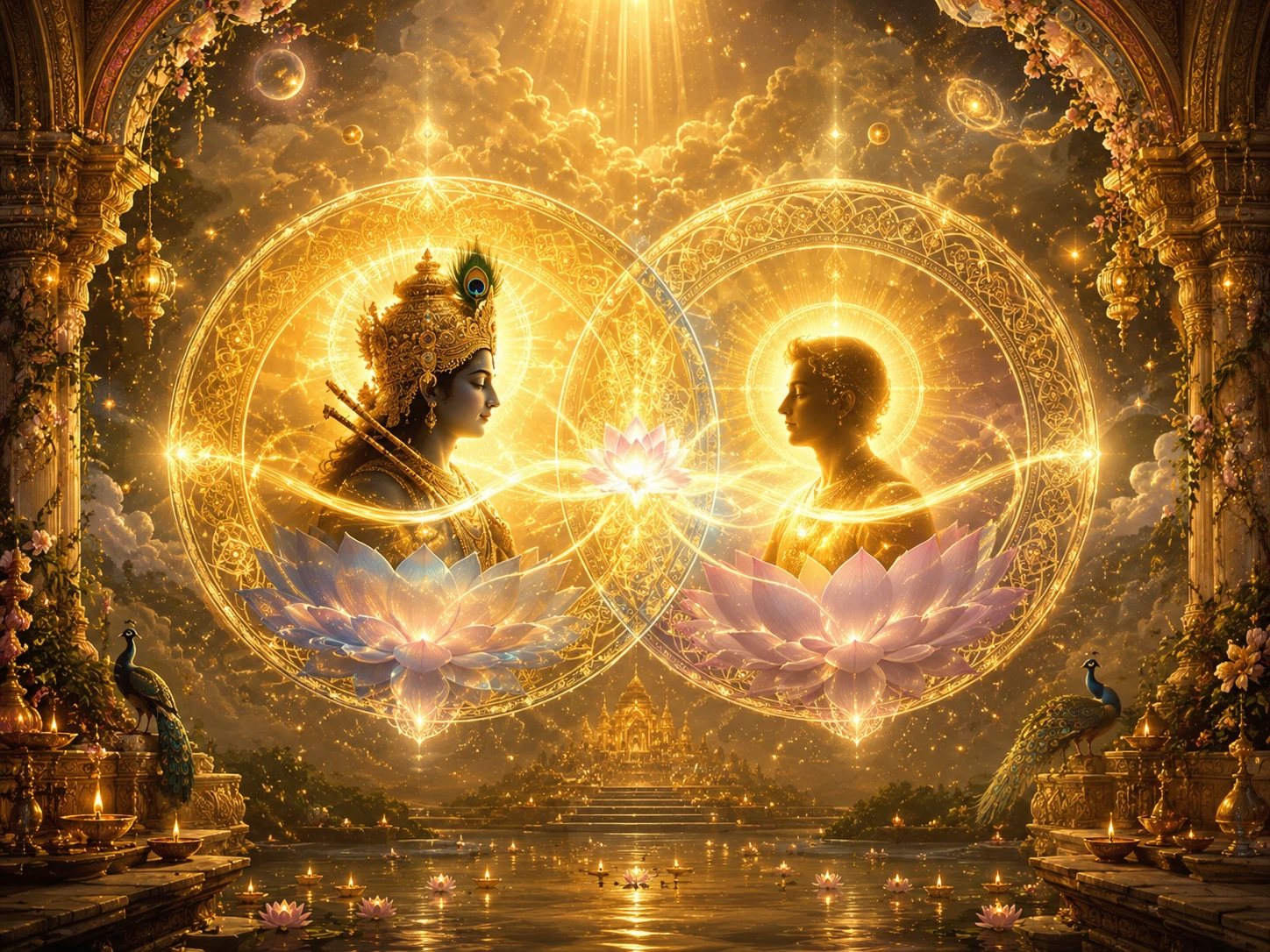
Chaitanya's position cuts the knot. The relationship between God and the soul is Achintya -- inconceivable to the human mind. It is simultaneously Bheda (different) and Abheda (non-different). Not sometimes one and sometimes the other. Not different in one aspect and identical in another. Both, fully, at the same time, in a manner that transcends logical categories. The sun and its rays are different (you can stand in the ray without being in the sun) and non-different (the ray IS the sun's energy, inseparable from it). The ocean and the wave are different (the wave has a shape the ocean does not) and non-different (the wave is nothing but ocean water). These analogies point toward the truth but cannot capture it fully -- because the truth is Achintya, beyond the capacity of intellect to resolve into either pure identity or pure difference.
जीवेर 'स्वरूप' हय -- कृष्णेर 'नित्य-दास'। कृष्णेर 'तटस्था-शक्ति', 'भेदाभेद-प्रकाश'॥
jīvera 'svarūpa' haya -- kṛṣṇera 'nitya-dāsa' | kṛṣṇera 'taṭasthā-śakti', 'bhedābheda-prakāśa' ||
The inherent nature of the living entity is to be an eternal servant of Krishna. The soul is Krishna's marginal energy -- a manifestation of simultaneous difference and non-difference.
— Chaitanya Charitamrita, Madhya Lila 20.108 (Krishnadasa Kaviraja)
The philosophical architecture of Achintya Bhedabheda rests on a sophisticated energy doctrine. Jiva Goswami, the greatest systematic theologian of the Gaudiya tradition, elaborated this in his monumental Sat-Sandarbha (Six Treatises). Krishna (identified as Svayam Bhagavan, the Supreme Personality of Godhead) possesses three primary energies: Antaranga Shakti (internal energy -- the spiritual realm, Vrindavan, the eternal associates), Bahiranga Shakti (external energy -- the material world, Maya, the three Gunas), and Tatastha Shakti (marginal energy -- the individual souls).
The Jiva (individual soul) is 'Tatastha' -- marginal, on the border between spiritual and material. Like the shoreline that belongs to both land and sea, the Jiva can orient toward God (and experience spiritual freedom) or toward Maya (and experience material bondage). This is why the soul is simultaneously one with God (being God's energy, qualitatively identical) and different from God (being a tiny part, quantitatively distinct). A spark is fire -- same substance, same quality of heat and light. But a spark is not the fire -- it is minute, vulnerable, and can be extinguished. The Jiva is Krishna's spark.
This framework resolves problems that plague both Advaita and Dvaita. If the soul is literally identical to Brahman (Advaita), why does bondage exist at all? How can the infinite become ignorant? Achintya Bhedabheda says: the soul is not identical to God in every respect -- it is a marginal energy, capable of coming under Maya's influence precisely because it is minute. If the soul is absolutely different from God (Dvaita), how can any relationship exist between them? How can the finite connect to the infinite? Achintya Bhedabheda says: the soul is not absolutely different -- it is God's own energy, qualitatively non-different, and therefore capable of an intimate, loving relationship with its source.
The word 'Achintya' (inconceivable) is not an intellectual cop-out. It is a deliberate philosophical position that recognises the limits of conceptual thought. The relationship between infinite God and finite soul is a reality that can be experienced (through Bhakti) but cannot be fully captured by any conceptual framework (through Jnana alone). Every analogy -- sun and ray, ocean and wave, fire and spark -- partially illuminates but ultimately fails. The truth exceeds all analogies. This is not anti-rational. It is the recognition that some realities are transrational -- they do not violate logic, but they transcend the categories logic has available.
For the ISKCON devotee chanting Hare Krishna on the streets of Juhu or in a temple in Mayapur, Achintya Bhedabheda is not academic philosophy. It is the theological ground of their practice. When they chant, they are not trying to merge into Krishna (Advaita). They are not merely petitioning a distant Lord (casual theism). They are engaging with a God who is simultaneously their very essence and infinitely beyond them -- a God they can love precisely because the relationship is real, not illusory, and eternal, not temporary.
Achintya Bhedabheda vs Other Vedantic Schools
| Question | Advaita (Shankara) | Dvaita (Madhva) | Vishishtadvaita (Ramanuja) | Achintya Bhedabheda (Chaitanya) |
|---|---|---|---|---|
| Soul-God relation | Identical | Eternally different | Different but inseparable (body-soul) | Simultaneously different AND identical (inconceivably) |
| World's reality | Apparent (Mithya) | Real and eternal | Real (part of God's body) | Real but transformable through Bhakti |
| Nature of Brahman | Nirguna (formless) | Saguna (Vishnu) | Saguna (Vishnu with infinite qualities) | Svayam Bhagavan Krishna -- personal, with form, qualities, and Lilas |
| Highest goal | Jnana -- know 'I am Brahman' | Bhakti -- eternal service in Vaikuntha | Prapatti -- surrender to Vishnu's grace | Prema Bhakti -- spontaneous ecstatic love for Krishna |
| Key analogy | Rope-snake (illusion) | Servant-master (eternal hierarchy) | Body-soul (organic unity) | Sun-rays, fire-sparks (simultaneous identity and difference) |
| Institutional base | Sringeri, Kanchi, Ramakrishna Mission | Udupi, Mantralaya | Srirangam, Tirupati | ISKCON, Gaudiya Math, Vrindavan temples |
Achintya Bhedabheda is often seen as a synthesis, but Gaudiya theologians insist it is not a compromise. It is a distinct position that claims both identity and difference are simultaneously and eternally true -- not as logical contradiction, but as transrational reality accessible through Bhakti.
ISKCON (International Society for Krishna Consciousness), founded by A.C. Bhaktivedanta Swami Prabhupada in New York City in 1966, is the world's largest organised dissemination of Achintya Bhedabheda philosophy. With over 800 temples and centres in more than 100 countries, ISKCON has made Gaudiya Vaishnavism the most globally visible school of Hindu philosophy. The Hare Krishna Mahamantra -- 'Hare Krishna Hare Krishna, Krishna Krishna Hare Hare / Hare Rama Hare Rama, Rama Rama Hare Hare' -- chanted on Marine Drive in Mumbai, in Times Square in New York, and in temples from Lagos to Tokyo, is the practical application of Chaitanya's theology. The mantra works, in Gaudiya theory, because the Name of God is non-different from God Himself (Abheda) yet the chanter remains a distinct individual offering service (Bheda) -- Achintya Bhedabheda in 16 words, repeated 1,728 times daily on a 108-bead japa mala.
Chant the Hare Krishna Mahamantra
Experience Achintya Bhedabheda directly. Chant the Hare Krishna Mahamantra -- the Name is non-different from Krishna, yet you remain you, offering love. That simultaneous unity and difference is the lived theology of Chaitanya.
Tags
Eternal Raga · शाश्वत राग
Institutional voice — scholarly articles on Sanatan Dharma
Deepen Your Understanding
अपनी समझ और गहरी करें
philosophy darshana
Dvaita vs Advaita -- The Greatest Debate in Hindu Philosophy
Are you and God the same being, temporarily confused? Or are you and God eternally different, connected by love but never identical? This question split Hindu philosophy into rival schools, produced centuries of razor-sharp debate, and still determines whether you pray saying 'I am Brahman' or 'I am Brahman's servant'. The answer depends on which genius you believe -- Shankaracharya or Madhvacharya.
philosophy darshana
Bhakti as Philosophy, Not Just Emotion
The intellectual establishment has always underestimated Bhakti. They call it emotional, sentimental, the path for those who cannot do 'real' philosophy. They are wrong. Bhakti has its own sutras, its own epistemology, its own metaphysics, and its own devastating critique of Jnana. Narada, Shandilya, the Alvars, the Haridasas, Mirabai, Tulsidas -- they did not bypass philosophy. They transcended it.
philosophy darshana
Vishishtadvaita -- Ramanuja's Philosophy of Qualified Non-Dualism
Shankaracharya said the world is an illusion. Ramanuja said: try telling that to a mother holding her sick child. Vishishtadvaita is the philosophy that insists both God and the world are real, that love is the highest spiritual method, and that liberation means eternal union with the divine -- not dissolution into emptiness.
deities avatars
Radha -- Krishna's Eternal Beloved and the Supreme Devotee Who Became Greater Than God
She is not mentioned by name in the Bhagavata Purana. She has no temple at the centre of Vrindavan. She did not marry Krishna. And yet -- in the devotional traditions of North India, in the poetry of Jayadeva, in the philosophy of Chaitanya, and in the hearts of millions who chant 'Radhe Radhe' -- she is considered superior to Krishna himself. That is the paradox and the power of Radha.
philosophy darshana
Moksha -- What Liberation Really Means
It is not heaven. It is not an afterlife reward. It is not escaping the world. Moksha -- the ultimate goal of Hindu life -- is the recognition that you were never bound in the first place. But each school defines it differently: for Advaita it is knowledge, for Dvaita it is eternal love, for Yoga it is aloneness. Same word, radically different destinations.
philosophy darshana
Atman and Brahman -- The Self and the Absolute
The Upanishads make a claim so radical that 3,000 years have not dulled its edge: the individual self (Atman) and the ultimate reality of the universe (Brahman) are not two different things. They are one. Every school of Hindu philosophy is essentially an argument about what this identity means.
philosophy darshana
Maya -- The Cosmic Illusion That Runs the Universe
You walk down a dark path and see a snake. Your heart pounds, your body freezes. Then someone brings a lamp. It was a rope. The snake was never there. Hindu philosophy says the entire universe works exactly like this -- and the lamp is called knowledge. Welcome to Maya, the most counterintuitive and most liberating idea in Indian thought.
ISKCON (International Society for Krishna Consciousness), founded by A.C. Bhaktivedanta Swami Prabhupada in New York City in 1966, is the world's largest organised dissemination of Achintya Bhedabheda philosophy. With ov…
More in Philosophy & Darshana
The 14 Lokas -- Hindu Cosmology as a Map of Consciousness
14 min read
Adhyasa -- Superimposition and the Foundational Error of the Self
13 min readAdi Shankaracharya -- The Teacher of Advaita
4 min readThe same translation error that turned '33 Koti' into '33 crore' in Hinduism also happened in Buddhism. The Chinese translation of Buddhist texts rendered 'Sapta Koti Buddha' (7 Supreme Buddhas) as '7 Crore Buddhas.' The…
Deities AvatarsCommunity Reflections
🕉️
Be the first to share your reflection.