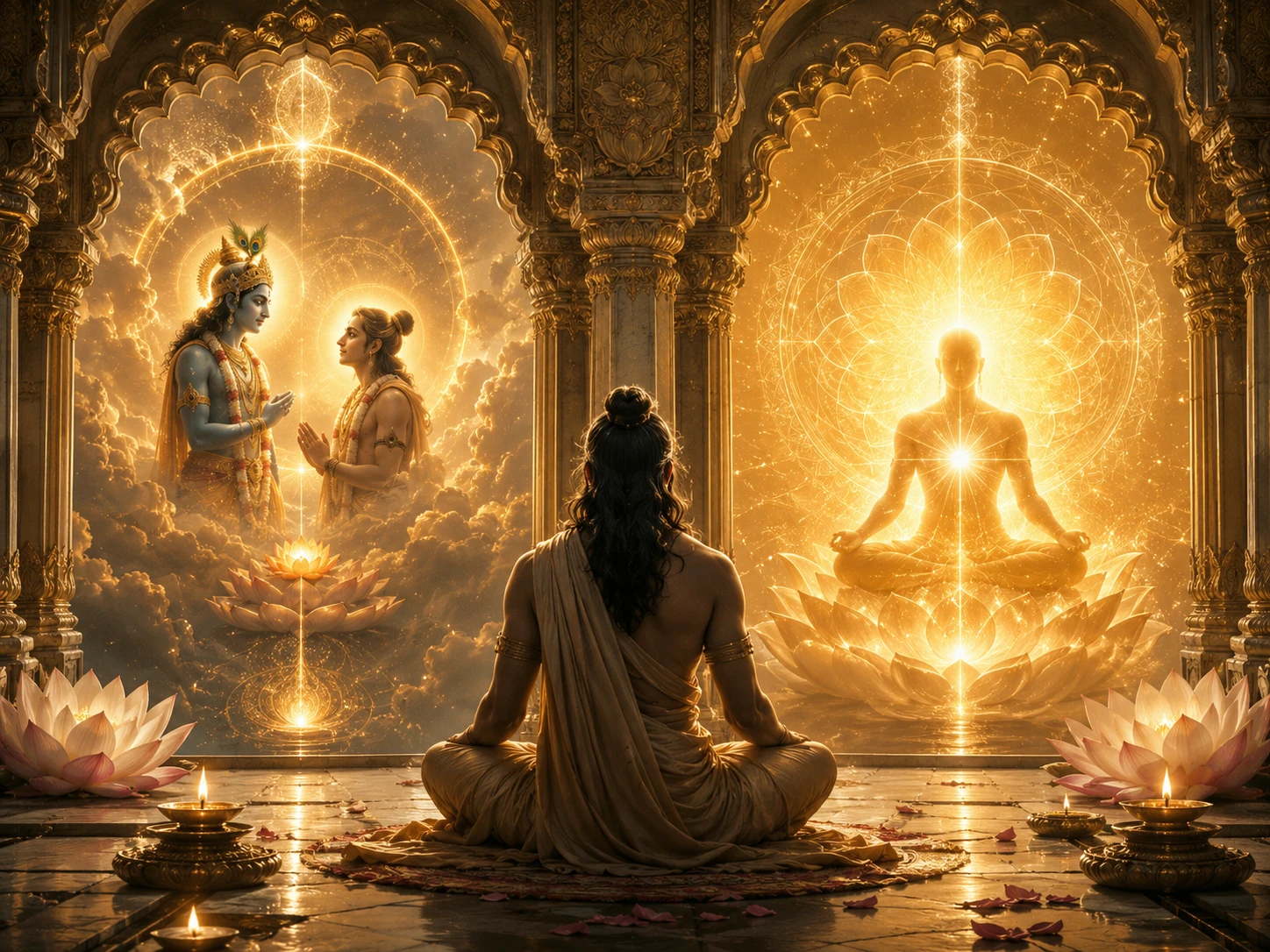
Dvaita vs Advaita -- The Greatest Debate in Hindu Philosophy
द्वैत बनाम अद्वैत -- हिन्दू दर्शन की सबसे बड़ी बहस
Imagine you are a wave in the ocean. Advaita Vedanta says: you are not really a wave. You are the ocean itself, temporarily appearing as a wave due to ignorance. The moment you realise you were always the ocean, the wave-identity dissolves and you are free.
Dvaita Vedanta says: you are a real wave, and the ocean is real, and you will always be a wave. You are not the ocean. You never were. You never will be. But the ocean sustains you, loves you, and is the source of everything you are. Your highest destiny is not to merge into the ocean but to know the ocean fully while remaining yourself -- a distinct, beloved, eternally individual wave.
This is, in simplified form, the greatest philosophical debate in the history of Hindu thought. On one side stands Adi Shankaracharya (8th century CE), the intellectual colossus who systematised Advaita (non-dualism) and argued that Brahman alone is real, the world is apparent, and the individual soul is identical to Brahman. On the other stands Madhvacharya (13th century CE), the Karnataka-born philosopher who established Dvaita (dualism) and argued with equal rigour that God, souls, and the world are all real and eternally distinct.
Between them -- chronologically, philosophically, and sometimes temperamentally -- stands Ramanujacharya (11th century CE), who proposed Vishishtadvaita (qualified non-dualism): Brahman is real, souls are real, the world is real, but souls and the world are the body of Brahman, real yet dependent, distinct yet inseparable.
These three positions are not minor theological quibbles. They determine everything: how you understand God, how you understand yourself, what prayer means, what devotion means, what liberation looks like, and whether the world you live in is ultimately real or ultimately illusory. When a devotee at the Udupi Krishna temple prostrates before the murti, they are enacting Madhva's theology -- I am the servant, You are the Lord. When a sadhu in Varanasi declares 'Aham Brahmasmi' (I am Brahman), they are speaking Shankara's language. Different temples, different mantras, different metaphysics.
ब्रह्म सत्यं जगन्मिथ्या जीवो ब्रह्मैव नापरः। अनेन वेद्यं सच्छास्त्रमिति वेदान्तडिण्डिमः॥
brahma satyaṃ jaganmithyā jīvo brahmaiva nāparaḥ | anena vedyaṃ sacchāstramiti vedāntaḍiṇḍimaḥ ||
Brahman is real. The world is apparent. The individual soul is Brahman itself and nothing else. This is the proclamation that resounds through Vedanta like a drumbeat.
— Attributed to Shankaracharya (Advaita tradition, from Brahma Jnana Vali Mala)
Shankaracharya's Advaita Vedanta is arguably the most influential philosophical system in Indian history. Born in Kaladi, Kerala around 788 CE (dates debated), Shankara accomplished in approximately 32 years what most scholars do not manage in a lifetime. He composed commentaries (bhashyas) on the Brahma Sutras, the principal Upanishads, and the Bhagavad Gita -- the 'triple canon' (Prasthanatrayi) of Vedanta. He established four mathas (monasteries) at the four corners of India -- Sringeri in the south, Puri in the east, Dwarka in the west, Joshimath in the north -- creating an institutional infrastructure that still functions today. He defeated rival philosophers in public debates across the subcontinent. And he articulated a philosophical position of such intellectual power that it became the default 'Hindu philosophy' in global academic discourse.
The core of Advaita is radical and simple. There is only one reality: Brahman -- infinite, formless, attributeless (nirguna), pure consciousness. Everything else -- the world of objects, the plurality of souls, the appearance of difference -- is Maya, cosmic illusion superimposed on Brahman the way a rope is mistaken for a snake in dim light. The snake seems absolutely real in the moment of confusion. Your heart races. Your body recoils. But when light falls on the rope, the snake simply disappears. It was never there. Similarly, when spiritual knowledge (jnana) illuminates the mind, the world of multiplicity does not need to be destroyed. It is simply seen through. It was never separate from Brahman in the first place.
The individual soul (jiva) is not a fragment of Brahman or a creation of Brahman. It IS Brahman, seen through the distorting lens of Avidya (ignorance). The Upanishadic Mahavakya 'Tat Tvam Asi' (That Thou Art, from Chandogya Upanishad 6.8.7) is Shankara's foundational proof text. When the father Uddalaka tells his son Shvetaketu 'Tat Tvam Asi', he is not making a poetic comparison. He is stating an ontological identity: the essence of you (Tvam) is identical to the essence of ultimate reality (Tat). Not similar. Not connected. Identical.
For the young seeker -- the engineering student who has read too much pop spirituality on Instagram, the NRI confused by Alan Watts and Eckhart Tolle who quote Advaita without knowing it -- this means something precise. You are not a small soul trying to reach a big God. You are already that God, dreaming that you are small. Liberation is not achievement. It is recognition.
Madhvacharya's response to Advaita is one of the most rigorous philosophical critiques in Indian history. Born near Udupi in Karnataka around 1238 CE (dates vary), Madhva was a Vaishnava theologian of extraordinary intellectual force. Where Shankara was subtle and paradoxical, Madhva was direct and uncompromising. His Dvaita Vedanta is built on a single, unshakable foundation: difference is real.
Madhva's central doctrine is Panchabheda -- the five-fold eternal difference. These five distinctions exhaust all possible relationships in reality: (1) Jiva and Ishvara are different -- the soul is never identical to God. (2) Jiva and Jiva are different -- each soul is unique; no two are the same. (3) Jiva and Jada are different -- the soul is distinct from inert matter. (4) Ishvara and Jada are different -- God is distinct from the material world. (5) Jada and Jada are different -- material objects are distinct from one another. These five differences are not temporary. They are not caused by ignorance. They are the eternal structure of reality.
Madhva's critique of Advaita is systematic. If the world is illusion (Maya), he asks, then what is Maya itself? If Maya is real, then there are at least two realities (Brahman and Maya), which contradicts non-dualism. If Maya is unreal, then it cannot cause the appearance of the world, because an unreal cause cannot produce even an unreal effect. If Maya is neither real nor unreal (Shankara's position -- 'anirvachaniya', indescribable), then Madhva argues you have introduced a category that violates the basic law of excluded middle -- something must be either existent or non-existent, not a mysterious third option.
This is not devotional sentiment dressed as philosophy. This is formal logic applied to metaphysics with the precision of a litigation brief at the Supreme Court. Madhva was a debater of legendary ferocity. He is said to have challenged the Advaita establishment at Sringeri itself. His intellectual descendants -- Jayatirtha, Vyasatirtha, Raghavendra Tirtha -- continued the debate for centuries, producing commentarial literature of extraordinary sophistication.
For the devotional practitioner -- the grandmother in Udupi who wakes at 4 AM to recite the Vishnu Sahasranama, the Hare Krishna devotee chanting on Marine Drive in Mumbai, the Carnatic musician rendering 'Bhavayami Gopala Balam' at the December Music Season in Chennai -- Madhva's Dvaita provides the philosophical foundation. You are different from God. That difference is what makes love possible. If you and God were identical, devotion would be self-worship. If the wave is the ocean, there is no one left to admire the ocean's beauty. Madhva's Dvaita preserves the space between lover and beloved that makes Bhakti meaningful.
Advaita vs Vishishtadvaita vs Dvaita -- The Three Vedantic Positions
| Dimension | Advaita (Shankara) | Vishishtadvaita (Ramanuja) | Dvaita (Madhva) |
|---|---|---|---|
| Core position | Brahman alone is real. World and souls are apparent. | Brahman is real. Souls and world are real but form Brahman's body. | Brahman (Vishnu), souls, and world are all real and eternally distinct. |
| Nature of Brahman | Nirguna (without attributes). Saguna Brahman is a lower view. | Saguna -- Brahman IS Vishnu with infinite auspicious qualities. | Saguna -- Vishnu is the Supreme Being with all perfections. |
| Atman and Brahman | Identical. 'Tat Tvam Asi' means literal identity. | Related as body to soul. Inseparable but not identical. | Eternally different. Soul is dependent on but never equal to God. |
| Status of the world | Mithya (apparent/illusory). Neither fully real nor fully unreal. | Real (satya). Part of Brahman's body. | Real and eternal. Created and sustained by God but distinct from Him. |
| Maya / Avidya | Beginningless ignorance superimposed on Brahman. | Real divine power (Shakti) of Brahman. | Real. But does not make the world illusory. |
| Liberation (Moksha) | Realisation: 'I am Brahman.' Individual identity dissolves. | Eternal loving service to God in Vaikuntha. Identity preserved. | Eternal bliss in God's presence. Individuality fully preserved. |
| Path | Jnana (knowledge) is primary. Bhakti is preparatory. | Prapatti (surrender) and Bhakti. Grace is essential. | Bhakti. Grace of Vishnu is the only means. |
| Key Mahavakya reading | 'Tat Tvam Asi' = You ARE That (identity) | 'Tat Tvam Asi' = You belong to That (relation) | 'Tat Tvam Asi' = You are NOT That (Madhva reads 'atat tvam asi') |
| Geographic heart | Sringeri, Kanchi, Varanasi, Puri, Dwarka, Joshimath | Srirangam, Tirupati, Melkote | Udupi, Mantralaya |
| Modern cultural expression | 'Aham Brahmasmi' as spiritual identity | Tirupati darshan culture, Prapatti theology | ISKCON, Haridasa tradition, Udupi temple worship |
All three schools accept the authority of the Upanishads, the Bhagavad Gita, and the Brahma Sutras. They differ profoundly in how they interpret the same texts -- the most famous example being 'Tat Tvam Asi' (Chandogya 6.8.7), where Shankara reads identity, Ramanuja reads relationship, and Madhva reads distinction.
Ramanujacharya's Vishishtadvaita deserves more than a footnote in this debate, because it represents the most sophisticated middle path in Vedantic philosophy. Born in Sriperumbudur, Tamil Nadu around 1017 CE, Ramanuja was a temple priest turned philosopher who argued that both Shankara's radical non-dualism and the strict dualism that Madhva would later propose miss something essential.
Ramanuja's position is elegant: Brahman is real, and Brahman has a body. That body consists of two things -- individual souls (chit) and the material world (achit). Just as your body is real but is not you (you are the soul that inhabits it), so the universe and all souls are real but are not Brahman -- they are Brahman's body. This means difference is real (souls are not Brahman) but unity is also real (everything is contained within Brahman as its body). The technical term is 'sharira-shariri-bhava' -- the body-soul relationship.
This has a practical consequence that resonates deeply in Tamil Vaishnavism and in the Tirupati tradition. When you go to Tirumala and stand in the queue (sometimes for 24 hours), you are not going to merge with God. You are going for darshan -- to see and be seen by the Lord. The relationship is personal, intimate, and eternal. You will always be you. God will always be God. But you are never separate from God because you are God's body. The devotee at Srirangam who says 'Adiyen' (your servant) is speaking Ramanuja's theology.
For the modern Indian navigating between spiritual traditions -- the corporate professional in Chennai who visits Tirumala on weekends, the UPSC aspirant trying to answer 'Compare Advaita, Vishishtadvaita, and Dvaita' in four pages, the NRI family in New Jersey debating whether to join an ISKCON temple or an Advaita Vedanta study group -- understanding these three positions is not academic trivia. It is the map of Hindu philosophical space.
The debate between these three schools is not merely historical. It is alive in Indian culture today in ways most people do not consciously register.
When the Shankaracharya of Sringeri or Kanchi speaks, they speak from the Advaita tradition. The four mathas Shankara established still function as the institutional pillars of Advaita, and their heads carry the title 'Shankaracharya' to this day. The Advaita tradition emphasises Jnana (knowledge) as the primary path, and its modern expressions include the Ramakrishna Mission (Swami Vivekananda's neo-Vedanta was largely Advaita-influenced), the Chinmaya Mission, and much of what passes for 'Hindu philosophy' in global yoga and meditation circles.
The Dvaita tradition lives in the eight mathas of Udupi, established by Madhvacharya, where priests from each matha take turns worshipping the Krishna idol in a biennial rotation called the Paryaya festival. It lives in the Haridasa movement of Karnataka -- the devotional singing tradition of Purandaradasa, Kanakadasa, and Vijaya Dasa, whose compositions form the foundation of Carnatic music. It lives in ISKCON (International Society for Krishna Consciousness), whose founder A.C. Bhaktivedanta Swami Prabhupada was a Gaudiya Vaishnava whose theology, while technically Achintya Bhedabheda rather than strict Dvaita, shares Madhva's insistence on the eternal distinction between soul and God.
Ramanuja's Vishishtadvaita is the theology of Tirupati -- the richest and most visited Hindu temple on earth. When 50,000 pilgrims daily climb the seven hills to Tirumala, they are entering a theological space shaped by Ramanuja. The Prapatti tradition (complete surrender to God's grace) that dominates South Indian Vaishnavism is Ramanuja's contribution. The Alvar saints -- the twelve Tamil poet-mystics whose devotional outpourings form the Tamil Veda (Divya Prabandham) -- are Ramanuja's spiritual ancestors.
So the next time you are in an argument about whether 'everything is one' (at a Vipassana retreat in Igatpuri) or whether 'God is a person you must love' (at an ISKCON Sunday feast in Juhu), you are, whether you know it or not, replaying a philosophical debate that has been running for over a thousand years. Both sides have produced saints, scholars, and living traditions of extraordinary depth. Neither is wrong in the way that a mathematical error is wrong. They are seeing different faces of the same mountain, and the mountain -- Brahman, however defined -- is vast enough to accommodate them all.
Madhvacharya's reading of 'Tat Tvam Asi' is one of the most audacious interpretive moves in the history of philosophy. While Shankara reads the Chandogya Upanishad's great statement as 'Tat Tvam Asi' (That Thou Art -- you are Brahman), Madhva breaks the Sanskrit differently, reading it as 'Atat Tvam Asi' (You are NOT That -- you are not Brahman). He argues that the 'a' (negation prefix) in the preceding sentence carries over grammatically. Centuries of debate have followed this single sandhi (conjunction) dispute. It is perhaps the highest-stakes grammatical argument in human history -- the entire structure of Hindu theology hanging on whether one Sanskrit syllable is present or absent.
Explore Both Paths -- Jnana and Bhakti
Whether Advaita's 'I am Brahman' or Dvaita's 'I am the servant of the Lord' speaks to you more, both paths meet in practice. Try ten minutes of silent witnessing, and on another day recite part of the Vishnu Sahasranama -- dear to both traditions -- and notice which draws you. The Sahasranama is on Eternal Raga with each name's meaning.
Eternal Raga · शाश्वत राग
Institutional voice — scholarly articles on Sanatan Dharma
Deepen Your Understanding
अपनी समझ और गहरी करें
philosophy darshana
Atman and Brahman -- The Self and the Absolute
The Upanishads make a claim so radical that 3,000 years have not dulled its edge: the individual self (Atman) and the ultimate reality of the universe (Brahman) are not two different things. They are one. Every school of Hindu philosophy is essentially an argument about what this identity means.
philosophy darshana
Brahma Sutra -- The Architecture of Vedantic Thought
555 aphorisms. 4 chapters. The most technically demanding text in Hindu philosophy. The Brahma Sutra is the text every school of Vedanta must interpret to prove its legitimacy -- and every school reads it completely differently. Welcome to the ultimate intellectual battlefield of Indian civilisation.
philosophy darshana
Vishishtadvaita -- Ramanuja's Philosophy of Qualified Non-Dualism
Shankaracharya said the world is an illusion. Ramanuja said: try telling that to a mother holding her sick child. Vishishtadvaita is the philosophy that insists both God and the world are real, that love is the highest spiritual method, and that liberation means eternal union with the divine -- not dissolution into emptiness.
philosophy darshana
The Four Mahavakyas -- Upanishadic Sentences That Changed Civilisation
Four sentences. Twelve words of Sanskrit. Three thousand years of commentary. The Mahavakyas are the most compressed, most powerful, and most debated statements in all of Indian philosophy. Each one claims that the individual self and the ultimate reality of the universe are not two different things. And each one has been interpreted to mean something completely different by every major school of Vedanta.
philosophy darshana
Maya -- The Cosmic Illusion That Runs the Universe
You walk down a dark path and see a snake. Your heart pounds, your body freezes. Then someone brings a lamp. It was a rope. The snake was never there. Hindu philosophy says the entire universe works exactly like this -- and the lamp is called knowledge. Welcome to Maya, the most counterintuitive and most liberating idea in Indian thought.
philosophy darshana
Bhakti as Philosophy, Not Just Emotion
The intellectual establishment has always underestimated Bhakti. They call it emotional, sentimental, the path for those who cannot do 'real' philosophy. They are wrong. Bhakti has its own sutras, its own epistemology, its own metaphysics, and its own devastating critique of Jnana. Narada, Shandilya, the Alvars, the Haridasas, Mirabai, Tulsidas -- they did not bypass philosophy. They transcended it.
philosophy darshana
Achintya Bhedabheda -- Chaitanya's Theology of Inconceivable Difference-and-Unity
Are you different from God or identical to God? Chaitanya Mahaprabhu's answer: both, simultaneously, inconceivably. This 16th-century Bengali mystic dissolved the Advaita-Dvaita debate not by choosing a side but by transcending the question. His philosophy powers ISKCON, the world's largest Vaishnava movement, and its logic is sharper than it first appears.
Madhvacharya's reading of 'Tat Tvam Asi' is one of the most audacious interpretive moves in the history of philosophy. While Shankara reads the Chandogya Upanishad's great statement as 'Tat Tvam Asi' (That Thou Art -- yo…
More in Philosophy & Darshana
The 14 Lokas -- Hindu Cosmology as a Map of Consciousness
14 min read
Achintya Bhedabheda -- Chaitanya's Theology of Inconceivable Difference-and-Unity
13 min read
Adhyasa -- Superimposition and the Foundational Error of the Self
13 min readThe same translation error that turned '33 Koti' into '33 crore' in Hinduism also happened in Buddhism. The Chinese translation of Buddhist texts rendered 'Sapta Koti Buddha' (7 Supreme Buddhas) as '7 Crore Buddhas.' The…
Deities AvatarsCommunity Reflections
🕉️
Be the first to share your reflection.