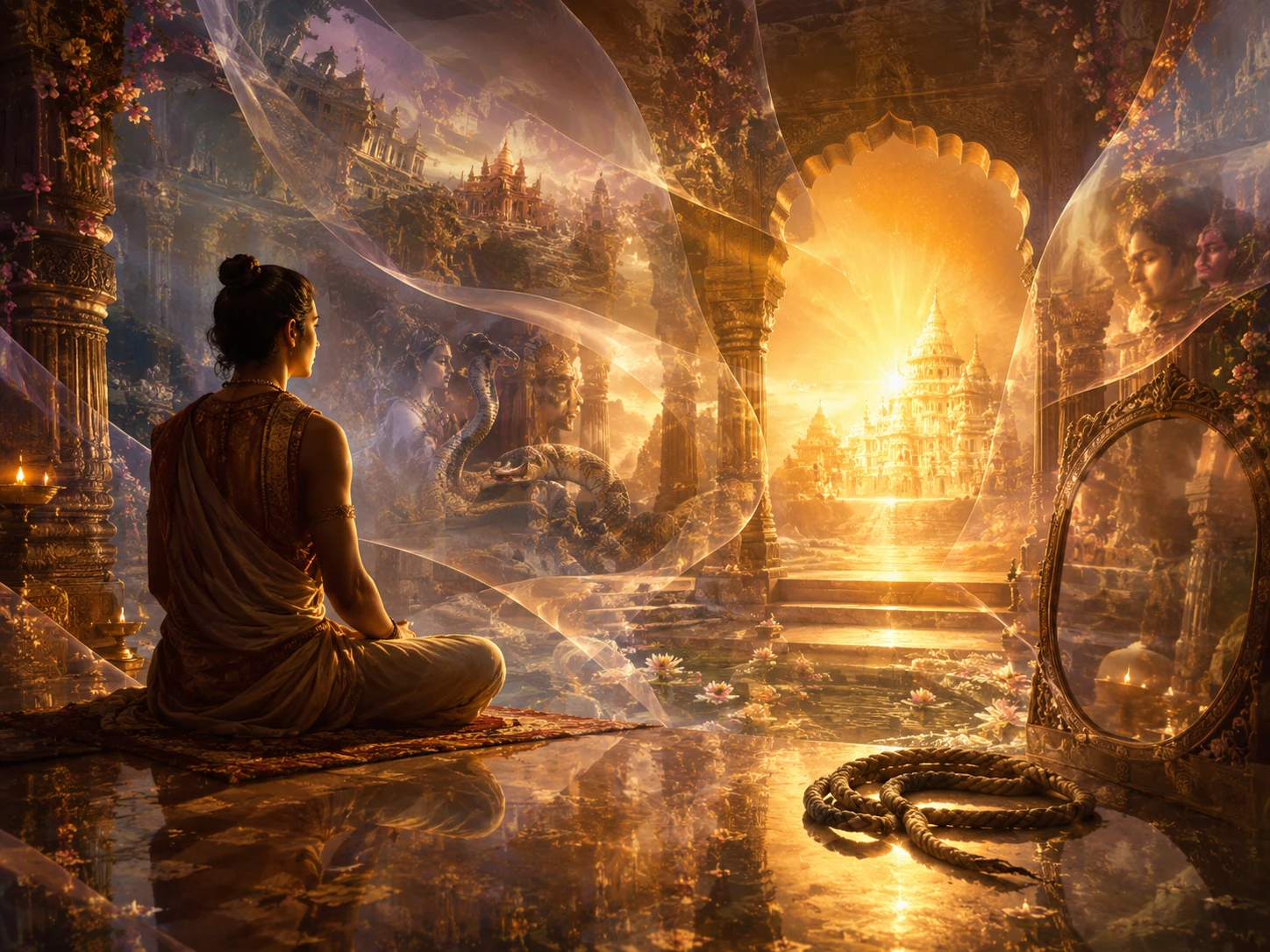
Maya -- The Cosmic Illusion That Runs the Universe
माया -- वह ब्रह्माण्डीय भ्रम जो सारा संसार चला रही है
You are sitting in a cinema hall in PVR. The lights go down. A story appears on the screen -- heroes, villains, love, betrayal, explosions, songs. For two and a half hours, you laugh, cry, clench your fists, and feel your heart race. Then the lights come on. What was the movie? Light projected through celluloid onto a white screen. The characters were never real. The emotions they triggered in you were real -- your tears, your tension, your joy -- but their cause was an illusion. The screen was always there, unchanging, before, during, and after the show. The screen did not become the movie. The movie appeared on the screen.
This is Maya. Not the cheap translation 'illusion' that makes it sound like a parlour trick. Maya is the cosmic projective power that makes the One appear as Many, the Unchanging appear as changing, the Infinite appear as finite. It is the reason you see a world of separate objects when, according to Advaita Vedanta, only Brahman exists. It is the reason you think you are a limited, vulnerable individual when you are, in your deepest nature, infinite consciousness.
Maya is not a lie. A lie has no experiential reality. When you mistake the rope for a snake, the snake is not a lie -- you genuinely perceive it, your body genuinely responds to it. But the snake is not ultimately real either. It has a dependent, borrowed reality that dissolves the instant true knowledge arrives. The technical Advaita term for this status is 'anirvachaniya' -- neither real (sat) nor unreal (asat), but indescribable, occupying a mysterious middle ground that defies the law of excluded middle. This is why Maya has fascinated and frustrated philosophers for over a thousand years.
The Rig Veda uses the word Maya to describe the creative power of the gods -- Indra's Maya, Varuna's Maya -- without the negative connotation of delusion. In the Svetasvatara Upanishad, Maya is explicitly linked to Prakriti (nature) and to God's creative power. But it is Shankaracharya who elevated Maya into the central philosophical concept of Advaita Vedanta, making it the single mechanism that explains why Brahman -- which is all that truly exists -- appears as a universe of multiplicity.
निश्चितायां यथा रज्ज्वां विकल्पो विनिवर्तते। रज्जुरेवेति चाद्वैतं तद्वदात्मविनिश्चयः॥
niścitāyāṃ yathā rajjvāṃ vikalpo vinivartate | rajjureveti cādvaitaṃ tadvadātmaviniścayaḥ ||
Just as when the rope is ascertained, all false imaginations about it cease and the non-dual knowledge arises that it is nothing but the rope -- so too is the ascertainment of the Self.
— Mandukya Karika (Gaudapada), Prakarana 2, Verse 18
The rope-snake analogy (Rajju Sarpa Nyaya) is the single most famous illustration in all of Indian philosophy, and understanding it deeply is the key to understanding Maya.
You are walking home at dusk in your village -- maybe a lane in rural Maharashtra near Nashik, or a path through a Keralan rubber plantation. The light is dim. You see a coiled shape on the ground. Instantly, without deliberation, your mind constructs a snake. Fear floods your body. Adrenaline spikes. You freeze or run. The snake is completely real in your experience. It determines your behaviour, your physiology, your emotional state.
Then someone brings a torch. The light falls on the coiled shape. It is a rope. The snake vanishes. Not slowly -- instantly. You do not need to kill the snake or push it away. Knowledge alone dispels it. And here is the critical philosophical point: the rope did not become a snake and then become a rope again. The rope was always a rope. The snake was superimposed (adhyasta) on the rope by your mind due to insufficient light (ignorance). The snake had no independent existence. It had a dependent, provisional reality -- real enough to make you sweat, but dissolved by a single flash of correct knowledge.
Shankara's Advaita applies this precisely to the ultimate question. Brahman is the rope. The universe of multiplicity -- the stars, the mountains, your job, your family, your LinkedIn profile, your Instagram aesthetic -- is the snake. These are not non-existent (you experience them), but they are not ultimately real (they are superimposed on Brahman by Avidya, cosmic ignorance). When Jnana -- the knowledge 'I am Brahman, all this is Brahman' -- arises, the universe does not physically disappear. But its independent reality evaporates, the way the snake's reality evaporates when the torch arrives. You see through it. You realise the screen was always there behind the movie.
This is not nihilism. Shankara is emphatic: from the perspective of the person still standing in the dark, the snake IS real. You must deal with it. You cannot say 'oh, it is Maya, it does not matter' while the snake is coiled at your feet and your heart is racing. Vyavaharika Satya (empirical reality) is fully valid within its domain. The laws of physics work. The doctor's prescription heals. The NEET exam score determines your medical college. Maya does not negate everyday reality -- it contextualises it within a larger metaphysical framework where only Brahman is Paramarthika Satya (absolute reality).
Three Levels of Reality in Advaita Vedanta
| Level | Sanskrit Term | Description | Example | Status |
|---|---|---|---|---|
| Absolute Reality | Paramarthika Satya | Brahman alone -- unchanging, non-dual, infinite consciousness | The rope itself. The screen behind the movie. | Always real. Never negated by any other knowledge. |
| Empirical Reality | Vyavaharika Satya | The everyday world of objects, persons, laws of nature. Sustained by Maya. | The snake you see. The movie on the screen. Physics, medicine, society. | Real within its domain. Negated only by knowledge of Brahman. |
| Illusory Reality | Pratibhasika Satya | Purely individual error -- private hallucinations, dream objects, mirages. | A mirage of water in a desert. Objects seen in a dream. | Negated even within empirical reality. Not shared by others. |
The genius of this framework is that it allows Advaita to say 'the world is not ultimately real' without saying 'the world does not exist'. Vyavaharika Satya is fully operational -- engineers, doctors, and scientists work within it. But it is not the final word.
Maya operates through two powers: Avarana Shakti (the veiling power) and Vikshepa Shakti (the projecting power). Understanding these two is essential.
Avarana Shakti conceals Brahman. It is the darkness that hides the rope. In lived experience, it is the reason you do not perceive yourself as Brahman. You wake up every morning and feel like a limited, separate person -- a 28-year-old data analyst in Pune, a worried mother in Jaipur, a retired schoolteacher in Varanasi. That sense of limitation is Avarana at work. The infinite is hidden, and you do not even know it is hidden. This is the deepest layer of ignorance -- not knowing that you do not know.
Vikshepa Shakti projects the world of multiplicity onto the concealed Brahman. Once the rope is hidden in darkness, the mind projects a snake. Once Brahman is concealed by Avarana, the mind projects the universe -- names, forms, relationships, hierarchies, distinctions. This projection is not random. It follows lawful patterns (the laws of karma, the regularities of nature, the structure of cause and effect). The dream is internally consistent. Gravity works within the projection. Economics works within the projection. The UPSC syllabus makes sense within the projection. But the projection is still a projection.
Here is where it gets philosophically tricky, and where most casual discussions of Maya go wrong. Maya is not a thing. It is not a substance floating somewhere between Brahman and the world. It is not a villain doing something to Brahman. Maya is, in Shankara's precise formulation, Brahman's own inexplicable power -- 'Brahman's own shakti that is neither real nor unreal.' Brahman does not intend to create Maya. Brahman does not suffer from Maya. Maya exists only from the perspective of the ignorant -- which is, of course, our perspective until we wake up.
The question 'Why does Maya exist?' is itself a product of Maya. From Brahman's perspective -- which is the only real perspective -- Maya does not exist, never existed, and the question is meaningless. This is the Advaitin's ultimate trump card, and also the reason rivals like Madhvacharya found Advaita frustrating. It is hard to argue against a system that says your argument is itself part of the illusion.
Maya's relevance to modern Indian life is not abstract. It is everywhere, hiding in plain sight.
Consider social media. Instagram presents a curated, filtered version of reality. The influencer's life looks perfect -- the travel, the outfits, the relationship, the body. You know intellectually that it is constructed. Yet it triggers real emotions: envy, inadequacy, aspiration. Your response to the Instagram feed is exactly the response to the snake: real emotions triggered by an unreal stimulus. The filter is Maya. The likes are Maya. The lifestyle you compare yourself to is a projection on a screen. The screen -- your own consciousness, your own intrinsic worth -- remains untouched.
Consider the education system. A student's worth in India is often collapsed into a single number -- a JEE rank, a NEET score, a CGPA, a board percentage. Families in Kota, Hyderabad, Delhi treat these numbers as though they are the student. Parents introduce their children by scores: 'Yeh mera beta hai, 99.2 percentile.' The number is superimposed on the child the way the snake is superimposed on the rope. Remove the number and the child is still there -- conscious, alive, inherently valuable. But the superimposition is so convincing that failing the exam feels like dying, because the exam has become the identity.
Consider money. A thousand-rupee note is a piece of paper. Its value is a shared projection -- Maya at the social level. If tomorrow the Reserve Bank of India declared that note invalid (as actually happened on November 8, 2016, with demonetisation), the paper remains the same but its 'reality' evaporates overnight. The value was never in the paper. It was in the collective agreement. That collective agreement is Vyavaharika Satya -- real within its operating system, but not Paramarthika. Demonetisation was, in a strange way, a mass experience of the Rajju Sarpa Nyaya: millions of Indians suddenly discovered that the 'snake' of currency value was a 'rope' of government decree.
Maya is also the philosophical key to understanding the recurring Indian wisdom about detachment (vairagya). When the Gita tells Arjuna to fight without attachment to results, it is not asking him to be emotionally numb. It is asking him to recognise that the outcomes he fears and desires are projections on the screen of Brahman. The screen is unaffected. The warrior fights, the doctor heals, the teacher teaches, the startup founder builds -- but with the background awareness that the entire show, however vivid, is playing on a surface that cannot be scratched.
The concept of Maya has striking parallels in modern science and philosophy. The simulation hypothesis -- popularised by philosopher Nick Bostrom in 2003 and by Elon Musk in public statements -- argues that we might be living in a computer simulation. The 'Matrix' films (which directly referenced Hindu and Buddhist philosophy in their production) present a world that looks real but is actually a projection. Neuroscience reveals that your brain constructs your experience of colour, sound, and spatial depth from electrical signals -- meaning the vivid world you perceive is technically a neural rendering, not 'reality itself'. Karl Friston's Free Energy Principle in neuroscience argues the brain is essentially a prediction machine constructing models of reality, not passively receiving it -- a framework that echoes Maya's Vikshepa Shakti (projecting power) with uncanny precision. Shankara got there 1,200 years earlier with no fMRI machine.
See Through the Projection -- Witness Meditation
Close your eyes and watch your thoughts arise. Notice that each thought appears, stays briefly, and dissolves -- like images on a screen. Ask: what is the screen? What remains when the thought ends? That unchanging awareness behind every thought is the rope behind the snake. The 'Who Is Sensing?' dharana on Eternal Raga sits with the same question.
Eternal Raga · शाश्वत राग
Institutional voice — scholarly articles on Sanatan Dharma
Deepen Your Understanding
अपनी समझ और गहरी करें
philosophy darshana
Atman and Brahman -- The Self and the Absolute
The Upanishads make a claim so radical that 3,000 years have not dulled its edge: the individual self (Atman) and the ultimate reality of the universe (Brahman) are not two different things. They are one. Every school of Hindu philosophy is essentially an argument about what this identity means.
philosophy darshana
Dvaita vs Advaita -- The Greatest Debate in Hindu Philosophy
Are you and God the same being, temporarily confused? Or are you and God eternally different, connected by love but never identical? This question split Hindu philosophy into rival schools, produced centuries of razor-sharp debate, and still determines whether you pray saying 'I am Brahman' or 'I am Brahman's servant'. The answer depends on which genius you believe -- Shankaracharya or Madhvacharya.
philosophy darshana
Neti Neti -- The Method of Negation That Reveals Everything
What is Brahman? Not the body. Not the mind. Not the intellect. Not the ego. Not the universe. Not even the gods. The Brihadaranyaka Upanishad's 'Neti Neti' is the most radical answer ever given to the most fundamental question -- an answer that works by refusing to answer, stripping away everything false until only truth remains.
philosophy darshana
The Four Mahavakyas -- Upanishadic Sentences That Changed Civilisation
Four sentences. Twelve words of Sanskrit. Three thousand years of commentary. The Mahavakyas are the most compressed, most powerful, and most debated statements in all of Indian philosophy. Each one claims that the individual self and the ultimate reality of the universe are not two different things. And each one has been interpreted to mean something completely different by every major school of Vedanta.
philosophy darshana
Sattva, Rajas, Tamas -- The Three Gunas That Run Your Life
Every mood you have ever felt, every decision you have ever made, every Netflix binge and every 4 AM study session -- Hindu philosophy says it all comes down to three forces. Sattva illuminates, Rajas agitates, Tamas numbs. The Bhagavad Gita's Chapter 14 is essentially a 2,000-year-old personality framework that modern psychology is only now catching up to.
scriptural exegesis
Mandukya Upanishad -- 12 Verses That Map the Entire Landscape of Consciousness
Twelve verses. The shortest Upanishad. And yet Gaudapada built the entire edifice of Advaita philosophy on it, and Rama told Hanuman in the Muktika Upanishad that this one text alone is sufficient for liberation. The Mandukya Upanishad maps consciousness into four states -- waking, dreaming, deep sleep, and Turiya (the Fourth) -- and then shows that the syllable AUM contains all four. It is not a meditation manual. It is a complete theory of reality compressed into 12 sentences.
philosophy darshana
Panchakosha -- The Five Sheaths That Hide Your True Self
You are not your body. You are not your breath. You are not your thoughts. You are not even your bliss. The Taittiriya Upanishad says you are wrapped in five sheaths -- like a sword inside a scabbard -- and the real you is hidden at the centre, untouched by any of them. Peel off all five and what remains is Atman.
The concept of Maya has striking parallels in modern science and philosophy. The simulation hypothesis -- popularised by philosopher Nick Bostrom in 2003 and by Elon Musk in public statements -- argues that we might be l…
More in Philosophy & Darshana
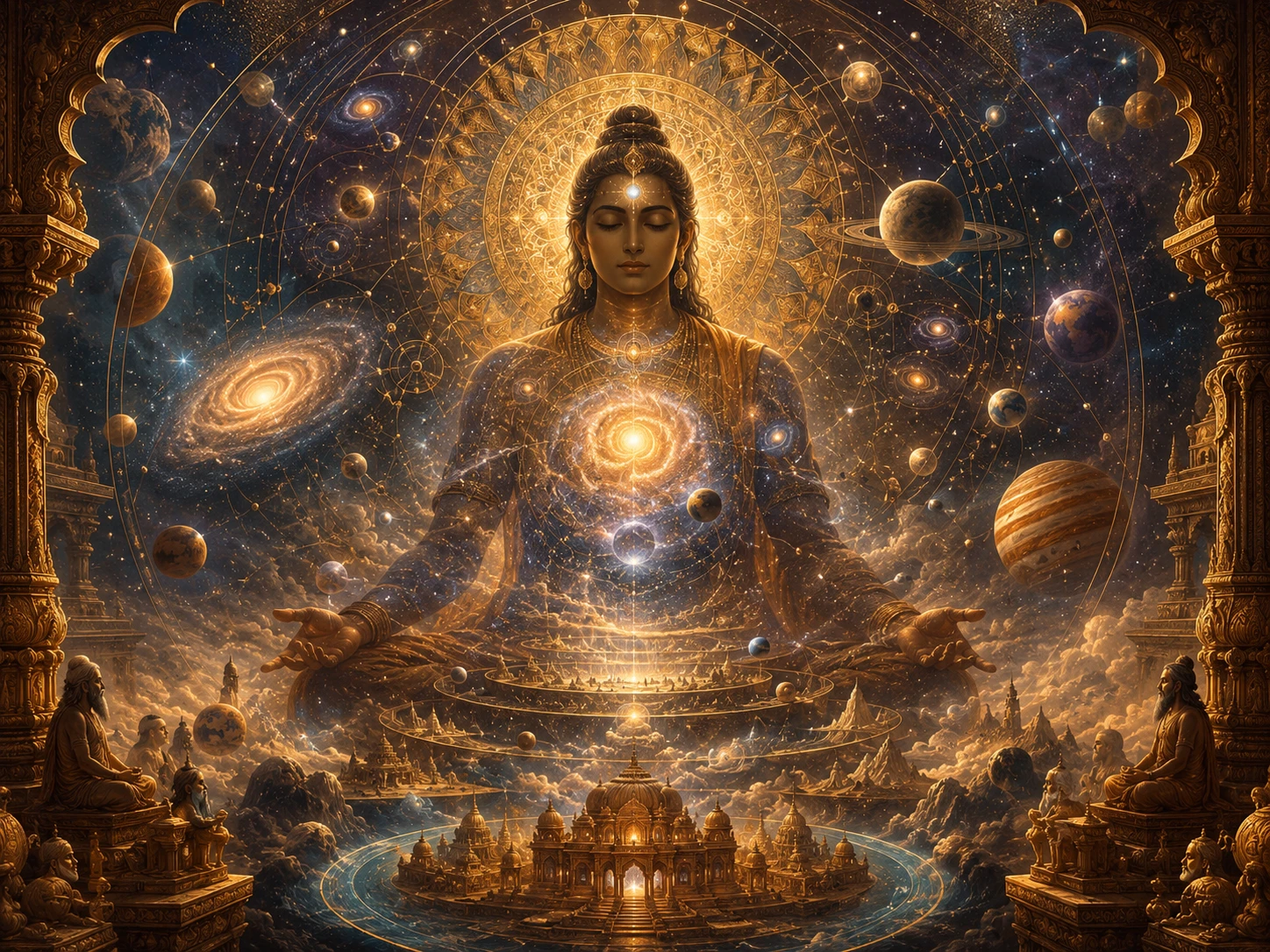
The 14 Lokas -- Hindu Cosmology as a Map of Consciousness
14 min read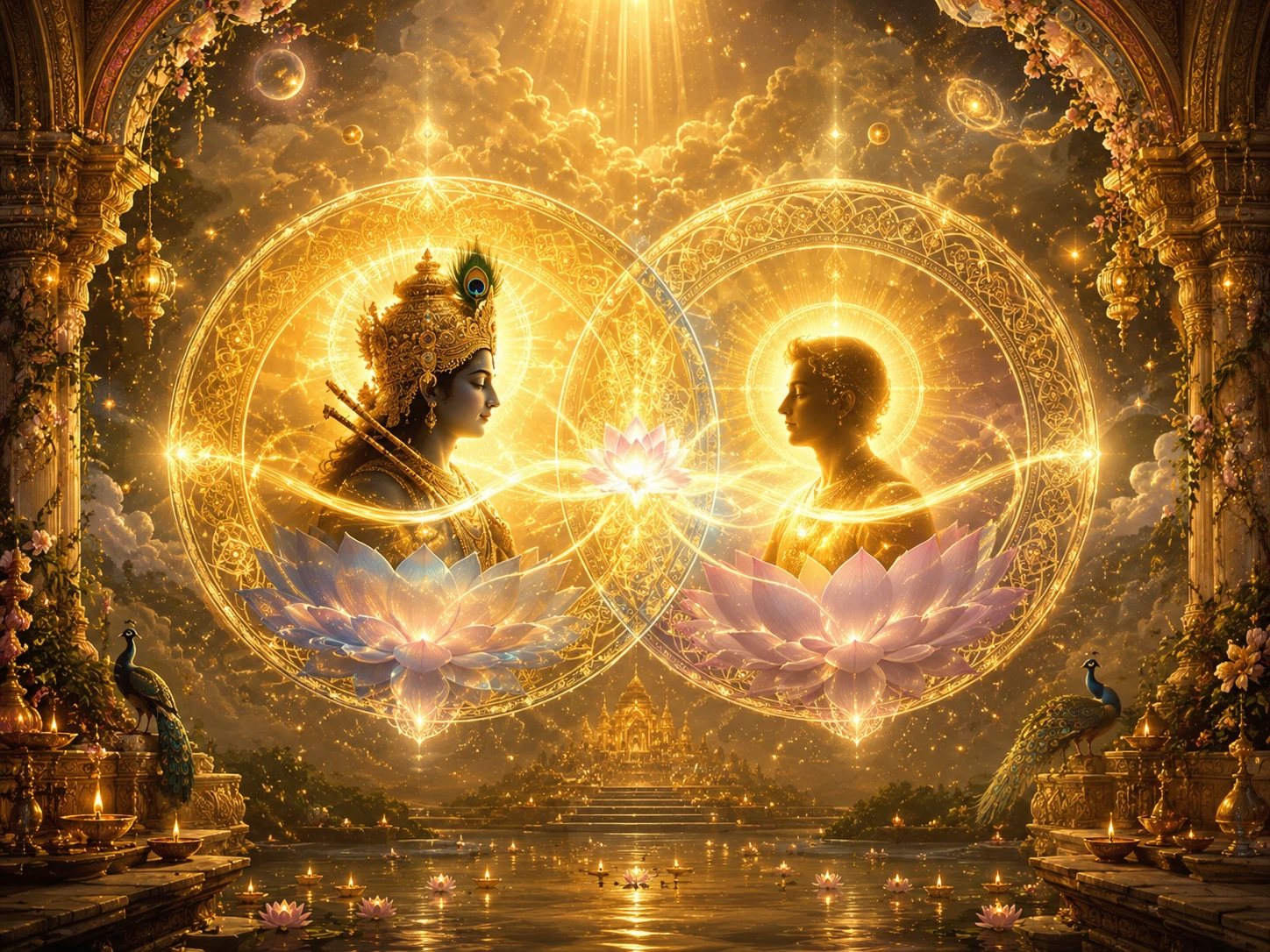
Achintya Bhedabheda -- Chaitanya's Theology of Inconceivable Difference-and-Unity
13 min read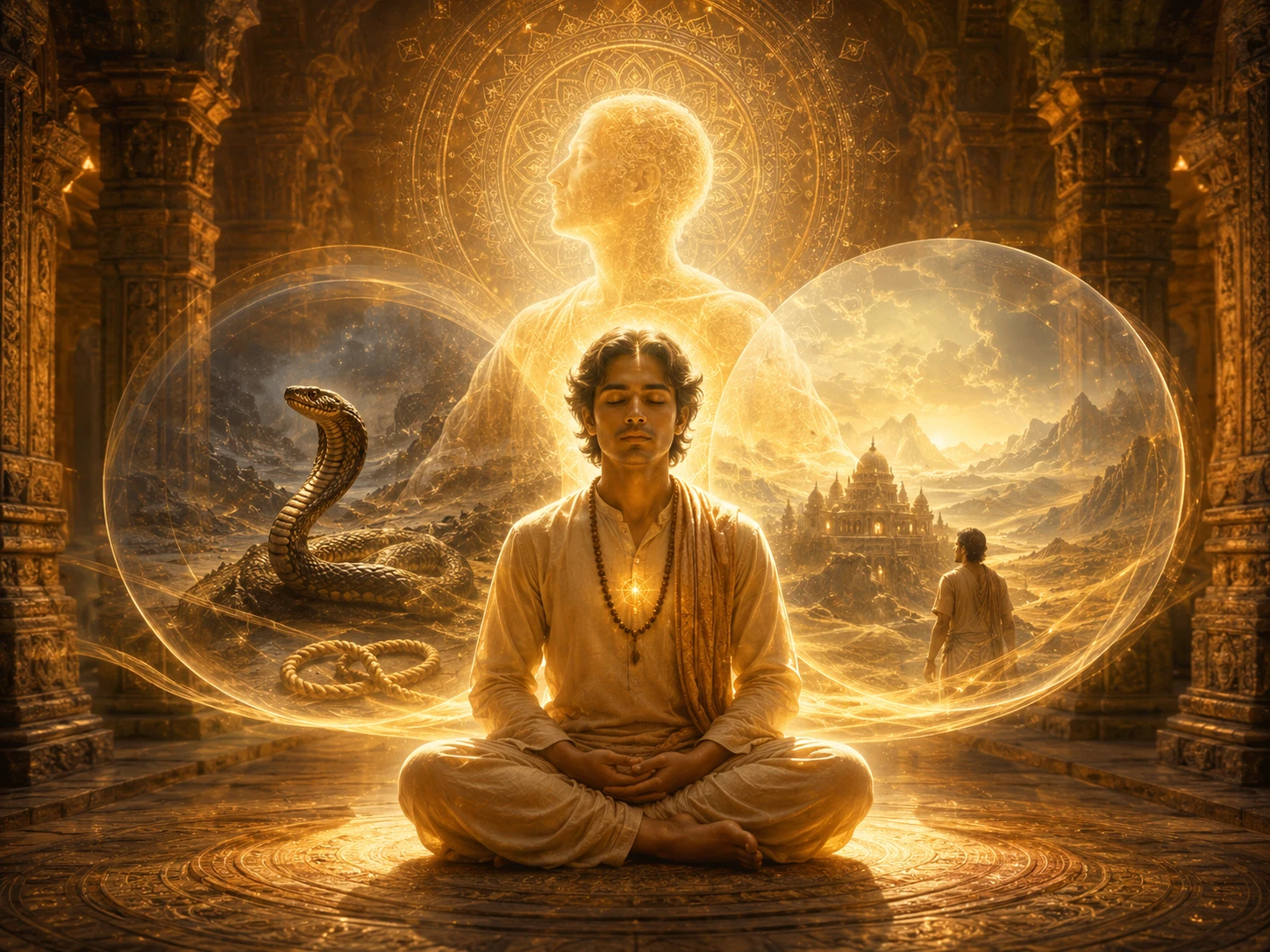
Adhyasa -- Superimposition and the Foundational Error of the Self
13 min readThe same translation error that turned '33 Koti' into '33 crore' in Hinduism also happened in Buddhism. The Chinese translation of Buddhist texts rendered 'Sapta Koti Buddha' (7 Supreme Buddhas) as '7 Crore Buddhas.' The…
Deities AvatarsCommunity Reflections
🕉️
Be the first to share your reflection.