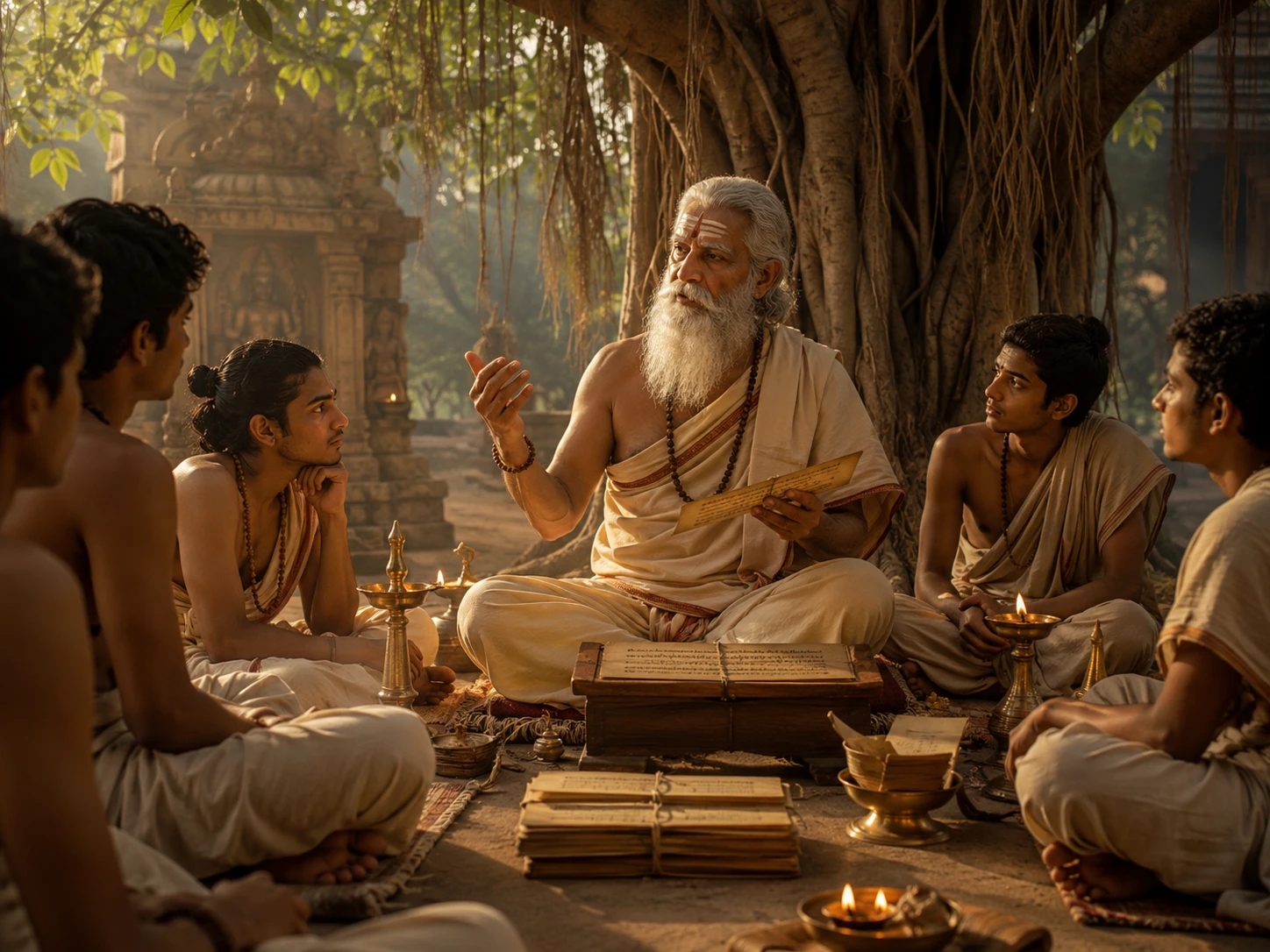
Mandukya Upanishad -- 12 Verses That Map the Entire Landscape of Consciousness
माण्डूक्य उपनिषद् -- 12 श्लोकों में चेतना का सम्पूर्ण मानचित्र
In the Muktika Upanishad, Rama tells Hanuman: 'The Mandukya alone is enough for the salvation of the aspirant.' This is an extraordinary claim. Among 108 Upanishads, one is singled out as self-sufficient. And it is the shortest -- just 12 verses of prose, no more than a page of Sanskrit. How can 12 sentences be enough for liberation?
The answer lies in what those 12 sentences actually do. The Mandukya Upanishad does not teach a doctrine. It performs a mapping operation. It takes the entirety of human experience -- everything you have ever felt, thought, perceived, or dreamed -- and shows you that all of it can be classified into exactly three states: waking (Vaishvanara), dreaming (Taijasa), and deep sleep (Prajna). Then it reveals a fourth -- Turiya -- which is not a state at all but the consciousness that witnesses and underlies all three. And then it maps these four onto the syllable AUM -- A for waking, U for dreaming, M for deep sleep, and the silence after M for Turiya.
This is not a mystical correspondence. It is a structural analysis of consciousness more rigorous than anything in Western philosophy until Husserl's phenomenology in the early 20th century. The Mandukya Upanishad belongs to the Atharvaveda, is listed as number 6 in the Muktika canon, and is classified as a Mukhya (principal) Upanishad. Its chronology is uncertain -- scholars place it anywhere from the 8th to 3rd century BCE. What is certain is its impact: Gaudapada (roughly 7th century CE), the grand-guru of Adi Shankara, wrote 215 verses of commentary on it called the Mandukya Karika, which became the foundational text of Advaita Vedanta as a formal philosophical school.
ओमित्येतदक्षरमिदं सर्वं तस्योपव्याख्यानं भूतं भवद्भविष्यदिति सर्वमोङ्कार एव । यच्चान्यत्त्रिकालातीतं तदप्योङ्कार एव ॥ १ ॥
omityetadakṣaramidaṃ sarvaṃ tasyopavyākhyānaṃ bhūtaṃ bhavadbhaviṣyaditi sarvamoṅkāra eva | yaccānyattrikālātītaṃ tadapyoṅkāra eva || 1 ||
AUM -- this syllable is all this. All that is past, present and future is AUM. And whatever transcends the three divisions of time -- that too is AUM.
— Mandukya Upanishad, Verse 1; Atharvaveda
The first verse is not devotional. It is definitional. It says AUM equals everything -- not metaphorically but literally. Past, present, future, and whatever lies beyond time itself. The Upanishad then immediately defines 'everything' as Brahman, and Brahman as Atman (Self), and the Atman as having four quarters (chatushpat). These four quarters correspond to the four states of consciousness.
The first state is Vaishvanara -- waking consciousness. The Upanishad describes it as outward-cognising (bahish-prajnah), having seven limbs and nineteen mouths, and experiencing gross objects. This is the ordinary waking state where you perceive the external world through your senses. The JEE student solving a physics problem, the Uber driver navigating Pune traffic, the doctor examining a patient -- all are in Vaishvanara.
The second state is Taijasa -- dream consciousness. It is described as inward-cognising (antah-prajnah), experiencing subtle objects. In the dream state, you create an entire world -- people, places, events -- from within your own mind. No external stimulus is needed. The dreamer is simultaneously the creator, the observer, and the world being observed. This is significant because it demonstrates a capacity of consciousness that the waking state conceals: the ability to project an entire reality from within.
The third state is Prajna -- deep sleep. It is described as a mass of consciousness (prajnana-ghana), experiencing bliss (anandabhuk). In deep sleep, there are no objects, no dreams, no perceptions. Yet you exist. Something is present. And when you wake up, you say 'I slept well' -- which means that awareness was present even in the absence of all content. This is the Upanishad's crucial observation: consciousness does not depend on objects. It exists even when there is nothing to be conscious of.
Now comes the revolutionary move. Most systems would stop at three. The Mandukya Upanishad declares a fourth -- Turiya -- which is not a fourth state alongside the other three but the ground of all three. Turiya is described through systematic negation: it is not outward-cognising, not inward-cognising, not a mass of cognition. It is not conscious, not unconscious. It is unperceivable, ungraspable, without characteristics, inconceivable, indescribable. It is the essence of the awareness of the one Self, the cessation of all phenomena, peaceful, auspicious, non-dual. That is Atman. That is to be known.
The Four States of Consciousness in Mandukya Upanishad
| State | Sanskrit Name | AUM Component | Direction of Awareness | Objects Experienced | Modern Parallel |
|---|---|---|---|---|---|
| Waking | Vaishvanara (विश्व) | A (अ) | Outward (bahish-prajnah) | Gross physical objects | Normal waking life -- work, study, sensory experience |
| Dreaming | Taijasa (तैजस) | U (उ) | Inward (antah-prajnah) | Subtle mental objects | Dream states -- also creative visualisation, mental simulation |
| Deep Sleep | Prajna (प्राज्ञ) | M (म) | Neither outward nor inward | None -- mass of bliss | Dreamless sleep -- anaesthesia, deep meditation states |
| The Fourth | Turiya (तुरीय) | Silence after M | Witness of all three | Not an object -- it IS awareness | Pure consciousness -- the 'hard problem' of neuroscience |
Turiya is not a 'state' in the same sense as the other three. It is the screen on which waking, dreaming, and deep sleep appear and disappear. Gaudapada's Karika emphasises: the three states are Turiya appearing as if limited.
The mapping of AUM onto the four states is the Mandukya Upanishad's signature innovation and one of the most elegant intellectual constructions in ancient thought. The sound AUM naturally contains three phonetic elements -- the open vowel A (produced at the back of the throat), the transitional U (produced in the middle of the mouth), and the nasal M (produced at the lips) -- followed by silence. The Upanishad maps A onto Vaishvanara (waking), U onto Taijasa (dreaming), M onto Prajna (deep sleep), and the silence after M onto Turiya.
This is not arbitrary. The sound AUM literally moves from the most open and external (A) through a middle transition (U) to the most closed and internal (M) and then into silence. This mirrors the journey of consciousness from external perception (waking) through internal perception (dreaming) to the absence of perception (deep sleep) and finally to the ground of all perception (Turiya). The phonetics embody the metaphysics.
Gaudapada's Mandukya Karika expanded these 12 verses into 215 verses across four chapters (prakaranas). The first chapter (Agama Prakarana) closely follows the Upanishad text. The second (Vaitathya Prakarana) argues that the objects of waking experience are as unreal as dream objects. The third (Advaita Prakarana) establishes non-duality. The fourth (Alatasanti Prakarana) uses the metaphor of a firebrand -- a torch whirled in circles creates the illusion of a circle of fire, but there is only the point of flame. Similarly, consciousness appears to move through states, but Turiya never actually moves.
Shankara later wrote his own commentary on both the Upanishad and the Karika, establishing the Mandukya as the philosophical nucleus of Advaita Vedanta. His teacher Govindapada was a direct student of Gaudapada. The lineage runs: Mandukya Upanishad to Gaudapada to Govindapada to Shankara -- four generations from text to the greatest Vedantic philosopher in history.
The Mandukya Upanishad's relevance to contemporary science is not metaphorical -- it is direct. The 'hard problem of consciousness,' formulated by philosopher David Chalmers in 1994, asks: why does subjective experience exist? We can explain how the brain processes information. We can map neural correlates of consciousness. But we cannot explain why there is 'something it is like' to be aware. The neural correlate of seeing red is a specific pattern of firing in the visual cortex. But why does that pattern feel like anything? Why is it not just information processing in the dark?
The Mandukya Upanishad addresses exactly this gap. Its deep sleep analysis is the key move. In Prajna (deep sleep), all neural content is absent -- no perceptions, no thoughts, no dreams. Yet the Upanishad insists that awareness is present. And upon waking, you confirm this: 'I slept peacefully.' You were aware of the absence of content. If awareness were identical to neural content (as materialists claim), deep sleep would be a gap in existence -- but it is not. You experience it as rest, as bliss, as continuity. Something persists through the absence of all objects. The Mandukya calls this Turiya.
This is directly relevant to the consciousness research happening at institutions like IIT Kanpur, NIMHANS Bangalore, and the Centre for Consciousness Studies at Pondicherry. Indian neuroscientists working on the neural correlates of meditation states -- EEG studies of Yoga Nidra, fMRI scans of advanced meditators -- are essentially investigating the Mandukya Upanishad's claims empirically. The states described in the Upanishad (waking, dreaming, deep sleep, and a witness-state beyond all three) map onto distinct neurological signatures that researchers are now documenting.
For the UPSC philosophy student, the Mandukya is essential reading. It appears in Indian philosophy papers alongside Western phenomenology (Husserl's intentionality, Heidegger's Dasein) and philosophy of mind (Chalmers, Nagel, Dennett). The comparison is not flattering to the Western tradition -- the Mandukya had a more complete mapping of consciousness 2,500 years before European philosophy even began asking the right questions.
The practical application of the Mandukya Upanishad is meditation on AUM -- not as devotional chanting but as a systematic investigation of consciousness. The practice involves three stages. First, chant A and bring awareness to your waking experience -- the body, the room, the world. Second, chant U and shift awareness inward -- to thoughts, images, inner landscape. Third, chant M and let all content dissolve -- no objects, no images, only the awareness that 'I am.' Fourth, rest in the silence after M -- the awareness that was present through all three states, unchanged, unmoving.
This is not relaxation. It is philosophical investigation conducted through direct experience. The meditator is not believing a theory. The meditator is testing the Upanishad's claim: is there a consciousness that persists through waking, dreaming, and deep sleep? If yes, that consciousness is Turiya. And if Turiya is always present, then the three states are appearances within it, not independent realities. This changes the meditator's relationship to experience: waking life becomes something witnessed, not something that defines identity.
The Mandukya's influence extends beyond Advaita. The Yoga tradition's concept of Yoga Nidra (conscious sleep) directly references the Prajna state. Buddhist philosophy, particularly Nagarjuna's Madhyamaka, shows structural parallels with Gaudapada's Karika -- scholars have debated for centuries whether Gaudapada borrowed from Buddhism or whether both drew from a common Upanishadic source. The Kashmir Shaivism tradition integrates the four-state analysis into its own framework, mapping them onto the 36 tattvas.
For the Indian student encountering consciousness studies for the first time -- whether in a philosophy class at JNU, a cognitive science course at IIT, or a neuroscience lab at AIIMS -- the Mandukya Upanishad is the foundational Indian text. It asks the question that Western science is still struggling with: what is the relationship between awareness and its contents? And it offers an answer that no amount of brain scanning can either confirm or refute: awareness is not produced by its contents. It is the ground from which all contents arise.
The Mandukya Upanishad's description of Turiya deserves careful unpacking because it is not describing an exotic altered state. It is describing the most ordinary thing in the world -- the fact that you are aware right now. You are aware while reading these words (waking). You were aware while dreaming last night (dreaming). And something was aware even during dreamless sleep, because you woke up knowing you slept (deep sleep). What is that awareness that persists through all three? Not the contents of awareness -- those change with every state. The awareness itself. That is Turiya.
The Upanishad describes Turiya through seven negations -- it is not this, not that, not the other. This via negativa approach is deliberate. Turiya cannot be described positively because any positive description turns it into an object of thought -- and the moment it becomes an object, it is no longer the subject. You cannot put the looker in front of the look. You cannot make awareness an object of awareness without creating an infinite regress.
This has a startling practical implication. The spiritual seeker who is 'searching for consciousness' or 'trying to achieve Turiya' is like a person wearing glasses and searching for their glasses. Turiya is not achieved. It is recognised. It is already the case. You are already the watching bird. You have simply been so absorbed in eating the fruit that you forgot you were also watching.
The firebrand metaphor (alata-shanti) from Gaudapada's fourth chapter illustrates this beautifully. When you whirl a burning stick in circles in the dark, you see a circle of fire. But there is no circle -- only a point of flame in motion. The 'circle' is an illusion created by the movement. Similarly, consciousness appears to move through waking, dreaming, and deep sleep, creating the illusion of three separate states. But Turiya -- the actual consciousness -- never moves. It is the still point. The states are appearances within it.
Modern virtual reality technology offers an accidental illustration. When you put on a VR headset, you experience a complete world -- visual, auditory, sometimes even tactile. You can walk through virtual rooms, interact with virtual objects, feel virtual emotions. Yet you are sitting in a chair in your living room. The VR world is the dream. Your body in the chair is the waking. And you -- the one who knows that both the VR and the chair are experiences happening to you -- that is Turiya. You do not need to remove the headset to be Turiya. You need only recognise that you were never not Turiya.
The Mandukya Upanishad's influence on world philosophy is significant and underappreciated. Gaudapada's Karika is considered by many scholars to be the bridge text between Upanishadic philosophy and formal Advaita Vedanta. His arguments about the unreality of the waking world (vaitathya) and the non-origination of the universe (ajativada) show structural parallels with Nagarjuna's Madhyamaka Buddhism. The debate about whether Gaudapada was influenced by Buddhism or vice versa has generated an entire sub-field of comparative philosophy.
In the 20th century, the Mandukya caught the attention of Western phenomenologists. Husserl's concept of 'transcendental consciousness' -- the consciousness that constitutes all experience without being an experience itself -- maps closely onto Turiya. Heidegger's Dasein (being-there) as the ground of all encounter with beings resonates with the Mandukya's insistence that Turiya is not an object but the condition for all objects. These parallels are not coincidental -- they arise because the problem of consciousness has a structure that any rigorous investigation will eventually discover.
For students of Indian philosophy preparing for UPSC or NET, the Mandukya occupies a strategic position. It connects Upanishadic thought (shruti) to Advaita Vedanta (darshana) through Gaudapada's Karika, making it the hinge text of the tradition. Understanding the Mandukya means understanding the logical backbone of non-dualism -- why Shankara argues what he argues, why the dream analogy is so central, why consciousness cannot be reduced to matter.
In popular Indian culture, the Mandukya's legacy lives on every time someone chants AUM. Most chanters understand AUM devotionally -- as a sacred sound, a prayer opener, a spiritual marker. The Mandukya Upanishad adds an entirely different dimension: AUM is not just a sound you make. It is a map of your own consciousness. Every time you chant it with awareness -- moving from A through U through M into silence -- you are rehearsing the journey from waking through dreaming through deep sleep into the witness that underlies all three.
The Mandukya Upanishad's twelve-verse structure is itself a teaching about economy of expression. Where the Brihadaranyaka needs hundreds of verses and the Chandogya sprawls across eight chapters, the Mandukya compresses the entire teaching into what can be written on a postcard. This compression is not accidental. The text embodies its own principle -- just as AUM is the shortest possible sound that maps the full landscape of consciousness, the Mandukya is the shortest possible text that maps the full landscape of Vedantic philosophy.
Verses 1-2 establish the identity: AUM = everything = Brahman = Atman. Verses 3-7 describe the four states. Verses 8-12 map the four states onto AUM. The logic is seamless: if you understand AUM, you understand consciousness; if you understand consciousness, you understand Atman; if you understand Atman, you understand Brahman; if you understand Brahman, you understand everything. The chain is complete in twelve steps.
The Mandukya has had particular influence in inter-traditional dialogue within Hinduism. Kashmir Shaivism maps the four states onto its own ontology -- Turiya becomes Shiva-consciousness, and the three states become the play (lila) of Shakti. The Vaishnava tradition reads the four states as four modes of Vishnu's presence -- Vishva, Taijasa, Prajna, and the Turiya as Vasudeva. The Shakta tradition identifies Turiya with the Devi -- the supreme goddess who is consciousness itself, the ground of all experience.
What makes the Mandukya unique among Upanishads is that it requires no story, no dialogue, no narrative frame. There is no Nachiketa and Yama (Katha), no Shaunaka and Angiras (Mundaka), no Uddalaka and Shvetaketu (Chandogya). It is pure philosophical prose -- twelve declarative statements about the nature of reality. It reads less like a spiritual text and more like a mathematical proof. Axiom, derivation, conclusion. And like any good proof, once you see it, you cannot unsee it. Once you recognise that awareness persists through waking, dreaming, and deep sleep, you cannot pretend that awareness is produced by the brain. The brain changes state. Awareness does not.
One final dimension of the Mandukya Upanishad that bears emphasis is its relationship with the practice of Yoga Nidra -- 'yogic sleep' -- which has become one of India's most significant cultural exports in the 21st century wellness industry. Yoga Nidra, as taught by Swami Satyananda Saraswati and popularised globally, is a systematic rotation of awareness through waking, dreaming, and deep sleep states while maintaining the thread of consciousness. This is precisely the Mandukya's experiment: can you remain aware through the transition from waking to sleep? If so, you have touched Turiya -- the awareness that does not sleep when the body sleeps, that does not dream when the mind dreams, that does not dissolve when all content dissolves. The Mandukya Upanishad gave the theoretical framework. Yoga Nidra gave the practical method. Together they represent Indian civilisation's deepest contribution to the science of consciousness -- a contribution that modern neuroscience is only now beginning to take seriously.
The Mandukya Upanishad's analysis of deep sleep anticipated a finding that neuroscience confirmed only in the 21st century. In 2013, researchers at the University of Wisconsin-Madison found that during deep sleep, the brain does not 'switch off' -- a specific pattern of slow-wave neural activity continues, suggesting a baseline consciousness even in the absence of dreams or perceptions. The Upanishad's description of Prajna as 'prajnana-ghana' (a mass of consciousness) experiencing 'ananda' (bliss) describes exactly this: not the absence of awareness, but awareness without objects. Additionally, India's national motto 'Satyameva Jayate' (Truth alone triumphs) comes from the Mundaka Upanishad (3.1.6), not the Mandukya -- but the two are often confused because both are short Atharvaveda Upanishads. The Mandukya's contribution to modern India is less visible but arguably deeper: every time someone in India sits in meditation and chants AUM, they are performing the Mandukya Upanishad's experiment.
Meditate with AUM -- The Mandukya Practice
Chant AUM slowly, dwelling on each syllable. A -- feel the waking world. U -- feel the inner landscape. M -- let everything dissolve. Silence -- rest in pure awareness. This is not devotional chanting. This is the Mandukya Upanishad's experiment in consciousness.
Tags
Eternal Raga · शाश्वत राग
Institutional voice — scholarly articles on Sanatan Dharma
Deepen Your Understanding
अपनी समझ और गहरी करें
philosophy darshana
The Four Mahavakyas -- Upanishadic Sentences That Changed Civilisation
Four sentences. Twelve words of Sanskrit. Three thousand years of commentary. The Mahavakyas are the most compressed, most powerful, and most debated statements in all of Indian philosophy. Each one claims that the individual self and the ultimate reality of the universe are not two different things. And each one has been interpreted to mean something completely different by every major school of Vedanta.
scriptural exegesis
Isha Upanishad -- The Complete Guide to 18 Verses That Changed Indian Philosophy
Eighteen verses. That is all. The Isha Upanishad is the shortest of the principal Upanishads -- the final chapter of the Shukla Yajurveda -- and yet it tackles more ground in fewer words than most philosophical treatises manage in hundreds of pages. Enjoy the world through renunciation. Act for a hundred years without attachment. See your Self in all beings. These are not greeting-card platitudes. They are precision-engineered instructions for living in the world without being destroyed by it. Gandhi called it the essence of Hinduism. Shankara built his Advaita commentary around it. And its opening verse remains the most quoted line in all Upanishadic literature.
scriptural exegesis
Kena Upanishad -- 'By Whom?' The Question That Humbled the Gods
By whom is the mind directed? By whom does the first breath move? By whose will do people speak? The Kena Upanishad opens with the most dangerous question a human can ask: what is the power behind my own power? It then delivers the answer through one of the greatest stories in Upanishadic literature -- the tale of Agni, Vayu, and Indra who could not burn, blow, or even identify a single blade of grass when challenged by Brahman. The goddess Uma Haimavati had to appear to tell them the truth they were too proud to see.
philosophy darshana
Om -- The Sound That Contains the Universe
Om is not a chant. It is not a religious symbol. According to the Mandukya Upanishad, it is the complete map of consciousness itself -- past, present, future, and whatever lies beyond all three. Twelve verses. Four states. One syllable. This is the most concentrated philosophical text in human history, and it fits on a single page.
philosophy darshana
Advaita Vedanta Explained -- Shankara's Radical Philosophy of Non-Duality
You are not your job title. You are not your Instagram bio. According to Adi Shankaracharya, you are not even your body or mind -- you are Brahman itself, the infinite consciousness wearing a temporary costume. Advaita Vedanta is the most radical philosophical claim in Indian history: that the entire universe is one undivided reality, and separation is the grandest illusion.
philosophy darshana
Atman and Brahman -- The Self and the Absolute
The Upanishads make a claim so radical that 3,000 years have not dulled its edge: the individual self (Atman) and the ultimate reality of the universe (Brahman) are not two different things. They are one. Every school of Hindu philosophy is essentially an argument about what this identity means.
philosophy darshana
Kashmir Shaivism -- The Philosophy of Divine Recognition
What if liberation is not about gaining something new but recognising what you already are? Kashmir Shaivism says you are already Shiva -- infinite, free, blissful consciousness. You have simply forgotten. The entire universe is Shiva's dance of self-concealment and self-recognition. Your job is to remember.
The Mandukya Upanishad's analysis of deep sleep anticipated a finding that neuroscience confirmed only in the 21st century. In 2013, researchers at the University of Wisconsin-Madison found that during deep sleep, the br…
More in Scriptural Exegesis
Abhimanyu and the Chakravyuha -- The Boy Who Knew How to Enter but Not How to Leave
14 min read
Adbhuta Ramayana -- The Ramayana Where Sita Becomes Kali
9 min read
After Kurukshetra -- What Happened Next
14 min readThe same translation error that turned '33 Koti' into '33 crore' in Hinduism also happened in Buddhism. The Chinese translation of Buddhist texts rendered 'Sapta Koti Buddha' (7 Supreme Buddhas) as '7 Crore Buddhas.' The…
Deities AvatarsCommunity Reflections
🕉️
Be the first to share your reflection.