After Kurukshetra -- What Happened Next
कुरुक्षेत्र के बाद -- फिर क्या हुआ
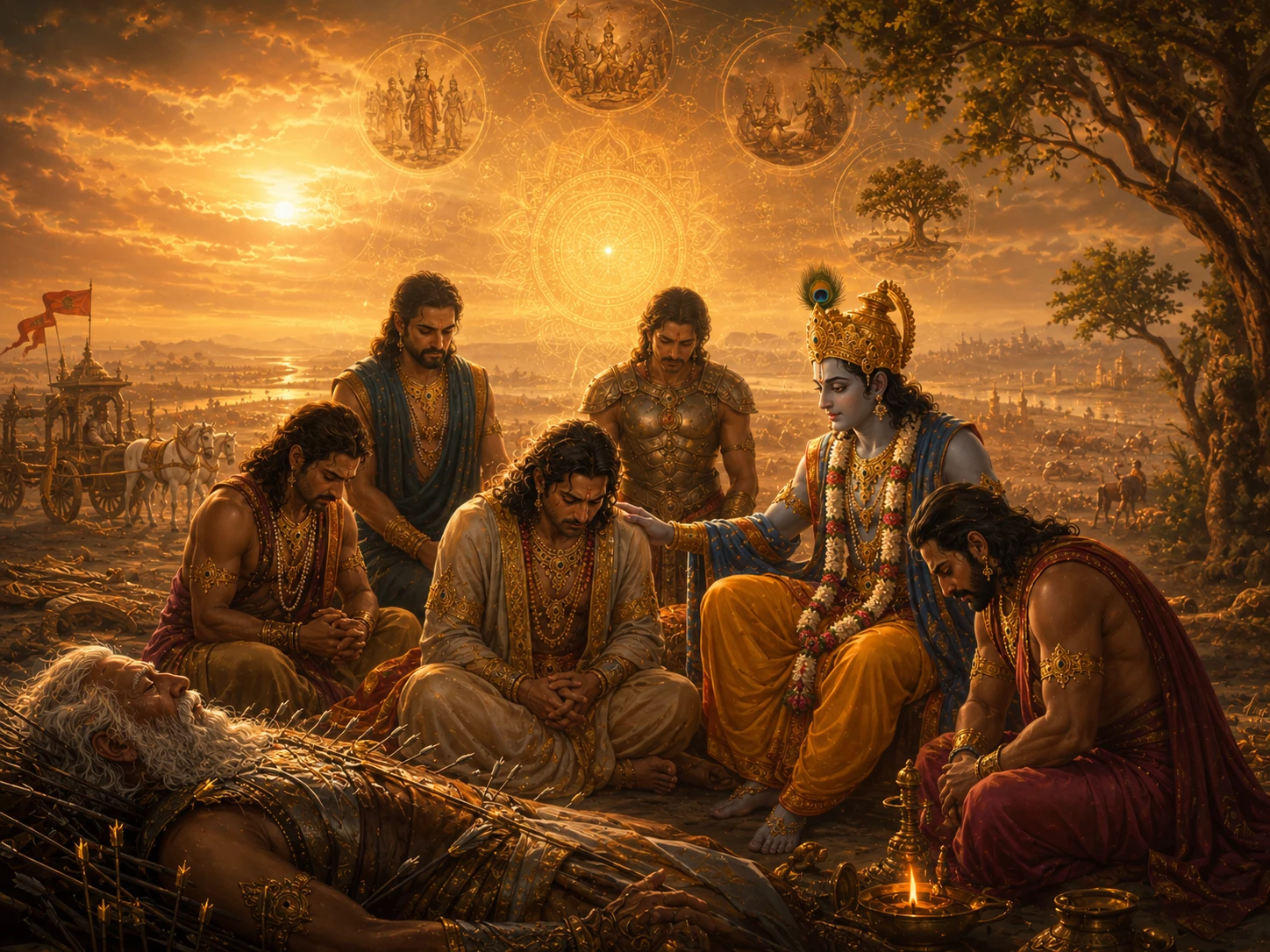
The Mahabharata war lasted eighteen days. The aftermath lasted thirty-six years. And the aftermath is where the real teaching lives.
Most people know the Mahabharata as a war story. The Bhagavad Gita, the Chakravyuha, Karna's armour, Bhishma's arrow bed -- these are the episodes that fill television serials, Amar Chitra Katha comics, and UPSC Art & Culture notes. But the Mahabharata has eighteen books, and the war occupies only five of them (Books 6 through 10). What happens in Books 11 through 18 -- the post-war narrative -- is where Vyasa's genius reaches its most disturbing and philosophically potent.
Here is the sequence of what happened after the victory conch fell silent on the eighteenth evening:
The Stri Parva (Book 11): The women of the dead warriors -- Gandhari, Kunti, Dhritarashtra, and thousands of widows -- walk the battlefield. Gandhari, blind-folded queen who lost all hundred sons, confronts Krishna and curses him: 'In thirty-six years, your own kinsmen will destroy each other just as mine have, and your city will be swallowed by the sea.' Krishna accepts the curse without protest.
The Shanti Parva (Book 12) and Anushasana Parva (Book 13): Bhishma, lying on his bed of arrows, delivers the longest discourse in the epic -- thousands of verses on dharma, governance, philosophy, and the duties of a king. These two books together are longer than the entire Iliad and Odyssey combined. Yudhishthira, broken by guilt over the carnage, is slowly rebuilt through Bhishma's teachings.
The Ashvamedhika Parva (Book 14): Yudhishthira performs the Ashvamedha Yajna -- the horse sacrifice -- to atone for the sin of killing kinsmen and to establish sovereign authority. During this yajna, Arjuna fights and reconciles with several regional kings.
The Ashramvasika Parva (Book 15): Dhritarashtra, Gandhari, and Kunti retire to the forest. Years later, they perish in a forest fire -- a quiet, undramatic end for three of the most powerful figures in the epic.
The Mausala Parva (Book 16): The Yadava clan destroys itself. This is the most shocking post-war chapter.
ऊर्ध्वबाहुर्विरौम्येष न च कश्चिच्छृणोति मे। धर्मादर्थश्च कामश्च स किमर्थं न सेव्यते॥
ūrdhvabāhur viraumyeṣa na ca kaścicchṛṇoti me | dharmād arthaśca kāmaśca sa kimarthaṃ na sevyate ||
With uplifted arms I cry aloud, but no one listens! From Dharma flow both Artha (prosperity) and Kama (desire) -- why then is Dharma not pursued?
— Swargarohana Parva, Mahabharata Book 18 (Vyasa's final lament)
The Destruction of the Yadavas -- Mausala Parva
Thirty-six years after Kurukshetra, the Yadava kingdom of Dwaraka is prosperous but morally decaying. The youth have become arrogant. Values have eroded. Gandhari's curse ticks like a clock.
The trigger is absurd. Krishna's son Samba and other Yadava youths, drunk on power and boredom, dress Samba as a pregnant woman and approach visiting sages -- Vishvamitra, Kanva, Narada -- as a prank, asking them to predict the baby's gender. The sages, enraged by the mockery, curse Samba: he will deliver an iron mace (mausala) that will destroy the entire clan.
The next day, Samba produces an iron pestle. Ugrasena, the Yadava king, orders it ground to powder and cast into the sea. One unbreakable fragment is swallowed by a fish. The powder washes ashore and grows into sharp eraka grass along the Prabhasa coast.
Krishna sees the gathering signs. He orders Dwaraka to abstain from alcohol. He leads the Yadavas to Prabhasa for a pilgrimage. But at the coast, the drinking resumes. Old war grudges resurface. Satyaki kills Kritavarma over an argument about who committed worse atrocities during Kurukshetra. The killing spreads. Having no weapons, the Yadavas pluck the eraka grass from the shore -- and it transforms into iron rods. The cursed mausala has returned.
In the fratricidal massacre, nearly every Yadava warrior dies -- including Pradyumna (Krishna's son) and Satyaki. Krishna himself, in fury, picks up the grass and kills those attacking his people. Balarama walks to the sea, enters a yogic trance, and dies. A serpent (Shesha) is seen leaving his body.
Krishna, alone, sits under a tree in the forest. A hunter named Jara -- whose arrowhead is made from the one unbreakable iron fragment -- mistakes Krishna's foot for a deer and shoots. Krishna dies. He tells the hunter: 'You are not at fault. This was ordained.'
Dwaraka sinks into the sea. Arjuna arrives too late. He leads the surviving women and children toward Hastinapura, but on the road, bandits attack -- and Arjuna's Gandiva bow fails him. His divine weapons no longer respond. The age of heroes is over.
The message is not subtle. The Mahabharata is saying: civilisations do not fall to external enemies. They fall to internal rot -- arrogance, mockery of wisdom, substance abuse, and the inability to resolve old conflicts. Every startup that imploded after its Series C, every political dynasty that self-destructed through infighting, every family business that collapsed because the third generation partied instead of worked -- all of them are Dwaraka.
The Post-War Books of the Mahabharata -- A Timeline
| Book # | Parva | Key Events | Time After War |
|---|---|---|---|
| 11 | Stri Parva (Book of Women) | Battlefield grief; Gandhari's curse on Krishna; Kunti reveals Karna's identity | Day 19 (immediately after war) |
| 12 | Shanti Parva (Book of Peace) | Bhishma's discourse on dharma, governance, moksha from his arrow bed | Weeks after war |
| 13 | Anushasana Parva (Book of Instructions) | Bhishma's final teachings; his death on Uttarayana | ~58 days after war |
| 14 | Ashvamedhika Parva (Horse Sacrifice) | Yudhishthira's Ashvamedha Yajna for atonement; Arjuna's campaigns | Year 1-2 |
| 15 | Ashramvasika Parva (Hermitage) | Dhritarashtra, Gandhari, Kunti retire to forest; die in forest fire | Year 15-18 |
| 16 | Mausala Parva (Book of Clubs) | Yadava self-destruction; Krishna's death; Dwaraka submerged | Year 36 |
| 17 | Mahaprasthanika Parva (Great Journey) | Pandavas renounce kingdom; walk to Himalayas; fall one by one | Year 36+ |
| 18 | Swargarohana Parva (Ascent to Heaven) | Yudhishthira's dog test; Kauravas in heaven; illusory hell; reunion | Year 36+ |
The post-war narrative (Books 11-18) spans 36+ years and contains more philosophy, more political science, and more human tragedy than the war itself.
The Archaeological Survey of India (ASI) and the National Institute of Oceanography (NIO) have conducted underwater excavations off the coast of modern-day Dwaraka in Gujarat since the 1960s. They discovered submerged stone structures, a stone-built jetty, stone anchors, and ceramic artifacts dating from approximately 1500 BCE to 500 BCE. While this does not prove the Mahabharata account, it establishes that an ancient port city existed at or near the location described in the text -- and that it was submerged by the sea, exactly as the Mausala Parva narrates.
Read the Bhagavad Gita -- Krishna's Pre-War Teaching
The post-war tragedy makes the Gita's pre-war teaching more urgent. Read the Bhagavad Gita on Eternal Raga, chapter by chapter, with Sanskrit, transliteration and meaning.
Tags
Eternal Raga · शाश्वत राग
Institutional voice — scholarly articles on Sanatan Dharma
Deepen Your Understanding
अपनी समझ और गहरी करें
scriptural exegesis
Pandavas in Hell -- The Shocking Finale of the Mahabharata
The Mahabharata does not end with victory. It ends with the heroes falling dead on a Himalayan climb, the villains seated in heaven, and the one righteous king demanding to be sent to hell. The Swargarohana Parva is the most unsettling, most philosophically radical, and most misunderstood finale in all of world literature.
scriptural exegesis
Parikshit to Janamejaya -- The Pandava Dynasty After the War and Why the Mahabharata Was Told
The child who survived a divine weapon in the womb became the king who united a shattered kingdom. His son, consumed by vengeance for his father's death by snakebite, launched a sacrifice to burn every serpent in the world -- and it was at that sacrifice that a sage named Vaishampayana narrated the entire Mahabharata for the first time. Without Parikshit's miraculous survival, there is no Pandava dynasty. Without Janamejaya's rage, there is no Mahabharata as we know it. These two generations are the reason the story exists.
scriptural exegesis
Karna's Tragedy -- The Sun's Forgotten Son
Born with divine armor, abandoned at birth, raised by a charioteer, humiliated for his caste, cursed by his teacher, and killed while defenseless -- Karna's story is not the Mahabharata's subplot. It is the Mahabharata's conscience. Every system that failed him is a system that still fails people today.
scriptural exegesis
Bhishma's Terrible Vow
A crown prince gave up the throne, love, marriage, and children -- forever -- so his father could marry a fisherwoman. That single vow made Bhishma immortal in name and set the entire Mahabharata into motion. Was it the noblest sacrifice in literature, or the most catastrophic?
scriptural exegesis
Kurukshetra Battle Alliances -- Which Kings Joined Which Side
Seven akshauhinis against eleven. 1.5 million warriors against 2.4 million. The Kurukshetra war was not two families fighting -- it was the entire Indian subcontinent choosing sides. From the Pandyas of Tamil Nadu to the Kambojas of Central Asia, from the Yadavas of Dwaraka to the Kekayas split down the middle -- here is the geopolitical map of who joined whom and why, sourced from Udyoga Parva.
scriptural exegesis
Yaksha Prashna -- Questions at the Lake
Four brothers lie dead beside an enchanted lake. One brother remains. A voice from the water asks 124 questions about dharma, death, happiness, and the self. Yudhishthira's answers in Vana Parva remain the most sophisticated ethical examination in all of Sanskrit literature.
The Archaeological Survey of India (ASI) and the National Institute of Oceanography (NIO) have conducted underwater excavations off the coast of modern-day Dwaraka in Gujarat since the 1960s. They discovered submerged st…
More in Scriptural Exegesis
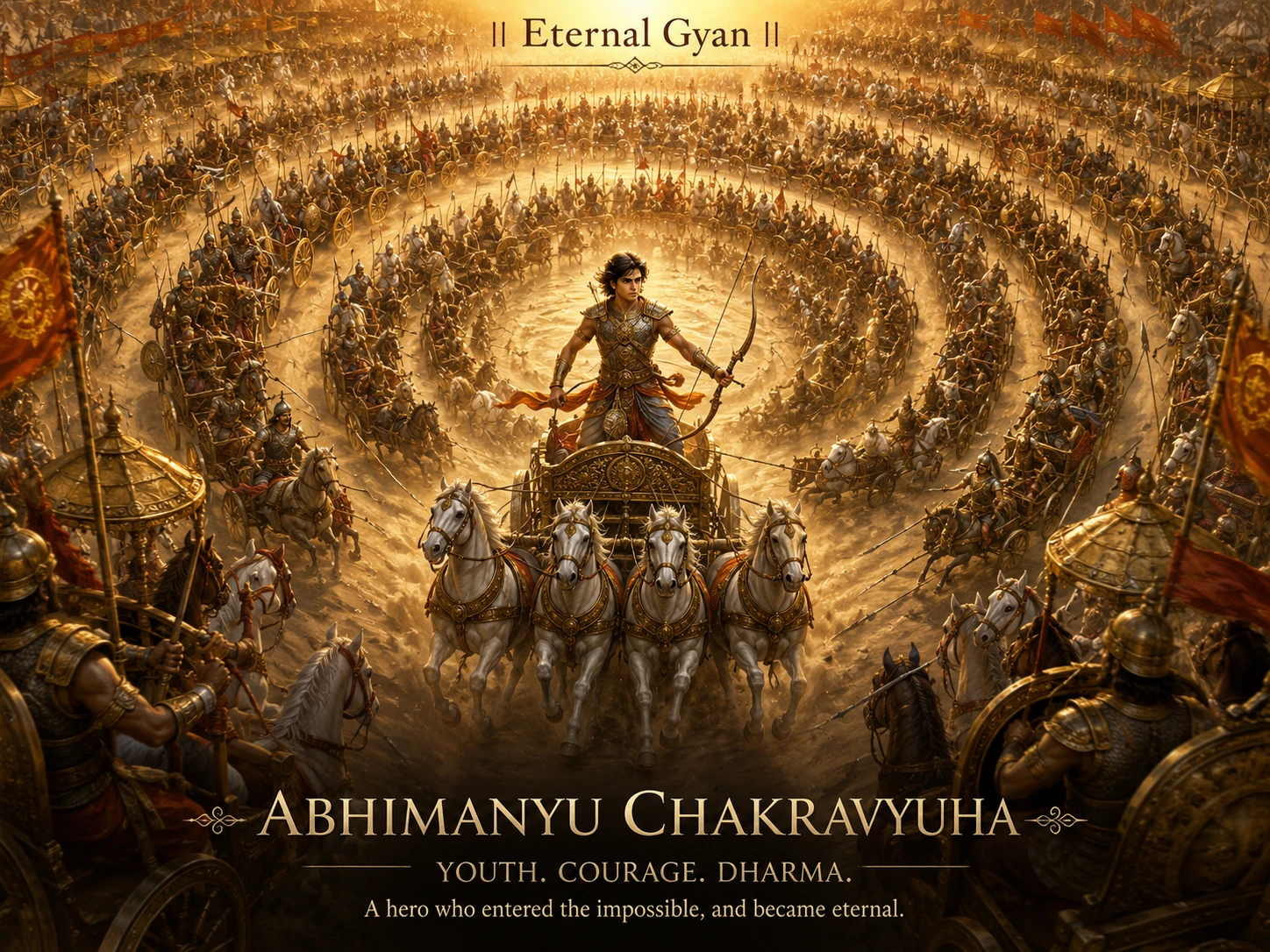
Abhimanyu and the Chakravyuha -- The Boy Who Knew How to Enter but Not How to Leave
14 min read
Adbhuta Ramayana -- The Ramayana Where Sita Becomes Kali
9 min read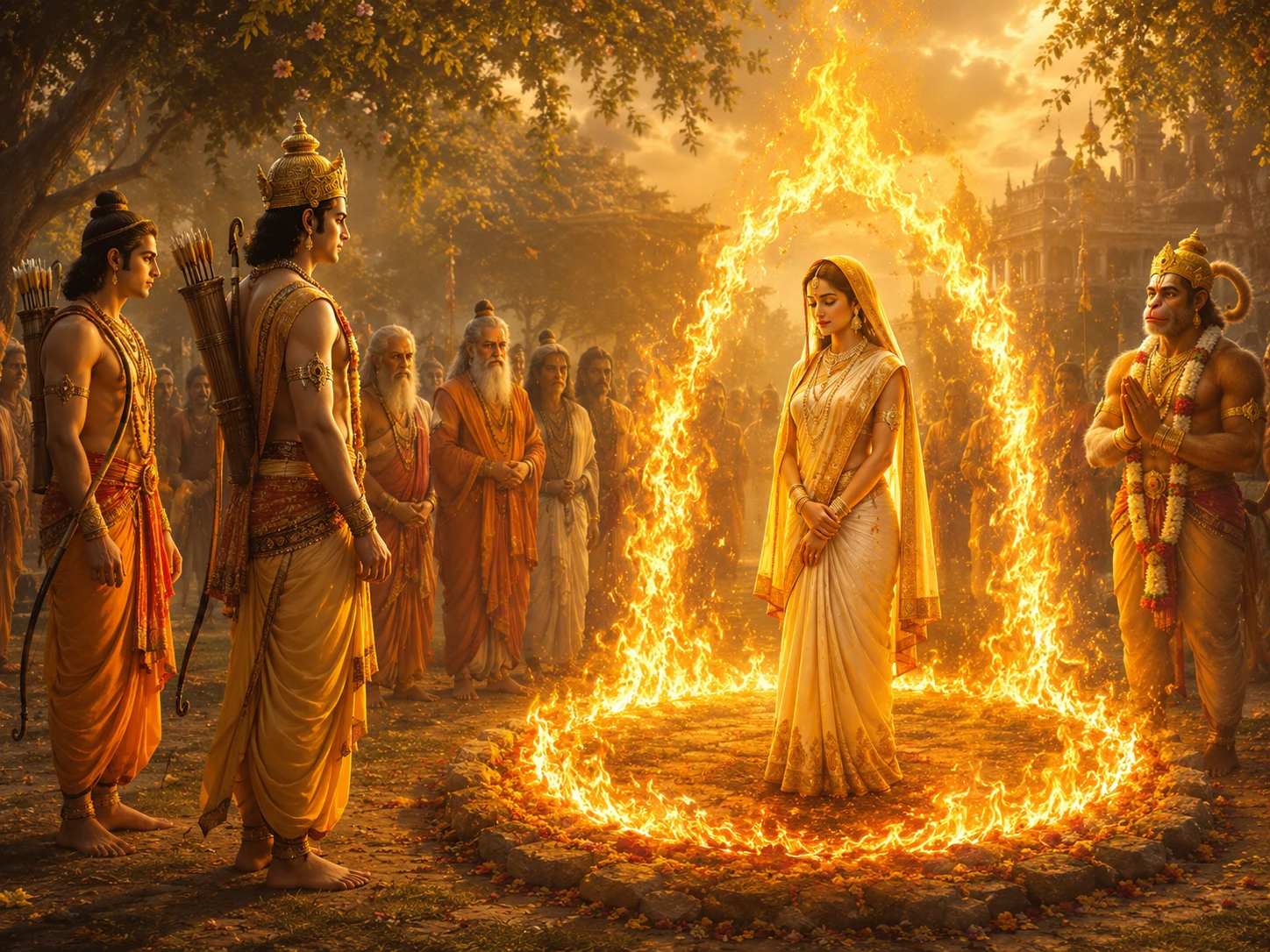
Agni Pariksha -- Sita's Fire Ordeal and the Interpretations That Divided India
15 min readThe same translation error that turned '33 Koti' into '33 crore' in Hinduism also happened in Buddhism. The Chinese translation of Buddhist texts rendered 'Sapta Koti Buddha' (7 Supreme Buddhas) as '7 Crore Buddhas.' The…
Deities AvatarsCommunity Reflections
🕉️
Be the first to share your reflection.