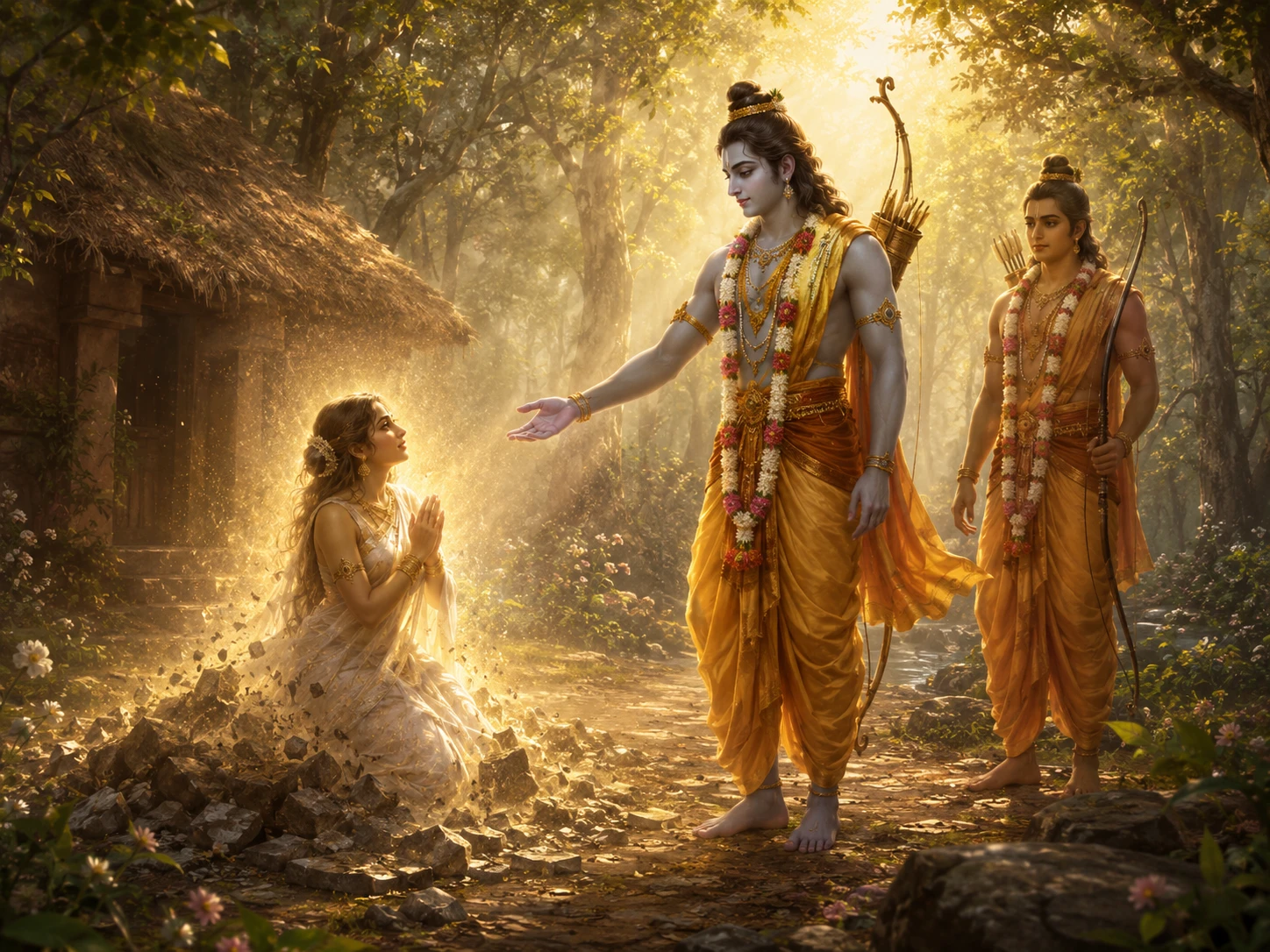
Ahalya Moksha -- The Woman Who Became Stone and the God Who Set Her Free
अहल्या मोक्ष -- वो स्त्री जो शिला बनी और वो भगवान जिन्होंने उसे मुक्त किया
The story of Ahalya is one of the most retold, most debated, and most misunderstood episodes in all of Hindu literature. Ask anyone in India -- from a grandmother in Varanasi to a literature professor at Jadavpur University -- and they will tell you: Ahalya was turned to stone for sleeping with Indra, and Rama's foot freed her.
Except that is not what the oldest text actually says.
In the Valmiki Ramayana -- the Adi Kavya, the first poem, the foundational text of the tradition -- Ahalya was not turned to stone at all. She was made invisible. She lived for thousands of years in her own hermitage, fasting on air, sleeping in ashes, unseen by all beings, practising fierce tapas in solitude. The petrifaction -- the 'stone' narrative that dominates popular imagination -- comes primarily from the Padma Purana and later retellings, not from Valmiki.
This distinction matters enormously. The difference between 'turned to stone' and 'made invisible' is not a minor textual variant. It is the difference between a woman rendered inanimate and a woman rendered unseen -- between being erased as an object and being erased as a person. The first is a fairy tale. The second is something that happens to women in India every single day.
The Ahalya episode occupies Sargas 48-49 of the Bala Kanda (Book of Youth) in the Valmiki Ramayana. Vishvamitra narrates the legend to the young princes Rama and Lakshmana as they pass through Gautama's deserted hermitage on the road to Mithila. The narrative is short -- barely fifty verses -- but its theological, philosophical, and cultural aftershocks have reverberated for over two millennia.
According to the Uttara Kanda of the Ramayana and the Brahma Purana, Ahalya was not merely beautiful. She was beauty itself -- crafted by Brahma from the most beautiful features of all living beings. The creator assembled her with deliberate, meticulous care and placed her in the custody of Sage Gautama until she reached maturity. When the time came, Brahma -- impressed by Gautama's extraordinary sexual restraint and ascetic discipline -- gave Ahalya to him in marriage rather than to the far more powerful Indra.
Indra never forgave this slight. The King of the Devas believed the most beautiful woman in creation was his by right. He watched. He waited. And one day, when Gautama left the hermitage for his pre-dawn ablutions, Indra assumed the sage's form and entered the ashram.
Here is where the texts diverge -- and where the consent debate begins.
In the Valmiki Ramayana (Bala Kanda, Sarga 48, Verses 17-21), the text is explicit: Ahalya recognized Indra despite his disguise. The verse uses the word 'vijnaya' -- 'having known clearly.' She identified him as the King of the Gods and yet, moved by what the text calls 'devrajakutuhala' -- curiosity about the king of gods -- she consented. After the encounter, she even asked Indra to leave quickly and protect them both from Gautama's wrath.
This is the hardest version of the story. It grants Ahalya agency but also culpability. She was not tricked. She chose. And for that choice, she was punished.
But later Puranic traditions -- the Brahma Purana, Padma Purana, Skanda Purana, Brahma Vaivarta Purana, and the Kamban and Tulsidas Ramayanas -- soften or completely reverse this. In these versions, Ahalya is either fully deceived by Indra's disguise, or she realizes the truth only mid-encounter, or she is presented as entirely innocent. The Adhyatma Ramayana makes her a pure devotee of Rama who endures the curse as a spiritual purification. Tulsidas in the Ramcharitmanas removes the seduction narrative entirely -- Ahalya is simply a woman patiently waiting for Rama's feet to touch her.
The textual tradition, in other words, could not agree on whether Ahalya was a willing participant, an unwilling victim, or something irreducibly in between. Two thousand years of commentary and rewriting produced not a single consensus -- which is itself the most honest possible outcome when grappling with questions of consent under coercion.
इह वर्षसहस्राणि बहूनि निवसिष्यसि। वायुभक्षा निराहारा तप्यन्ती भस्मशायिनी। अदृश्या सर्वभूतानामाश्रमेऽस्मिन् निवसिष्यसि॥
iha varṣasahasrāṇi bahūni nivasiṣyasi | vāyubhakṣā nirāhārā tapyantī bhasmaśāyinī | adṛśyā sarvabhūtānāmāśrame'smin nivasiṣyasi ||
You shall dwell here for many thousands of years, subsisting only on air, without food, practising austerities, sleeping in ashes, invisible to all beings -- you shall live in this hermitage unseen.
— Valmiki Ramayana, Bala Kanda, Sarga 48, Verses 29-30
Gautama's curse on Indra was immediate and physical. The Valmiki Ramayana states that Gautama cursed Indra to lose his testicles -- the organ of the desire that caused the transgression. The Brahma Vaivarta Purana and several other texts describe the curse differently: a thousand yonis (female organs) appearing on Indra's body, later transformed into a thousand eyes through the intervention of other deities. This is the origin of Indra's epithet Sahasraksha -- the thousand-eyed -- a name that every student of Hindu mythology encounters but whose humiliating backstory is rarely taught.
The asymmetry of punishment is the first thing a modern reader notices. Indra, the aggressor who disguised himself and entered another man's home, lost his testicles -- a punishment that was later reversed, his masculinity restored, his throne returned. Ahalya, who was at worst curious and at best entirely deceived, lost everything -- her body, her visibility, her marriage, her place in society -- for thousands of years. The restoration of Indra was a divine bureaucratic fix. The restoration of Ahalya required the avatar of God himself.
This asymmetry is not a bug in the narrative. It is the narrative's central observation about how patriarchal societies process transgression. The man's punishment is temporary and reversible. The woman's punishment is existential and permanent -- until a higher power intervenes. For anyone who has watched a corporate harassment case play out in an Indian MNC, where the male executive is 'counselled' and the female employee is 'transferred,' the Ahalya pattern will feel disturbingly familiar.
Gautama's curse on Ahalya, however, contains something remarkable: a built-in escape clause. He tells her that when Rama visits the ashram, she will be 'divested of greed and delusion' and resume her own form. The curse is not infinite. It is penance with a defined endpoint. This reframes the entire episode: Gautama is not merely punishing. He is prescribing a path of purification that ends in divine grace. The curse is harsh, but it is not nihilistic.
The moment of Ahalya's liberation is one of the most visually iconic scenes in the Ramayana. Vishvamitra, guiding the young Rama and Lakshmana through the forest on their way to Janaka's court in Mithila, reaches Gautama's abandoned ashram. He tells Rama the story and instructs him to enter.
In the Valmiki Ramayana (Bala Kanda, Sarga 49), Rama steps into the hermitage and Ahalya manifests herself from her invisible state. She is described in breathtaking imagery: 'like the befogged moonshine of a full moon,' 'like an unwatchable sunshine mirrored in water,' 'whose limbs are like tongues of a flaring fire around which fumes are cloaking.' She emerges not broken but luminous -- thousands of years of tapas have not diminished her but refined her. She receives Rama and Lakshmana with proper hospitality (atithya), flowers rain from the sky, celestial musicians sing. Gautama himself arrives through his divine knowledge, accepts his now-purified wife, and they resume their ascetic life together.
In the Padma Purana and popular tradition, the scene is more dramatic: Rama's foot literally touches a stone, and the stone transforms into a woman. This is the version painted, sculpted, danced, and filmed across India -- the Ahalya Uddhar (liberation of Ahalya) that appears in Bharatanatyam, Odissi, Yakshagana, Kathakali, and every Ramayana-based television serial from Ramanand Sagar's 1987 Ramayan to the latest streaming adaptations.
Theologically, the liberation of Ahalya establishes a pattern that recurs throughout the Ramayana: Rama does not merely defeat evil -- he restores those who have been unjustly punished. He is not a warrior-king. He is a liberator. The liberation of Ahalya foreshadows his liberation of Sita from Ravana, his acceptance of Shabari's half-eaten berries, his alliance with the outcast Guha. Rama's path through the Ramayana is a continuous act of restoring the invisible, the marginalised, and the cursed to dignity.
Ahalya Across Texts -- How Different Traditions Tell the Story
| Text | Date (approx.) | Did Ahalya Know? | Form of Curse | How Liberated |
|---|---|---|---|---|
| Valmiki Ramayana (Bala Kanda) | c. 500-300 BCE | Yes -- recognized Indra, consented out of curiosity | Made invisible, fasted on air, slept in ashes | Manifests when Rama enters hermitage; offers him hospitality |
| Valmiki Ramayana (Uttara Kanda) | c. 200 BCE-200 CE (later addition) | Brahma created her; Indra resented her marriage to Gautama | Details vary; emphasis on Indra's emasculation | Reunion with Gautama after purification |
| Padma Purana | c. 4th-15th century CE | Deceived by Indra's disguise | Turned to stone (shila) | Rama's foot touches the stone; she transforms back |
| Brahma Purana | c. 4th-13th century CE | Did not recognize Indra | Turned to stone (or river, in some recensions) | Rama's touch restores her |
| Adhyatma Ramayana | c. 14th century CE | Innocent; portrayed as Rama-bhakta | Turned to stone; told to meditate on Rama | Touches Rama's feet; sings devotional hymn |
| Kamban Ramayanam (Tamil) | c. 12th century CE | Innocent; emphasis on Indra's villainy | Stone | Rama's compassion restores her |
| Tulsidas Ramcharitmanas | c. 16th century CE | Seduction narrative entirely removed | Rock; waits patiently for Rama | Dust from Rama's feet purifies her |
| Mahabharata (Anushasana Parva) | c. 400 BCE-400 CE | Innocent; Indra fully to blame | Not specified in detail | Mentioned as one of the Panchakanya (five ideal women) |
The progression from 'knowing participant' (Valmiki) to 'innocent victim' (later Puranas) to 'pure devotee' (Tulsidas) mirrors the evolution of bhakti theology, where divine grace supersedes human culpability.
The question of whether Ahalya 'knew' is not merely an ancient textual puzzle. It is the fault line of every consent debate in modern India -- from campus harassment cases at DU and BHU to the workplace harassment conversations that erupted after the #MeToo movement reached Mumbai and Bangalore in 2018.
The Valmiki Ramayana uses the word 'vijnaya' -- which unambiguously means 'having recognized' or 'having known clearly.' The critical edition at the BORI (Bhandarkar Oriental Research Institute, Pune) retains this reading. Ahalya knew. She chose. And then she was punished far more severely than the man who initiated the encounter.
But the later tradition could not accept this. The Brahma Purana says she did not recognize Indra. The Adhyatma Ramayana makes her an innocent devotee. Tulsidas removes the encounter altogether. Why? Because as bhakti theology evolved, the idea that a woman whom Rama personally liberates could have been a 'willing' participant became theologically uncomfortable. If Rama is God, and God's grace is given to the innocent, then Ahalya must be innocent -- retroactively, across centuries of rewriting.
This is not dishonesty. It is theological evolution. The same process happens in every living religious tradition. But it means that anyone who says 'the Hindu tradition says X about Ahalya' is cherry-picking from a tradition that deliberately said multiple, contradictory things. The honest position is: Valmiki gave her agency and punished her. The Puranas took away her agency to protect her innocence. Tulsidas made her a saint. All three coexist in the canon. A student at NLSIU studying consent law, a survivor sharing her story on social media, a mother explaining the Ramayana to her daughter -- each will find the version they need, because the tradition provided all of them.
There is another dimension to Ahalya's story that rarely receives attention: the geography of her redemption. Gautama's hermitage is located on the road between Vaishali (Vishala) and Mithila -- the route Rama walks before meeting Sita. This is not an accident of geography. It is narrative architecture.
Rama liberates Ahalya immediately before he lifts Shiva's bow and wins Sita's hand. The sequence is deliberate: first, he restores a woman wrongly punished for a sexual transgression. Then, he earns the right to marry. The Ramayana is telling us that Rama's worthiness for Sita is not merely his physical strength (breaking the bow) but his moral character (liberating the cursed). He proves himself worthy of a wife by first proving himself capable of compassion toward a woman the world had abandoned.
The specific location also matters. Mithila is in present-day Janakpur, Nepal, and the Darbhanga-Madhubani region of Bihar. The entire belt from Vaishali to Mithila is saturated with Ramayana geography. Ahraura near Mirzapur, Ahilya Sthan in Darbhanga district, and the Gautam Kund near Brahmaur in Himachal Pradesh all claim connection to the Ahalya episode. The Ahilya Sthan temple in Darbhanga's Ahiyari village is one of the few temples in India dedicated specifically to Ahalya -- not as a goddess but as a woman worthy of pilgrimage in her own right.
For the people of Bihar and eastern UP, Ahalya is not a mythological abstraction. She is a neighbour. Her hermitage was down the road. Her liberation happened in their soil. When a girl from Madhubani paints the Ahalya Uddhar scene in Mithila art -- the distinctive geometric style with its natural dyes and cosmological themes -- she is painting a local legend, not an imported epic. This rootedness in place is what gives the Ramayana its civilisational power: it is not a book read from a shelf. It is a landscape walked through daily.
Ahalya is one of the Panchakanya -- the five ideal women of Hindu tradition, invoked in a famous shloka recited at dawn:
'Ahalya Draupadi Kunti Tara Mandodari tatha / panchakanyah smarennittyam mahapataka nashakam' -- Remembering the five virgins daily destroys even the greatest sins.
The inclusion of Ahalya in this list is itself a radical theological statement. The Panchakanya are not women who lived 'perfect' lives by conventional patriarchal standards. Ahalya had an extra-marital encounter. Draupadi had five husbands. Kunti had a son before marriage. Tara and Mandodari were widows who remarried. By the standards of any Manusmriti-quoting orthodoxy, these women should be condemned. Instead, they are elevated to the highest spiritual status -- their daily remembrance destroys mahapataka, the greatest sins.
The Panchakanya tradition is Hinduism's own internal critique of patriarchal morality. It says, in effect: the women your society judges most harshly are the women closest to God. Their suffering, their complexity, their refusal to fit into simple categories of 'good woman' and 'bad woman' is precisely what makes them spiritually potent.
For a young woman in India navigating the contradictions of modern life -- studying at an IIT but expected to accept an arranged marriage, running a D2C brand on Instagram but judged for a photo in a sleeveless top, achieving professionally but told her real job is kitchen management -- the Panchakanya offer a startling counter-narrative from within the tradition itself. The tradition did not only produce Manusmriti. It also produced the Panchakanya. Both exist. Which one you choose to emphasize reveals more about you than about Hinduism.
The Ahalya episode directly inspired one of the most celebrated compositions in Carnatic music. Tyagaraja's kriti 'Sri Rama Padama' in Raga Amritavahini explicitly references Ahalya lying as a 'wayside stone, shedding tears' (darini silayai) and begs Rama's feet to bestow the same grace on the devotee. Muthuswami Dikshitar and Syama Sastri, the other two members of the Carnatic Trinity, also composed pieces referencing Ahalya. In Bharatanatyam, the Ahalya Uddhar is a standard narrative item (abhinaya piece) performed in arangetrams across Tamil Nadu and Karnataka. The scene where the stone transforms into a woman gives dancers an extraordinary range -- transitioning from the stillness of stone to the flowing grace of a liberated being in a single varnam.
What does Ahalya's story mean for India today? It means at least three things.
First, it means that the question of consent has been debated in Indian literature for over two thousand years. The idea that consent is a 'Western import' is factually illiterate. Valmiki raised the question in the oldest epic poem in human history. The Puranic authors spent centuries arguing about whether Ahalya's consent was informed, coerced, or invalidated by Indra's disguise. India's engagement with consent pre-dates Western feminist theory by at least fifteen centuries.
Second, it means that punishment for sexual transgression in Hindu mythology falls disproportionately on women -- and the tradition itself noticed this and built corrective mechanisms. The Panchakanya shloka is one such corrective. Rama's specific, deliberate act of liberating Ahalya before any other major event in his journey is another. The tradition punished Ahalya harshly. The tradition also made a god walk through a forest specifically to undo that punishment. Both truths coexist.
Third, it offers a theology of redemption that modern India desperately needs. In a social media era where one mistake, one poorly worded tweet, one leaked photograph can permanently cancel a person's public existence -- Ahalya's story says: there is a way back. Penance is real. Purification is possible. The invisible can become visible again. Grace exists. This is not an excuse for wrongdoing. It is a refusal to accept that wrongdoing is the end of the story.
Ahalya lay unseen for thousands of years. Then a boy walked through the forest, and everything changed. The Ramayana is full of wars and palaces and demons. But its most revolutionary act may be a single footstep in an empty ashram.
The town of Ahilya Ghat in Varanasi -- one of the most photographed ghats on the Ganga -- is named after Ahilyabai Holkar (1725-1795), the legendary Maratha queen of Indore who rebuilt temples across India. But the naming carries a deliberate echo of Ahalya of the Ramayana. Ahilyabai, like her mythological namesake, was a woman whom the establishment dismissed -- widowed at 28, expected to commit sati or retreat to obscurity. Instead, she ruled Malwa for 30 years, built or restored temples from Somnath to Kashi, and is remembered as one of India's greatest administrators. In 1996, the Indian government issued a postal stamp in her honour. Her story is a real-world Ahalya Moksha -- a woman rendered invisible by widowhood who, through decades of dharmic action, made herself permanently visible.
Meditate on Rama's Compassion
Ahalya's liberation was not earned by perfect behaviour; it was gifted through grace. Rama did not ask her to prove her innocence. He walked into the ashram, and his presence was enough. Sit quietly today with the idea of receiving grace rather than earning it. Valmiki tells Ahalya's deliverance in Bala Kanda sarga 49, on Eternal Raga with Sanskrit and translation.
Tags
Eternal Raga · शाश्वत राग
Institutional voice — scholarly articles on Sanatan Dharma
Deepen Your Understanding
अपनी समझ और गहरी करें
deities avatars
When Gods Were Cursed -- Divine Punishments in Hindu Mythology
Hindu mythology does something no other tradition dares -- it puts its own gods on trial. Brahma lost his worship. Vishnu became a stone. Shiva was reduced to a symbol. Indra was humiliated a hundred times over. These are not theological accidents but deliberate statements: even the divine is accountable.
scriptural exegesis
Agni Pariksha -- Sita's Fire Ordeal and the Interpretations That Divided India
A woman walks into fire to prove she is 'pure.' The man who asked her to do it is called God. For two thousand years, India has argued about what this scene means -- and the argument is far from over. Devotional reading, feminist critique, textual scholarship, and political appropriation all collide in the most contested episode of the Ramayana.
deities avatars
Dashavatara -- Why Vishnu Comes Back Ten Times
Fish, tortoise, boar, half-lion, dwarf, axe-warrior, prince, cowherd, enlightened teacher, future horseman. The ten avatars of Vishnu are not random folklore. Read them in sequence and you get something startling -- a narrative that mirrors evolutionary biology, tracks the rise and fall of political systems, and argues that God does not sit above history but enters it, gets dirty, and does the work. The Dashavatara is Hinduism's answer to the question every civilisation asks: why does the world keep breaking, and who fixes it?
philosophy darshana
Karma Explained -- Not Punishment, Not Reward, but the Physics of Action
Karma is not cosmic revenge. It is not 'what goes around comes around.' It is India's most sophisticated theory of causation -- a framework that explains why your choices matter, why consequences are inescapable, and why freedom is still possible. The Gita's karma teaching changed Oppenheimer's life. It might change yours.
deities avatars
Devi Swaroopa -- Forms of the Goddess
She is Durga on the battlefield and Annapurna in the kitchen. She is Kali at the cremation ground and Lakshmi in the boardroom. She is Saraswati at the university and Parvati in the family. The Hindu Goddess is not one deity with accessories -- she is the entire spectrum of feminine power, from terrifying to tender, from cosmic to domestic. Understanding her forms is understanding the universe itself.
philosophy darshana
Dharma, Artha, Kama, Moksha -- The Four Goals That Make a Complete Life
Hinduism does not ask you to choose between God and money. Between spirituality and pleasure. Between duty and desire. Its four Purusharthas -- Dharma, Artha, Kama, Moksha -- are the most holistic life-framework any civilisation has designed. The catch? Each must be pursued in the right order, at the right time, under the right constraints.
rituals traditions
The 16 Samskaras -- Rites of Passage from Womb to Pyre
Hinduism does not leave life to chance. From the moment a couple decides to conceive to the moment the body returns to the five elements, there are sixteen rituals -- samskaras -- designed to refine the human being at every critical transition. Think of them as firmware updates for the soul, installed at precisely the right moments.
The Ahalya episode directly inspired one of the most celebrated compositions in Carnatic music. Tyagaraja's kriti 'Sri Rama Padama' in Raga Amritavahini explicitly references Ahalya lying as a 'wayside stone, shedding te…
More in Scriptural Exegesis
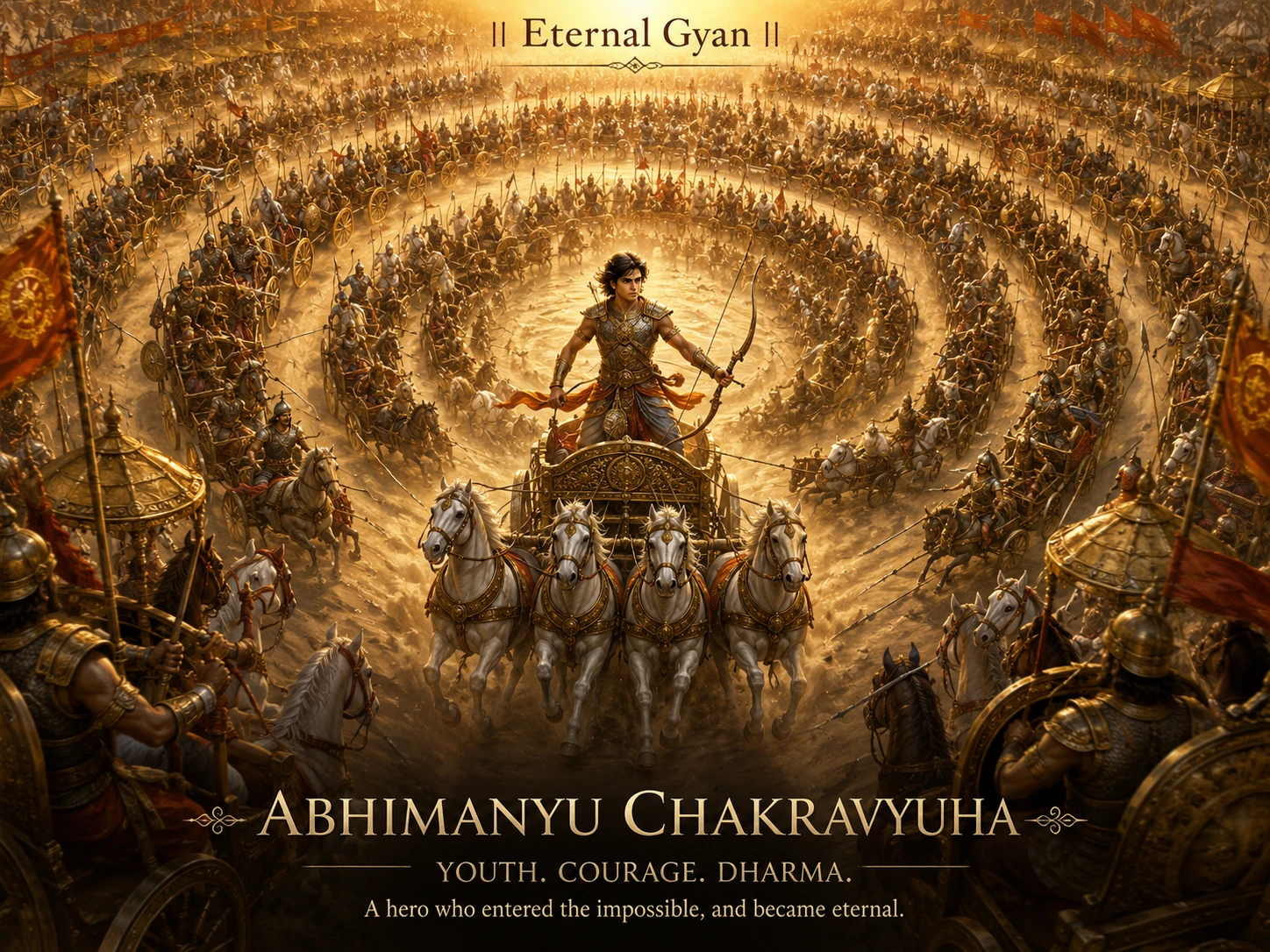
Abhimanyu and the Chakravyuha -- The Boy Who Knew How to Enter but Not How to Leave
14 min read
Adbhuta Ramayana -- The Ramayana Where Sita Becomes Kali
9 min read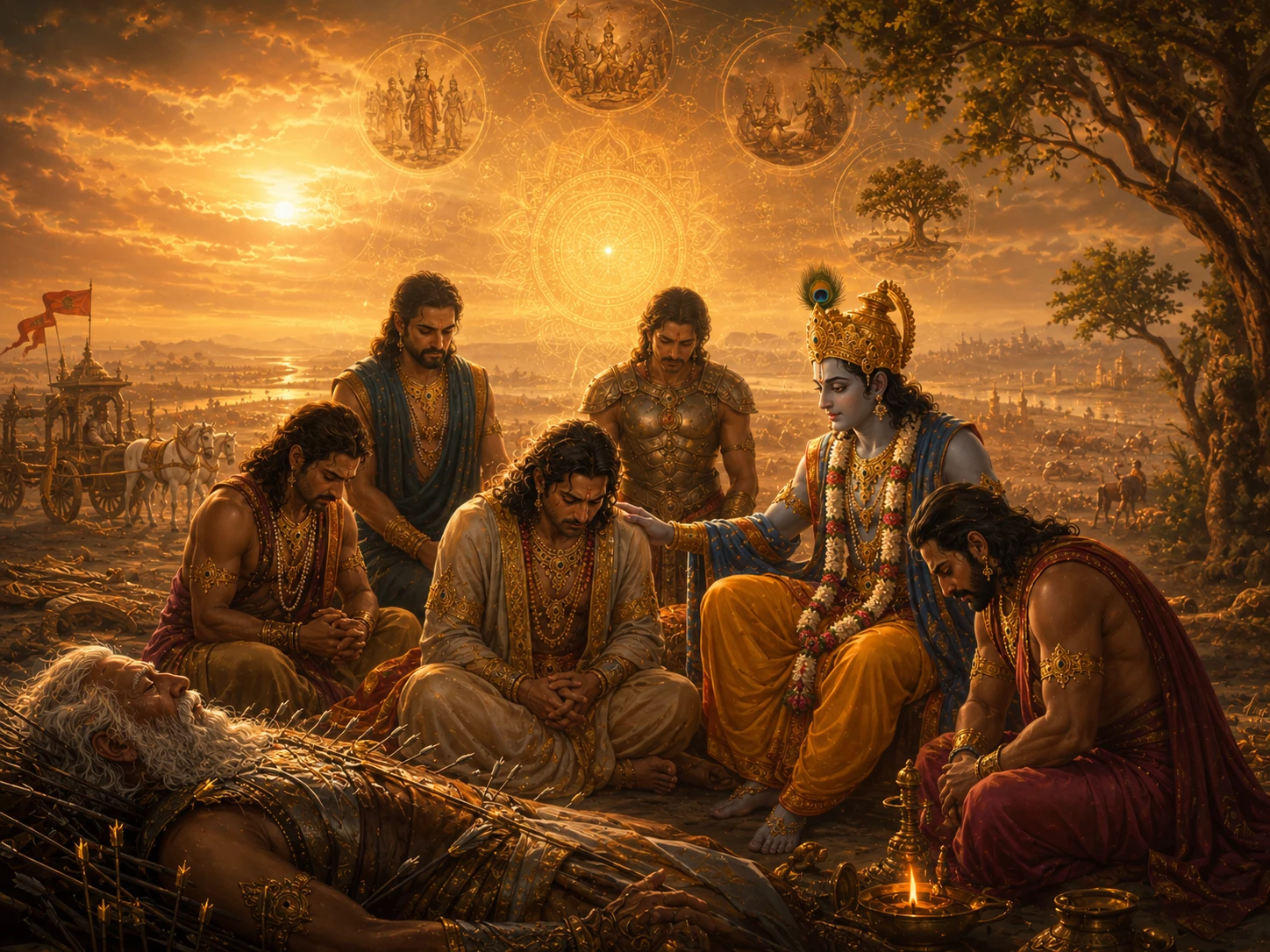
After Kurukshetra -- What Happened Next
14 min readThe same translation error that turned '33 Koti' into '33 crore' in Hinduism also happened in Buddhism. The Chinese translation of Buddhist texts rendered 'Sapta Koti Buddha' (7 Supreme Buddhas) as '7 Crore Buddhas.' The…
Deities AvatarsCommunity Reflections
🕉️
Be the first to share your reflection.