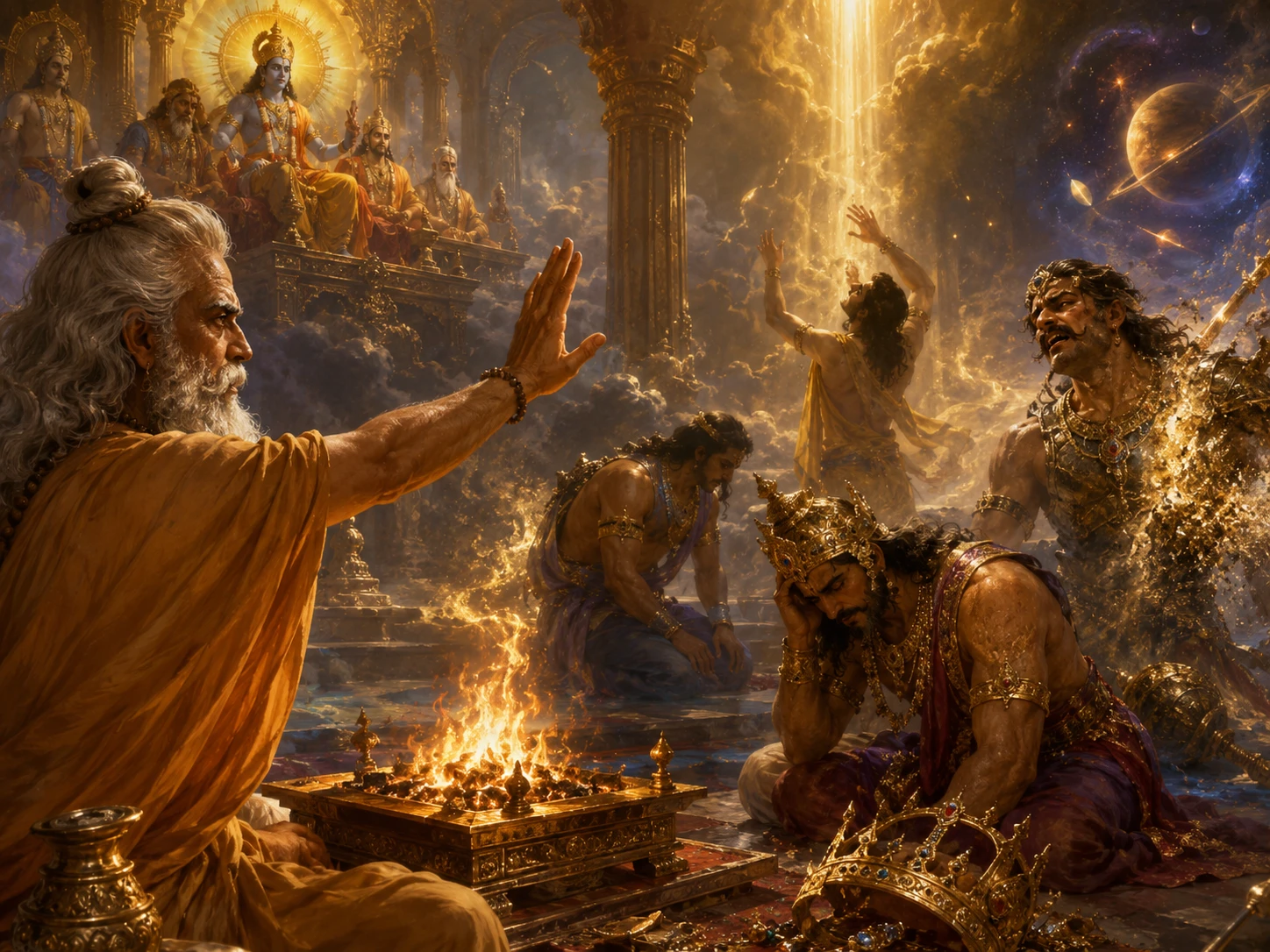
When Gods Were Cursed -- Divine Punishments in Hindu Mythology
जब देवताओं को शाप मिला -- हिन्दू पौराणिक कथाओं में दिव्य दण्ड
There is a question that separates Hindu mythology from almost every other religious tradition on earth: can God be wrong?
In most theological systems, the divine is beyond reproach. Questioning God's actions is blasphemy. Cursing God is unthinkable. But in Hindu Puranic literature, gods are cursed -- routinely, publicly, and with devastating consequences. Brahma, the Creator, was cursed by Sage Bhrigu to receive no worship in the Kali Yuga. Vishnu, the Preserver, was cursed by a betrayed woman to become a lifeless stone. Shiva, the Destroyer, was cursed to be worshipped only as a Linga. Indra, King of the Devas, accumulated so many curses that listing them all would require a separate article.
These stories are not anomalies or folk corruptions of a 'pure' theology. They are central to the Puranic worldview. They appear in the Shiva Purana, the Bhagavata Purana, the Padma Purana, the Matsya Purana, and the Mahabharata itself. They are recited in temples, depicted in art, and referenced in legal and philosophical texts.
The reason is deceptively simple: in Hindu cosmology, even gods operate within the framework of Dharma and Karma. No being -- however powerful -- is exempt from cosmic law. A curse is not an act of rebellion against the divine order. It is the divine order enforcing itself. When a sage or a pativrata (devoted wife) curses a god, they are not breaking the system. They are proving that the system works.
For a generation raised on Instagram reels about 'toxic accountability' and LinkedIn posts about leadership failures, these are not ancient relics. They are case studies in what happens when power meets consequence.
अहं भवान् वयश्चैव मुनयश्च महात्मनः। सर्वे वयं शापभाजः सर्वे धर्मपरायणाः॥
ahaṃ bhavān vayaścaiva munayaśca mahātmanaḥ | sarve vayaṃ śāpabhājaḥ sarve dharmparāyaṇāḥ ||
I, you, and all these great sages -- we are all subject to curses, and we are all devoted to Dharma. (The acknowledgement that even the divine is bound by cosmic law.)
— Mahabharata, Anushasana Parva (Ganguli translation reference)
The most sweeping set of divine curses comes from a single incident: Sage Bhrigu's test of the Trimurti, narrated in the Bhagavata Purana (Canto 10, Chapter 89) and expanded in the Shiva Purana and Padma Purana.
The story begins at a great yajna on the banks of the Sarasvati River. The assembled sages could not agree on which of the three supreme deities -- Brahma, Vishnu, or Shiva -- was most worthy of receiving the principal offering. They deputed Bhrigu, one of the Saptarishis and a mind-born son of Brahma himself, to test all three.
Bhrigu went first to Brahmaloka. He deliberately displayed disrespect to Brahma, refusing to prostrate or offer hymns. Brahma's face reddened with anger. His own son had insulted him publicly. Sarasvati intervened to prevent violence, but the damage was done. Bhrigu cursed Brahma: 'Since you could not control your anger even before your own son, you shall receive no worship in the Kali Yuga.' To this day, Brahma has virtually no temples in India. The Brahma Temple in Pushkar, Rajasthan, stands as a near-solitary exception -- and even that has a complex local legend explaining why it exists at all.
Bhrigu then went to Kailasha. Nandi, Shiva's bull guardian, stopped him at the gate because Shiva and Parvati were in private. Bhrigu, already irritated, cursed Shiva to be worshipped only in the form of a Linga -- the abstract, aniconic form -- rather than in full anthropomorphic imagery. This is why, across thousands of Shiva temples from Varanasi's Kashi Vishwanath to Tamil Nadu's Ramanathaswamy, the primary deity is a Linga rather than a sculpted human form.
Finally, Bhrigu reached Vaikuntha. Vishnu was asleep. Bhrigu, now thoroughly tested by his own impatience, kicked Vishnu on the chest -- the very spot where Lakshmi resides (the Srivatsa mark). Vishnu woke up and, instead of retaliating, asked: 'Maharishi, is your foot hurt? My chest is hard.' This response -- humility in the face of insult -- proved Vishnu the most even-tempered of the three. But Lakshmi, witnessing the kick on her sacred abode, cursed all Brahmins to live in perpetual poverty. Bhrigu's foot-print on Vishnu's chest became the Srivatsa mark visible on every Vishnu murti.
Think about this: one sage, one set of tests, and the entire landscape of Hindu worship was reshaped. Brahma has no temples. Shiva is worshipped as Linga. Vishnu bears a foot-mark. Brahmins were cursed to poverty. The Bhrigu-Trimurti episode is the origin story for observable religious reality across the subcontinent.
But Bhrigu's curses were only the beginning. Vishnu accumulated a separate, arguably more devastating curse from a completely different source: the betrayed wife Vrinda.
The story, narrated primarily in the Padma Purana and Shiva Purana, centres on the demon king Jalandhara. Born from the flames of Shiva's third eye, Jalandhara was immensely powerful. His wife Vrinda was a devoted pativrata whose chastity created an impenetrable spiritual shield around her husband. As long as Vrinda's virtue was intact, Jalandhara could not be defeated -- not even by Shiva himself.
The Devas, desperate after years of losing battles, appealed to Vishnu. And Vishnu did something that the tradition itself acknowledges as morally troubling: he disguised himself as Jalandhara and approached Vrinda while her husband was away at war. Vrinda, believing it was her husband, welcomed him. The moment her chastity was compromised -- not through her fault but through deception -- Jalandhara's divine protection collapsed, and Shiva killed him.
When Vrinda discovered the truth, her grief was absolute. The god she had worshipped with lifelong devotion had betrayed her. She cursed Vishnu: 'Just as you have turned me into a widow by deceit, you too shall become a lifeless stone.' Vishnu accepted the curse without protest. He became the Shaligrama stone -- the smooth black fossil found exclusively along the banks of the Gandaki River in Nepal, worshipped to this day as a direct manifestation of Vishnu in millions of Hindu homes during Satyanarayan Puja and daily worship.
Vrinda, consumed by grief, either self-immolated or was transformed -- depending on the Puranic recension -- into the Tulsi plant. Every year during Kartik month (October-November), the Tulsi Vivah ceremony ritually marries the Tulsi plant to a Shaligrama stone, re-enacting Vishnu's promise to Vrinda that he would be united with her forever. This festival marks the beginning of the Hindu wedding season.
The next time your grandmother places a Tulsi leaf on Vishnu's prasad, remember: that leaf is Vrinda. And the black stone in the puja thali is the God who accepted a curse because he knew he had violated his own Dharma.
But Vishnu was not finished collecting curses. The Matsya Purana records a separate, even more consequential curse -- one that explains the very existence of Vishnu's avatars on earth.
During the war between the Devas and Asuras, the Asura guru Shukracharya (son of Bhrigu) left to perform penance for a powerful boon from Shiva. In his absence, the Asuras took refuge at Bhrigu's ashram with his wife Kavyamata. The Devas, led by Indra, attacked the defenceless Asuras. Kavyamata used her yogic powers to immobilize Indra. The terrified Devas appealed to Vishnu, who -- in a moment of battlefield exigency -- used his Sudarshana Chakra and beheaded Kavyamata.
When Bhrigu returned and found his wife dead at the hands of Vishnu, his fury was volcanic. He revived Kavyamata with sacred water, but the act of killing a woman -- particularly a Brahmin's wife who was protecting refugees -- was an irredeemable violation of Dharma. Bhrigu cursed Vishnu: 'You shall be born on earth many times and suffer the pain of mortal birth and death.'
According to the Padma Purana, this curse specifically mandated seven births among humans. These births became the Dashavatara -- the ten avatars of Vishnu, including Rama, who endured fourteen years of exile and separation from Sita, and Krishna, who witnessed the annihilation of his entire clan. Every time Vishnu incarnated on earth, suffered human emotions, experienced loss, faced betrayal -- he was living out the consequence of Bhrigu's curse.
This is a staggering theological claim. The Ramayana exists because of a curse. The Mahabharata exists because of a curse. The Bhagavad Gita -- the most influential philosophical text in Hinduism -- exists because Vishnu was cursed to be born as Krishna on a battlefield. Remove Bhrigu's curse and you remove the entire architecture of Hindu epic literature.
Indra, the King of the Devas, occupies a unique position in Puranic literature: he is the most cursed god in the entire Hindu pantheon. His curses are so numerous that they form a recurring narrative pattern -- power leading to arrogance, arrogance leading to transgression, transgression leading to humiliation.
The most famous of Indra's curses comes from the Ahalya episode in the Ramayana. Sage Gautama's wife Ahalya was considered the most beautiful woman in creation. Indra, consumed by desire, disguised himself as Gautama and approached Ahalya. When the sage discovered the deception, he cursed Indra with a thousand yonis (female organs) covering his body -- a curse later mitigated to a thousand eyes (hence his epithet Sahasraksha, the thousand-eyed). Ahalya herself was cursed to become a stone, redeemed only when Rama's foot touched her millennia later.
But this was hardly Indra's only curse. Sage Durvasa cursed him with the loss of all his divine glory (Sri) after Indra's elephant Airavata trampled a garland gifted by the sage -- an insult that led directly to the Samudra Manthan. Sage Brihaspati abandoned him after being disrespected. Nahusa temporarily replaced him as king of heaven. Vritra's death through deceit earned him the sin of Brahmahatya (killing a Brahmin). The Bhagavata Purana records that at one point, Indra had to hide inside a lotus stem in Manasarovar Lake to escape his accumulated consequences.
The pattern is not accidental. The Puranic authors used Indra as a deliberate case study in the failure of power without wisdom. He holds the highest temporal position among the Devas but lacks the spiritual maturity of Vishnu's patience or Shiva's detachment. He is, in modern corporate language, the CEO who keeps getting promoted beyond his competence -- the mythological Peter Principle. Every IAS officer in North Block, every startup founder who just raised Series C funding, every politician who confuses electoral victory with divine mandate would benefit from reading Indra's résumé.
Even the Moon was not spared. The Padma Purana and Mahabharata (Shalya Parva) narrate how Chandra, the moon god, was cursed by his own father-in-law, Prajapati Daksha.
Daksha had given twenty-seven of his daughters -- representing the twenty-seven Nakshatras (lunar mansions) -- in marriage to Chandra. The condition was explicit: Chandra must devote equal time and affection to all twenty-seven wives. Instead, Chandra became infatuated with Rohini and neglected the other twenty-six. The sisters complained to Daksha, who warned Chandra repeatedly. When Chandra refused to change, Daksha cursed him: 'You shall waste away, losing your lustre day by day, until you vanish entirely.'
The curse took hold. The Moon began to wane, and with it, all vegetation on earth began to die -- since the Moon governs plant growth, tidal rhythms, and the medicinal properties of herbs in Vedic cosmology. The Devas, alarmed at the ecological catastrophe, intervened. Daksha relented partially: the Moon would wane for fifteen days (Krishna Paksha) and wax for fifteen days (Shukla Paksha), never fully disappearing. Chandra, desperate, performed intense penance at Prabhasa Tirtha and worshipped Shiva, who placed the crescent Moon on his matted locks -- earning the name Chandrashekhara and partially shielding Chandra from the full force of the curse.
The Somnath Temple in Gujarat -- one of the twelve Jyotirlingas -- is traditionally held to be the very site where Chandra performed this penance. The temple's name literally means 'Lord of the Moon.' When Mahmud of Ghazni sacked Somnath in 1026 CE, he was -- though he didn't know it -- destroying the mythological site where the Moon begged for redemption. The temple has been rebuilt multiple times since, most recently in 1951 under the initiative of Sardar Vallabhbhai Patel, and stands today as both a spiritual landmark and a symbol of civilisational resilience.
The Great Divine Curses -- Who Cursed Whom and Why
| Cursed Deity | Cursed By | Reason | The Curse | Visible Result Today | Primary Source |
|---|---|---|---|---|---|
| Brahma | Sage Bhrigu | Uncontrolled anger when tested | No worship in Kali Yuga | Only 1 major Brahma temple (Pushkar) | Shiva Purana, Padma Purana |
| Shiva | Sage Bhrigu | Denied entry at Kailasha by Nandi | Worshipped only as Linga | Linga is primary form in most Shiva temples | Shiva Purana |
| Vishnu (Shaligrama) | Vrinda | Deceived her by taking husband's form | Become a lifeless stone | Shaligrama worship; Tulsi Vivah festival | Padma Purana, Shiva Purana |
| Vishnu (Avatars) | Sage Bhrigu | Killed Bhrigu's wife Kavyamata | Born on earth repeatedly in mortal form | Dashavatara; Ramayana and Mahabharata | Matsya Purana, Padma Purana |
| Indra | Sage Gautama | Seduced Ahalya by deception | 1000 marks on body (later 1000 eyes) | Epithet Sahasraksha (thousand-eyed) | Ramayana, Brahma Vaivarta Purana |
| Indra | Sage Durvasa | Airavata trampled sage's garland | Loss of all divine glory (Sri) | Led to Samudra Manthan | Bhagavata Purana |
| Chandra (Moon) | Prajapati Daksha | Neglected 26 of 27 wives for Rohini | Waste away until vanishing | Moon waxes and wanes; Somnath temple | Padma Purana, Mahabharata Shalya Parva |
Multiple Puranas offer variant details of the same curses. The table follows the most widely cited recensions. Some traditions assign Bhrigu's curse on Shiva to the Kailasha-entry incident; others link it to the Daksha yajna.
The curse tradition in Hinduism reveals a theological architecture radically different from Abrahamic monotheism. In Abrahamic traditions, God is the source of all law and is therefore above it. But in Hindu cosmology, even the gods are inside the system. Dharma is not an edict issued by a supreme being -- it is the operating system of the cosmos itself, and every being, from a worm to the Trimurti, operates within it.
This is why curses work on gods. A sage or a pativrata does not overpower the divine. Rather, they invoke the same cosmic law (Rita/Dharma) that the gods themselves uphold. When Vrinda cursed Vishnu, she did not defeat him. She reminded the universe that the Preserver himself had violated the principle of preservation. When Bhrigu cursed Brahma, he was not stronger than the Creator -- he was pointing out that the Creator's creation (anger) had failed the test of creation's own purpose. The curse is not rebellion. It is audit.
This framework has profound implications for how power should be understood. In India's constitutional democracy, the idea that no authority -- however exalted -- is above the law echoes directly from this Puranic principle. Article 14 of the Indian Constitution guarantees equality before the law. The Hindu curse tradition is, in a sense, the mythological version of this guarantee: even Vishnu stands equal before Dharma.
For a UPSC aspirant in Delhi's Old Rajinder Nagar reading about the separation of powers, or for a law student at NLSIU Bangalore studying judicial review, the Bhrigu-Trimurti episode is not just mythology. It is the oldest surviving case study in accountability -- one where the highest authorities in the universe submit to the judgment of a system they themselves did not create.
The Tirupati-Tirumala connection has its roots in a curse narrative. According to the Venkatachala Mahatmya, when Bhrigu kicked Vishnu's chest, Lakshmi was so furious that she left Vaikuntha and was reborn on earth as Padmavati, daughter of King Akasha Raja. Vishnu, desperate to reunite with her, descended to earth as Lord Venkateswara and took a massive loan from Kubera (god of wealth) to fund his wedding. This is why devotees donate so generously at Tirupati -- they believe they are helping Vishnu repay his eternal debt to Kubera. The Tirumala Tirupati Devasthanams (TTD) is the richest Hindu temple trust in the world, managing assets estimated at over Rs 2.5 lakh crore. Bhrigu's kick literally funded India's largest religious economy.
Parvati, too, features in the curse tradition -- though in a lesser-known but deeply revealing episode. In certain recensions of the Shiva Purana and Brahmavaivarta Purana, Parvati cursed the river goddess Ganga.
The story arises from a celestial gathering where Ganga, flowing from Vishnu's feet into Shiva's matted hair, was perceived by Parvati as an intimate rival. In some versions, Parvati saw Ganga exchanging glances with Shiva and, consumed by jealousy, cursed her to descend permanently to earth and be stepped upon by mortal feet. Other versions frame this as Parvati's reaction to Ganga's pride in being held on Shiva's head -- a position Parvati considered her own privilege.
Regardless of the recension, the theological point is consistent: even divine consorts are subject to emotional consequences, and even goddesses can be cursed by other goddesses. The Ganga's earthly descent -- narrated more famously through the Bhagiratha episode -- has this lesser-known thread of jealousy woven into its Puranic fabric.
This matters because it humanizes the divine in ways that are psychologically sophisticated. Parvati is not diminished by her jealousy. She remains Adi Shakti, the primordial power. But she is also a wife who feels threatened when another woman enters her domestic space. The Puranic authors understood that emotional authenticity -- not moral perfection -- is what makes divine characters relatable. A generation scrolling through relationship advice on Reddit would find Parvati's reaction not alien but achingly familiar.
What unifies all these curse narratives is a principle that modern India desperately needs to internalize: power without accountability is not power at all -- it is corruption waiting to manifest.
Brahma's anger was punished because a Creator who cannot control himself is unfit to create. Shiva's inaccessibility was punished because a God who cannot be approached by a seeker has failed his fundamental function. Vishnu's deception was punished because a Preserver who destroys trust has undermined the very thing he is meant to preserve. Indra's lust was punished because a King whose appetites override his duties is no king at all. Chandra's favouritism was punished because a husband who neglects twenty-six of twenty-seven wives has violated his own marriage contract.
In each case, the punishment fits the crime with surgical precision. The theology is not that gods are weak. It is that gods are responsible. And if they fail their responsibility, the cosmos itself corrects them -- not through revolution from below but through the automatic operation of Dharma.
This is why the curse tradition remains the most relevant branch of Puranic literature for contemporary India. In a nation where political leaders are worshipped, where corporate titans operate above regulation, where caste and money buy impunity -- the Puranic message is bracing: if Vishnu can be turned to stone for violating a woman's trust, what makes any mortal think they are exempt?
The next time someone in a boardroom in Gurugram, a government office in Lucknow, or a campaign rally in Chennai claims to be beyond question -- remember: the gods tried that. It did not end well for them either.
Pushkar in Rajasthan is one of the only places in the world with a dedicated Brahma temple. The temple's origin legend says Brahma's wife Savitri cursed him after he performed a yajna with another woman (Gayatri) sitting in the wife's seat. Savitri declared that Brahma would be worshipped only in Pushkar and nowhere else. This curse, layered on top of Bhrigu's curse, essentially double-locked Brahma out of mainstream Hindu worship. The annual Pushkar Camel Fair, which attracts thousands of domestic and international tourists every November, takes place during the Kartik Purnima bathing festival at Pushkar Lake -- a lake believed to have been created when a lotus fell from Brahma's hand.
Chant the Maha Mrityunjaya Mantra
When Chandra was cursed by Daksha and began to fade, he chanted the Maha Mrityunjaya Mantra at Prabhasa Tirtha. Shiva, moved by his devotion, placed the Moon on his head and became Chandrashekhara. This mantra -- from Rigveda 7.59.12 -- is the original remedy for curses, fears, and mortality itself. Begin your practice today.
Tags
Eternal Raga · शाश्वत राग
Institutional voice — scholarly articles on Sanatan Dharma
Deepen Your Understanding
अपनी समझ और गहरी करें
deities avatars
Dashavatara -- Why Vishnu Comes Back Ten Times
Fish, tortoise, boar, half-lion, dwarf, axe-warrior, prince, cowherd, enlightened teacher, future horseman. The ten avatars of Vishnu are not random folklore. Read them in sequence and you get something startling -- a narrative that mirrors evolutionary biology, tracks the rise and fall of political systems, and argues that God does not sit above history but enters it, gets dirty, and does the work. The Dashavatara is Hinduism's answer to the question every civilisation asks: why does the world keep breaking, and who fixes it?
scriptural exegesis
Ahalya Moksha -- The Woman Who Became Stone and the God Who Set Her Free
She was Brahma's most perfect creation. She was cursed for a crime that may not have been hers. She lay as stone -- or invisible, or in ashes, depending on which text you trust -- for thousands of years. Then a boy-prince's foot touched her, and she rose. Ahalya's story is Hinduism's oldest argument about consent, punishment, and grace.
sacred artefacts
Shalagrama Shila -- The 140-Million-Year-Old Face of Vishnu
A black river stone from a Himalayan gorge in Nepal. A fossil of a creature that swam in an ocean that no longer exists. And yet, for over two thousand years, Hindus have recognised this stone as a direct, living manifestation of Vishnu -- not a symbol, not a representation, but the deity Himself. Science calls it an ammonite. Faith calls it God.
deities avatars
Who is Shiva?
He is the ash-smeared ascetic who is also the ideal husband. The destroyer of the universe who is called 'The Auspicious One.' The god of death who drank poison to save all life. He sits in meditation on a Himalayan peak, and simultaneously dances the cosmos into existence and annihilation. No deity in Hinduism contains more contradictions -- and no deity resolves them more completely. This is not a mythology explainer. This is an attempt to stand at the foot of the mountain and look up.
sacred artefacts
Samudra Manthan Treasures -- The 14 Things That Came Out When Gods and Demons Churned the Ocean Together
Poison came first. Immortality came last. In between: a goddess, a gem, a cow, a horse, a tree, a physician, a bow, a moon, and an elephant. The Samudra Manthan is not just a myth -- it is a startup pitch deck for the universe. Two rival teams. One impossible project. Fourteen deliverables. And a hostile takeover at the end.
scriptural exegesis
Agni Pariksha -- Sita's Fire Ordeal and the Interpretations That Divided India
A woman walks into fire to prove she is 'pure.' The man who asked her to do it is called God. For two thousand years, India has argued about what this scene means -- and the argument is far from over. Devotional reading, feminist critique, textual scholarship, and political appropriation all collide in the most contested episode of the Ramayana.
deities avatars
Devi Swaroopa -- Forms of the Goddess
She is Durga on the battlefield and Annapurna in the kitchen. She is Kali at the cremation ground and Lakshmi in the boardroom. She is Saraswati at the university and Parvati in the family. The Hindu Goddess is not one deity with accessories -- she is the entire spectrum of feminine power, from terrifying to tender, from cosmic to domestic. Understanding her forms is understanding the universe itself.
The Tirupati-Tirumala connection has its roots in a curse narrative. According to the Venkatachala Mahatmya, when Bhrigu kicked Vishnu's chest, Lakshmi was so furious that she left Vaikuntha and was reborn on earth as Pa…
More in Deities & Avatars
33 Koti Devata -- Why Hinduism Has 33 Types of Gods, Not 33 Crore
13 min read
Agni -- The Fire God
19 min read
Annapurna -- Goddess of Food
19 min readThe same translation error that turned '33 Koti' into '33 crore' in Hinduism also happened in Buddhism. The Chinese translation of Buddhist texts rendered 'Sapta Koti Buddha' (7 Supreme Buddhas) as '7 Crore Buddhas.' The…
Deities AvatarsCommunity Reflections
🕉️
Be the first to share your reflection.