Annapurna -- Goddess of Food
अन्नपूर्णा -- अन्न की देवी
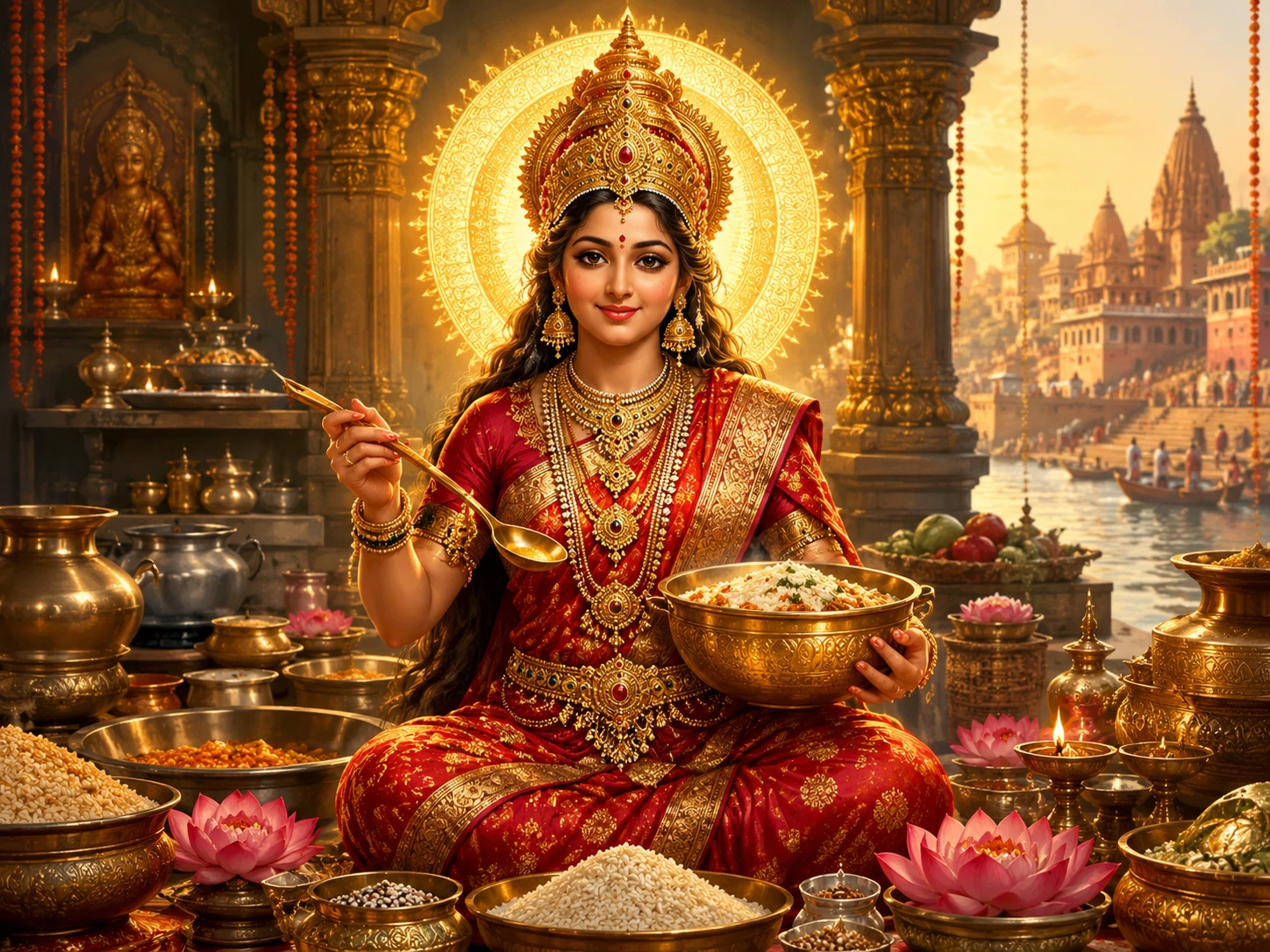
Annapurna is the Hindu goddess of food and nourishment, a specific form of Parvati whose concern is the actual caloric and emotional feeding of beings in the world. Her Sanskrit name combines anna (food, grain, cooked rice) and purna (full, complete), giving a name that means 'she who is full of food' or 'she whose abundance is food.' Her iconographic signature is a golden ladle held in one hand and a jewelled bowl of steaming food held in the other, sometimes with Shiva standing before her as a supplicant with a begging bowl. She is seated, dressed in red or pink, with a serene maternal expression, and her domain is the kitchen -- specifically the continuous provision of cooked food to beings who would otherwise go hungry. This is not a symbolic role in Hindu theology. Every meal in a traditional Hindu home begins with the utterance annam brahma -- food is Brahman -- and this teaching is traced directly to Annapurna. She is not a goddess who receives food offerings; she is the goddess whose own essence becomes the food that is offered. When a grandmother in Madurai lights a small lamp before serving breakfast, she is invoking Annapurna. When a langar in a Punjabi gurdwara feeds thousands, the Hindu theological reading of that service is that Annapurna is operating through the granthi and the sevadars. The goddess spans the actual moment of nourishment.
The central Annapurna narrative, preserved in the Skanda Purana's Kashi Khanda and in the Devi Bhagavata Purana, gives the origin of her specific form. Shiva and Parvati once had a philosophical disagreement about whether food was real or whether it was, like the rest of the material world, mere illusion (maya). Shiva, taking the ascetic position, argued that food was part of the illusion and could be transcended. Parvati, taking the position that embodiment and its needs were real, disagreed. To prove her point, she withdrew from the cosmos entirely. The immediate result was catastrophe: crops failed, kitchens went cold, seas dried, rivers stopped yielding fish. The gods, the rishis, and ordinary beings all began to starve. Shiva himself, unable to meditate past his growing hunger, descended from Kailash and searched for food. He found Parvati in Kashi, in the form of Annapurna, serving food to the hungry from an inexhaustible pot. Shiva approached her with a begging bowl and asked for alms. Parvati-as-Annapurna fed him. Shiva, fed, acknowledged the point: food is not illusion. Embodied beings require actual food, and the goddess who provides it is not lesser than the god who meditates on the absolute. This narrative establishes Annapurna as the goddess of a specific corrective teaching: philosophical abstraction that denies the reality of bodily need is incomplete, and even Shiva himself must come to Annapurna with hands cupped.
नित्यानन्दकरी वराभयकरी सौन्दर्यरत्नाकरी निर्धूताखिलघोरपावनकरी प्रत्यक्षमाहेश्वरी । प्रालेयाचलवंशपावनकरी काशीपुराधीश्वरी भिक्षां देहि कृपावलम्बनकरी मातान्नपूर्णेश्वरी ॥१॥
nityānandakarī varābhayakarī saundaryaratnākarī nirdhūtākhilaghorapāvanakarī pratyakṣamāheśvarī | prāleyācalavaṃśapāvanakarī kāśīpurādhīśvarī bhikṣāṃ dehi kṛpāvalambanakarī mātānnapūrṇeśvarī ||1||
She who grants eternal bliss; she who gives boons and fearlessness; she who is the ocean of the jewel of beauty; the Great Goddess who directly manifests, purifying all terrible afflictions; the purifier of the Himalayan lineage, sovereign lady of the city of Kashi -- O Mother Annapurneshwari, support of grace, grant me alms.
— Annapurna Stotram by Adi Shankaracharya, Verse 1
The Annapurna Temple at Varanasi is the principal seat of the goddess's worship and one of the most visited shrines in Kashi. Located within a short walking distance of the Kashi Vishwanath Temple, the Annapurna Mandir was rebuilt in 1725 by Bajirao I, the Maratha Peshwa, on the site of an earlier temple destroyed during the medieval period. The primary deity is a beautiful seated Annapurna made of gold, with the jewelled bowl and ladle, flanked by Shiva as a bhikshu (mendicant). The temple conducts anna-prasada distribution every day of the year, and the quantity of food given out is substantial: current estimates place the daily free-prasada distribution at about 5,000 meals on ordinary days and 20,000 on major festival days. The annual Annakoot festival, held on the day after Diwali (Kartik Shukla Pratipada), involves the preparation of a massive mountain of food -- annakoot literally means 'mountain of food' -- offered to the deity and then distributed to pilgrims. The sight of the golden Annapurna in Kashi, the deity making eye contact with her devotees across the garbhagriha, is considered one of the great pilgrimage experiences in Hindu tradition. The temple is open to all Hindus and is particularly visited by couples seeking marital prosperity and by families seeking relief from food-related anxieties.
The teaching annadana param danam -- 'the gift of food is the supreme gift' -- is one of the most universally accepted dharmic principles in Hindu tradition, and Annapurna is the deity most directly associated with it. The Mahabharata's Anushasana Parva (chapter 64) states that of all the forms of charity, annadana produces the most immediate and unambiguous merit because food sustains life itself. The Bhagavad Gita in chapter 17 classifies offerings of food according to the three gunas and identifies sattvic food-giving as the highest form. The Skanda Purana, the Padma Purana, and nearly every major Puranic text carry similar teachings. Contemporary Hindu practice continues to honour this at multiple scales. At the household scale, tradition holds that no guest should leave hungry; the Sanskrit phrase atithi devo bhava -- the guest is god -- is closely tied to this teaching. At the temple scale, every major Hindu temple operates some form of anna-prasada, from the Tirumala Venkateswara Temple's daily 3 lakh meals down to the smallest neighborhood shrine's Tuesday ladoo distribution. At the civilizational scale, initiatives like the Akshaya Patra Foundation, founded in 2000 and now providing mid-day meals to approximately 2 million Indian schoolchildren daily, explicitly frame their work as Annapurna-seva. A Bengaluru-based philanthropist writing a cheque to Akshaya Patra is understood by the tradition to be participating in Annapurna's work.
Major Annapurna Temples and Food-Centric Hindu Sites
| Site | Location | Significance |
|---|---|---|
| Annapurna Mandir / अन्नपूर्णा मंदिर | Varanasi, Uttar Pradesh / वाराणसी, उ.प्र. | Principal Annapurna temple; daily prasada for thousands; gold image of the goddess. / प्रमुख अन्नपूर्णा मंदिर; हज़ारों को दैनिक प्रसाद; देवी की स्वर्ण मूर्ति। |
| Tirumala Venkateswara / तिरुमाला वेंकटेश्वर | Andhra Pradesh / आंध्र प्रदेश | Distributes roughly 3 lakh meals daily through its Nitya Anna Prasadam scheme. / अपनी नित्य अन्न प्रसादम योजना से दैनिक लगभग 3 लाख भोजन वितरित करता है। |
| Jagannath Puri Rosaghar / जगन्नाथ पुरी रसोईघर | Odisha / ओड़िशा | The world's largest temple kitchen; serves mahaprasadam to 100,000-200,000 pilgrims daily. / विश्व की सबसे बड़ी मंदिर-रसोई; दैनिक 1-2 लाख तीर्थयात्रियों को महाप्रसादम परोसती है। |
| Golden Temple Langar / स्वर्ण मंदिर लंगर | Amritsar, Punjab / अमृतसर, पंजाब | Though Sikh, the langar embodies the Annadana principle; 50,000-100,000 meals daily. / यद्यपि सिख, लंगर अन्नदान सिद्धांत को मूर्त करता है; दैनिक 50,000-1,00,000 भोजन। |
| Annapurna Temple, Indore / अन्नपूर्णा मंदिर, इंदौर | Madhya Pradesh / मध्य प्रदेश | Major Annapurna temple with continuous free food distribution; particularly crowded on Tuesdays and Fridays. / प्रमुख अन्नपूर्णा मंदिर जिसमें निरंतर निःशुल्क भोजन वितरण होता है; मंगलवार और शुक्रवार को विशेष भीड़। |
Beyond these institutional sites, Hindu tradition holds that every home kitchen is an Annapurna-sthana (Annapurna-place) and that the woman who cooks is, for the duration of the meal's preparation, serving as Annapurna's agent. The daily act of feeding a family is ritually equated with temple food-distribution, which is why Hindu women traditionally perform a brief prayer before starting to cook.
Annapurna Jayanti, the full moon of Margashirsha (usually December), marks the day on which the goddess is said to have manifested her specific form to feed Shiva in Kashi. The festival is observed principally in North India and in Maharashtra, and in Hindu households it involves a specific set of practices. Women clean and polish all kitchen vessels on the previous day. On the Jayanti itself, a new diya is lit in the kitchen, and the first food prepared is offered to Annapurna before being served to anyone. The household puja includes recitation of the Annapurna Stotram, and the day's cooking is performed with particular attention to purity and mindfulness. A second major Annapurna observance is on Akshaya Tritiya, the third day of the waxing moon in Vaishakha (April-May), considered one of the most auspicious days in the Hindu calendar. The word akshaya means 'imperishable,' and the day is considered doubly auspicious for acts of charity, particularly anna-dana. Families distribute food to the needy; temples run special bhandara (food-distribution events). The Indian government's National Food Security Act was passed in 2013, and commentators have noted the thematic resonance between the Act's framing of food as a right and the Annapurna tradition's framing of food as the goddess's universal gift. The theological and the political converge on a simple proposition: no person in the land should go hungry.
The Akshaya Patra Foundation, founded in 2000 in Bengaluru, is the world's largest NGO-run school meal programme and is explicitly framed by its founding organization (the International Society for Krishna Consciousness, ISKCON) as an Annapurna-adjacent Hindu service initiative. The Foundation operates centralized kitchens across India, serving hot, freshly cooked mid-day meals to government school children. As of 2024, it serves approximately 2 million children daily across 19 Indian states, with a goal of reaching 5 million by 2025. The cost per meal is roughly 10 rupees, funded through a mix of government partnership under the Mid-Day Meal Scheme, corporate CSR contributions, and individual donations. The organization's name, Akshaya Patra, refers directly to the inexhaustible pot of food that Krishna provided to the Pandavas during their forest exile in the Mahabharata -- a mythological referent that places the Foundation's work within a continuous Hindu tradition of food-centered service. Its kitchens have been visited by the Dalai Lama, President Obama, and numerous other global figures as models of food-service efficiency and scale. A Bengaluru IT worker who donates monthly to Akshaya Patra is participating in what the Hindu tradition understands as Annapurna-seva through modern organizational means. The goddess operates through whatever institutional form is available.
The ritual of annaprashana, the first solid food ceremony for Hindu infants, is directly dedicated to Annapurna. Performed typically between the sixth and ninth month of a child's life, the ceremony marks the baby's transition from exclusive breastfeeding to solid food. A small amount of payasam (sweet rice pudding) is prepared, blessed by a priest with mantras that invoke Annapurna, and then offered to the child as the first solid meal. The maternal grandmother or a senior woman of the family conducts the actual feeding. The ceremony is attended by extended family, gifts are given to the child, and a brief puja is performed before the feeding. The theological framework is that the child, before annaprashana, has lived only on the mother's body (through pregnancy and breastfeeding) but from this day forward will participate in the larger food-economy of the world, which is Annapurna's domain. The ceremony is therefore simultaneously a celebration of the child's growth and a formal introduction to Annapurna as the child's future provider. The tradition is observed across most Hindu communities in India and in the diaspora, including among families who otherwise do not perform many religious ceremonies. A software engineer in Gurgaon with an eight-month-old daughter will likely still conduct an annaprashana even if he does not perform any other sanskara. The ceremony marks a specific biological and social transition that the tradition has given explicit theological weight.
The Annapurna Upanishad, a minor Upanishad attached to the Atharva Veda, is specifically focused on the goddess and on her philosophical role. In five short chapters, the text presents a dialogue between the sage Ribhu and his disciple Nidagha, in which the sage teaches the disciple that Annapurna is not merely the physical provider of food but the cosmic principle of nourishment in its highest metaphysical sense. The Upanishad argues that Annapurna's form is deliberate pedagogy: by showing the goddess with the ladle and the bowl, Hindu theology communicates that ultimate reality is not indifferent to embodied beings' needs; it is, specifically, providential. Swami Chinmayananda in the twentieth century published a commentary on this Upanishad arguing that it is among the most underrated texts in the corpus and that its theology of embodied provision is directly relevant to contemporary questions about religion's role in social welfare. The Upanishad also contains specific meditation instructions involving visualization of the goddess with the bowl, reflection on the sources of one's own nourishment, and the practice of gratitude before eating. These meditation instructions are taught today at the Chinmaya Mission centres worldwide and have been incorporated into some modern Hindu-adjacent meditation programs. A Mumbai-based Chinmaya Mission devotee who practices Annapurna-meditation before meals is working within a textual tradition whose roots trace back at least a thousand years.
Hindu food traditions treat the act of cooking as itself a yajna (sacrifice) when performed with the right attitude. The Bhagavad Gita 3.13 states: yajna-shishta-ashinah santo muchyante sarva-kilbishaih -- 'Those who eat what remains from the yajna are freed from all sins.' The verse is explicitly about ritual sacrifice, but traditional commentary extends it to all food that is cooked, offered first to the divine (and specifically to Annapurna), and then eaten as prasada. In this framework, cooking is not a mundane household chore but a daily ritual act with cosmic implications. The cook's state of mind affects the food's subtle quality. Food cooked in anger or haste carries tamasic (inert, heavy) energy; food cooked in peace carries sattvic (clear, light) energy. These distinctions are taken seriously in orthodox Hindu households, and Ayurvedic medicine explicitly correlates them to physiological outcomes. Contemporary nutritional science has begun to investigate related questions -- the effect of mindfulness on digestion, the impact of stress on gut microbiome -- and some findings converge with the traditional teachings. A Hindu grandmother who refuses to cook when angry and instead waits until she has calmed down is not being superstitious. She is following a practical teaching about how cooking-state translates into food-quality translates into bodily and mental state. Annapurna is the deity who links these translations.
The relationship between Annapurna-theology and contemporary debates about vegetarianism versus non-vegetarianism in India deserves direct acknowledgment. Hindu tradition is internally plural on this question. Many communities have been vegetarian for centuries or millennia, for reasons that interweave ahimsa (non-harm), Annapurna-type food-theology, and Brahminical ritual purity concerns. Many other communities, including large Shaiva and Shakta traditions, have always eaten meat, and scriptural support exists for both positions depending on which texts are given weight. Annapurna herself is not associated with any specific dietary rule; she is the goddess of food, not a specific cuisine. Contemporary Indian political discourse has, at times, framed vegetarianism as the authentic Hindu position, which scholars from Romila Thapar to Tony Joseph have pushed back against, noting that the archaeological, historical, and scriptural records are much more plural than that framing suggests. A balanced Annapurna-theology would observe: what the goddess cares about is that food is given and received with gratitude and without waste, not that the food be of any particular composition. A Hindu family in Mangalore serving fish curry with rice, a Jain family in Ahmedabad serving strictly vegetarian thali, a Nepali family in Kathmandu serving buffalo momos on a ritual day -- each is, at the theological level, participating in Annapurna's provision. The goddess does not specify the menu.
The global Hare Krishna movement (ISKCON), founded by A.C. Bhaktivedanta Swami Prabhupada in New York in 1966, has elevated Annapurna-adjacent food-service to a principal outreach activity. Every ISKCON temple worldwide -- from the Mumbai Juhu temple to the New York Brooklyn temple to the Alachua Florida farm -- operates a Sunday feast program, conducts festival-day prasadam distribution, and runs food-based community engagement. The theology is explicit: food cooked in a temple kitchen, offered first to Krishna (whom the tradition identifies with the ultimate source of provision that Annapurna represents), becomes prasadam, and eating prasadam is itself a devotional practice. ISKCON's Food for Life Global programme, founded in 1974, has served approximately 3 billion plant-based meals in more than 60 countries as of 2023, operating disaster relief kitchens in conflict zones and poverty-stricken regions. The programme is run primarily by volunteer devotees and is funded through donations. During the COVID-19 pandemic of 2020-2022, Food for Life India alone served approximately 100 million meals to migrant workers stranded by the lockdowns, operating from ISKCON kitchens across the country. A Delhi-based Hare Krishna devotee who cooked prasadam for migrant workers at Anand Vihar bus terminal in April 2020 was doing Annapurna-seva in a specific operational form that had been impossible until the twentieth-century organizational infrastructure existed. The goddess is operationally nimble.
The archaeology of Annapurna worship shows the cult's relatively late emergence within the broader Devi traditions of Hinduism. While goddess-worship in various forms extends back to the Indus Valley, the specific iconographic form of Annapurna with the ladle and the food-bowl appears consolidated only by the medieval period, with the Kashi temple's reconstruction in the eighteenth century being one of the most important surviving references. Annapurna-specific Puranic references are largely concentrated in the Skanda Purana's Kashi Khanda and in the Devi Bhagavata Purana, both relatively late Puranas that probably reached their current form between the eighth and thirteenth centuries. This late emergence is sometimes read by scholars as evidence that Annapurna was a consolidation of older regional food-goddess cults into a classical Sanskritic form, rather than a deity present from the Vedic period. The reading does not diminish Annapurna's theological weight; rather, it shows how Hindu tradition continuously absorbs and formalizes regional feminine-divine concerns into its central pantheon. The goddess of food in rural India was worshipped for millennia under many names; Annapurna is the name the classical tradition eventually gave to the entire category, with Kashi as the codifying site. A contemporary scholar tracing Annapurna's history is therefore studying how a universal rural concern became a central-Sanskritic deity over a gradual process of theological absorption.
For a contemporary Hindu who wants to begin an Annapurna practice, the simplest entry point is the meal itself. Before any meal at home or outside, pause for a moment. Mentally say or silently recite: annam brahma, the short form of the Upanishadic teaching that food is Brahman. Reflect briefly on the chain of sources that brought the food to your plate: the farmer, the transport worker, the shopkeeper, the cook, the person serving. Thank them in your mind. Eat without speaking for the first minute. This takes no ritual infrastructure and is compatible with any eating context -- a corporate lunch, a college canteen, a family dinner, an airline meal. The practice is specifically Annapurna-directed even without explicit mantra recitation, because the goddess's domain is precisely this moment of nourishment. A second practice, more traditional, is to prepare a portion of every meal with the intention of offering it before eating. The small portion is placed on a separate plate or in a small bowl before the first bite. After the offering, the portion can be eaten as prasada or given to an animal or a needy person. Observed daily for a few weeks, these two practices together are reported by practitioners to produce a measurable shift in the relationship with food: less overeating, less waste, more gratitude, and a felt sense of the meal as a gift rather than a consumption event. This is, in theological terms, the experience Annapurna wants her devotees to have.
Recite the Annapurna Stotram before Cooking
Adi Shankara's Annapurna Stotram is on Eternal Raga with its meaning. Recite the verses before starting to cook, especially on Margashirsha Purnima (Annapurna Jayanti), on Akshaya Tritiya, and on Tuesdays and Fridays. The stotra is traditionally paired with lighting a small lamp in the kitchen before cooking begins.
Tags
Eternal Raga · शाश्वत राग
Institutional voice — scholarly articles on Sanatan Dharma
Deepen Your Understanding
अपनी समझ और गहरी करें
deities avatars
Parvati -- Shakti, Wife, Mother, and the Woman Who Moved a Mountain God
She is the daughter of the Himalayas who performed tapas so intense that even Shiva -- the god who burned Kamadeva to ash for daring to disturb his meditation -- was compelled to open his eyes. Parvati is Hinduism's most complete feminine archetype: lover, mother, warrior, philosopher, and the literal other half of god.
deities avatars
Who is Shiva?
He is the ash-smeared ascetic who is also the ideal husband. The destroyer of the universe who is called 'The Auspicious One.' The god of death who drank poison to save all life. He sits in meditation on a Himalayan peak, and simultaneously dances the cosmos into existence and annihilation. No deity in Hinduism contains more contradictions -- and no deity resolves them more completely. This is not a mythology explainer. This is an attempt to stand at the foot of the mountain and look up.
deities avatars
Ganga as Goddess
The Ganga is not a river with divine associations. In Hindu theology she is a goddess who takes the form of a river. She flows from the feet of Vishnu through the matted hair of Shiva to the plains of North India, and every drop is considered capable of dissolving lifetimes of accumulated karma. This is the living goddess whose physical body 600 million Hindus drink, bathe in, and surrender their ashes to.
deities avatars
Nine Forms of Shiva -- The Many Faces of Mahadeva
He is the silent teacher under a banyan tree and the screaming destroyer on a battlefield. He is half-woman and half-man. He drank the poison that would have ended the universe and his throat turned blue. Nine scripturally-attested forms of Shiva -- from Nataraja to Rudra -- and why each one exists.
rituals traditions
Tirtha Yatra -- Why Hindus Travel to Get Closer to God
The word 'Tirtha' does not mean 'holy place.' It means 'crossing point' -- a ford where the river of worldly existence can be crossed to reach the far shore of liberation. Hindu pilgrimage is not tourism with a spiritual label. It is the deliberate journey to locations where the boundary between the material and the divine is believed to be thinnest -- where the crossing is easiest. From Kashi to Kailash, from Char Dham to Kumbh Mela, the tradition maps a sacred geography onto the physical landscape of the subcontinent, turning the act of travel itself into a spiritual practice.
rituals traditions
Vrata -- What a Hindu Vow Really Means (It Is Not Just Fasting)
Your mother kept Karva Chauth without water for sixteen hours. Your grandmother observed Ekadashi every fortnight without fail. Your colleague skips lunch on Tuesdays 'for Hanuman.' The world sees Hindu fasting as dietary restriction. The tradition sees it as something far more radical: Vrata is a voluntary, time-bound act of self-imposed discipline that rewires the relationship between desire and willpower. Fasting is the most visible expression. But the real Vrata happens inside.
tantra mantra yantra
Mahamrityunjaya Mantra -- Conquering Death
A 16-year-old boy clings to a Shiva Linga as the god of death throws a noose around his neck. Shiva emerges from the Linga, kicks Yama in the chest, and declares the boy immortal. That boy is Markandeya. That mantra is the Mahamrityunjaya. It appears in the Rig Veda, the Yajur Veda, and the Atharva Veda -- the only healing mantra attested in three of the four Vedas. It is chanted in ICU corridors, before surgeries, at bedsides, and in cremation grounds. This is not a mantra about avoiding death. It is a mantra about not being afraid of it.
The Akshaya Patra Foundation, founded in 2000 in Bengaluru, is the world's largest NGO-run school meal programme and is explicitly framed by its founding organization (the International Society for Krishna Consciousness,…
More in Deities & Avatars
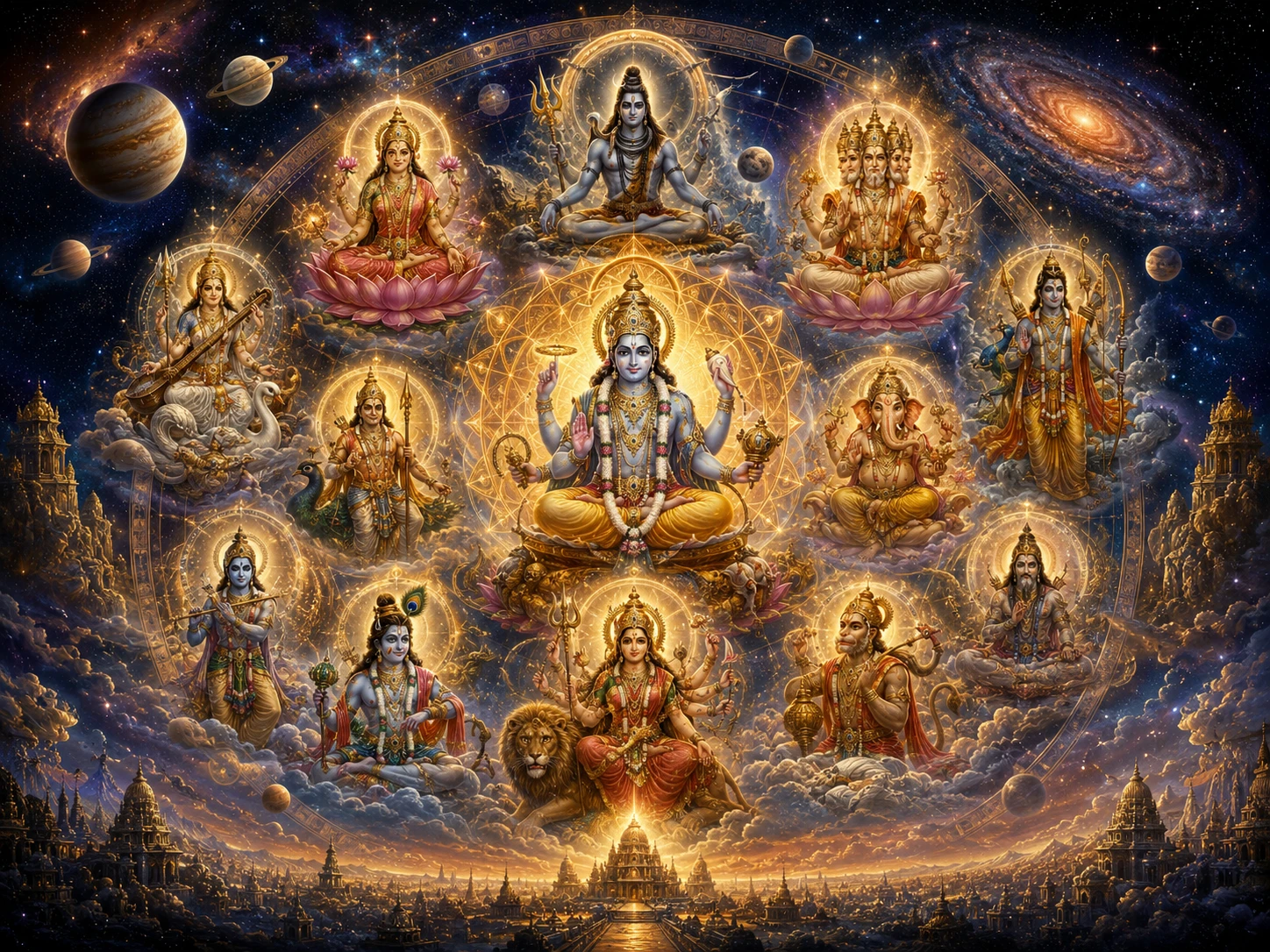
33 Koti Devata -- Why Hinduism Has 33 Types of Gods, Not 33 Crore
13 min read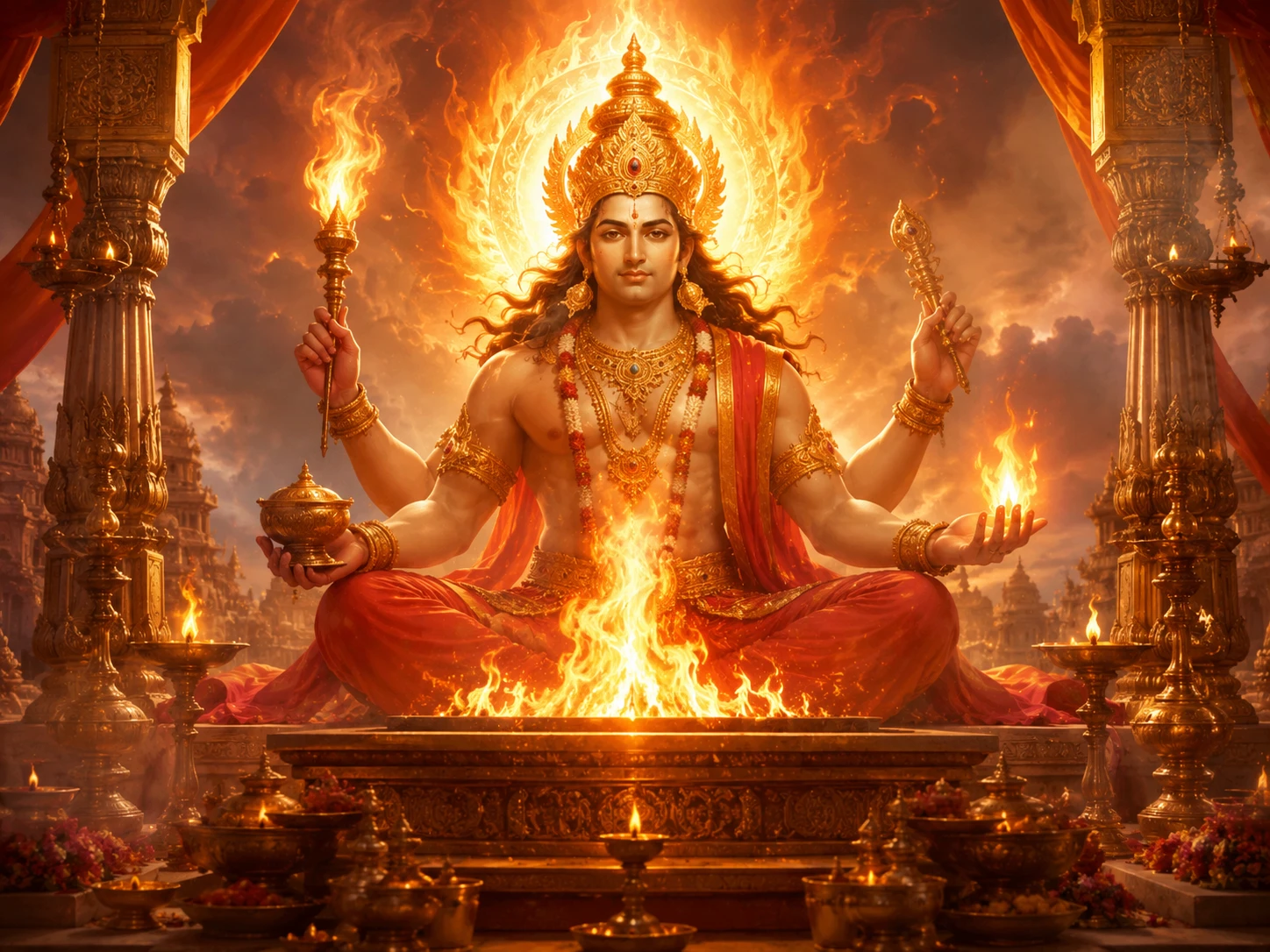
Agni -- The Fire God
19 min read
Apah -- The Waters of the Rig Veda
9 min readThe same translation error that turned '33 Koti' into '33 crore' in Hinduism also happened in Buddhism. The Chinese translation of Buddhist texts rendered 'Sapta Koti Buddha' (7 Supreme Buddhas) as '7 Crore Buddhas.' The…
Deities AvatarsCommunity Reflections
🕉️
Be the first to share your reflection.