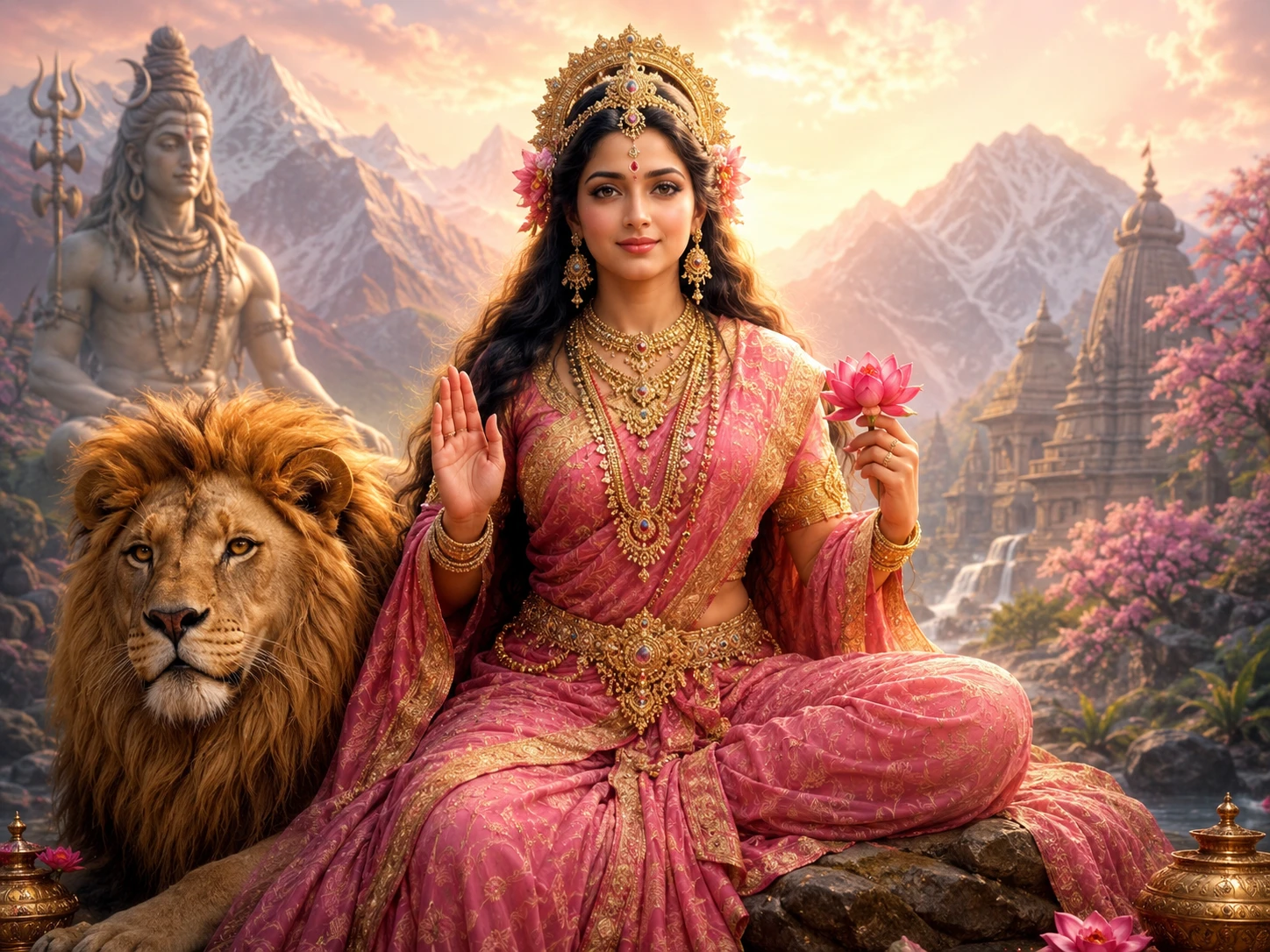
Parvati -- Shakti, Wife, Mother, and the Woman Who Moved a Mountain God
पार्वती -- शक्ति, पत्नी, माता, और वो स्त्री जिसने पर्वत-देव को हिला दिया
In a tradition where gods ride on eagles and wield weapons that can unmake galaxies, the most consequential act of power in Hindu mythology is a woman sitting still.
Parvati -- daughter of Himavat, the king of the Himalayas -- performed tapas (austerity) so severe, so prolonged, and so disciplined that she accomplished what no weapon, no army, and no celestial being had managed: she drew Shiva out of his cosmic meditation. The god who had burned Kamadeva (the god of love) to ashes with a single glance from his third eye for daring to interrupt his trance was compelled -- not by force, not by seduction, but by the sheer spiritual intensity of a woman's will -- to open his eyes, recognise her as his equal, and take her as his wife.
This is not a love story in the Bollywood sense. It is a theological argument about the nature of reality. The Shaiva and Shakta traditions hold that Shiva without Shakti is shava -- a corpse. Consciousness without energy is inert. The masculine principle without the feminine principle is dead matter. Parvati does not merely marry Shiva; she completes him. She is not an accessory to his divinity; she is the condition of it.
For the IIT student in Kharagpur pulling all-nighters before end-sems, for the UPSC aspirant on her third attempt in Mukherjee Nagar, for the single mother running a tiffin service from a one-room kitchen in Dharavi -- Parvati's tapas is not ancient mythology. It is a recognition that the most powerful thing a human being can do is decide what they want and then refuse to stop until the universe yields.
या देवी सर्वभूतेषु शक्तिरूपेण संस्थिता। नमस्तस्यै नमस्तस्यै नमस्तस्यै नमो नमः॥
yā devī sarvabhūteṣu śaktirūpeṇa saṃsthitā | namastasyai namastasyai namastasyai namo namaḥ ||
To that Devi (Goddess) who abides in all beings in the form of Shakti (energy, power) -- salutations to her, salutations to her, salutations to her, again and again.
— Devi Mahatmya (Durga Saptashati), Chapter 5, Verse 12 -- Markandeya Purana
Parvati's biography -- as assembled from the Shiva Purana, Linga Purana, Skanda Purana, Kalidasa's Kumarasambhava, and various regional traditions -- is one of the richest narrative arcs in Hindu literature.
She is born as the daughter of Himavat (the personified Himalayas) and Mena (also called Menaka or Mainavati). Her birth is not accidental -- it is cosmically necessary. In her previous birth, she was Sati, the daughter of Daksha Prajapati, who had married Shiva against her father's wishes. When Daksha held a great yajna and deliberately humiliated Shiva by not inviting him, Sati -- unable to bear the insult to her husband -- immolated herself in the sacrificial fire. Shiva, maddened with grief, carried Sati's body across the cosmos in his Tandava dance of destruction, and Vishnu had to intervene by cutting her body into pieces with his Sudarshana Chakra. The places where the pieces fell became the Shakti Peethas -- fifty-one sacred sites scattered across the Indian subcontinent, from Kamakhya in Assam to Hinglaj in Balochistan.
After Sati's death, Shiva withdrew into permanent meditation on Mount Kailash, abandoning his cosmic duties. The universe was in crisis: the demon Tarakasura had obtained a boon that he could only be killed by a son of Shiva. With Shiva in permanent trance, no such son could be born. The solution required Sati to be reborn and to win Shiva back.
Parvati is that rebirth. But unlike her previous incarnation, she does not merely choose Shiva emotionally -- she earns him through tapas. The Shiva Purana describes her austerities in extraordinary detail: she begins by eating only leaves (earning the name Aparna, 'the leafless one'), then gives up even that, meditating in the open through heat, rain, cold, and storm. Shiva, disguised as a young Brahmana, tests her by criticising himself in her presence -- calling Shiva a homeless ascetic, a dweller of cremation grounds, wearing snakes and ashes, unfit for a princess. Parvati refutes every criticism with theological precision, defending Shiva's attributes as cosmic principles rather than personal defects.
This test -- where the lover must defend the beloved against the beloved himself in disguise -- is one of the great literary motifs in Indian mythology, adapted by Kalidasa in Kumarasambhava into some of the finest Sanskrit poetry ever composed. Parvati does not merely love Shiva; she understands him. And it is that understanding, not beauty or desire, that makes the marriage possible.
Their wedding, described in lavish detail across multiple Puranas, is the most important divine marriage in Hindu tradition. The baraat (wedding procession) of Shiva descends from Kailash -- accompanied by ganas (his attendant spirits), ghosts, goblins, snakes, ascetics, and every being that polite society rejects. When Mena, Parvati's mother, sees the groom's procession, she faints. This is played for comedy in folk tellings across India -- the mother-in-law horrified by the groom's appearance is a universally relatable wedding trope -- but the theological point is serious: Shiva encompasses all of existence, including the parts that make us uncomfortable. Parvati's choice to marry him is a choice to embrace the totality of reality, not just its pleasant surfaces.
The Ardhanarishvara -- the half-male, half-female form of Shiva-Parvati -- is one of the most powerful theological concepts in any world religion, and it is Parvati who makes it possible.
The Ardhanarishvara (literally 'the Lord who is half woman') depicts Shiva and Parvati fused into a single body, split vertically -- the right side male (Shiva), the left side female (Parvati). This is not a metaphor for companionship. It is a statement about the fundamental structure of reality: the universe is composed of consciousness (Purusha/Shiva) and energy (Prakriti/Shakti/Parvati), and neither can exist without the other. They are not two beings who happen to be together; they are two aspects of one being who cannot be separated without destroying both.
The Linga Purana and Shiva Purana provide several origin stories for the Ardhanarishvara form. In one, Brahma, unable to create progeny despite having created many male beings, prays to Shiva for help. Shiva appears as Ardhanarishvara, revealing that creation requires both masculine and feminine principles. From the feminine half, Brahma receives the ability to create female beings, and only then does creation proceed.
In another account from the Skanda Purana, Parvati asks Shiva to let her reside in his body so that she would never be separated from him. Shiva grants this wish, and they merge into the Ardhanarishvara form. The romantic reading is obvious -- she loves him so much that physical proximity is not enough; she must become part of him. But the philosophical reading is deeper: subject and object, knower and known, consciousness and its manifestation, are ultimately one.
The Ardhanarishvara has become an icon in contemporary gender discourse. The idea that divinity is explicitly both male and female -- not one or the other, not one subordinate to the other, but both in equal, inseparable union -- is a claim that most Western religious traditions do not make. When the Indian Supreme Court recognised transgender rights in the NALSA judgment (2014), references to Ardhanarishvara appeared in public discourse as evidence that Indian civilisation has always recognised gender beyond the binary. This is historically nuanced -- traditional acceptance of the hijra community is complex and cannot be simply mapped onto modern LGBTQ+ rights frameworks -- but the theological point is undeniable: Hinduism's most important god is literally half woman.
Parvati's names are not decorative titles -- they are a map of her theological terrain. Each name corresponds to a form, a story, a function, and a regional worship tradition.
Uma: The gentle, golden form. Uma is Parvati as the ideal wife and companion -- she who persuaded her mother to allow the marriage, she who sits beside Shiva on Kailash discussing philosophy. The Kena Upanishad features Uma Haimavati (Uma, daughter of Himavat) as the one who reveals the identity of Brahman to the gods when Indra, Agni, and Vayu fail to recognise it. This is a remarkable role: in one of the oldest Upanishads, it is a goddess -- not a male sage -- who possesses and transmits the highest knowledge.
Gauri: The fair, radiant form. Gauri is associated with fertility, marital auspiciousness, and the Gauri Vrat observed by married women across North India. Gauri Puja during Ganesh Chaturthi (particularly in Maharashtra) is a major domestic festival.
Annapurna: The form that feeds the world. In Kashi (Varanasi), the Annapurna temple is among the most revered in the city. Shiva himself is said to have begged for alms from Annapurna, and she is depicted with a golden pot of rice, feeding the universe. Every anna-daan (food donation) programme in India invokes her, whether consciously or not.
Kamakshi (in Kanchipuram), Meenakshi (in Madurai), Visalakshi (in Varanasi) -- these are regional Parvati forms with their own temple complexes, festivals, and theological traditions. The Meenakshi Temple in Madurai, one of the most spectacular temple complexes in India, is dedicated not to Shiva but to Parvati in her Meenakshi form -- she is the primary deity, and Shiva (as Sundareshwar) is her consort. The temple architecture itself makes the theological point: the Meenakshi shrine is larger than the Sundareshwar shrine. In this tradition, the goddess is not the consort; the god is.
And then there are the fierce forms. When cosmic evil demands a response that Shiva's meditation cannot provide, Parvati transforms. She becomes Durga to slay Mahishasura. She becomes Kali to drink the blood of Raktabija. She becomes Chandi, she becomes Chamunda, she becomes the ten Mahavidyas. The gentle wife of Kailash, the mother who makes laddoos for Ganesha, the philosopher who discusses Advaita with her husband on moonlit nights -- she is also the warrior goddess who rides a lion into the heart of darkness and comes back with demon blood on her tongue.
This is not a contradiction. This is completeness. Parvati's theology says: a complete being is capable of tenderness and terror, of nurture and destruction, of philosophical subtlety and battlefield ferocity. The corporate professional who is gentle in the office but ruthless in the boardroom, the mother who reads bedtime stories to her children but will burn down the world if someone threatens them -- they are living the Parvati archetype.
सर्वमङ्गलमाङ्गल्ये शिवे सर्वार्थसाधिके। शरण्ये त्र्यम्बके गौरि नारायणि नमोऽस्तु ते॥
sarvamaṅgalamāṅgalye śive sarvārthasādhike | śaraṇye tryambake gauri nārāyaṇi namo'stu te ||
O auspiciousness of all that is auspicious, O consort of Shiva (Shive), O fulfiller of all objectives and desires! O giver of refuge, O three-eyed one, O Gauri (the radiant goddess) -- O Narayani, salutations to you.
— Devi Mahatmya (Durga Saptashati), Chapter 11, Verse 9 -- Markandeya Purana
Parvati as mother is one of the most beloved aspects of her worship, and the stories of her motherhood are among the most retold in all of Hindu mythology.
Ganesha's birth story exists in multiple versions, but the most popular (from the Shiva Purana) has Parvati creating Ganesha from turmeric paste (or sandalwood paste in some versions) to guard her door while she bathed. When Shiva returns and is denied entry by the boy, he beheads him in anger. Parvati's rage at the killing of her son is one of the most emotionally charged moments in Puranic literature -- she threatens to destroy the universe unless Shiva restores the child. Shiva sends his ganas to find the head of the first creature they encounter facing north, which turns out to be an elephant. The elephant head is placed on the boy's body, and he is brought back to life as Ganesha. Shiva additionally declares Ganesha as the lord of all ganas and grants him the boon of being worshipped first before all deities.
The story works on multiple levels. As family drama, it is devastating -- a mother's creation, a father's violence, a resurrection that heals but cannot undo. As theology, it establishes Ganesha's unique nature: born of the goddess alone (without Shiva), he is pure Shakti in form, which is why he is worshipped before all other gods -- he is the gateway to divine experience.
Kartikeya (Murugan/Subramanya), the other son, is born differently. He is the son of Shiva's cosmic energy, deposited through a complex chain (from Shiva to Agni to Ganga to the Krittikas, the six Pleiades stars who nurse him -- hence six faces, Shanmukha). Parvati's relationship with Kartikeya is loving but marked by the famous cosmic race story (the subject of a separate article), in which Kartikeya and Ganesha compete to circumnavigate the universe. Ganesha wins by simply walking around his parents, declaring them to be his universe -- a story that every Indian child knows and that every Indian parent secretly hopes their children will one day understand.
Parvati's motherhood extends beyond her biological children. She is Jagadamba -- the Mother of the Universe. The festival cycles of Navaratri, Karva Chauth, Hartalika Teej, Gauri Puja, and Ganesh Chaturthi all centre on Parvati in various aspects. Karva Chauth and Teej -- fasts observed by married women for the long life of their husbands -- are explicitly Parvati festivals, recalling her tapas for Shiva. Whether these fasts are empowering devotion or patriarchal imposition is a contemporary debate, but the theological root is clear: Parvati chose her husband through her own will and sustained the marriage through her own power. She is not a passive wife; she is an active agent who decided that this particular bond was worth any price.
Parvati's Many Names -- One Goddess, Many Dimensions
| Name | Meaning | Form / Function | Major Temple / Region |
|---|---|---|---|
| Uma | Light, Splendour | Gentle companion, revealer of Brahman (Kena Upanishad) | Pan-India, Kena Upanishad tradition |
| Gauri | The Fair / Radiant One | Fertility, marital auspiciousness, Gauri Vrat | Maharashtra (Gauri Puja during Ganesh Chaturthi) |
| Annapurna | She who is full of food | Nourishment, feeding the universe, food as sacred | Kashi Annapurna Temple, Varanasi |
| Meenakshi | Fish-eyed (beautiful eyes) | Primary deity (Shiva as her consort), Pandya queen | Meenakshi Temple, Madurai, Tamil Nadu |
| Kamakshi | She whose eyes awaken desire | Sri Vidya tradition, Shankaracharya's seat | Kamakshi Amman Temple, Kanchipuram |
| Lalita | The Playful, The Beautiful | Supreme Goddess in Sri Vidya, Lalita Sahasranama | Shakta Peethas, tantric traditions |
| Durga | The Invincible | Warrior form, slayer of Mahishasura | Kolkata Durga Puja, Vaishno Devi |
| Kali | The Dark, The Time | Fiercest form, destroyer of ego and illusion | Dakshineswar, Kalighat (Kolkata), Kamakhya |
| Aparna | The Leafless One | Parvati during her severest tapas | Shiva Purana narrative tradition |
| Hemavati / Haimavati | Daughter of the Snowy One | Mountain princess, Himalayan origin | Kena Upanishad, Kumarasambhava |
Parvati's names are not aliases -- they are facets. Each name activates a different aspect of her being, and the devotee chooses the name that speaks to their current need: Annapurna when hungry, Durga when embattled, Gauri when seeking domestic harmony, Uma when seeking wisdom.
The Meenakshi Temple in Madurai receives approximately 15,000-25,000 visitors daily and hosts the Meenakshi Thirukalyanam (divine wedding) festival annually, which re-enacts the marriage of Meenakshi (Parvati) and Sundareshwar (Shiva). It is one of the largest wedding celebrations on Earth, attended by over a million people. The temple complex covers 14 acres and contains 33,000 sculptures. Meanwhile, the Indian Army's counter-insurgency force is named 'Durga' -- a direct invocation of Parvati's warrior form. India's first indigenously developed nuclear-capable submarine-launched ballistic missile was tested from INS Arihant ('Destroyer of Enemies' -- an epithet of Shiva), reminding us that in Indian defence naming, Shiva and Parvati are never far apart. And the Ardhanarishvara concept inspired a 2019 Indian postage stamp, making it possibly the only postal service in the world to have issued a stamp depicting a non-binary deity.
Parvati's conversations with Shiva form the structural basis of some of the most important texts in Hindu philosophy. The Shiva Sutras, Vijnana Bhairava Tantra, and portions of the Yoga Vasistha use the dialogue format of Parvati asking questions and Shiva answering -- but this is not a teacher-student relationship. It is a partnership of inquiry.
In the Vijnana Bhairava Tantra -- one of the most important texts of Kashmir Shaivism -- Parvati opens by asking Shiva: 'What is your true nature? What is this wonder-filled universe? What constitutes the seed of the universe? Who centres the universal wheel?' These are not the questions of a devotee. These are the questions of a philosopher, and Shiva responds with 112 meditation techniques (dharanas) -- the most comprehensive manual of contemplative practice in the Indian tradition.
The theological implication is striking: the highest knowledge in Hinduism is revealed not by a male deity lecturing but by a goddess asking the right questions. Parvati's questions shape the teaching. Without her inquiry, Shiva's knowledge remains unexpressed -- which is precisely the Shakta point: without Shakti, Shiva is inert.
This dialogical structure has profoundly influenced Indian intellectual culture. The guru-shishya tradition, the viva voce examination in Indian universities, the style of UPSC interview preparation where the aspirant practises answering questions from all angles -- all echo the Shiva-Parvati dialogue model. The assumption is that truth emerges not from monologue but from dialogue, not from assertion but from questioning.
For the contemporary world, Parvati offers something that no other deity quite matches: the complete archetype. She is wife, mother, warrior, philosopher, and goddess. She performs tapas with the discipline of a NEET aspirant, debates philosophy with the rigour of a JNU scholar, fights demons with the ferocity of an army commando, and nurtures her family with the tenderness of a grandmother. She is never only one thing. She is always all things.
And at the centre of it all, she is the half that makes the whole. Without her, Shiva is a corpse. Without her questions, his knowledge is mute. Without her tapas, his meditation is mere avoidance. Without her Shakti, his consciousness is a lamp without oil.
The Himalayas still stand. The daughter who came down from them changed the universe.
Chant the Ya Devi Sarvabhuteshu Stuti
Recite the most powerful hymn to the Goddess from the Devi Mahatmya, recognising her presence as Shakti, Buddhi, Nidra, Kshama and Shanti in all beings. The Ya Devi hymn is on Eternal Raga with its meaning.
The Shakti Peethas -- the fifty-one sacred sites where parts of Sati's body fell when Vishnu's Sudarshana Chakra dismembered her -- constitute one of the most important pilgrimage networks in Hinduism, and they are entirely Parvati's legacy.
The geography of the Shakti Peethas spans the entire Indian subcontinent and beyond. Kamakhya in Guwahati (Assam), where the yoni (womb) fell, is one of the most powerful tantric centres in India. Kalighat in Kolkata, where the right toe fell, gives Calcutta its name. Hinglaj in Balochistan (Pakistan), where Sati's cranium fell, has been a Hindu pilgrimage site for over a thousand years despite being in a Muslim-majority region. Jwala Ji in Himachal Pradesh, where Sati's tongue fell, features a natural gas vent that produces eternal flames -- worshipped as the Goddess's fire. Naina Devi in Bilaspur (Himachal Pradesh), where Sati's eyes fell. Vishalakshi in Varanasi, where her earrings fell.
The Shakti Peetha network creates a sacred geography that unites India from corner to corner. A pilgrim who visits all fifty-one Peethas has, in effect, circumambulated the subcontinent. This was not accidental -- the myth of Sati's dismembered body falling across the land is a theological statement about the Goddess's omnipresence: she is not in one temple or one city. She is everywhere. Her body IS the land.
For modern India, the Shakti Peetha tradition has practical implications. The Vaishno Devi shrine in Jammu receives over 8 million pilgrims annually, making it one of the most visited religious sites in the world. The trek to the shrine -- 13 kilometres uphill -- is undertaken by everyone from elderly grandmothers to toddlers carried on fathers' backs to NRI families flying in from New Jersey. The Kamakhya Temple in Guwahati hosts the Ambubachi Mela every June, when the temple closes for three days to mark the Goddess's menstrual cycle -- one of the only religious traditions in the world that explicitly sacralises menstruation rather than treating it as impure.
Parvati's temples across India tell a story that the textbooks do not: that goddess worship in India is not a minor tradition within a male-dominated pantheon. It is, in many regions, the dominant form of worship. Tamil Nadu's great temple complexes -- Madurai, Kanchipuram, Tiruvannamalai -- give the goddess primacy. Kerala's Attukal Pongala festival holds the Guinness record for the largest gathering of women for a religious activity (over 3.5 million women). Bengal's annual rhythm revolves around Durga Puja. And in village India, from Rajasthan to Odisha, the local kuldevata (clan deity) is more often a goddess than a god.
Parvati, in all her forms, is not a consort who accompanies the main deity. She is the main deity. And the land itself -- from the Himalayas where she was born to the seas where Sati's pieces fell -- is her body.
Tags
Eternal Raga · शाश्वत राग
Institutional voice — scholarly articles on Sanatan Dharma
Deepen Your Understanding
अपनी समझ और गहरी करें
deities avatars
Saraswati -- Goddess of Knowledge, Music, and the Flowing Stream of Consciousness
She is the only Hindu deity worshipped with a musical instrument in her hands -- not a weapon, not a boon-granting gesture, but a veena. Saraswati is the goddess who makes knowledge possible, and the fact that India has a national holiday dedicated to placing books at her feet tells you everything about a civilisation's priorities.
deities avatars
Lakshmi -- Beyond Wealth, the Goddess Who Refuses to Stay
India lights 300 million diyas on Diwali night for a goddess whose central teaching is that wealth is not meant to be hoarded. Lakshmi is the most worshipped and most misunderstood deity in Hinduism -- she represents not money but the flow of abundance, and the moment you try to trap her, she leaves.
deities avatars
Durga -- The Warrior Goddess Who Cannot Be Defeated
When every male god in the Hindu pantheon failed to defeat the buffalo demon Mahishasura, they pooled their tejas -- their divine radiance and rage -- into a single being. What emerged was not another god. It was a goddess. And she succeeded where they could not. That is the origin story of Durga, and it rewrites every assumption about power.
deities avatars
Kali -- The Fierce Mother Who Devours Time Itself
Black-skinned, wild-haired, wearing a garland of fifty severed heads and a skirt of severed arms, standing on Shiva's chest with her tongue extended in shock -- Kali is the most misunderstood deity in Hinduism and the most theologically radical. She is not a demon. She is not 'dark energy.' She is Time in feminine form, the cosmic mother who destroys everything so that everything can be reborn. Ramakrishna called her 'Ma.' Millions still do.
deities avatars
Devi Swaroopa -- Forms of the Goddess
She is Durga on the battlefield and Annapurna in the kitchen. She is Kali at the cremation ground and Lakshmi in the boardroom. She is Saraswati at the university and Parvati in the family. The Hindu Goddess is not one deity with accessories -- she is the entire spectrum of feminine power, from terrifying to tender, from cosmic to domestic. Understanding her forms is understanding the universe itself.
deities avatars
Nataraja -- The Cosmic Dancer
One foot crushes a dwarf. The other is raised in liberation. A ring of fire frames the dance. A drum beats creation into existence. An open palm says 'do not fear.' This is Nataraja -- Shiva as the Lord of Dance -- and it is the single most replicated Indian bronze in the history of art. The physicists at CERN chose it to stand outside the world's largest particle accelerator. The Chola bronzesmiths of Tamil Nadu perfected it a thousand years ago. And every time a subatomic particle appears and disappears, the cosmic dance continues.
deities avatars
Kartikeya vs Ganesh -- The Cosmic Race Around the Universe That Every Indian Parent Secretly Hopes Their Children Will Understand
Two divine brothers are challenged to race around the universe. Kartikeya, the warrior god, mounts his peacock and flies across all three worlds at cosmic speed. Ganesh, the elephant-headed god, simply walks around his parents and says: 'You are my universe.' Ganesh wins. And in that victory is encoded everything Indian civilisation believes about the relationship between wisdom and strength, devotion and ambition, family and cosmos.
The Meenakshi Temple in Madurai receives approximately 15,000-25,000 visitors daily and hosts the Meenakshi Thirukalyanam (divine wedding) festival annually, which re-enacts the marriage of Meenakshi (Parvati) and Sundar…
More in Deities & Avatars
33 Koti Devata -- Why Hinduism Has 33 Types of Gods, Not 33 Crore
13 min read
Agni -- The Fire God
19 min read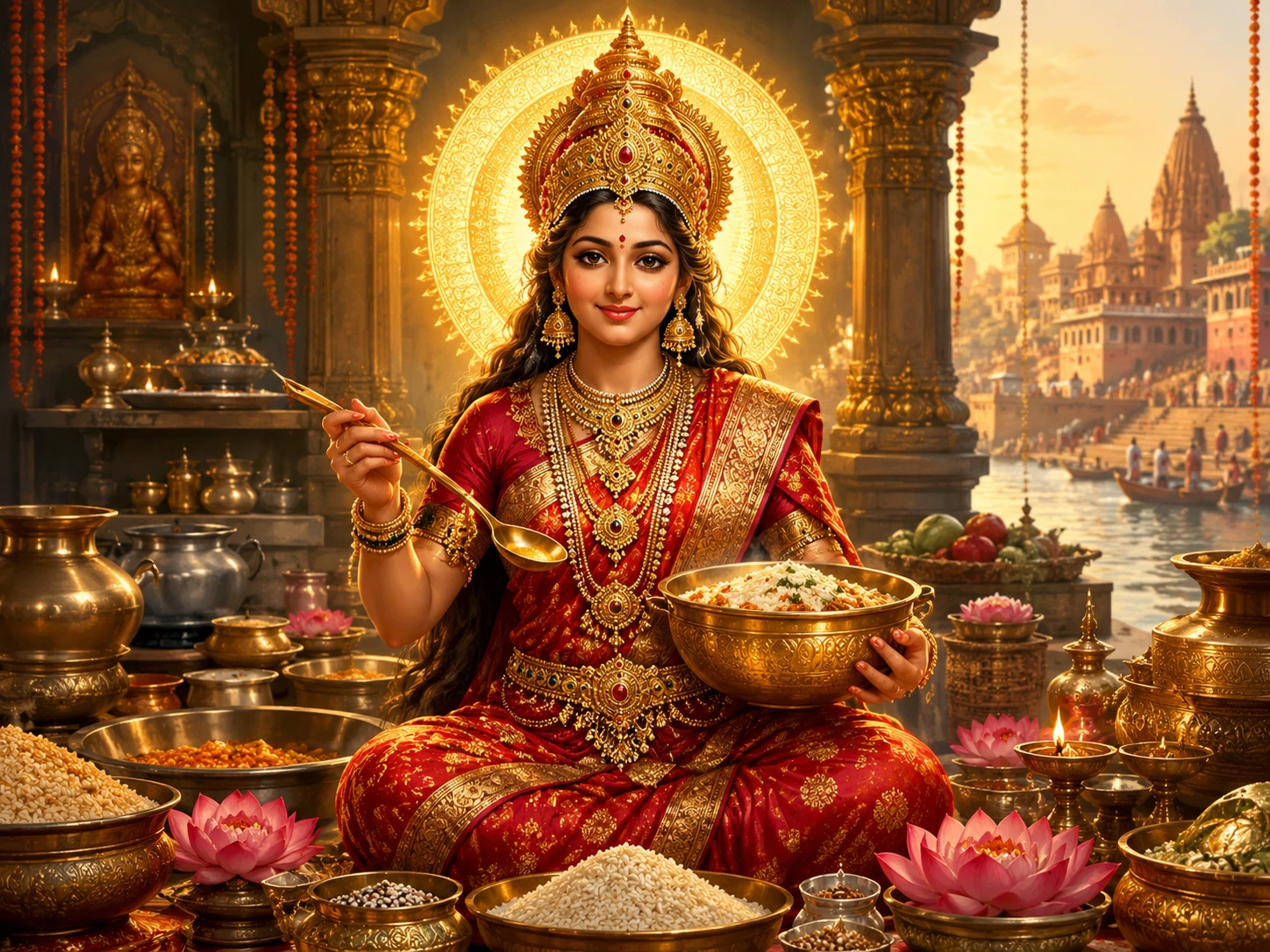
Annapurna -- Goddess of Food
19 min readThe same translation error that turned '33 Koti' into '33 crore' in Hinduism also happened in Buddhism. The Chinese translation of Buddhist texts rendered 'Sapta Koti Buddha' (7 Supreme Buddhas) as '7 Crore Buddhas.' The…
Deities AvatarsCommunity Reflections
🕉️
Be the first to share your reflection.