Lakshmi -- Beyond Wealth, the Goddess Who Refuses to Stay
लक्ष्मी -- धन से परे, वो देवी जो रुकने से इनकार करती हैं
On the night of Diwali, something happens in India that has no parallel anywhere on Earth. Nearly three hundred million households light earthen diyas, place rangoli at their doorsteps, clean their homes to surgical precision, open their front doors, and wait. They are waiting for Lakshmi -- the goddess of wealth, fortune, and abundance -- to walk in.
This is not metaphorical. In the Diwali puja tradition, it is believed that Lakshmi moves through the world on Amavasya night (the darkest night of the year), and she enters the homes that are clean, well-lit, and have their doors open. Closed doors, dark houses, and dirty rooms are skipped. The economic implication of this belief -- embedded in a civilisation that has practised it for over two thousand years -- is extraordinary: wealth is not something you lock up. It is something you prepare for, invite, and keep the doors open for. Wealth is a guest, not a prisoner.
This is the central paradox of Lakshmi, and it is the reason she is simultaneously the most worshipped and the most misunderstood deity in Hinduism. People pray to her for money -- and she represents something far more complex than money. She represents Shri -- a Sanskrit word that has no precise English equivalent but encompasses prosperity, auspiciousness, grace, beauty, radiance, royal authority, and the quality that makes life worth living. Shri is not your bank balance. Shri is what makes your bank balance meaningful.
The startup founder in Koramangala who has raised Series B funding but feels empty -- he has Lakshmi's money but not her Shri. The retired schoolteacher in Varanasi whose students touch her feet at weddings -- she has no money but is overflowing with Shri. Understanding Lakshmi requires understanding this distinction, and most Diwali puja pamphlets do not make it.
हिरण्यवर्णां हरिणीं सुवर्णरजतस्रजाम्। चन्द्रां हिरण्मयीं लक्ष्मीं जातवेदो म आवह॥
hiraṇyavarṇāṃ hariṇīṃ suvarṇarajatasrajām | candrāṃ hiraṇmayīṃ lakṣmīṃ jātavedo ma āvaha ||
O Jataveda (Agni, the fire who knows all beings), invoke for me that Lakshmi who is golden-hued, beautiful like a deer, adorned with garlands of gold and silver, radiant like the moon, and golden in her luminance.
— Sri Suktam, Verse 1 (Rig Veda Khilani, Appendix to Mandala 5)
Lakshmi's primary origin story is the Samudra Manthan -- the Churning of the Ocean of Milk -- and it is one of the most important narratives in Hindu cosmology, depicted on the walls of Angkor Wat, recited in every major Purana, and referenced in temple architecture from Mahabalipuram to Konark.
The story is straightforward in its setup but cosmic in its implications. The Devas (gods) and Asuras (demons) cooperate to churn the cosmic ocean, using Mount Mandara as the churning rod and the serpent Vasuki as the rope. Vishnu, in his Kurma (tortoise) avatara, supports the mountain from below. As the ocean is churned, fourteen treasures (chaturdasha ratnas) emerge in sequence. Among the first is Halahala -- the cosmic poison so deadly that it threatens to destroy the universe, consumed by Shiva (who earns the name Neelakantha, the blue-throated one). Among the last is Lakshmi herself.
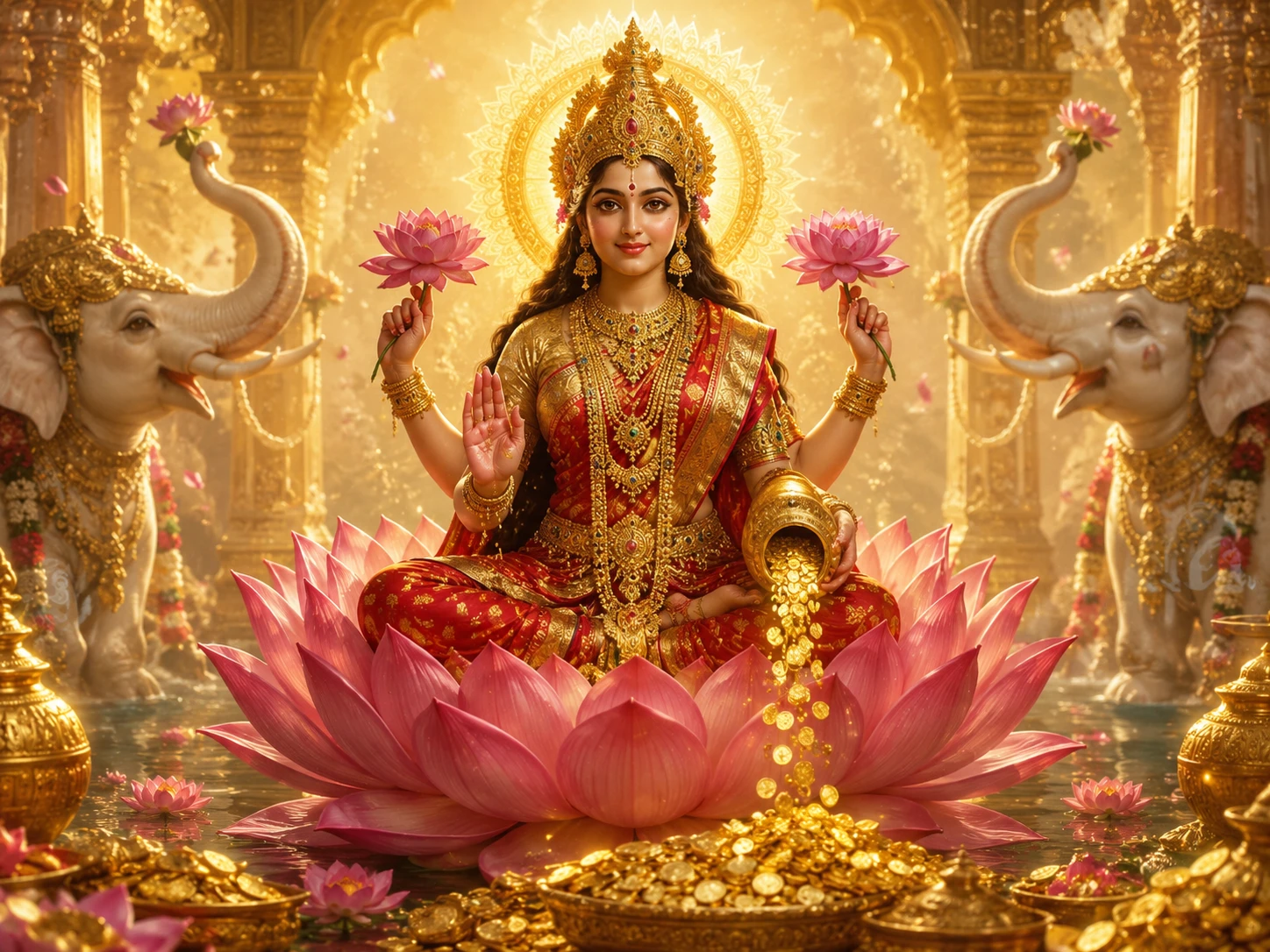
The sequence matters. Before Lakshmi emerges, the churning produces: Halahala (poison), Kamadhenu (the wish-fulfilling cow), Ucchaishravas (the divine horse), Airavata (the divine elephant), Kaustubha (the divine gem), Parijata (the celestial tree), Varuni (the goddess of wine), Dhanvantari (the divine physician with the pot of amrita), and the Apsaras (celestial nymphs). Lakshmi emerges near the end -- radiant, seated on a lotus, anointed by elephants pouring sacred water over her.
The theological message embedded in this sequence is profound: prosperity comes after effort, after poison has been dealt with, after medicine has been discovered, after the basic necessities of life have been secured. Lakshmi is not the first thing you get when you churn. She is among the last. The JEE aspirant who expects results before doing the work is not following the Samudra Manthan protocol.
When Lakshmi emerges, she chooses Vishnu as her consort. Not Brahma. Not Shiva. Not Indra, who as the king of the gods might have seemed the obvious choice. She chooses the Preserver -- the one whose job is to sustain, to maintain dharmic order, to ensure that the universe runs. The implication: true prosperity attaches itself to those who sustain and protect, not to those who merely create or destroy. The most stable businesses are not the flashy disruptors but the companies that reliably serve their customers year after year -- Lakshmi theology, applied to startup culture.
नमस्तेऽस्तु महामाये श्रीपीठे सुरपूजिते। शङ्खचक्रगदाहस्ते महालक्ष्मि नमोऽस्तु ते॥
namaste'stu mahāmāye śrīpīṭhe surapūjite | śaṅkhacakragadāhaste mahālakṣmi namo'stu te ||
Salutations to you, O Great Maya (the cosmic enchantress), enthroned upon the Sri Pitha (the seat of divine prosperity), worshipped by all the gods. O Mahalakshmi, who holds the conch, the discus, and the mace in her hands -- I bow to you.
— Mahalakshmi Ashtakam, Verse 1 (Padma Purana, recited by Indra)
Lakshmi's iconography is rich, layered, and reveals a theology of abundance that goes far beyond currency notes.
The Lotus (Padma): Lakshmi's most iconic symbol. She sits on a lotus, holds lotuses in two of her hands, and is called Padma, Padmavati, Kamala, and Kamalasana -- all lotus-derived names. The lotus represents abundance that grows from unseen roots in murky water but blooms immaculate on the surface. Wealth, Lakshmi is saying, has humble origins. The most successful entrepreneur in Bengaluru may have started from a middle-class family in a tier-2 town. The lotus does not deny its roots; it transforms them.
The Gold Coins: From one of Lakshmi's hands, gold coins perpetually flow. They do not rest in a pile. They flow. This is not a static image of hoarded treasure -- it is a dynamic image of circulation. Lakshmi's wealth is wealth in motion. The moment wealth stops moving -- the moment it is locked in a vault, hidden in Swiss accounts, or stuffed under a mattress -- it ceases to be Lakshmi's kind of wealth. It becomes dead money. Indian businessmen who donate to temple trusts, who fund weddings for underprivileged families, who run dharamshalas and anna-daan centres, are -- whether they know the theology or not -- keeping Lakshmi's gold in motion.
The Four Hands: Lakshmi has four hands, representing the four purusharthas (goals of human life): Dharma (righteousness), Artha (wealth), Kama (desire/pleasure), and Moksha (liberation). This is a critical theological claim: Lakshmi does not represent only Artha. She represents the entire spectrum of a well-lived life. Wealth without Dharma is corruption. Wealth without Kama is joylessness. Wealth without Moksha is a golden cage. Lakshmi's four hands say: pursue all four, in balance.
The Elephants (Gaja Lakshmi): In one of Lakshmi's most ancient forms -- Gaja Lakshmi, depicted on coins from the Maurya period (4th century BCE) and in reliefs at Sanchi and Bharhut -- two elephants flank the goddess, pouring water over her from golden vessels. Elephants represent royal authority, strength, and rainfall (critical for agrarian prosperity). Gaja Lakshmi is the goddess of collective, agricultural, national wealth -- not personal income but the prosperity of the land.
The Owl (Uluka): Lakshmi's vahana is the owl -- a choice that puzzles many. The owl can see in the dark, navigating what others cannot. This represents the ability to find opportunity where others see only darkness. But the owl is also associated with blindness in daylight -- a warning that those fixated on wealth may be blind to other forms of light. The owl vahana is Lakshmi's subtle critique of her own devotees: do not let the pursuit of wealth make you blind to everything else.
The theology of Lakshmi is not simply 'goddess of wealth.' It is a sophisticated system that recognises eight distinct forms of prosperity -- the Ashta Lakshmi -- each representing a different dimension of abundance that human life requires.
Adi Lakshmi (the Primordial Lakshmi): The original form, representing the eternal, uncaused nature of divine grace. She is Lakshmi as Narayana's consort -- not a gift-giver but the very nature of auspiciousness itself. She is why we put 'Shri' before names -- it invokes the fundamental quality of being blessed.
Dhana Lakshmi (Wealth): The form most people think of when they think of Lakshmi. She bestows material wealth -- gold, currency, property, financial security. But even Dhana Lakshmi is not merely about accumulation; she is about the dharmic generation and use of wealth.
Dhanya Lakshmi (Grain): The agricultural form. In a country where 60% of the population was agrarian until very recently, Dhanya Lakshmi was arguably the most important form. A good monsoon, a bountiful harvest, full granaries -- this was the original meaning of 'prosperity' for most of human history. The farmer in Punjab praying for his wheat crop is praying to Dhanya Lakshmi, whether he knows the name or not.
Gaja Lakshmi (Elephants / Royal Power): Sovereignty, authority, and the prosperity that comes from good governance. The Ashoka Pillar, the seal of the Republic of India, depicts lions -- but the theological ancestor of state prosperity is Gaja Lakshmi. The IAS officer working to improve district administration is, in a sense, a servant of Gaja Lakshmi.
Santana Lakshmi (Progeny): Children are wealth. In Indian tradition, the continuation of the family line -- having children who are healthy, virtuous, and who will perform your last rites -- is a form of abundance that no amount of money can replace. Santana Lakshmi is why Indian families invest disproportionately in education, healthcare, and marriage ceremonies for their children.
Veera Lakshmi (Courage): The prosperity of bravery and strength. This is Lakshmi as the power behind warriors, as the shakti that makes you stand up when everything in you wants to quit. The UPSC aspirant on her fourth attempt, the cancer patient refusing to surrender, the soldier at Siachen -- all are sustained by Veera Lakshmi.
Vidya Lakshmi (Knowledge): The overlap with Saraswati is deliberate. Knowledge is wealth. Vidya Lakshmi represents the prosperity that comes from education, skill, and intellectual capital. In modern India, Vidya Lakshmi is the government scholarship portal (literally named Vidya Lakshmi) that funds higher education for economically weaker students.
Vijaya Lakshmi (Victory): The prosperity of success, triumph, and achievement. Not merely winning but winning with dharma -- righteous victory. Vijaya Lakshmi Pandit, Nehru's sister and the first woman president of the UN General Assembly, bore this name.
The Ashta Lakshmi -- Eight Forms of Prosperity
| Form | Domain | Symbol | Modern Equivalent |
|---|---|---|---|
| Adi Lakshmi | Primordial grace and auspiciousness | Lotus, four arms with abhaya and varada mudra | The unearned goodness in your life -- health, family, safe birth |
| Dhana Lakshmi | Material wealth and financial security | Gold coins flowing from hand | Bank balance, investments, property, financial freedom |
| Dhanya Lakshmi | Grain, food, agricultural abundance | Sheaves of grain, paddy | Food security, agriculture, the farmer's harvest, supply chains |
| Gaja Lakshmi | Royal power, sovereignty, governance | Flanked by elephants pouring water | Good governance, strong institutions, IAS administration |
| Santana Lakshmi | Progeny, healthy and virtuous children | Child on lap, surrounded by children | Family planning, child education, next-generation success |
| Veera Lakshmi / Dhairya Lakshmi | Courage, strength, perseverance | Eight-armed warrior form | UPSC aspirant's fourth attempt, startup pivot, cancer fight |
| Vidya Lakshmi | Knowledge and intellectual capital | Books, veena-like instruments | Vidya Lakshmi portal, IIT/IIM education, skill development |
| Vijaya Lakshmi | Victory, success, achievement | Disc and sword of righteous triumph | Sports victories, election wins, courtroom justice, startup exits |
The Ashta Lakshmi framework reveals that Hindu theology never reduced 'prosperity' to money alone. The eight forms together constitute a complete theory of human flourishing -- closer to Amartya Sen's Capability Approach than to any crude GDP metric.
The Lakshmi-Vishnu relationship is not merely a consort pairing -- it is a theological engine that drives the entire Vaishnava understanding of how the universe works.
In Vaishnava theology, Lakshmi is Vishnu's Shakti -- the active, dynamic force that makes his cosmic functions possible. Vishnu preserves and sustains the universe; Lakshmi is the wealth, prosperity, and abundance that make preservation meaningful. A universe that is preserved but impoverished is not worth preserving. Lakshmi gives Vishnu something worth sustaining.
This is why Lakshmi accompanies Vishnu in every avatara. When Vishnu incarnates as Rama, Lakshmi incarnates as Sita -- the ideal of wifely devotion, the wealth of the Raghu dynasty, the cause over which the entire Ramayana war is fought. When Vishnu incarnates as Krishna, Lakshmi incarnates as Rukmini -- the queen of Dwaraka, the embodiment of royal prosperity and dharmic queenship. In the Vamana avatara, Lakshmi is present as Padmavati. In the Narasimha avatara, she appears as Chenchu Lakshmi in some South Indian traditions.
The theological logic is consistent: wherever Vishnu goes to preserve dharma, Lakshmi goes to ensure that the preserved world has the resources to flourish. This is not a dependent relationship -- it is a partnership of complementary cosmic functions.
The most spectacular expression of this partnership is at Tirumala, where Venkateswara (a form of Vishnu) resides. The Tirumala Tirupati Devasthanams (TTD) is the richest religious institution in the world, receiving an estimated Rs 3,000-4,000 crore annually in donations. The hundi (donation box) of Tirupati collects more wealth than most Indian states generate in tax revenue from certain sectors. This is Lakshmi's presence -- concentrated, visible, flowing into the world's most visited temple as gold, cash, hair offerings, and the faith of over 50,000 pilgrims daily. The Padmavathi temple at Tiruchanur, just 5 km from Tirumala, is dedicated to Lakshmi herself, and devotees traditionally visit Tiruchanur first -- seeking Lakshmi's blessings before approaching Vishnu.
Lakshmi's relationship with Alakshmi -- her elder sister, the goddess of misfortune -- is one of the most psychologically sophisticated concepts in Hindu theology.
According to Puranic tradition, when the ocean was churned, Alakshmi (also called Jyeshtha or Daridra) emerged alongside Lakshmi. Where Lakshmi is beautiful, radiant, and auspicious, Alakshmi is associated with quarrel, poverty, laziness, jealousy, anger, and misfortune. They are sisters -- born from the same churning -- and they are inseparable. The tradition says: wherever Lakshmi goes, Alakshmi is never far behind.
This is not pessimism. It is realism of the highest order. The tradition is saying: wealth and misfortune are two sides of the same churning. Every prosperity carries within it the seeds of its own undoing. The successful startup that becomes complacent. The wealthy family that loses its dharmic compass. The lottery winner who ends up bankrupt. Alakshmi is the shadow of Lakshmi, and pretending the shadow does not exist is a form of spiritual blindness.
The practical rituals around Alakshmi are fascinating. On the night before Diwali -- Naraka Chaturdashi -- many families clean the house and symbolically sweep out Alakshmi. Brooms are placed at doorsteps. Junk is removed. The house is scrubbed not merely for hygiene but as an act of theological preparation: you make room for Lakshmi by evicting Alakshmi. The startup founder who does a 'spring cleaning' of bad debts before raising a new round is performing Naraka Chaturdashi economics.
In South India, particularly in Tamil Nadu, there is a folk tradition that Alakshmi resides in places of filth, darkness, quarrelling, laziness, and jealousy. The practical advice derived from this: keep your home clean, keep the lights on, do not quarrel, work hard, and do not envy others. This is not superstition -- it is behavioural economics encoded in mythology. A clean, well-lit, harmonious home actually does attract better economic outcomes, because the habits that maintain such a home -- discipline, cooperation, work ethic -- are the same habits that generate wealth.
The Sri Suktam, from which our opening verse is drawn, is the oldest surviving hymn to Lakshmi and arguably the most important devotional text in the Lakshmi worship tradition. It appears in the Khilani (appendices) of the Rig Veda -- specifically appended to the fifth Mandala -- and dates to the pre-Buddhist period, making it at least 2,500 years old.
The Sri Suktam is unique in Vedic literature for several reasons. First, it is addressed to Agni (Jataveda, 'the fire who knows all beings'), asking Agni to invoke Lakshmi. This fire-mediated invocation suggests that the earliest Lakshmi worship was performed through the Vedic fire ritual (yajna) -- you did not pray to Lakshmi directly but asked Agni to bring her to you. Second, the hymn associates Lakshmi with both solar and lunar imagery -- gold and silver, sun and moon -- suggesting that prosperity has both active (solar, generating) and receptive (lunar, nurturing) dimensions.
The Sri Suktam is recited during the Thirumanjanam (sacred bath) ceremony at the Tirumala Venkateswara Temple every Friday -- a three-hour ritual where the deity is bathed while Vedic hymns are chanted. It is one of the Pancha Suktam (five hymns) used in this ceremony, alongside the Purusha Suktam, Narayana Suktam, Bhu Suktam, and Nila Suktam. For anyone who has stood in the pre-dawn queue at Tirumala, waiting for darshan as the sound of Sri Suktam floats over the Seven Hills, the experience is not intellectual -- it is visceral. The oldest hymn to wealth in human civilisation, still being chanted at the world's richest temple, before sunrise, in the same language it was composed in. That is continuity that no other civilisation on Earth can match.
The Kanakadhara Stotram, composed by Adi Shankaracharya, provides another key Lakshmi text. According to tradition, when the young Shankara went begging for alms and came to the door of a desperately poor woman who had nothing to give except a single dried amla (gooseberry), Shankara was so moved by her generosity that he composed the Kanakadhara Stotram on the spot, and Lakshmi showered golden amlas upon the woman's house. The story encodes a central Lakshmi teaching: generosity in poverty attracts wealth. Lakshmi is drawn not to those who have the most, but to those who give the most freely -- even when they have almost nothing.
The Reserve Bank of India's currency notes carry the image of Lakshmi in an indirect but unmistakable way: the Ashoka Pillar lion capital (which adorns all Indian currency) was originally placed at a site where Gaja Lakshmi reliefs were common Maurya-era motifs. More directly, the Indian government actually issued gold coins featuring Lakshmi's image during Diwali 2020 and 2021 as part of its 'Digital Gold' promotion. Meanwhile, the Tirumala Tirupati Devasthanams runs its own bank, gold deposit scheme, and laddu prasadam operation that constitutes one of the largest food logistics operations in Asia -- serving over 100,000 laddus daily. The TTD's annual budget exceeds that of several small countries. Lakshmi, it turns out, is not only a theological concept but also an economic force -- the world's most successful divine franchise, if you will.
In the final analysis, Lakshmi's most important teaching is not about money. It is about the nature of abundance itself.
Abundance flows. It circulates. It enters homes whose doors are open and leaves homes whose doors are shut. It rewards generosity and punishes hoarding. It accompanies those who sustain and protect (Vishnu) and avoids those who merely accumulate. It has a shadow (Alakshmi) that cannot be wished away but must be actively managed through discipline and right conduct. And it comes in eight forms -- not just financial wealth but health, children, knowledge, courage, victory, governance, and the simple, irreducible blessing of being alive.
The India that lights three hundred million diyas on Diwali night understands this, even if it cannot always articulate it. The rangoli at the door is not decoration -- it is an invitation. The clean house is not hygiene -- it is theology. The open front door is not carelessness -- it is faith.
Lakshmi is coming. Keep the lights on.
Chant the Sri Suktam
The Sri Suktam, from the khila appendix of the Rigveda, is the most ancient hymn to Lakshmi. Recite it slowly on Fridays, verse by verse. The full hymn, all fifteen verses and its closing phalashruti, is on Eternal Raga with meaning.
Tags
Eternal Raga · शाश्वत राग
Institutional voice — scholarly articles on Sanatan Dharma
Deepen Your Understanding
अपनी समझ और गहरी करें
deities avatars
Saraswati -- Goddess of Knowledge, Music, and the Flowing Stream of Consciousness
She is the only Hindu deity worshipped with a musical instrument in her hands -- not a weapon, not a boon-granting gesture, but a veena. Saraswati is the goddess who makes knowledge possible, and the fact that India has a national holiday dedicated to placing books at her feet tells you everything about a civilisation's priorities.
deities avatars
Parvati -- Shakti, Wife, Mother, and the Woman Who Moved a Mountain God
She is the daughter of the Himalayas who performed tapas so intense that even Shiva -- the god who burned Kamadeva to ash for daring to disturb his meditation -- was compelled to open his eyes. Parvati is Hinduism's most complete feminine archetype: lover, mother, warrior, philosopher, and the literal other half of god.
deities avatars
Devi Swaroopa -- Forms of the Goddess
She is Durga on the battlefield and Annapurna in the kitchen. She is Kali at the cremation ground and Lakshmi in the boardroom. She is Saraswati at the university and Parvati in the family. The Hindu Goddess is not one deity with accessories -- she is the entire spectrum of feminine power, from terrifying to tender, from cosmic to domestic. Understanding her forms is understanding the universe itself.
sacred artefacts
Divine Gems -- Syamantaka, Kaustubha, and Chintamani
Hindu mythology's most precious stones are not mere ornaments -- they are plot devices, moral tests, and cosmic forces. The Syamantaka Mani turned Krishna into a detective. The Kaustubha emerged from the Ocean of Milk to sit forever on Vishnu's chest. The Chintamani fulfils every wish -- and teaches why that might be the worst thing that could happen to you.
scriptural exegesis
Samudra Manthan -- When Gods and Demons Ran a Joint Venture and the Universe Almost Died
A cosmic ocean. A mountain for a churning rod. A serpent king for a rope. Gods on one end, demons on the other. And out came 14 treasures -- including wealth, beauty, medicine, immortality, and one poison so lethal it could end creation itself. The Samudra Manthan is not mythology. It is the original playbook for collaboration, crisis management, and how to handle it when your joint venture partner tries to cheat you.
deities avatars
Venkateswara -- The Lord of Seven Hills and the World's Most Visited God
Every day, 50,000 to 100,000 pilgrims climb the Seven Hills of Tirumala to see a deity whose face is so sacred that artificial eyes are placed over his real ones so devotees do not look directly into them. The Tirumala Tirupati Devasthanams receives more annual donations than the GDP of several small countries. Venkateswara is not just a god. He is an institution.
rituals traditions
Diwali -- Five Days of Light
Diwali is not one night of firecrackers. It is a five-day arc from Dhanteras to Bhai Dooj, layering wealth, ancestors, Lakshmi, community, and sibling bonds into a single liturgical sequence. Its origins span Rama's return, Krishna's Narakasura victory, Jain Mahavira's nirvana, and Sikh Bandi Chhor Divas -- making it the most theologically layered festival in the Indian calendar.
The Reserve Bank of India's currency notes carry the image of Lakshmi in an indirect but unmistakable way: the Ashoka Pillar lion capital (which adorns all Indian currency) was originally placed at a site where Gaja Laks…
More in Deities & Avatars
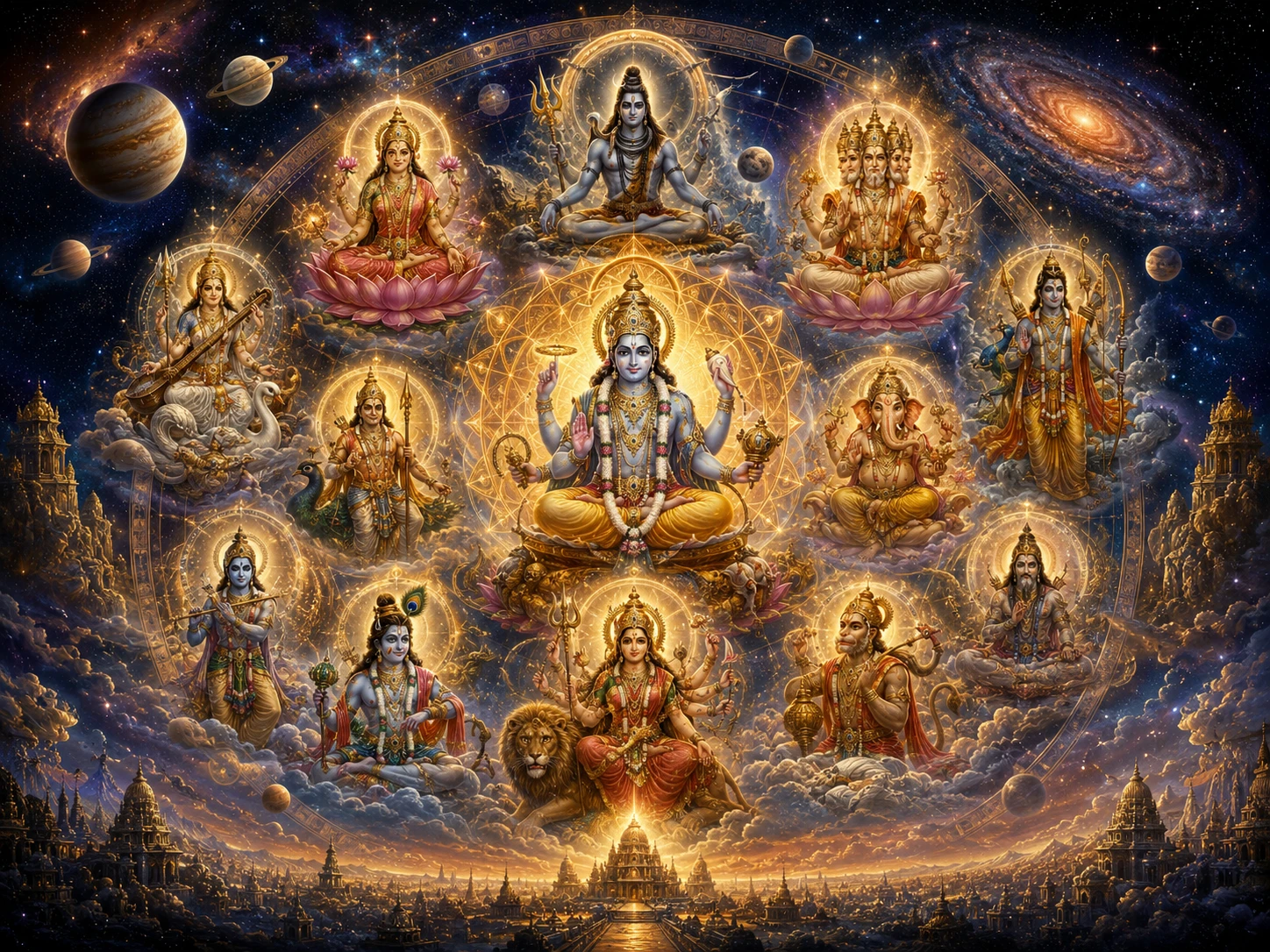
33 Koti Devata -- Why Hinduism Has 33 Types of Gods, Not 33 Crore
13 min read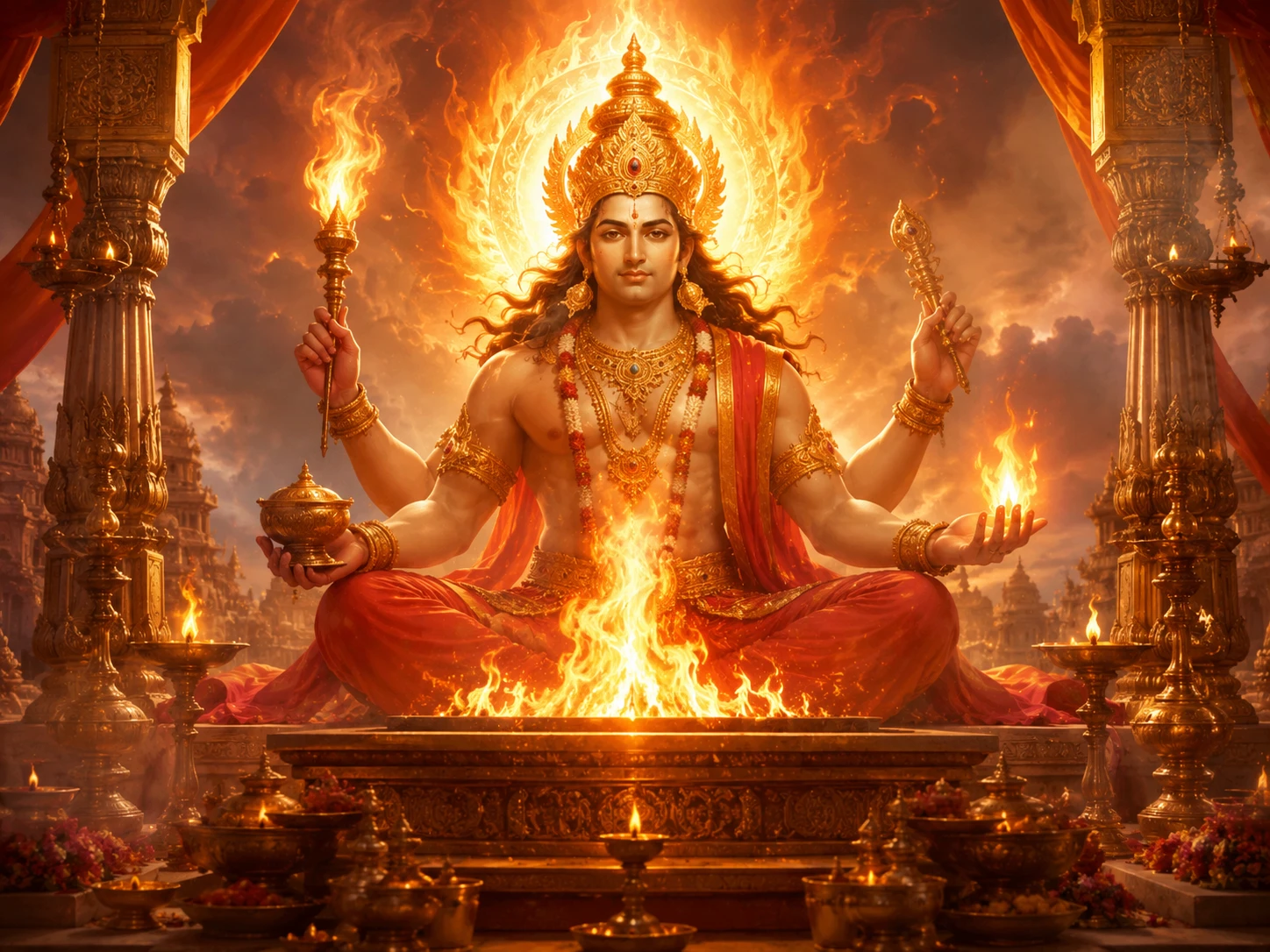
Agni -- The Fire God
19 min read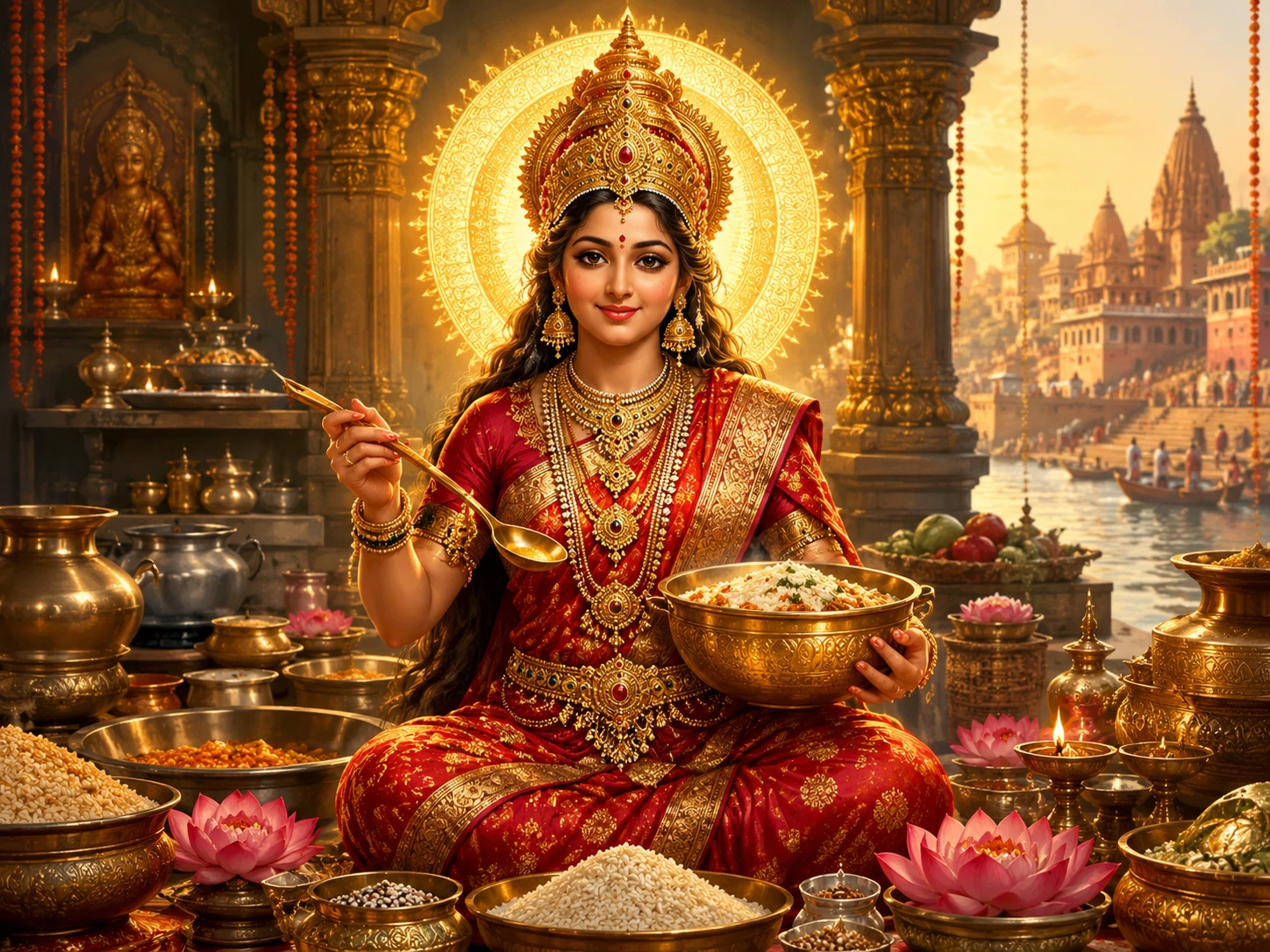
Annapurna -- Goddess of Food
19 min readThe same translation error that turned '33 Koti' into '33 crore' in Hinduism also happened in Buddhism. The Chinese translation of Buddhist texts rendered 'Sapta Koti Buddha' (7 Supreme Buddhas) as '7 Crore Buddhas.' The…
Deities AvatarsCommunity Reflections
🕉️
Be the first to share your reflection.
Related across Eternal Raga