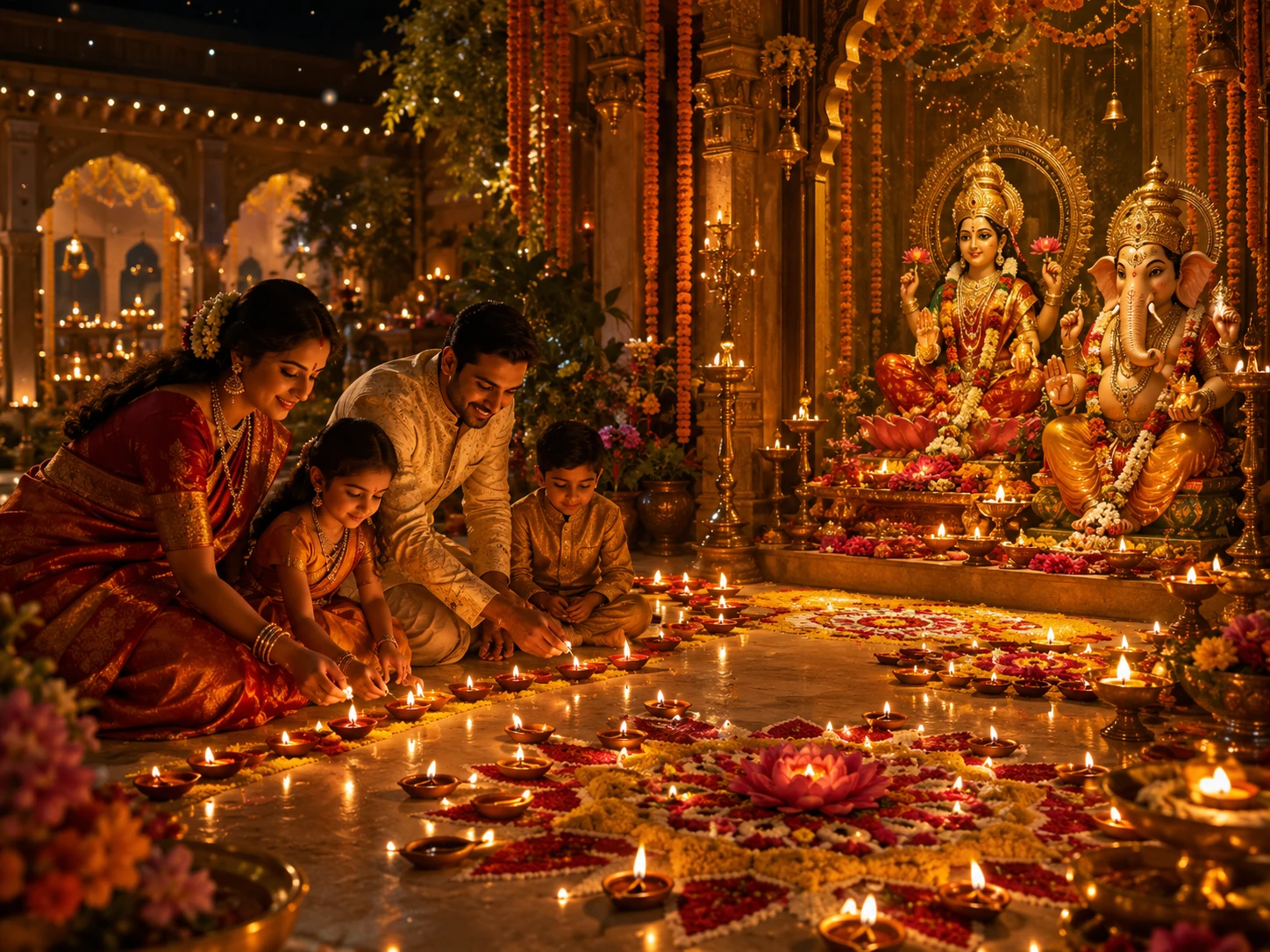
Diwali -- Five Days of Light
दीवाली -- रोशनी के पाँच दिन
Most Indians celebrate Diwali as a single night of Lakshmi Puja, firecrackers, sweets, and new clothes. Most non-Indians know it as the 'festival of lights.' Both descriptions are accurate. Neither is complete.
Diwali is a five-day liturgical arc that unfolds across the amavasya (new moon) of Kartik month (October-November), with each day carrying its own distinct theology, rituals, and origin stories. The five days are: Dhanteras (Day 1), Naraka Chaturdashi / Chhoti Diwali (Day 2), Lakshmi Puja / main Diwali (Day 3), Govardhan Puja / Annakut / Padwa (Day 4), and Bhai Dooj / Yama Dwitiya (Day 5). Collapsing them into one night is like reducing Christmas to December 25th while ignoring Advent, Christmas Eve, and Epiphany.
The word Deepavali itself comes from Sanskrit -- deepa (lamp) + avali (row). A row of lamps. The Skanda Purana and Padma Purana both reference Deepavali as an established festival, suggesting its codification happened no later than the early medieval period. But its actual practice is almost certainly older. Archaeological evidence from Mohenjo-Daro includes terracotta lamps that some scholars (notably BB Lal and SP Gupta) have interpreted as ritual objects, though connecting them specifically to a Diwali prototype requires caution.
The festival's genius is its theological layering. Unlike Christmas (one event, one theology) or Eid (one revelation), Diwali accommodates at least four independent origin narratives simultaneously. Vaishnavas celebrate Rama's return to Ayodhya after 14 years of exile and the defeat of Ravana. Krishna devotees commemorate his victory over Narakasura (Bhagavata Purana, Skandha 10). Jains observe the nirvana (moksha) of Mahavira at Pavapuri in 527 BCE -- the Jain Diwali at Pavapuri temple in Bihar draws lakhs every year. Sikhs celebrate Bandi Chhor Divas, marking Guru Hargobind's release from Gwalior Fort along with 52 Hindu kings in 1619 CE.
No other festival on earth carries this many independent theological foundations within a single calendrical event. This is not syncretism -- each tradition maintains its own narrative integrity. It is convergence, four rivers meeting at one point without losing their distinct currents.
The economic scale is staggering. The Confederation of Indian Industry estimates Diwali-season consumer spending in India exceeds Rs 3.5 lakh crore annually (approximately $42 billion), making it the single largest consumer spending event in South Asia. Gold sales during Dhanteras alone account for 15-20% of India's annual gold consumption. Amazon India and Flipkart's 'Great Indian Festival' and 'Big Billion Days' sales are timed specifically around Diwali. The NRI Diwali diaspora celebrations have turned it into a global event -- Diwali is a gazetted holiday in New York City public schools since 2023, and the Times Square Diwali celebration draws over 100,000 attendees.
But commerce is a late addition. At its core, Diwali is an annual confrontation between light and darkness, played out on the darkest night of the lunar calendar. Choosing amavasya -- the absolute absence of moonlight -- is deliberate. The festival says: light matters most precisely when darkness is total. That is not metaphor. It is architecture.
Day 1: Dhanteras (Trayodashi). Dhan means wealth. This is Dhanvantari's day -- the physician-god who emerged during the Samudra Manthan bearing the pot of amrita (nectar of immortality) and the science of Ayurveda. Families buy gold, silver, or new utensils. The purchase is not consumerism disguised as religion -- it is an act of consecration. You bring new metal into the home because metal conducts prosperity. Utensils are cleaned and arranged because the home itself is being prepared as a temple for Lakshmi's arrival two days later. In Gujarat and Rajasthan, account books are closed and new ledgers opened -- the original financial year-end, predating the British fiscal calendar by centuries. Jewellers on Delhi's Dariba Kalan and Zaveri Bazaar in Mumbai report that Dhanteras alone accounts for 30-40% of their annual gold revenue.
Day 2: Naraka Chaturdashi (Chhoti Diwali). Krishna kills Narakasura, the demon-king of Pragjyotishpur (identified with modern Guwahati, Assam). The Bhagavata Purana (Skandha 10, Chapter 59) describes this battle in detail -- Narakasura had stolen Aditi's earrings, imprisoned 16,100 women, and hoarded divine weapons. Krishna, riding Garuda with Satyabhama at his side, destroys Narakasura at dawn. The morning oil bath ritual (abhyanga snana) on this day commemorates Krishna washing Narakasura's blood off his body. In South India, particularly Karnataka and Tamil Nadu, this day is the main Diwali, not the amavasya. Families wake at 4 AM, crack open bitter gourd (symbolic of Narakasura's head), apply oil and ubtan, and burst crackers at sunrise -- not night. The North-South split in Diwali's primary day is one of the most visible regional liturgical differences in Hinduism.
Day 3: Lakshmi Puja (main Diwali, Amavasya). This is the night most people think of as 'Diwali.' Lakshmi is worshipped in her four-armed form -- holding lotus, gold coins, and gesturing abhaya (protection) and varada (boon-giving). The puja happens after sunset, in the pradosha kaal (first three hours of night). Homes are lit with diyas specifically to guide Lakshmi in -- she will not enter a dark house. Rangoli at the doorstep is not decoration; it is a ritual invitation, a welcome mat encoded in geometry. Ganesh is worshipped alongside Lakshmi because wealth without wisdom leads to ruin -- the pairing is deliberate theology, not decorative choice. In Bengal, this night belongs to Kali, not Lakshmi. Kali Puja on Diwali night at Kalighat and Dakshineswar temples is one of Kolkata's most intense ritual events, with animal sacrifice still practised at some sites. The same amavasya, two entirely different goddesses, two entirely different theological registers.
Day 4: Govardhan Puja (Annakut / Padwa). Krishna lifts Mount Govardhan on his little finger to shelter the people of Vrindavan from Indra's wrath. This is the Mahabharata and Harivamsha's most beloved Krishna episode after the Rasa Lila. Annakut -- literally 'mountain of food' -- involves preparing 56 or 108 dishes offered to Krishna's murti, then distributed as prasad. At Nathdwara's Shrinathji temple in Rajasthan, the Annakut display is legendary -- tonnes of food arranged into a mountain. In North India, newlywed couples celebrate Padwa (Kartik Shukla Pratipada) as their first festival together. In Maharashtra, this day is the actual New Year -- Diwali Padwa, celebrated with oil baths, halwa, and the husband honouring the wife with a gift.
Day 5: Bhai Dooj (Yama Dwitiya). Yama, the god of death, visits his sister Yamuna on this day. She feeds him, applies tilak, and prays for his long life. In return, Yama blesses all brothers who visit their sisters. The festival inverts Raksha Bandhan -- there, the sister ties a thread for the brother's protection; here, the brother travels to the sister's home. The asymmetry is beautiful: protection flows both ways across the year. In Varanasi, Bhai Dooj at the Yamuna Ghat is a massive gathering. Among India's armed forces, soldiers on border postings who cannot visit their sisters observe the day by sending tilak kits by India Post -- the Defence Postal Service handles a documented spike in 'Bhai Dooj parcels' every year.
शुभं करोति कल्याणमारोग्यं धनसम्पदम्। शत्रुबुद्धिविनाशाय दीपज्योतिर्नमोऽस्तु ते॥
śubhaṃ karoti kalyāṇam ārogyaṃ dhanasampadam | śatrubuddhivināśāya dīpajyotir namo'stu te ||
O light of the lamp, you bring auspiciousness, well-being, health, and abundance of wealth. You destroy the intellect of enmity. I bow to you.
— Deepa Jyoti Namostute -- traditional Diwali shloka recited during lamp-lighting; found in compilations of Skanda Purana-associated prayer verses and widely used in North Indian Diwali liturgy
The most widespread origin narrative links Diwali to Rama's return to Ayodhya after 14 years of exile and the defeat of Ravana in Lanka. The Valmiki Ramayana (Yuddha Kanda) does not explicitly mention a festival of lamps -- this is important to acknowledge. The Diwali-Rama connection is established primarily through the Ramacharitmanas of Tulsidas (16th century) and regional oral traditions, not the Valmiki original.
What Valmiki does describe is the scene of homecoming. Rama, Sita, and Lakshmana return to Ayodhya in the Pushpaka Vimana. Bharata, who has governed as regent for fourteen years, prepares the city. The streets are cleaned, the citizens assemble, garlands hang from every house. The coronation (Rama Rajyabhisheka) follows. The emotional weight of the scene is immense -- a kingdom that has been holding its breath for fourteen years finally exhales.
Tulsidas in the Ramacharitmanas (Uttarkand) describes Ayodhya lit with rows of lamps -- deepmala -- and this passage is the direct textual basis for the Diwali-Rama association as practised across most of North India. The Ramlila tradition, performed over the Navaratri-Dussehra period that precedes Diwali by twenty days, sets up the narrative arc. Dussehra marks Ravana's death; Diwali marks Rama's homecoming. The twenty-day gap between Dussehra and Diwali roughly corresponds to the travel time from Lanka to Ayodhya in the Pushpaka Vimana -- whether this calendrical alignment is coincidence or design is debated.
Ayodhya itself has become the epicentre of a massive Diwali spectacle. Since 2017, the Uttar Pradesh government has organised a Deepotsav event that holds the Guinness World Record for the most diyas lit simultaneously -- over 22 lakh earthen lamps along the banks of the Saryu River in 2023. The Ram Mandir inauguration in January 2024 added another layer; Diwali 2024 at Ayodhya was the first since the new temple's consecration, and drew an estimated 30 lakh visitors.
But there is a theological subtlety here that gets lost in spectacle. Rama returns not as a conquering hero but as a king who has been away too long. His first act is to honour Bharata's stewardship. His first concern is governance, not celebration. The Diwali lights celebrate not victory but reunion -- not the end of a war but the restoration of an order. That distinction matters. Diwali is not Dussehra. Dussehra is about the destruction of evil. Diwali is about what comes after: the hard, quiet work of rebuilding normal life after crisis. Every Indian family that has survived a serious illness, a financial disaster, a family split, and then lit diyas together on Diwali night understands this intuitively even if they have never read a word of the Ramayana.
Five Days of Diwali -- Theology, Rituals, and Regional Variations
| Day | Name | Deity / Event | Key Ritual | Regional Variation |
|---|---|---|---|---|
| 1 (Trayodashi) | Dhanteras | Dhanvantari / Kubera | Buy gold, silver, utensils; clean house | Gujarat: new ledger books opened; Marwari community: Chopda Pujan |
| 2 (Chaturdashi) | Naraka Chaturdashi / Chhoti Diwali | Krishna vs Narakasura | Pre-dawn oil bath (abhyanga snana); crackers at sunrise | South India: THIS is the main Diwali; Karnataka: Ashoka tree worship |
| 3 (Amavasya) | Lakshmi Puja / Diwali | Lakshmi + Ganesh | Evening puja, diyas, rangoli, fireworks | Bengal: Kali Puja; Odisha: worship of ancestors (Badabadi) |
| 4 (Pratipada) | Govardhan Puja / Padwa / Annakut | Krishna lifts Govardhan | 56/108 dish offering (Annakut); husband honours wife | Maharashtra: Diwali Padwa (New Year); Gujarat: Bestu Varas (New Year) |
| 5 (Dwitiya) | Bhai Dooj / Yama Dwitiya | Yama visits sister Yamuna | Sister applies tilak; brother brings gift | Varanasi: Yamuna Ghat gathering; Nepal: Bhai Tika (five-day Tihar) |
Calendar positions given in Kartik month (Amanta system used in North India). In the Purnimanta system (parts of South and East India), the month designation shifts but the tithis remain identical.
Light the Diyas for Lakshmi Puja
Away from home this Diwali? Light a single diya wherever you are at the time of Lakshmi Puja, set a sankalpa for the year ahead, and recite a Lakshmi stotra or aarti. Lakshmi's hymns and aartis are gathered on Eternal Raga.
Tags
Eternal Raga · शाश्वत राग
Institutional voice — scholarly articles on Sanatan Dharma
Deepen Your Understanding
अपनी समझ और गहरी करें
deities avatars
Rama -- Ideal of Dharmic Living
Why does India still name its sons after a prince who chose exile over a throne? Rama's life is not a fairy tale -- it is a manual for dharmic decision-making under impossible pressure. From boardrooms to battlefields, his choices remain the hardest moral benchmark in civilization.
scriptural exegesis
Krishna's 16,108 Queens -- The Story Behind the Number
The number sounds absurd until you understand what it means. Krishna did not 'collect' 16,108 wives. He rescued 16,100 women from a demon's prison, and when no one in society would accept them back -- because they were 'tainted' -- he married every single one to restore their honour. Add 8 named queens (the Ashtabharya) married through love, valour, or diplomacy, and you get the most misunderstood number in Hindu mythology. This is not a harem story. It is the largest social rehabilitation programme in ancient literature.
scriptural exegesis
Prahlada and Narasimha -- Faith That Split a Pillar
A five-year-old boy told the most powerful being in the universe that God exists everywhere -- even in a pillar. His father smashed the pillar to prove him wrong. God stepped out. The Prahlada-Narasimha story is not a children's tale. It is the most radical statement about faith in all of Hindu literature.
vedic sciences
Kaal Ganana -- The Hindu Measure of Time
From a single blink of the eye (Nimesha) to one Day of Brahma (4.32 billion years) -- explore the complete cosmic time hierarchy of Hindu cosmology, anchored in Vishnu Purana 1.3, with its remarkable parallels to modern science.
deities avatars
Hanuman -- The Perfect Devotee
He could lift mountains, leap oceans, and burn Lanka to the ground -- yet his greatest power was this: he never forgot whose work he was doing. Hanuman is not just a mythological hero. He is the operating system of selfless devotion that India still runs on.
rituals traditions
Govardhan Puja and Annakut -- The Day After Diwali
The day after Diwali, households shape a hill out of cow dung, temples pile up a mountain of food, and pilgrims walk twenty-one kilometres around a low ridge in Braj. Why: the story of the boy who held up Govardhan for seven days, and how the festival is kept today.
More in Rituals & Traditions
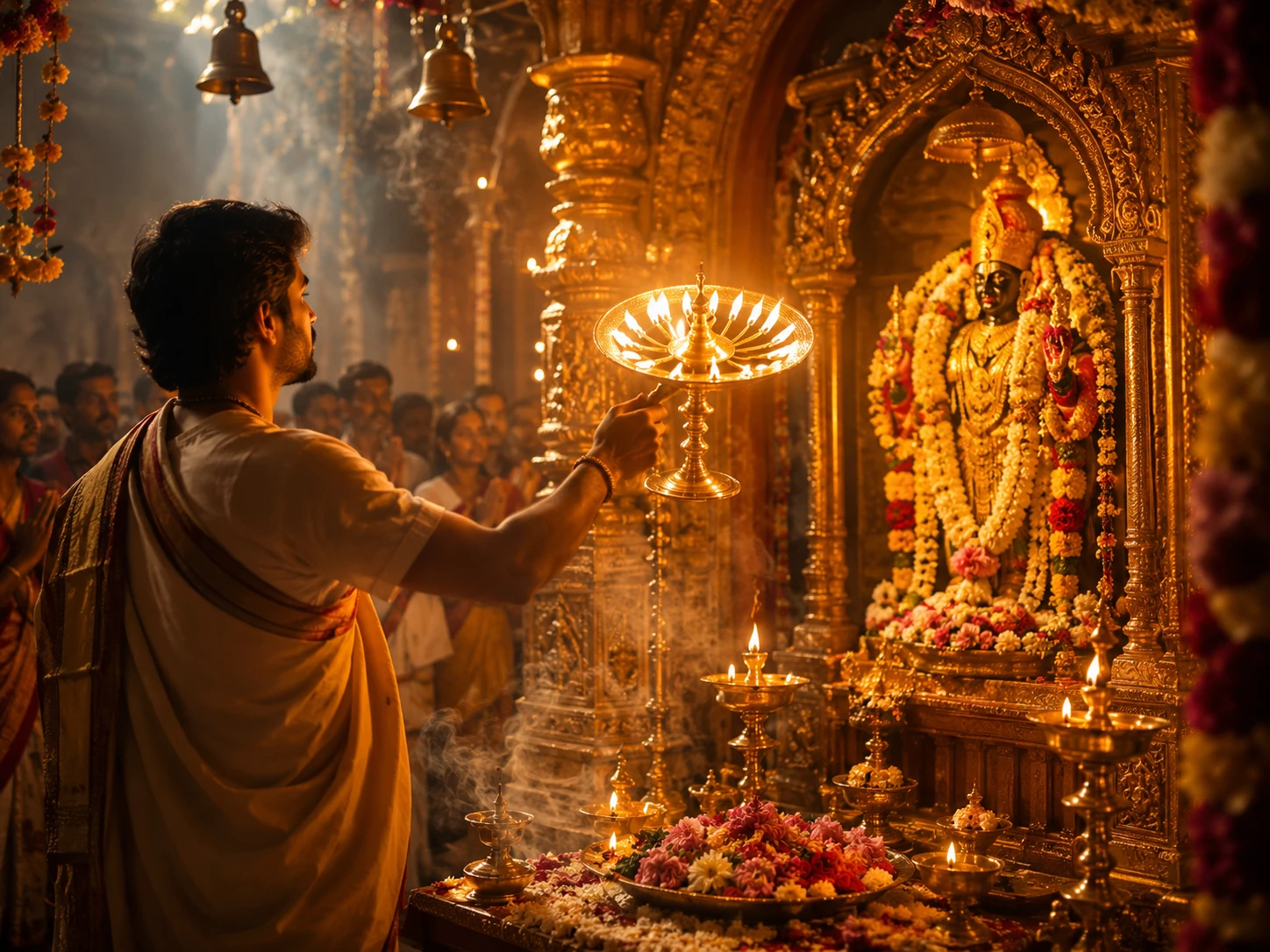
Aarti -- Why Hindus Circle Light Before God
13 min read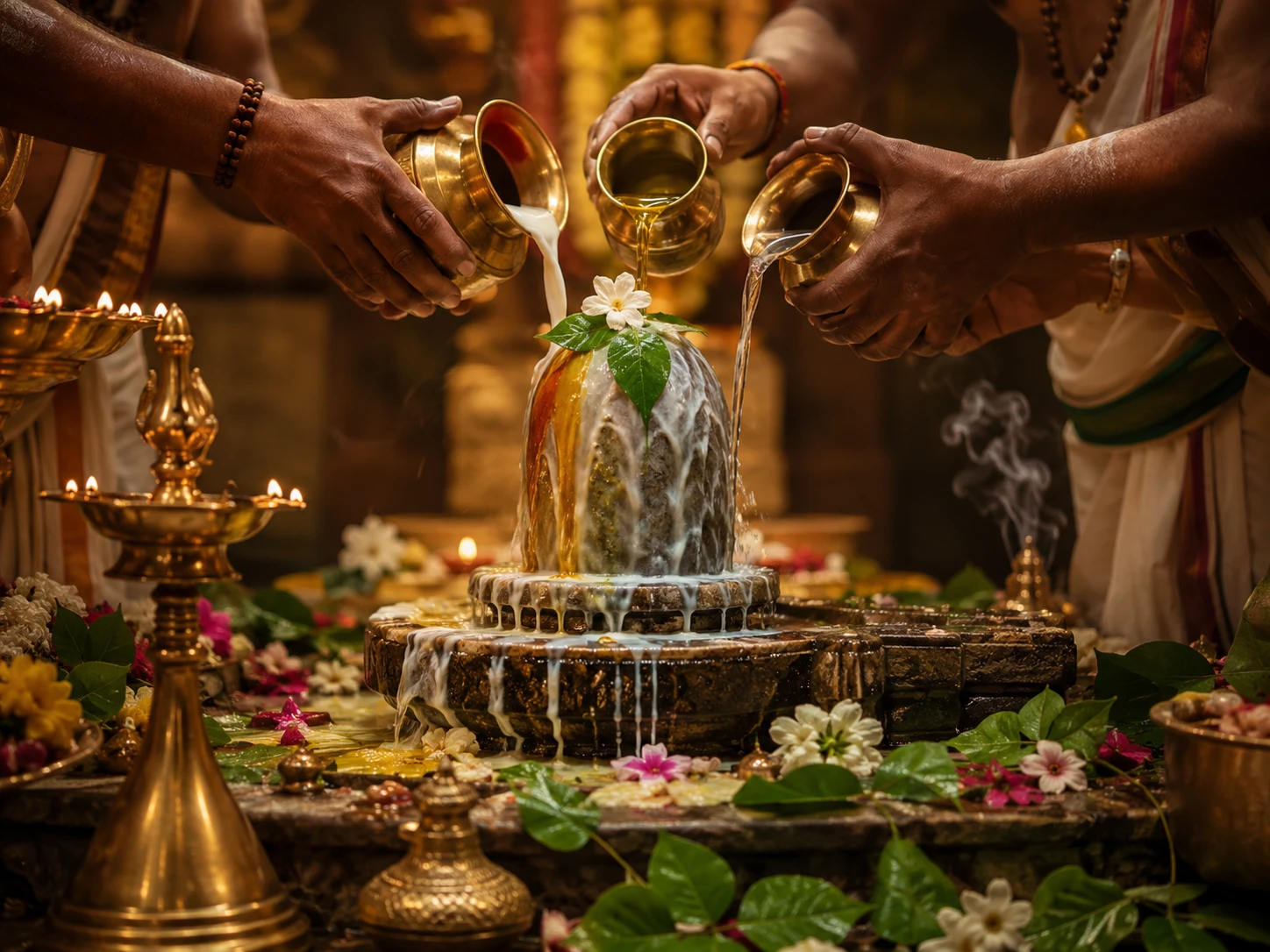
Abhisheka -- Why Hindus Bathe Their Gods
10 min read
Akshaya Tritiya -- The Day Nothing Given Away Runs Out
12 min readThe same translation error that turned '33 Koti' into '33 crore' in Hinduism also happened in Buddhism. The Chinese translation of Buddhist texts rendered 'Sapta Koti Buddha' (7 Supreme Buddhas) as '7 Crore Buddhas.' The…
Deities AvatarsCommunity Reflections
🕉️
Be the first to share your reflection.
Related across Eternal Raga