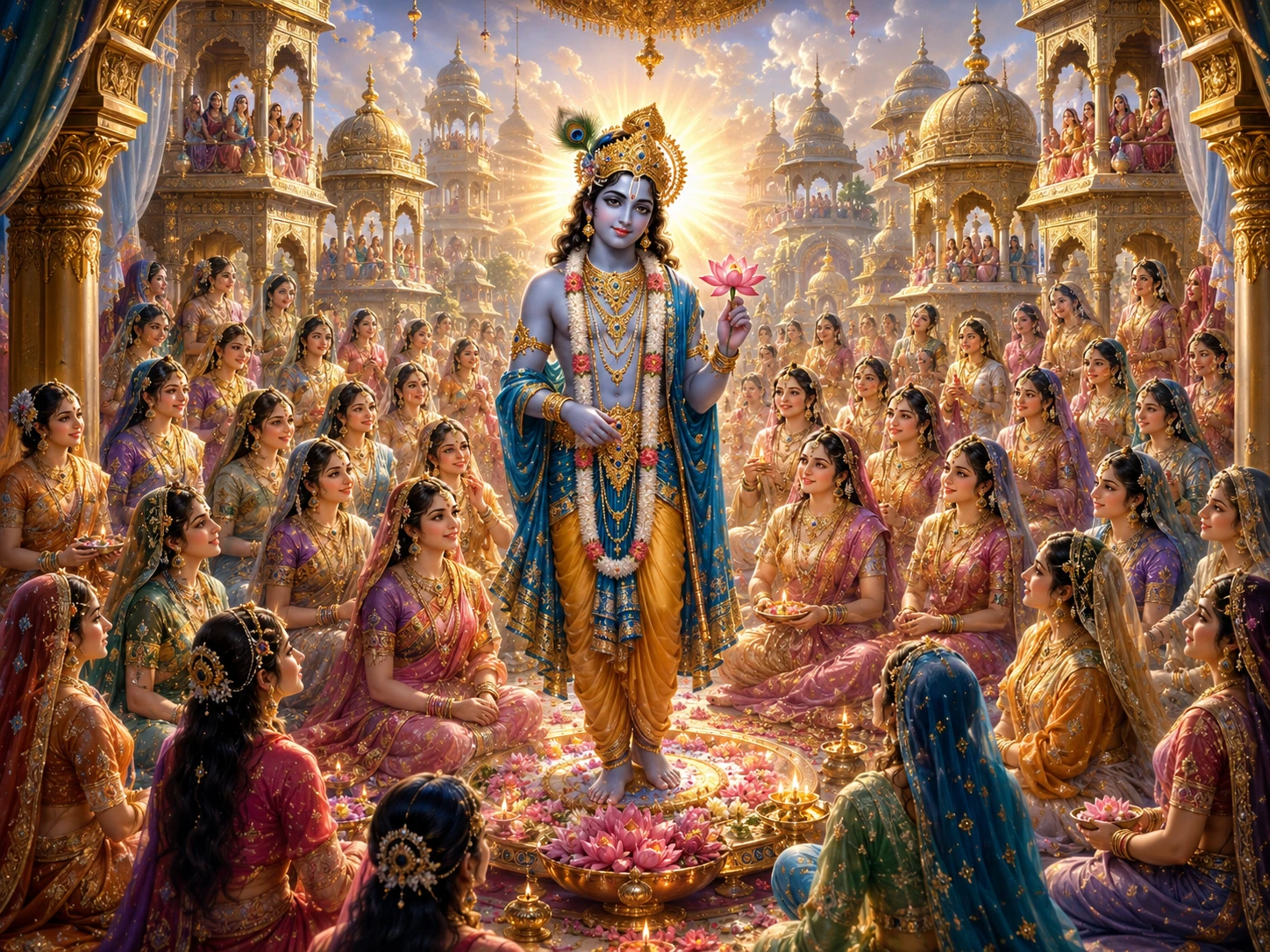
Krishna's 16,108 Queens -- The Story Behind the Number
कृष्ण की 16,108 रानियाँ -- संख्या के पीछे की कहानी
No fact about Krishna generates more confusion, more mockery, and more embarrassment among casual Hindus than this one: he had 16,108 wives. Critics use it to paint him as a polygamous libertine. Defenders either ignore it or mumble about 'symbolic meaning.' Both responses miss what the Bhagavata Purana actually describes -- a story about rescue, social justice, and the radical act of using marriage as a tool of rehabilitation in a society that destroyed women through stigma.
The number 16,108 breaks into two groups. The first group is 8: the Ashtabharya, Krishna's principal queens, each married through a distinct story involving love, heroism, or political alliance. These are named, individualised women with distinct personalities, independent story arcs, and recorded agency. The second group is 16,100: women kidnapped by the demon Narakasura and held captive in his fortress city of Pragjyotishapura (modern-day Guwahati, Assam). When Krishna killed Narakasura and freed them, they had nowhere to go. Their families would not take them back. Society considered them 'defiled.' Krishna married all 16,100 to give each woman the status, protection, and social dignity of a queen of Dwarka.
This is not a footnote. This is the moral centre of the Narakasura episode. The battle with the demon takes a few verses. The social rehabilitation of 16,100 women takes an entire theological argument. The Bhagavata Purana wants you to understand that killing the villain was the easy part. Fixing what the villain broke in society was the real act of divinity.
ताः कृष्णमीक्ष्य विभ्रष्टबन्धनाः स्वसुखावहम्। मनसा वव्रिरे पत्यौ प्रह्वाः शीलगुणान्विताः॥
taah krishnamiikshya vibhrashTabandhanaah svasukhaaavaham | manasaa vavrire patyau prahvaah shiilaagunaanvitaah ||
Those women, freed from their bondage, seeing Krishna as the bringer of their happiness, with modesty and virtue, chose him in their hearts as their husband.
— Bhagavata Purana, Skandha 10, Adhyaya 59 (Narakasura-vadha episode; verse paraphrased from critical edition)
The Narakasura episode is set in Pragjyotishapura, identified with modern Guwahati in Assam. Narakasura (also called Bhauma, son of Bhumi/Earth) had conquered vast territories, stolen Aditi's earrings (Aditi being the mother of the Devas), appropriated Varuna's celestial umbrella, and -- critically -- kidnapped 16,100 princesses and women of noble birth from kingdoms across the subcontinent. He held them in his inner citadel.
The battle itself involves several remarkable elements. Satyabhama accompanies Krishna to the battle and plays an active combat role. In some textual traditions, it is Satyabhama who delivers the killing blow to Narakasura, fulfilling a boon that he could only be killed by his own mother (Bhumi Devi), and Satyabhama is an incarnation of Bhumi. After Narakasura falls, his son Bhagadatta surrenders and becomes a loyal ally -- he later fights on the Kaurava side at Kurukshetra with the fearsome Supratika elephant.
When the 16,100 captives are freed, the text describes their state: weakened, traumatised, socially ruined. In the dharmic framework of the era, women who had been held captive by a male captor were considered 'touched' regardless of whether actual violation occurred. No king would marry them. No family would reclaim them. They faced a life of permanent social death -- wandering as 'fallen women' without status, protection, or community.
Krishna's response is not charity. It is not pity. It is marriage -- full, legitimate, status-granting marriage. Each of the 16,100 women receives her own palace in Dwarka, her own household, her own servants, and the full rights of a queen. The Bhagavata Purana explicitly states that Krishna expanded himself into 16,108 identical forms so that each wife experienced him as her sole, undivided husband. This is the theological device: God's infinitude is not metaphorical. He is simultaneously and completely present to each person who needs him.
The 8 Ashtabharya -- Krishna's Principal Queens
| Queen | Father / Origin | How She Married Krishna | Personality / Role | Notable Children |
|---|---|---|---|---|
| Rukmini (रुक्मिणी) | Bhishmaka, King of Vidarbha (Maharashtra) | Sent a letter to Krishna via a Brahmin. Krishna eloped with her from her Swayamvara, defeating Rukmi and Shishupala. | First queen. Lakshmi incarnate. Calm, wise, graceful. Chief consort. | Pradyumna (incarnation of Kamadeva). Charumati (daughter). |
| Satyabhama (सत्यभामा) | Satrajit (Yadava nobleman, owner of Syamantaka gem) | Married after Krishna cleared his name in the Syamantaka gem theft case. Satrajit offered her in gratitude. | Fiery, proud, competitive. Warrior queen. Fought Narakasura personally. | Bhanu. 9 other sons in some Puranas. |
| Jambavati (जाम्बवती) | Jambavan (the bear-king from Ramayana era) | After Krishna fought Jambavan for 21 days over Syamantaka gem, Jambavan recognised him as Rama and offered Jambavati. | Devoted, quiet. Links Krishna's avatarhood to Rama. | Samba (who triggered the Yadava destruction through a prank with sages). |
| Kalindi (कालिन्दी) | Surya (Sun God). River goddess (daughter of Yamuna). | Met Krishna on the banks of the Yamuna during a picnic with Arjuna. She had been doing penance to marry Vishnu. | Serene, patient. Represents divine nature connection. | Shruta. Other sons vary by text. |
| Mitravinda (मित्रविन्दा) | King of Avanti (Ujjain region) | Krishna won her at her Swayamvara. Her brothers opposed but were defeated. | Brave, headstrong. Chose Krishna against family opposition. | Vrika and other sons. |
| Satya / Nagnajiti (सत्या / नाग्नजिती) | King Nagnajit of Kosala | Krishna tamed seven wild bulls simultaneously to win her hand. | Courageous. Bull-taming test echoes Draupadi's archery test. | Bhadravinda and other sons. |
| Bhadra (भद्रा) | Dhrishtaketu, King of Kekeya (Punjab region) | Married through family arrangement. Her brothers escorted her to Dwarka. | Gentle, diplomatic. The political alliance bride. | Sangramajit and other sons. |
| Lakshmana (लक्ष्मणा) | King of Madra (also Punjab region) | Won at Swayamvara through an archery feat (fish-eye, similar to Draupadi's). | Sharp, accomplished. Last of the eight principal queens. | Gatravaan and other sons. |
The 8 Ashtabharya represent 8 different kingdoms/civilisations: Vidarbha (Maharashtra), Yadava nobility, Ramayana-era lineage, divine river, Avanti (MP), Kosala (UP), Kekeya (Punjab), Madra (Punjab). Krishna's marriages were a diplomatic masterclass spanning the entire subcontinent.
The theological meaning of 16,108 simultaneous marriages is the Bhagavata Purana's most radical statement about the nature of God. The text describes how the sage Narada, curious whether Krishna truly lives with each queen, visits Dwarka and goes door to door to every single palace. In each palace, he finds Krishna fully present -- eating with one wife, playing with children in another, performing evening prayers in a third, discussing state affairs in a fourth. The same Krishna, simultaneously and completely, in 16,108 places.
Narada is stunned. This is not delegated attention. This is not 'quality time' parcelled out by schedule. This is total, undivided presence multiplied by infinity. The passage uses the domestic setting deliberately -- not a cosmic battlefield, not a theological discourse, but a husband sitting with his wife over dinner. God's infinitude is proven not through power but through presence.
For a working parent in Pune juggling office deadlines and school pickups, the Narada-in-Dwarka episode asks a genuine question: can you be fully present to the person in front of you? Not multitasking, not half-listening, not thinking about the next meeting while your child tells you about their day -- but actually there? Krishna's 16,108-fold presence is the mythological ideal. Human beings cannot replicate it literally. But the direction it points is clear: the quality of your attention is the truest measure of your love.
The Dwarka that housed all these queens is not entirely mythological. The underwater archaeological site off the coast of Dwarka in Gujarat, explored by the Archaeological Survey of India (ASI) and the National Institute of Oceanography (NIO) since the 1960s, has revealed submerged stone structures, anchors, and pottery consistent with a major port city. Whether or not this is 'Krishna's Dwarka,' the archaeological evidence confirms that a significant urban settlement existed at this location in antiquity -- and that it was submerged, consistent with the Mahabharata's account of Dwarka being swallowed by the sea after Krishna's departure.
The festival of Diwali in large parts of India is celebrated as the day Krishna killed Narakasura and freed the 16,100 captive women. In Goa and South India (especially Karnataka and Andhra Pradesh), Naraka Chaturdashi -- the day before Diwali -- is specifically dedicated to this event. An effigy of Narakasura is burnt at dawn. This is distinct from the North Indian Diwali tradition that celebrates Rama's return to Ayodhya. The same festival, celebrated across India on the same date, commemorates two entirely different events from two different epics -- a reminder that Hinduism is not a monolith but a mosaic.
The Pradyumna born to Krishna and Rukmini is considered the reincarnation of Kamadeva (the god of love), who was burnt to ashes by Shiva's third eye. Pradyumna's son Aniruddha married Usha, the granddaughter of the demon king Bana, in one of the most romantic stories in the Bhagavata Purana -- Usha saw Aniruddha in a dream, her friend Chitralekha drew his portrait from Usha's description (the first 'forensic sketch' in mythology), identified him, and magically transported him to Usha's palace. The story of Krishna's family extends across generations, each with their own tales of love, war, and consequence.
Chant the Krishna Ashtottaram
Experience the 108 names of Krishna -- the same Krishna who was simultaneously husband, king, diplomat, charioteer, and divine presence to 16,108 souls. Each name is an aspect of that infinite love.
Tags
Eternal Raga · शाश्वत राग
Institutional voice — scholarly articles on Sanatan Dharma
Deepen Your Understanding
अपनी समझ और गहरी करें
scriptural exegesis
Wives of Arjuna -- Four Women Who Shaped the War
Arjuna did not marry for romance. Each of his four marriages -- to Draupadi, Subhadra, Ulupi, and Chitrangada -- was a strategic alliance that brought the Pandavas military power, divine protection, or political legitimacy they could not have won on the battlefield. A Panchala princess, a Yadava sister, a Naga queen, and a Manipuri warrior-princess: four women from four different civilisations, each changing the course of the Mahabharata.
scriptural exegesis
100 Kauravas -- The Forgotten Brothers of the Mahabharata
Everyone knows Duryodhana and Dushasana. But what about Vikarna, who stood up for Draupadi when no one else did? Or Yuyutsu, who defected to the Pandavas because his conscience demanded it? The Mahabharata names all 100 sons of Dhritarashtra -- warriors, strategists, and dissenters -- most of whom are killed across 18 days. Their story is not just a casualty list. It is the most devastating portrait of fratricidal war ever composed.
sacred artefacts
Divine Gems -- Syamantaka, Kaustubha, and Chintamani
Hindu mythology's most precious stones are not mere ornaments -- they are plot devices, moral tests, and cosmic forces. The Syamantaka Mani turned Krishna into a detective. The Kaustubha emerged from the Ocean of Milk to sit forever on Vishnu's chest. The Chintamani fulfils every wish -- and teaches why that might be the worst thing that could happen to you.
deities avatars
Krishna Leela -- Why God Chose to Play
He stole butter, broke pots, lied to his mother's face, danced with married women under the full moon, and lifted an entire mountain on his little finger. The Bhagavata Purana's Tenth Skandha -- the most popular 4,000 verses in all of Hindu literature -- is not a biography. It is a theological argument that the Supreme Being's highest expression is not creation, destruction, or cosmic governance. It is play. Krishna Leela is the radical idea that God's truest nature is joy.
deities avatars
Dashavatara -- Why Vishnu Comes Back Ten Times
Fish, tortoise, boar, half-lion, dwarf, axe-warrior, prince, cowherd, enlightened teacher, future horseman. The ten avatars of Vishnu are not random folklore. Read them in sequence and you get something startling -- a narrative that mirrors evolutionary biology, tracks the rise and fall of political systems, and argues that God does not sit above history but enters it, gets dirty, and does the work. The Dashavatara is Hinduism's answer to the question every civilisation asks: why does the world keep breaking, and who fixes it?
scriptural exegesis
Samudra Manthan -- When Gods and Demons Ran a Joint Venture and the Universe Almost Died
A cosmic ocean. A mountain for a churning rod. A serpent king for a rope. Gods on one end, demons on the other. And out came 14 treasures -- including wealth, beauty, medicine, immortality, and one poison so lethal it could end creation itself. The Samudra Manthan is not mythology. It is the original playbook for collaboration, crisis management, and how to handle it when your joint venture partner tries to cheat you.
divine arsenal
The Cosmic Forge -- Vishwakarma, Divine Engineer
Every divine weapon. Every celestial city. Every flying chariot. They all have the same maker. Vishwakarma -- the architect of the gods -- built Lanka for Kubera, Dwarka for Krishna, Indraprastha for the Pandavas, and forged every weapon in the divine arsenal. He is the patron deity of Indian engineers, craftsmen, and factory workers, worshipped annually on Vishwakarma Puja with the tools of modern industry laid at his feet.
The festival of Diwali in large parts of India is celebrated as the day Krishna killed Narakasura and freed the 16,100 captive women. In Goa and South India (especially Karnataka and Andhra Pradesh), Naraka Chaturdashi -…
More in Scriptural Exegesis
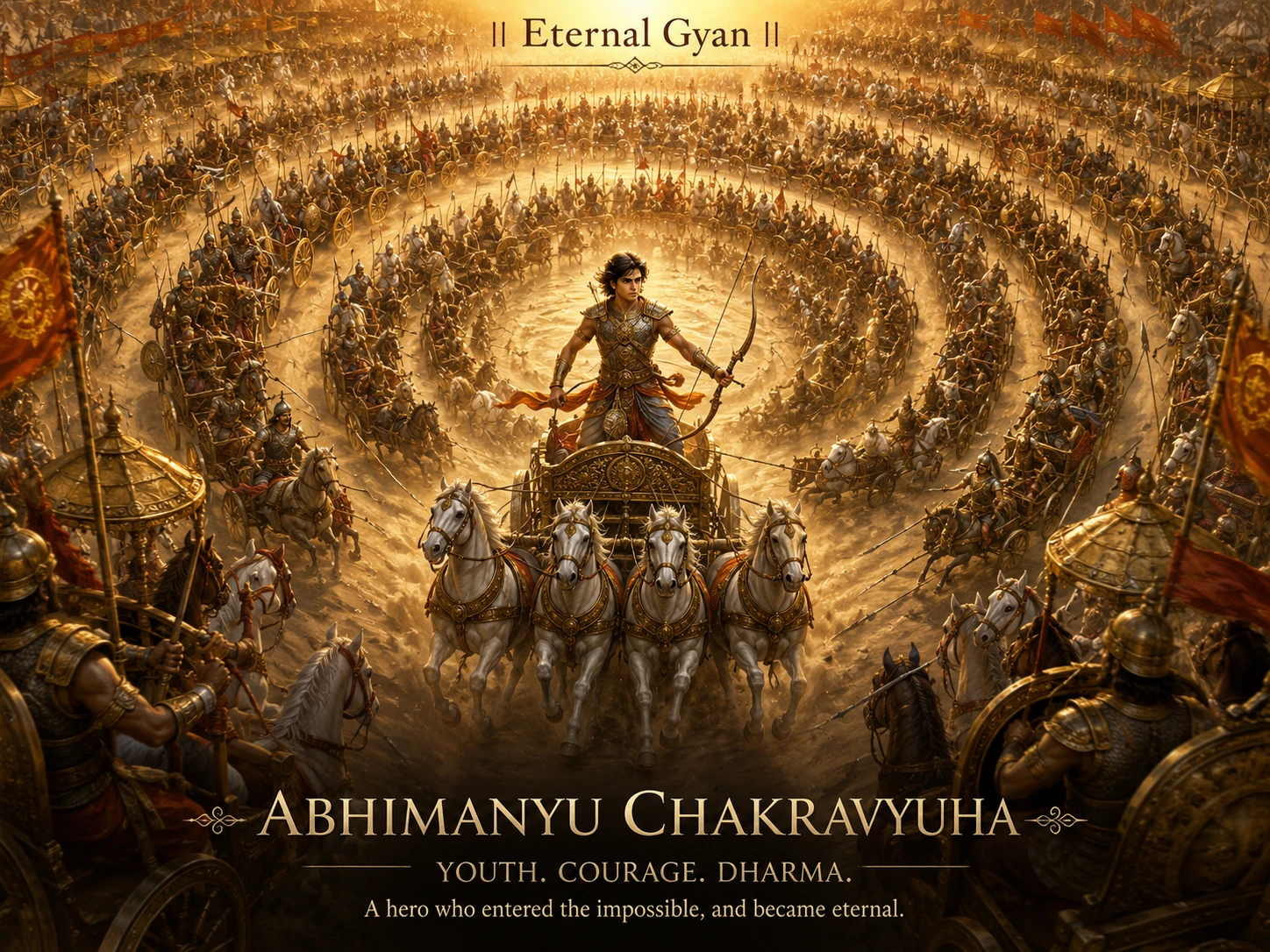
Abhimanyu and the Chakravyuha -- The Boy Who Knew How to Enter but Not How to Leave
14 min read
Adbhuta Ramayana -- The Ramayana Where Sita Becomes Kali
9 min read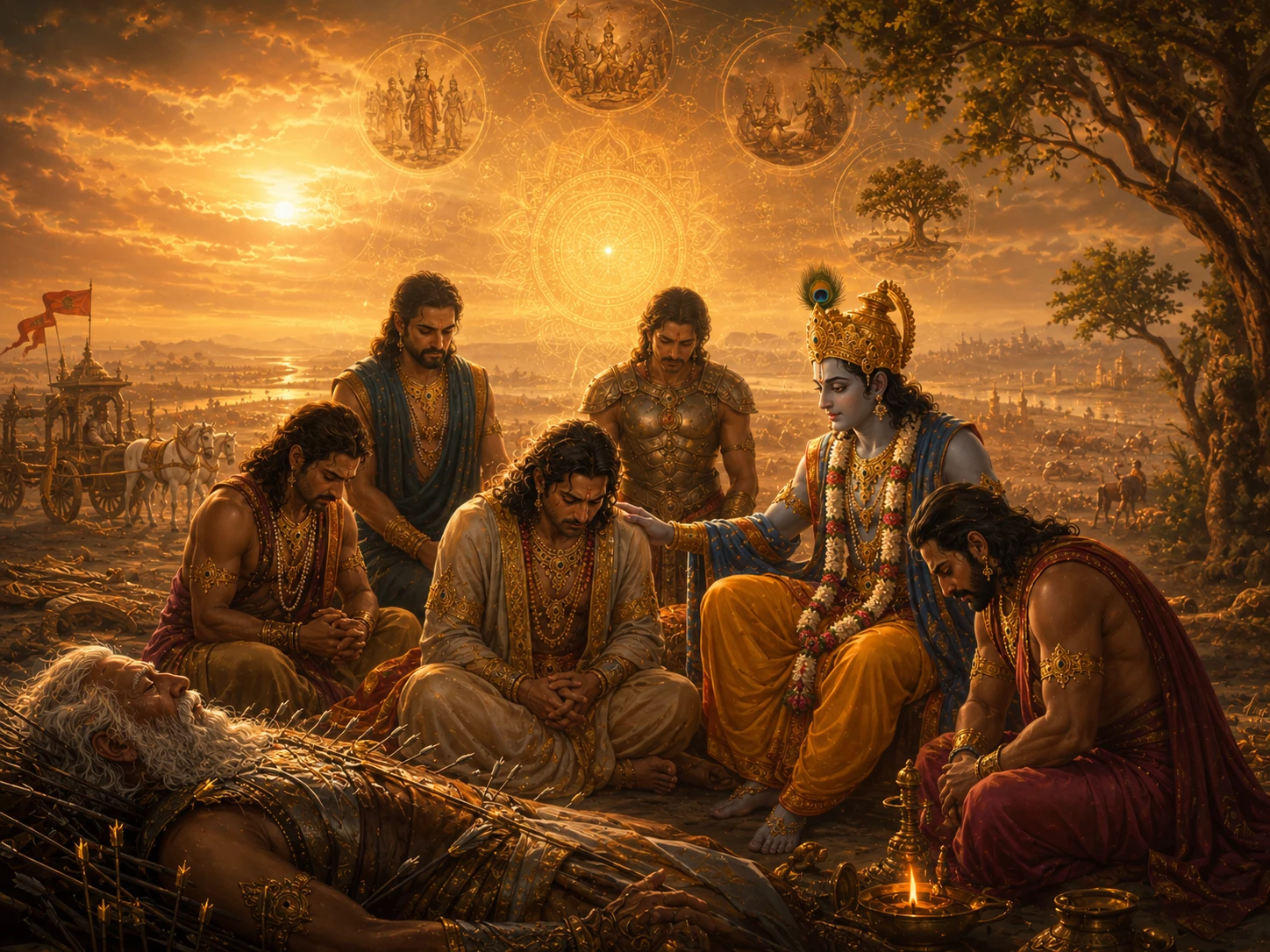
After Kurukshetra -- What Happened Next
14 min readThe same translation error that turned '33 Koti' into '33 crore' in Hinduism also happened in Buddhism. The Chinese translation of Buddhist texts rendered 'Sapta Koti Buddha' (7 Supreme Buddhas) as '7 Crore Buddhas.' The…
Deities AvatarsCommunity Reflections
🕉️
Be the first to share your reflection.