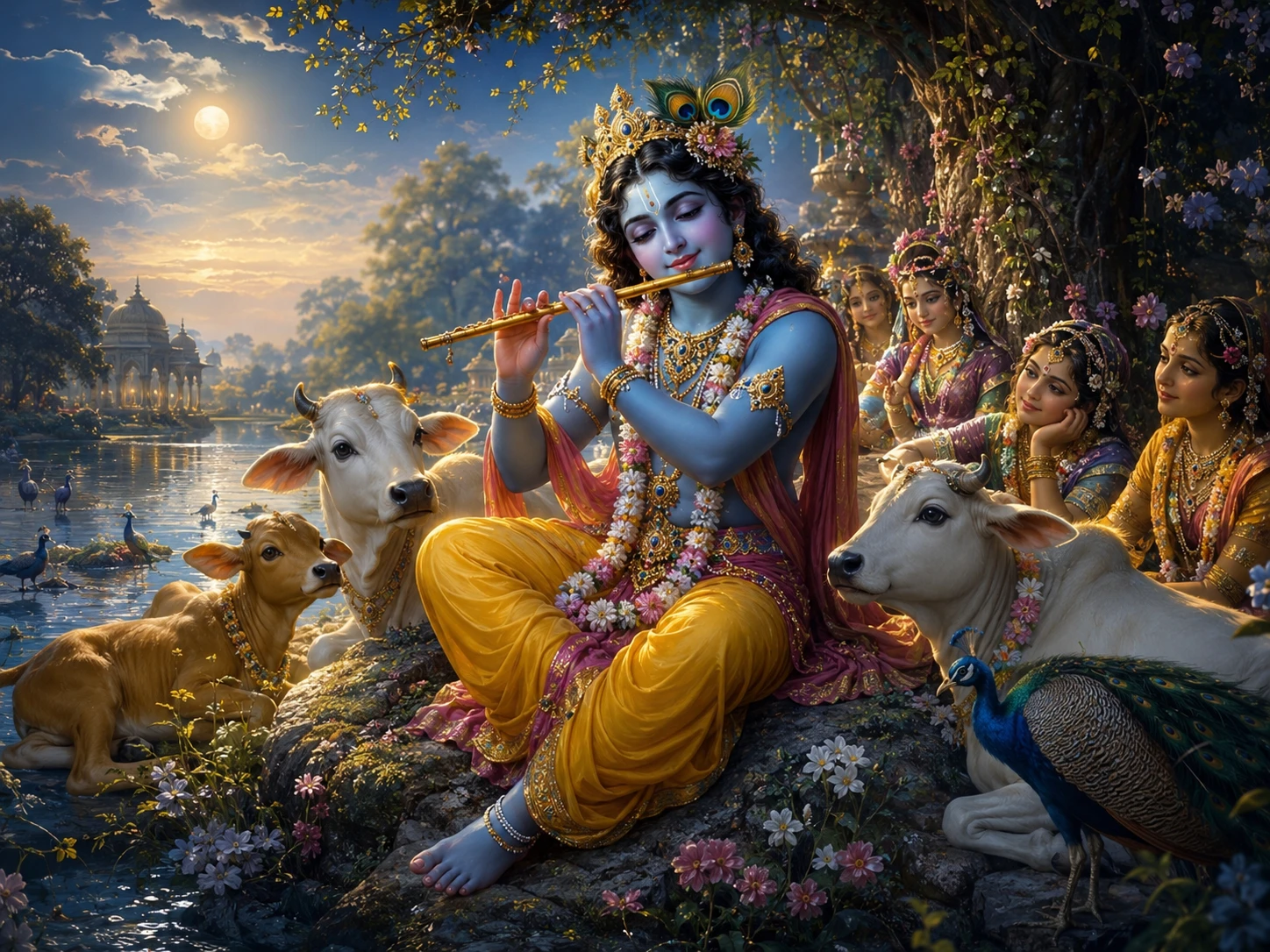
Krishna Leela -- Why God Chose to Play
कृष्ण लीला -- भगवान ने खेलना क्यों चुना
Every religion has a God who creates. Several have a God who destroys. Hinduism has a God who plays.
The Sanskrit word 'leela' does not translate neatly into English. It is not 'miracle' -- miracles are exceptional interruptions of natural law. It is not 'story' -- stories imply narrative distance. It is not 'game' -- games have winners and losers. Leela is spontaneous, purposeless, joyful activity that arises from fullness rather than need. When a child spins in circles laughing for no reason, that is closer to leela than any theological term. The Bhagavata Purana's radical claim is that the Supreme Being -- the source of infinite universes, the ground of all existence -- expresses His highest nature not through cosmic governance but through exactly this kind of play.
The Tenth Skandha (Canto) of the Bhagavata Purana is the heart of this argument. With approximately 4,000 of the text's 18,000 total verses, it is the longest, most celebrated, and most recited section. It covers Krishna's life from divine birth in Kamsa's prison to his childhood in Gokula and Vrindavan, his adolescence among the Gopas and Gopis, and his departure for Mathura. Scholars date the Bhagavata Purana between the 6th and 10th centuries CE, but its stories have saturated every layer of Indian culture -- from Tanjore paintings to Manipuri dance, from Surdas's padas to WhatsApp good morning forwards.
But here is what most people miss. The Tenth Skandha is not a random collection of cute stories about a divine child. It is a carefully structured sequence of escalating theological revelations, each leela designed to demonstrate a specific aspect of the divine nature. The butter theft teaches that God desires intimate relationship, not formal worship. The Govardhan episode teaches that God protects through presence, not through institutional religion. The Rasa Leela teaches that divine love transcends all social categories. Each leela is a philosophical argument wearing the costume of a village story.
नेमं विरिञ्चो न भवो न श्रीरप्यङ्गसंश्रया। प्रसादं लेभिरे गोपी यत्तत्प्राप यशोदा॥
nemaṁ viriñco na bhavo na śrīr apy aṅga-saṁśrayā | prasādaṁ lebhire gopī yat tat prāpa yaśodā ||
Neither Brahma, nor Shiva, nor even Lakshmi who rests on His chest could obtain from the Lord the mercy that Mother Yashoda received.
— Bhagavata Purana, Skandha 10, Adhyaya 9, Shloka 20
This verse is the theological key to the entire Tenth Skandha. The cosmic administrators of the universe -- Brahma the creator, Shiva the destroyer, Lakshmi the goddess of fortune -- cannot access what a simple cowherd mother in a village has. What does Yashoda have that they do not? She has the audacity to scold God, to chase Him around the courtyard with a stick, to tie Him to a grinding mortar when He misbehaves. She treats the infinite as her toddler. And the Bhagavata Purana says this is the highest spiritual attainment -- higher than Brahma's knowledge, higher than Shiva's asceticism, higher than Lakshmi's eternal companionship.
This inverts everything you think you know about Hindu theology. The popular image is of devotees bowing before an all-powerful deity, maintaining respectful distance, chanting formulaic prayers. The Bhagavata says: God does not want your awe. He wants your butter. He wants you to grab His ear and say 'Stop lying to me.' He wants the messy, intimate, unscripted love of a family -- not the polished performance of a temple ritual.
Think of it this way. If you are a JEE aspirant in Kota, grinding through 16-hour study days, your relationship with your mother back home is probably the most honest relationship you have. You do not perform for her. You do not calculate what to say. You call her when you are exhausted, you complain about the food, you cry when rankings come out badly. That unfiltered honesty, that refusal to maintain distance -- that is what the Bhagavata Purana calls 'vatsalya rasa' (parental love), and it says this is what God actually craves from us.
The Bal Leela -- Krishna's childhood pastimes -- form the most beloved section of the Bhagavata Purana. Let us walk through the major episodes, understanding what each one teaches.
Putana Vadha (Killing of Putana, Skandha 10, Adhyaya 6): The demoness Putana disguises herself as a beautiful woman and attempts to kill the infant Krishna by feeding him poisoned breast milk. Krishna suckles the life out of her instead. When her true, monstrous form is revealed, the residents of Gokula are terrified -- but the text says Putana attained liberation because she performed the act of a mother (breastfeeding), even with murderous intent. The teaching is startling: even a hostile approach to God, if it involves intimate contact, can lead to liberation. If you come to God to kill Him, you still have to get close enough to hold Him. That proximity transforms.
Makhan Chori (Butter Theft, Skandha 10, Adhyaya 9): The butter-stealing episodes are the most popular Krishna stories in Indian culture -- painted by Tanjore artists, sung by Surdas, enacted in every Janmashtami celebration from Mumbai's Dahi Handi to a Delhi school annual day. Young Krishna breaks into the houses of the Gopis, steals their freshly churned butter, shares it with monkeys, and denies everything to Yashoda with comical innocence. On the surface, these are charming stories of a naughty child. Underneath, they carry a specific theological argument: God desires the simple, home-made offering of the heart (butter that you churned yourself with effort) over grand temple rituals (milk bought from the market). The monkey detail matters -- He does not hoard what He takes. He distributes. The divine appetite is not for accumulation but for sharing.
Damodara Leela (Binding of God, Skandha 10, Adhyaya 9): After repeated complaints from the Gopis about Krishna's butter raids, Yashoda decides to punish Him. She tries to tie Him to a wooden grinding mortar with a rope. But every rope she uses turns out to be two fingers too short. She ties rope after rope after rope, exhausting her supply, and they are always two fingers short. Finally, seeing His mother sweating with effort, tears of frustration streaming down her face, Krishna allows Himself to be bound. The symbolism is precise. The two fingers represent two things the devotee must supply: personal effort (purushartha) and divine grace (kripa). Neither alone is sufficient. God is bound not by force but by love's persistent effort. The moment you exhaust yourself trying and still do not give up -- that is when grace arrives.
Brahmanda Darshana (Universe in Krishna's Mouth, Skandha 10, Adhyaya 8): One day, Krishna's playmates complain to Yashoda that He has been eating mud. When she forces Him to open His mouth, she sees the entire cosmos inside -- planets, stars, mountains, oceans, all living beings, the passage of time, and herself standing in Vrindavan looking into Krishna's mouth. For one vertiginous moment, the mother realises her toddler contains the universe. Then Yogamaya (divine illusion) covers her awareness, and she simply kisses His forehead and goes back to churning butter. This is not a failure of realisation. It is a deliberate theological point: the mother-child relationship is so precious that God Himself protects it from being disrupted by cosmic knowledge. Yashoda does not need to know He is God. She needs to love Him as her son. And that is enough.
Govardhan Leela (Lifting of Mount Govardhan, Skandha 10, Adhyaya 24-25): When Krishna is about seven years old, the residents of Vraja prepare their annual worship of Indra, the rain god. Krishna persuades them to stop. His argument is practical and anti-establishment: we are cowherds, not Brahmins performing Vedic rituals. Our dharma is to honour the hill that feeds our cattle, the cows that sustain our families, and the Brahmins who guide our community. Worship what you can see and what sustains you. Furious Indra sends a devastating storm. Krishna lifts the entire Govardhan mountain on His little finger and holds it like an umbrella for seven days while the entire community shelters beneath. The message cuts deep: when you stand up against entrenched power structures for the right reasons, divine protection comes -- not as a distant prayer answered, but as a mountain held over your head.
In modern India, the Govardhan story resonates with anyone who has challenged a system. The startup founder who left a stable corporate job and found that the ecosystem supported her. The RTI activist who filed against a powerful bureaucrat and found unexpected allies. The first-generation college student from a village who refused to take the 'safe route' of a government job and instead pursued IIT -- and found that the mountain held.
Rasa Leela (The Celestial Dance, Skandha 10, Adhyaya 29-33): This is the most misunderstood and most philosophically charged episode in all of Krishna literature. On a full moon night in the month of Sharad (autumn), Krishna plays His flute. The sound is so irresistible that the Gopis of Vrindavan -- married women, mothers, daughters-in-law -- abandon everything. Some leave half-cooked food on the stove. Some leave their sleeping infants. Some leave mid-sentence in a conversation. They run to the forest where Krishna waits.
What follows is not what popular culture imagines. Krishna first tests them with a sermon on dharma: 'You are married women. Your duty is to your husbands and families. Go home.' The Gopis refuse. They argue that their love for Krishna supersedes all social obligations because He is the indweller of all beings -- by loving Him, they are fulfilling all duties simultaneously. Krishna accepts their argument and multiplies Himself so that each Gopi dances with her own Krishna, each experiencing Him as exclusively hers.
The Rasa Leela is not a romantic escapade. It is the Bhagavata Purana's answer to the oldest question in Hindu philosophy: can the householder attain liberation, or must one renounce the world? The Gopis are the Bhagavata's answer. They do not renounce -- they transcend. Their love does not destroy their social roles; it reveals those roles as subsets of a larger love. The milk left on the stove does not burn. The babies do not cry. Time itself pauses during the Rasa. The text is saying: when divine love floods in, worldly duties do not suffer -- they are held in suspension by the same grace that holds the Govardhan mountain.
Sridhara Swami's commentary makes this explicit: the Rasa Leela is a demonstration of 'parakiya rasa' -- love that exists outside social ownership, love that cannot be domesticated into contractual obligation. Modern Indian parallels are not hard to find. Think of the passion that drives an ISRO scientist to work through the night on a mission -- not because the contract says so, but because the work itself has become indistinguishable from love. Think of the tabla player in a jugalbandi who stops calculating ragas and starts simply responding to the other musician's breath. That self-forgetting absorption is rasa.
7 Key Leelas -- What Each One Teaches
| Leela | Bhagavatam Reference | Surface Story | Theological Teaching | Modern Parallel |
|---|---|---|---|---|
| Putana Vadha | 10.6 | Demoness killed while pretending to be a nurse | Even hostile approach to God, if intimate, leads to liberation | The critic who reads the Gita to attack it and ends up transformed |
| Makhan Chori | 10.9 | Child steals butter from neighbours | God desires heartfelt offering over ritualistic worship | The handwritten letter vs the forwarded WhatsApp wish |
| Damodara Leela | 10.9 | Mother ties God with a rope | God is bound by love's persistent effort (purushartha + kripa) | The IIT aspirant who does not give up after 3rd attempt |
| Brahmanda Darshana | 10.8 | Universe seen inside child's mouth | Intimate love is protected from being disrupted by cosmic knowledge | The parent who sees their child succeed globally but still calls them 'munna' |
| Govardhan Leela | 10.24-25 | Mountain lifted on a finger as shelter | Challenge entrenched power; divine protection comes through presence | The startup founder defying the 'safe route' with ecosystem support |
| Rasa Leela | 10.29-33 | Moonlit dance with Gopis | Divine love transcends social categories; householder can attain liberation | The ISRO scientist working through the night from love, not contract |
| Kaliya Nartana | 10.16-17 | Dancing on the serpent's hood in Yamuna | Evil is subdued through grace, not annihilation; Kaliya is exiled, not killed | Environmental activism -- cleaning the Yamuna rather than abandoning it |
Each leela operates on at least three levels: narrative (what happened), theological (what it means about God's nature), and practical (how it applies to your life today).
Kaliya Nartana (Dance on the Serpent, Skandha 10, Adhyaya 16-17): The multi-hooded serpent Kaliya has poisoned the Yamuna river, making its waters lethal. Trees on the banks have withered. Birds drop dead mid-flight over the river. Young Krishna dives in, finds Kaliya, and dances on his hoods until the serpent is subdued. Kaliya's wives intervene, begging for mercy. Krishna does not kill Kaliya -- He exiles him to the ocean, away from Garuda (Kaliya's predator), ensuring the serpent's survival while restoring the river.
This story is not just mythology. Guwahati, Varanasi, Delhi -- every major Indian city on a river faces the exact same problem the story describes: a water body poisoned by a 'Kaliya' of industrial waste, untreated sewage, and urban indifference. The Namami Gange project, launched in 2014 with a 20,000 crore budget, is essentially a national-scale Kaliya Nartana -- an attempt to subdue the poison without killing the river's ecosystem. The story's solution matters: Krishna does not drain the Yamuna. He does not destroy Kaliya. He relocates the source of poison and lets the river heal itself. This is ecological wisdom wrapped in narrative.
Venu Gita (Song of the Flute, Skandha 10, Adhyaya 21): When Krishna plays His flute in the forests of Vrindavan, the effect is cosmic. Rivers stop flowing. Clouds gather to provide shade for Him. Deer approach and stand motionless. The Gopis describe the flute's sound to each other in ecstatic detail -- each one hears something different, yet each one is equally devastated by beauty. This is the Bhagavata's meditation on art and its power. The flute has no song of its own. It is completely hollow, completely surrendered to the breath of the player. Its emptiness is what makes it capable of producing divine music. The teaching is clear: spiritual attainment is not about filling yourself with knowledge. It is about emptying yourself so completely that the divine can play through you.
For anyone who has ever sat in a concert hall when a maestro hits that one note that makes the audience collectively hold its breath -- Pandit Hariprasad Chaurasia on the bansuri, Ustad Bismillah Khan on the shehnai -- that involuntary surrender to beauty is the closest modern experience to what the Gopis describe.
The Rasa Panchadhyayi -- the five chapters describing the Rasa Leela (Bhagavata Purana 10.29-33) -- is the single most influential text in the history of Indian classical dance. Manipuri Ras Leela, Odissi's Gopi dances, Bharatanatyam's Krishna compositions, and Kathak's chakkar sequences all trace their choreographic DNA to these five chapters. When Birju Maharaj performed his legendary Krishna sequences in Kathak, he was not illustrating a story. He was re-enacting a theological argument about the nature of divine love -- one that was composed over a thousand years ago and has been danced continuously ever since. India's entire classical dance ecosystem is, at root, a commentary on five chapters of one book.
The philosophical framework behind Krishna Leela rests on a concept called 'Ananda' -- bliss as the fundamental nature of Brahman (the ultimate reality). The Taittiriya Upanishad declares 'raso vai sah' -- He (Brahman) is rasa (essence, flavour, delight). If the ultimate reality is bliss, then its self-expression must be joyful activity -- not work, not obligation, not cosmic duty, but play. This is why the Bhagavata Purana insists on leela rather than karma (action) or dharma (duty) as the defining attribute of the divine.
The implications are profound and counter-intuitive. Most religious traditions position suffering as the central spiritual problem and liberation from suffering as the goal. The Bhagavata Purana positions joy as the central spiritual reality and our inability to access it as the problem. You are not trying to escape pain. You are trying to remember that you are made of delight. Krishna's leelas are demonstrations: this is what reality looks like when illusion is stripped away. Children steal butter. Friends wrestle in the mud. Lovers dance under the moon. Mountains are held up by love. Rivers are cleaned by grace. This is not an escape from reality. This is reality without the filter of fear.
Consider a 22-year-old in Bengaluru's Koramangala, building a startup, sleeping four hours a night, fuelled by Maggi and filter coffee. She does not call her work 'suffering.' She calls it 'building something.' The early morning coding sessions, the investor rejections, the pivot meetings -- there is joy woven into the struggle because the work is chosen, not imposed. That is closer to leela than sitting in a cave meditating on emptiness. The Bhagavata's God does not sit in a cave. He runs through village lanes with butter smeared on His face.
This is perhaps the most important thing to understand about Krishna Leela: it is not escapist mythology. It is the most aggressive possible claim about the nature of reality -- that beneath the surface of suffering, loss, and confusion, the fundamental texture of existence is play. Not play as frivolity. Play as the spontaneous expression of a fullness so complete that it overflows into creation, preservation, destruction, and everything in between. The next time you watch a child laugh for no reason, remember: the Bhagavata Purana says that child is closer to the truth than any philosopher.
तव कथामृतं तप्तजीवनं कविभिरीडितं कल्मषापहम्। श्रवणमङ्गलं श्रीमदाततं भुवि गृणन्ति ये भूरिदा जनाः॥
tava kathāmṛtaṁ tapta-jīvanaṁ kavibhir īḍitaṁ kalmaṣāpaham | śravaṇa-maṅgalaṁ śrīmad-ātataṁ bhuvi gṛṇanti ye bhūri-dā janāḥ ||
Your stories are nectar for those scorched by the world, praised by great poets, destroyers of sin, auspicious to hear, abundant with beauty. Those who spread them on earth are the greatest givers.
— Bhagavata Purana, Skandha 10, Adhyaya 31, Shloka 9 (Gopi Gita)
The Govardhan Leela has a direct architectural legacy. The town of Govardhan in Uttar Pradesh's Mathura district has a 21-km parikrama (circumambulation) path around the hill that millions walk annually. ISKCON's massive temple in Vrindavan, the Chandrodaya Mandir (proposed height: 213 metres, making it one of the tallest religious structures in the world), is themed entirely around the Vrindavan leelas. And every year, during Annakut festival, temples across India recreate the Govardhan scene by building a mountain of 56 food items (chhappan bhog) -- a tradition that survives from Bihar's Rajgir to California's Fremont BAPS mandir.
Sit with Krishna's Flute
Put on a recording of the bansuri, close your eyes, and let the sound be the only thing you attend to for ten minutes. In the Venu Gita the gopis say the flute empties the mind of everything else; let it do the same for you. The Meditate section has guided practices to begin with.
Tags
Eternal Raga · शाश्वत राग
Institutional voice — scholarly articles on Sanatan Dharma
Deepen Your Understanding
अपनी समझ और गहरी करें
deities avatars
Dashavatara -- Why Vishnu Comes Back Ten Times
Fish, tortoise, boar, half-lion, dwarf, axe-warrior, prince, cowherd, enlightened teacher, future horseman. The ten avatars of Vishnu are not random folklore. Read them in sequence and you get something startling -- a narrative that mirrors evolutionary biology, tracks the rise and fall of political systems, and argues that God does not sit above history but enters it, gets dirty, and does the work. The Dashavatara is Hinduism's answer to the question every civilisation asks: why does the world keep breaking, and who fixes it?
scriptural exegesis
Krishna's 16,108 Queens -- The Story Behind the Number
The number sounds absurd until you understand what it means. Krishna did not 'collect' 16,108 wives. He rescued 16,100 women from a demon's prison, and when no one in society would accept them back -- because they were 'tainted' -- he married every single one to restore their honour. Add 8 named queens (the Ashtabharya) married through love, valour, or diplomacy, and you get the most misunderstood number in Hindu mythology. This is not a harem story. It is the largest social rehabilitation programme in ancient literature.
scriptural exegesis
Gita Chapter 12 -- Bhakti Yoga: The Shortest Chapter With the Longest Impact
With just 20 verses, Gita Chapter 12 is the shortest in the entire scripture -- yet it answers the biggest question: what does God actually want from you? Krishna's answer is not rituals, not renunciation, not philosophy. It is love. And then he draws the most specific personality sketch of an ideal human being ever written.
scriptural exegesis
Gita Chapter 11 -- Vishwaroop: When Arjuna Saw Everything and Could Not Bear It
Arjuna asks to see Krishna's true form. He gets what he asks for. Infinite mouths, infinite eyes, infinite arms, the entire universe being consumed. Warriors rushing into blazing mouths like moths into flame. Time itself as a devouring force. This is the chapter Oppenheimer quoted at Trinity. It is the Gita's most terrifying passage -- and its most honest statement about what happens when a human mind encounters infinity without a filter.
scriptural exegesis
Samudra Manthan -- When Gods and Demons Ran a Joint Venture and the Universe Almost Died
A cosmic ocean. A mountain for a churning rod. A serpent king for a rope. Gods on one end, demons on the other. And out came 14 treasures -- including wealth, beauty, medicine, immortality, and one poison so lethal it could end creation itself. The Samudra Manthan is not mythology. It is the original playbook for collaboration, crisis management, and how to handle it when your joint venture partner tries to cheat you.
scriptural exegesis
The Rasa Lila -- What Krishna's Dance with the Gopis Means
On an autumn full-moon night, Krishna's flute called the women of Vraja into the forest, and he danced with all of them at once. The five chapters of the Bhagavata that tell the story, why the text itself raises the obvious objection, and how the tradition answers it.
The Rasa Panchadhyayi -- the five chapters describing the Rasa Leela (Bhagavata Purana 10.29-33) -- is the single most influential text in the history of Indian classical dance. Manipuri Ras Leela, Odissi's Gopi dances, …
More in Deities & Avatars
33 Koti Devata -- Why Hinduism Has 33 Types of Gods, Not 33 Crore
13 min read
Agni -- The Fire God
19 min read
Annapurna -- Goddess of Food
19 min readThe same translation error that turned '33 Koti' into '33 crore' in Hinduism also happened in Buddhism. The Chinese translation of Buddhist texts rendered 'Sapta Koti Buddha' (7 Supreme Buddhas) as '7 Crore Buddhas.' The…
Deities AvatarsCommunity Reflections
🕉️
Be the first to share your reflection.
Related across Eternal Raga