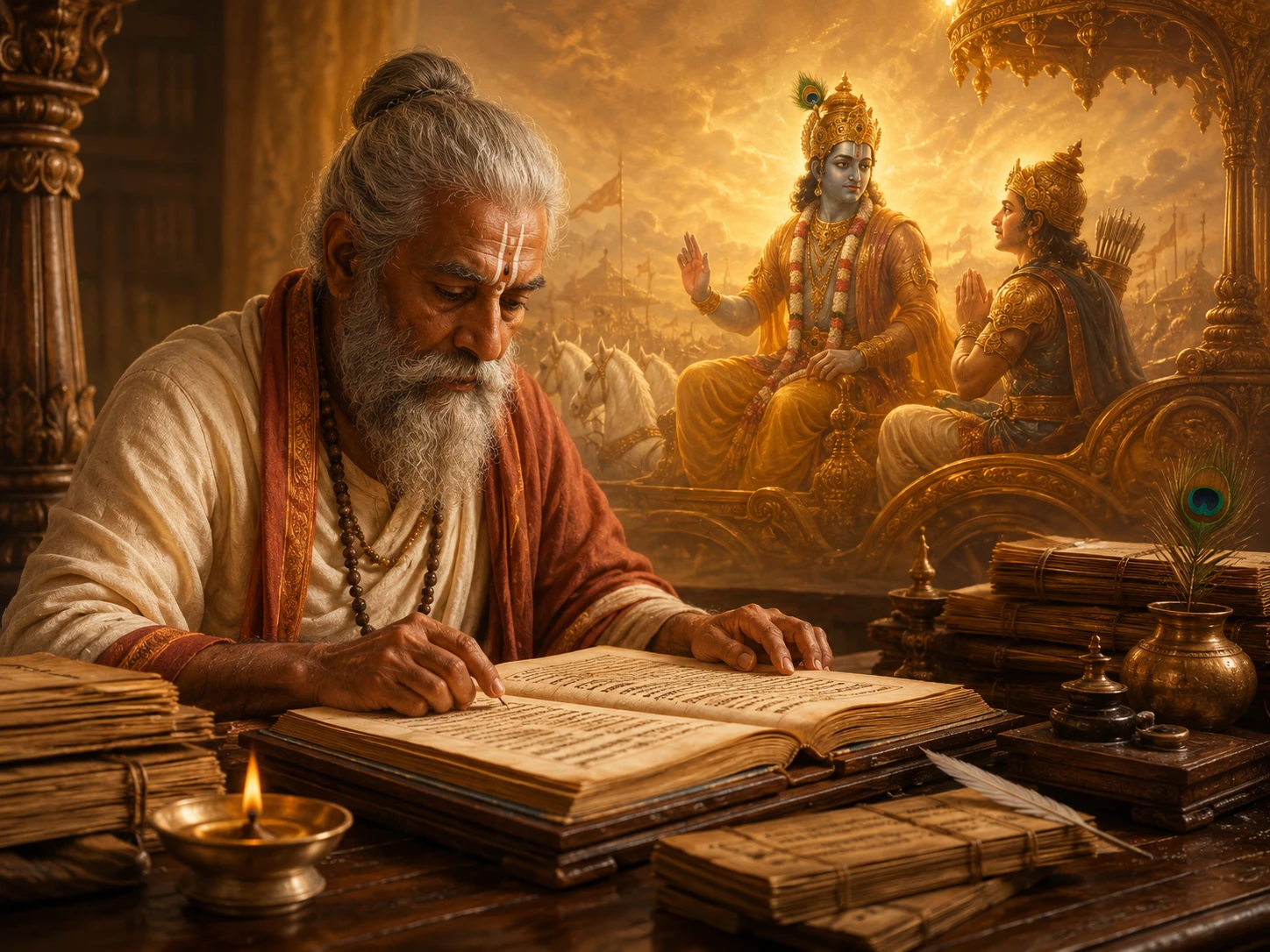
Gita Chapter 11 -- Vishwaroop: When Arjuna Saw Everything and Could Not Bear It
गीता अध्याय 11 -- विश्वरूप: जब अर्जुन ने सब कुछ देखा और सह नहीं पाया
For ten chapters, Krishna has been speaking philosophy. He has discussed the nature of the soul, the ethics of action, the paths of knowledge and devotion, the distinction between the perishable and the imperishable. Arjuna has listened, questioned, and gradually moved from paralysis toward clarity. Then, in Chapter 11, Arjuna makes a request that changes everything: 'Show me your cosmic form. I have heard your words. Now I want to see with my own eyes what you actually are.'
Krishna grants him divya drishti -- divine sight, a supernatural faculty that allows human eyes to perceive what they are not built to perceive. And then He reveals the Vishwaroop.
What follows in verses 10-31 is the most sustained piece of visionary literature in the Hindu canon. Arjuna sees a form with infinite mouths, eyes, ornaments, and weapons. He sees the entire universe -- all Devas, Rishis, celestial serpents, and cosmic beings -- contained within a single body. He sees the sun's brilliance multiplied a thousandfold. He sees the past, present, and future simultaneously. He sees warriors from both armies -- Bhishma, Drona, Karna, his own allies -- rushing into gigantic blazing mouths and being crushed between terrible teeth. He sees the world being consumed.
Arjuna's response is not devotional ecstasy. It is terror. His hair stands on end. His hands join involuntarily. He stammers. He says: 'Seeing your immense form with many mouths and eyes, with many arms, thighs, and feet, with many stomachs, and with many terrible teeth -- the worlds are trembling, and so am I.' (Verse 23). This is not worship. This is the raw human response to encountering infinity unmediated.
Verse 32 is the verse that entered world history: 'kalo 'smi loka-kshaya-krit pravriddho' -- 'I am Time, the great destroyer of worlds, here engaged in destroying the worlds.' J. Robert Oppenheimer, the director of the Manhattan Project, recalled this verse after witnessing the first nuclear detonation at Trinity, New Mexico, on July 16, 1945. His exact words, as recorded in a 1965 NBC interview: 'Now I am become Death, the destroyer of worlds.' The verse he quoted was this one -- though his translation used 'Death' where the Sanskrit says 'Kala' (Time), which is more accurate and more devastating. Time does not kill through malice. It kills through progression. Everything that exists will cease to exist -- not because God is angry, but because time is real.
कालोऽस्मि लोकक्षयकृत्प्रवृद्धो लोकान्समाहर्तुमिह प्रवृत्तः। ऋतेऽपि त्वां न भविष्यन्ति सर्वे येऽवस्थिताः प्रत्यनीकेषु योधाः॥
kālo 'smi loka-kṣaya-kṛt pravṛddho lokān samāhartum iha pravṛttaḥ | ṛte 'pi tvāṁ na bhaviṣyanti sarve ye 'vasthitāḥ pratyanīkeṣu yodhāḥ ||
I am Time, the mighty destroyer of the world, engaged here in destroying the worlds. Even without your participation, all the warriors standing in the opposing armies will cease to exist.
— Bhagavad Gita, Adhyaya 11, Shloka 32
The theological structure of Chapter 11 is a deliberate shock therapy. Krishna has been accessible for ten chapters -- a charioteer, a friend, a teacher speaking in human language. The Vishwaroop breaks that accessibility. It says: the being who has been sitting next to you, eating with you, joking with you, is also the being that contains every star, every death, every moment of time. Your friend is also the void.
Arjuna cannot handle it. He begs Krishna to return to his familiar four-armed Vishnu form, then to his two-armed human form. 'Seeing this fierce form of Yours, I am terrified. Be gracious, Lord of Lords, and show me again your gentle form' (Verse 45). Krishna complies. He goes back to being the charioteer. The man returns to the box. But nothing is the same. Arjuna now knows that the person driving his chariot is the same entity that is devouring the universe.
This is the Gita's commentary on the limits of human comprehension. We can discuss infinity intellectually. We can nod along to phrases like 'God is omnipresent' and 'everything is Brahman.' But when we actually see it -- when the filter drops and the raw signal comes through -- we break. The Vishwaroop is what reality looks like without cognitive mediation. It is too much. And Krishna, in His compassion, allows the filter to return.
Christopher Nolan's 2023 film Oppenheimer brought Gita 11.32 back into global conversation. But the film, focused on nuclear destruction, captures only one dimension of the chapter. The Vishwaroop is not just about destruction. It is about totality -- creation, preservation, and destruction occurring simultaneously, infinite beauty and infinite terror coexisting in the same frame. The physicist who splits the atom sees this. The doctor in the operating room who holds a human heart in her hands sees this. The parent who watches a child being born -- covered in blood, screaming, impossibly alive -- sees this. The Vishwaroop is any moment when the thin membrane between ordinary perception and raw reality tears open.
The chapter's resolution offers a profound comfort. After the cosmic terror, Krishna tells Arjuna in Verse 55 that the way to reach Him is through devotion, single-minded work, freedom from attachment, and freedom from enmity toward all beings. After showing the most terrifying vision in all of scripture, God's practical instruction is remarkably gentle: love Me, do your work, let go, and be kind. The cosmos is overwhelming. Your path through it is simple.
The Vishwaroop has been depicted in Indian art for at least 1,500 years. The earliest surviving sculptural representation is at the Deogarh Dashavatara temple (5th century CE, Uttar Pradesh). The most famous painting is the 18th-century Basohli miniature now in the Los Angeles County Museum of Art, showing Krishna's cosmic form with hundreds of tiny figures inside his body. In 2023, a digital art exhibition at the National Gallery of Modern Art, New Delhi, used AI-generated projections to create an immersive 360-degree Vishwaroop experience -- visitors reported the same physical symptoms Arjuna describes: goosebumps, vertigo, and involuntary tears. The chapter has also directly influenced science fiction: the 'Overview Effect' that astronauts report when seeing Earth from space -- a cognitive shift involving awe, interconnectedness, and existential terror -- maps precisely onto Arjuna's experience.
Meditate on the Vishwaroop
Read Chapter 11 slowly, then close your eyes and walk through Arjuna's vision yourself -- from the chariot to the cosmic form and back to the breath. Not for the faint-hearted. The chapter is on Eternal Raga with Sanskrit and meaning.
Tags
Eternal Raga · शाश्वत राग
Institutional voice — scholarly articles on Sanatan Dharma
Deepen Your Understanding
अपनी समझ और गहरी करें
scriptural exegesis
Gita Chapter 2 -- Sankhya Yoga: The Chapter That Changed Indian Philosophy Forever
Arjuna drops his bow. His hands shake. He tells Krishna he would rather beg for food than kill his teachers and cousins. Krishna's response in Chapter 2 is the philosophical backbone of the entire Gita -- covering the immortality of the soul, the ethics of action without attachment, and the portrait of the Sthitaprajna (the person of steady wisdom). This single chapter contains more quotable verses than most entire scriptures. 'Karmanye vadhikaraste' lives on WhatsApp statuses for a reason.
scriptural exegesis
Gita Chapter 12 -- Bhakti Yoga: The Shortest Chapter With the Longest Impact
With just 20 verses, Gita Chapter 12 is the shortest in the entire scripture -- yet it answers the biggest question: what does God actually want from you? Krishna's answer is not rituals, not renunciation, not philosophy. It is love. And then he draws the most specific personality sketch of an ideal human being ever written.
scriptural exegesis
Gita Chapter 18 -- Moksha Sannyasa Yoga: The Final Exam Where Krishna Says 'Do As You Wish'
78 verses. The longest chapter in the Gita. Krishna classifies everything -- knowledge, action, doer, intellect, happiness -- into three gunas, then drops the most radical verse in Indian scripture: abandon all dharmas and just surrender to Me. And then, in a move no dictator would ever make, he tells Arjuna: now do as you wish.
deities avatars
Dashavatara -- Why Vishnu Comes Back Ten Times
Fish, tortoise, boar, half-lion, dwarf, axe-warrior, prince, cowherd, enlightened teacher, future horseman. The ten avatars of Vishnu are not random folklore. Read them in sequence and you get something startling -- a narrative that mirrors evolutionary biology, tracks the rise and fall of political systems, and argues that God does not sit above history but enters it, gets dirty, and does the work. The Dashavatara is Hinduism's answer to the question every civilisation asks: why does the world keep breaking, and who fixes it?
deities avatars
Narasimha -- The Avatar Who Broke Every Rule to Keep His Word
Hiranyakashipu thought he had hacked the universe. His boon covered every loophole -- no man, no animal, no weapon, no time, no place could kill him. He forgot one thing: God is not bound by the categories God created. Narasimha -- half-man, half-lion, appearing at twilight on a threshold with bare claws -- is Hinduism's most terrifying avatar and its most precise legal argument. The message is not that tyranny will be punished. The message is that tyranny's own logic contains its destruction.
deities avatars
Krishna Leela -- Why God Chose to Play
He stole butter, broke pots, lied to his mother's face, danced with married women under the full moon, and lifted an entire mountain on his little finger. The Bhagavata Purana's Tenth Skandha -- the most popular 4,000 verses in all of Hindu literature -- is not a biography. It is a theological argument that the Supreme Being's highest expression is not creation, destruction, or cosmic governance. It is play. Krishna Leela is the radical idea that God's truest nature is joy.
The Vishwaroop has been depicted in Indian art for at least 1,500 years. The earliest surviving sculptural representation is at the Deogarh Dashavatara temple (5th century CE, Uttar Pradesh). The most famous painting is …
More in Scriptural Exegesis
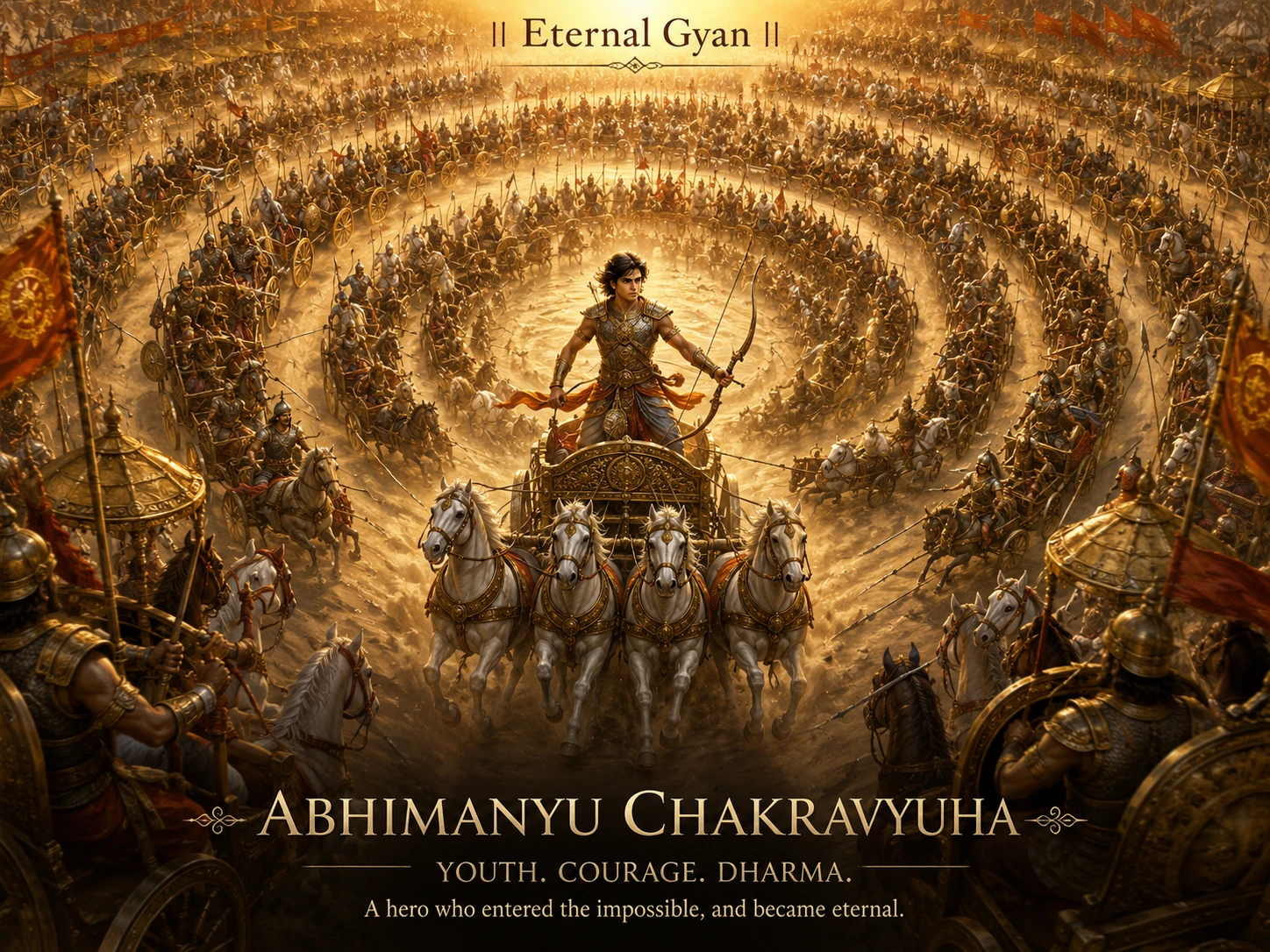
Abhimanyu and the Chakravyuha -- The Boy Who Knew How to Enter but Not How to Leave
14 min read
Adbhuta Ramayana -- The Ramayana Where Sita Becomes Kali
9 min read
After Kurukshetra -- What Happened Next
14 min readThe same translation error that turned '33 Koti' into '33 crore' in Hinduism also happened in Buddhism. The Chinese translation of Buddhist texts rendered 'Sapta Koti Buddha' (7 Supreme Buddhas) as '7 Crore Buddhas.' The…
Deities AvatarsCommunity Reflections
🕉️
Be the first to share your reflection.