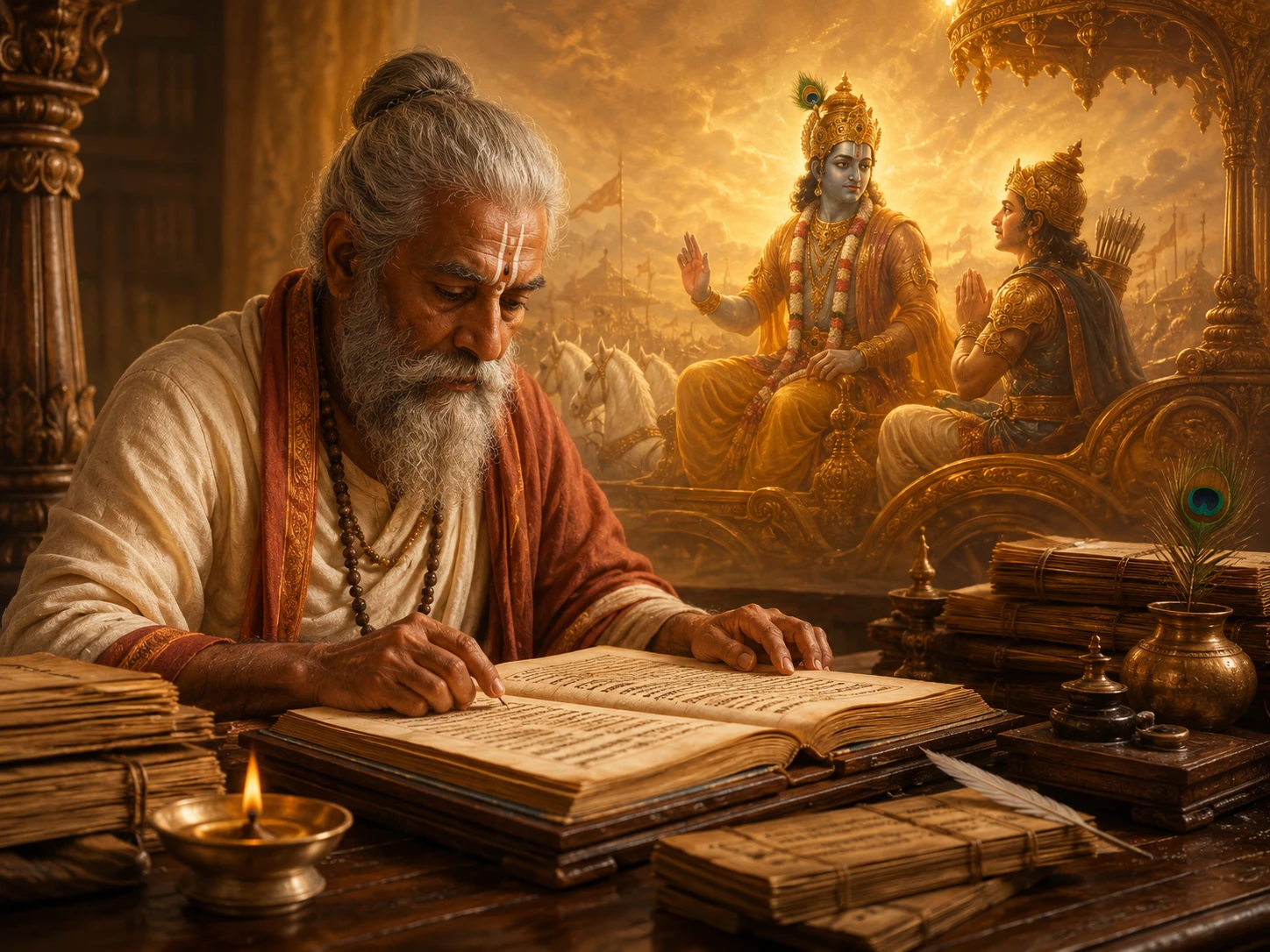
Gita Chapter 2 -- Sankhya Yoga: The Chapter That Changed Indian Philosophy Forever
गीता अध्याय 2 -- सांख्य योग: वह अध्याय जिसने भारतीय दर्शन सदा के लिए बदल दिया
Chapter 1 of the Bhagavad Gita ended with Arjuna collapsing. He has seen his grandfather Bhishma, his guru Drona, his cousins the Kauravas, and his own kin lined up on both sides of the battlefield. The man who is considered the greatest archer alive -- a warrior who spent his entire life training for exactly this moment -- sits down on the chariot floor and says he cannot fight. His gandiva bow slips from his fingers. He weeps.
Chapter 2 begins with Krishna's first real response, and it is not gentle. He does not say 'I understand your pain.' He does not offer therapy. He says, in Verse 2: 'kutastvā kaśmalam idam' -- 'Where has this weakness come from? It is not befitting of you. It leads neither to heaven nor to honour.' The Sanskrit word 'kaśmala' means not grief but impurity, contamination, cowardice. Krishna's opening is a slap: you are not experiencing noble sorrow. You are experiencing failure of nerve.
This framing is critical because it establishes the entire Gita's therapeutic method. The Gita does not treat Arjuna's crisis as a problem to be sympathised with. It treats it as a delusion to be diagnosed and corrected. Krishna is not a counsellor. He is a surgeon. And Chapter 2 is the scalpel.
The chapter has 72 verses and covers three massive philosophical territories. Verses 11-30 establish the metaphysics of the soul (Atman). Verses 31-38 address the specific ethics of Arjuna's situation as a Kshatriya warrior. Verses 39-72 introduce Karma Yoga (the discipline of selfless action) and culminate in the famous description of the Sthitaprajna -- the person whose wisdom is so stable that neither pleasure nor pain, success nor failure, can shake them.
For anyone who has ever frozen at a critical moment -- the student who blanks during a board exam, the entrepreneur who chokes during an investor pitch, the cricketer who cannot bat under pressure in a knockout match -- Chapter 2 is not ancient scripture. It is a real-time performance manual for functioning under existential stress.
नैनं छिन्दन्ति शस्त्राणि नैनं दहति पावकः। न चैनं क्लेदयन्त्यापो न शोषयति मारुतः॥
nainaṁ chindanti śastrāṇi nainaṁ dahati pāvakaḥ | na cainaṁ kledayanty āpo na śoṣayati mārutaḥ ||
Weapons cannot cut the soul, fire cannot burn it, water cannot wet it, wind cannot dry it.
— Bhagavad Gita, Adhyaya 2, Shloka 23
The soul argument (Verses 11-30) is Krishna's first philosophical salvo. His core claim: what you are grieving about -- death -- does not actually happen to the thing that matters. The body is temporary. The Atman (soul) is eternal, indestructible, and beyond all physical processes. Verse 22 gives the most famous analogy: 'vasamsi jirnani yatha vihaya navani grhnati naro parani' -- just as a person discards worn-out clothes and puts on new ones, the soul discards worn-out bodies and enters new ones.
This is not an argument for indifference to death. It is an argument for correct identification. Arjuna is identified with the bodies on the battlefield -- his grandfather's body, his guru's body. Krishna says: those bodies were always temporary. The beings you love are not their bodies. You cannot kill what they actually are. And they cannot kill what you actually are. The sword touches the sheath, never the blade inside.
The practical implication is staggering. If the soul is indestructible, then the worst thing that can happen to you in any situation -- losing a job, failing an exam, being rejected, even dying -- does not touch what you fundamentally are. This is not toxic positivity. It is a precise metaphysical argument: your identity is not your resume, your body, your social position, or your relationships. Those are garments. You are what remains when all garments are removed.
Verse 47 -- 'karmanye vadhikaraste ma phaleshu kadachana' -- is the most quoted Gita verse in modern India and possibly the most misquoted. It appears on motivational posters, in JEE coaching centre hallways, on cricket dressing room walls, and in WhatsApp statuses. It is usually translated as 'do your duty without expecting results,' and treated as a productivity hack: focus on the process, not the outcome.
The actual verse is more radical than that. It says: your right (adhikara) is to action alone, never to its fruits. You should never consider yourself the cause of the results. But also -- do not be attached to inaction. This is not just 'work hard and forget about results.' It is a complete restructuring of the relationship between agent and action. You are not the doer in the ultimate sense. You are the instrument through which action flows. Your job is to make the instrument sharp and the aim true. What happens after the arrow leaves the bow is not your domain.
The chapter's climax is the Sthitaprajna description (Verses 54-72), triggered by Arjuna's question: 'What does a person of steady wisdom look like? How does such a person sit, speak, move?' Krishna's answer paints a portrait so precise that it reads like a diagnostic checklist for psychological maturity.
The Sthitaprajna is not emotionless. He is emotion-complete. He has withdrawn his senses from their objects the way a tortoise withdraws its limbs (Verse 58) -- not by cutting them off, but by having the ability to retract at will. He feels pleasure and pain but is not destabilised by either. He is like the ocean: rivers of experience flow into him constantly, but his depth does not change (Verse 70). He has no craving for what he does not have, no attachment to what he does have, and no anger when things are taken away.
This portrait is not superhuman abstraction. It is observable in specific modern Indians. Think of M.S. Dhoni in the 2011 World Cup final -- calm at the crease with 275 runs needed, India's billion hopes on his bat, playing each ball as if it were a practice session in Ranchi. Think of APJ Abdul Kalam after the failed GSLV launch in 1994 -- taking full responsibility in front of the press, protecting his team, then going back to work the next day without visible disturbance. Think of your grandmother who survived Partition, built a family from nothing, and still laughs more than anyone you know. The Sthitaprajna is not a mystical figure. She is your grandmother.
Chapter 2 ends with a warning that is often overlooked. Verse 62-63 describe a precise chain of psychological destruction: 'From contemplation of sense objects comes attachment; from attachment comes desire; from desire comes anger; from anger comes delusion; from delusion comes loss of memory; from loss of memory comes destruction of intelligence; and from destruction of intelligence comes total ruin.' This is the Gita's earliest description of what modern psychology calls 'escalation of commitment' or 'emotional cascade.' One unchecked thought leads to attachment, which leads to compulsion, which leads to rage when the compulsion is thwarted, which leads to delusion, which leads to forgetting who you actually are, which leads to making catastrophically bad decisions.
Every addiction counsellor, every behavioural economist, every cognitive therapist would recognise this sequence. The Gita described it in 72 verses, 2,000 years before any of those fields existed.
कर्मण्येवाधिकारस्ते मा फलेषु कदाचन। मा कर्मफलहेतुर्भूर्मा ते सङ्गोऽस्त्वकर्मणि॥
karmaṇy evādhikāras te mā phaleṣu kadācana | mā karma-phala-hetur bhūr mā te saṅgo 'stv akarmaṇi ||
Your right is to action alone, never to its fruits. Do not consider yourself the cause of results, but also do not be attached to inaction.
— Bhagavad Gita, Adhyaya 2, Shloka 47
Chapter 2's Three Philosophical Pillars
| Section | Verses | Core Question | Krishna's Answer | Modern Application |
|---|---|---|---|---|
| Atman Metaphysics | 11-30 | Why should I not grieve for the dead? | The soul is eternal; death is a costume change | Identity is not your body, resume, or social position |
| Kshatriya Dharma | 31-38 | Why must I fight specifically? | Your role demands it; abstaining is also a choice with consequences | Inaction is not neutral; avoiding hard decisions has costs |
| Karma Yoga + Sthitaprajna | 39-72 | How do I act without being destroyed by the outcomes? | Act with skill, detach from results, become the ocean | Dhoni at the crease; Kalam after a failed launch |
Chapter 2 is often called the 'Gita in miniature' because it introduces all three paths (Jnana, Karma, Bhakti) that the remaining 16 chapters will elaborate.
During the Pokhran-II nuclear tests in 1998, scientists reportedly found a copy of the Bhagavad Gita in the control room. The connection between the Gita and nuclear science dates to J. Robert Oppenheimer, who famously quoted Gita 11.32 ('Now I am become Death, the destroyer of worlds') after the first atomic test in 1945. But Chapter 2's influence is quieter and more pervasive: Indian military academies use Verse 47 ('Karmanye vadhikaraste') as an institutional motto. IMA Dehradun, NDA Khadakwasla, and OTA Chennai all incorporate Gita teachings into officer training, specifically Chapter 2's framework for performing duty without paralysis by outcome-anxiety.
Read Chapter 2 on Eternal Raga
Read Bhagavad Gita Chapter 2 on Eternal Raga, verse by verse, with Sanskrit, transliteration and meaning in English and Hindi. Copy your favourite verses into a notebook for daily reflection.
Tags
Eternal Raga · शाश्वत राग
Institutional voice — scholarly articles on Sanatan Dharma
Deepen Your Understanding
अपनी समझ और गहरी करें
scriptural exegesis
Gita Chapter 3 -- Karma Yoga: Why Sitting Still Is Not an Option
After hearing Chapter 2, Arjuna asks the most logical follow-up question in the history of philosophy: 'If knowledge is superior to action, why are you pushing me to fight?' Krishna's answer in Chapter 3 builds the complete architecture of Karma Yoga -- why action is inescapable, how selfless action purifies, why leaders must act even when they have nothing to gain, and how desire is the real enemy on every battlefield.
scriptural exegesis
Gita Chapter 11 -- Vishwaroop: When Arjuna Saw Everything and Could Not Bear It
Arjuna asks to see Krishna's true form. He gets what he asks for. Infinite mouths, infinite eyes, infinite arms, the entire universe being consumed. Warriors rushing into blazing mouths like moths into flame. Time itself as a devouring force. This is the chapter Oppenheimer quoted at Trinity. It is the Gita's most terrifying passage -- and its most honest statement about what happens when a human mind encounters infinity without a filter.
scriptural exegesis
Gita Chapter 18 -- Moksha Sannyasa Yoga: The Final Exam Where Krishna Says 'Do As You Wish'
78 verses. The longest chapter in the Gita. Krishna classifies everything -- knowledge, action, doer, intellect, happiness -- into three gunas, then drops the most radical verse in Indian scripture: abandon all dharmas and just surrender to Me. And then, in a move no dictator would ever make, he tells Arjuna: now do as you wish.
deities avatars
Dashavatara -- Why Vishnu Comes Back Ten Times
Fish, tortoise, boar, half-lion, dwarf, axe-warrior, prince, cowherd, enlightened teacher, future horseman. The ten avatars of Vishnu are not random folklore. Read them in sequence and you get something startling -- a narrative that mirrors evolutionary biology, tracks the rise and fall of political systems, and argues that God does not sit above history but enters it, gets dirty, and does the work. The Dashavatara is Hinduism's answer to the question every civilisation asks: why does the world keep breaking, and who fixes it?
deities avatars
Krishna Leela -- Why God Chose to Play
He stole butter, broke pots, lied to his mother's face, danced with married women under the full moon, and lifted an entire mountain on his little finger. The Bhagavata Purana's Tenth Skandha -- the most popular 4,000 verses in all of Hindu literature -- is not a biography. It is a theological argument that the Supreme Being's highest expression is not creation, destruction, or cosmic governance. It is play. Krishna Leela is the radical idea that God's truest nature is joy.
philosophy darshana
The Six Darshanas -- India's Original Intellectual Operating Systems
Long before Greek philosophy had its first argument, India had six complete philosophical systems -- each with its own logic, metaphysics, epistemology, and liberation path. Nyaya built formal logic. Vaisheshika invented atomic theory. Samkhya mapped consciousness. Yoga engineered the mind. Mimamsa decoded ritual. Vedanta asked the final question. Together, they are the most comprehensive intellectual framework any civilisation has produced.
During the Pokhran-II nuclear tests in 1998, scientists reportedly found a copy of the Bhagavad Gita in the control room. The connection between the Gita and nuclear science dates to J. Robert Oppenheimer, who famously q…
More in Scriptural Exegesis
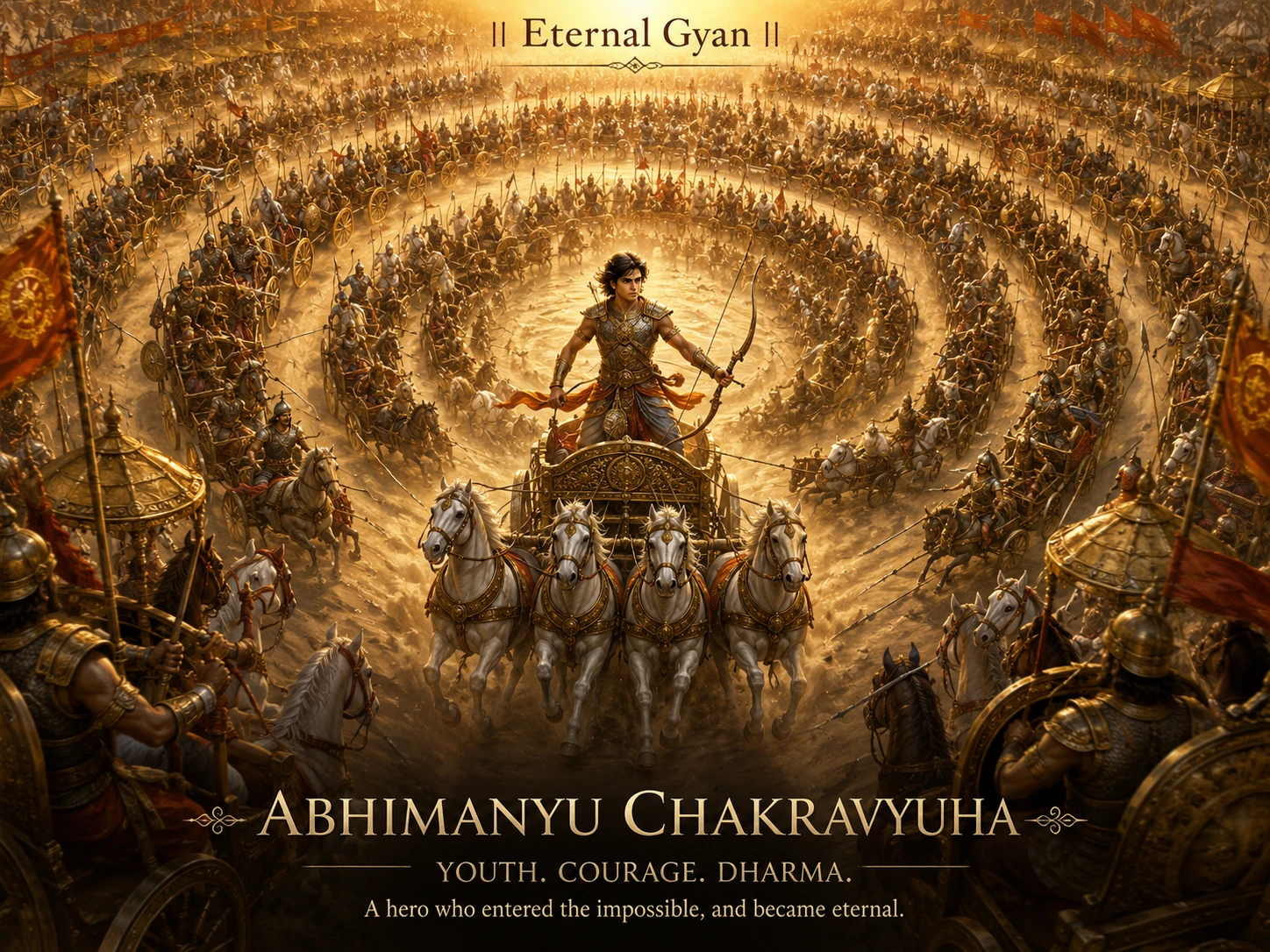
Abhimanyu and the Chakravyuha -- The Boy Who Knew How to Enter but Not How to Leave
14 min read
Adbhuta Ramayana -- The Ramayana Where Sita Becomes Kali
9 min read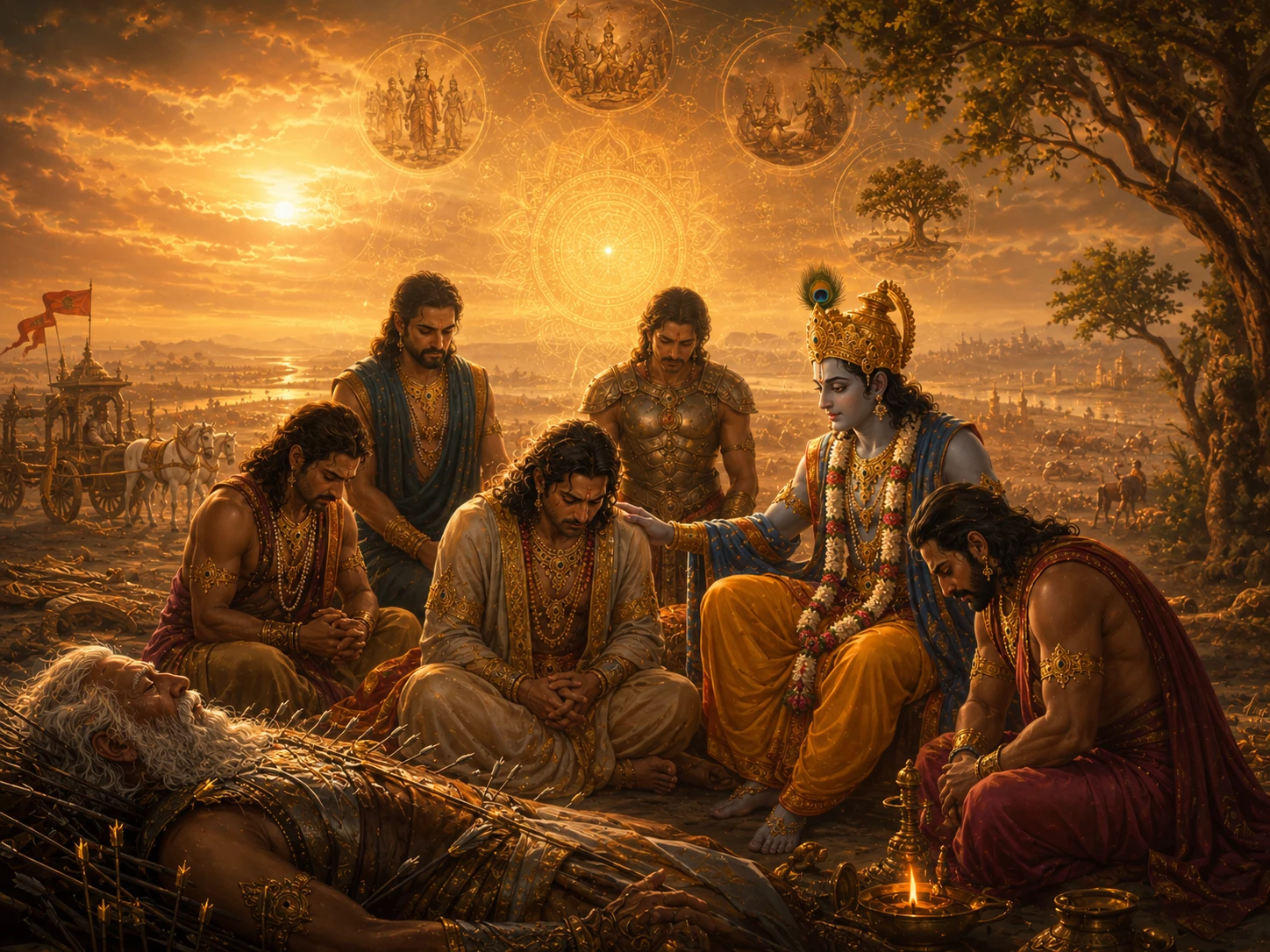
After Kurukshetra -- What Happened Next
14 min readThe same translation error that turned '33 Koti' into '33 crore' in Hinduism also happened in Buddhism. The Chinese translation of Buddhist texts rendered 'Sapta Koti Buddha' (7 Supreme Buddhas) as '7 Crore Buddhas.' The…
Deities AvatarsCommunity Reflections
🕉️
Be the first to share your reflection.