
Gita Chapter 3 -- Karma Yoga: Why Sitting Still Is Not an Option
गीता अध्याय 3 -- कर्मयोग: बैठे रहना विकल्प क्यों नहीं है
Arjuna has listened carefully to Chapter 2. He has heard that knowledge (jnana) leads to liberation, that the soul is beyond action, and that the wise person is unmoved by outcomes. His response is perfectly rational: 'Then why should I act at all? If the soul does not do anything, and if knowledge is the goal, why are you asking me to engage in this terrible violence? You seem to be pushing me toward action with one hand and pulling me toward detachment with the other. Pick one, Krishna.'
This is not Arjuna being difficult. This is Arjuna thinking clearly. And his confusion is the exact confusion that every serious reader of the Gita faces: how do you reconcile detachment with engagement? How do you simultaneously not care about results and still work with intensity? This apparent contradiction is the central puzzle of the Bhagavad Gita, and Chapter 3 is where Krishna begins to solve it.
Krishna's answer is built in layers. First, the impossibility of inaction. Verse 5: 'na hi kaschit kshanam api jatu tishthaty akarma-krit' -- 'No one can remain without action even for a moment, for everyone is helplessly driven to action by the qualities (gunas) born of material nature.' You cannot choose not to act. Even sitting still is an action. Even refusing to fight is a choice with consequences. The renunciate who sits in a cave is still breathing, still digesting, still thinking -- all of which are actions driven by the three gunas (sattva, rajas, tamas). The fantasy of 'I will withdraw from action' is itself a delusion.
Second, the hierarchy of action. There are three kinds of doers: the person who acts selfishly (driven by desire for personal reward), the person who suppresses action while mentally obsessing over the objects of desire (the spiritual fraud), and the person who acts with full engagement but without attachment to outcomes. Krishna is devastating about the second type (Verse 6): the person who restrains the organs of action but sits with the mind dwelling on sense objects is deluded and a hypocrite (mithyachara). This verse demolishes an entire industry of performative renunciation -- the sanyasi who has 'given up the world' but privately craves comfort, the corporate leader who talks about 'servant leadership' while optimising for personal brand.
Third, the concept of loka sangraha -- literally 'holding the world together.' Verse 20-21: Krishna tells Arjuna that King Janaka (Sita's father in the Ramayana) attained perfection through action alone. And then the devastating verse: 'yad yad acharati shreshthah tat tad evetaro janah' -- 'Whatever a great person does, common people follow. Whatever standard that person sets, the world follows.' If you are in a position of influence -- a teacher, a parent, a team leader, a politician, a cricket captain -- your personal desire for withdrawal is irrelevant. You must act because others are watching and calibrating their behaviour based on yours.
This is the Gita's argument for leadership as duty, not privilege. The startup founder who wants to take a sabbatical but knows that the team will collapse without her presence. The school principal in a rural Bihar school who personally unlocks the gate every morning at 6 AM because if she does not, three other teachers will start arriving at 8. The ISRO mission director who stays at the control room through the night not because the protocol requires it but because leaving would signal to 200 junior scientists that the mission is less important than sleep. Loka sangraha is not about heroism. It is about the quiet, unglamorous, relentless act of showing up.
नियतं कुरु कर्म त्वं कर्म ज्यायो ह्यकर्मणः। शरीरयात्रापि च ते न प्रसिद्ध्येदकर्मणः॥
niyataṁ kuru karma tvaṁ karma jyāyo hy akarmaṇaḥ | śarīra-yātrāpi ca te na prasiddhyed akarmaṇaḥ ||
Perform your prescribed duty, for action is better than inaction. Even the maintenance of your body would not be possible through inaction.
— Bhagavad Gita, Adhyaya 3, Shloka 8
The yajna (sacrifice/offering) framework in verses 10-16 introduces a concept that is both ancient and radically modern. Krishna describes a cosmic cycle: the rains nourish the earth, the earth produces food, food sustains beings, beings perform yajna, yajna generates rain. Break any link in this cycle and the system collapses. The person who eats without contributing to the cycle is, in Krishna's words, a thief (Verse 12).
This is essentially a circular economy argument, articulated 2,000 years before the term existed. Every resource you consume creates an obligation to return something to the system. The farmer who takes from the soil must replenish it. The employee who takes a salary must contribute value. The citizen who uses roads, police, and courts must pay taxes and participate in governance. The concept of yajna is not limited to fire rituals. It is any action performed as an offering to the larger system that sustains you.
The chapter culminates in verses 36-43 with Arjuna's most urgent question: 'What drives a person to commit sin, even against their own will, as if compelled by force?' Krishna's answer: 'kama esha krodha esha' -- 'It is desire (kama), it is anger (krodha), born of rajo-guna, all-consuming and sinful. Know this to be the enemy.' And then the devastating metaphor: desire covers wisdom the way smoke covers fire, dust covers a mirror, and the embryonic membrane covers a foetus (Verse 38). In each case, the covering is natural -- fires produce smoke, mirrors collect dust, embryos grow membranes. The implication is that desire does not come from outside. It is a natural byproduct of being alive. The challenge is not to eliminate desire (impossible) but to see through it (possible with practice).
This is the Gita's most precise contribution to practical psychology. The enemy is not external. It is not the Kauravas on the other side of the field. It is the internal mechanism of desire-anger-delusion that hijacks your intelligence and makes you act against your own interests. Every recovering addict knows this truth. Every person who has sent an angry email at midnight and regretted it by morning knows this truth. The Gita says: the first battlefield is inside.
Three Types of Workers According to Chapter 3
| Type | Description | Krishna's Verdict | Modern Example |
|---|---|---|---|
| Selfish Actor | Acts for personal reward only | Bound by karma | Employee who works only for bonus, quits when denied |
| Spiritual Fraud | Suppresses action but craves sense objects mentally | Mithyachara -- hypocrite (Verse 6) | Instagram influencer posting about minimalism from a luxury resort |
| Karma Yogi | Acts fully but without attachment to outcome | Freed while acting (Verse 7) | Dhoni finishing the match, Kalam going back to work after failure |
Krishna's harshest criticism in the chapter is reserved not for the selfish actor but for the spiritual fraud -- the person who performs detachment while internally craving attachment.
Mahatma Gandhi considered Chapter 3 the most practically important chapter of the Gita. His concept of 'trusteeship' -- the idea that the wealthy hold their assets in trust for society -- directly derives from the yajna cycle described in verses 10-16. When Gandhi said that India would be free only when Indians learned to work without personal reward, he was paraphrasing Karma Yoga. The Sabarmati Ashram's daily schedule included Gita recitation with Chapter 3 given special emphasis. Vinoba Bhave's Bhoodan movement (1951-69), which convinced landlords to voluntarily donate land to the landless, was explicitly framed as loka sangraha in action -- a modern yajna where the offering was acres, not ghee.
Read Chapter 3 on Eternal Raga
Read Bhagavad Gita Chapter 3 on Eternal Raga. Follow the argument of the yajna cycle verse by verse, and keep a journal of your reflections on selfless action.
Tags
Eternal Raga · शाश्वत राग
Institutional voice — scholarly articles on Sanatan Dharma
Deepen Your Understanding
अपनी समझ और गहरी करें
scriptural exegesis
Gita Chapter 2 -- Sankhya Yoga: The Chapter That Changed Indian Philosophy Forever
Arjuna drops his bow. His hands shake. He tells Krishna he would rather beg for food than kill his teachers and cousins. Krishna's response in Chapter 2 is the philosophical backbone of the entire Gita -- covering the immortality of the soul, the ethics of action without attachment, and the portrait of the Sthitaprajna (the person of steady wisdom). This single chapter contains more quotable verses than most entire scriptures. 'Karmanye vadhikaraste' lives on WhatsApp statuses for a reason.
scriptural exegesis
Gita Chapter 18 -- Moksha Sannyasa Yoga: The Final Exam Where Krishna Says 'Do As You Wish'
78 verses. The longest chapter in the Gita. Krishna classifies everything -- knowledge, action, doer, intellect, happiness -- into three gunas, then drops the most radical verse in Indian scripture: abandon all dharmas and just surrender to Me. And then, in a move no dictator would ever make, he tells Arjuna: now do as you wish.
scriptural exegesis
Gita Chapter 12 -- Bhakti Yoga: The Shortest Chapter With the Longest Impact
With just 20 verses, Gita Chapter 12 is the shortest in the entire scripture -- yet it answers the biggest question: what does God actually want from you? Krishna's answer is not rituals, not renunciation, not philosophy. It is love. And then he draws the most specific personality sketch of an ideal human being ever written.
deities avatars
Krishna Leela -- Why God Chose to Play
He stole butter, broke pots, lied to his mother's face, danced with married women under the full moon, and lifted an entire mountain on his little finger. The Bhagavata Purana's Tenth Skandha -- the most popular 4,000 verses in all of Hindu literature -- is not a biography. It is a theological argument that the Supreme Being's highest expression is not creation, destruction, or cosmic governance. It is play. Krishna Leela is the radical idea that God's truest nature is joy.
deities avatars
Dashavatara -- Why Vishnu Comes Back Ten Times
Fish, tortoise, boar, half-lion, dwarf, axe-warrior, prince, cowherd, enlightened teacher, future horseman. The ten avatars of Vishnu are not random folklore. Read them in sequence and you get something startling -- a narrative that mirrors evolutionary biology, tracks the rise and fall of political systems, and argues that God does not sit above history but enters it, gets dirty, and does the work. The Dashavatara is Hinduism's answer to the question every civilisation asks: why does the world keep breaking, and who fixes it?
scriptural exegesis
Samudra Manthan -- When Gods and Demons Ran a Joint Venture and the Universe Almost Died
A cosmic ocean. A mountain for a churning rod. A serpent king for a rope. Gods on one end, demons on the other. And out came 14 treasures -- including wealth, beauty, medicine, immortality, and one poison so lethal it could end creation itself. The Samudra Manthan is not mythology. It is the original playbook for collaboration, crisis management, and how to handle it when your joint venture partner tries to cheat you.
Mahatma Gandhi considered Chapter 3 the most practically important chapter of the Gita. His concept of 'trusteeship' -- the idea that the wealthy hold their assets in trust for society -- directly derives from the yajna …
More in Scriptural Exegesis
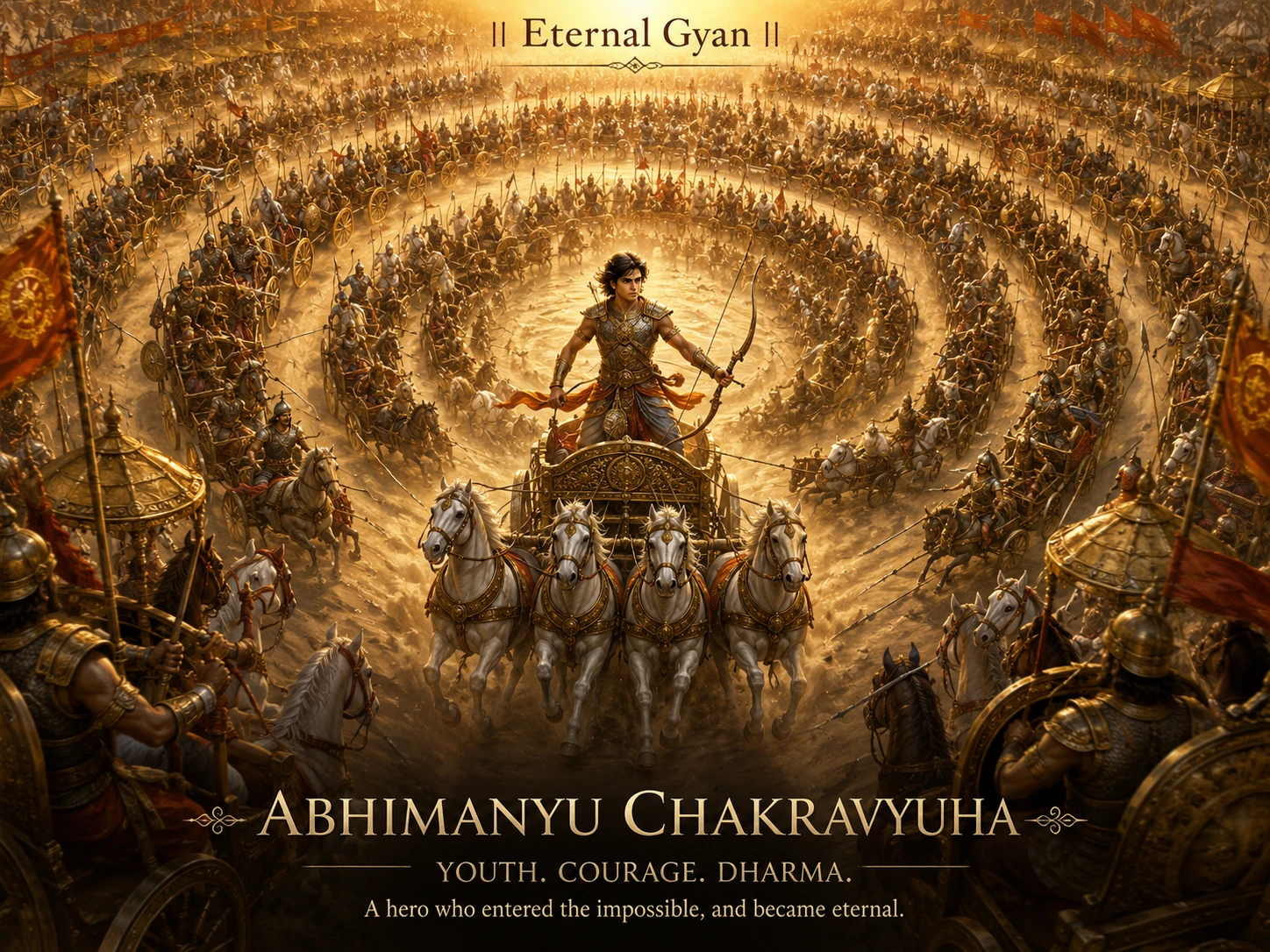
Abhimanyu and the Chakravyuha -- The Boy Who Knew How to Enter but Not How to Leave
14 min read
Adbhuta Ramayana -- The Ramayana Where Sita Becomes Kali
9 min read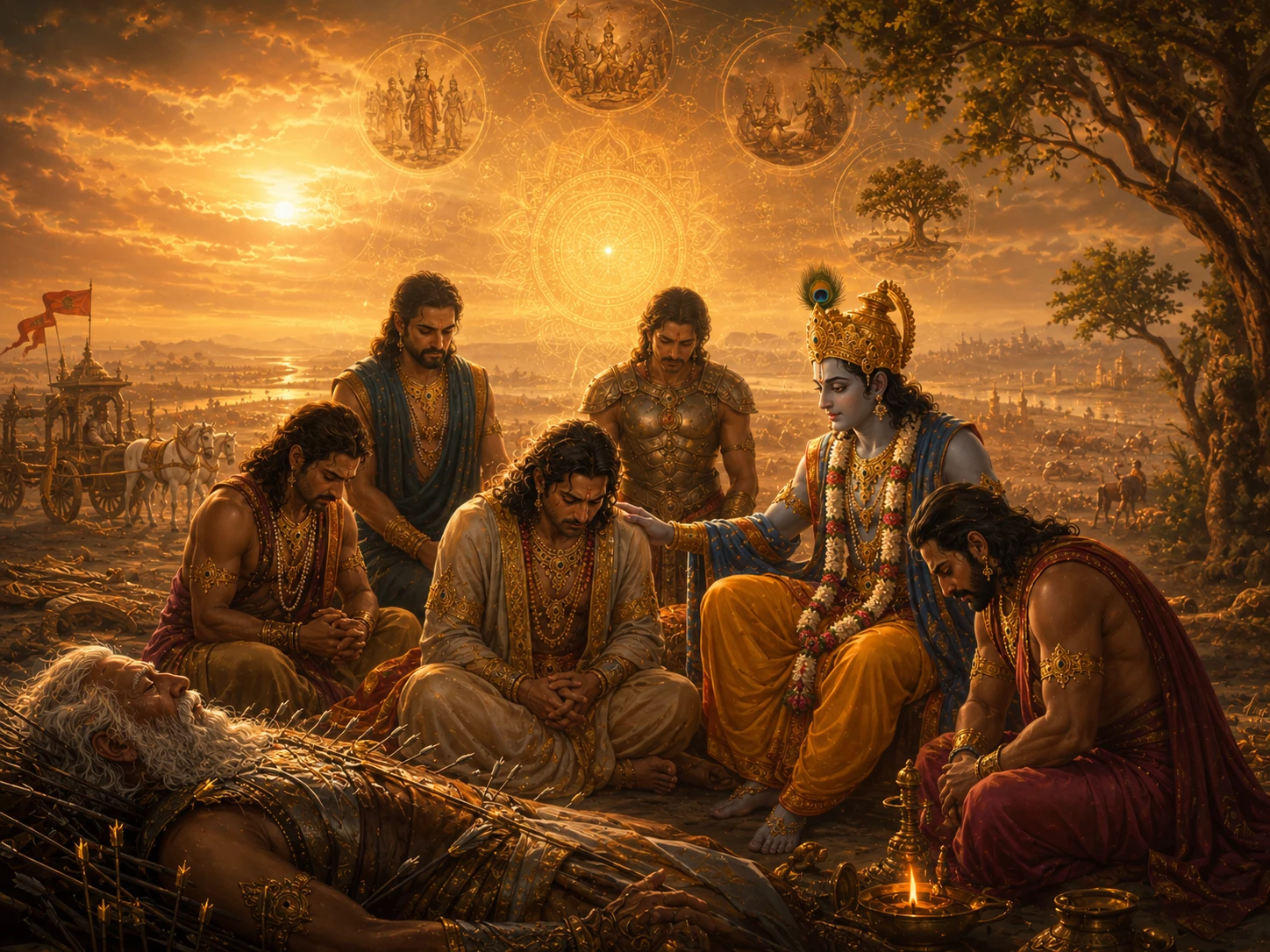
After Kurukshetra -- What Happened Next
14 min readThe same translation error that turned '33 Koti' into '33 crore' in Hinduism also happened in Buddhism. The Chinese translation of Buddhist texts rendered 'Sapta Koti Buddha' (7 Supreme Buddhas) as '7 Crore Buddhas.' The…
Deities AvatarsCommunity Reflections
🕉️
Be the first to share your reflection.