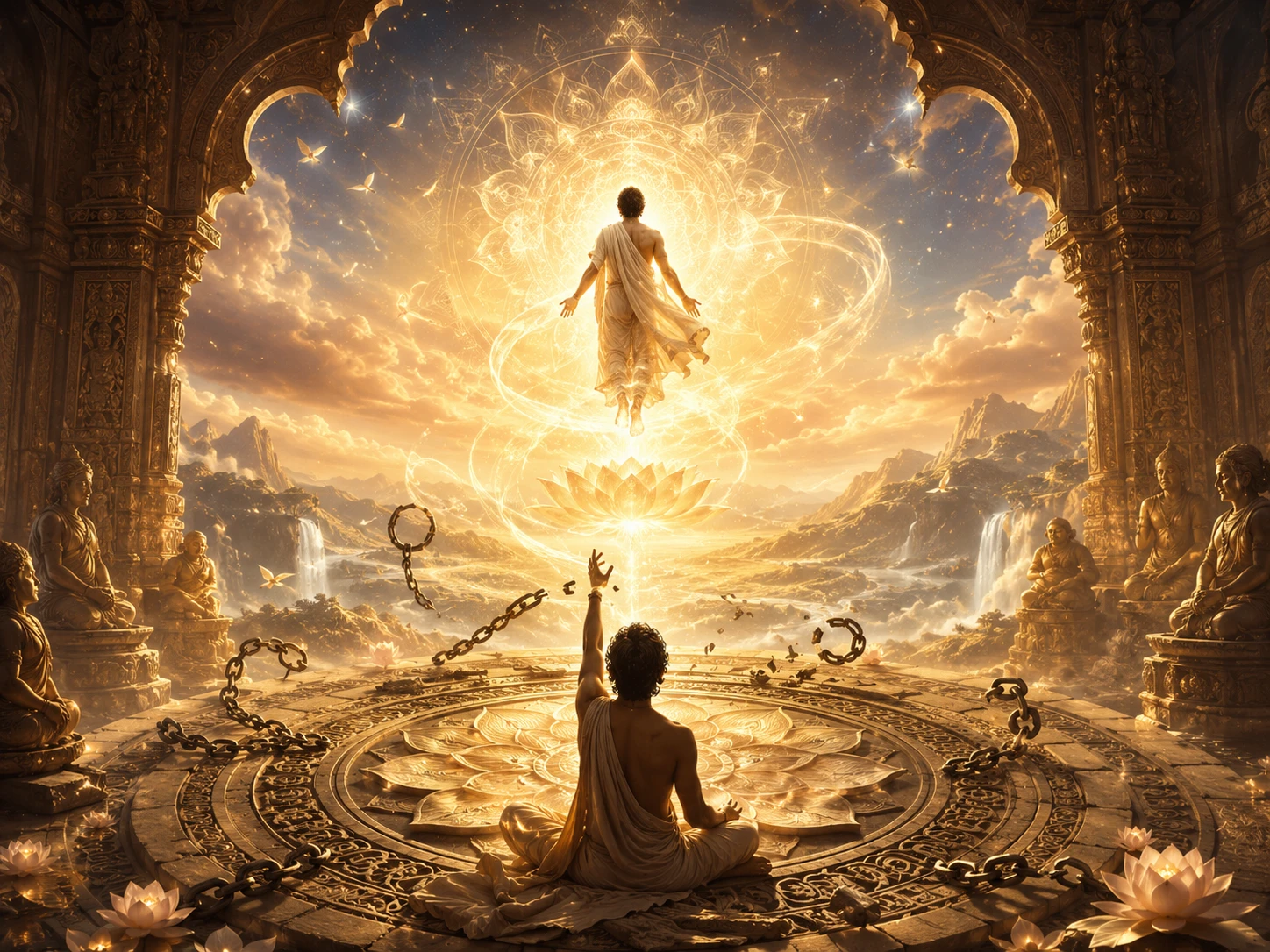
Gita Chapter 18 -- Moksha Sannyasa Yoga: The Final Exam Where Krishna Says 'Do As You Wish'
गीता अध्याय 18 -- मोक्ष संन्यास योग: वो आखिरी परीक्षा जहाँ कृष्ण कहते हैं 'जो चाहो, करो'
Every great story needs a finale that does two things simultaneously: wrap up every thread, and then blow the roof off with something nobody saw coming. Chapter 18 of the Bhagavad Gita does both.
At 78 verses, it is the longest chapter in the text -- nearly four times the length of Chapter 12 (the shortest). It opens with Arjuna asking about the difference between sannyasa (renunciation of action) and tyaga (renunciation of the fruit of action). What follows is the Gita's grand taxonomy: Krishna classifies knowledge, action, doer, intellect, resolve, and even happiness into three categories based on the three gunas -- sattva, rajas, and tamas. It reads like a final-semester syllabus review where the professor systematically covers every topic one last time before the exam.
But the exam, when it comes, is not what anyone expected. After 17 chapters of systematic instruction, Krishna delivers the most compressed, most radical, most debated verse in Indian philosophical history: sarva-dharman parityajya mam ekam sharanam vraja -- 'Abandon all dharmas and surrender to Me alone. I will free you from all sins. Do not grieve.' (18.66). And then -- in a move that separates the Gita from every authoritarian scripture ever written -- he tells Arjuna in 18.63: 'I have told you this knowledge, more secret than any secret. Reflect on it fully, and then do as you wish' (yathecchasi tatha kuru).
God gives the instruction. And then gives the freedom to reject it. No other religious text in the ancient world does this. The Torah says obey. The Quran says submit. The Gita says: think, and then choose. This is not moral relativism -- Krishna has been clear about what he considers the best path. It is something rarer: a teacher who respects the student's autonomy even at the moment of highest stakes. For every Indian student who has been told what career to pursue, what person to marry, what life to live -- 'yathecchasi tatha kuru' is the most liberating sentence in the history of Indian thought.
सर्वधर्मान्परित्यज्य मामेकं शरणं व्रज । अहं त्वां सर्वपापेभ्यो मोक्षयिष्यामि मा शुचः ॥
sarva-dharmān parityajya mām ekaṁ śaraṇaṁ vraja ahaṁ tvāṁ sarva-pāpebhyo mokṣayiṣyāmi mā śucaḥ
Abandoning all dharmas, take refuge in Me alone. I shall liberate you from all sins. Do not grieve.
— Bhagavad Gita, Chapter 18, Verse 66
THE THREE-GUNA TAXONOMY: EVERYTHING SORTED (18.1-40)
The first forty verses of Chapter 18 are Krishna's most systematic teaching. He takes the three gunas -- sattva (clarity/goodness), rajas (passion/agitation), and tamas (inertia/delusion) -- and applies them to every dimension of human life.
Sannyasa vs. Tyaga (18.1-12): Arjuna opens by asking the difference. Krishna's answer is precise: true tyaga is not abandoning action itself, but abandoning attachment to the fruit of action. Sacrifice (yajna), charity (dana), and austerity (tapas) should never be given up -- they purify the wise. But they should be performed without clinging to results. This distinction matters enormously in modern India. The IIT professor who teaches with dedication but does not obsess over student ratings is practising sattvic tyaga. The Infosys employee who volunteers at an NGO on weekends but does not post about it on LinkedIn is practising nishkama karma. Tyaga is not withdrawal from life -- it is withdrawal from scorekeeping.
Three Types of Knowledge (18.20-22): Sattvic knowledge sees the one imperishable reality in all beings -- unity in diversity. Rajasic knowledge sees every being as separate, distinct, fragmented -- the worldview of 'me vs. them.' Tamasic knowledge clings to one fragment and treats it as the whole -- the person who thinks their caste, their state, their language IS the entire truth. When WhatsApp forwards reduce complex geopolitical events to single-cause conspiracy theories, that is tamasic knowledge in 21st-century form.
Three Types of Action (18.23-25): Sattvic action is performed without attachment, without ego, with steadiness in success and failure. Rajasic action is done with intense desire for results, with ego, with great exertion. Tamasic action is undertaken through delusion, without regard to consequences, loss, or injury to others. The startup founder who builds because the problem genuinely needs solving is sattvic. The one who builds for the TechCrunch headline is rajasic. The one who builds a predatory lending app knowing it will harm users is tamasic.
Three Types of Doer (18.26-28): The sattvic doer is free from attachment and ego, endowed with resolve and enthusiasm, unmoved by success or failure. The rajasic doer craves results, is greedy, prone to harm, impure, and swings between elation and depression. The tamasic doer is undisciplined, vulgar, stubborn, deceitful, lazy, and procrastinating. Krishna is essentially describing three personality archetypes that any HR professional, therapist, or sports coach would instantly recognize.
Three Types of Happiness (18.36-39): This is perhaps the most practically useful classification. Sattvic happiness feels like poison in the beginning (the discomfort of discipline, early mornings, hard study) but turns to nectar -- born of clarity of self-knowledge. Rajasic happiness feels like nectar in the beginning (the dopamine rush of social media likes, the first drink, the impulse purchase) but turns to poison. Tamasic happiness is delusion from start to finish -- arising from sleep, laziness, and negligence.
Every JEE coaching student in Kota knows this taxonomy intuitively. The 5 AM wake-up call is sattvic (painful now, rewarding later). The late-night Instagram scroll is rajasic (pleasurable now, regret later). Skipping class to sleep is tamasic (dull comfort that leads nowhere). Krishna's framework is the original behavioral psychology.
Krishna's Three-Guna Classification of Human Experience (Chapter 18)
| Dimension | Sattvic (Clarity) | Rajasic (Passion) | Tamasic (Inertia) |
|---|---|---|---|
| Knowledge (18.20-22) | Sees one reality in all beings | Sees all beings as separate, fragmented | Clings to one fragment as the whole truth |
| Action (18.23-25) | Without attachment, ego, or craving for results | Driven by desire, ego, and great exertion | Deluded, careless about harm to self or others |
| Doer (18.26-28) | Free from ego, steady in success and failure | Greedy, envious, impure, swings between highs and lows | Undisciplined, lazy, deceitful, procrastinating |
| Intellect (18.30-32) | Knows action vs. inaction, fear vs. fearlessness, bondage vs. liberation | Cannot distinguish dharma from adharma consistently | Sees adharma as dharma -- everything inverted |
| Resolve (18.33-35) | Unwavering focus on mind, prana, and senses through yoga | Clings to dharma, artha, kama with attachment to fruits | Cannot give up sleep, fear, grief, depression, arrogance |
| Happiness (18.36-39) | Poison at first, nectar later -- born from self-knowledge | Nectar at first, poison later -- born from sense contact | Delusion from start to finish -- born from sleep and laziness |
This six-dimensional framework (jnana, karma, karta, buddhi, dhriti, sukha) is arguably the most comprehensive personality typology in ancient literature. Modern parallels include the Big Five personality traits and Daniel Kahneman's System 1/System 2 thinking.
SVADHARMA AND VARNA: THE CONTROVERSIAL SECTION (18.41-48)
Verses 41-48 are the most debated passage in the entire Gita, because Krishna describes the duties of Brahmanas, Kshatriyas, Vaishyas, and Shudras as arising from their inherent nature (svabhava-prabhavaih gunaih). Read through a caste-oppression lens, this looks like divine sanction for birth-based hierarchy. Read through a guna-based lens (which the chapter itself establishes in 18.40), it describes four functional temperaments that exist in every society: the knowledge-seekers (teachers, researchers), the protectors (military, police, administrators), the wealth-creators (entrepreneurs, farmers, traders), and the service-providers (craftspeople, operators, support systems).
The critical verse is 18.47: shreyan sva-dharmo vigunah para-dharmat sv-anushthitat -- 'Better is one's own dharma, even imperfectly performed, than the dharma of another, well performed.' This is not a defence of caste. It is a defence of authenticity. The engineer who becomes a mediocre MBA because 'that is what successful people do' has abandoned svadharma for paradharma. The IAS officer's son who forces himself into UPSC when his heart is in music is living someone else's dharma.
Babasaheb Ambedkar's critique of this passage remains essential reading. He argued that guna-karma classification became birth-based ossification precisely because the original flexibility was lost. The Gita's own logic -- that gunas are about psychological tendencies, not bloodlines -- is the strongest argument against hereditary caste. If a Shudra displays Brahminical qualities (18.42: shama, dama, tapas, shaucha, kshanti, arjava), then by the Gita's own framework, their svadharma IS that of a Brahmana. The text contains both the disease and the cure.
THE CHARAMA SHLOKA: THE GITA'S ULTIMATE VERSE (18.65-66)
Vedantic tradition calls verse 18.66 the 'charama shloka' -- the ultimate, final verse -- not because it is literally the last verse, but because it is considered the distilled essence of the entire Gita. Sri Vaishnavas treat it as a maha-mantra. Ramanuja built his entire theology of prapatti (surrender) on this single verse.
But to understand 18.66, you must first read 18.65: 'Fix your mind on Me, be My devotee, sacrifice to Me, bow to Me. You shall come to Me. Truly I promise you -- you are dear to Me.' The word 'pratijane' (I promise) is extraordinary. Krishna does not just teach -- he takes a vow. This is not philosophy. This is a personal guarantee from the divine to the individual.
Then comes 18.66: sarva-dharman parityajya mam ekam sharanam vraja. The interpretive range is enormous:
Shankaracharya reads 'sarva-dharman' as 'all notions of doership' -- renounce the ego that thinks it is the agent, and realize the actionless Self.
Ramanuja reads it as 'all other spiritual paths' -- give up your faith in karma, jnana, and yoga as independent means, and rely entirely on God's grace.
Madhva reads it as 'all material duties done with selfish motive' -- perform your duties, but redirect them entirely to God.
The modern reader might hear something else: stop performing dharma as performance. Stop being good because it looks good, stop being religious because it earns social capital, stop following rules because rules give you a sense of control. Instead, come to a place of genuine, undefended vulnerability before the divine -- not 'I have earned your grace' but 'I have nothing, and I come to you anyway.'
This is why the charama shloka resonates so deeply with people in crisis -- in hospital waiting rooms, after job losses, during divorces, in the quiet 3 AM hours when all defences are down. It is not a philosophical proposition. It is an emergency number.
ARJUNA'S RESOLUTION: THE STUDENT SPEAKS (18.73)
After 700 verses of listening, Arjuna finally speaks his conclusion: 'nashto mohah smritir labdha tvat-prasadat maya achyuta / sthito'smi gata-sandehah karishye vachanam tava' -- 'My delusion is destroyed. I have regained my memory by Your grace, O Achyuta. I stand firm, free from doubt. I shall act according to Your word.'
The word 'karishye' -- 'I shall do' -- closes the circle that 'na yotsya iti' (I shall not fight, 2.9) opened. The Gita begins with a man who will not act and ends with a man who chooses to act. Not from compulsion, not from anger, not from obedience -- but from clarity. The war has not changed. The armies are the same. The only thing that has changed is Arjuna's understanding of who he is and what action means.
Sanjaya, the narrator, then delivers the closing verses (18.74-78), declaring that wherever Krishna and Arjuna are together, there is prosperity, victory, glory, and firm righteousness (dhruva nitih). The Gita ends not with an abstract principle but with a relationship -- the divine and the human, the teacher and the student, the charioteer and the warrior, standing together on a field of action.
इति ते ज्ञानमाख्यातं गुह्याद्गुह्यतरं मया । विमृश्यैतदशेषेण यथेच्छसि तथा कुरु ॥
iti te jñānam ākhyātaṁ guhyād guhyataraṁ mayā vimṛśyaitad aśeṣeṇa yathecchasi tathā kuru
Thus I have explained to you this knowledge, more secret than all secrets. Reflect on it fully, and then do as you wish.
— Bhagavad Gita, Chapter 18, Verse 63
WHY CHAPTER 18 IS THE GITA'S MASTERCLASS IN LEADERSHIP
Chapter 18 is not just a spiritual text. It is a case study in how to lead without controlling.
Krishna's teaching method across the entire Gita, but especially in this chapter, follows a pattern that every modern leadership thinker would recognize: diagnose before prescribing (he asks Arjuna to describe his confusion before offering solutions), teach frameworks not just answers (the three-guna taxonomy is a thinking tool, not a dogma), escalate gradually from impersonal to personal (chapters 1-6 are about karma and self-discipline, 7-12 about devotion, 13-18 about the deepest metaphysics), and ultimately empower the student to make their own decision.
The phrase 'yathecchasi tatha kuru' should be printed on the wall of every school, every parenting workshop, every corporate training room in India. It encodes a radical idea: the best teacher does not produce obedient followers. The best teacher produces people who can choose well. IIM Ahmedabad's case study method, which forces students to make decisions under ambiguity rather than memorize textbook answers, is an institutional expression of yathecchasi tatha kuru.
And the charama shloka (18.66) is not the opposite of this freedom -- it is its foundation. Krishna says 'surrender to Me' AND 'do as you wish' in the space of three verses. The apparent contradiction dissolves when you see surrender not as loss of agency but as the ground from which genuine agency arises. The person who has truly surrendered their anxiety about outcomes is the person who can think most clearly about what to do. DRDO scientists developing the Agni missile series -- named after the Vedic fire god -- work with this exact combination: total dedication to the mission, total equanimity about personal credit.
Chapter 18 closes the Bhagavad Gita the way a great commencement speech closes a graduation: with a synthesis of everything learned, a final challenge, a promise of support, and then -- the letting go. The chariot moves. The conch shells blow. The war begins. But the war was never the point. The point was the conversation.
The phrase 'yathecchasi tatha kuru' (do as you wish) in verse 18.63 makes the Bhagavad Gita the only major ancient scripture where God explicitly grants the listener freedom to reject the teaching. Prabhupada's commentary notes that this line proves God 'does not interfere with the little independence of the living entity.' India's Constitution framers, many of whom were deeply familiar with the Gita, embedded a similar principle in the Preamble: liberty of thought, expression, belief, faith, and worship. B.R. Ambedkar, who critiqued the Gita's varna passages, nonetheless admired this emphasis on individual moral agency.
Chapter 18's three-guna taxonomy of happiness (18.36-39) maps precisely onto modern neuroscience. Sattvic happiness (poison first, nectar later) describes the dopamine-serotonin shift in delayed gratification -- the same mechanism behind compound interest, fitness gains, and deep learning. Rajasic happiness (nectar first, poison later) describes the dopamine spike-and-crash cycle of addiction, doom-scrolling, and sugar highs. Tamasic happiness (delusion throughout) maps onto the anhedonia of depression. Stanford neuroscientist Andrew Huberman has cited similar frameworks when discussing dopamine management protocols -- 2,500 years after Krishna laid out the same taxonomy on a battlefield.
Practise Chapter 18: Surrender Through Japa
Krishna's ultimate instruction is surrender, and japa is the simplest doorway. Chant Om Namo Bhagavate Vasudevaya on a mala, beginning with Step 4 -- let go of outcomes -- and let the practice deepen naturally. Chapter 18, with its verse of surrender (18.66), is on Eternal Raga with its meaning.
Tags
Eternal Raga · शाश्वत राग
Institutional voice — scholarly articles on Sanatan Dharma
Deepen Your Understanding
अपनी समझ और गहरी करें
scriptural exegesis
Gita Chapter 2 -- Sankhya Yoga: The Chapter That Changed Indian Philosophy Forever
Arjuna drops his bow. His hands shake. He tells Krishna he would rather beg for food than kill his teachers and cousins. Krishna's response in Chapter 2 is the philosophical backbone of the entire Gita -- covering the immortality of the soul, the ethics of action without attachment, and the portrait of the Sthitaprajna (the person of steady wisdom). This single chapter contains more quotable verses than most entire scriptures. 'Karmanye vadhikaraste' lives on WhatsApp statuses for a reason.
scriptural exegesis
Gita Chapter 3 -- Karma Yoga: Why Sitting Still Is Not an Option
After hearing Chapter 2, Arjuna asks the most logical follow-up question in the history of philosophy: 'If knowledge is superior to action, why are you pushing me to fight?' Krishna's answer in Chapter 3 builds the complete architecture of Karma Yoga -- why action is inescapable, how selfless action purifies, why leaders must act even when they have nothing to gain, and how desire is the real enemy on every battlefield.
scriptural exegesis
Gita Chapter 11 -- Vishwaroop: When Arjuna Saw Everything and Could Not Bear It
Arjuna asks to see Krishna's true form. He gets what he asks for. Infinite mouths, infinite eyes, infinite arms, the entire universe being consumed. Warriors rushing into blazing mouths like moths into flame. Time itself as a devouring force. This is the chapter Oppenheimer quoted at Trinity. It is the Gita's most terrifying passage -- and its most honest statement about what happens when a human mind encounters infinity without a filter.
scriptural exegesis
Gita Chapter 12 -- Bhakti Yoga: The Shortest Chapter With the Longest Impact
With just 20 verses, Gita Chapter 12 is the shortest in the entire scripture -- yet it answers the biggest question: what does God actually want from you? Krishna's answer is not rituals, not renunciation, not philosophy. It is love. And then he draws the most specific personality sketch of an ideal human being ever written.
deities avatars
Dashavatara -- Why Vishnu Comes Back Ten Times
Fish, tortoise, boar, half-lion, dwarf, axe-warrior, prince, cowherd, enlightened teacher, future horseman. The ten avatars of Vishnu are not random folklore. Read them in sequence and you get something startling -- a narrative that mirrors evolutionary biology, tracks the rise and fall of political systems, and argues that God does not sit above history but enters it, gets dirty, and does the work. The Dashavatara is Hinduism's answer to the question every civilisation asks: why does the world keep breaking, and who fixes it?
deities avatars
Krishna Leela -- Why God Chose to Play
He stole butter, broke pots, lied to his mother's face, danced with married women under the full moon, and lifted an entire mountain on his little finger. The Bhagavata Purana's Tenth Skandha -- the most popular 4,000 verses in all of Hindu literature -- is not a biography. It is a theological argument that the Supreme Being's highest expression is not creation, destruction, or cosmic governance. It is play. Krishna Leela is the radical idea that God's truest nature is joy.
tantra mantra yantra
Om Namo Narayanaya -- The Eight-Syllable Key to Vishnu
Eight syllables. No complicated ritual. No prerequisite initiation for the basic form. Om Namo Narayanaya is the most accessible Vishnu mantra in existence -- chanted by Alvars in Tamil Nadu, ISKCON devotees in Manhattan, grandmothers in Tirupati queues, and software engineers in Bengaluru doing japa on their morning commute. But simplicity is not shallowness. The Ashtakshara Mantra encodes an entire theology of surrender, and the three schools of Vedanta have spent centuries arguing about what exactly 'Namo' means.
The phrase 'yathecchasi tatha kuru' (do as you wish) in verse 18.63 makes the Bhagavad Gita the only major ancient scripture where God explicitly grants the listener freedom to reject the teaching. Prabhupada's commentar…
More in Scriptural Exegesis
Abhimanyu and the Chakravyuha -- The Boy Who Knew How to Enter but Not How to Leave
14 min read
Adbhuta Ramayana -- The Ramayana Where Sita Becomes Kali
9 min read
After Kurukshetra -- What Happened Next
14 min readThe same translation error that turned '33 Koti' into '33 crore' in Hinduism also happened in Buddhism. The Chinese translation of Buddhist texts rendered 'Sapta Koti Buddha' (7 Supreme Buddhas) as '7 Crore Buddhas.' The…
Deities AvatarsCommunity Reflections
🕉️
Be the first to share your reflection.