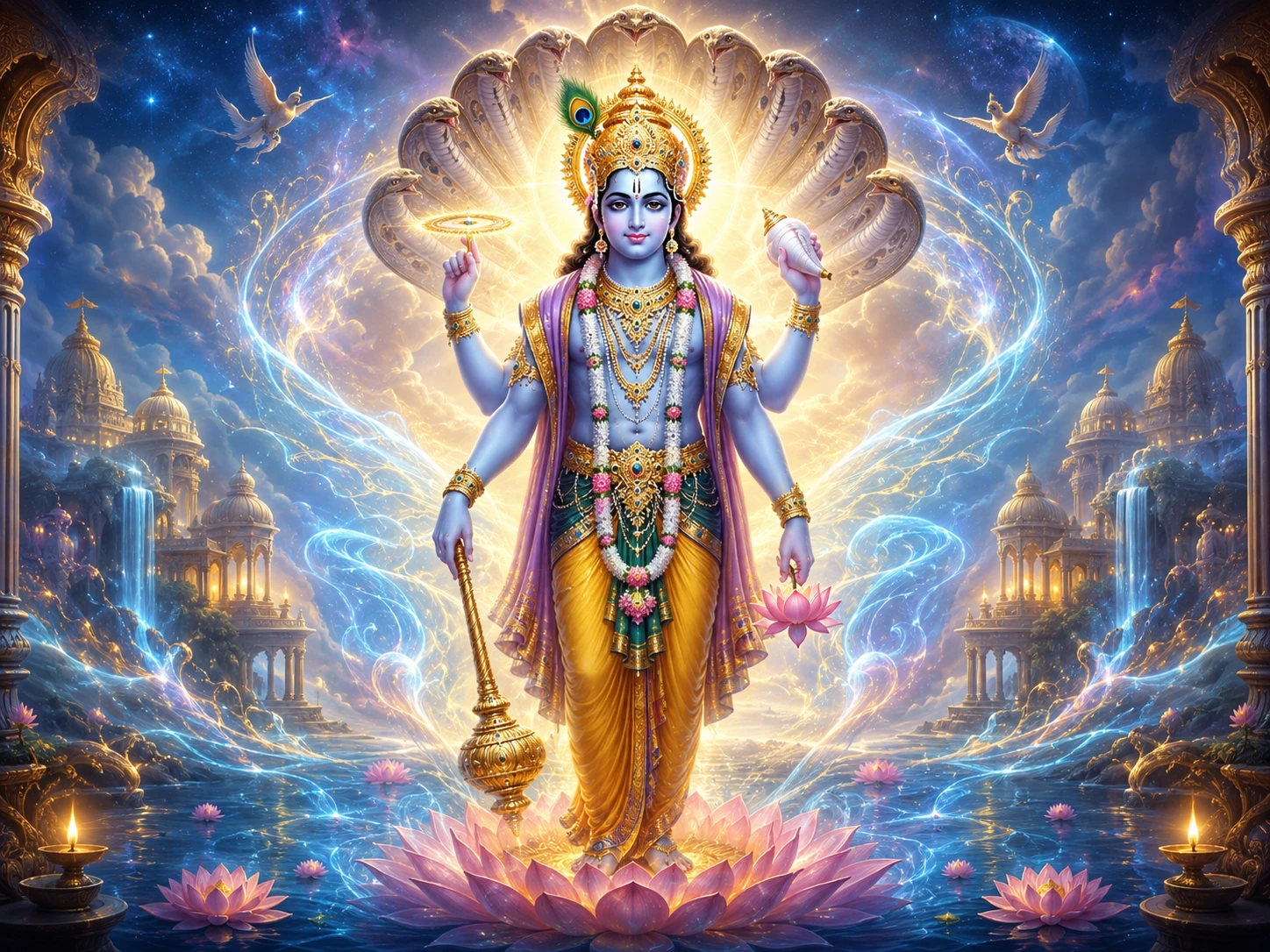
Om Namo Narayanaya -- The Eight-Syllable Key to Vishnu
ॐ नमो नारायणाय -- विष्णु का अष्टाक्षर मन्त्र
In Sri Vaishnavism -- the tradition founded on the teachings of Ramanujacharya and rooted in the Tamil Alvar poet-saints -- the Ashtakshara Mantra (Om Namo Narayanaya) holds the same position that 'La ilaha illallah' holds in Islam or the Shema holds in Judaism. It is the foundational declaration. Everything else in the tradition is commentary on these eight syllables.
The mantra appears in the Narayana Upanishad (also called the Narayana Atharvashirsha), one of the minor Upanishads associated with the Atharvaveda. The key verse states: 'Om ity agre vyaharet, nama iti pashchat, narayanaya ity uparishtat.' -- 'First utter Om, then Namah, then Narayanaya.' This is not casual instruction. The Upanishad prescribes a specific sequence because each component carries distinct metaphysical weight.
Om is the pranava -- the primordial sound from which all creation emerges. In Mandukya Upanishad terms, it contains the three states of consciousness (waking, dreaming, deep sleep) plus the transcendent fourth state (turiya). Namah means 'not mine' -- it is the negation of ahamkara (ego). The literal breakdown is 'na' (not) + 'mama' (mine), contracted to 'namah.' This is not a greeting. It is a philosophical act of surrender -- the conscious declaration that the self does not belong to itself. Narayanaya is the dative case of Narayana, meaning 'for Narayana' or 'unto Narayana.' Narayana itself derives from 'nara' (the eternal being/human) + 'ayana' (abode/refuge), making Narayana 'the refuge of all beings.'
Put together, the mantra reads: 'The primordial reality (Om) -- I am not my own (Namah) -- I exist for the refuge of all beings (Narayanaya).' It is simultaneously a cosmological statement, a psychological technique, and a devotional act. In eight syllables, you acknowledge the ground of reality, dissolve the ego's claim of ownership, and redirect your existence toward its ultimate purpose.
For someone in their twenties scrolling through LinkedIn at midnight, anxious about career growth, comparing themselves to batchmates who seem to be doing better -- the mantra's architecture offers a radical reframe. 'Na mama' -- this anxiety is not mine; it belongs to a constructed self-image that does not reflect my actual nature. 'Narayanaya' -- my existence has a purpose larger than my job title. This is not escapism. It is the most precise possible therapy for the specific modern disease of identity-attachment.
ॐ इत्यग्रे व्याहरेत्। नम इति पश्चात्। नारायणायेत्युपरिष्टात्। ॐ नमो नारायणायेत्ययमष्टाक्षरो मनुः॥
om ity agre vyāharet | nama iti paścāt | nārāyaṇāyety upariṣṭāt | om namo nārāyaṇāyety ayam aṣṭākṣaro manuḥ ||
First utter Om, then Namah, then Narayanaya. This Om Namo Narayanaya is the eight-syllabled sacred formula.
— Narayana Upanishad (Narayana Atharvashirsha), associated with Atharvaveda
The three great Vedantic acharyas -- Shankara, Ramanuja, and Madhva -- each interpreted the Ashtakshara differently, and their disagreements reveal the deepest fault lines in Hindu philosophy.
For Adi Shankaracharya (Advaita -- non-dualism), 'Namah' means 'I am not separate from Narayana.' The ego is dissolved not by submitting to a separate God but by realising there was never a separation. The mantra is a tool of jnana -- knowledge that the individual self (jivatma) is identical with the Supreme Self (Paramatma). When you chant 'Om Namo Narayanaya,' you are not calling out to someone else. You are remembering what you already are.
For Ramanujacharya (Vishishtadvaita -- qualified non-dualism), 'Namah' means 'I belong to Narayana and exist for His purpose.' The individual soul is real, God is real, and the relationship is real -- but the soul is a part of God, not separate from Him. The mantra is an act of prapatti (total surrender) -- the conscious choice to stop relying on one's own effort and instead trust completely in divine grace. Ramanuja's interpretation made the Ashtakshara the central mantra of Sri Vaishnavism and the key to his revolutionary claim that moksha is available to everyone regardless of caste, gender, or learning -- because surrender requires no qualification.
For Madhvacharya (Dvaita -- dualism), 'Namah' means 'I bow to Narayana who is eternally distinct from me.' The individual soul and God are permanently separate. The mantra is an act of bhakti -- devotional love directed toward a Being who will always remain the beloved Other. Moksha is not merger but eternal companionship. Madhva's interpretation preserves the emotional intensity of the devotee-God relationship -- you can love someone fully only if they remain distinct from you.
Three acharyas, three meanings of the same two syllables. And here is the remarkable thing: all three interpretations are available to you when you chant the mantra. You do not have to choose a philosophical camp before picking up your japa mala. The mantra holds all three simultaneously. This is the genius of Sanskrit sacred formulas -- they are semantically compressed enough to sustain multiple valid readings across centuries of philosophical evolution.
Three Vedantic Readings of 'Namah'
| School | Acharya | Meaning of Namah | Nature of Moksha | Mantra Function |
|---|---|---|---|---|
| Advaita | Shankaracharya | I am not separate from Narayana | Merger with Brahman | Jnana (knowledge tool) |
| Vishishtadvaita | Ramanujacharya | I belong to Narayana | Eternal service in Vaikuntha | Prapatti (surrender) |
| Dvaita | Madhvacharya | I bow to the eternally distinct Narayana | Eternal companionship with God | Bhakti (devotional love) |
All three readings are considered valid within their respective traditions. The mantra does not require choosing one interpretation -- its semantic compression allows multiple simultaneous readings.
The Ashtakshara is the foundation mantra of the Tirumala Tirupati temple -- the richest and most visited Hindu temple on earth, processing an average of 50,000 to 100,000 pilgrims daily. When devotees stand in the darshan queue -- sometimes for 12 to 24 hours -- the ambient chant that fills the air is 'Om Namo Narayanaya.' The Tirumala Tirupati Devasthanams (TTD) trust has made this mantra the sonic identity of the temple complex. It plays on loops in the queue corridors, during the darshan itself, and in the free meals served at the anna prasadam hall.
But the mantra's reach extends far beyond Tirumala. In the ISKCON tradition, 'Om Namo Narayanaya' is chanted alongside the Hare Krishna Mahamantra. In Swaminarayan temples across Gujarat and the global diaspora (BAPS and other branches), it forms part of daily worship. In the Datta Sampradaya (Dattatreya tradition) common in Maharashtra and Karnataka, 'Om Namo Narayanaya' is one of the three mantra pillars alongside 'Om Namah Shivaya' and 'Sri Guru Datta.' The mantra thus transcends sectarian boundaries within Hinduism itself.
The practice is straightforward. Traditional recommendation is 108 repetitions (one mala), ideally during Brahma Muhurta (roughly 4:00-5:30 AM), facing east, seated on an asana. However, the beauty of the Ashtakshara is that it carries no rigid prerequisites. You can chant it on the Mumbai local at 8:47 AM, crushed between commuters, headphones in, eyes closed. You can chant it while stuck in Bangalore traffic on the Outer Ring Road, the auto-rickshaw meter ticking. You can chant it while waiting for JEE results to load on a laggy NTA website. The mantra does not require a temple, a priest, or a specific posture. It requires only the willingness to say: not mine.
Advanced practitioners in the Sri Vaishnava tradition receive the Ashtakshara through panchasamskara -- a formal initiation involving five sacraments, including branding with the conch and chakra symbols on the upper arms. After initiation, the mantra is considered 'alive' in a different register. But Ramanuja himself argued that the basic chanting of 'Om Namo Narayanaya' is effective for anyone, initiated or not. This was one of his most revolutionary positions -- he essentially democratised access to the most powerful Vaishnava mantra by declaring that God's grace does not require an intermediary's permission.
Ramanujacharya's most famous act of rebellion was climbing the temple gopuram in Tirukoshtiyur and shouting the Ashtakshara Mantra to the public. His guru, Tirukkoshtiyur Nambi, had given him the mantra with strict instruction to keep it secret -- it was traditionally transmitted only to initiated Brahmins. Ramanuja agreed that sharing it might send him to hell, but argued that if it could liberate thousands, his personal damnation was a fair price. This act -- called 'Tanian' (the proclamation) -- is celebrated in Sri Vaishnava tradition as the moment the mantra became universal. The ISKCON founder A.C. Bhaktivedanta Swami Prabhupada, arriving in New York in 1965 with essentially nothing, performed a similar democratisation when he began chanting in Tompkins Square Park -- Sanskrit mantras that had been guarded by priestly gatekeeping for centuries, now available to anyone who happened to walk through a Manhattan park.
ॐ नमो नारायणाय नम ॐ नमो नारायणाय। नारायणाय नम ॐ नमो नारायणाय॥
om namo nārāyaṇāya nama om namo nārāyaṇāya | nārāyaṇāya nama om namo nārāyaṇāya ||
This is the japa pattern as chanted in Sri Vaishnava tradition -- the mantra repeated in a flowing cycle, each repetition seamlessly connecting to the next.
— Traditional Sri Vaishnava japa pattern (oral tradition)
Start Your Om Namo Narayanaya Japa
Chant the Ashtakshara mantra 108 times on a mala, ideally at Brahma Muhurta, and keep the same time every day to build a steady sadhana. The mantra's page on Eternal Raga gives its meaning and how to chant it.
Tags
Eternal Raga · शाश्वत राग
Institutional voice — scholarly articles on Sanatan Dharma
Deepen Your Understanding
अपनी समझ और गहरी करें
deities avatars
Dashavatara -- Why Vishnu Comes Back Ten Times
Fish, tortoise, boar, half-lion, dwarf, axe-warrior, prince, cowherd, enlightened teacher, future horseman. The ten avatars of Vishnu are not random folklore. Read them in sequence and you get something startling -- a narrative that mirrors evolutionary biology, tracks the rise and fall of political systems, and argues that God does not sit above history but enters it, gets dirty, and does the work. The Dashavatara is Hinduism's answer to the question every civilisation asks: why does the world keep breaking, and who fixes it?
deities avatars
Krishna Leela -- Why God Chose to Play
He stole butter, broke pots, lied to his mother's face, danced with married women under the full moon, and lifted an entire mountain on his little finger. The Bhagavata Purana's Tenth Skandha -- the most popular 4,000 verses in all of Hindu literature -- is not a biography. It is a theological argument that the Supreme Being's highest expression is not creation, destruction, or cosmic governance. It is play. Krishna Leela is the radical idea that God's truest nature is joy.
scriptural exegesis
Gita Chapter 12 -- Bhakti Yoga: The Shortest Chapter With the Longest Impact
With just 20 verses, Gita Chapter 12 is the shortest in the entire scripture -- yet it answers the biggest question: what does God actually want from you? Krishna's answer is not rituals, not renunciation, not philosophy. It is love. And then he draws the most specific personality sketch of an ideal human being ever written.
tantra mantra yantra
Om Namah Shivaya -- The Panchakshari Mantra
Five syllables. Three thousand years of continuous chanting. The most spoken mantra in Shaivism, extracted from the heart of the Vedas -- the eighth Anuvaka of the Sri Rudram in the Krishna Yajurveda. Na is earth. Ma is water. Shi is fire. Va is air. Ya is space. When you chant Om Namah Shivaya, you are not simply praying to a deity. You are vibrating the five elements that constitute your body, the universe, and the consciousness that witnesses both. This is how a mantra becomes a technology.
tantra mantra yantra
Tantra, Mantra and Yantra -- The Three Pillars of Spiritual Practice
Tantra is the loom, Mantra is the thread, Yantra is the pattern. Together they form the complete technology of spiritual transformation that India gifted to the world -- and they are far more profound than popular culture imagines.
deities avatars
Venkateswara -- The Lord of Seven Hills and the World's Most Visited God
Every day, 50,000 to 100,000 pilgrims climb the Seven Hills of Tirumala to see a deity whose face is so sacred that artificial eyes are placed over his real ones so devotees do not look directly into them. The Tirumala Tirupati Devasthanams receives more annual donations than the GDP of several small countries. Venkateswara is not just a god. He is an institution.
Ramanujacharya's most famous act of rebellion was climbing the temple gopuram in Tirukoshtiyur and shouting the Ashtakshara Mantra to the public. His guru, Tirukkoshtiyur Nambi, had given him the mantra with strict instr…
More in Tantra, Mantra & Yantra
Agama vs Tantra vs Veda -- Three Streams of Hindu Practice
14 min read
Agni Dhyana -- What Meditation on Fire Is Actually Grounded In
8 min read
Ashta Siddhi -- The Eight Yogic Powers and How Hanuman Embodies Them
13 min readThe same translation error that turned '33 Koti' into '33 crore' in Hinduism also happened in Buddhism. The Chinese translation of Buddhist texts rendered 'Sapta Koti Buddha' (7 Supreme Buddhas) as '7 Crore Buddhas.' The…
Deities AvatarsCommunity Reflections
🕉️
Be the first to share your reflection.