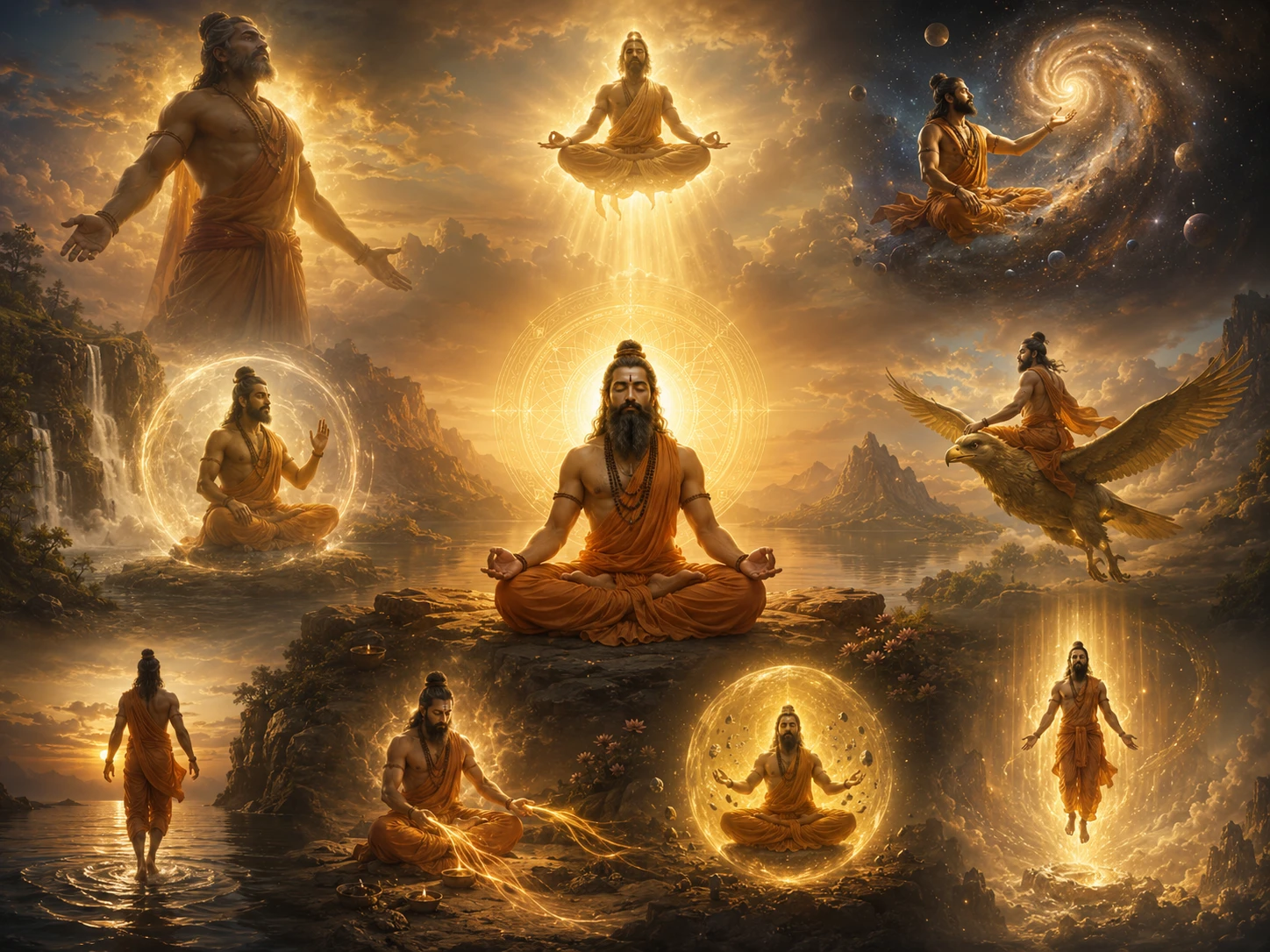
Ashta Siddhi -- The Eight Yogic Powers and How Hanuman Embodies Them
अष्ट सिद्धि -- आठ योग सिद्धियाँ और हनुमान का स्वरूप
Three texts, separated by roughly 1,800 years, all stop to enumerate the same eight powers. Patanjali catalogues them in the Vibhuti Pada around the second century BCE. Krishna repeats the list to Uddhava in the Bhagavata Purana, possibly compiled in the eighth or ninth century CE. Tulsidas tucks them into a single chaupai of the Hanuman Chalisa in sixteenth-century Awadh. The Sanskrit names line up almost perfectly across all three: Anima, Mahima, Garima, Laghima, Prapti, Prakamya, Ishitva, Vashitva. The eight yogic perfections.
This is what Hindu civilisation does with its serious ideas. It carries them, refines them, hands them across centuries. The Ashta Siddhi framework is not a fringe doctrine. It sits at the centre of the yoga tradition, and the figure most associated with it in Indian devotional memory is not a sage in samadhi but a vanara warrior on a mission for Sri Rama.
The puzzle is this. Patanjali warns explicitly that siddhis are obstacles to samadhi, traps for the seeker who mistakes power for liberation. And yet Hindu memory celebrates Hanuman as the master of all eight. How do these two positions reconcile? The answer turns out to be the most practical lesson in the entire siddhi literature, and one that lands directly on a UPSC aspirant in Old Rajinder Nagar at 4 AM.
अष्ट सिद्धि नौ निधि के दाता। अस बर दीन्ह जानकी माता॥
aṣṭa siddhi nau nidhi ke dātā asa bara dīnha jānakī mātā
You are the bestower of the eight siddhis and the nine treasures. Such a boon Mother Janaki herself granted to you.
— Hanuman Chalisa, Chaupai 31 (Goswami Tulsidas, c. 16th century CE)
Three observations about this verse. First, Tulsidas does not say Hanuman acquired the siddhis through tapasya or yoga. He says Sita gifted them. The framing is bhakti, not technique. Second, Hanuman is not just a possessor of the siddhis -- he is the dispenser. He can grant them to others. This is the function the Chalisa attributes to him in millions of households across India. Third, the verse joins the eight siddhis to the nine nidhis (treasures of Kubera). Power and prosperity, both delegated downward to a devotee.
The word siddhi is a slippery one. Patanjali uses it for paranormal abilities arising from samyama, the combined application of dharana, dhyana, and samadhi on a chosen object. The Bhagavata Purana frames the same powers as natural perfections of consciousness when it has fully purified itself. Sankhya teachers like Kapila treat siddhi differently still, as forms of attainment in the cognitive faculty rather than physical capability. Hanuman Chalisa folds all of this into a single bhakti grammar: the powers exist, they are real, they belong to the bhakta who has surrendered to Rama, and they are given through grace.
For the article, we will hold the three traditions side by side rather than collapse them into one. They are not competing accounts. They are complementary lenses on the same eight names.
ततोऽणिमादिप्रादुर्भावः कायसम्पत्तद्धर्मानभिघातश्च॥
tato'ṇimādi-prādurbhāvaḥ kāya-sampat-tad-dharmānabhighātaśca
From that [mastery over the elements through samyama] arises the manifestation of Anima and the rest, the perfection of the body, and immunity from being injured by the qualities of those elements.
— Patanjali Yoga Sutra 3.45 (Vibhuti Pada)
Patanjali names them in a single compound -- Anima-adi -- because the eight are a known set, an established list by his time. He does not need to enumerate. Vyasa's commentary, the oldest surviving gloss on the Sutras, fills in the names. Vachaspati Mishra in the ninth century elaborates further. By the time we reach the Bhagavata Purana, Krishna himself takes Uddhava through a structured count of eighteen siddhis -- the eight primary ones plus ten secondary ones -- in canto eleven, chapter fifteen. The eight remain the same eight.
What shifts across the traditions is the cause. Patanjali says they arise from samyama on the mahabhutas, the five elements. The Bhagavata Purana says they arise from the consciousness's own purified nature, through devotion to Krishna. The Hanuman Chalisa says they are bestowed by Sita as a vara, a boon. Three causal stories, one set of effects. Indian thought is comfortable with this kind of layering. A single phenomenon can have a yogic explanation, a theological explanation, and a devotional explanation, and they need not cancel each other out.
What follows in the comparison table is the canonical eight, with their meanings and the canonical Hanuman episode each is associated with in tradition. We have been careful here -- some popular framings on Instagram and YouTube conflate episodes incorrectly, and we have corrected those.
The Eight Siddhis -- Sanskrit Names, Meanings, and Hanuman Episodes
| Siddhi | सिद्धि | Meaning | Hanuman Episode (corrected) | Source |
|---|---|---|---|---|
| Anima (अणिमा) | अणिमा | Power to become smaller than the smallest, atom-like | Shrinks to cat-size to enter Lanka and search for Sita without alerting Lankini | Sundara Kanda 2.49--54 (Valmiki Ramayana) |
| Mahima (महिमा) | महिमा | Power to expand to limitless size | Expands to ocean-leaping proportions before crossing to Lanka, also shows the Vishvarupa-like form to Sita in Ashoka Vatika | Sundara Kanda 1 (ocean leap), Sundara Kanda 35 (form shown to Sita) |
| Garima (गरिमा) | गरिमा | Power to become immensely heavy, immovable | Makes his tail so heavy that Bhima, despite his strength, cannot lift it -- the Kadali-vana episode | Mahabharata, Vana Parva 146--148 (Bhima meets Hanuman) |
| Laghima (लघिमा) | लघिमा | Power to become weightless, to move without friction | The very leap to Lanka itself -- traversing 100 yojanas of ocean is a Laghima feat as much as a Mahima one | Sundara Kanda 1 (Valmiki Ramayana) |
| Prapti (प्राप्ति) | प्राप्ति | Power to obtain anything, reach any place, contact any being | Locates Sita in a city of millions, returns with the chudamani -- finding what is hidden is the Prapti signature | Sundara Kanda 14--38 (Valmiki Ramayana) |
| Prakamya (प्राकाम्य) | प्राकाम्य | Power to fulfill any desire, to act unobstructed | Fetches the entire Sanjeevani-bearing Dronagiri mountain when he cannot identify the herb -- desire fulfilled by lifting the whole problem | Yuddha Kanda 74 (Valmiki Ramayana, Lakshmana revival episode) |
| Ishitva (ईशित्व) | ईशित्व | Sovereign command over situations, mastery without ego | Carries the Dronagiri across continents while remaining unattached to the deed itself -- the lordship is over the task, not over self | Yuddha Kanda 74 |
| Vashitva (वशित्व) | वशित्व | Mastery over senses and over others' minds; the name Jitendriya derives from this capacity | Walks through Ravana's pleasure-gardens and harem at midnight searching for Sita and is never tempted -- the senses remain wholly under command | Sundara Kanda 9--11 (Valmiki Ramayana) |
Two corrections from popular social-media versions of this list: (1) The Garima episode where Hanuman becomes immovable is from Bhima's encounter in Mahabharata Vana Parva, not from any Lanka scene. (2) Mahima's clearest demonstration is the ocean leap and the Vishvarupa-like form shown to Sita, not the burning of Lanka -- the Lanka-dahan is a tail-fire escape, not a Mahima act per se.
Now to the deeper readings. The siddhis stop being a Marvel-comic checklist of superpowers when you notice that each one has a sober inner translation, repeatedly given by yoga commentators from Vyasa to Vivekananda. Anima is not just shrinking the body; it is the capacity to make oneself negligible, to enter rooms and conversations without occupying them. Mahima is not body-magnification; it is the inner expansion of consciousness to encompass the situation in front of you, so the situation does not crush you. Garima is gravitas, the unshakability of a mind that cannot be moved by panic, flattery, or threat. Laghima is the lightness of one who carries no resentment forward.
Prapti -- attainment -- is read by commentators as the reach of awareness rather than the reach of the hand. The yogi who has Prapti can touch the moon, says Vyasa, but the deeper meaning is that consciousness itself is non-local. Prakamya is the alignment of intention with reality so that what is wanted is also what arrives -- not because the wanting is forced on the world, but because the wanting has been refined down to what dharma is already producing. Ishitva is sovereignty without arrogance: the executive without ego. Vashitva is self-mastery so complete that the world reorganises itself around the steady centre.
Read this way, the Ashta Siddhi is a complete portrait of the integrated human being. Patanjali was not promising a circus act. He was naming what happens when consciousness is no longer fragmented across desire, fear, and self-image.
The framework lands hard on present-day India because every one of the eight has a recognisable adult counterpart. The IAS aspirant who walks into the interview room without taking up emotional space, who answers crisply and yields the floor -- that is Anima, real Anima. The startup founder in Koramangala who has just received a 50-crore funding offer and goes home, eats with her parents, sleeps her usual seven hours, and shows up at standup the next morning unchanged -- that is Garima. The young engineer at Tata Motors in Pune, dropped into a crisis on the assembly line, who expands her field of attention to take in the entire situation rather than reacting to one sub-failure -- that is Mahima. The senior manager who exits a toxic role and arrives at the new one without carrying the grudge across -- Laghima. The cricketer in the IPL final who, with seventeen needed off the last over, settles into a strike-rate calm that produces the right shot for the right ball -- Prakamya. The CEO who runs an organisation of eighteen thousand people without losing the thread of who she is in private -- Ishitva. The student preparing for NEET who can sit at her desk for ten hours with WhatsApp on the same table and never reach for it -- Vashitva.
This is not metaphor stretched too thin. This is what the siddhi tradition was always pointing toward. The supernatural framing serves a purpose -- it captures the attention of the seeker, it dignifies the practice, it gives mystery to what would otherwise sound like ordinary self-improvement. But the substance underneath is integrated human functioning at its highest level.
Patanjali himself warns against pursuing the siddhis. In Yoga Sutra 3.37, he calls them upasarga -- obstacles -- to samadhi, even though they are accomplishments in the outgoing state of mind. The deepest paradox of the Hanuman tradition is that he holds all eight precisely because he never sought even one. He was after Rama. The siddhis arrived as side effects of the chase, not as the chase itself.
ते समाधावुपसर्गा व्युत्थाने सिद्धयः॥
te samādhāv-upasargā vyutthāne siddhayaḥ
These [supernatural attainments] are obstacles in the state of samadhi, though they are accomplishments in the outgoing, ordinary state of mind.
— Patanjali Yoga Sutra 3.37 (Vibhuti Pada)
This sutra is the master key to the entire Vibhuti Pada. Patanjali takes thirty-five sutras to describe the powers, and then in one curt line tells the seeker not to want them. Why catalogue them at all? Because they are diagnostic. They confirm that the practice is working. A yogi who is approaching mastery will notice these capacities arising. The sutra warns: notice them, recognise them as evidence of progress, and keep walking. Do not stop to set up shop.
The reason siddhis become obstacles is straightforward. They reintroduce the very thing yoga is trying to dissolve -- the doer-self, the I-can-now-do-this self. Each demonstrated power inflates a subtle ego, and ego is the last barrier between the seeker and kaivalya, isolated awareness. Patanjali knows this from inside the practice. He is not being a killjoy. He is describing a real trap that catches real practitioners.
Hanuman walks past this trap because he never owns the powers in the first person. Every act in the Sundara Kanda is for Rama. The form-shifting is for the mission. The leap is for the news Sita is alive. The mountain-bearing is for Lakshmana's life. The siddhis pass through him; they do not adhere to him. This is exactly the disposition Patanjali points toward in 3.37, but where Patanjali warns through prohibition, the Ramayana shows through example.
Three Traditions on the Same Eight Siddhis
| Aspect | Patanjali Yoga Sutra | Bhagavata Purana | Hanuman Chalisa |
|---|---|---|---|
| Date and source | c. 2nd century BCE, Vibhuti Pada (3.37, 3.45) | c. 8th--9th century CE, Canto 11 Chapter 15 (Krishna to Uddhava) | 16th century CE, Chaupai 31 (Tulsidas) |
| Cause of siddhis | Samyama on the five elements | Pure consciousness purified through bhakti to Krishna | Boon from Sita to Hanuman |
| Number listed | Eight (Anima-adi, named in Vyasa-bhashya) | Eighteen total: 8 primary + 10 secondary | Eight siddhis + nine nidhis |
| Stance toward seeking | Warns explicitly: siddhis are obstacles to samadhi | Krishna says they arrive on their own when consciousness is fixed on Him | Bestowed by grace; Hanuman holds them only to dispense |
| Primary register | Yogic technique and discipline | Devotional yoga and divine description | Bhakti and surrender |
| What this means in practice | Walk past them, do not stop | Let them come, do not pursue | Surrender, and they reach you through Hanuman |
The three traditions are not contradictory. They describe the same eight names from three different methodological standpoints -- technique (Patanjali), description (Bhagavata), grace (Tulsidas). A serious seeker reads them together.
How does this sit on a young Indian life today? Practically, in three places. First, in the recognition that the eight siddhis are not magic to be acquired but byproducts of integrated practice. The student who has begun pranayama, who is reading the Gita, who is holding a steady sleep schedule -- she is already on the gradient. The siddhis at the small scale show up as concentration that holds for ninety minutes, equanimity in a difficult conversation, the absence of resentment toward a friend who got the offer she did not. These are real Anima, real Garima, real Laghima. Naming them helps her see the practice working.
Second, in the ego-trap warning. Many young Indians who get serious about meditation start collecting experiences -- a vivid dream, a sense of expansion in dhyana, a coincidence interpreted as siddhi. The Patanjali line in 3.37 is the protective warning. Walk past these. They are evidence that the work is on, not stations to occupy.
Third, in the Hanuman example. The path to siddhi is paradoxically the path of not-seeking. You give yourself fully to a worthy task -- preparing for Civil Services to serve, building a startup that genuinely solves a problem, raising children honestly -- and the eight perfections begin to form around you. They do not announce themselves. Years later, you notice you have become the kind of person who can shrink to fit a difficult conversation, expand to hold a crisis, remain heavy in panic, light in setbacks, find what is hidden, achieve what is needed, command without ego, master your own senses. That is when you realise the Chalisa has been describing you all along, in advance, through the figure of a vanara who carried a mountain.
A note worth pausing on: when Krishna in the Bhagavata Purana takes Uddhava through the siddhis, he does not stop at eight. He lists eighteen. The eight primary ones are the ashta-siddhi we have walked through. Beyond these, he gives ten secondary attainments that fill out the picture of what an integrated yogi can do. These ten include freedom from hunger and thirst, hearing things spoken at a distance, seeing things at a distance, moving the body wherever the mind wishes, entering another's body, dying at one's chosen moment, witnessing the play of celestials, having one's intentions become reality, gaining unobstructed command, and possessing irresistible word.
This fuller list deserves a moment because it explains why Hanuman appears in so many capacities at once across the Ramayana. He hears Sita's lament from a distance in Ashoka Vatika. He moves where his mind wishes -- to Lanka, back to Kishkindha, north to the Dronagiri, back to the battlefield. He speaks words that Ravana cannot dismiss. He chooses his moments of restraint and his moments of demonstration. The pattern matches the Bhagavata's expanded count, not just the Ashta Siddhi headline.
Why then does the Hanuman Chalisa fix on the eight? Because Tulsidas is writing a devotional hymn for daily recitation, not a yoga shastra. The eight are the canonical short-list, the most widely recognised, the names that travel easily through Avadhi and Brij and Bhojpuri household speech. The Chalisa compresses centuries of yoga literature into a single chaupai that a grandmother in a Kanpur lane and a software engineer in Hyderabad can both carry.
This is the genius of Hindu pedagogy. Patanjali built the technical map. Vyasa filled in the names. The Bhagavata gave the bhakti context. Tulsidas distilled it to a household-recitable line. Each layer did its specific job, and none made the others unnecessary. A serious seeker today reads all of them in series. A working professional may begin only with the chaupai and find that the deeper layers open up over years of practice.
There is also a Sankhya reading worth knowing. In the Sankhyakarika tradition, the eight siddhis are not paranormal at all -- they are eight forms of intellectual attainment that prepare the mind for kaivalya. Reasoning, hearing, study, removal of the threefold suffering, association with worthy minds, ritual purity, generosity, and knowledge from teachers. This is closer to the modern educational ladder than to anything supernatural. Sankhya's reading does not contradict Patanjali; it sits alongside as an alternate vocabulary for the same path.
When the IIT student in Mumbai sits at her desk, when the doctor at AIIMS performs surgery, when the army officer at the LAC holds command under pressure, when the homemaker in a Pune chawl raises children with patience -- the eight siddhis are at work in their Sankhya register. Anima as the discipline of focus. Mahima as the expansion of capacity to meet demand. Garima as the steadiness under stress. Laghima as the lightness that prevents burnout. Prapti as the access to knowledge that India's universities have built over decades. Prakamya as the alignment of skill and need. Ishitva as command without arrogance. Vashitva as the daily mastery of one's own appetites and reactions. Without ever calling them siddhis, present-day India is producing them at scale.
One closing note on Hanuman Jayanti and Tuesday observance. The traditional injunction to recite the Hanuman Chalisa on Tuesdays and Saturdays is not folkloric decoration. It is a structured practice that lays the verse including chaupai 31 over the practitioner's week with regularity. Tuesdays in many North Indian households mean a shorter meal, an evening visit to a Hanuman temple, the Chalisa recited eleven or one hundred and eight times. The young software engineer in Bengaluru who keeps this Tuesday discipline through her seven-year career, the police constable in Lucknow who recites the Chalisa before night duty, the cricket fan watching India play Australia at the SCG who chants it during a tense final over -- all of them are participating in the same structure that Tulsidas built four hundred years ago. The siddhi-vidya is folded into a household ritual that anyone can carry.
This is why the Ashta Siddhi article belongs in the Tantra-Mantra-Yantra section of Eternal Gyan and not only in a Hanuman entry. The siddhis are a mantra-yoga technology with a devotional carrier. They are technical and intimate at once. India never had to choose.
Recite the Hanuman Chalisa with Eternal Raga
The Hanuman Chalisa is on Eternal Raga with its meaning in English and Hindi -- including chaupai 31, the verse on the ashta siddhi. Recite it daily, or every Tuesday and Saturday.
Tags
Eternal Raga · शाश्वत राग
Institutional voice — scholarly articles on Sanatan Dharma
Deepen Your Understanding
अपनी समझ और गहरी करें
philosophy darshana
Yoga Darshana -- Patanjali's Science of the Mind
Before yoga became a global fitness trend worth $80 billion, it was India's most rigorous system of psychology. Patanjali's 196 sutras are not about touching your toes -- they are about rewiring your mind. Here is the philosophy the world forgot when it turned yoga into exercise.
deities avatars
Hanuman -- The Perfect Devotee
He could lift mountains, leap oceans, and burn Lanka to the ground -- yet his greatest power was this: he never forgot whose work he was doing. Hanuman is not just a mythological hero. He is the operating system of selfless devotion that India still runs on.
tantra mantra yantra
Hatha Yoga Pradipika
The 15th century yogi Svatmarama compiled 389 verses into the Hatha Yoga Pradipika, the single most influential manual of physical yoga ever written. Four chapters walk the practitioner from asana to pranayama to mudra to samadhi in a specific graduated sequence. Every modern yoga studio from Rishikesh to Los Angeles, even those that have forgotten the text's name, traces its practice back to what Svatmarama wrote.
tantra mantra yantra
Kundalini -- The Serpent Power That Sleeps at Your Spine's Base
A coiled serpent sleeps at the base of your spine. When awakened through yoga, mantra, or guru's grace, she rises through seven energy centres, dissolving every limitation of body and mind, until she merges with pure consciousness at the crown of your head. This is not New Age fantasy. This is the central psycho-spiritual technology of Tantric Hinduism -- mapped in Sanskrit texts over 1,500 years ago and now studied by neuroscientists at institutions from Harvard to NIMHANS Bangalore.
tantra mantra yantra
Kavacha Literature -- The Armour of Mantras
Karna wore physical armour fused to his body. But the Hindu tradition developed something more powerful -- armour woven from Sanskrit syllables that protects not the body but the soul. Narayana Kavacham, Devi Kavacham, Narasimha Kavacham: these are not prayers. They are force-fields activated by sound, assigning a specific deity to guard every inch of your being.
tantra mantra yantra
Shiva Samhita
An anonymous author in 14th or 15th century Varanasi compiled a yoga text that is unusual among the classical manuals -- it was written explicitly for householders, not renunciates. The Shiva Samhita has five chapters, teaches only four asanas, emphasises meditation and Kundalini over athletic posture, and opens with a philosophical claim straight out of Advaita Vedanta. It is also the only major hatha yoga text that frames itself as tantra throughout.
Patanjali himself warns against pursuing the siddhis. In Yoga Sutra 3.37, he calls them upasarga -- obstacles -- to samadhi, even though they are accomplishments in the outgoing state of mind. The deepest paradox of the …
More in Tantra, Mantra & Yantra
Agama vs Tantra vs Veda -- Three Streams of Hindu Practice
14 min read
Agni Dhyana -- What Meditation on Fire Is Actually Grounded In
8 min read
Bandhas and Mudras -- Locks and Seals as a Working System
11 min readThe same translation error that turned '33 Koti' into '33 crore' in Hinduism also happened in Buddhism. The Chinese translation of Buddhist texts rendered 'Sapta Koti Buddha' (7 Supreme Buddhas) as '7 Crore Buddhas.' The…
Deities AvatarsCommunity Reflections
🕉️
Be the first to share your reflection.