Kundalini -- The Serpent Power That Sleeps at Your Spine's Base
कुण्डलिनी -- मेरुदण्ड के मूल में सोई सर्प शक्ति
In any yoga class in Indiranagar, Bangalore, you will hear the word 'Kundalini.' In any wellness retreat in Rishikesh, you will be offered 'Kundalini awakening.' On Instagram, you will find influencers in athleisure claiming their Kundalini 'rose' during a breathwork session. The word has been so thoroughly appropriated by global wellness culture that its original meaning -- precise, technical, and deeply embedded in Tantric philosophy -- has been nearly lost.
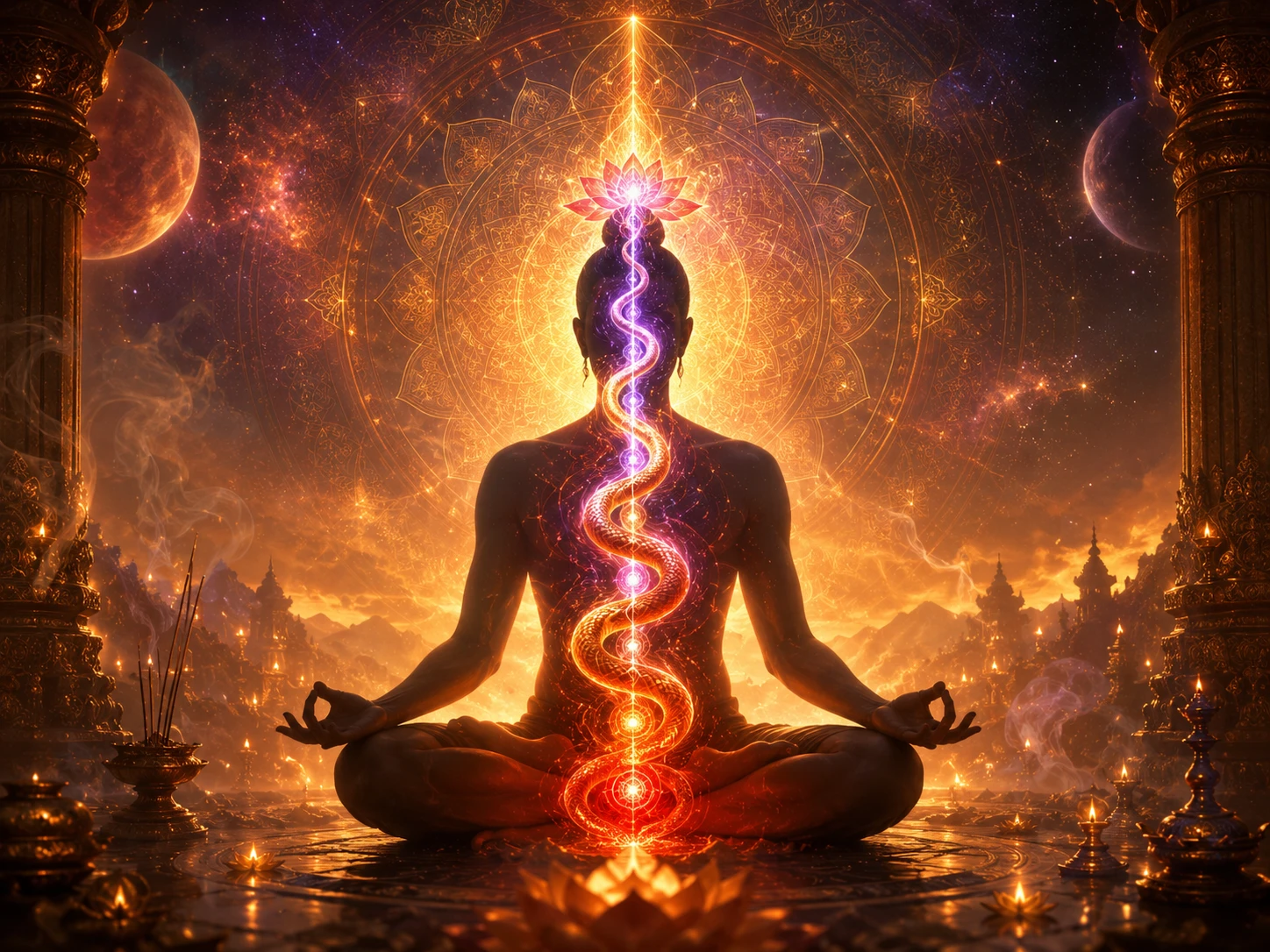
Kundalini (from the Sanskrit 'kundala' meaning 'coiled') refers to a dormant spiritual energy visualised as a serpent coiled three and a half times at the base of the spine, in the Muladhara Chakra. She is not a metaphor. In Tantric physiology, Kundalini is Shakti herself -- the cosmic feminine energy that has descended into the individual body and lies sleeping, waiting to be awakened.
When awakened -- through specific yogic practices (pranayama, bandha, mudra), mantra repetition, guru's transmission (shaktipat), or intense devotion -- Kundalini uncoils and begins to rise through the Sushumna Nadi (the central energy channel running along the spinal cord). As she ascends, she passes through each of the seven chakras (energy centres), activating and transforming them. When she reaches the Sahasrara (crown chakra), she merges with Shiva -- pure consciousness. This union is described as the ultimate spiritual experience: non-dual awareness, the dissolution of the individual self into the cosmic self.
The primary classical source is the Shat-Chakra-Nirupana (Description of the Six Centres) by Purnananda Swami (16th century CE), part of his larger work Shri-Tattva-Cintamani. Arthur Avalon's (Sir John Woodroffe's) 1919 translation 'The Serpent Power' introduced this text to the Western world and remains a standard reference. But the concepts appear much earlier -- in the Yoga Upanishads, the Hatha Yoga Pradipika (15th century), and various Tantric texts dating from the 8th-10th centuries.
The three-and-a-half coils are significant. Three coils represent the three gunas (sattva, rajas, tamas) and the three states of consciousness (waking, dreaming, deep sleep). The half coil represents the transcendent fourth state (turiya) -- the doorway to liberation that Kundalini opens.
कुण्डली कुटिलाकारा सर्पवत् परिवेष्टिता। शक्तिरूपा कुटिलाङ्गी भुजङ्गी कुण्डलाकृतिः॥
kuṇḍalī kuṭilākārā sarpavat pariveṣṭitā | śaktirūpā kuṭilāṅgī bhujaṅgī kuṇḍalākṛtiḥ ||
She who is coiled, of curved form, wrapped like a serpent, who is the form of Shakti, of curved body, serpentine, coil-shaped.
— Shat-Chakra-Nirupana, Verse 10 (Purnananda Swami, 16th century CE)
The Three Nadis -- Highways of Subtle Energy
Kundalini does not rise through the physical body. She rises through the subtle body (sukshma sharira) -- the energetic blueprint that underlies and interpenetrates the physical form. The subtle body's primary infrastructure consists of 72,000 nadis (energy channels), of which three are paramount:
Ida Nadi runs along the left side of the spine. It carries lunar, cooling, feminine energy. It governs the parasympathetic nervous system (rest-and-digest), intuition, creativity, and emotional processing. When Ida dominates, a person feels calm, reflective, and inward-focused.
Pingala Nadi runs along the right side. It carries solar, heating, masculine energy. It governs the sympathetic nervous system (fight-or-flight), analytical thinking, physical vitality, and outward action. When Pingala dominates, a person feels alert, energetic, and outward-focused.
Sushumna Nadi runs through the centre, along the spinal cord. It is the highway of Kundalini. In most people, Sushumna remains dormant -- prana flows alternately through Ida and Pingala (which is why your nostrils alternate in dominance throughout the day, as any yoga practitioner knows). When Ida and Pingala are balanced -- through pranayama, meditation, or grace -- prana enters Sushumna, and Kundalini begins to stir.
The three nadis meet at several junction points called granthis (knots): Brahma Granthi (at Muladhara, the knot of physical attachment), Vishnu Granthi (at Anahata, the knot of emotional attachment), and Rudra Granthi (at Ajna, the knot of intellectual attachment). Kundalini must pierce through each granthi to continue her ascent. Each piercing represents a fundamental letting-go: of physical security, of emotional dependency, of intellectual certainty.
A software architect at a Pune IT park who meditates before work and notices that her left nostril is open (Ida dominant) while coding creatively, and her right nostril opens (Pingala dominant) during standup meetings -- she is experiencing nadi dynamics in real time, whether she frames it in Sanskrit or not.
Three Primary Nadis -- At a Glance
| Nadi | नाड़ी | Position | Energy Type | Governs | Modern Parallel |
|---|---|---|---|---|---|
| Ida | इड़ा | Left of spine | Lunar, cooling, feminine | Intuition, creativity, rest | Parasympathetic nervous system |
| Pingala | पिंगला | Right of spine | Solar, heating, masculine | Analysis, vitality, action | Sympathetic nervous system |
| Sushumna | सुषुम्ना | Centre (spinal cord) | Neutral, transcendent | Kundalini ascent, samadhi | Central nervous system / vagus nerve (partial) |
The Ida-Pingala alternation corresponds to the nasal cycle -- the well-documented phenomenon in which nostril dominance shifts every 90-120 minutes. Yoga texts described this alternation centuries before it was clinically measured. The correspondence is suggestive but not proof of identity between nadis and nerves.
Researchers at NIMHANS Bangalore and the Swami Vivekananda Yoga Anusandhana Samsthana (S-VYASA) have studied Kundalini experiences using EEG, fMRI, and autonomic function tests. Their findings suggest that advanced meditators who report Kundalini-type experiences show measurable changes in brain wave patterns -- specifically, increased gamma wave coherence across brain regions that do not normally synchronise. Harvard Medical School researchers have similarly found that long-term meditators show structural brain changes consistent with descriptions in Tantric texts. None of this 'proves' Kundalini in the Tantric sense, but it establishes that the subjective experiences described in 1,500-year-old Sanskrit texts correspond to measurable neurological phenomena.
A Word of Caution -- Why Guru Matters
Every classical text on Kundalini contains the same warning: do not attempt forced awakening without a qualified guru. The Hatha Yoga Pradipika states that improper practice can lead to disease rather than liberation. The Kularnava Tantra insists that the guru's guidance is as essential to Kundalini practice as water is to a fish.
This is not mystical gatekeeping. Kundalini awakening, when it occurs in an unprepared body-mind, can produce intense and disorienting experiences: involuntary physical movements (kriyas), emotional upheavals, visual and auditory phenomena, disrupted sleep patterns, and psychological states that modern medicine might misdiagnose as psychotic episodes. Stanislav Grof, a psychiatrist who studied non-ordinary states of consciousness, coined the term 'spiritual emergency' for precisely these experiences.
The guru's role is not to 'give' Kundalini but to prepare the container (the body-mind) so that the energy can flow safely, and to guide the practitioner through the inevitable disruptions that accompany genuine awakening. Think of it as electrical wiring: Kundalini is high-voltage power. The nadis and chakras are the wiring. If the wiring is not prepared, the power blows the circuit.
This is why the traditional approach emphasises years of preparatory practice -- asana, pranayama, ethical conduct (yama-niyama), devotion, mantra -- before any direct Kundalini work. The Instagram-friendly version of 'awakening your Kundalini in a weekend workshop' is not just inaccurate. It can be genuinely harmful.
Begin Safely -- Nadi Shuddhi Pranayama
The safest entry point for kundalini-related practice is nadi shuddhi (alternate-nostril breathing), which balances ida and pingala without forcing an awakening. Sit comfortably, close the right nostril with the thumb, inhale through the left for 4 counts, close both nostrils for 4 counts, and exhale through the right for 4 counts. Reverse, and repeat for 10 minutes. The nadi shodhana page on Eternal Raga explains the technique step by step.
Tags
Eternal Raga · शाश्वत राग
Institutional voice — scholarly articles on Sanatan Dharma
Deepen Your Understanding
अपनी समझ और गहरी करें
tantra mantra yantra
The Seven Chakras -- Energy Centres That Map Your Inner Universe
You have seven power stations running along your spine. Each governs a specific domain of human experience -- from survival instinct to sexual energy to willpower to love to expression to intuition to cosmic consciousness. The chakra system is not mystical poetry. It is the most detailed map of human psychology ever embedded in a spiritual framework -- and modern neuroscience is only now catching up to what Tantric yogis described 1,500 years ago.
tantra mantra yantra
Tantra, Mantra and Yantra -- The Three Pillars of Spiritual Practice
Tantra is the loom, Mantra is the thread, Yantra is the pattern. Together they form the complete technology of spiritual transformation that India gifted to the world -- and they are far more profound than popular culture imagines.
tantra mantra yantra
Sri Yantra -- The Supreme Geometry of Creation
Nine interlocking triangles. 43 smaller triangles. A single point from which the entire universe unfolds. The Sri Yantra is the most complex and revered sacred diagram in Hinduism -- and modern mathematicians have found that constructing it requires solving simultaneous equations that Western mathematics did not formalise until the 18th century. This is not decoration. This is the visual body of the Goddess.
philosophy darshana
Shakta Philosophy -- Devi as Ultimate Reality
What if God is not He but She? Not an abstract principle but a living, breathing, dancing power? Shakta philosophy does not merely add a feminine dimension to Hindu theology. It inverts the entire structure: Shakti is the primary reality, and consciousness without her is inert. Shiva without Shakti is shava -- a corpse. This is not metaphor. This is metaphysics.
tantra mantra yantra
Dasha Mahavidya -- Ten Wisdom Goddesses Who Map the Entire Universe
One holds her own severed head. Another is an ugly old widow. A third paralyses enemies by seizing their tongues. The Dasha Mahavidya are not comfortable goddesses. They are the ten dimensions of reality that most religions are too afraid to acknowledge -- from transcendent beauty to terrifying destruction, from cosmic abundance to abject poverty. Together, they form the most complete map of feminine divinity ever conceived.
tantra mantra yantra
Nadis and the Subtle Body
Your body has 72,000 nadis. You will not find them in a surgical dissection. They are channels of prana, the subtle life energy, running through the subtle body that underlies the physical. Three are principal -- Ida running down the left, Pingala down the right, and Sushumna running through the centre of the spine. Every pranayama, every mudra, every mantra practice is shaping the flow of these invisible highways.
deities avatars
Devi Swaroopa -- Forms of the Goddess
She is Durga on the battlefield and Annapurna in the kitchen. She is Kali at the cremation ground and Lakshmi in the boardroom. She is Saraswati at the university and Parvati in the family. The Hindu Goddess is not one deity with accessories -- she is the entire spectrum of feminine power, from terrifying to tender, from cosmic to domestic. Understanding her forms is understanding the universe itself.
Researchers at NIMHANS Bangalore and the Swami Vivekananda Yoga Anusandhana Samsthana (S-VYASA) have studied Kundalini experiences using EEG, fMRI, and autonomic function tests. Their findings suggest that advanced medit…
More in Tantra, Mantra & Yantra
Agama vs Tantra vs Veda -- Three Streams of Hindu Practice
14 min read
Agni Dhyana -- What Meditation on Fire Is Actually Grounded In
8 min read
Ashta Siddhi -- The Eight Yogic Powers and How Hanuman Embodies Them
13 min readThe same translation error that turned '33 Koti' into '33 crore' in Hinduism also happened in Buddhism. The Chinese translation of Buddhist texts rendered 'Sapta Koti Buddha' (7 Supreme Buddhas) as '7 Crore Buddhas.' The…
Deities AvatarsCommunity Reflections
🕉️
Be the first to share your reflection.