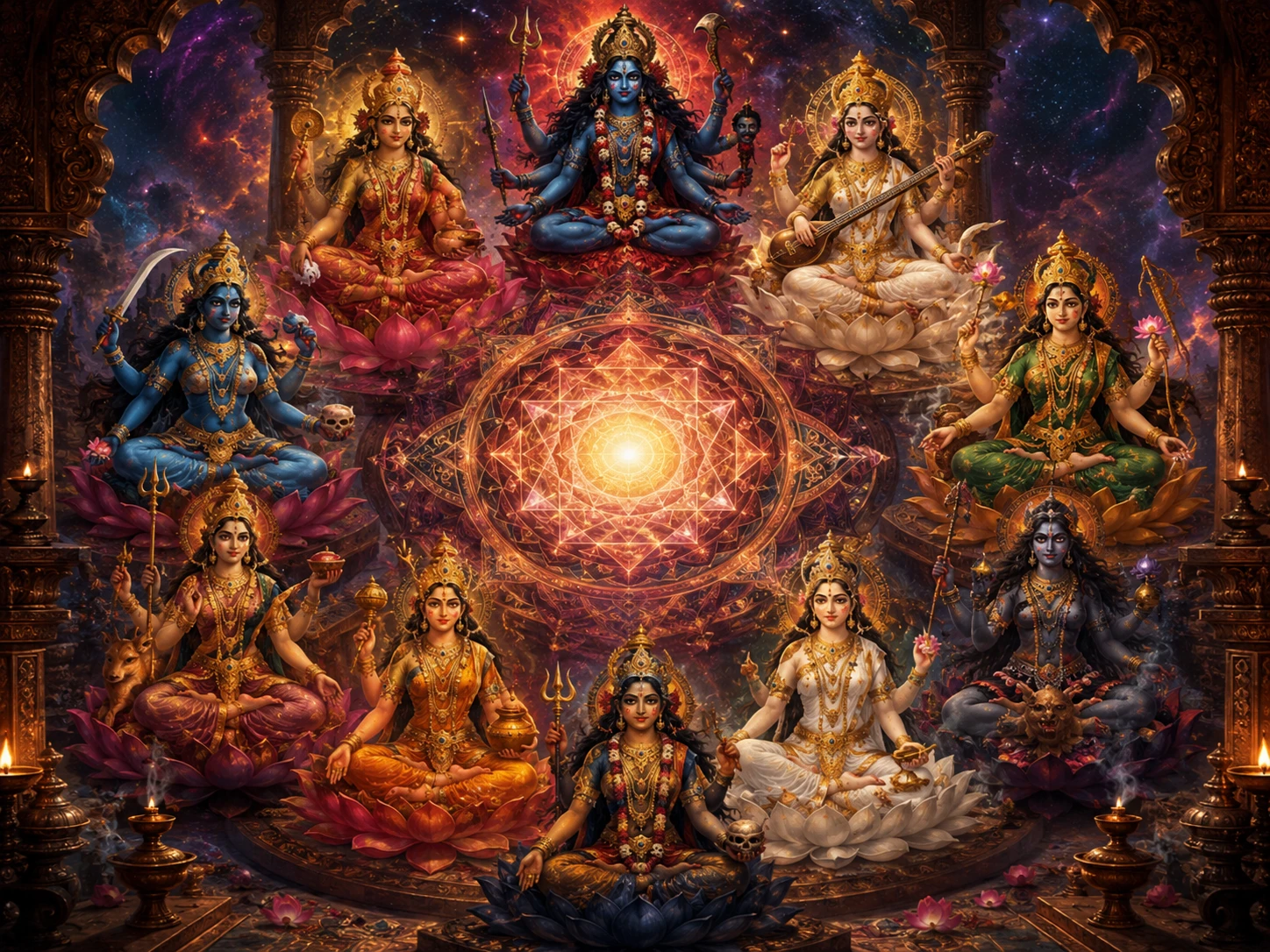
Dasha Mahavidya -- Ten Wisdom Goddesses Who Map the Entire Universe
दश महाविद्या -- दस ज्ञान देवियाँ जो सम्पूर्ण ब्रह्माण्ड का मानचित्र हैं
Most religions offer one or two images of the divine feminine: the gentle mother, the beautiful consort. Hinduism offers ten -- and several of them would terrify the average worshipper of any other tradition.
The Dasha Mahavidya (Ten Great Wisdoms) are ten forms of the supreme Goddess, each representing a distinct aspect of ultimate reality. They are not ten separate goddesses competing for devotees. They are ten lenses through which the one infinite Shakti allows herself to be perceived. The gentle and the terrifying, the beautiful and the grotesque, the auspicious and the inauspicious -- all are her. To worship only the pleasant forms is to know only half the truth.
The origin story, found in the Mahabhagavata Purana and other Shakta texts, is dramatic. When Sati (Shiva's first wife) wished to attend her father Daksha's yajna against Shiva's wishes, Shiva blocked her path. Furious at being denied her agency, Sati manifested ten terrifying forms that surrounded Shiva from all ten directions. Each form was so overwhelming that Shiva trembled and could not move. He surrendered, saying: 'Wherever I look, I see only you.' Sati had proved her point -- the Goddess cannot be contained, cannot be controlled, cannot be reduced to a single obedient form.
This origin story is not incidental. It establishes the Mahavidyas as expressions of feminine rage at patriarchal control -- a woman's refusal to be told where she can and cannot go. For any woman in India who has been denied permission by a father, husband, or in-law to attend an event, visit a place, or exercise her own choice -- Sati's ten-directional fury is not ancient mythology. It is lived experience given cosmic validation.
The ten Mahavidyas are traditionally listed in this order: Kali, Tara, Tripura Sundari (Shodashi), Bhuvaneshwari, Bhairavi, Chhinnamasta, Dhumavati, Bagalamukhi, Matangi, and Kamala. The sequence moves from the most terrifying (Kali) to the most conventionally beautiful (Kamala/Lakshmi), encompassing the entire spectrum of human and cosmic experience.
काली तारा महाविद्या षोडशी भुवनेश्वरी। भैरवी छिन्नमस्ता च विद्या धूमावती तथा॥ बगला सिद्धविद्या च मातङ्गी कमलात्मिका। एता दश महाविद्याः सिद्धविद्याः प्रकीर्तिताः॥
kālī tārā mahāvidyā ṣoḍaśī bhuvaneśvarī | bhairavī chinnamastā ca vidyā dhūmāvatī tathā || bagalā siddhavidyā ca mātaṅgī kamalātmikā | etā daśa mahāvidyāḥ siddhavidyāḥ prakīrtitāḥ ||
Kali, Tara, the Great Wisdom Shodashi, Bhuvaneshwari, Bhairavi, Chhinnamasta, Dhumavati, Bagalamukhi the Accomplished Wisdom, Matangi, and Kamala -- these are proclaimed as the Ten Great Wisdoms, the Accomplished Vidyas.
— Todala Tantra (traditional enumeration verse, also found in Mundamala Tantra)
The Ten -- A Complete Map of Reality
1. KALI -- The Power of Time and Transformation. Black-skinned, wild-haired, garlanded with severed heads, standing on Shiva's chest with her tongue extended. Kali is Time itself -- the force that devours everything and everyone, including itself. She is worshipped first because without dissolution, nothing new can arise. For the entrepreneur whose startup has just failed, for the student who did not clear JEE, for the employee who was laid off -- Kali is the reminder that destruction precedes creation. Her tongue is extended in surprise at having stepped on Shiva -- the classic Bengali interpretation -- showing that even cosmic power can have a moment of self-awareness.
2. TARA -- The Power of Compassion That Saves. Often confused with the Buddhist Tara (and possibly sharing historical origins), Tara is the Goddess who guides devotees across the ocean of worldly suffering. She is depicted standing on a cremation pyre, wearing a tiger skin, carrying scissors and a skull. She is the compassion that operates not through comfort but through cutting -- severing the devotee's attachment to suffering. Major worship centre: Tarapith in Birbhum, West Bengal.
3. TRIPURA SUNDARI (SHODASHI) -- The Power of Supreme Beauty. She is the most beautiful being in all three worlds (Tripura = three cities/worlds). She sits on a throne supported by Brahma, Vishnu, Shiva, and Rudra -- all four serving as legs of her seat. This is the Sri Vidya tradition's primary deity. Her worship involves the Sri Yantra and the Panchadashi (15-syllable) mantra. She represents the beauty inherent in all existence -- not superficial attractiveness but the radiant structure of reality itself. IIT researchers studying the mathematical properties of the Sri Yantra are, whether they know it, studying her geometry.
4. BHUVANESHWARI -- The Power of Space and Sovereignty. She is the Goddess as infinite space -- the container within which the universe exists. Where Kali is Time, Bhuvaneshwari is Space. Together they provide the fundamental coordinates of existence. She is depicted as beautiful, golden, seated on a lotus, holding a noose and goad. She is the cosmic queen who governs without force.
5. BHAIRAVI -- The Power of Fierce Grace. Bhairavi is the heat of tapas, the fire of spiritual practice, the burning intensity of devotion that scorches everything inessential. She is linked to the Kundalini fire that ascends through the chakras. Her worship is associated with the Bhairavas (fierce forms of Shiva) and represents the truth that genuine spiritual transformation is not gentle. It burns.
6. CHHINNAMASTA -- The Power of Self-Sacrifice. The most visually shocking of the Mahavidyas: she holds her own severed head in one hand while three streams of blood jet from her neck -- one into her own mouth, the other two feeding her attendants Dakini and Varnini. She stands on a copulating couple (Kama and Rati). The symbolism is dense: she feeds others with her own life force (the ultimate act of giving), she transcends sexual desire by standing above it, and she severs the ego (head = identity) to achieve liberation. For a generation raised on 'self-care' rhetoric, Chhinnamasta is a radical counter-narrative: sometimes the highest act is not caring for the self but giving the self away.
7. DHUMAVATI -- The Power of Absence and Desolation. She is the only Mahavidya who is a widow -- ugly, old, impoverished, riding a chariot with a crow banner. She has no consort, no beauty, no auspiciousness. She is the Goddess of everything that society discards: old age, widowhood, famine, defeat, loneliness. Her worship teaches that the divine is present even in the absence of all that is considered good. For the widow in Vrindavan whom society has abandoned, for the old parent in an empty house whose children have moved abroad -- Dhumavati says: I am here. Even here.
8. BAGALAMUKHI -- The Power to Paralyse Enemies. She seizes her enemy's tongue with her left hand and strikes him with a club in her right. She is the power to silence falsehood, to paralyse opposition, to freeze an adversary mid-attack. Her worship is especially popular among lawyers, politicians, and litigants -- which tells you something about how Indians understand the intersection of spirituality and power. Bagalamukhi temples in Datia (MP) and Kangra (HP) draw devotees seeking protection from legal and political enemies.
9. MATANGI -- The Power of the Outcast and the Artist. She is the 'outcaste' Goddess -- the Chandala, the Dombi, the one who dwells among the marginalised. She is also the Goddess of music, art, and creative expression. This combination is not accidental. In Hindu theology, true art comes from the margins, from the places that polite society ignores. Matangi is the patron deity of musicians, writers, and artists. She carries a veena and a parrot (symbol of speech). She is Saraswati's darker, wilder, more transgressive twin.
10. KAMALA -- The Power of Abundance and Lotus-Beauty. She is the Mahavidya form of Lakshmi -- bathed by four elephants, seated on a lotus, radiating golden light. She represents material and spiritual abundance, the culmination of the Mahavidya journey. After facing Kali's destruction, Tara's compassion, Chhinnamasta's sacrifice, Dhumavati's desolation, and all the other fierce truths -- Kamala is the reward: the beauty that emerges on the other side of everything. She is the lotus that grows from the mud.
Ten Mahavidyas -- Complete Reference
| # | Name | नाम | Domain | Iconography | Associated Cosmic Function |
|---|---|---|---|---|---|
| 1 | Kali | काली | Time and Destruction | Black, garland of heads, on Shiva | Dissolution -- what must end before creation |
| 2 | Tara | तारा | Compassionate Rescue | Blue, scissors, skull-cup, on pyre | Salvation -- guiding across the ocean of suffering |
| 3 | Tripura Sundari | त्रिपुर सुन्दरी | Supreme Beauty | Red/golden, on throne of 4 gods | Cosmic desire -- the beauty that drives creation |
| 4 | Bhuvaneshwari | भुवनेश्वरी | Space and Sovereignty | Golden, noose and goad, on lotus | Space -- the container of all existence |
| 5 | Bhairavi | भैरवी | Fierce Tapas | Red, fire-like, trident, book | Purifying fire of spiritual practice |
| 6 | Chhinnamasta | छिन्नमस्ता | Self-Sacrifice | Headless, feeding attendants | Ego dissolution and radical giving |
| 7 | Dhumavati | धूमावती | Absence and Sorrow | Old widow, crow, empty chariot | The divine in misfortune and void |
| 8 | Bagalamukhi | बगलामुखी | Paralysis of Enemies | Yellow, seizing tongue, club | Power to silence falsehood |
| 9 | Matangi | मातंगी | Art and Outcast Wisdom | Dark green, veena, parrot | Creativity born from the margins |
| 10 | Kamala | कमला | Abundance | Golden, elephants, lotus, wealth | Material and spiritual fullness |
The order and number of Mahavidyas can vary slightly across different Tantric traditions. The Todala Tantra and Mundamala Tantra enumerate the standard ten. Some traditions include additional forms or substitute one Mahavidya for another. The ten listed here represent the most widely accepted canonical sequence.
The Mahavidya tradition has left a visible mark on India's legal landscape. Bagalamukhi temples in Datia (Madhya Pradesh) and Kangra (Himachal Pradesh) see massive footfall before major court cases and elections. Lawyers, politicians, and business leaders routinely commission Bagalamukhi pujas to 'paralyse' their opponents. During state elections, the Datia temple reportedly sees a 300% increase in visitors. Whether or not this 'works,' it reveals something important: for millions of Indians, the boundary between spiritual practice and strategic action is not a boundary at all. The Mahavidyas are not museum pieces. They are operational deities.
Begin with Kali -- The First Mahavidya
The traditional entry point for Mahavidya practice is Kali, the first and most foundational. Her beej, Kreem, is traditionally received from a guru through initiation, and Eternal Raga's Kreem page presents it for understanding rather than open chanting. Without initiation, approach her through the devotional japa Om Kali Ma, 108 times on a mala, and the Mahakali Stotram; both are on Eternal Raga.
Tags
Eternal Raga · शाश्वत राग
Institutional voice — scholarly articles on Sanatan Dharma
Deepen Your Understanding
अपनी समझ और गहरी करें
deities avatars
Kali -- The Fierce Mother Who Devours Time Itself
Black-skinned, wild-haired, wearing a garland of fifty severed heads and a skirt of severed arms, standing on Shiva's chest with her tongue extended in shock -- Kali is the most misunderstood deity in Hinduism and the most theologically radical. She is not a demon. She is not 'dark energy.' She is Time in feminine form, the cosmic mother who destroys everything so that everything can be reborn. Ramakrishna called her 'Ma.' Millions still do.
deities avatars
Devi Swaroopa -- Forms of the Goddess
She is Durga on the battlefield and Annapurna in the kitchen. She is Kali at the cremation ground and Lakshmi in the boardroom. She is Saraswati at the university and Parvati in the family. The Hindu Goddess is not one deity with accessories -- she is the entire spectrum of feminine power, from terrifying to tender, from cosmic to domestic. Understanding her forms is understanding the universe itself.
philosophy darshana
Shakta Philosophy -- Devi as Ultimate Reality
What if God is not He but She? Not an abstract principle but a living, breathing, dancing power? Shakta philosophy does not merely add a feminine dimension to Hindu theology. It inverts the entire structure: Shakti is the primary reality, and consciousness without her is inert. Shiva without Shakti is shava -- a corpse. This is not metaphor. This is metaphysics.
tantra mantra yantra
Sri Yantra -- The Supreme Geometry of Creation
Nine interlocking triangles. 43 smaller triangles. A single point from which the entire universe unfolds. The Sri Yantra is the most complex and revered sacred diagram in Hinduism -- and modern mathematicians have found that constructing it requires solving simultaneous equations that Western mathematics did not formalise until the 18th century. This is not decoration. This is the visual body of the Goddess.
tantra mantra yantra
Tantra, Mantra and Yantra -- The Three Pillars of Spiritual Practice
Tantra is the loom, Mantra is the thread, Yantra is the pattern. Together they form the complete technology of spiritual transformation that India gifted to the world -- and they are far more profound than popular culture imagines.
scriptural exegesis
Devi Mahatmya -- The Three Charitas That Changed How India Worships the Feminine
700 verses. 13 chapters. Three battles. One thesis: when every god in the universe has failed, a woman finishes the job. The Devi Mahatmya from the Markandeya Purana is not just a scripture -- it is the founding document of Shakta theology and the reason 300 million people celebrate Navaratri.
tantra mantra yantra
10 Mahavidya Yantras
Ten goddesses. Ten geometries. Ten frequencies of awakening. The Das Mahavidya yantras are the most advanced tools in Shakta tantra, each a precision-engineered diagram mapped to a specific goddess, a specific siddhi, and a specific emotional landscape. Kali is not Kamala. Chinnamasta is not Bhuvaneshwari. The yantras make the difference visible.
The Mahavidya tradition has left a visible mark on India's legal landscape. Bagalamukhi temples in Datia (Madhya Pradesh) and Kangra (Himachal Pradesh) see massive footfall before major court cases and elections. Lawyers…
More in Tantra, Mantra & Yantra
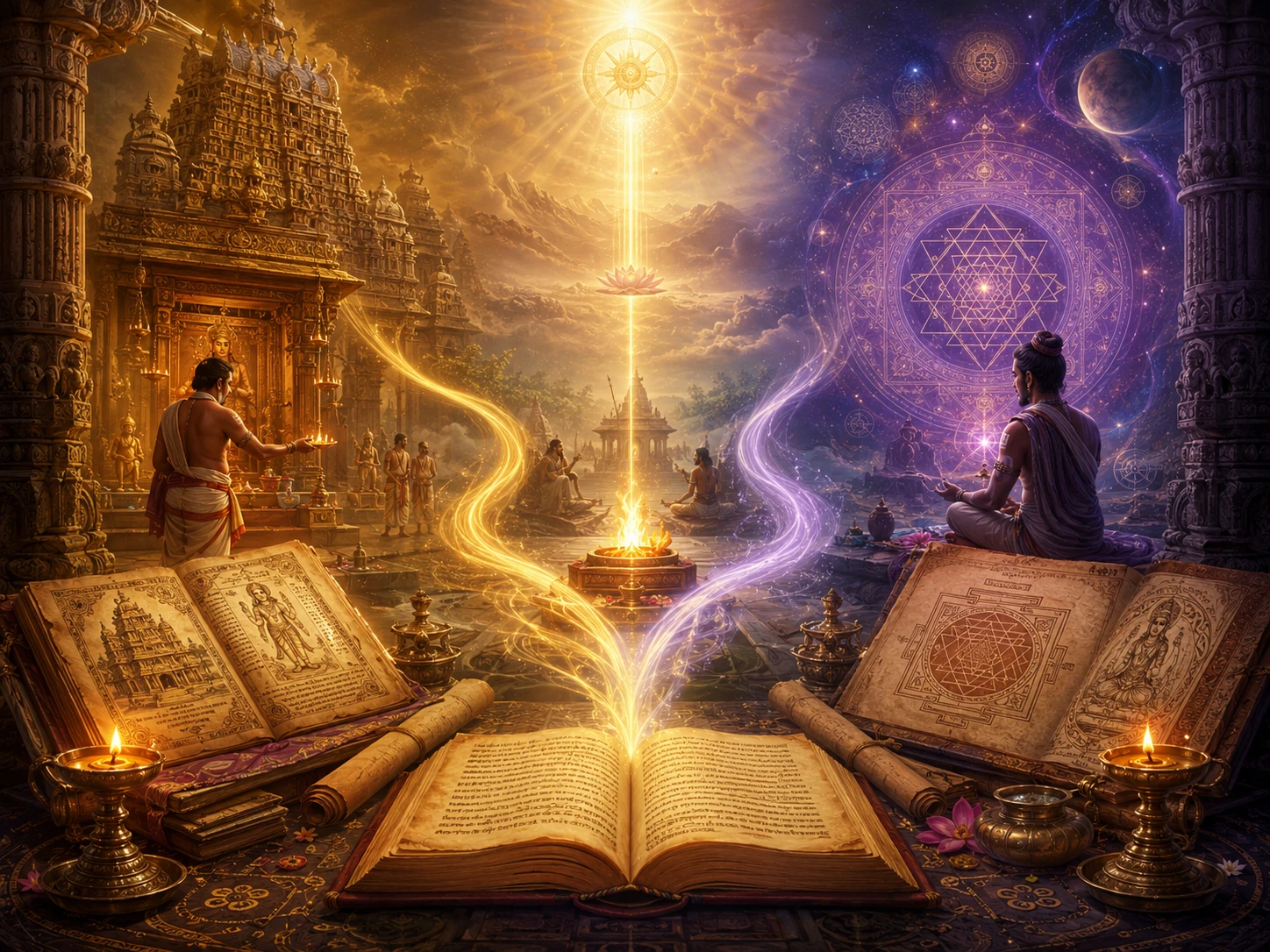
Agama vs Tantra vs Veda -- Three Streams of Hindu Practice
14 min read
Agni Dhyana -- What Meditation on Fire Is Actually Grounded In
8 min read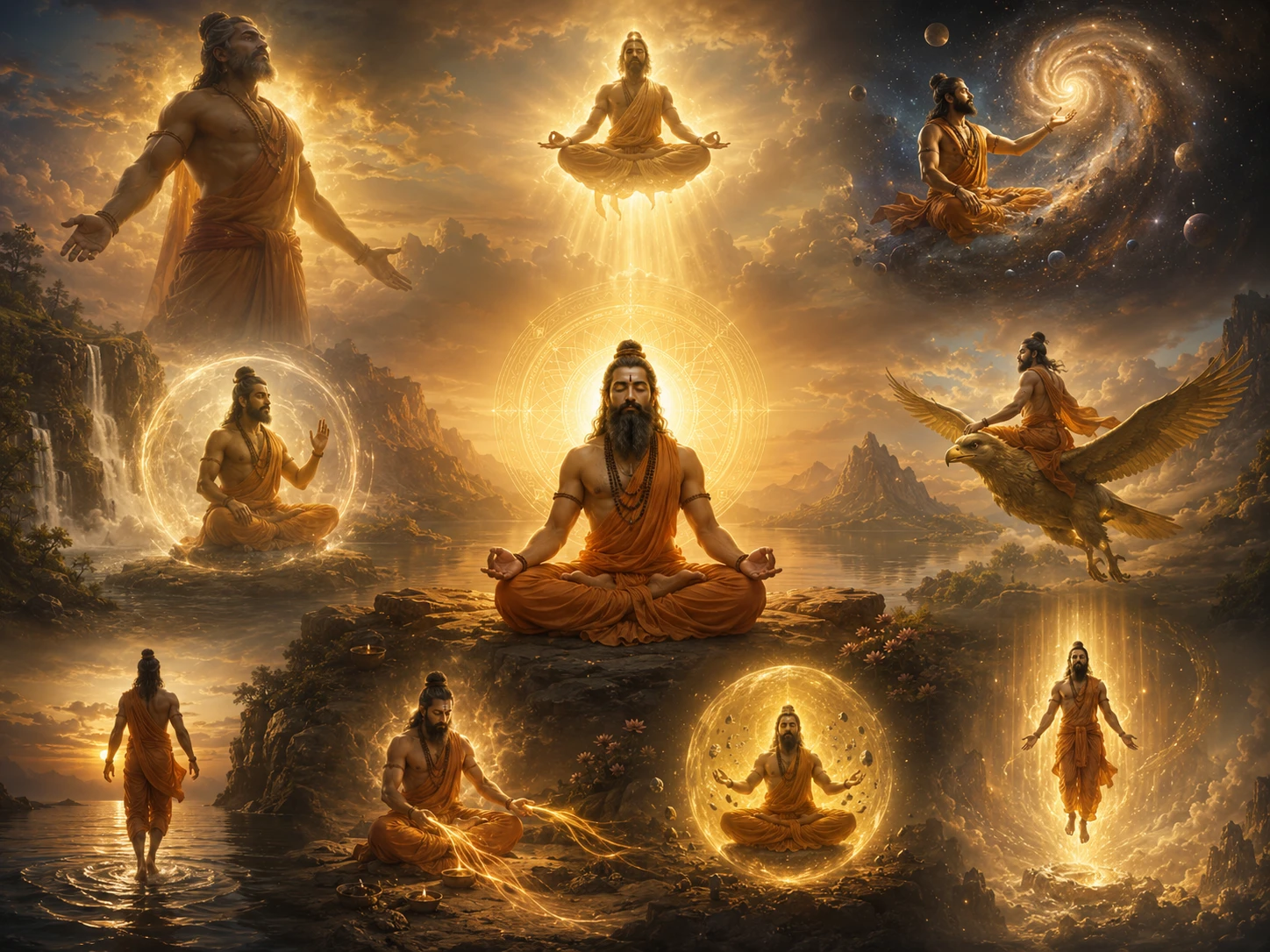
Ashta Siddhi -- The Eight Yogic Powers and How Hanuman Embodies Them
13 min readThe same translation error that turned '33 Koti' into '33 crore' in Hinduism also happened in Buddhism. The Chinese translation of Buddhist texts rendered 'Sapta Koti Buddha' (7 Supreme Buddhas) as '7 Crore Buddhas.' The…
Deities AvatarsCommunity Reflections
🕉️
Be the first to share your reflection.