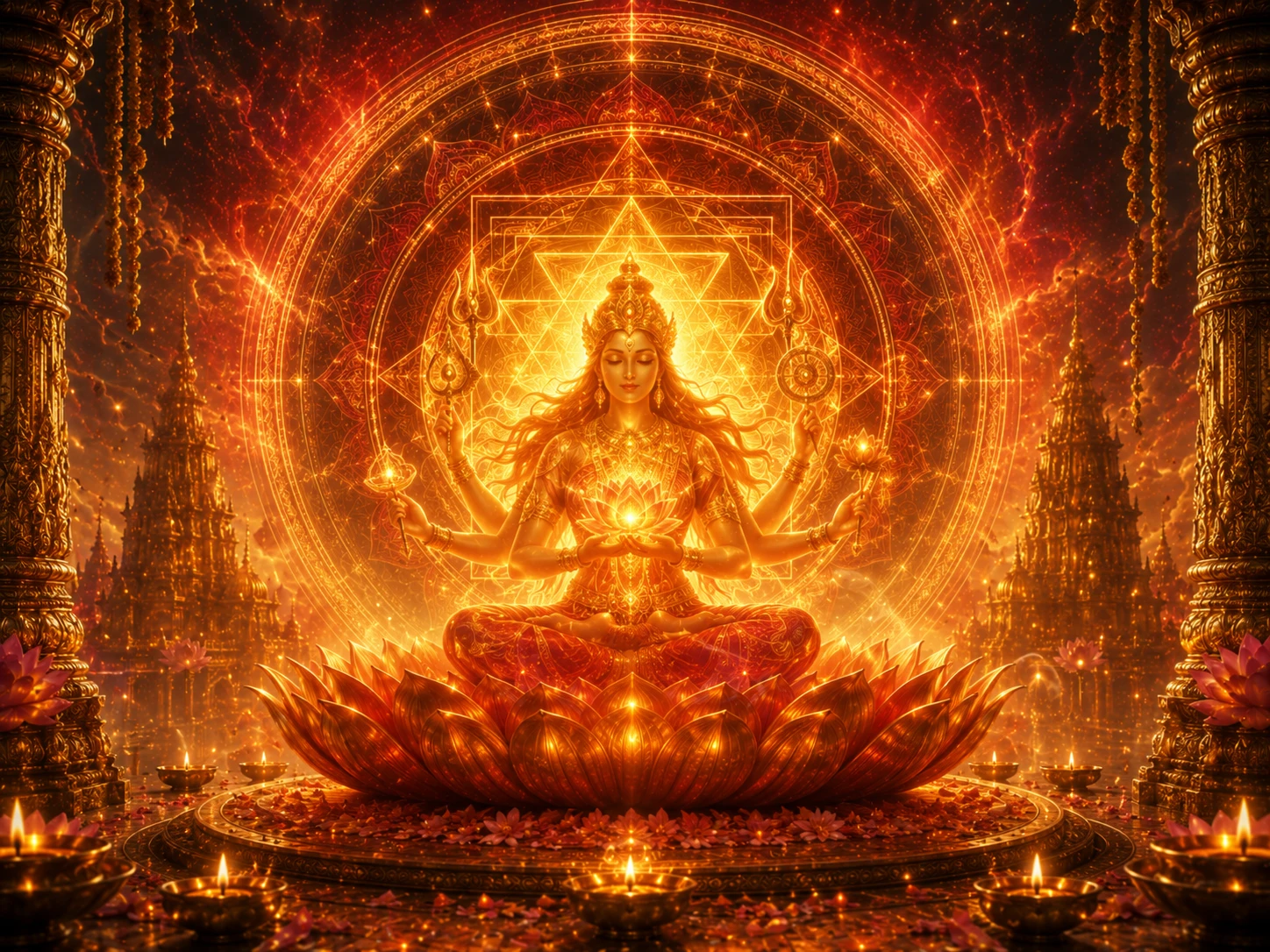
Shakta Philosophy -- Devi as Ultimate Reality
शाक्त दर्शन -- देवी परम तत्त्व
Walk into any bookshop in India -- whether it is Crossword in Kemps Corner or a dusty stall outside BHU -- and look at the philosophy section. You will find shelves on Advaita Vedanta (Shankara), Vishishtadvaita (Ramanuja), Dvaita (Madhva), Yoga (Patanjali), Buddhism, Jainism. You will rarely find a shelf labelled 'Shakta Philosophy.' Yet Shaktism is arguably the most practised philosophical tradition in India. Every temple that performs Agamic worship, every family that does Navratri puja, every devotee who chants 'Ya Devi Sarvabhuteshu' is operating within the Shakta framework -- whether they know it or not.
Shakta philosophy is the systematic articulation of a single radical idea: that the ultimate reality of the universe is not masculine consciousness (Purusha), not neuter Brahman, not personal God (Ishvara) -- but Shakti, the dynamic feminine power that creates, sustains, and dissolves all existence. In Shakta theology, consciousness (Shiva) without energy (Shakti) is literally a corpse. The famous formulation 'Shivah shaktivihinah shavah' -- 'Shiva without Shakti is a shava (corpse)' -- is not poetic exaggeration. It is an ontological claim: consciousness without the power to act, to create, to manifest is inert, dead, non-functional.
This is not a minor theological adjustment. It is a complete inversion of the Vedantic hierarchy that places abstract consciousness at the top and material energy as a lower manifestation. In Shaktism, energy IS consciousness in dynamic mode. There is no formless Brahman sitting above Shakti. Shakti IS the formless, and every form is her dance.
For the philosophy student preparing for NET-JRF, for the UPSC aspirant tackling optional philosophy, for anyone trying to understand why India worships the feminine divine with an intensity unmatched anywhere in the world -- Shakta philosophy is not a footnote. It is the main text that nobody assigned.
शिवः शक्त्या युक्तो यदि भवति शक्तः प्रभवितुम्। न चेदेवं देवो न खलु कुशलः स्पन्दितुमपि॥
śivaḥ śaktyā yukto yadi bhavati śaktaḥ prabhavitum | na ced evaṁ devo na khalu kuśalaḥ spanditum api ||
Shiva, only when united with Shakti, has the power to create. Without her, the God is not able even to stir.
— Saundaryalahari, Verse 1 (attributed to Adi Shankaracharya)
Three Streams of Shakta Thought
Shakta philosophy is not monolithic. It has three major sub-traditions, each with its own emphasis, practice, and relationship to the body:
The Samaya tradition (also called Dakshinachara -- 'right-hand path') is the most internalised and philosophical. It holds that the Goddess is to be worshipped entirely within the body through meditation on the chakras and the ascent of Kundalini. No external rituals, no physical substances, no social transgression. The Sri Vidya system as practised in South India -- particularly by the Shankaracharya mathas -- falls primarily in this stream. The great 7th-century philosopher Gaudapada (Shankara's guru's guru) is thought to have been a Shakta, and the Saundaryalahari attributed to Shankara himself is a deeply Shakta text.
The Kaula tradition (also called Vamachara -- 'left-hand path') is the most radical. It insists that liberation comes through embracing what conventional religion rejects: the body, sexuality, death, impurity. The Panchamakara (five M's) -- madya (wine), mamsa (meat), matsya (fish), mudra (parched grain/gesture), and maithuna (sexual union) -- are ritual substances used in Kaula worship. Whether these are literal or symbolic has been debated for centuries, but the philosophical point is clear: Shakti is present in all experiences, including those that polite society considers taboo. The Kaula tradition is strongest in Bengal, Assam, and Odisha.
The Mishra tradition (middle path) combines elements of both. It uses external rituals and substances but interprets them symbolically. Most mainstream Shakta worship in India today falls in this category -- the family that performs Navratri puja with a Kalash, chants the Saptashati, and offers prasad without engaging in Tantric ritual is practising Mishra Shakta worship.
These three streams are not competitors. They are stages of a single journey. The Mishra practitioner may graduate to Samaya meditation. The Kaula practitioner may return to Mishra simplicity. The Goddess accommodates all approaches because she IS all approaches.
The Key Texts -- Scriptural Foundation
Shakta philosophy draws on a rich textual tradition spanning Vedic, Puranic, Tantric, and devotional literature:
The Devi Suktam (Rigveda 10.125) is the earliest articulation of feminine divine sovereignty in any Indo-European scripture. The Devi Mahatmya (Markandeya Purana, 5th-6th century CE) is the foundational narrative text. The Devi Bhagavata Purana (9th-14th century CE) is the Shakta equivalent of the Bhagavata Purana -- presenting the Goddess's cosmic play (leela) across twelve books. The Lalita Sahasranama (from the Brahmanda Purana) lists 1,000 names of the Goddess in a precise sequence that maps the entire Sri Vidya philosophical system.
Beyond the Puranic texts, the Tantras form the practice-oriented backbone. The Kularnava Tantra, the Mahanirvana Tantra, the Yogini Tantra, and the Kali Tantra detail specific sadhana practices. The Saundaryalahari (attributed to Adi Shankara) describes the Goddess's beauty in 100 verses that simultaneously function as meditation instructions and yantra visualisations.
The Tripura Rahasya -- a relatively lesser-known but philosophically profound text -- presents Shakta Advaita (non-dualism from the Goddess perspective) through the story of Princess Hemalekha. It is sometimes called the 'Shakta Gita' for its clarity and depth.
For the serious student, the Devi Upanishads (Devi Upanishad, Tripura Upanishad, Saubhagya-Lakshmi Upanishad) bridge Vedantic and Tantric philosophy, establishing the Goddess's identity with Brahman in Upanishadic language.
Three Streams of Shakta Practice
| Aspect | Samaya (Right Path) | Kaula (Left Path) | Mishra (Middle Path) |
|---|---|---|---|
| Core Method | Internal meditation on Chakras | External ritual with Panchamakara | Combination of external and internal |
| Body View | Body as temple of Kundalini | Body as site of all experience | Body honoured but rituals external |
| Social Stance | Conventional, orthodox | Deliberately transgressive | Mainstream, family-oriented |
| Key Text | Saundaryalahari, Tripura Rahasya | Kularnava Tantra, Kali Tantra | Devi Mahatmya, Lalita Sahasranama |
| Geography | South India (Sringeri, Kanchi) | Bengal, Assam, Odisha, Nepal | Pan-India |
| Guru Lineage | Shankaracharya mathas | Kaula guru-shishya parampara | Family purohit tradition |
| Modern Accessibility | Requires initiation and long practice | Requires qualified guru (rare) | Accessible to all householders |
These categories are analytical, not rigid. Many practitioners combine elements of all three. The great 18th-century Shakta saint Bhaskararaya, for example, integrated Samaya philosophy with Kaula practice in his commentary on the Lalita Sahasranama.
The Shankara mathas -- the four monasteries established by Adi Shankaracharya, who is usually associated with Advaita Vedanta -- are all deeply Shakta in their daily practice. The Sringeri matha's presiding deity is Sharada (Saraswati). The Kanchi matha performs elaborate Sri Chakra puja. The Saundaryalahari, attributed to Shankara himself, is one of the most celebrated Shakta devotional texts in Sanskrit. This suggests that the sharp distinction between 'Vedantic' and 'Shakta' philosophy is a modern academic convenience that does not reflect how these traditions have historically co-existed. The greatest Advaitin may also have been one of the greatest Shaktas.
Shakta Philosophy in Modern Life
Shakta philosophy's relevance to modern India is not abstract. It operates in lived reality at every level.
At the political level, the Shakti Peetha network -- 51 (or 108, depending on tradition) sacred sites scattered across the subcontinent where parts of Sati's body fell -- constitutes one of the oldest pilgrimage networks in the world. From Kamakhya in Assam to Hinglaj in Balochistan (now Pakistan), from Naina Devi in Himachal to Kalighata in Kolkata, these sites create a sacred geography that predates nation-states and transcends political borders.
At the cultural level, India's most popular festivals are Shakta: Navratri, Durga Puja, Diwali (Lakshmi worship), Vasant Panchami (Saraswati worship), and Navaratri garba. The Goddess is not a marginal deity. She is the most-worshipped divine form in the subcontinent.
At the personal level, Shakta philosophy offers something that abstract Advaita Vedanta does not: a relationship. You can love the Goddess. You can argue with her. You can be angry at her. You can pour your confusion, your grief, your desperate midnight questions into a form that receives them. The Devi is not a concept. She is a person -- the ultimate person, infinite and intimate simultaneously.
For the MBA student at IIM Ahmedabad questioning whether success and spirituality are compatible, for the software engineer in Hyderabad feeling that temple visits are 'backward,' for the NRI in Toronto who cannot explain to her Canadian friends why she fasts during Navratri -- Shakta philosophy provides not just permission but a framework: the world is not an obstacle to the divine. The world IS the divine. Every spreadsheet, every code commit, every corporate presentation is Shakti in motion. You do not need to renounce the world to find God. You need to recognise God in the world. And that God has always been She.
Enter the Shakta Path -- Begin with Lalita Sahasranama
The Lalita Sahasranama is the gateway to Shakta practice; each of its thousand names encodes a philosophical principle. It is on Eternal Raga with the meaning of each name. Begin by reciting it once daily -- it takes about twenty-five minutes -- and watch how its language settles into you.
Eternal Raga · शाश्वत राग
Institutional voice — scholarly articles on Sanatan Dharma
Deepen Your Understanding
अपनी समझ और गहरी करें
deities avatars
Devi Swaroopa -- Forms of the Goddess
She is Durga on the battlefield and Annapurna in the kitchen. She is Kali at the cremation ground and Lakshmi in the boardroom. She is Saraswati at the university and Parvati in the family. The Hindu Goddess is not one deity with accessories -- she is the entire spectrum of feminine power, from terrifying to tender, from cosmic to domestic. Understanding her forms is understanding the universe itself.
scriptural exegesis
Devi Mahatmya -- The Three Charitas That Changed How India Worships the Feminine
700 verses. 13 chapters. Three battles. One thesis: when every god in the universe has failed, a woman finishes the job. The Devi Mahatmya from the Markandeya Purana is not just a scripture -- it is the founding document of Shakta theology and the reason 300 million people celebrate Navaratri.
tantra mantra yantra
Sri Yantra -- The Supreme Geometry of Creation
Nine interlocking triangles. 43 smaller triangles. A single point from which the entire universe unfolds. The Sri Yantra is the most complex and revered sacred diagram in Hinduism -- and modern mathematicians have found that constructing it requires solving simultaneous equations that Western mathematics did not formalise until the 18th century. This is not decoration. This is the visual body of the Goddess.
tantra mantra yantra
Kundalini -- The Serpent Power That Sleeps at Your Spine's Base
A coiled serpent sleeps at the base of your spine. When awakened through yoga, mantra, or guru's grace, she rises through seven energy centres, dissolving every limitation of body and mind, until she merges with pure consciousness at the crown of your head. This is not New Age fantasy. This is the central psycho-spiritual technology of Tantric Hinduism -- mapped in Sanskrit texts over 1,500 years ago and now studied by neuroscientists at institutions from Harvard to NIMHANS Bangalore.
tantra mantra yantra
Dasha Mahavidya -- Ten Wisdom Goddesses Who Map the Entire Universe
One holds her own severed head. Another is an ugly old widow. A third paralyses enemies by seizing their tongues. The Dasha Mahavidya are not comfortable goddesses. They are the ten dimensions of reality that most religions are too afraid to acknowledge -- from transcendent beauty to terrifying destruction, from cosmic abundance to abject poverty. Together, they form the most complete map of feminine divinity ever conceived.
tantra mantra yantra
Tantra, Mantra and Yantra -- The Three Pillars of Spiritual Practice
Tantra is the loom, Mantra is the thread, Yantra is the pattern. Together they form the complete technology of spiritual transformation that India gifted to the world -- and they are far more profound than popular culture imagines.
philosophy darshana
Sri Vidya -- The Philosophy of the Goddess as Ultimate Reality
Sri Vidya is the most rigorously argued of all goddess traditions. It does not say the Devi is one form of the divine. It says she is the divine, and Shiva is her stillness. This is the philosophy that produced the Sri Yantra, Lalita Sahasranama, and Saundarya Lahari -- and why it still asks for an initiated teacher in 2026.
The Shankara mathas -- the four monasteries established by Adi Shankaracharya, who is usually associated with Advaita Vedanta -- are all deeply Shakta in their daily practice. The Sringeri matha's presiding deity is Shar…
More in Philosophy & Darshana
The 14 Lokas -- Hindu Cosmology as a Map of Consciousness
14 min read
Achintya Bhedabheda -- Chaitanya's Theology of Inconceivable Difference-and-Unity
13 min read
Adhyasa -- Superimposition and the Foundational Error of the Self
13 min readThe same translation error that turned '33 Koti' into '33 crore' in Hinduism also happened in Buddhism. The Chinese translation of Buddhist texts rendered 'Sapta Koti Buddha' (7 Supreme Buddhas) as '7 Crore Buddhas.' The…
Deities AvatarsCommunity Reflections
🕉️
Be the first to share your reflection.