Sri Yantra -- The Supreme Geometry of Creation
श्री यन्त्र -- सृष्टि की सर्वोच्च ज्यामिति
In the mathematics department of IIT Madras, a professor once projected a Sri Yantra on the screen and asked a room of engineering students what they saw. Most said 'a religious symbol.' One student said 'a star pattern.' The professor smiled and said: 'You are looking at one of the most sophisticated geometric constructions ever produced by human civilisation -- and nobody assigned it as homework because it is classified as religion, not mathematics.'
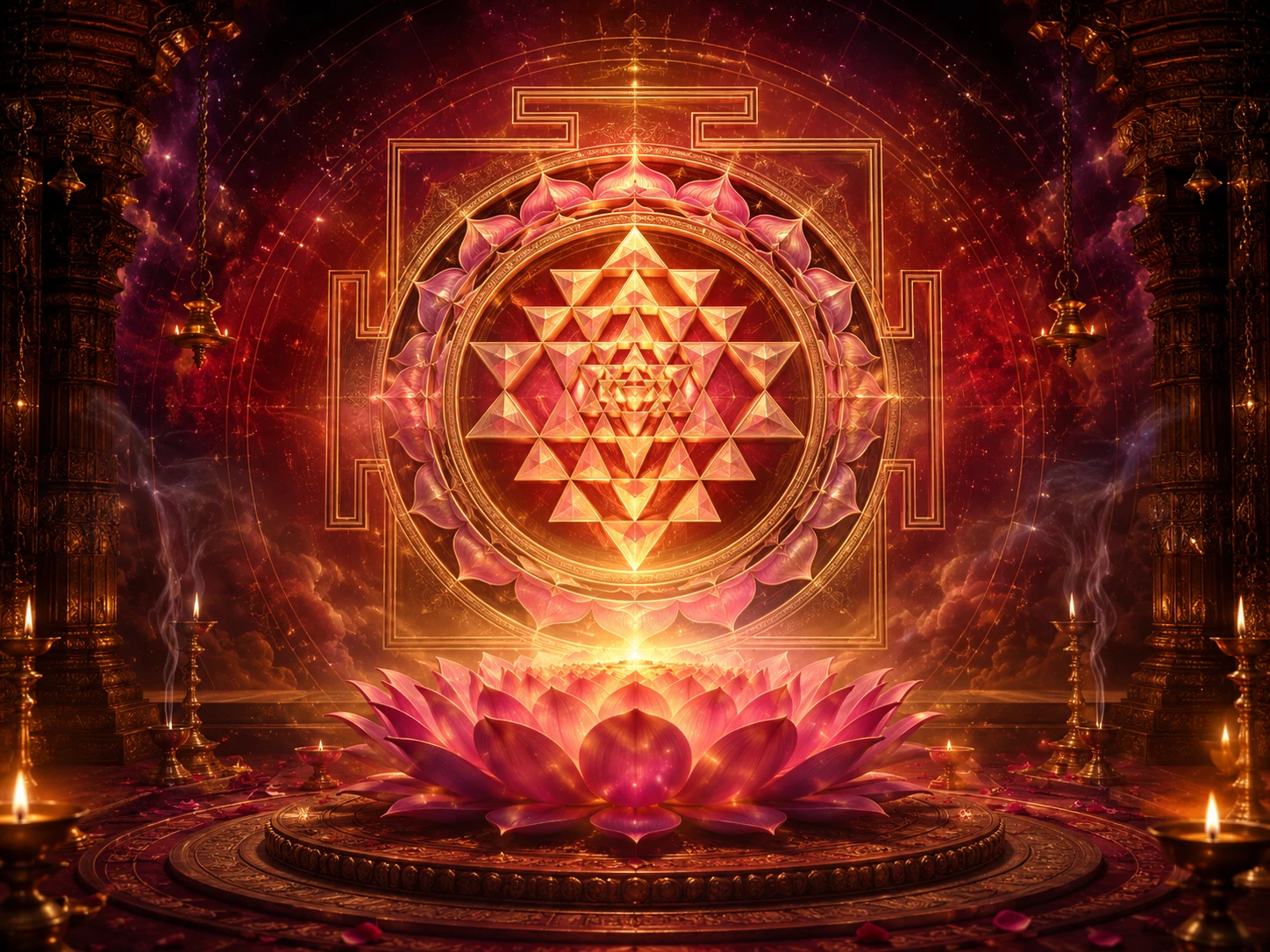
The Sri Yantra (also called Sri Chakra) is a diagram composed of nine interlocking triangles -- four pointing upward (representing Shiva/consciousness) and five pointing downward (representing Shakti/energy). These nine triangles, when they intersect, create exactly 43 smaller triangles arranged in a concentric pattern around a central point called the Bindu. The entire structure is enclosed within two concentric circles of lotus petals (one with 8, one with 16), which are themselves enclosed within a square boundary called the Bhupura with four gates.
Every element is symbolic. The Bindu is the point of creation -- undifferentiated consciousness from which all multiplicity emerges. The upward triangles are Shiva (pure awareness, static). The downward triangles are Shakti (dynamic energy, creative power). Their union produces the universe. The lotus petals represent the unfolding of creation. The Bhupura is the material world -- the square, earthly container of the cosmic dance.
But the Sri Yantra is not merely symbolic. It is mathematically rigorous. Constructing it accurately requires that all nine triangles intersect at exactly 54 points (called marma sthanas -- vital junction points). If even one triangle is slightly off, the entire pattern collapses into incoherence. In 1987, a study at the School of Architecture, CEPT Ahmedabad, demonstrated that the precise construction of the Sri Yantra requires solving a system of simultaneous non-linear equations. Similar findings emerged from researchers at IIT Kanpur. This level of mathematical sophistication was not formalised in European mathematics until the work of Newton and Leibniz in the 17th-18th centuries.
The question is not whether the ancient creators 'knew' calculus. The question is: how did they arrive at a construction so precise that it accidentally satisfies mathematical conditions that would not be formally described for another millennium? The Tantric tradition's answer is straightforward: through dhyana (meditation). The Sri Yantra was not calculated. It was seen.
बिन्दुत्रिकोणवसुकोणदशारयुग्म- मन्वश्रनागदलसंयुतषोडशारम्। वृत्तत्रयं च धरणीसदनत्रयं च श्रीचक्रमेतदुदितं परदेवतायाः॥
bindu-trikoṇa-vasukoṇa-daśāra-yugma- manvaśra-nāga-dala-saṁyuta-ṣoḍaśāram | vṛtta-trayaṁ ca dharaṇī-sadana-trayaṁ ca śrī-cakram etad uditaṁ para-devatāyāḥ ||
The Bindu, triangle, eight-cornered figure, pair of ten-pointed stars, fourteen-pointed star, eight-petalled and sixteen-petalled lotuses, three circles, and three-lined square boundary -- this is the Sri Chakra, proclaimed as belonging to the Supreme Goddess.
— Saundaryalahari, Verse 11 (attributed to Adi Shankaracharya)
The Nine Enclosures -- Navavarana
The Sri Yantra is not a flat diagram to be admired from the outside. It is a map to be entered. The Navavarana (nine enclosures) system describes the Sri Yantra as a series of concentric layers, each representing a stage in the devotee's journey from the material world to absolute consciousness.
The journey begins at the outermost layer -- the Bhupura (square boundary with four gates) -- representing the earth plane and the physical body. It moves inward through the lotus petals (desire and fulfilment), through the series of triangular enclosures (the dissolution of duality), until it reaches the innermost point: the Bindu, where Shiva and Shakti are one, where subject and object merge, where the individual self recognises itself as the universal self.
Each enclosure has its own presiding deity, its own set of yoginis (divine attendants), its own mantra, and its own offering. The Navavarana Puja -- the worship of all nine enclosures in sequence -- is the highest ritual in the Sri Vidya tradition. It takes 4-6 hours to perform correctly and requires initiation from a qualified guru.
The nine enclosures, from outside to inside: Trailokya Mohana (Enchanter of the Three Worlds), Sarvashaparipuraka (Fulfiller of All Desires), Sarvasamkshobhana (Agitator of All), Sarvasaubhagyadayaka (Bestower of All Auspiciousness), Sarvarthasadhaka (Accomplisher of All Purposes), Sarvarakshakara (Protector of All), Sarvarogahara (Remover of All Diseases), Sarvasiddhiprada (Bestower of All Perfections), and Sarvanandamaya (Full of All Bliss).
Notice the progression: from enchantment (being attracted to the divine) through desire, agitation, auspiciousness, accomplishment, protection, healing, perfection, to bliss. It is a complete psychological journey mapped onto sacred geometry. When a JEE aspirant in Kota feels the progression from initial fascination with a subject to deep struggle to eventual mastery -- that is, in miniature, the Navavarana journey.
Sri Yantra Components -- Structure Decoded
| Component | घटक | Count | Symbolism | Navavarana Layer |
|---|---|---|---|---|
| Bindu | बिन्दु | 1 | Source of creation, Shiva-Shakti union | 9th (innermost) -- Sarvanandamaya |
| Inner Triangle | अन्तः त्रिकोण | 1 | Kama-Kala triangle of desire | 8th -- Sarvasiddhiprada |
| Ashtar (8 triangles) | अष्टार | 8 | Eight Vasini Shaktis | 7th -- Sarvarogahara |
| Inner Dashar (10 triangles) | अन्तः दशार | 10 | Ten Kulotteerna yoginis | 6th -- Sarvarakshakara |
| Outer Dashar (10 triangles) | बहिः दशार | 10 | Ten Sarvasiddhiprada yoginis | 5th -- Sarvarthasadhaka |
| Chaturdashara (14 triangles) | चतुर्दशार | 14 | Fourteen Sarvamangala yoginis | 4th -- Sarvasaubhagyadayaka |
| Ashtadala Padma | अष्टदल कमल | 8 petals | Eight powers (Ananga group) | 3rd -- Sarvasamkshobhana |
| Shodashadala Padma | षोडशदल कमल | 16 petals | Sixteen desire-powers | 2nd -- Sarvashaparipuraka |
| Bhupura | भूपुर | Square + 4 gates | Material world, ten Siddhi devis | 1st (outermost) -- Trailokya Mohana |
The total count of triangles (1 + 8 + 10 + 10 + 14 = 43) plus the Bindu represents the complete mapping of cosmic creation. The 43 triangles are formed by the intersection of the 9 primary triangles -- 4 upward (Shiva) and 5 downward (Shakti).
The Sringeri Sharada Peetham -- established by Adi Shankaracharya himself, the great Advaitin -- has a Sri Yantra consecrated in its sanctum that is worshipped daily with full Navavarana Puja. The Kanchi Kamakoti Peetham similarly centres its worship around the Sri Chakra. The fact that the two most important Advaita Vedanta institutions in India perform daily Sri Yantra worship reveals that the supposed divide between 'Vedantic philosophy' and 'Tantric practice' is largely an academic fiction. In reality, the highest philosophical traditions and the most elaborate ritual traditions have always been deeply intertwined. The geometry of the Sri Yantra is simultaneously the highest mathematics and the deepest devotion.
Meditate on the Sri Yantra
The simplest Sri Yantra practice needs no initiation: place a printed or etched Sri Yantra before you, light a lamp, and gaze at the bindu, the central point, for fifteen minutes without moving your eyes. Let the geometry enter your awareness. The Lalita Sahasranama calls the goddess Bindu-mandala-vasini, she who dwells in that bindu; it is on Eternal Raga with each name's meaning.
Tags
Eternal Raga · शाश्वत राग
Institutional voice — scholarly articles on Sanatan Dharma
Deepen Your Understanding
अपनी समझ और गहरी करें
tantra mantra yantra
Tantra, Mantra and Yantra -- The Three Pillars of Spiritual Practice
Tantra is the loom, Mantra is the thread, Yantra is the pattern. Together they form the complete technology of spiritual transformation that India gifted to the world -- and they are far more profound than popular culture imagines.
tantra mantra yantra
Dasha Mahavidya -- Ten Wisdom Goddesses Who Map the Entire Universe
One holds her own severed head. Another is an ugly old widow. A third paralyses enemies by seizing their tongues. The Dasha Mahavidya are not comfortable goddesses. They are the ten dimensions of reality that most religions are too afraid to acknowledge -- from transcendent beauty to terrifying destruction, from cosmic abundance to abject poverty. Together, they form the most complete map of feminine divinity ever conceived.
philosophy darshana
Shakta Philosophy -- Devi as Ultimate Reality
What if God is not He but She? Not an abstract principle but a living, breathing, dancing power? Shakta philosophy does not merely add a feminine dimension to Hindu theology. It inverts the entire structure: Shakti is the primary reality, and consciousness without her is inert. Shiva without Shakti is shava -- a corpse. This is not metaphor. This is metaphysics.
tantra mantra yantra
Kundalini -- The Serpent Power That Sleeps at Your Spine's Base
A coiled serpent sleeps at the base of your spine. When awakened through yoga, mantra, or guru's grace, she rises through seven energy centres, dissolving every limitation of body and mind, until she merges with pure consciousness at the crown of your head. This is not New Age fantasy. This is the central psycho-spiritual technology of Tantric Hinduism -- mapped in Sanskrit texts over 1,500 years ago and now studied by neuroscientists at institutions from Harvard to NIMHANS Bangalore.
tantra mantra yantra
The Seven Chakras -- Energy Centres That Map Your Inner Universe
You have seven power stations running along your spine. Each governs a specific domain of human experience -- from survival instinct to sexual energy to willpower to love to expression to intuition to cosmic consciousness. The chakra system is not mystical poetry. It is the most detailed map of human psychology ever embedded in a spiritual framework -- and modern neuroscience is only now catching up to what Tantric yogis described 1,500 years ago.
tantra mantra yantra
Navavarana Puja -- Sri Chakra Worship
Navavarana Puja is the crown ritual of Sri Vidya. Nine concentric enclosures of the Sri Chakra, each housing a circle of yoginis, each offering a distinct siddhi, are worshipped one by one. The full ritual moves either from outside inward, dissolving the world into the Goddess, or from the centre outward, bringing Her out to fill the world. A seasoned upasaka finishes in three hours. The structure itself holds a full cosmology.
tantra mantra yantra
Sri Vidya -- The Supreme Worship System
Sri Vidya is the most guarded, most intricate worship system inside Hinduism. It worships the Divine Mother Lalita Tripura Sundari through a fifteen-syllable mantra, the Sri Chakra yantra, and an initiation line that reaches back through Adi Shankaracharya to the Rig Veda. Miss the diksha and nothing works. Receive it, and the entire cosmos reorganizes itself inside you.
The Sringeri Sharada Peetham -- established by Adi Shankaracharya himself, the great Advaitin -- has a Sri Yantra consecrated in its sanctum that is worshipped daily with full Navavarana Puja. The Kanchi Kamakoti Peetham…
More in Tantra, Mantra & Yantra
Agama vs Tantra vs Veda -- Three Streams of Hindu Practice
14 min read
Agni Dhyana -- What Meditation on Fire Is Actually Grounded In
8 min read
Ashta Siddhi -- The Eight Yogic Powers and How Hanuman Embodies Them
13 min readThe same translation error that turned '33 Koti' into '33 crore' in Hinduism also happened in Buddhism. The Chinese translation of Buddhist texts rendered 'Sapta Koti Buddha' (7 Supreme Buddhas) as '7 Crore Buddhas.' The…
Deities AvatarsCommunity Reflections
🕉️
Be the first to share your reflection.