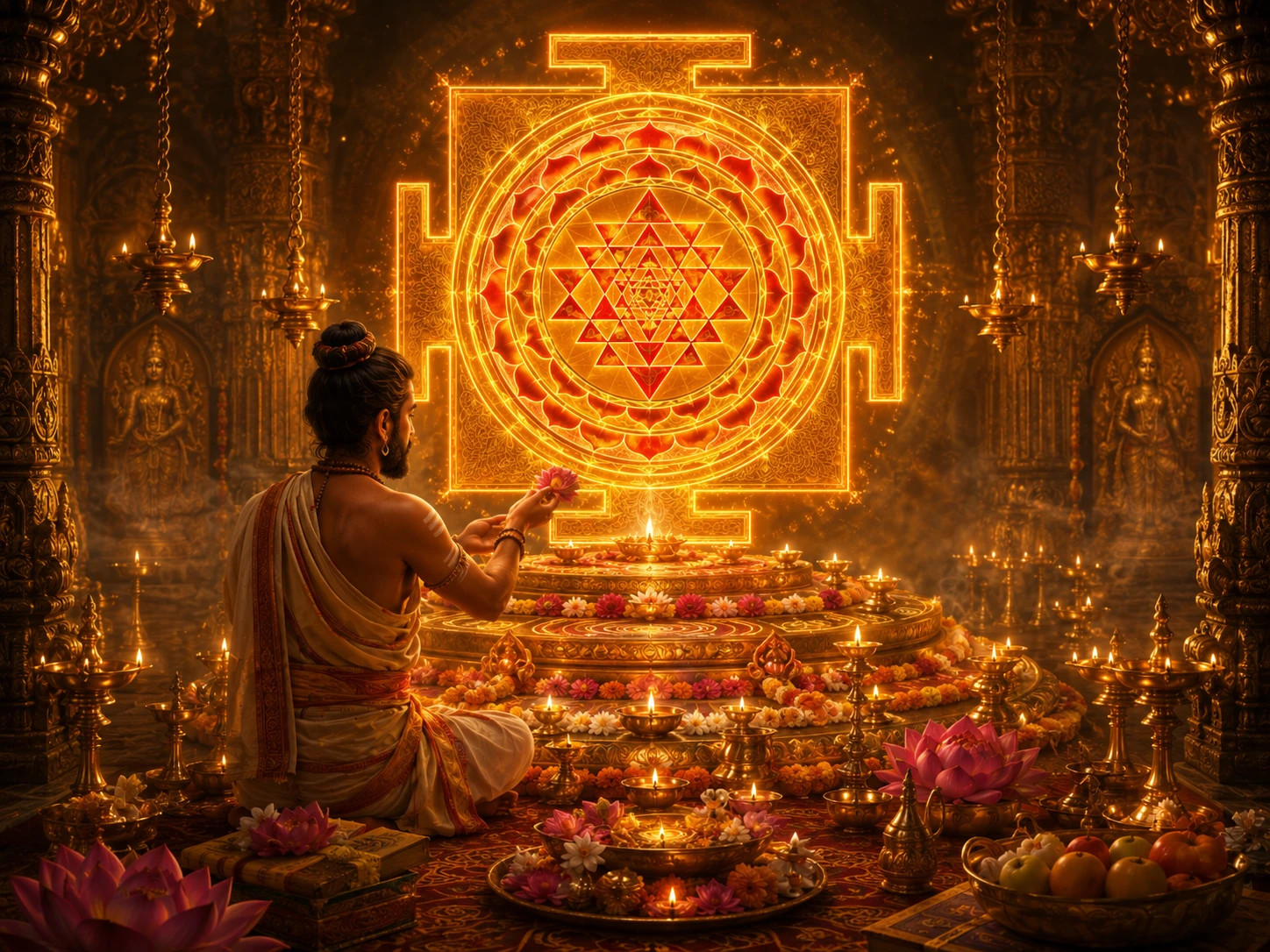
Navavarana Puja -- Sri Chakra Worship
नवावरण पूजा -- श्री चक्र आराधना
Imagine a ritual where you worship a goddess nine times in a single sitting, each time calling Her by a different name, offering flowers to a different circle of attendants, meditating on a different geometric enclosure of the same diagram, asking for a different kind of inner achievement, and by the end, arriving at a central point where all nine worships collapse into one. This is Navavarana Puja. Its name says the whole structure. Nava means nine. Avarana means enclosure, or veil, or circle of attendants. Puja means systematic worship. Navavarana Puja is the worship of the nine enclosures of the Sri Chakra, the supreme yantra of Goddess Lalita Tripura Sundari. Among Sri Vidya upasakas it is the single most elaborate recurring sadhana after daily mantra japa. A committed householder performs it weekly on Fridays or monthly on full moon days. A full-time upasaka at a matha performs it daily. The ritual is long, technically demanding, and internally vast. Its payoff, traditionally, is to install the entire Sri Chakra inside the practitioner's awareness so that external worship eventually becomes an optional echo of what is already continuous within.
Before getting into each enclosure, the direction of traversal matters. Sri Vidya texts describe two valid orders of Navavarana Puja, and a sadhaka is taught one first, then sometimes both. Srishti Krama is the creation order. It begins at the Bindu, the central point, and moves outward through each successive enclosure to the Bhupura, the outermost square. This mirrors how the universe itself unfolds from consciousness into increasingly dense forms. Samhara Krama is the dissolution order. It begins at the Bhupura, the outer square that represents the solid world, and moves inward through each enclosure towards the central Bindu. This mirrors how the yogi reverses creation, dissolving form back into consciousness. Bhavana Upanishad, a short Shakta Upanishad of some thirty-odd sutras, prescribes the samhara krama for its inward contemplation. Most living upasakas begin their daily puja from the outside and move in, completing at the bindu. The logic is direct. We all begin the day already thrown into the world; we use the ritual to walk back to the source. A third order, Sthiti Krama, starts and ends at the central bindu after moving through both motions, but this is advanced practice and not commonly described in beginner texts.
आबाल-गोप-विदिता सर्वानुल्लङ्घ्य-शासना। श्रीचक्रराज-निलया श्रीमत्-त्रिपुरसुन्दरी॥
ābāla-gopa-viditā sarvānullaṅghya-śāsanā | śrīcakrarāja-nilayā śrīmat-tripurasundarī ||
She is known even by children and cowherds. Her commands are transgressed by none. She dwells in the Sri Chakra, the king among all yantras. She is Sri Tripura Sundari, the auspicious beautiful one of the three worlds.
— Lalita Sahasranama, verse 180-182 (names 995-998), from Brahmanda Purana, Lalitopakhyana
The Lalita Sahasranama identifies the Sri Chakra as the king of all yantras and the Goddess's own dwelling. This is the textual warrant for why Navavarana Puja is treated as the complete worship. If She lives in the Sri Chakra, then worshipping each part of the Sri Chakra is worshipping every part of Her. The ritual framework always begins with the same preliminary steps that any Hindu puja uses, but each step is keyed to Sri Vidya specifics. Sankalpa, the formal statement of intent, names the Goddess as Lalita Maha Tripura Sundari and the puja as Sri Chakra Navavarana. Kalasha Sthapana, the installation of the water pot, specifies Shri Kalasha with specific mantras. Ganapati puja follows. Then come the six-fold nyasas, where the upasaka touches fifty Matrika letters, the three kutas of the Panchadasi mantra, the Rishi mantra group, and specific tattva-installations into his own body. Only after this long nyasa sequence, typically thirty to forty-five minutes, does the actual worship of the nine avaranas begin. Beginners sometimes find the preliminaries disproportionately long. Advanced upasakas know that the preliminaries are what make the avarana worship actually work.
Each of the nine avaranas has its own name, its own shape, its own group of yoginis, its own presiding chakreshwari, its own mudra, its own siddhi offered, and its own mystical state of consciousness. Textual traditions vary slightly in the numbering between Bhavana Upanishad, Yogini Hridaya and Parashurama Kalpa Sutra, but the Bhaskararaya synthesis is the form most widely followed today. The outer square Bhupura, called Trailokyamohana Chakra, enchants all three worlds. The sixteen-petal lotus just inside, called Sarvasha Paripuraka Chakra, fulfils every desire. The eight-petal lotus is Sarva Sankshobhana, the Agitator of All, disturbing the complacency that blocks spiritual movement. The fourteen triangles of the Chaturdasha Kona are Sarva Saubhagya Dayaka, the Giver of Full Auspiciousness. The outer ten triangles, Bahirdashara, are Sarvartha Sadhaka, Accomplisher of All Meanings. The inner ten triangles, Antardashara, are Sarva Raksha Kara, the Complete Protector. The eight triangles of Ashtakona are Sarva Roga Hara, the Remover of All Diseases. The innermost triangle, Trikona, is Sarva Siddhi Prada, the Bestower of All Siddhis. Finally, the central bindu is Sarvananda Maya, the Form of All Bliss. The names progress from the grossest benefit (enchantment of the world) to the highest (pure bliss itself), tracking the upasaka's own movement inward.
The Nine Avaranas of Sri Chakra
| Avarana | Name of Chakra | Shape / Geometry | Presiding Devi | Benefit Offered |
|---|---|---|---|---|
| 1st (outermost) | Trailokyamohana | Outer square with four gates (Bhupura) | Tripura | Enchantment of the three worlds |
| 2nd | Sarvasha Paripuraka | 16-petal lotus | Tripureshi | Fulfilment of all desires |
| 3rd | Sarva Sankshobhana | 8-petal lotus | Tripura Sundari | Agitation of inner obstacles |
| 4th | Sarva Saubhagya Dayaka | 14 triangles (Chaturdasha Kona) | Tripura Vasini | Giving of full auspiciousness |
| 5th | Sarvartha Sadhaka | 10 outer triangles (Bahirdashara) | Tripura Shri | Accomplishment of all meanings |
| 6th | Sarva Raksha Kara | 10 inner triangles (Antardashara) | Tripura Malini | Complete protection |
| 7th | Sarva Roga Hara | 8 triangles (Ashtakona) | Tripura Siddha | Removal of all diseases |
| 8th | Sarva Siddhi Prada | Central triangle (Trikona) | Tripuramba | Bestowal of all siddhis |
| 9th (innermost) | Sarvananda Maya | Central bindu | Maha Tripura Sundari | Pure bliss, non-dual realisation |
This sequence follows the samhara krama, moving from the outermost square inward to the central bindu. In srishti krama the order is reversed, beginning at the bindu and moving outward through the same nine stations.
Within each avarana lives a specific circle of yoginis whom the upasaka invokes and offers worship to. The yoginis are not decorative. They are names for specific aspects of consciousness that the practitioner activates at that stage. The outermost Bhupura carries ten Siddhi Devis like Anima, Laghima and Mahima, then eight Matrikas beginning with Brahmi and Maheshwari, then ten Mudra Devis. The sixteen-petal lotus carries the Nitya Shaktis, each named for a day of the lunar fortnight plus the embodiment of the full moon herself. The eight-petal lotus carries the Vak Devatas, the eight goddesses of sacred speech whose names begin with Vashini. The fourteen triangles carry the Sampradaya Yoginis, the protectors of tradition. The outer ten triangles carry the Kulotirna Yoginis, beyond-the-clan yoginis. The inner ten carry the Nigarbha Yoginis, womb-hidden ones. The eight triangles carry the Rahasya Yoginis, the secret ones. The innermost triangle carries four deities -- Kameshwari, Vajreshwari, Bhagamalini and Tripurasundari herself. The Bindu carries only Maha Tripura Sundari. Offerings to each circle include red flowers, red kumkum, sandal paste, rice grains turned red with saffron, and specific food offerings traditionally prepared without onion, garlic or astringent spices.
The actual physical offering to each avarana is the Shodashopachara, the sixteen-fold service, reduced and expanded according to time and capacity. In full, each avarana receives its own sixteen offerings -- seat, welcome, foot-water, hand-water, sip, bath, garment, sacred thread, ornaments, fragrance, flowers, incense, lamp, food, betel, and circumambulation. Nine avaranas times sixteen offerings equals 144 individual gestures, each with its own mantra. A full ritual done according to the Paramashiva Kalpa text can take five hours and consume considerable physical stamina. More commonly, modern householders observe the Panchopachara or Dashopachara -- five or ten offerings per avarana -- bringing the ritual to a manageable two to three hours. Neither is wrong; the tradition prescribes different versions for different capacities. What matters is that every avarana receives its own distinct worship. A Navavarana Puja done by worshipping only the central bindu and mentally gesturing at the outer eight is not the ritual. It is a simplification that breaks the logic of gradual progression.
Bhavana Upanishad, the short Shakta text that most directly addresses Navavarana Puja, turns the whole ritual inward in a single move. It declares that the human body with its nine openings is itself the Sri Chakra. The nine avaranas correspond to nine specific body regions. The fourteen triangles correspond to the fourteen primary nadis of subtle-body physiology. The eight Vak Devatas of the eight-petal lotus sit in the eight dhatus of the body -- skin, blood, flesh, fat, bone, marrow, semen and prana. The central bindu sits in the heart. After some years of practice, the upasaka is supposed to realise that the external ritual was always a rehearsal for the internal. The mantras spoken to flowers placed on a metal plate are the same mantras that the upasaka now speaks silently to specific points in his own body. Bhaskararaya, in his commentary on the Bhavana Upanishad, says the aim is to reach a state where external and internal worship cannot be distinguished because the practitioner has become transparent enough to the Goddess that the distinction itself dissolves. That sentence takes decades to embody. It takes about two minutes to read.
Modern India preserves Navavarana Puja with remarkable fidelity across a handful of centres. Sringeri Sharada Peetham in Karnataka performs it daily in the sanctum before the Sri Chakra installed by Adi Shankaracharya himself, according to the Peetham's tradition. Kanchi Kamakoti Peetham at Kanchipuram maintains a similar daily practice. The Kamakshi temple nearby in Kanchipuram hosts Navavarana sessions every Friday open to observers. The Mookambika temple at Kollur, Karnataka, conducts it on special days. In Delhi, a few Sri Vidya circles around Hauz Khas and South Extension hold weekly practices, drawing professionals from the nearby embassies and IT corridors. A Chennai-based upasaka may drive to the Kamakshi temple in Kanchipuram on a Friday morning, observe the ritual, and be back in office in Nungambakkam by afternoon. In Pune, two or three established lineage holders conduct private Navavarana Pujas once a month for initiated disciples. A 2026 Bengaluru techie who searches YouTube for Navavarana Puja will find several hour-long videos posted by genuine upasakas, typically in Sanskrit and Tamil, occasionally with English captions. These are useful for orientation. They are not substitutes for learning the ritual from a Guru who can correct the dozens of small technical errors that beginners invariably introduce.
A practical question often arises about the time and stamina required. A committed Sri Vidya upasaka in 2026 typically budgets three hours for a full Navavarana Puja at the Panchopachara level, often starting at 5 AM, completing by 8 AM, and reaching his office in Whitefield, Gurgaon or Powai by 10 AM. Monthly Purnima Navavarana Pujas may extend to four hours. Annual Maha Navavarana Pujas, done during Navaratri, can extend over a full day with extended nyasa, homa (fire offering) added to the sequence, and a community feast at the end. The stamina required is both physical and mental. Physically, the upasaka sits cross-legged for hours while performing precise hand gestures, holding mudras, and alternating between bowls and the central diagram. Mentally, the upasaka must track which avarana he is on, which yoginis have been invoked, which mantras have been completed, and which mudras have been offered. Beginners benefit from a paddhati, a written ritual manual opened on the altar. After three or four years, most practitioners have the full sequence memorised and work without notes. This memorisation is itself considered part of the practice -- the ritual gradually takes up residence inside the practitioner, becoming as familiar as brushing teeth, until the boundary between ritual and ordinary life softens significantly. Some upasakas adopt a fixed Friday morning observance that stretches across decades; others move to monthly observance after their children are grown and the household demands relax. Neither rhythm is superior to the other, and the tradition encourages the upasaka to find the cadence that actually gets followed rather than the one that looks most impressive on paper.
A subtle detail that distinguishes Navavarana Puja from other Hindu rituals is the treatment of the Kumari Puja, the worship of a young girl as the living form of the Goddess. In full Navavarana observance, especially during Navaratri, the ritual climaxes with Kumari Puja, where a pre-pubescent girl is formally worshipped, offered red clothes, fed, and prostrated before as the material embodiment of the Goddess who was invoked in the yantra. This practice is widespread in Bengal for Durga Puja but less commonly known in its Sri Vidya form in other regions. The philosophy behind it is that the Sri Chakra worship culminates only when the Goddess is recognised not only as a geometric abstraction or a yogic interior state but also as the actual presence in another living being. A nine-year-old girl in red clothes sitting on a raised seat receiving coconut and kumkum from the upasaka is the final externalisation before the ritual closes. For the upasaka this is often the emotionally heaviest part, because the shift from geometric form to living child makes concrete what the entire morning has been gesturing towards. The Goddess is not elsewhere. She is in the child in front of him, and by extension in every living being he will encounter when he steps out of the puja room.
Contemporary diaspora Sri Vidya practice has adapted Navavarana Puja to conditions the 18th century tradition never anticipated. An NRI software engineer in the San Francisco Bay Area wakes at 4 AM, does the ritual on a small Sri Chakra plate in the corner of her apartment because she has no dedicated puja room, uses whatever flowers the local Whole Foods carries (often tulips and carnations, adjusted mentally to stand in for the traditional red hibiscus), and video-calls her Guru in Mylapore for the post-puja abhisheka confirmation. Sri Vidya upasakas in London, Toronto, Sydney and Singapore have developed similar workarounds. The purists object to some adaptations. Most teachers accept them with a realistic eye on what sustaining the practice in diaspora conditions requires. What teachers refuse to compromise on is the fundamental structure -- nine distinct avarana worships, six-fold nyasa maintained, silent recitation of the mantra in proper form, refusal to post the mantra publicly on social media. The rest can be adapted without the tradition breaking. In fact, many Indian mathas now consider the diaspora transmission as one of the quieter successes of post-liberalisation Hindu religious life. A practice that could easily have calcified into ritual repetition at a few temples is instead making new contact with scientifically trained minds in Menlo Park and Mississauga.
A final question worth addressing is who should attempt this. The honest answer from the tradition is short and counter-intuitive. No one should attempt Navavarana Puja without initiation in the Panchadasi mantra and explicit permission from the Guru to begin the Navavarana framework. This gate is firmer than almost any other in Hindu worship. A Hanuman Chalisa can be recited by anyone. A Gayatri Mantra can be initiated with minimal ceremony. A Maha Mrityunjaya Mantra is openly taught in most temples. Navavarana Puja, by contrast, is explicitly a Sri Vidya sadhana, and Sri Vidya requires formal diksha from a living teacher in an established lineage. The standard preparatory path for a sincere aspirant is to begin with Bala Tripura Sundari mantra, which has lower barriers and allows a few years of orientation. If the Guru sees steady practice and temperament match, Panchadasi diksha may be offered. Only after the mantra itself has stabilised, typically with purascharana completed, does the teacher introduce the Navavarana puja as a complement. Short-cuts exist in the marketplace, especially online. They are without effect and sometimes harmful, because the nyasa installations done without proper transmission can disturb the nervous system in subtle ways that are hard to reverse without the same teaching line that caused them. The tradition is not being gate-keeping to exclude. It is being gate-keeping to protect.
A remarkable feature of Navavarana Puja that newer observers rarely notice is the parallel between its structure and the architecture of traditional Hindu temple design itself. A classical Shakta temple such as Kamakhya in Guwahati or Mookambika in Kollur is not an arbitrary building. It is a three-dimensional Sri Chakra rendered in stone. The outer compound wall corresponds to the Bhupura. The first courtyard corresponds to the sixteen-petal lotus. The second courtyard corresponds to the eight-petal lotus. The mandapas with their pillars correspond to the triangles. The antarala just before the sanctum corresponds to the innermost triangle. The garbhagriha where the deity sits corresponds to the bindu. When a pilgrim walks from the outer gate to the inner sanctum, she is physically performing the samhara krama Navavarana Puja without ever opening her eyes to the logic. The ritual that a Sri Vidya upasaka performs on a copper plate at home is the same ritual that the temple architecture performs on the body of every visitor. This is why walking in to an old Shakta temple often produces an inexplicable interior shift even in non-practitioners. The geometry itself is doing the work. The upasaka who has done Navavarana Puja at home for years walks into such a temple and recognises the entire architecture immediately. Every wall, every doorway, every pillar is an avarana he has already worshipped mentally.
The Sringeri Sharada Peetham preserves a copper Sri Chakra said to have been installed by Adi Shankaracharya himself in the 9th century. This plate has received Navavarana Puja daily, without recorded interruption, for over twelve hundred years. No matter who sat on the peetham, no matter whether the region was under Chola, Vijayanagar, Hyder Ali, Tipu Sultan, British, or independent Indian rule, the daily ritual continued. A 2026 visitor to Sringeri can watch the current Acharya or his appointed Pujari perform Navavarana Puja in the morning, and mathematically calculate that he is witnessing the single longest-continuous ritual documented in world religious history. No Egyptian temple, no Roman cult, no Western European monastery has preserved one specific worship pattern at the same altar for twelve centuries. The Sri Chakra at Sringeri is not merely old. It is, in a quite literal sense, a continuous operational artefact.
Begin with Sri Chakra Meditation
You cannot perform Navavarana Puja without Sri Vidya diksha. What you can do is sit daily with a printed Sri Chakra, take your eye slowly from the outer square inward through the lotuses and triangles to the central bindu, and learn the architecture by attention alone. The Lalita Sahasranama, on Eternal Raga with each name's meaning, is the natural companion to this practice. Many practitioners came to the tradition through exactly such preparatory attention, years before they formally sought diksha.
Tags
Eternal Raga · शाश्वत राग
Institutional voice — scholarly articles on Sanatan Dharma
Deepen Your Understanding
अपनी समझ और गहरी करें
tantra mantra yantra
Sri Vidya -- The Supreme Worship System
Sri Vidya is the most guarded, most intricate worship system inside Hinduism. It worships the Divine Mother Lalita Tripura Sundari through a fifteen-syllable mantra, the Sri Chakra yantra, and an initiation line that reaches back through Adi Shankaracharya to the Rig Veda. Miss the diksha and nothing works. Receive it, and the entire cosmos reorganizes itself inside you.
tantra mantra yantra
Sri Yantra -- The Supreme Geometry of Creation
Nine interlocking triangles. 43 smaller triangles. A single point from which the entire universe unfolds. The Sri Yantra is the most complex and revered sacred diagram in Hinduism -- and modern mathematicians have found that constructing it requires solving simultaneous equations that Western mathematics did not formalise until the 18th century. This is not decoration. This is the visual body of the Goddess.
tantra mantra yantra
Yantra Components -- Bindu, Triangle, Lotus, Bhupura
Every Hindu yantra, from the simple Ganesh Yantra to the intricate Sri Chakra, is built from the same short list of geometric components. A bindu. Triangles pointing up or down. Hexagrams. Lotuses of four, eight, sixteen or more petals. An outer square with four gates. Learn this vocabulary, and every yantra becomes readable. Mistake the grammar, and the yantra is only a pretty drawing.
tantra mantra yantra
10 Mahavidya Yantras
Ten goddesses. Ten geometries. Ten frequencies of awakening. The Das Mahavidya yantras are the most advanced tools in Shakta tantra, each a precision-engineered diagram mapped to a specific goddess, a specific siddhi, and a specific emotional landscape. Kali is not Kamala. Chinnamasta is not Bhuvaneshwari. The yantras make the difference visible.
tantra mantra yantra
Matrika Shakti -- The Sacred Alphabet as Cosmic Blueprint
The Sanskrit alphabet is not a human invention. It is a cosmological map -- each letter a compressed Shakti, each vowel a tattva, the whole Varnamala a sonic replica of the universe unfolding from pure consciousness to gross matter. When Shiva's damaru sounded fourteen times, it did not produce grammar. It produced reality.
tantra mantra yantra
Nyasa -- Installing Mantra in the Body
Before any mantra japa begins, the tantric practitioner performs Nyasa -- the systematic touching of body parts while chanting specific syllables, literally installing the deity's presence in their own flesh. This is not metaphor. It is the ancient world's most sophisticated body-mind integration technology -- and the direct ancestor of modern Yoga Nidra.
tantra mantra yantra
Diksha -- Why Initiation Matters and What It Actually Means
The Kularnava Tantra is unambiguous: there is no liberation without Diksha, no Diksha without a Guru, and no Guru without a Parampara. In an age where mantras are available on YouTube and spiritual apps offer 'instant enlightenment,' understanding why initiation is non-negotiable separates the seeker from the tourist.
The Sringeri Sharada Peetham preserves a copper Sri Chakra said to have been installed by Adi Shankaracharya himself in the 9th century. This plate has received Navavarana Puja daily, without recorded interruption, for o…
More in Tantra, Mantra & Yantra
Agama vs Tantra vs Veda -- Three Streams of Hindu Practice
14 min read
Agni Dhyana -- What Meditation on Fire Is Actually Grounded In
8 min read
Ashta Siddhi -- The Eight Yogic Powers and How Hanuman Embodies Them
13 min readThe same translation error that turned '33 Koti' into '33 crore' in Hinduism also happened in Buddhism. The Chinese translation of Buddhist texts rendered 'Sapta Koti Buddha' (7 Supreme Buddhas) as '7 Crore Buddhas.' The…
Deities AvatarsCommunity Reflections
🕉️
Be the first to share your reflection.