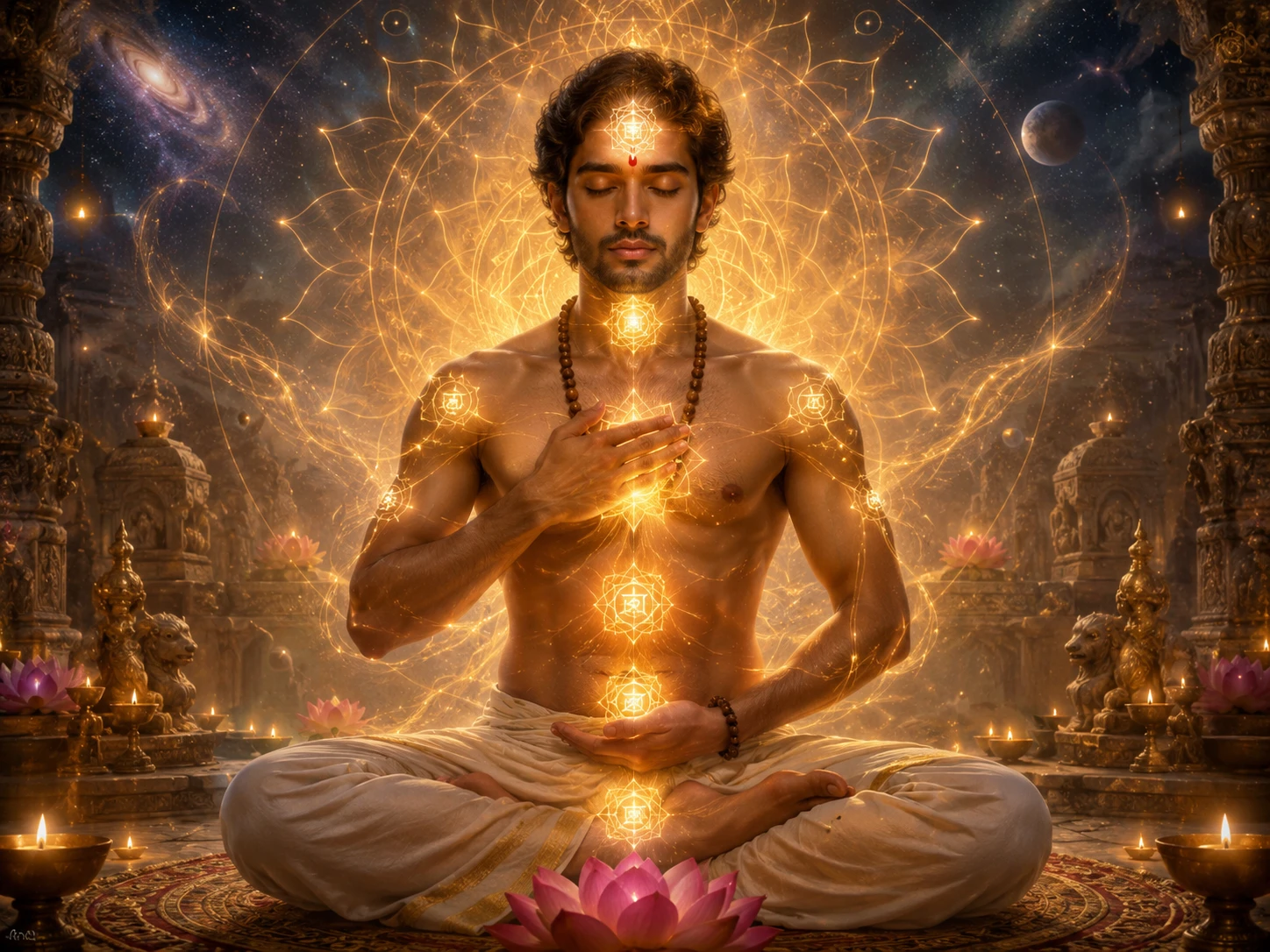
Nyasa -- Installing Mantra in the Body
न्यास -- शरीर में मन्त्र स्थापन
Every yoga class in the world ends with something called Yoga Nidra -- the guided relaxation where the teacher asks you to bring awareness to your toes, then your ankles, then your shins, moving systematically through the body. You lie in Shavasana while the teacher's voice tours your anatomy point by point, and by the end, your mind is floating in a space between waking and sleep.
What your yoga teacher almost certainly does not tell you is that this practice is a direct descendant of an ancient Tantric ritual called Nyasa.
Nyasa -- from the Sanskrit root 'nyas' meaning 'to place' or 'to deposit' -- is the systematic placement of mantras onto specific points of the practitioner's body through physical touch, vocal recitation, and mental visualization, performed simultaneously. It is a triple-channel operation: the hand touches the body part (tactile), the mouth chants the mantra syllable (auditory), and the mind visualizes the deity or energy associated with that syllable (visual). Three channels. One moment. Repeated across the entire body.
This is not casual ritual. This is the ancient world's most sophisticated technique for converting the human body from an ordinary biological vessel into a consecrated temple of divine presence. The Tantric texts are explicit: without Nyasa, mantra Japa is incomplete. A mantra chanted without first installing it in the body is like software loaded onto a computer that has not been formatted -- it may run, but not optimally.
The word Vinyasa -- that yoga term every studio in Bengaluru, Mumbai, and Brooklyn uses -- literally comes from 'vi' (special) + 'nyasa' (placement). Every time a yoga teacher says 'vinyasa flow,' they are invoking the legacy of this Tantric body-mapping practice, whether they know it or not.
न्यासं विना जपः सर्वो निष्फलो भवति ध्रुवम्। तस्मात् सर्वप्रयत्नेन न्यासं कुर्यात् समाहितः॥
nyāsaṃ vinā japaḥ sarvo niṣphalo bhavati dhruvam | tasmāt sarva-prayatnena nyāsaṃ kuryāt samāhitaḥ ||
Without Nyasa, all Japa is certainly fruitless. Therefore, with complete effort and concentration, one should perform Nyasa.
— Sharadatilaka Tantra (commonly cited Tantric injunction)
Kara Nyasa -- Consecrating the Hands
Kara Nyasa is the first step -- the consecration of the hands. Since the hands are the primary instruments of ritual action (they hold the mala, make offerings, perform mudras, and touch the body during Anga Nyasa), they must be purified and energised first.
In Kara Nyasa, each of the six parts of the hand is assigned a specific mantra syllable. The practitioner touches each part with the thumb while chanting the corresponding mantra. The standard sequence for Sadanga Kara Nyasa uses the six body-mantra combinations: Hridayaya Namah (heart -- thumb), Shirase Svaha (head -- index finger), Shikhayai Vashat (crown tuft -- middle finger), Kavachaya Hum (armour -- ring finger), Netra-trayaya Vaushat (three eyes -- little finger), and Astraya Phat (weapon -- palm and back of hand clapped together).
Each touch is not merely contact. It is an act of intention. As the thumb presses the base of the index finger and slides to its tip while chanting 'Hridayaya Namah,' the practitioner is literally installing the heart energy of the deity in that finger. When all six parts are complete, the hands are no longer ordinary -- they have become ritual instruments charged with mantra shakti.
Think of it as the spiritual equivalent of sanitising your hands before entering an operation theatre. A surgeon does not touch a patient with unwashed hands. A tantric practitioner does not touch their body for Anga Nyasa, or handle a mala for Japa, with unconsecrated hands. The preparation is non-negotiable.
For the medical student preparing for NEET or the physiotherapy student studying dermatomes -- the mapping of specific nerve pathways to specific body regions -- Kara Nyasa will look strikingly familiar. The tantric system maps specific mantra vibrations to specific body zones, creating a vibrational dermatome chart millennia before Western neurology mapped the physical one.
Anga Nyasa -- Consecrating the Body
After the hands are consecrated, Anga Nyasa extends the process to six major zones of the body. The practitioner touches each zone with the right hand while chanting the corresponding mantra and visualizing the deity energy entering that point.
The six standard zones of Sadanga (six-limbed) Nyasa are: Hridaya (heart -- touched with all fingers of the right hand), Shirah (head -- touched with fingertips on the crown), Shikha (top-knot/crown point -- touched at the back of the head), Kavacha (torso/armour -- arms crossed over the chest), Netra-traya (three eyes -- fingertips touching both eyes and the point between the eyebrows), and Astra (weapon -- a circular motion around the head, followed by a clap).
The symbolism is layered. The heart receives the deity's love and life force. The head receives wisdom. The shikha (the point where the Brahmarandhra, the subtle opening at the crown, is located) receives the connection to the transcendent. The kavacha creates spiritual armour -- this is the origin of the Kavacha Stotram tradition where chanting specific verses protects the practitioner. The three eyes receive divine sight. And the astra provides the power to dissolve obstacles.
When a priest at Tirupati or Madurai performs his morning preparation before entering the garbhagriha, Anga Nyasa is mandatory. He cannot touch the deity without first having transformed his own body into a consecrated vehicle. This is not superstition; it is protocol -- as precise and non-negotiable as the sterilisation procedures in a surgical operating theatre.
The parallels to modern somatic therapy are striking. Body-scan meditation, progressive muscle relaxation, EMDR (Eye Movement Desensitization and Reprocessing) -- all modern Western therapeutic techniques involve systematically directing awareness to specific body parts to release stored trauma or tension. The tantric tradition achieved the same effect through Nyasa thousands of years ago, but with an additional layer: the mantra vibration, which the tradition holds creates a resonance between the body part and the cosmic energy it represents.
Matrika Nyasa -- The 50 Letters as Cosmic Map
The most elaborate form of Nyasa is Matrika Nyasa -- the placement of all 50 letters of the Sanskrit alphabet (the Matrikas, literally 'little mothers') on the body. Each letter is prefixed with Om and suffixed with Namah, then placed on a specific body part or chakra petal.
The philosophical foundation is breathtaking. In Tantric metaphysics, the 50 letters of Sanskrit are not arbitrary human inventions -- they are the sonic building blocks of reality. Each letter is a Shakti, a divine energy, a frequency of consciousness. The 50 Matrikas correspond to the 50 petals of the chakra system (4 at Muladhara, 6 at Swadhisthana, 10 at Manipura, 12 at Anahata, 16 at Vishuddha, and 2 at Ajna = 50). When the practitioner places these 50 letters on the corresponding body parts, they are literally re-inscribing the cosmic blueprint onto their physical form -- making the microcosm (body) a perfect mirror of the macrocosm (universe).
This is the deepest meaning of the Tantric dictum: 'Yat pinde tat brahmande' -- what is in the body is in the universe. Matrika Nyasa is the technology that makes this philosophical statement a lived experience.
For the IIT computer science student, this will resonate: Matrika Nyasa is essentially flashing firmware onto the human operating system. The 50 Sanskrit letters are the instruction set. The body is the hardware. The placement ritual is the flashing process. After Matrika Nyasa, the body runs on divine code.
The Mahanirvana Tantra provides detailed instructions for Matrika Nyasa, as does the Sharadatilaka. In Sri Vidya practice, the Matrika Nyasa is performed before every daily puja and is considered absolutely essential. The Shankaracharya tradition preserves this practice in the daily Puja Vidhi performed at the five mathas across India.
A Yoga Mimamsa journal study using Electrophotonic Imaging (EPI) devices measured participants performing Gayatri Japa with and without Nyasa. The group that performed Kara and Anga Nyasa before Japa showed improved integral entropy (decreased) and integral area (increased) compared to the control group -- both indicators of enhanced energetic coherence in the biofield. The sample was small, but the direction was consistent with the tradition's claims.
Rishi Nyasa -- Honouring the Lineage Before You Begin
Before Kara and Anga Nyasa, many traditions prescribe Rishi Nyasa -- a preliminary step that acknowledges the spiritual DNA of the mantra itself.
Every Vedic and Tantric mantra has three identity markers: a Rishi (the seer who first 'heard' or received the mantra), a Chandas (the metre or rhythmic structure in which the mantra is composed), and a Devata (the deity who is the presiding consciousness of the mantra). These three are the mantra's birth certificate -- its provenance, its architecture, and its addressee.
In Rishi Nyasa, the practitioner touches three body points while declaring these three: the head (for the Rishi -- wisdom resides in the head), the mouth or nose (for the Chandas -- metre is carried by breath and speech), and the heart (for the Devata -- the deity dwells in the devotee's heart). For the Gayatri Mantra, for example: the Rishi is Vishwamitra, the Chandas is Gayatri (24 syllables in three lines of eight), and the Devata is Savitri (the solar creative force).
This preliminary Nyasa is profoundly meaningful. It is an act of intellectual humility -- acknowledging that you did not invent this mantra, that it comes from a lineage of realised beings stretching back to the dawn of consciousness. In academic terms, it is a citation. In corporate terms, it is an attribution. In spiritual terms, it is a bow.
The UPSC aspirant will recognise the Chandas component from the Indian Heritage section -- Gayatri, Anushtubh, Trishtubh, Jagati are the four primary Vedic metres, each with a specific syllable count that creates a distinct rhythmic effect. The IIT student studying signal processing will note that different metres create different frequency patterns in recitation -- the Gayatri's 8-8-8 syllable structure creates a different resonance than the Anushtubh's 8-8-8-8. Rishi Nyasa ensures the practitioner is calibrated to the correct frequency before the mantra begins.
Nyasa in Daily Hindu Practice -- What You Already Do Without Knowing
Nyasa is not confined to elaborate tantric rituals performed by initiated sadhaks in dimly lit puja rooms. It permeates daily Hindu life in forms so familiar that most people do not recognise them as Nyasa.
When a grandmother applies a tilak of kumkum or sandalwood paste to her forehead before puja, she is performing a simplified Nyasa -- placing a sacred substance on the Ajna Chakra point with an intention of invoking divine protection. When a mother applies kajal to her baby's eyes and a black dot behind the ear to ward off the evil eye (nazar), the underlying logic is Nyasa: placing a protective mark on a vulnerable point of the body.
The Vibhuti (sacred ash) that Shaivites apply on three horizontal lines across the forehead, arms, and chest is Tripundra -- a form of Nyasa that places the three qualities of Shiva (creation, preservation, destruction) on the body. The Urdhva Pundra (vertical Vishnu Nama tilak) that Vaishnavites apply on twelve body parts during their morning Ahnika (daily routine) is explicitly called Dwadasha Tilaka Nyasa -- twelve-point body marking with the names of Vishnu.
The Sandhyavandana -- the twilight prayer performed by traditional Brahmins three times daily -- includes both Kara Nyasa and Anga Nyasa as mandatory preparatory steps before the Gayatri Mantra is chanted. Without Nyasa, the Gayatri Japa is technically incomplete according to the Dharma Shastras. This means that the UPSC aspirant studying in Old Rajinder Nagar whose father performs Sandhyavandana every morning is watching a man perform Nyasa -- whether either of them uses that Sanskrit term or not.
Even the act of touching one's chest while swearing an oath, or touching one's forehead in salute -- gestures that feel entirely secular -- carry echoes of the Nyasa principle: placing intention at a specific body point to activate a specific quality. The heart-touch invokes sincerity. The forehead-touch invokes respect. The hand-on-head blessing by an elder is functionally a Sparsha Nyasa -- the placement of protective energy through touch.
Recognising these everyday acts as Nyasa does not make them less natural. It makes them more profound. It reveals that the boundary between 'ritual' and 'daily life' in Hindu civilisation was never a hard line. The entire culture was designed as a continuous field of sacred practice -- and Nyasa is the mechanism that makes every touch a consecration.
How to Perform Basic Nyasa -- A Step-by-Step Guide
For the practitioner who wants to incorporate Nyasa into daily Japa, here is a simplified Sadanga sequence that can be completed in under three minutes.
Sit in your meditation posture. Close your eyes. Take three deep breaths to settle the mind.
Kara Nyasa (Hands): With the right hand, touch each finger of the left hand with the right thumb, chanting: 1. Thumb base to tip: Om Hridayaya Namah (I salute the Heart) 2. Index finger base to tip: Om Shirase Svaha (I offer to the Head) 3. Middle finger base to tip: Om Shikhayai Vashat (I invoke the Crown) 4. Ring finger base to tip: Om Kavachaya Hum (I armour myself) 5. Little finger base to tip: Om Netra-trayaya Vaushat (I activate the Three Eyes) 6. Front and back of palm clapped: Om Astraya Phat (I wield the Weapon) Repeat with the left hand.
Anga Nyasa (Body): With the right hand fingers, touch: 1. Heart centre (mid-chest): Om Hridayaya Namah 2. Crown of head: Om Shirase Svaha 3. Back of head (Shikha point): Om Shikhayai Vashat 4. Cross arms over chest: Om Kavachaya Hum 5. Both eyes + Ajna point with three fingers: Om Netra-trayaya Vaushat 6. Circular sweep around head, then clap: Om Astraya Phat
Now your hands and body are consecrated. Begin your Japa.
The entire sequence takes approximately two to three minutes. It can be done in a Pune apartment before dawn, in a Noida metro seat with eyes closed, or in a corner of the office during a lunch-break meditation. The tradition recommends performing Nyasa before every Japa session. Over time, the body begins to respond to the sequence with Pavlovian efficiency -- the moment you begin Kara Nyasa, the mind shifts into meditation mode, because the body has been trained to associate these touches with sacred space.
Major Types of Nyasa -- From Hands to Cosmos
| Nyasa Type | Body Zone | What is Placed | When Performed |
|---|---|---|---|
| Kara Nyasa | Fingers and palms (6 parts) | Six-limbed mantra (Hridaya, Shirah, Shikha, Kavacha, Netra, Astra) | First -- before any other Nyasa or Japa |
| Anga Nyasa | Six major body zones (heart, head, crown, torso, eyes, aura) | Same six-limbed mantra as Kara, now on body | After Kara Nyasa, before Japa |
| Rishi Nyasa | Head, mouth, heart | Rishi (seer), Chandas (metre), Devata (deity) of the mantra | Before specific mantra Japa -- identifies the mantra's lineage |
| Matrika Nyasa | 50 body points corresponding to 50 chakra petals | All 50 letters of Sanskrit alphabet (the Matrikas) | Advanced practice -- maps entire alphabet onto body |
| Sadanga Nyasa | Heart, head, tuft, arms, eyes, palms | Six Beej mantras with long vowels | Standard Tantric preparation for deity worship |
| Pitha Nyasa | Specific body seats (pithas) | Shakti Pithas or sacred geography mapped onto body | Sri Vidya and advanced Shakta practice |
| Tattva Nyasa | 36 Tattvas mapped from toes to crown | 36 categories of Shaiva metaphysics | Kashmir Shaiva tradition -- maps reality onto body |
Nyasa types build upon each other. A complete tantric puja may include Rishi Nyasa, Kara Nyasa, Anga Nyasa, and Matrika Nyasa in sequence -- each layer adding a deeper dimension of consecration.
Nyasa to Yoga Nidra -- The Modern Legacy
The connection between Nyasa and modern Yoga Nidra is not speculative -- it is historically documented.
Swami Satyananda Saraswati, who founded the Bihar School of Yoga and systematised Yoga Nidra as a global practice in the 1960s and 70s, explicitly stated that his technique was derived from the Tantric practice of Nyasa. He adapted the body-rotation element -- moving awareness systematically from point to point -- directly from the Nyasa tradition, but stripped away the mantra component to make it accessible to non-Hindu practitioners worldwide.
The 61-point relaxation technique taught in many yoga schools (also called Shava Yatra, 'pilgrimage through the corpse') is even closer to traditional Nyasa. In this practice, the practitioner mentally visits 61 specific points on the body, either placing a mantra or visualising a blue star at each point. The 61 points correspond roughly to the marma points of Ayurveda -- vital energy junctions that are also used in Kalaripayattu (the martial art of Kerala) and in traditional massage.
What is lost in the modernised versions is the mantra -- and the tradition would argue that the mantra is precisely what makes Nyasa transformative rather than merely relaxing. A body scan without mantra calms the nervous system. A body scan with mantra rewires the energetic architecture. The difference is like the difference between a warm bath and a warm bath infused with medicinal herbs -- both are pleasant, but only one is therapeutic at the cellular level.
For the yoga practitioner in Rishikesh, Mysuru, or any training school globally, understanding that Yoga Nidra descends from Nyasa adds depth to the practice. It is not a relaxation technique invented in the 20th century. It is a Tantric consecration practice refined over millennia, adapted for a secular audience but carrying within it the DNA of one of the most powerful body-mind technologies ever developed.
The word 'Sannyasa' -- the Hindu monastic vow of complete renunciation -- literally means 'total Nyasa' (sam + nyasa). When a person takes Sannyasa, they are performing the ultimate Nyasa: placing their entire life, identity, possessions, and ego at the feet of the Divine. The physical Nyasa of touching body parts with mantras is a microcosmic rehearsal for this macrocosmic act of total self-offering. Meanwhile, research at Swami Vivekananda Yoga Anusandhana Samsthana (S-VYASA) in Bengaluru has explored the physiological effects of Nyasa-based practices, finding correlations between systematic body-awareness techniques and improved autonomic nervous system regulation -- supporting the tradition's claim that Nyasa harmonises the body's involuntary systems.
Experience Nyasa -- Begin with Simple Kara Nyasa Before Japa
Before your next japa, perform a simple kara nyasa, touching the thumbs to each finger in turn: Om angushthabhyam namah (the thumbs), Om tarjanibhyam namah (index fingers), Om madhyamabhyam namah (middle), Om anamikabhyam namah (ring), Om kanishthikabhyam namah (little fingers), and Om karatala-karaprishthabhyam namah (palms and backs of the hands). Then begin your japa and notice the difference in focus. The mantra meditation library on Eternal Raga has mantras to choose from.
Tags
Eternal Raga · शाश्वत राग
Institutional voice — scholarly articles on Sanatan Dharma
Deepen Your Understanding
अपनी समझ और गहरी करें
tantra mantra yantra
Tantra, Mantra and Yantra -- The Three Pillars of Spiritual Practice
Tantra is the loom, Mantra is the thread, Yantra is the pattern. Together they form the complete technology of spiritual transformation that India gifted to the world -- and they are far more profound than popular culture imagines.
tantra mantra yantra
Diksha -- Why Initiation Matters and What It Actually Means
The Kularnava Tantra is unambiguous: there is no liberation without Diksha, no Diksha without a Guru, and no Guru without a Parampara. In an age where mantras are available on YouTube and spiritual apps offer 'instant enlightenment,' understanding why initiation is non-negotiable separates the seeker from the tourist.
tantra mantra yantra
Mudras in Ritual and Yoga -- The Silent Language of the Hands
When you press your palms together and say Namaste, you are performing Anjali Mudra -- a gesture older than any surviving scripture. When you meditate with thumb touching index finger, you are performing Gyan Mudra -- uniting individual consciousness with the universal. Mudras are the oldest programming language in human history, and your hands are the keyboard.
tantra mantra yantra
Japa -- Vachika, Upamshu, Manasika and the Art of Sacred Repetition
Krishna declares in the Gita: 'Among sacrifices, I am Japa.' Not the fire ritual, not the horse sacrifice, not the Soma offering -- but the silent repetition of a sacred name. Three levels of chanting, one mala of 108 beads, and a practice you can do on the Delhi Metro without anyone knowing.
tantra mantra yantra
The Seven Chakras -- Energy Centres That Map Your Inner Universe
You have seven power stations running along your spine. Each governs a specific domain of human experience -- from survival instinct to sexual energy to willpower to love to expression to intuition to cosmic consciousness. The chakra system is not mystical poetry. It is the most detailed map of human psychology ever embedded in a spiritual framework -- and modern neuroscience is only now catching up to what Tantric yogis described 1,500 years ago.
tantra mantra yantra
Beeja Mantras of Major Deities -- The Seed Syllables That Contain Universes
Om is not just a sound. It is the compression of the entire Vedic cosmology into a single syllable. Shreem contains Lakshmi's abundance. Hreem holds Devi's creative power. Kleem carries Krishna's attraction. Aim encodes Saraswati's wisdom. Each Beej Mantra is a cosmic zip file -- one syllable containing the complete energy signature of a deity.
tantra mantra yantra
The Science of Mantra -- How Sacred Sound Rewires Consciousness
A mantra is not a prayer. It is not a wish. It is a precision instrument of consciousness -- a vibrational key engineered in Sanskrit thousands of years ago to unlock specific states of mind. Modern neuroscience is only now catching up.
The word 'Sannyasa' -- the Hindu monastic vow of complete renunciation -- literally means 'total Nyasa' (sam + nyasa). When a person takes Sannyasa, they are performing the ultimate Nyasa: placing their entire life, iden…
More in Tantra, Mantra & Yantra
Agama vs Tantra vs Veda -- Three Streams of Hindu Practice
14 min read
Agni Dhyana -- What Meditation on Fire Is Actually Grounded In
8 min read
Ashta Siddhi -- The Eight Yogic Powers and How Hanuman Embodies Them
13 min readThe same translation error that turned '33 Koti' into '33 crore' in Hinduism also happened in Buddhism. The Chinese translation of Buddhist texts rendered 'Sapta Koti Buddha' (7 Supreme Buddhas) as '7 Crore Buddhas.' The…
Deities AvatarsCommunity Reflections
🕉️
Be the first to share your reflection.