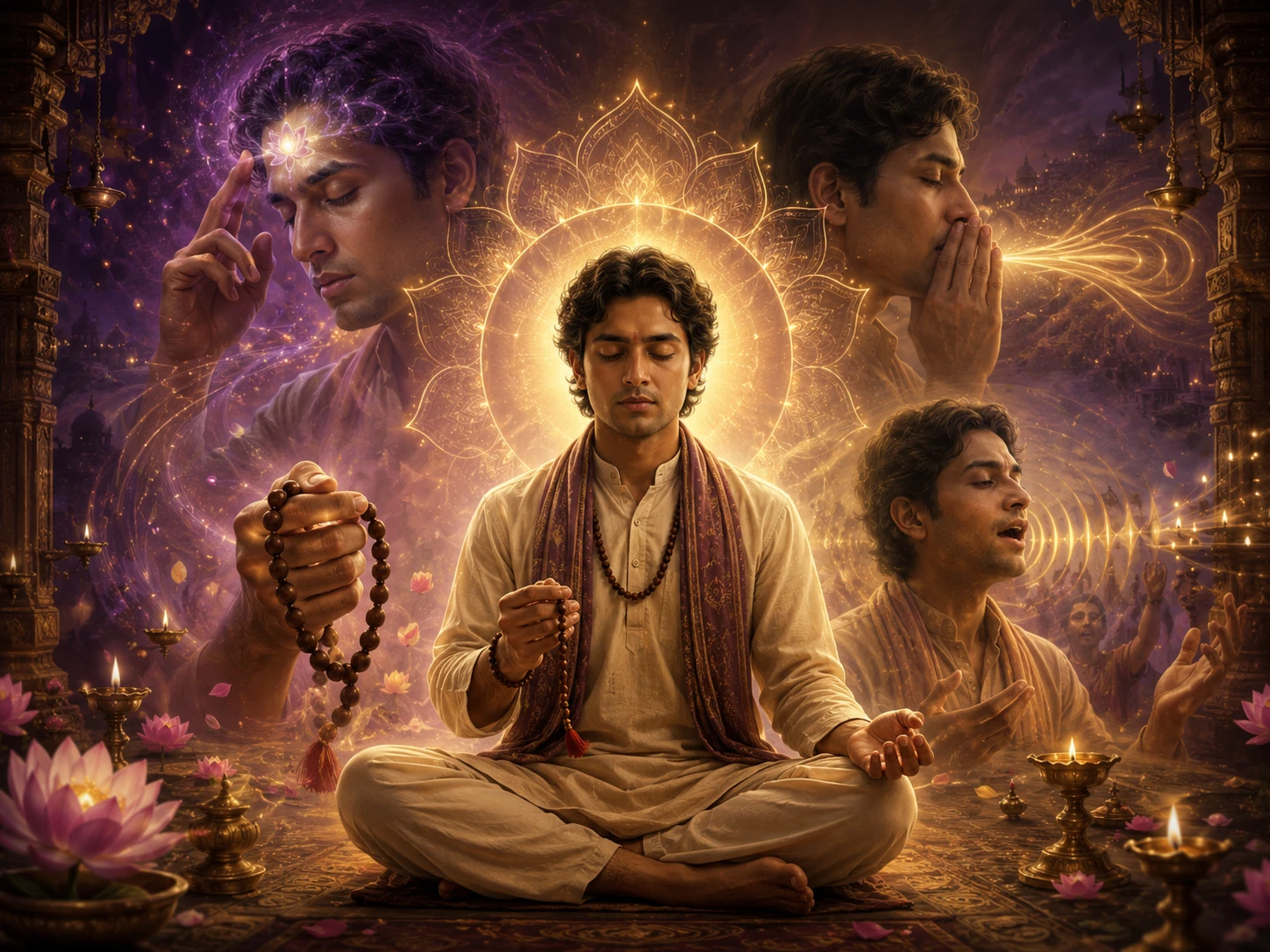
Japa -- Vachika, Upamshu, Manasika and the Art of Sacred Repetition
जप -- वाचिक, उपांशु, मानसिक और पवित्र पुनरावृत्ति की कला
Every exam topper has a study technique. Some read textbooks aloud, highlighting and annotating. Some whisper notes to themselves, lips moving silently over equations. Some close their eyes and run the entire chapter through memory without looking at a single page. The progression from loud to whispered to silent is intuitive -- it is how the human mind naturally deepens its engagement with information.
The yogis of ancient India formalised this exact progression thousands of years ago -- not for exam preparation, but for the most consequential memorisation task in human life: embedding the Divine Name in the deepest layer of consciousness.
They called this practice Japa -- from the Sanskrit root 'jap,' meaning to repeat in a low voice, to mutter, to recite internally. The word carries a deeper etymology: 'ja' destroys the cycle of birth and death, 'pa' destroys sin. Japa, at its root, is the practice that dissolves both karma and mortality through the vibrational power of repetition.
The Bhagavad Gita elevates Japa above all other forms of sacrifice. In Chapter 10, Verse 25, when Krishna catalogues the supreme expressions of divinity across every category of existence, He declares: 'Yajnanam japa-yajno'smi' -- among sacrifices, I am the sacrifice of Japa. This is extraordinary. Krishna does not say He is the Ashvamedha (horse sacrifice) or the Rajasuya (royal consecration) -- the most elaborate and prestigious Vedic rituals. He identifies with the simplest, most portable, most democratic spiritual practice available: the repetition of a sacred name or mantra.
This one verse changed the trajectory of Hindu devotional practice. It placed into the hands of every person -- Brahmin or Shudra, man or woman, scholar or illiterate, king or servant -- a direct path to the Divine that requires no priest, no fire altar, no temple, and no money. Just a name. Just repetition. Just faith.
Today, Japa remains the most widely practised spiritual discipline in Hinduism. The grandmother turning her tulsi mala in Varanasi, the tech professional silently chanting on the Bengaluru bus, the ISKCON devotee circling Govardhan with Hare Krishna on his lips, the retired colonel doing his morning Gayatri in a Defence Colony flat in Delhi -- all are performing Japa. What distinguishes a casual recitation from a transformative practice is understanding the levels.
यज्ञानां जपयज्ञोऽस्मि स्थावराणां हिमालयः।
yajñānāṃ japa-yajño'smi sthāvarāṇāṃ himālayaḥ |
Among sacrifices, I am the sacrifice of Japa (sacred repetition). Among immovable things, I am the Himalayas.
— Bhagavad Gita 10.25
Vachika Japa -- The Spoken Voice
Vachika Japa (also called Vaikhari Japa) is chanting the mantra aloud, with clear pronunciation, audible to the practitioner and those nearby. This is the most accessible level -- the entry point for beginners and the foundation on which the other two levels are built.
In Vachika Japa, the full vocal apparatus is engaged: lungs, vocal cords, tongue, lips, and palate all participate in producing the sound. The mantra is spoken distinctly, each syllable given its proper weight and duration. The Vedic tradition is extraordinarily precise about pronunciation -- the Shiksha Vedanga (the science of phonetics, one of the six limbs of Vedic study) exists solely to ensure that mantras are pronounced with acoustic accuracy. A mispronounced mantra, the tradition warns, is like a poorly aimed arrow -- it may miss its target entirely or, worse, produce the opposite effect.
The power of Vachika Japa is environmental. When you chant aloud, you create a physical sound field -- vibrations that propagate through the air, bounce off walls, and enter the ears of anyone present. Temple kirtans, group chanting sessions, the Sundarkanda paath at a Hanuman temple on Tuesday evening -- all are Vachika Japa at scale. The vibrations purify not just the chanter but the space.
Modern acoustic research supports this. Studies on the vibrations produced by Sanskrit chanting have shown measurable effects on ambient air quality, bacterial growth patterns, and water crystallisation structures. The IIT Kanpur study on Vedic chanting and its acoustic properties found that specific recitation patterns create standing wave formations in enclosed spaces -- precisely what temple garbhagrihas are designed to amplify.
Practically, Vachika Japa is best for: beginners learning pronunciation, group devotional settings, overcoming restlessness (the physical act of speaking anchors a wandering mind), and purifying the environment. It is also the required mode for Sandhyavandana -- the daily twilight prayer that traditional Brahmins perform, where the Gayatri Mantra must be recited at specific audibility levels.
Upamshu Japa -- The Whispered Bridge
Upamshu Japa is the intermediate level -- the bridge between outer sound and inner silence. In this mode, the lips and tongue move, the mantra is formed in the mouth, but the sound is so soft that only the practitioner can hear it. No one sitting next to you would know you are chanting.
The Apastamba Yajnaparibhasha Sutra describes Upamshu as the mode where one can see the movement of the vocal organs but should not hear the sound at a distance. This is not mere whispering in the casual sense. It is a precise calibration: the mantra is articulated fully but the volume is reduced to the threshold of self-audibility.
Upamshu is the workhorse of daily sadhana for most serious practitioners. It combines the articulatory precision of Vachika (ensuring correct pronunciation) with the beginning of internalisation that characterises Manasika. The tongue still shapes the syllables, providing a physical anchor, but the reduced volume draws the mind inward.
This is the level most naturally suited to modern Indian life. You can do Upamshu Japa on the Mumbai local, in the office cafeteria during lunch, during a walk in Cubbon Park in Bengaluru, or in the passenger seat of an Ola while stuck in Silk Board traffic. Your lips move slightly; no one notices. Your mind, which was scrolling through Instagram three minutes ago, is now locked onto the rhythm of a sacred syllable.
The Smriti texts state that Upamshu Japa is ten times more powerful than Vachika. This multiplier is not arbitrary mysticism -- it reflects the increased mental engagement required. When you chant aloud, the sound itself does much of the work of holding attention. When you whisper, the mind must actively participate in maintaining the mantra, because the external anchor is weaker. Greater effort means greater engagement means greater transformation.
For the NEET aspirant studying neuroscience: Upamshu Japa activates both the motor cortex (lip and tongue movement) and the auditory cortex (self-hearing at threshold), creating a dual-channel engagement that strengthens neural pathways more than either loud chanting or silent repetition alone. It is, in cognitive science terms, a multimodal learning technique applied to spiritual practice.
Manasika Japa -- The Silent Apex
Manasika Japa is the silent apex of the practice. No sound is produced. The lips do not move. The tongue is still. The mantra is repeated entirely within the mind -- heard only by the inner ear of awareness.
Swami Vivekananda described it with characteristic precision: 'The inaudible repetition of the Mantra, accompanied with the thinking of its meaning, is called the mental repetition, and is the highest.' The Yajnavalkya Smriti and multiple Tantric texts confirm that Manasika Japa is the supreme form -- hundred times or even a thousand times more powerful than Vachika, depending on the source.
This supremacy is not hierarchy for its own sake. It reflects a physiological and psychological reality. In Manasika Japa, the mind has no external crutch. There is no sound to listen to, no lip movement to maintain rhythm, no physical sensation to anchor attention. The mind must hold the mantra through sheer will and concentration. This is the equivalent of solving a complex JEE Advanced problem without pen and paper -- entirely in the head. It demands and develops extraordinary Ekagrata (one-pointed focus).
The tradition describes Manasika Japa as the practice that penetrates the subconscious mind (chitta). While Vachika purifies the environment and Upamshu purifies the conscious mind, Manasika reaches the deep layers where samskaras (habitual patterns) and vasanas (latent tendencies) reside. This is where real transformation happens -- not at the surface level of thought but at the architectural level of personality.
There is a beautiful progression that experienced practitioners describe: when Manasika Japa is sustained over months and years, a stage arrives where the mantra seems to chant itself. You are not doing the Japa; the Japa is happening to you. This is called Ajapa Japa -- the repetition without repetition. The mantra has sunk so deep into consciousness that it runs continuously, like background software, even while you work, eat, sleep, and dream. The Nath Yogis describe this as the mantra becoming 'Siddha' -- alive and self-sustaining within the practitioner.
Manasika Japa can be practised anywhere, at any time. It requires no mala (though mental counting is possible), no specific posture, no preparation. The scriptures say it can be done in any state of ritual purity or impurity, which makes it the most universally accessible form of spiritual practice in Hinduism. The businesswoman in a board meeting can silently repeat her mantra between agenda items. The student waiting for a NEET result can anchor anxiety with Manasika Japa. The soldier on border duty can carry his ishta-mantra where no temple exists.
The Three Primary Levels of Japa Compared
| Dimension | Vachika (Spoken) | Upamshu (Whispered) | Manasika (Silent) |
|---|---|---|---|
| Sound level | Fully audible to self and others | Audible only to self; lips move visibly | Entirely internal; no sound, no lip movement |
| Physical engagement | Full vocal apparatus -- lungs, cords, tongue, lips | Tongue and lips move; minimal breath engagement | Mind only; body completely still |
| Relative power (traditional) | Base level (1x) | 10x more powerful than Vachika | 100x to 1000x more powerful than Vachika |
| Best suited for | Beginners, group chanting, space purification, learning pronunciation | Daily personal sadhana, commuting, semi-public settings | Advanced meditation, deep chitta purification, anywhere/anytime |
| Primary challenge | Distraction from external environment | Maintaining rhythm without full vocal support | Mind wandering without any physical anchor |
| Mala usage | External mala in right hand, standard technique | External mala often concealed in a gomukhi bag | Mental counting or no counting; mala optional |
| Scriptural reference | Sandhyavandana requires Vachika for Gayatri | Apastamba Sutra describes as vocal organs visible but inaudible | Bhagavad Gita 10.25 -- Krishna identifies as Japa |
| Modern neuroscience parallel | Activates auditory + motor cortex + Broca's area | Dual-channel motor + subthreshold auditory activation | Default mode network suppression; prefrontal engagement |
The progression from Vachika to Upamshu to Manasika is not a hierarchy of worth but a ladder of internalisation. Each level serves its purpose. Most practitioners use all three depending on context, time, and state of mind.
Beyond the Three -- Likhita and Ajapa Japa
Two additional forms of Japa complete the spectrum.
Likhita Japa is the written repetition of the mantra or divine name. The practitioner takes a dedicated notebook and writes the mantra hundreds or thousands of times, often in Sanskrit or Devanagari, sometimes in their native script. The Yajnavalkya Smriti praises Likhita Japa as a karmic purifier of extraordinary potency. The physical act of writing engages the motor cortex in a different way than speaking -- the hand-eye-brain coordination creates a unique neural pathway for the mantra to embed itself. Many traditional families in South India maintain Rama Nama notebooks -- generations of family members writing 'Sri Rama Jayam' lakhs of times, filling volume after volume.
In the age of keyboards and voice notes, Likhita Japa carries a special resonance. It forces you to slow down. Each letter must be formed deliberately. There is no autocomplete, no copy-paste, no undo. The practice has found new life in the journaling movement -- if you are already journaling for mental health (as Instagram therapists recommend), consider turning part of that practice into Likhita Japa. Write your mantra 108 times. The meditative focus required is identical to what journaling aims for, but with a vibrational dimension that journaling lacks.
Ajapa Japa, as discussed earlier, is the spontaneous stage where the mantra repeats itself without conscious effort. It is not a technique you can learn; it is a state that emerges from sustained practice of the other forms. The Hamsa mantra -- the natural sound of breathing, where the inhalation sounds like 'Ham' and the exhalation like 'Sa' -- is considered the primordial Ajapa Japa. Every living being performs 21,600 repetitions of Hamsa daily simply by breathing. When the practitioner becomes aware of this natural Japa, the ordinary act of breathing transforms into continuous worship.
This is why the tradition says that Japa never truly ends. It merely moves from the gross to the subtle, from effort to effortlessness, from practice to presence.
The Sacred Mala -- 108 Beads and the Science of Counting
The Japa Mala -- the string of 108 beads with a Meru (summit bead) -- is the most recognisable tool of Hindu devotional practice. It is the instrument that transforms abstract intention into disciplined repetition.
Why 108? The number encodes cosmic mathematics. There are 27 Nakshatras (lunar mansions) multiplied by 4 Padas (quarters) each, yielding 108. The distance between the Earth and the Sun is approximately 108 times the Sun's diameter. There are 54 letters in the Sanskrit alphabet, each with a masculine (Shiva) and feminine (Shakti) form, totalling 108. The 108 Upanishads. The 108 names in the Ashtottara Shatanamavali of every deity. The number is not arbitrary; it is a intersection point of astronomical, linguistic, and metaphysical systems.
The technique of using the mala has precise rules. The mala rests on the ring finger or middle finger of the right hand. The index finger -- considered the 'ego finger' -- must never touch the beads. The thumb moves each bead toward the practitioner with each repetition. When you reach the Meru bead (the 109th, larger bead that serves as the starting and ending point), you do not cross over it. Instead, you reverse direction. The Meru represents the Guru or Ishta Devata -- you do not step over the divine.
Many practitioners use a Gomukhi -- a cloth bag shaped like a cow's mouth -- to conceal the mala during Japa. This serves two purposes: it keeps the mala clean and it maintains the privacy of the practice. Japa is intimate. The mantra given at diksha is often told to be kept secret -- sharing it dilutes its power. The Gomukhi is the practitioner's portable temple, enclosing a universe of repetition in a small cloth pouch.
For the pragmatic modern practitioner who finds 108 repetitions too long, the tradition offers alternatives: a half-mala of 54 beads, a quarter-mala of 27, or even a minimum sankalpa of 11 repetitions. What matters more than the number is the regularity. Daily Japa -- even 10 minutes of Upamshu with a 27-bead mala -- compounds over time like a SIP investment in spiritual growth.
Japa in the Bhakti Traditions -- From Chaitanya to ISKCON
While the Tantric and Yogic traditions treat Japa as a precise technology for mind control and chakra activation, the Bhakti traditions transformed it into something simpler and more radical: pure love.
Chaitanya Mahaprabhu, the 15th-century Bengali saint, did not teach complex Kundalini meditation or Yantra worship. He taught one thing: the incessant chanting of the Hare Krishna Mahamantra -- Hare Krishna Hare Krishna Krishna Krishna Hare Hare, Hare Rama Hare Rama Rama Rama Hare Hare. He danced through the streets of Navadwip and Puri, weeping, singing, and chanting until the boundaries between Japa, Kirtan, and ecstatic absorption dissolved. For Chaitanya, Japa was not a ladder to climb but an ocean to drown in.
The Mahamantra has no esoteric complexity. It contains only three names: Hare (Radha/Shakti), Krishna, and Rama. Thirty-two syllables. No Beej mantra, no complex visualization, no prerequisite Diksha (though the Gaudiya tradition strongly recommends it). The practice is to chant 16 rounds on a 108-bead mala daily -- that is 1,728 repetitions, taking approximately two hours. This is the committed standard for ISKCON devotees worldwide, from the temple in Vrindavan to the centre in London to the community in Nairobi.
The Bhakti approach to Japa strips away every excuse. You do not need to know Sanskrit. You do not need to be initiated (though it deepens the practice). You do not need a quiet room. You need only your voice and your heart. The Bhagavata Purana declares that in Kali Yuga -- this current age of confusion and decline -- the chanting of the Divine Name is the easiest and most effective path to liberation. Not the elaborate Yajna of the Satya Yuga. Not the temple worship of the Treta Yuga. Not the meditative discipline of the Dvapara Yuga. Just the Name.
This democratisation of spiritual practice through Japa is arguably India's greatest gift to the world. When a yoga studio in Brooklyn begins class with three rounds of Om, when a mindfulness app offers 'mantra meditation,' when a stressed-out startup founder in Koramangala repeats 'Om Namah Shivaya' to calm down before a pitch meeting -- all of these trace back to the Bhakti revolution's core insight: the Name is enough. The Name is everything.
A 2015 study published in the journal Brain and Behavior found that repetitive mantra meditation (essentially Japa) reduced default mode network activity in the brain -- the same network responsible for mind-wandering, rumination, and the anxious inner monologue that plagues modern life. The effect was comparable to mindfulness meditation but achieved faster, suggesting that the rhythmic structure of Japa provides an efficiency advantage. Meanwhile, cardiologists at the Lucknow-based Sanjay Gandhi Postgraduate Institute found that patients who practised Japa of the Mahamrityunjaya Mantra showed measurable reductions in cortisol levels and blood pressure after just 40 days of daily practice.
Start Your Japa Practice Today -- 108 Counts in 10 Minutes
Begin with 108 repetitions of Om, Om Namah Shivaya or any mantra of your choice on a mala. Practise vachika (aloud) for a week, upamshu (whispered) for the next, then attempt manasika (silent). A mala and a notebook are all the equipment you need. The mantra meditation library on Eternal Raga has mantras to choose from.
Eternal Raga · शाश्वत राग
Institutional voice — scholarly articles on Sanatan Dharma
Deepen Your Understanding
अपनी समझ और गहरी करें
tantra mantra yantra
The Science of Mantra -- How Sacred Sound Rewires Consciousness
A mantra is not a prayer. It is not a wish. It is a precision instrument of consciousness -- a vibrational key engineered in Sanskrit thousands of years ago to unlock specific states of mind. Modern neuroscience is only now catching up.
tantra mantra yantra
The Gayatri Mantra -- 24 Syllables That Illuminate the Mind
The most chanted verse in human history is not a prayer for wealth, power, or protection. It is a prayer for light -- for the divine radiance to illuminate the intellect. 24 syllables from Rig Veda 3.62.10, attributed to Rishi Vishwamitra, have shaped Indian civilisation for over three thousand years.
tantra mantra yantra
Mahamrityunjaya Mantra -- Conquering Death
A 16-year-old boy clings to a Shiva Linga as the god of death throws a noose around his neck. Shiva emerges from the Linga, kicks Yama in the chest, and declares the boy immortal. That boy is Markandeya. That mantra is the Mahamrityunjaya. It appears in the Rig Veda, the Yajur Veda, and the Atharva Veda -- the only healing mantra attested in three of the four Vedas. It is chanted in ICU corridors, before surgeries, at bedsides, and in cremation grounds. This is not a mantra about avoiding death. It is a mantra about not being afraid of it.
tantra mantra yantra
What Makes a Mantra -- The Anatomy of Sacred Sound
Not every Sanskrit word is a mantra. Not every chant carries power. A mantra is an engineered formula with six mandatory components -- rishi, devata, chhanda, beej, shakti, and viniyoga. Miss any one and the circuit is incomplete. Here is the blueprint.
tantra mantra yantra
Diksha -- Why Initiation Matters and What It Actually Means
The Kularnava Tantra is unambiguous: there is no liberation without Diksha, no Diksha without a Guru, and no Guru without a Parampara. In an age where mantras are available on YouTube and spiritual apps offer 'instant enlightenment,' understanding why initiation is non-negotiable separates the seeker from the tourist.
sacred symbols
108 -- The Sacred Number That Links Your Mala to the Solar System
Why does a japa mala have exactly 108 beads? Why do temples list 108 names for every deity? The answer involves astronomy, anatomy, music, and mathematics -- and a coincidence so precise it still stuns astrophysicists: the distance from Earth to the Sun is approximately 108 times the Sun's diameter.
tantra mantra yantra
Nada Yoga -- The Yoga of Sacred Sound
The Hatha Yoga Pradipika declares that of all paths to samadhi, meditation on Nada -- the inner sound -- is supreme. In a world drowning in noise-cancelling earbuds and Spotify playlists, the oldest yoga of sound asks you to listen to the one frequency that needs no device.
A 2015 study published in the journal Brain and Behavior found that repetitive mantra meditation (essentially Japa) reduced default mode network activity in the brain -- the same network responsible for mind-wandering, r…
More in Tantra, Mantra & Yantra

Agama vs Tantra vs Veda -- Three Streams of Hindu Practice
14 min read
Agni Dhyana -- What Meditation on Fire Is Actually Grounded In
8 min read
Ashta Siddhi -- The Eight Yogic Powers and How Hanuman Embodies Them
13 min readThe same translation error that turned '33 Koti' into '33 crore' in Hinduism also happened in Buddhism. The Chinese translation of Buddhist texts rendered 'Sapta Koti Buddha' (7 Supreme Buddhas) as '7 Crore Buddhas.' The…
Deities AvatarsCommunity Reflections
🕉️
Be the first to share your reflection.