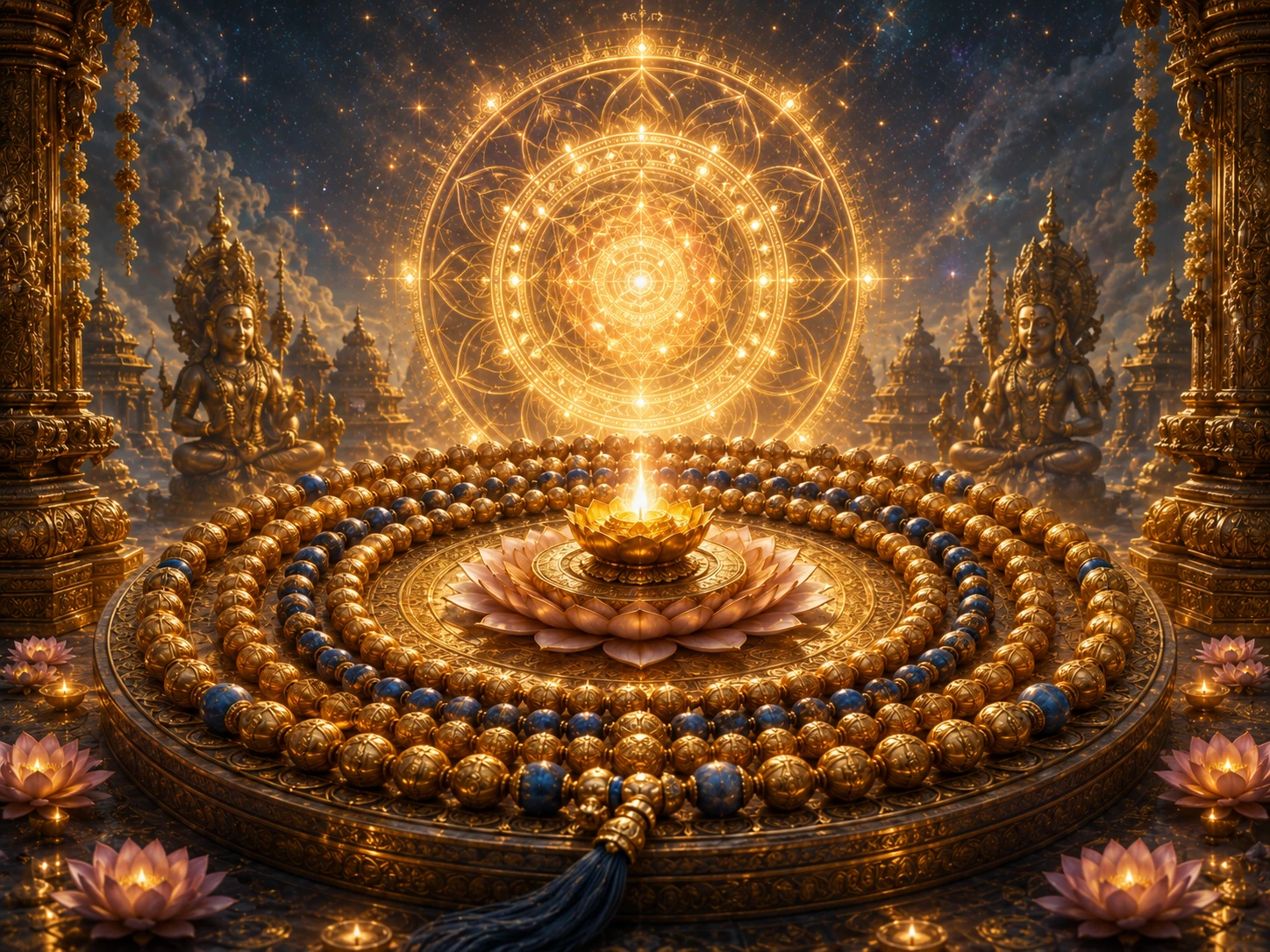
108 -- The Sacred Number That Links Your Mala to the Solar System
108 -- वो पवित्र संख्या जो तुम्हारी माला को सौरमण्डल से जोड़ती है
Pick up any japa mala from any temple shop in Varanasi, Haridwar, or the devotional section of your neighbourhood's general store. Count the beads. 108. Visit the Padmanabhaswamy Temple in Thiruvananthapuram or the Tirupati Balaji Temple in Andhra Pradesh. Ask for the deity's Ashtottara Shatanamavali -- the litany of names. 108. Open the Muktika canon of Upanishads. Count the principal texts. 108. Ask your grandmother how many times to chant a mantra for it to 'take effect.' She will say 108 without hesitation, and she will not be able to tell you why.
The number 108 saturates Hindu practice the way water saturates the ocean. It is so ubiquitous that most practitioners never stop to ask the obvious question: why this specific number? Why not 100, which is mathematically cleaner? Why not 12, which maps to the zodiac? Why not 7, which maps to the chakras?
The answer, when you dig into it, is one of the most fascinating convergences in the history of human knowledge -- a point where astronomy, mathematics, anatomy, music theory, and spiritual practice all arrive at the same number through completely independent routes. Whether you believe this convergence is cosmic design or extraordinary coincidence, the fact remains: 108 keeps showing up in places it has no business showing up, unless the universe is built on a pattern the ancient rishis somehow detected.
Start with astronomy, because that is where 108 becomes genuinely eerie. Three facts that any standard astronomy reference will verify as excellent approximations:
The average distance from the Earth to the Sun is approximately 108 times the Sun's diameter. (149.6 million km / 1.39 million km = approximately 107.5.)
The average distance from the Earth to the Moon is approximately 108 times the Moon's diameter. (384,400 km / 3,474.8 km = approximately 110.6, and at certain orbital points the ratio passes through 108 exactly.)
The Sun's diameter is approximately 108 times the Earth's diameter. (1.39 million km / 12,742 km = approximately 109.)
None of these ratios are exactly 108 -- the orbits are elliptical, distances vary, and rounding is involved. But the fact that all three independent measurements cluster this tightly around a single number is, to put it mildly, unusual. Professor Subhash Kak of Oklahoma State University, a Padma Shri recipient and member of the Prime Minister's Science, Technology and Innovation Advisory Council, has argued in peer-reviewed publications that ancient Indian astronomers knew at least the first two of these ratios. The Surya Siddhanta, one of India's oldest astronomical texts, uses 108-based calculations for celestial distances. Whether the ancient rishis derived 108 from astronomical observation or arrived at it independently and the astronomical coincidence was discovered later remains debated. But the correlation exists.
This leads to a breathtaking metaphysical interpretation: if the distance from Earth to the Sun is 108 Sun-diameters, and the japa mala has 108 beads, then each bead represents one step on the journey from the material body (Earth) to the divine light (Sun). Indian thought has always held that the macrocosm mirrors the microcosm. The mala in your hand is, symbolically, a map of the solar system.
ओमित्येकाक्षरं ब्रह्म व्याहरन्मामनुस्मरन्। यः प्रयाति त्यजन्देहं स याति परमां गतिम्॥
om ity ekākṣaraṃ brahma vyāharan mām anusmaran | yaḥ prayāti tyajan dehaṃ sa yāti paramāṃ gatim ||
One who departs the body while uttering the single syllable Om, thinking of Me, attains the supreme goal.
— Bhagavad Gita, Chapter 8, Verse 13
Now move from the sky to the zodiac. The Atharvaveda divides the ecliptic -- the apparent path of the Sun across the sky -- into 27 Nakshatras (lunar mansions or constellations). Each Nakshatra spans 13 degrees and 20 minutes of the 360-degree ecliptic. Each Nakshatra is further divided into 4 Padas (quarters). 27 Nakshatras multiplied by 4 Padas equals exactly 108. In Vedic astrology, these 108 Padas represent the complete journey of consciousness through all possible life configurations. Your birth chart places you in one Pada; your life's journey traverses many others. The mala's 108 beads thus also map the complete zodiacal journey.
In Ayurveda, the Sushruta Samhita describes 107 Marma points in the human body -- vital junctions where muscles, bones, veins, and joints converge. The Tamil Siddha and Kerala Kalari traditions count 108 Marma points (the additional point being the crown of the head, where consciousness is said to exit at death). A Kalari martial artist training in Thiruvananthapuram today studies these 108 points both to heal and to immobilise -- the identical knowledge deployed in opposite directions.
In classical Indian music, the Natya Shastra of Bharata Muni catalogues 108 Karanas -- synchronized movements of hands and feet that form the foundational vocabulary of classical dance. A Bharatanatyam dancer performing at the Chennai Music Season and a Kathak performer at Lucknow's Bhatkhande University are both drawing from this 108-karana matrix, though their styles differ radically.
In literature, there are 108 principal Upanishads in the Muktika canon. The Mahabharata has 18 Parvas -- and 18 is 108 divided by 6. The Bhagavad Gita has 18 chapters. There are 18 major Puranas. The Rig Veda contains 10,800 stanzas -- 108 multiplied by 100. The number operates like a fractal: it appears at every scale of the tradition.
Where 108 Appears Across Hindu Tradition
| Domain | The 108 Connection | Source / Context |
|---|---|---|
| Astronomy | Earth-Sun distance is approximately 108 x Sun's diameter; Earth-Moon distance is approximately 108 x Moon's diameter | Surya Siddhanta; modern astrophysics (approximate values) |
| Vedic Astrology | 27 Nakshatras x 4 Padas = 108 divisions of the ecliptic | Atharvaveda; Jyotish Shastra |
| Japa Mala | 108 beads on every standard rosary for mantra chanting | Universal across Hindu, Buddhist, and Jain traditions |
| Upanishads | 108 principal Upanishads in the Muktika canon | Muktika Upanishad (dialogue between Rama and Hanuman) |
| Deity Names | Ashtottara Shatanamavali -- 108 names for every major deity | Shiva Purana, Vishnu Sahasranama subsets, Lalita Sahasranama subsets |
| Temples | 108 Divya Desams (sacred Vishnu temples) revered by the 12 Alvars | Nalayira Divya Prabandham (Tamil Vaishnavite canon) |
| Ayurveda / Marma | 107-108 Marma (vital energy) points in the human body | Sushruta Samhita (107); Tamil Siddha and Kalari traditions (108) |
| Dance | 108 Karanas (movement units) in classical Indian dance | Natya Shastra of Bharata Muni |
| Rig Veda | 10,800 stanzas (108 x 100) | Rig Veda Samhita |
| Breath | Approximately 21,600 breaths per day (108 x 200); 10,800 solar + 10,800 lunar | Tantra Shastra; Pranayama traditions |
Astronomical ratios are approximations (the actual values vary between ~107-111 due to elliptical orbits). The Sushruta Samhita counts 107 Marmas; the 108th is added in certain regional traditions. Breath count is an average estimate.
The japa mala itself deserves attention. The standard mala has 108 beads plus one additional bead called the Meru or Sumeru -- the 'mountain' bead that marks the beginning and end of the circuit. The Meru is never counted and never crossed; when you complete 108 repetitions and reach it, you turn the mala around and go back the way you came. This is not arbitrary ritual. The Meru represents the point of transcendence -- the moment where counting ends and awareness takes over. It is the silence after Om, the Turiya after the three states.
Different traditions use different mala materials, and the material is not decorative but functional. Rudraksha beads (from the Elaeocarpus ganitrus tree) are associated with Shiva worship and are believed to have electromagnetic properties that calm the nervous system. Tulsi (holy basil) malas are used for Vishnu and Krishna worship. Crystal (sphatik) malas are used for Devi worship and general meditation. Sandalwood malas are cooling and used for calming practices. Each material creates a different tactile experience, and the tactile repetition is itself a neurological technique -- the rhythmic movement of fingers across beads activates the sensorimotor cortex and creates a meditative feedback loop.
At the Kashi Vishwanath Temple in Varanasi, sadhus can be seen moving through their malas at dawn. At the ISKCON temple in Vrindavan, devotees chant 16 rounds of 108 beads daily -- that is 1,728 repetitions of the Hare Krishna Mahamantra. At a Vipassana centre in Igatpuri, Maharashtra, practitioners use 108 as a structural unit for breath counting. At a yoga studio in Indiranagar, Bangalore, a '108 Sun Salutations' challenge on Makar Sankranti has become an annual event. The number operates across all levels of practice, from the most traditional to the most contemporary.
For the startup founder in HSR Layout who keeps a rudraksha mala on the desk 'for energy,' and the UPSC aspirant in Old Rajinder Nagar who chants Gayatri 108 times before the prelims paper, and the grandmother in Allahabad who has worn her mala smooth through fifty years of daily japa -- 108 is the architecture of devotion. It is the number that turns repetition into ritual, and ritual into transcendence.
The phenomenon of total solar eclipses -- where the Moon perfectly covers the Sun's disk -- is possible only because the Sun is roughly 400 times larger than the Moon AND roughly 400 times farther away. This means both the Sun and Moon appear almost exactly the same size from Earth. The 108-ratio plays into this: the Sun's distance from Earth is approximately 108 Sun-diameters, and the Moon's distance from Earth is approximately 108 Moon-diameters. This precise ratio is unique in our solar system -- no other planet has a moon that produces perfect total eclipses. Ancient Indian astronomers documented eclipses (Rahu-Ketu) with remarkable accuracy, and the Surya Siddhanta's eclipse prediction algorithms were operational centuries before equivalent European methods.
108 Japa -- Guided Mala Meditation
Complete one full mala of 108 repetitions today. Choose your mantra, hold the mala in the right hand, move one bead with each repetition, and turn back at the meru bead rather than crossing it. The mantra meditation library on Eternal Raga has mantras to choose from, with a guide for each.
Tags
Eternal Raga · शाश्वत राग
Institutional voice — scholarly articles on Sanatan Dharma
Deepen Your Understanding
अपनी समझ और गहरी करें
sacred symbols
Om -- The Primordial Sound That Contains the Universe
Every temple bell, every mantra, every meditation session begins and ends with Om. But what exactly IS Om? The Mandukya Upanishad claims this single syllable contains all of reality -- past, present, future, and whatever lies beyond time itself. Twelve verses. One sound. The entire map of consciousness.
vedic sciences
Surya Siddhanta -- The Ancient Astronomy Text That Got the Year Right to 1.4 Seconds
Before Copernicus, before Galileo, before the telescope existed -- an Indian text calculated the tropical year as 365.2421756 days. The modern value is 365.2421904. The difference is 1.4 seconds per year. The Surya Siddhanta also described gravity, computed planetary diameters within 1% accuracy, and invented the sine function. It did all this in Sanskrit verse.
vedic sciences
Panchang -- The Five-Limbed Hindu Calendar That Runs on the Moon and the Sun
Your phone uses the Gregorian calendar. Your grandmother uses the Panchang. One tracks the Sun. The other tracks the Sun AND the Moon AND the stars AND something called Yoga AND something called Karana. Five moving parts, one unified system -- and it determines every wedding date, every festival, and every 'shubh muhurat' in a billion Hindu lives.
vedic sciences
Kaal Ganana -- The Hindu Measure of Time
From a single blink of the eye (Nimesha) to one Day of Brahma (4.32 billion years) -- explore the complete cosmic time hierarchy of Hindu cosmology, anchored in Vishnu Purana 1.3, with its remarkable parallels to modern science.
sacred symbols
Sri Chakra -- The Sacred Geometry That Takes a Lifetime to Draw Perfectly
Nine interlocking triangles. Four pointing upward (Shiva). Five pointing downward (Shakti). Their intersection creates 43 smaller triangles that map the entire journey of consciousness from the material to the divine. The Sri Yantra is the most complex sacred geometric figure in any world tradition -- and mathematicians still argue about whether it can be drawn with perfect precision.
vedic sciences
Vedic Mathematics -- 16 Sutras, One Shankaracharya, and a Controversy That Won't Die
In 1965, a posthumous book by Shankaracharya Bharati Krishna Tirthaji claimed that 16 Sanskrit sutras could solve all of mathematics -- from basic arithmetic to calculus. The techniques are brilliant. The 'Vedic' label is contested. The debate reveals everything about how modern India negotiates between civilisational pride and academic rigour.
The phenomenon of total solar eclipses -- where the Moon perfectly covers the Sun's disk -- is possible only because the Sun is roughly 400 times larger than the Moon AND roughly 400 times farther away. This means both t…
More in Sacred Symbols
Ashtamangala -- The Eight Auspicious Symbols of Hindu Tradition
13 min read
Bindu -- The Point from which Creation Emerges
12 min read
Gau -- Why the Cow Holds the Place She Does in Hindu Life
14 min readThe same translation error that turned '33 Koti' into '33 crore' in Hinduism also happened in Buddhism. The Chinese translation of Buddhist texts rendered 'Sapta Koti Buddha' (7 Supreme Buddhas) as '7 Crore Buddhas.' The…
Deities AvatarsCommunity Reflections
🕉️
Be the first to share your reflection.