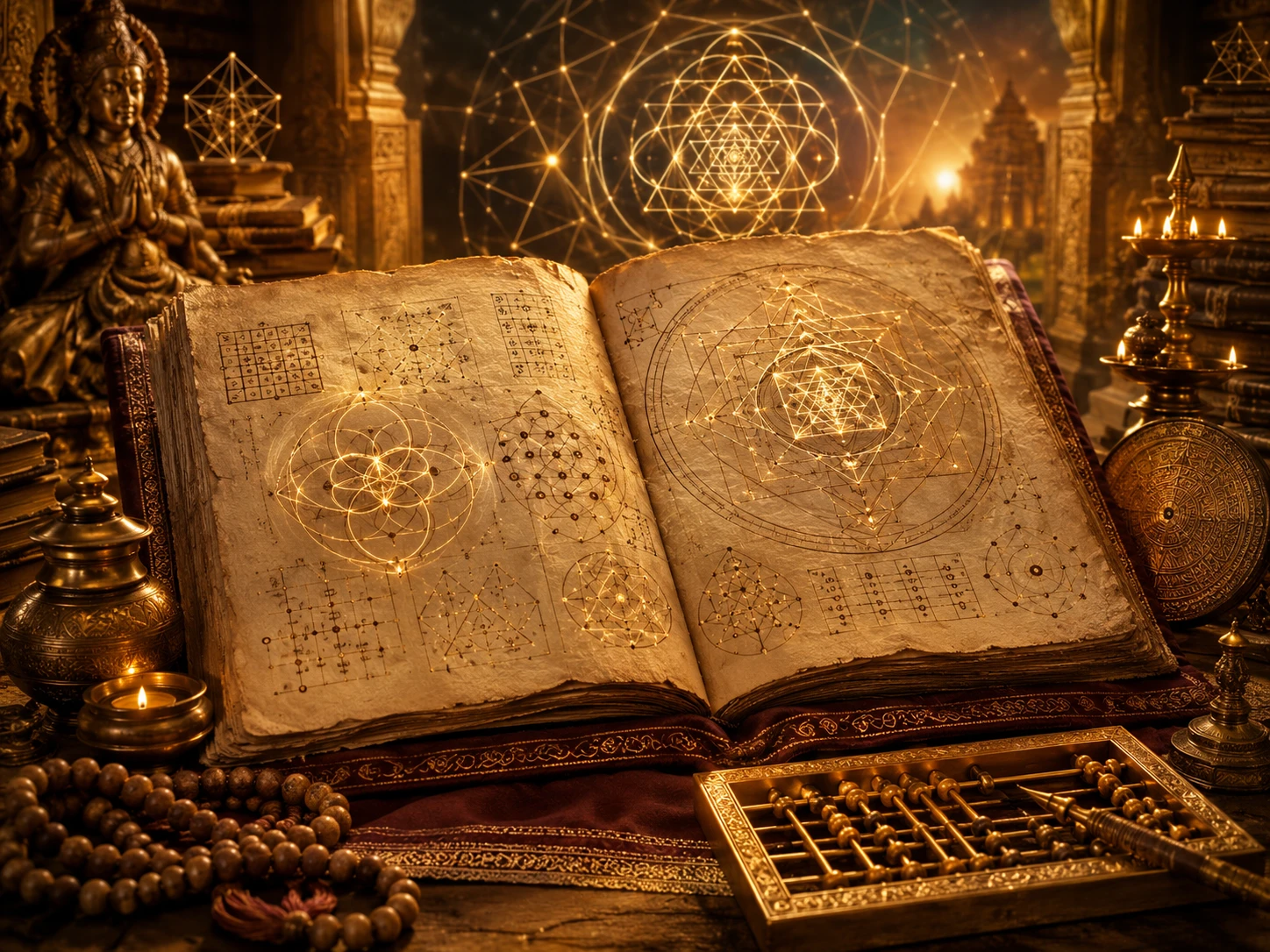
Vedic Mathematics -- 16 Sutras, One Shankaracharya, and a Controversy That Won't Die
वैदिक गणित -- 16 सूत्र, एक शंकराचार्य, और एक विवाद जो थमता नहीं
In any Kota coaching centre during JEE preparation season, ask a student about Vedic Maths and you will get one of two responses. Either a confident demonstration of how to multiply 97 by 96 in three seconds flat, or a dismissive 'it's just tricks, not real maths.' Both responses are partially correct. And the tension between them tells you something important about how India relates to its own intellectual heritage.
The story begins with Jagadguru Shankaracharya Swami Bharati Krishna Tirthaji (1884-1960), one of the most extraordinary minds in modern Indian history. Born Venkatraman Shastri to a Tamil Brahmin family, he earned seven master's degrees by the age of twenty, including Mathematics, Sanskrit, English, Philosophy, and History. He became Shankaracharya of Govardhana Matha in Puri -- one of the four highest seats of Hindu religious authority -- in 1925. He was also arrested alongside Muslim leaders in the Khilafat movement, making him one of the few Shankaracharyas in history with both a spiritual and a revolutionary political biography.
Between 1911 and 1918, during years of solitary study and meditation at Sringeri, Karnataka, Tirthaji claimed to have deciphered sixteen Sanskrit sutras in the Parishishta (appendix) of the Atharvaveda. These sutras, he said, contained the complete mathematical knowledge of the ancient Vedic tradition. He wrote sixteen volumes expounding them. The manuscripts were lost. Before his death, he rewrote a single introductory volume from memory. That book -- 'Vedic Mathematics: Sixteen Simple Mathematical Formulae from the Vedas' -- was published posthumously in 1965, and it detonated a slow-burning intellectual explosion that has not stopped.
The techniques themselves are genuinely ingenious. Take the Nikhilam Sutra: 'All from 9 and the last from 10.' To multiply 97 by 96, you note that both are close to 100. Their deficiencies from 100 are 3 and 4. Cross-subtract either deficiency from the other number: 97-4 = 93 or 96-3 = 93. That is the left part. Multiply the deficiencies: 3 x 4 = 12. That is the right part. Answer: 9312. Done in seconds, no calculator needed.
Or take Urdhva Tiryagbhyam -- 'Vertically and Crosswise.' This sutra provides a method for multiplying any two numbers through a pattern of vertical and diagonal products that can be performed mentally. For two-digit numbers, it is fast. For three-digit numbers, it is faster than the standard algorithm. For polynomial multiplication in algebra, it is elegant.
Ekadhikena Purvena -- 'By One More than the Previous One' -- gives instant results for dividing by numbers ending in 9 (like 1/19, 1/29, 1/49). Paravartya Yojayet -- 'Transpose and Apply' -- provides a systematic approach to division and solving linear equations. Vyashtisamanstih -- 'Individuality and Totality' -- handles simultaneous equations with remarkable conciseness.
These are not trivial tricks. They represent a genuinely different way of approaching computation -- one that prioritises mental pattern recognition over written algorithmic procedure. For competitive exam students, this difference is critical. The IIT JEE paper gives you three hours for a hundred-plus questions. Every second saved on computation is a second available for analysis. The CAT exam for IIMs similarly rewards speed. Banking exams (IBPS, SBI PO) have quantitative sections where Vedic Math techniques can shave minutes off total time.
This is why Vedic Mathematics has become a cottage industry in Indian education. YouTube channels like 'Vedic Maths by Gaurav' and 'Speed Maths India' have millions of subscribers. Coaching centres in Kota, Hyderabad, and Delhi offer Vedic Maths as a supplementary module. Apps on the Google Play Store promise 'Vedic Maths Tricks for JEE' and 'Vedic Speed Mathematics for Bank Exams.' The market is real because the utility is real.
The 16 Vedic Mathematics Sutras
| # | Sanskrit Sutra | English Meaning | Primary Application |
|---|---|---|---|
| 1 | Ekadhikena Purvena | By one more than the previous one | Division by numbers ending in 9; recurring decimals |
| 2 | Nikhilam Navatashcaramam Dashatah | All from 9 and last from 10 | Multiplication near a base (10, 100, 1000) |
| 3 | Urdhva Tiryagbhyam | Vertically and crosswise | General multiplication; polynomial products |
| 4 | Paravartya Yojayet | Transpose and apply | Division; solving linear equations |
| 5 | Shunyam Samyasamuccaye | When the total is the same, total is zero | Simplification of algebraic expressions |
| 6 | Anurupye Shunyam Anyat | If one is in ratio, the other is zero | Simultaneous equations |
| 7 | Sankalana Vyavakalanabhyam | By addition and subtraction | Simultaneous equations; factoring |
| 8 | Puranapuranabhyam | By completion or non-completion | Completing the square; quadratics |
| 9 | Chalana Kalanabhyam | Differences and similarities | Calculus concepts; differential equations |
| 10 | Yavadunam | Whatever the extent of deficiency | Squaring numbers near a base |
| 11 | Vyashtisamanstih | Individuality and totality | Simultaneous equations; algebraic identities |
| 12 | Shesanyankena Charamena | Remainder by the last digit | Express fractions as decimals |
| 13 | Sopantyadvayamantyam | The ultimate and twice the penultimate | Specific fraction sums |
| 14 | Ekanyunena Purvena | By one less than the previous one | Multiplication by series of 9s |
| 15 | Gunitasamuchyah | The product of the sum is the sum of the product | Verification of factorisation |
| 16 | Gunakasamuchyah | The factors of the sum is equal to the sum of the factors | Verification of multiplication |
All 16 sutras as presented in 'Vedic Mathematics' (1965) by Bharati Krishna Tirthaji. The 'Primary Application' column shows the most common competitive exam usage; Tirthaji claimed broader applications across all mathematics.
Now the controversy, which this article will not shy away from because intellectual honesty is non-negotiable.
No scholar -- including the book's own editor V. S. Agrawala -- has been able to locate these sixteen sutras in any existing edition of the Atharvaveda or its Parishishta. When mathematician K. S. Shukla directly asked Tirthaji to point out the sutras in the standard Parishishta, Tirthaji reportedly said they appeared in 'his own Parishishta' and not any other. The language style of the sutras does not match Vedic Sanskrit. Several of the mathematical techniques they encode deal with decimal fractions and polynomial algebra -- concepts that did not exist in the Vedic period. Professor S. G. Dani of IIT Bombay, in his influential 2006 paper, described the system as a 'compilation of tricks in elementary arithmetic and algebra' with no verifiable Vedic origin. Similar techniques exist in the Trachtenberg system (1950s) and in Lester Meyers' 'High Speed Mathematics' (1947), neither of which claims ancient origins.
This does not mean the techniques are invalid. It means the label 'Vedic' is almost certainly a misnomer -- or at best, uses 'Veda' in its broader sense of 'knowledge' rather than referring to the actual Vedic texts. The most likely explanation, as Dani suggests, is that Tirthaji -- a genuine mathematical prodigy with seven master's degrees -- developed these techniques through his own experimentation and framed them in Sanskrit sutra form because that was the intellectual tradition he inhabited.
This matters because Eternal Gyan is committed to evidence-based content. We do not reject Tirthaji's work -- it is brilliant. We do not reject the 'Vedic' framing -- it has become a culturally meaningful brand that motivates millions of students. But we note clearly: the direct Vedic textual origin is unverified, and honest engagement with India's intellectual heritage requires saying so. Ancient Indian mathematics HAS genuine Vedic-era achievements -- the Sulba Sutras' geometry, the Shulbasutra altar constructions that predate the Pythagorean theorem, Aryabhata's zero and decimal system, Brahmagupta's negative numbers, the Kerala School's proto-calculus. These are historically documented, textually verified, and need no inflation. Tirthaji's system is a 20th-century achievement dressed in ancient clothing -- and it would be no less impressive if it were presented as what it most likely is: the work of a modern genius.
यदा यदा हि धर्मस्य ग्लानिर्भवति भारत। अभ्युत्थानमधर्मस्य तदात्मानं सृजाम्यहम्॥
yadā yadā hi dharmasya glānir bhavati bhārata | abhyutthānam adharmasya tadātmānaṃ sṛjāmy aham ||
Whenever there is a decline of dharma and a rise of adharma, O Bharata, then I manifest myself.
— Bhagavad Gita, Chapter 4, Verse 7
Why this verse in an article about mathematics? Because Tirthaji's project was, at its heart, a dharmic one. He was a Shankaracharya -- a religious leader -- not merely a mathematician. He believed that the Vedas contained all knowledge, including mathematical knowledge, and that recovering it was a form of dharma restoration. Whether or not the sutras are literally Vedic, the impulse behind them -- that Indian civilisation possessed deep mathematical insight that the modern world has forgotten -- is not wrong. It is, in fact, historically demonstrable.
The Sulba Sutras (circa 800-200 BCE) contain geometric constructions for Vedic fire altars that embody the Pythagorean theorem centuries before Pythagoras. Panini's Ashtadhyayi (circa 4th century BCE) is the world's first formal generative grammar -- and its rule structure is identical to the Backus-Naur Form used in modern computer science. Aryabhata (476 CE) computed pi to four decimal places and described the Earth's rotation. Brahmagupta (598 CE) defined zero as a number and formulated rules for negative number arithmetic. Madhava of Sangamagrama (14th century CE) and the Kerala School developed infinite series for trigonometric functions that predate Newton and Leibniz by two centuries.
These are documented, peer-reviewed, acknowledged facts of mathematical history. They need no embellishment. The irony of the Vedic Mathematics controversy is that India's actual mathematical heritage is so extraordinary that overclaiming actually diminishes it. When you say 'these tricks are from the Vedas' without evidence, you invite debunking -- and in the process of debunking, the genuinely Vedic and post-Vedic mathematical achievements get overlooked.
For the UPSC aspirant, Vedic Mathematics appears in Science and Technology questions about India's contributions. For the IIT student, the debate about its origins is a lesson in scientific temper -- the ability to appreciate utility while demanding evidence. For the NRI parent teaching their child 'Indian math tricks' in Cupertino, California, it is an entry point into a much larger story about Indian mathematical genius that stretches from the Sulba Sutras to Ramanujan to the Indian engineers who built Silicon Valley's backbone.
Use the techniques. They work. But know where they actually come from. That is the Vedic spirit at its best: relentless pursuit of truth, even when the truth complicates a good story.
The Kerala School of Mathematics (14th-16th century CE), led by Madhava of Sangamagrama, independently discovered the infinite series for pi, sine, cosine, and arctangent -- concepts that Europe would not formalise until Newton and Leibniz in the late 17th century. In 2023, IIT Madras and the Kerala University of Digital Sciences collaborated on digitising the original palm-leaf manuscripts of the Kerala School's Tantrasangraha and Yuktibhasa, making these genuine ancient Indian mathematical treasures accessible to the world for the first time in searchable digital form.
Mental Maths -- Try a Vedic Sutra
Try Nikhilam multiplication on 97 × 96. Each falls short of 100, by 3 and 4. Cross-subtract to get 93 (97 minus 4), multiply the shortfalls to get 12, and the answer is 9312. Time yourself on five more pairs near 100. The Vedic Sciences section of Eternal Gyan has more.
Tags
Eternal Raga · शाश्वत राग
Institutional voice — scholarly articles on Sanatan Dharma
Deepen Your Understanding
अपनी समझ और गहरी करें
vedic sciences
Surya Siddhanta -- The Ancient Astronomy Text That Got the Year Right to 1.4 Seconds
Before Copernicus, before Galileo, before the telescope existed -- an Indian text calculated the tropical year as 365.2421756 days. The modern value is 365.2421904. The difference is 1.4 seconds per year. The Surya Siddhanta also described gravity, computed planetary diameters within 1% accuracy, and invented the sine function. It did all this in Sanskrit verse.
sacred symbols
108 -- The Sacred Number That Links Your Mala to the Solar System
Why does a japa mala have exactly 108 beads? Why do temples list 108 names for every deity? The answer involves astronomy, anatomy, music, and mathematics -- and a coincidence so precise it still stuns astrophysicists: the distance from Earth to the Sun is approximately 108 times the Sun's diameter.
vedic sciences
Panchang -- The Five-Limbed Hindu Calendar That Runs on the Moon and the Sun
Your phone uses the Gregorian calendar. Your grandmother uses the Panchang. One tracks the Sun. The other tracks the Sun AND the Moon AND the stars AND something called Yoga AND something called Karana. Five moving parts, one unified system -- and it determines every wedding date, every festival, and every 'shubh muhurat' in a billion Hindu lives.
vedic sciences
Kaal Ganana -- The Hindu Measure of Time
From a single blink of the eye (Nimesha) to one Day of Brahma (4.32 billion years) -- explore the complete cosmic time hierarchy of Hindu cosmology, anchored in Vishnu Purana 1.3, with its remarkable parallels to modern science.
sacred symbols
Sri Chakra -- The Sacred Geometry That Takes a Lifetime to Draw Perfectly
Nine interlocking triangles. Four pointing upward (Shiva). Five pointing downward (Shakti). Their intersection creates 43 smaller triangles that map the entire journey of consciousness from the material to the divine. The Sri Yantra is the most complex sacred geometric figure in any world tradition -- and mathematicians still argue about whether it can be drawn with perfect precision.
sacred symbols
Om -- The Primordial Sound That Contains the Universe
Every temple bell, every mantra, every meditation session begins and ends with Om. But what exactly IS Om? The Mandukya Upanishad claims this single syllable contains all of reality -- past, present, future, and whatever lies beyond time itself. Twelve verses. One sound. The entire map of consciousness.
The Kerala School of Mathematics (14th-16th century CE), led by Madhava of Sangamagrama, independently discovered the infinite series for pi, sine, cosine, and arctangent -- concepts that Europe would not formalise until…
More in Vedic Sciences

Agnichayana -- The Falcon-Shaped Fire Altar That Survived 3,000 Years
12 min read
Ancient Indian Metallurgy -- The Iron Pillar That Refuses to Rust
13 min readAryabhata -- The Astronomer Who Said the Earth Turns
3 min readThe same translation error that turned '33 Koti' into '33 crore' in Hinduism also happened in Buddhism. The Chinese translation of Buddhist texts rendered 'Sapta Koti Buddha' (7 Supreme Buddhas) as '7 Crore Buddhas.' The…
Deities AvatarsCommunity Reflections
🕉️
Be the first to share your reflection.