Charaka vs Sushruta -- The Two Founders of Ayurveda and Why India Had Both Internal Medicine and Surgery 2,000 Years Ago
चरक बनाम सुश्रुत -- आयुर्वेद के दो संस्थापक और भारत के पास 2,000 वर्ष पहले आन्तरिक चिकित्सा और शल्यचिकित्सा दोनों क्यों थीं
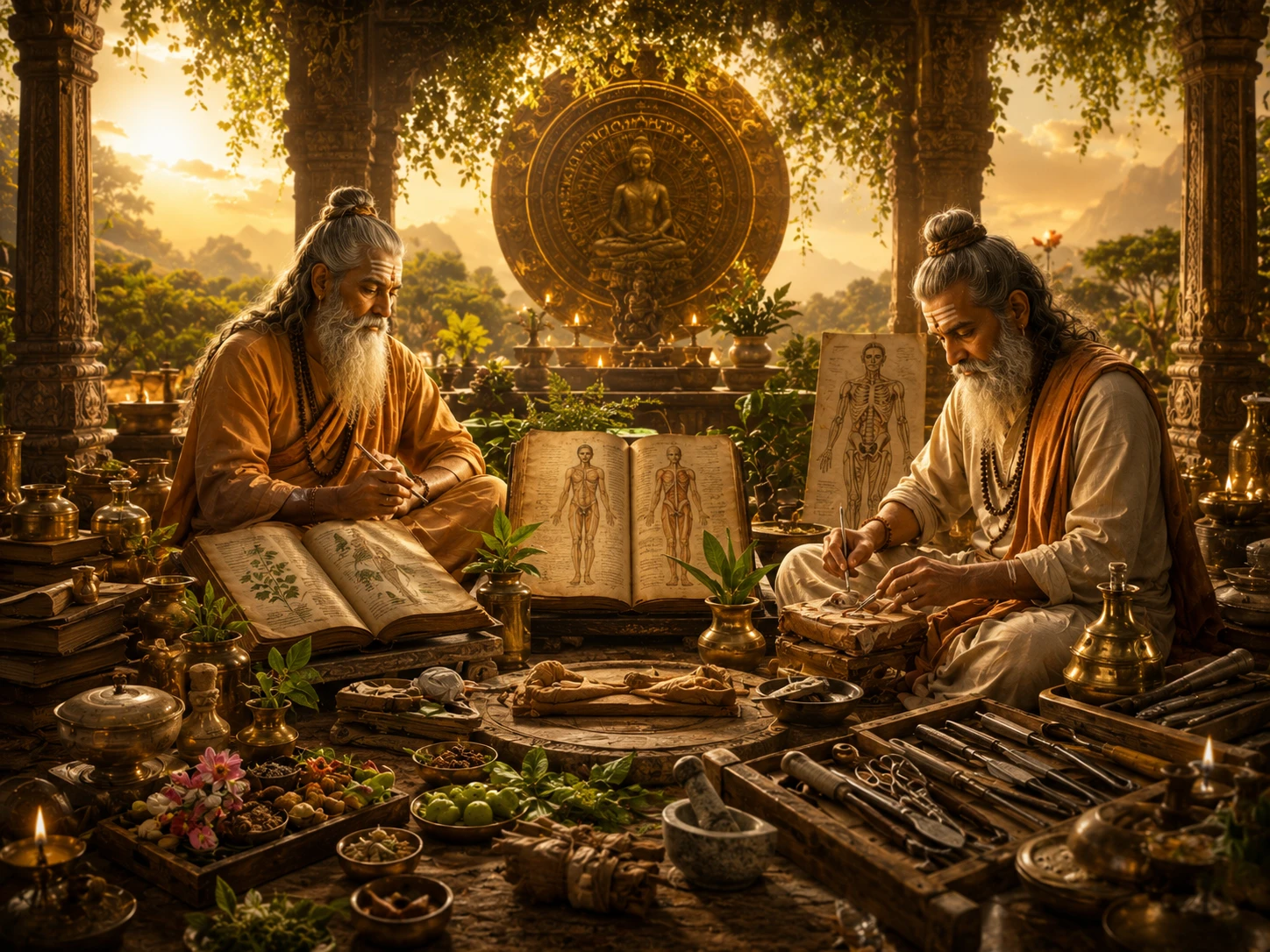
Ayurveda's two founding texts represent two fundamentally different approaches to healing -- and together they form a medical system of extraordinary completeness. The Charaka Samhita (attributed to Charaka, circa 2nd century BCE - 2nd century CE) is primarily a treatise on Kayachikitsa -- internal medicine. It focuses on diagnosis, aetiology (understanding the cause of disease), pharmacology (herbal and mineral medicines), diet, lifestyle modification, and preventive health. The Sushruta Samhita (attributed to Sushruta, circa 6th century BCE - 3rd century CE, with later revisions) is primarily a treatise on Shalya Tantra -- surgery. It describes over 300 surgical procedures, 121 surgical instruments, wound management, anaesthesia (using wine and specific herbs), plastic surgery (including rhinoplasty), and detailed human anatomy based on dissection.
The contrast is not adversarial -- it is complementary. Charaka asks: why is the patient sick, and how can we restore balance without cutting? Sushruta asks: when the body is damaged beyond internal repair, how do we physically reconstruct it? Modern medicine made the same distinction when it separated physicians (internal medicine doctors) from surgeons. India made this distinction 2,000 years earlier.
Both texts share the foundational Ayurvedic framework: the Tridosha theory (Vata, Pitta, Kapha), the Sapta Dhatu (seven tissue types), the Panchakarma (five detoxification procedures), and the concept of Prakriti (individual constitutional type). But they apply this framework differently. Charaka applies it to understand why disease arises and how to prevent it through diet, herbs, and lifestyle. Sushruta applies it to understand when physical intervention is necessary and how to perform it safely.
स्वस्थस्य स्वास्थ्यरक्षणं आतुरस्य विकारप्रशमनं च।
svasthasya svāsthya-rakṣaṇaṁ āturasya vikāra-praśamanaṁ ca |
The twin purpose of Ayurveda: to protect the health of the healthy, and to cure the disease of the sick.
— Charaka Samhita, Sutra Sthana 30.26
Charaka Samhita vs Sushruta Samhita -- Two Pillars of Ayurveda
| Parameter | Charaka Samhita | Sushruta Samhita |
|---|---|---|
| Primary Domain | Kayachikitsa -- internal medicine | Shalya Tantra -- surgery |
| Attributed Author | Charaka (with Agnivesha and Dridhabala as earlier/later contributors) | Sushruta (possibly a school rather than a single author) |
| Approximate Date | 2nd century BCE - 2nd century CE (with later redactions) | 6th century BCE - 3rd century CE (debated; likely compiled over centuries) |
| Parent Veda | Atharvaveda (also linked to Rigveda in some traditions) | Atharvaveda |
| Structure | 8 Sthanas (sections), 120 chapters, ~10,000 verses | 6 Sthanas, 186 chapters, ~7,000+ verses |
| Diagnostic Strength | Nadi Pariksha (pulse), Ashtavidha Pariksha (8-fold examination), detailed questioning | Anatomical examination, wound classification, foreign body identification |
| Therapeutic Focus | Herbal pharmacology (600+ medicinal plants), diet therapy, Panchakarma detox, Rasayana (rejuvenation) | 300+ surgical procedures, 121 instruments, wound suturing, plastic surgery, anaesthesia |
| Landmark Achievement | Systematic classification of diseases by dosha imbalance; preventive medicine framework | Rhinoplasty (nose reconstruction from cheek flap); cataract couching; lithotomy (stone removal); caesarean section |
| Training Method | Clinical apprenticeship; debate-based examination | Practice on vegetables (watermelon, gourd), leather bags, dead animals, and wax models before human surgery |
| Modern Legacy | Foundation of Ayurvedic general practice; BAMS curriculum; Patanjali, Dabur product lines | Credited as 'Father of Surgery' (Sushruta); WHO recognises Indian rhinoplasty as earliest known plastic surgery |
The Sushruta Samhita's rhinoplasty procedure -- reconstructing a severed nose using a flap of skin from the cheek or forehead -- was observed by British surgeons in India in the 18th century and directly inspired the development of modern plastic surgery in Europe.
Sushruta's surgical achievements deserve particular attention because they are among the most concrete, verifiable claims in all of ancient Indian science. The Sushruta Samhita describes rhinoplasty (nasikasandhana) in precise operational detail: a leaf-shaped flap of skin is measured and cut from the cheek, rotated to cover the nose defect, sutured into place with horse hair or bark thread, and kept in place with tubes inserted into the nostrils to maintain airway and shape during healing. The wound is dressed with sesame oil, honey, and ghee -- all of which have demonstrated antimicrobial properties in modern studies. This is not mythology. This is a surgical technique that was independently observed by British surgeons Thomas Cruso and James Findlay in the 1790s in Pune, published in the Gentleman's Magazine (1794), and directly adopted into European surgical practice.
The text also describes: cataract couching (pushing a clouded lens out of the visual axis using a curved needle), lithotomy (surgical removal of bladder stones through perineal incision), caesarean delivery, fracture setting with bamboo splints, and the use of wine and cannabis preparations for anaesthesia. Sushruta classified surgical procedures into eight categories: excision (chedya), incision (bhedya), scraping (lekhya), puncturing (vedhya), probing (eshya), extraction (aharya), drainage (visravaniya), and suturing (sivya). These categories remain recognisable to any modern surgeon.
For training, Sushruta prescribed a remarkable curriculum: students practised incisions on watermelons and gourds, practised probing and extraction on leather bags filled with seeds, practised suturing on pieces of cloth, and practised puncturing and draining on dead animals. Only after demonstrating proficiency on these models was a student permitted to operate on a human patient. This graduated training protocol -- simulation before live surgery -- is exactly the principle behind modern surgical training with laparoscopic simulators and cadaver labs.
The honest caveat: not every claim in Sushruta can be verified, and some anatomical descriptions are inaccurate by modern standards. The text describes a number of body channels and organs in ways that do not map precisely onto modern anatomy. But the surgical procedures themselves -- particularly rhinoplasty, cataract surgery, and wound management -- are demonstrably real, and their historical verification through independent European observation is among the strongest evidence for any ancient medical claim anywhere in the world.
The British surgeon Joseph Constantine Carpue performed Europe's first successful rhinoplasty in 1815 -- directly based on the Indian technique he learned from accounts of Sushruta's method published in the Gentleman's Magazine in 1794. He openly credited India as the source. The WHO recognises Sushruta as the 'Father of Surgery.' The Charaka Samhita describes over 600 medicinal plants, 350 of which have been validated by modern pharmacology for bioactive compounds. Turmeric (haridra), neem (nimba), and ashwagandha (ashvagandha) -- three of Charaka's most prescribed herbs -- are now multi-billion-dollar global nutraceutical products. India's BAMS (Bachelor of Ayurvedic Medicine and Surgery) degree, taught at over 400 colleges across India, covers both Charaka and Sushruta as core texts. The Dhanvantari idol at AIIMS Delhi -- the medical school's unofficial mascot -- honours the mythological physician-deity from whom both Charaka and Sushruta traditions claim descent.
Explore Ayurveda on Eternal Raga
Ayurveda's twin pillars -- internal medicine (Charaka) and surgery (Sushruta) -- represent the most complete medical system of the ancient world. Explore the Ayurveda Fundamentals article for the full Tridosha framework.
Tags
Eternal Raga · शाश्वत राग
Institutional voice — scholarly articles on Sanatan Dharma
Deepen Your Understanding
अपनी समझ और गहरी करें
vedic sciences
Ayurveda -- The 3,000-Year-Old Science That Knows Your Body Type Before You Do
Long before personalised medicine became a Silicon Valley buzzword, the Charaka Samhita classified every human being into one of seven constitutional types based on three biological forces -- Vata, Pitta, and Kapha. Modern genomic studies at CSIR-IGIB have found that these ancient types correlate with distinct gene expression profiles. Ayurveda did not guess. It observed.
vedic sciences
Upavedas -- The Four Applied Sciences of Hindu Tradition
The Vedas gave India its philosophy and rituals. The Upavedas gave India its professions. Four applied knowledge systems -- Ayurveda (medicine), Dhanurveda (warfare), Gandharvaveda (music and performing arts), and Sthapatyaveda (architecture) -- were classified as subsidiary Vedas, each attached to one of the four main Vedas. They represent the Hindu tradition's insistence that sacred knowledge must produce practical results: a healed body, a defended nation, a beautiful performance, a well-built home. Together, the Upavedas form the intellectual infrastructure of pre-modern Indian civilisation -- from the surgeon's scalpel to the architect's blueprint to the musician's raga.
vedic sciences
The Science Behind Yoga -- From Patanjali's 196 Sutras to NIMHANS Brain Scans
Yoga is the most successful cultural export in Indian history -- practised by over 300 million people worldwide. But what most people call 'yoga' is only the third limb (asana) of an eight-limbed system that Patanjali designed as a complete technology for mastering the mind. The Yoga Sutras do not mention a single pose by name. They define yoga in four words: 'yogash chitta vritti nirodhah' -- yoga is the cessation of the fluctuations of the mind. This article traces yoga from its Vedic roots through Patanjali's systematic framework to the neuroscience labs at AIIMS and NIMHANS that are now proving what the sutras described 2,000 years ago -- that sustained practice physically rewires the brain.
vedic sciences
Shad Vedangas -- The Six Limbs of the Veda
The Vedas are not a single book you can pick up and read. They are a living system with six auxiliary sciences -- phonetics, metre, grammar, etymology, astronomy, and ritual procedure -- that function like limbs of a body. Without them, the Vedas are a voice without a mouth, a path without eyes. Here is the operating manual India's knowledge system ran on for three thousand years.
vedic sciences
Sacred City Planning -- How Hindu Scriptures Designed Cities Before the World Had Zoning Laws
Ancient India did not stumble into urban planning. The Ramayana describes Ayodhya's seven-storey buildings and water-sprinkled highways 3,000 years before Haussmann redesigned Paris. The Arthashastra lays out road widths, waste zones, and water reservoirs with the precision of a modern municipal manual. And the Manasara Shilpa Shastra names eight distinct city grid patterns -- each with a Sanskrit name, a geometric logic, and a moat system. This is not archaeology. This is scripture.
vedic sciences
Vastu Shastra -- The Ancient Science of Architecture That India Still Builds By
Before Frank Lloyd Wright talked about buildings harmonising with nature, before Le Corbusier designed Chandigarh, and before LEED green-building certifications existed, Indian architects were writing Sanskrit manuals on how to align a house with sunlight, wind, water, and the earth's magnetic field. Vastu Shastra -- literally 'the science of dwelling' -- is not superstition wrapped in incense. At its core, it is an empirical framework for orienting buildings so that natural light, ventilation, and thermal comfort work in the occupants' favour. The problem is that centuries of misapplication have buried the science under astrology, pseudoscience, and real-estate marketing. This article separates the architecture from the astrology.
vedic sciences
The Invention of Zero -- India's Gift That Made Modern Civilisation Possible
Without zero, there is no binary code, no computers, no GPS, no banking system, no physics equation that works. The number that represents nothing is the single most important invention in the history of mathematics -- and it came from India. Not as a sudden discovery but as a centuries-long evolution: from a philosophical concept of 'shunya' (void) in Sanskrit thought, to a placeholder dot in the Bakhshali manuscript, to Aryabhata's positional number system, to Brahmagupta's formal arithmetic rules for zero in 628 CE. From India it travelled through Arab scholars to Europe, replacing Roman numerals and igniting the Scientific Revolution. This is the story of how nothing changed everything.
The British surgeon Joseph Constantine Carpue performed Europe's first successful rhinoplasty in 1815 -- directly based on the Indian technique he learned from accounts of Sushruta's method published in the Gentleman's M…
More in Vedic Sciences
Agnichayana -- The Falcon-Shaped Fire Altar That Survived 3,000 Years
12 min read
Ancient Indian Metallurgy -- The Iron Pillar That Refuses to Rust
13 min readAryabhata -- The Astronomer Who Said the Earth Turns
3 min readThe same translation error that turned '33 Koti' into '33 crore' in Hinduism also happened in Buddhism. The Chinese translation of Buddhist texts rendered 'Sapta Koti Buddha' (7 Supreme Buddhas) as '7 Crore Buddhas.' The…
Deities AvatarsCommunity Reflections
🕉️
Be the first to share your reflection.