Shad Vedangas -- The Six Limbs of the Veda
षड्वेदाङ्ग -- वेदों के छह अंग
Imagine downloading a complex software application -- say, a full programming IDE -- but without any documentation, no syntax highlighting, no compiler, no debugger, and no clock to tell you when to deploy. You have the raw code, but no way to read it, understand it, time it, or execute it. That is what the Vedas would be without the Vedangas.
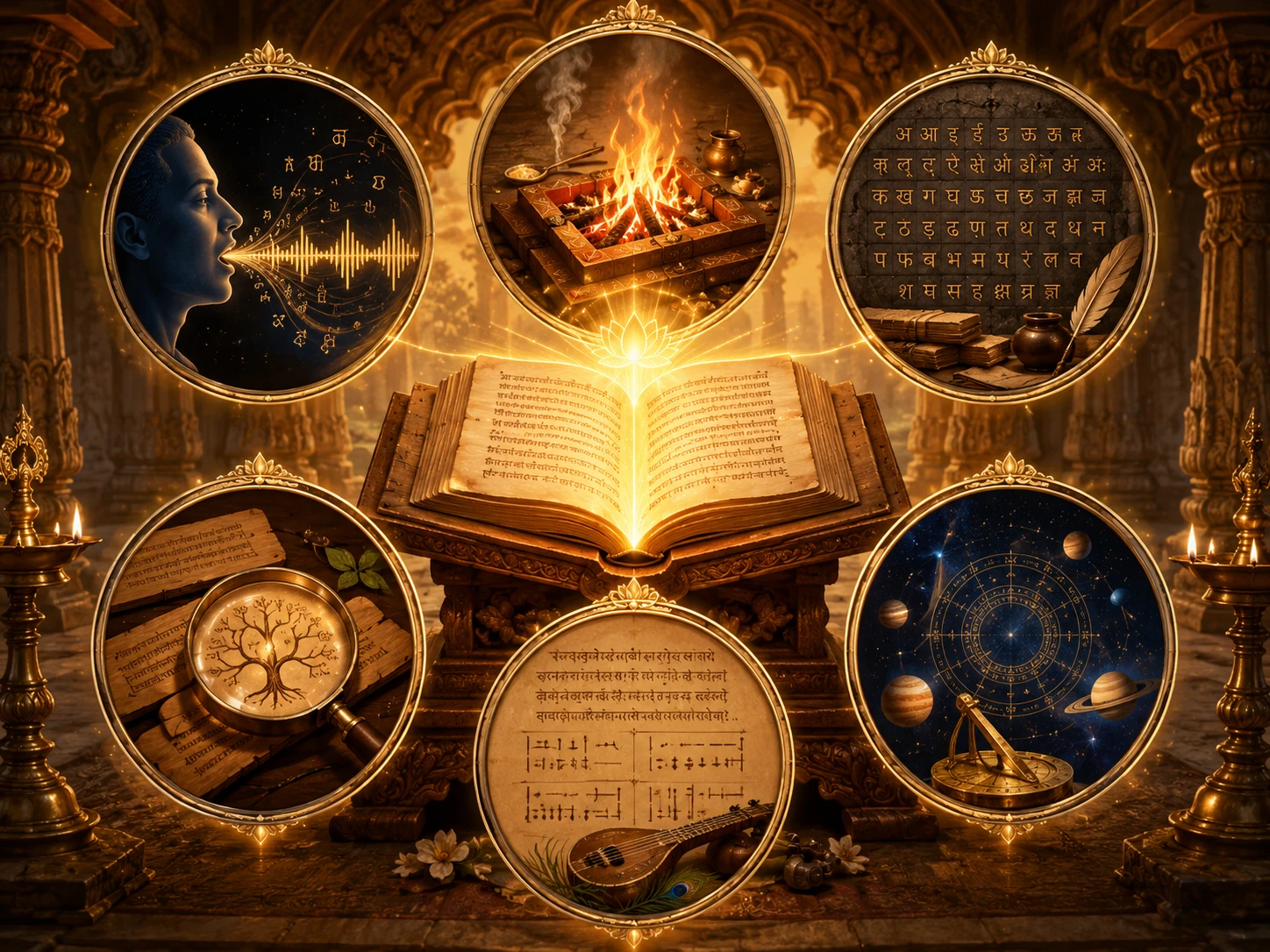
The word Vedanga literally means 'limb of the Veda' (veda + anga). The Paniniya Shiksha, one of the oldest texts to enumerate them, uses a striking metaphor: the Veda is a Purusha -- a cosmic person -- and the six Vedangas are its body parts. Chandas (metre) is its two feet, for metre carries the hymn forward. Kalpa (ritual procedure) is its two hands, for ritual is the Veda in action. Jyotisha (astronomy) is its two eyes, for it sees the right time. Nirukta (etymology) is its ears, for it hears the true meaning. Shiksha (phonetics) is its nose, for breath is the source of sound. And Vyakarana (grammar) is its mouth, for grammar gives the Veda its voice.
This is not just poetic decoration. It is a design philosophy. The ancient architects of Vedic education understood that a sacred text cannot survive on content alone. It needs an ecosystem of supporting disciplines -- a full technology stack, if you will -- to ensure that every syllable is pronounced correctly, every word is understood precisely, every metre is maintained, every ritual is performed at the right astronomical moment, and every sentence is grammatically coherent. The Vedangas are that stack.
The oldest record of their names appears in the Mundaka Upanishad (1.1.5), which classifies them as 'lower knowledge' (apara vidya) -- not because they are unimportant, but because they are the instruments through which one approaches the 'higher knowledge' (para vidya) of Brahman. They are the staircase, not the roof. But try reaching the roof without the staircase.
छन्दः पादौ तु वेदस्य हस्तौ कल्पोऽथ पठ्यते। ज्योतिषामयनं चक्षुर्निरुक्तं श्रोत्रमुच्यते। शिक्षा घ्राणं तु वेदस्य मुखं व्याकरणं स्मृतम्॥
chandaḥ pādau tu vedasya hastau kalpo'tha paṭhyate | jyotiṣām ayanaṃ cakṣur niruktaṃ śrotram ucyate | śikṣā ghrāṇaṃ tu vedasya mukhaṃ vyākaraṇaṃ smṛtam ||
Chandas is the two feet of the Veda, Kalpa is said to be its two hands. Jyotisha is its eyes, Nirukta is called its ears. Shiksha is the nose of the Veda, and Vyakarana is remembered as its mouth.
— Paniniya Shiksha, Verses 41-42
The Six Vedangas at a Glance
| Vedanga | Sanskrit | English | Body Part of Veda Purusha | Key Text | Modern Parallel |
|---|---|---|---|---|---|
| Shiksha | शिक्षा | Phonetics & Pronunciation | Nose (ghrana) | Paniniya Shiksha; Pratishakhyas | International Phonetic Alphabet (IPA); speech recognition AI |
| Chandas | छन्दस् | Metre & Prosody | Feet (pada) | Chandas Sutra of Pingala | Poetic metre in literature; rhythm in music production software |
| Vyakarana | व्याकरण | Grammar & Linguistic Analysis | Mouth (mukha) | Ashtadhyayi of Panini | Formal grammar in programming languages; NLP models like GPT |
| Nirukta | निरुक्तम् | Etymology & Word Meaning | Ears (shrotra) | Nirukta of Yaska | Oxford English Dictionary etymologies; semantic analysis in search engines |
| Kalpa | कल्पः | Ritual Procedure & Law | Hands (hasta) | Shrauta, Grihya, Dharma, Shulba Sutras | Standard Operating Procedures (SOPs); legal codes; civil engineering manuals |
| Jyotisha | ज्योतिषम् | Astronomy & Timekeeping | Eyes (chakshu) | Vedanga Jyotisha of Lagadha | Astronomical software; GPS-based calendar apps; ISRO mission timelines |
The Vedangas were not standalone textbooks. They were integrated into the gurukula curriculum as mandatory prerequisites for Vedic study.
A Closer Look at Each Vedanga
Shiksha -- the science of phonetics -- is about getting the sound right. In Vedic tradition, the power of a mantra lies not merely in its meaning but in its exact acoustic form. A mispronounced syllable is not just an error -- it can invert the intended outcome of a ritual. The Pratishakhya texts, which are the earliest Shiksha manuals, describe the precise point of articulation for every Sanskrit phoneme -- where the tongue touches, how the breath flows, whether the sound is nasal, aspirated, or voiced. This is phonetic science at a level that Western linguistics would not reach until the 19th century. Today, when AIIMS researchers study the neurological effects of Vedic chanting, they are measuring what Shiksha codified three millennia ago.
Chandas -- the science of metre -- is the rhythm engine. Pingala's Chandas Sutra, composed perhaps around the 3rd century BCE, classifies Vedic metres by the number of syllables per line. The Gayatri has 24 syllables (8 per line, 3 lines). The Anushtubh has 32. The Trishtubh has 44. But Pingala did something far more revolutionary than catalogue metres. In his system for enumerating metrical patterns, he developed a binary-like notation that some scholars consider a precursor to binary numbers -- the foundation of all modern computing. The concepts of laghu (light, short syllable, value 0) and guru (heavy, long syllable, value 1) map directly onto the 0s and 1s that every smartphone on the planet runs on.
Vyakarana -- grammar -- is perhaps the most influential Vedanga of all. Its crowning achievement, Panini's Ashtadhyayi, is not just a grammar book. It is the world's first formal generative grammar -- a system of approximately 4,000 rules that can produce any valid Sanskrit sentence from a set of roots and affixes. Linguists and computer scientists have compared it to a Turing machine. Noam Chomsky's formal grammar, which underpins modern programming languages and natural language processing, bears a structural resemblance to Panini's system that is not coincidental -- the intellectual lineage is traceable. We give Vyakarana its own dedicated article in this series.
Nirukta -- etymology -- is the Vedanga of meaning. Yaska's Nirukta (roughly 5th century BCE) is not a dictionary in the modern sense. It is a systematic attempt to recover the original meaning of obscure Vedic words by tracing them back to their root forms (dhatu). Yaska's method is remarkably modern: he analyses words by breaking them into morphological components, considers context, and distinguishes between literal and figurative usage. When a UPSC aspirant in Old Rajinder Nagar struggles to remember whether a particular GS term has a specific Sanskrit root, they are wrestling with the same problem Yaska solved 2,500 years ago.
Kalpa -- ritual procedure -- is the most expansive Vedanga, because it branches into four sub-disciplines. Shrauta Sutras govern the major public sacrifices. Grihya Sutras govern domestic rituals -- from the naming ceremony of a child (namakarana) to the last rites (antyeshti). Dharma Sutras lay down social and legal codes, and are the direct ancestors of texts like the Manusmriti and later Dharmashastra literature. And the Shulba Sutras -- the most mathematically rich texts of the Vedic period -- provide the geometry for constructing fire altars of specific shapes and areas. These Shulba Sutras contain, among other things, the earliest known statement of the Pythagorean theorem, predating Pythagoras by several centuries. We cover Shulba Sutras in a dedicated article.
Jyotisha -- astronomy and timekeeping -- is the Veda's calendar. The Vedanga Jyotisha of Lagadha (roughly 1200 BCE, though dates are debated) is the oldest known Indian astronomical text. Its purpose is strictly practical: determining the correct date and time for performing Vedic sacrifices based on the positions of the sun and moon. It introduces a five-year cycle (yuga) of 1,830 days, solstice tracking, and intercalation rules. Modern Jyotisha has expanded far beyond its Vedic roots into a vast system of horoscopic astrology, but the original Vedanga Jyotisha was pure positional astronomy -- more like an ISRO orbital calculation than a newspaper horoscope column.
Pingala's Chandas Sutra (roughly 3rd century BCE) contains an enumeration technique for metrical patterns that is mathematically equivalent to binary number representation. His terms laghu (short) and guru (long) map to 0 and 1. Scholars like B. van Nooten have argued that Pingala effectively discovered binary representation over two millennia before Leibniz, who is usually credited with its invention in 1679. The Fibonacci-like Meru Prastara (Pascal's Triangle) also appears in Pingala's work -- centuries before Pascal was born.
Why the Vedangas Still Matter
The Vedangas are not museum pieces. Their intellectual DNA runs through modern India in ways most people do not recognise. Every time a Carnatic vocalist maintains precise shruti, she is practising Shiksha. Every time a software engineer writes a context-free grammar for a parser, she is working in the tradition of Vyakarana. Every time ISRO calculates a launch window based on planetary positions, the intellectual ancestor is Vedanga Jyotisha. Every time a temple priest determines the muhurta for a wedding based on the panchanga, he is applying Kalpa and Jyotisha simultaneously.
For UPSC aspirants, the Vedangas are a perennial question topic in Art and Culture. But beyond the exam, they represent something larger: the idea that knowledge is not a single stream but an ecosystem. The Vedas without the Vedangas are like the Indian Constitution without the Judiciary, the Legislature, and the Executive -- the text exists, but the operating system does not.
The Vedangas also challenge a common misconception about ancient India: that it was purely spiritual and lacked analytical rigour. The opposite is true. Shiksha is empirical phonetics. Chandas is applied mathematics. Vyakarana is formal logic. Nirukta is semantic analysis. Kalpa is procedural engineering. Jyotisha is observational astronomy. Together, they form one of the most integrated knowledge systems the ancient world produced -- a system where the sacred and the scientific were not separate departments but a single curriculum.
Three thousand years later, the limbs still move.
Experience the Sound of the Vedas
Listen to a recording of traditional Vedic chanting -- a ghana-patha recitation if you can find one -- and notice the precision of each syllable. That is Shiksha at work. The Paniniya Shiksha, the classic text on Vedic pronunciation, is on Eternal Raga with translation.
Tags
Eternal Raga · शाश्वत राग
Institutional voice — scholarly articles on Sanatan Dharma
Deepen Your Understanding
अपनी समझ और गहरी करें
vedic sciences
Panini and Ashtadhyayi -- The Science of Sanskrit Grammar
In the 5th century BCE, a man in Gandhara wrote approximately 4,000 rules that could generate every valid sentence in Sanskrit. No exceptions. No ambiguity. His system anticipated formal grammar, programming languages, and natural language processing by two and a half millennia. His name was Panini, and his Ashtadhyayi is not a grammar book -- it is an algorithm.
vedic sciences
Shulba Sutras -- Geometry of Sacred Altars
Centuries before Pythagoras was born, a Vedic priest named Baudhayana wrote a rule about rectangles, diagonals, and areas that would later bear a Greek mathematician's name. The Shulba Sutras are where Indian mathematics began -- not in a classroom, but at a fire altar, with a rope and a stake, solving geometry because the gods demanded precision.
vedic sciences
Kaal Ganana -- The Hindu Measure of Time
From a single blink of the eye (Nimesha) to one Day of Brahma (4.32 billion years) -- explore the complete cosmic time hierarchy of Hindu cosmology, anchored in Vishnu Purana 1.3, with its remarkable parallels to modern science.
scriptural exegesis
Shastra Vriksha -- The Complete Map of Hindu Scriptures
Vedas, Upanishads, Puranas, Gita -- everyone has heard these names, but almost nobody knows how they connect to each other. Shastra Vriksha is the GPS of Hindu scripture -- a single interactive tree that maps every major text, from the root of the four Vedas to the 126 catalogued Gitas, and finally makes the whole system click.
philosophy darshana
Yoga Darshana -- Patanjali's Science of the Mind
Before yoga became a global fitness trend worth $80 billion, it was India's most rigorous system of psychology. Patanjali's 196 sutras are not about touching your toes -- they are about rewiring your mind. Here is the philosophy the world forgot when it turned yoga into exercise.
philosophy darshana
Atman and Brahman -- The Self and the Absolute
The Upanishads make a claim so radical that 3,000 years have not dulled its edge: the individual self (Atman) and the ultimate reality of the universe (Brahman) are not two different things. They are one. Every school of Hindu philosophy is essentially an argument about what this identity means.
Pingala's Chandas Sutra (roughly 3rd century BCE) contains an enumeration technique for metrical patterns that is mathematically equivalent to binary number representation. His terms laghu (short) and guru (long) map to …
More in Vedic Sciences

Agnichayana -- The Falcon-Shaped Fire Altar That Survived 3,000 Years
12 min read
Ancient Indian Metallurgy -- The Iron Pillar That Refuses to Rust
13 min readAryabhata -- The Astronomer Who Said the Earth Turns
3 min readThe same translation error that turned '33 Koti' into '33 crore' in Hinduism also happened in Buddhism. The Chinese translation of Buddhist texts rendered 'Sapta Koti Buddha' (7 Supreme Buddhas) as '7 Crore Buddhas.' The…
Deities AvatarsCommunity Reflections
🕉️
Be the first to share your reflection.