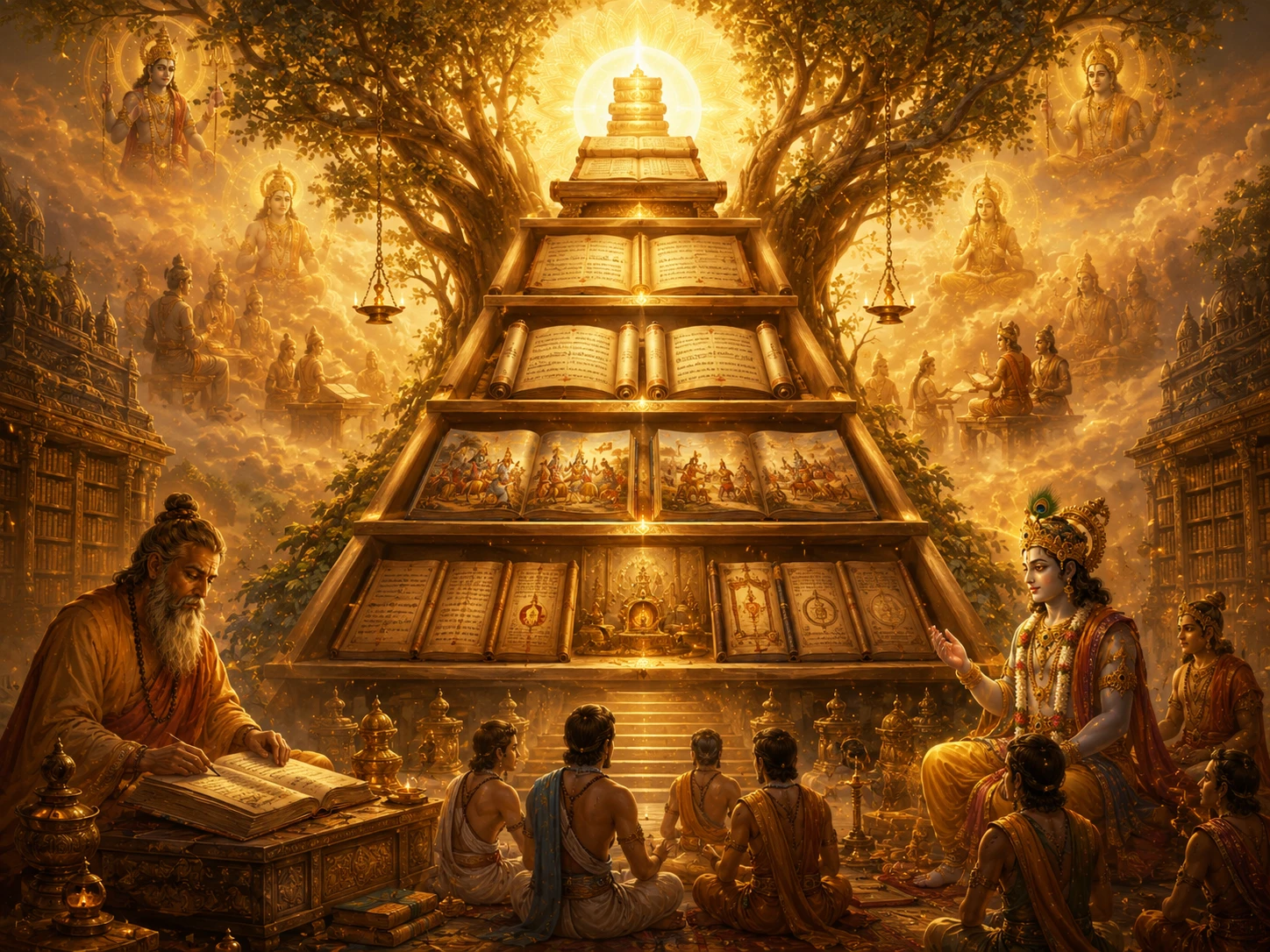
Shastra Vriksha -- The Complete Map of Hindu Scriptures
शास्त्र वृक्ष -- हिन्दू शास्त्रों का सम्पूर्ण मानचित्र
Shastra Vriksha
The Tree of Hindu Scriptures — Tap any node to explore
Picture this. You are scrolling through Instagram Reels and someone quotes a 'shloka from the Vedas.' Next reel -- a motivational page shares a 'Bhagavad Gita verse.' Third reel -- a pandit explains something from 'the Puranas.' You double-tap, save, and move on. But a question lingers: how do these texts actually connect to each other? Is the Gita part of the Vedas? Are Puranas separate from the Mahabharata? Where do the Upanishads fit?
Here is the uncomfortable truth -- most Hindus, even practicing ones, cannot draw the family tree of their own scriptures. Not because they are ignorant, but because nobody ever showed them the map. Schools teach Shakespeare and Wordsworth but skip Vyasa and Valmiki. Coaching centres in Kota drill differential equations but never mention that the binary number system traces back to Pingala's Chhandas Shastra. UPSC aspirants in Old Rajinder Nagar memorise the Indian Constitution but remain unaware that the concept of checks and balances (Dandaniti) appears in the Arthashastra -- a text branching directly from the Atharva Veda.
This article is that missing map. We call it Shastra Vriksha -- the Scripture Tree. Not a flat list. Not a Wikipedia dump. A living, branching tree where every text has a parent, siblings, and children. By the time you finish reading, you will be able to trace any Hindu scripture back to its root -- and finally understand why the Bhagavad Gita, despite being the most famous Hindu text globally, is technically a small section inside one chapter of one epic inside one branch of one category of knowledge.
तस्मै स होवाच। द्वे विद्ये वेदितव्ये इति ह स्म यद्ब्रह्मविदो वदन्ति परा चैवापरा च॥
tasmai sa hovāca | dve vidye veditavye iti ha sma yadbrahmavido vadanti parā caivāparā ca ||
To him (Saunaka), he (Angiras) said: Two kinds of knowledge must be known -- this is what the knowers of Brahman declare -- the Higher (Para) and the Lower (Apara).
— Mundaka Upanishad 1.1.4
This verse from the Mundaka Upanishad is the original classification engine of all Hindu knowledge. Everything that follows in the scripture tree grows from this single seed: there is Apara Vidya (lower knowledge) -- the four Vedas, the six Vedangas, ritual science, grammar, astronomy, etymology -- essentially everything you can study, memorise, and debate. And then there is Para Vidya (higher knowledge) -- the direct realisation of the Imperishable (Akshara), which is Brahman itself.
Why does this matter for understanding the tree? Because the entire structure of Hindu scripture is an attempt to move a seeker from Apara to Para. The Vedas give you the hymns. The Brahmanas give you the rituals. The Aranyakas move you into the forest of contemplation. And the Upanishads arrive at the destination -- direct philosophical inquiry into the nature of Self and Brahman. The tree is not random. It is a curriculum.
The Great Divide -- Shruti vs Smriti
Before diving into individual branches, you need the one distinction that governs the entire tree: Shruti versus Smriti.
Shruti (literally 'that which is heard') refers to texts considered to be directly revealed -- not authored by any human being (apaurusheya). The Rishis did not compose the Vedas; they 'heard' them in deep states of meditation. This gives Shruti texts the highest doctrinal authority in Hindu tradition. If a Smriti text contradicts a Shruti text, Shruti wins. No exceptions.
Smriti (literally 'that which is remembered') refers to texts composed by human sages based on their understanding of Shruti. These include the epics (Ramayana and Mahabharata), the Puranas, the Dharma Shastras (law codes), and all derivative literature. Smriti is enormously respected, deeply influential, and practically more widely read than Shruti -- but it ranks below Shruti in doctrinal authority.
Think of it like the Indian legal system. Shruti is the Constitution -- the supreme law. Smriti is like Parliamentary legislation -- valid and binding, but cannot override the Constitution. If a statute conflicts with the Constitution, the Supreme Court strikes it down. Similarly, when a Puranic story contradicts a Vedic principle, traditional scholars defer to the Vedic source.
On the Shastra Vriksha above, Shruti is coloured violet and Smriti is coloured green. Watch how the tree splits from the root into these two great rivers of knowledge.
वेदः स्मृतिः सदाचारः स्वस्य च प्रियमात्मनः। एतच्चतुर्विधं प्राहुः साक्षाद्धर्मस्य लक्षणम्॥
vedaḥ smṛtiḥ sadācāraḥ svasya ca priyam ātmanaḥ | etac caturvidhaṃ prāhuḥ sākṣād dharmasya lakṣaṇam ||
The Veda, the Smriti, the conduct of the virtuous, and what is agreeable to one's own conscience -- these four are declared to be the direct marks of Dharma.
— Manusmriti 2.12
The Root -- Four Vedas
Everything begins here. The four Vedas -- Rigveda, Yajurveda, Samaveda, and Atharvaveda -- are the absolute root of the scripture tree. Every other Hindu text either directly grows from them (Shruti branch) or derives its authority by referencing them (Smriti branch).
But here is what most people miss: each Veda is not a single book. Each Veda contains four distinct layers, like geological strata. The outermost layer is the Samhita (the core collection of hymns and mantras). Beneath that is the Brahmana (ritual manuals explaining how to perform yajnas). Deeper still is the Aranyaka (forest texts for contemplation, meant for those who have retired from active ritual life). And at the very core is the Upanishad (philosophical dialogues on the nature of reality).
This four-layer structure is not decorative. It mirrors a human life. The Samhitas serve the student (Brahmachari) learning the hymns. The Brahmanas serve the householder (Grihastha) performing rituals. The Aranyakas serve the retiree (Vanaprastha) moving inward. The Upanishads serve the renunciant (Sannyasi) seeking liberation. The Vedas contain their own GPS for the four stages of life.
The Rigveda is the oldest, with 1,028 suktas (hymns) and 10,552 mantras, organised into 10 Mandalas. It is primarily praise -- hymns addressed to Agni, Indra, Varuna, Ushas, and other deities. The Yajurveda (split into Shukla and Krishna recensions) provides the sacrificial formulas. The Samaveda sets Rigvedic verses to musical notation -- it is essentially the world's oldest songbook. The Atharvaveda, often called the 'people's Veda,' deals with practical life -- healing, protection, marriage rites, statecraft, and philosophy.
The Four Vedas -- Structure at a Glance
| Veda | Core Theme | Samhita Content | Key Numbers | Associated Upaveda |
|---|---|---|---|---|
| Rigveda (ऋग्वेद) | Praise and cosmology | 1,028 suktas in 10 Mandalas | 10,552 mantras. Oldest text. | Ayurveda (medicine) |
| Yajurveda (यजुर्वेद) | Ritual formulas | Shukla (Vajasaneyi) + Krishna (Taittiriya) recensions | 1,975 verses (Shukla). Guides yajna procedure. | Dhanurveda (warfare) |
| Samaveda (सामवेद) | Melody and chant | 1,875 verses, mostly from Rigveda, set to musical notation (Samagana) | World's oldest songbook. 3 notations: Udatta, Anudatta, Svarita. | Gandharva Veda (music) |
| Atharvaveda (अथर्ववेद) | Daily life, healing, philosophy | 730 suktas in 20 Kandas. Charms, medicine, statecraft. | Unique content not found in other Vedas. Includes Prashna and Mundaka Upanishads. | Arthashastra (statecraft) |
Each Veda internally contains four layers: Samhita (hymns) > Brahmana (ritual manuals) > Aranyaka (forest contemplation) > Upanishad (philosophical core). This four-layer structure maps to the four Ashramas of life.
The Limbs and the Applied Sciences -- Vedangas and Upavedas
Two important branches sprout directly from the Vedas before we reach the great Shruti-Smriti fork.
The six Vedangas (literally 'limbs of the Veda') are the technical tools without which the Vedas cannot be properly studied. Shiksha teaches correct pronunciation -- a single mispronounced syllable in a mantra can invert its meaning. Vyakarana is grammar -- and its masterpiece, Panini's Ashtadhyayi (3,959 sutras), is considered the most sophisticated grammar ever composed in any language. Chhandas is the science of poetic meter -- Pingala's treatise on this subject contains the earliest known description of binary numbers, a full two millennia before Leibniz. Nirukta is etymology, explaining the root meanings of Vedic words. Jyotisha is astronomy and time-keeping, essential for calculating auspicious moments for rituals. Kalpa is the science of ritual procedure itself.
The four Upavedas (subsidiary Vedas) are applied knowledge systems, each traditionally attached to one of the four Vedas. Ayurveda (medicine) connects to the Rigveda. Dhanurveda (military science) connects to the Yajurveda. Gandharva Veda (music and performing arts) connects to the Samaveda. Arthashastra (statecraft and economics) connects to the Atharvaveda.
Notice something interesting: these are not scriptures you sit and read for spiritual upliftment. They are functional sciences. This is why on the Shastra Vriksha, they branch off early and feed into the Eternal Gyan knowledge base rather than the Scripture reader. A JEE student studying combinatorics is, unknowingly, walking in Pingala's Chhandas footsteps. An AIIMS student learning anatomy is operating in the same domain as Sushruta's Ayurveda. The Vedic knowledge system was never only about prayer. It was always an entire civilisation's operating system.
The Philosophical Crown -- Upanishads
The Upanishads are where the Vedas stop describing and start asking. They sit at the innermost layer of each Veda (the fourth stratum after Samhita, Brahmana, and Aranyaka), and their collective name -- Vedanta, literally 'end of the Veda' -- tells you exactly where they stand.
There are over 108 Upanishads in the Muktika canon, but ten are considered Mukhya (principal) because Adi Shankaracharya chose to write commentaries on them: Isha, Kena, Katha, Prashna, Mundaka, Mandukya, Taittiriya, Aitareya, Chandogya, and Brihadaranyaka. These ten contain the philosophical heavy artillery of Hinduism -- concepts like Brahman (the absolute reality), Atman (the individual self), Maya (cosmic illusion), and the Mahavakyas (great utterances) like 'Tat Tvam Asi' (You are That) and 'Aham Brahmasmi' (I am Brahman).
Here is the critical link on the tree: the Upanishads serve as one of the three legs of the Prasthana Trayi -- the triple foundation of Vedanta philosophy. This means they connect downward to the Vedas (as their innermost layer) and simultaneously connect forward to the Darshana branch (as the Shruti Prasthana -- the revealed foundation of Vedanta). They are the hinge of the entire tree.
For an NRI parent explaining Hinduism to a child growing up in New Jersey or Toronto, the Upanishads are the answer to 'But what do Hindus actually believe?' For a startup founder in Koramangala going through burnout, the Katha Upanishad's dialogue between young Nachiketa and Yama (Death) on what truly matters is more relevant than any LinkedIn productivity post.
The Remembered Branch -- Smriti, Itihasa, and Puranas
Now we cross from the violet (Shruti) side of the tree to the green (Smriti) side. This is where most Hindus actually live -- the stories, the festivals, the characters they grew up with.
Smriti is organised through four Upangas (supplementary limbs): Dharma Shastra (law and ethics), Itihasa (historical epics), Purana (ancient narratives), and Nyaya-Mimamsa (logic and ritual interpretation).
Itihasa means 'thus it was' -- and it contains two of the most monumental works in world literature. The Ramayana, composed by Valmiki, has 24,000 shlokas across 7 Kandas. It is the story of Rama, Sita, Lakshmana, and Hanuman, and it has shaped the moral imagination of South and Southeast Asia for three thousand years. The Mahabharata, attributed to Vyasa, is the longest poem ever composed -- over 100,000 shlokas across 18 Parvas. It contains the Bhagavad Gita (in the Bhishma Parva), the Vidura Niti, the Shanti Parva, and dozens of other embedded texts. If you have ever heard the phrase 'whatever is here is found elsewhere; what is not here is nowhere,' that is the Mahabharata describing itself.
The 18 Mahapuranas and 18 Upapuranas form the narrative backbone of popular Hinduism. Most temple traditions, festival origin stories, and deity mythologies come from the Puranas. Vishnu Purana, Bhagavata Purana, Shiva Purana, Markandeya Purana (which contains the Devi Mahatmya), Skanda Purana (the largest, with sections covering every major pilgrimage site in India) -- these are the texts that turn philosophy into story and story into culture.
Here is the crucial tree connection: many of the 126 Gitas catalogued in the Gita Universe are embedded within Puranas and Itihasa. The Devi Gita is inside the Devi Bhagavata Purana. The Ganesha Gita is inside the Ganesha Purana. The Bhagavad Gita itself is inside the Mahabharata. The branches are not independent -- they are deeply intertwined.
The Six Eyes -- Shad Darshana
The word 'Darshana' literally means 'way of seeing.' The six orthodox Darshanas are six different philosophical lenses through which the Vedic tradition interprets reality. All six accept the authority of the Vedas (which is what makes them 'orthodox' or Astika), but they arrive at very different conclusions about the nature of God, the universe, and the self.
These six schools come in three traditional pairs: Nyaya-Vaisheshika (logic and atomism), Sankhya-Yoga (cosmic enumeration and discipline), and Purva Mimamsa-Uttara Mimamsa (ritual hermeneutics and philosophical inquiry). The last pair is especially important for our tree, because Uttara Mimamsa is simply another name for Vedanta -- the school that dominates modern Hindu philosophy.
The Six Darshanas at a Glance
| Darshana | Founder | Core Question | Key Idea | Modern Parallel |
|---|---|---|---|---|
| Nyaya (न्याय) | Aksapada Gautama | How do we know what is true? | 16 categories of logical reasoning (Padarthas). 4 valid means of knowledge (Pramanas). | Formal logic, courtroom argumentation, IIT entrance reasoning |
| Vaisheshika (वैशेषिक) | Kanada | What is reality made of? | 6 categories (Padarthas) including atoms (paramanu). World is made of indivisible particles. | Atomic theory. Kanada predated Democritus. Modern particle physics. |
| Sankhya (सांख्य) | Kapila | How did creation happen? | 25 Tattvas. Purusha (consciousness) + Prakriti (matter). Dualistic. | Consciousness studies. Hard problem of consciousness in neuroscience. |
| Yoga (योग) | Patanjali | How do I still the mind? | 8-limbed path (Ashtanga). Chitta-vritti-nirodha -- cessation of mental fluctuations. | Global yoga industry (Rs 3.7 lakh crore). Mindfulness apps. Sports psychology. |
| Purva Mimamsa (पूर्व मीमांसा) | Jaimini | How do we correctly interpret the Vedas? | Dharma is what the Veda commands. Focus on ritual action (Karma Kanda). | Legal hermeneutics. Constitutional interpretation. 'Original intent' debate. |
| Uttara Mimamsa / Vedanta (उत्तर मीमांसा / वेदान्त) | Badarayana (Brahma Sutra) | What is the nature of Brahman? | Inquiry into the Upanishads. Sub-schools: Advaita (Shankara), Vishishtadvaita (Ramanuja), Dvaita (Madhva). | Dominant school today. Shapes temple philosophy, ISKCON, Ramakrishna Mission, Chinmaya Mission. |
The six Darshanas come in three traditional pairs: Nyaya-Vaisheshika, Sankhya-Yoga, Purva Mimamsa-Uttara Mimamsa. Each pair complements the other -- one provides the theory, the other the method.
The Triple Gateway -- Prasthana Trayi
Here is where the tree produces its most important junction. Vedanta -- the dominant philosophical school -- rests on three foundational texts called the Prasthana Trayi (Triple Canon):
1. The Upanishads -- the Shruti Prasthana (revealed foundation). These are the direct voice of the Vedas. They establish what Brahman is through philosophical dialogues and Mahavakyas.
2. The Brahma Sutra -- the Nyaya Prasthana (logical foundation). Composed by Badarayana, these 555 terse aphorisms systematise the Upanishadic teachings into a logical framework. Every major Vedanta sub-school (Advaita, Vishishtadvaita, Dvaita) defines itself by its commentary on the Brahma Sutra.
3. The Bhagavad Gita -- the Smriti Prasthana (practical foundation). This is where the Gita sits in the hierarchy. Not as the 'Hindu Bible.' Not as the supreme standalone text. But as the practical, accessible, narrative-driven leg of the Vedantic triple canon. It takes the abstract philosophy of the Upanishads and the logical structure of the Brahma Sutra and delivers it through a crisis on a battlefield -- making it the most relatable entry point into Hindu philosophy for any generation.
This is why the Gita is so widely quoted. It is the only Prasthana text that tells a story. And stories travel faster than sutras.
On the Shastra Vriksha, you can see how the Prasthana Trayi pulls from three different branches -- Shruti (Upanishads, violet), Darshana (Brahma Sutra, blue), and Smriti/Itihasa (Gita, gold) -- and weaves them into one coherent system. It is the intellectual crossroads of the entire tree.
The Expanding Universe -- 126 Gitas and Beyond
From the Prasthana Trayi's Gita leg, the tree opens into something most people do not expect: the Gita Universe. The Bhagavad Gita is the most famous, but it is not the only Gita. Hindu tradition has catalogued at least 126 Gita texts across the Mahabharata, Puranas, and independent philosophical works.
These Gitas span seven thematic pillars -- from the Ashtavakra Gita (radical non-dualism) to the Devi Gita (the Goddess as Supreme), from the Uddhava Gita (Krishna's final teaching before leaving earth) to the Avadhuta Gita (the song of the liberated wanderer). Each Gita is a divine dialogue -- a conversation between a teacher and a seeker at a moment of crisis.
On the Eternal Raga platform, the Gita Universe is a living, growing section. Currently three Gitas are live (Bhagavad, Rama, Shiva), with five more coming soon (Ashtavakra, Avadhuta, Uddhava, Devi, Ganesha) and 118 in the pipeline.
The Living Traditions -- Agama and Tantra
Finally, on the right edge of the tree, stands a tradition that shapes how Hinduism is practiced daily -- even though most Hindus have never heard of it. The Agamas are the texts that govern temple worship, mantra practice, deity installation, and daily puja procedure.
Three major streams flow here: the Shaiva Agamas (28 principal texts governing Shiva worship), the Vaishnava Agamas (Pancharatra and Vaikhanasa traditions governing Vishnu worship), and the Shakta Tantras (64 principal texts governing Devi worship). Additionally, three minor traditions exist: Ganapathya (Ganesha), Kaumara (Kartikeya), and Soura (Surya).
Every time you visit Tirupati, Meenakshi Temple, or Somnath, the specific mantras chanted, the way the deity's garments are draped, the sequence of the abhishekam -- all of this comes from the Agamas, not from the Vedas directly. The Agamas are the bridge between scripture and lived devotion.
Master Scripture Categories -- Shruti, Smriti, Darshana, Agama
| Category | Authority Source | What It Contains | How It Reaches You Today | Tree Colour |
|---|---|---|---|---|
| Shruti (श्रुति) | Directly revealed (Apaurusheya). No human author. | 4 Vedas (each with Samhita, Brahmana, Aranyaka, Upanishad layers) + Vedangas + Upavedas | Temple chanting, Sandhyavandana, Upanayana, Vedic schools (Pathashalas) | Violet |
| Smriti (स्मृति) | Composed by sages. Derived from Shruti. | Itihasa (Ramayana, Mahabharata), 36 Puranas, Dharma Shastras, Nibandhas | Festivals (Diwali, Navratri), Katha traditions, Bollywood adaptations, Amar Chitra Katha | Green |
| Darshana (दर्शन) | Systematic philosophical reasoning grounded in Vedic authority. | 6 schools: Nyaya, Vaisheshika, Sankhya, Yoga, Purva Mimamsa, Vedanta. Prasthana Trayi. | Yoga studios, meditation apps, Vedanta centres (Ramakrishna, Chinmaya, ISKCON) | Blue |
| Agama / Tantra (आगम / तन्त्र) | Revealed dialogue between Shiva-Parvati or Vishnu-Lakshmi. Parallel to Shruti for many traditions. | Shaiva (28), Vaishnava (Pancharatra + Vaikhanasa), Shakta (64 Tantras), minor traditions | Temple architecture, deity installation, daily puja procedure, mantra diksha | Orange |
The Gita Universe (gold on the tree) is not a separate category but a cross-cutting collection spanning Smriti, Itihasa, and Puranic traditions -- 126 divine dialogues catalogued by Eternal Raga.
Why This Map Changes Everything
Once you see the Shastra Vriksha, you cannot unsee it. Every WhatsApp forward that begins with 'As the Vedas say...' now triggers a question: which Veda? Which layer -- Samhita, Brahmana, Aranyaka, or Upanishad? Every Instagram graphic quoting a 'Gita verse' now invites a follow-up: which Gita -- Bhagavad, Uddhava, Ashtavakra, or one of the other 123?
This map matters for three practical reasons.
First, intellectual honesty. Hindu civilisation produced one of the most elaborate knowledge systems in human history. It deserves to be understood as a system -- not as a collection of random quotes floating on social media. When you know that the Gita sits inside the Mahabharata which sits inside the Smriti branch which is secondary to Shruti, you stop treating it as the 'only' Hindu text and start appreciating it as the most accessible gateway into a much larger tradition.
Second, personal practice. If you are drawn to ritual, the Karma Kanda of the Vedas and the Agamas are your path. If you are drawn to philosophy, the Upanishads, Brahma Sutra, and the Darshana literature await. If you want stories that encode wisdom, the Puranas and Itihasa are limitless. If you want direct, concentrated teachings, the 126 Gitas are a lifetime's treasury. The tree helps you find your branch.
Third, cultural confidence. The next time someone at a dinner table in Delhi or a dorm room in Berkeley asks 'What do Hindus believe?', you do not need to fumble. Point them to this tree. Show them that Hinduism is not a single book with a single message. It is an entire forest -- rooted in four Vedas, branching through philosophy, narrative, logic, and living ritual, and still growing new leaves today.
The Shastra Vriksha is not a museum exhibit. It is a living map of a living tradition. And now, for the first time, you can see all of it in one place.
The Bhagavad Gita -- the most globally recognised Hindu text -- is technically a 700-verse section inside the Bhishma Parva (Book 6), which is one of 18 Parvas of the Mahabharata, which is one of two Itihasas, which is one of four Upangas under Smriti. In the scripture tree, it sits five levels below the root. Yet its influence is arguably greater than all the texts above it combined. When J. Robert Oppenheimer quoted 'Now I am become Death, the destroyer of worlds' after the first nuclear test in 1945, he was quoting Chapter 11, Verse 32 of this fifth-level text. When ISRO scientists perform Gita recitations before satellite launches, when IAS officers in Mussoorie study it during training, when a chess grandmaster like Viswanathan Anand credits Hindu philosophy for his composure -- they are all drawing from one small branch of a vast, ancient tree that most of them have never seen in full.
Start Reading the Scriptures
Now that you have the map, dive into the texts themselves. Start with the Bhagavad Gita on Eternal Raga -- read any chapter with Sanskrit, transliteration and meaning side by side.
Tags
Eternal Raga · शाश्वत राग
Institutional voice — scholarly articles on Sanatan Dharma
Deepen Your Understanding
अपनी समझ और गहरी करें
philosophy darshana
The Six Darshanas -- India's Original Intellectual Operating Systems
Long before Greek philosophy had its first argument, India had six complete philosophical systems -- each with its own logic, metaphysics, epistemology, and liberation path. Nyaya built formal logic. Vaisheshika invented atomic theory. Samkhya mapped consciousness. Yoga engineered the mind. Mimamsa decoded ritual. Vedanta asked the final question. Together, they are the most comprehensive intellectual framework any civilisation has produced.
philosophy darshana
Advaita Vedanta Explained -- Shankara's Radical Philosophy of Non-Duality
You are not your job title. You are not your Instagram bio. According to Adi Shankaracharya, you are not even your body or mind -- you are Brahman itself, the infinite consciousness wearing a temporary costume. Advaita Vedanta is the most radical philosophical claim in Indian history: that the entire universe is one undivided reality, and separation is the grandest illusion.
philosophy darshana
The Four Mahavakyas -- Upanishadic Sentences That Changed Civilisation
Four sentences. Twelve words of Sanskrit. Three thousand years of commentary. The Mahavakyas are the most compressed, most powerful, and most debated statements in all of Indian philosophy. Each one claims that the individual self and the ultimate reality of the universe are not two different things. And each one has been interpreted to mean something completely different by every major school of Vedanta.
philosophy darshana
Brahma Sutra -- The Architecture of Vedantic Thought
555 aphorisms. 4 chapters. The most technically demanding text in Hindu philosophy. The Brahma Sutra is the text every school of Vedanta must interpret to prove its legitimacy -- and every school reads it completely differently. Welcome to the ultimate intellectual battlefield of Indian civilisation.
vedic sciences
Kaal Ganana -- The Hindu Measure of Time
From a single blink of the eye (Nimesha) to one Day of Brahma (4.32 billion years) -- explore the complete cosmic time hierarchy of Hindu cosmology, anchored in Vishnu Purana 1.3, with its remarkable parallels to modern science.
tantra mantra yantra
Tantra, Mantra and Yantra -- The Three Pillars of Spiritual Practice
Tantra is the loom, Mantra is the thread, Yantra is the pattern. Together they form the complete technology of spiritual transformation that India gifted to the world -- and they are far more profound than popular culture imagines.
philosophy darshana
Atman and Brahman -- The Self and the Absolute
The Upanishads make a claim so radical that 3,000 years have not dulled its edge: the individual self (Atman) and the ultimate reality of the universe (Brahman) are not two different things. They are one. Every school of Hindu philosophy is essentially an argument about what this identity means.
The Bhagavad Gita -- the most globally recognised Hindu text -- is technically a 700-verse section inside the Bhishma Parva (Book 6), which is one of 18 Parvas of the Mahabharata, which is one of two Itihasas, which is o…
More in Scriptural Exegesis
Abhimanyu and the Chakravyuha -- The Boy Who Knew How to Enter but Not How to Leave
14 min read
Adbhuta Ramayana -- The Ramayana Where Sita Becomes Kali
9 min read
After Kurukshetra -- What Happened Next
14 min readThe same translation error that turned '33 Koti' into '33 crore' in Hinduism also happened in Buddhism. The Chinese translation of Buddhist texts rendered 'Sapta Koti Buddha' (7 Supreme Buddhas) as '7 Crore Buddhas.' The…
Deities AvatarsCommunity Reflections
🕉️
Be the first to share your reflection.