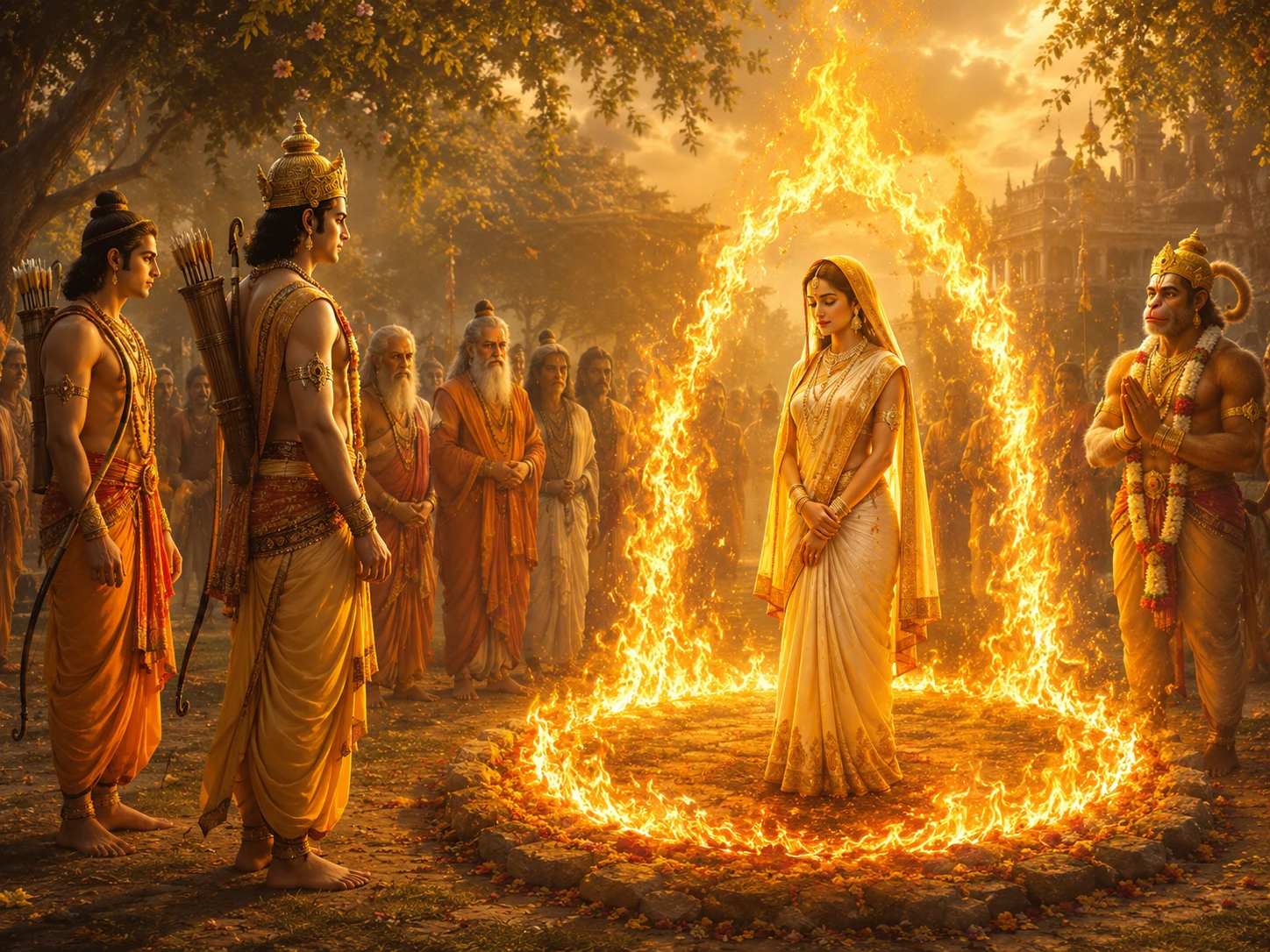
Agni Pariksha -- Sita's Fire Ordeal and the Interpretations That Divided India
अग्नि परीक्षा -- सीता की अग्नि-परीक्षा और वो व्याख्याएँ जिन्होंने भारत को बाँटा
No episode in Hindu scripture provokes as much discomfort, devotion, fury, and philosophical complexity as the Agni Pariksha -- the fire ordeal of Sita in the Yuddha Kanda of the Ramayana.
The basic outline is known to every Indian: after Rama defeats Ravana and rescues Sita from captivity in Lanka, he does not embrace her. Instead, he publicly questions her chastity, noting that she has lived for months in another man's household. Sita, devastated and furious, asks Lakshmana to prepare a funeral pyre. She invokes Agni as witness, declares her purity, circumambulates the fire, and walks in. The fire god Agni rises from the flames, carries Sita unharmed in his arms, and presents her to Rama, testifying to her absolute purity. Rama accepts her.
That is the narrative. But what it means has been argued for over two millennia -- and the argument has only intensified in modern India, where the Agni Pariksha has become a flashpoint in debates about patriarchy, devotion, women's rights, textual authenticity, and the politics of religion.
The episode occurs in Sargas 115-118 of the Yuddha Kanda in the Valmiki Ramayana. These four chapters contain some of the most emotionally devastating verses in all of Sanskrit literature -- Rama's cold public rejection, Sita's anguished response, the stunned silence of the assembled warriors, and the divine intervention of Agni, Brahma, and the gods who reveal Rama's true identity as Vishnu.
अप्रीतेन गुणैर्भर्त्रा त्यक्ता या जनसंसदि। या क्षमा मे गतिर्गन्तुं प्रवेक्ष्ये हव्यवाहनम्॥
aprītena guṇairbhartrā tyaktā yā janasaṃsadi | yā kṣamā me gatirgantum praveṣye havyavāhanam ||
Abandoned by a husband displeased with my qualities, in the midst of an assembly of men -- the only fitting course for me is to enter the fire.
— Valmiki Ramayana, Yuddha Kanda, Sarga 116, Verse 19
The Valmiki Ramayana's account is the most psychologically raw. Rama's words to Sita upon their reunion are not those of a loving husband. They are the words of a king performing statecraft in front of his army. He says the war was fought to avenge his honour, not to rescue her. He tells her she is free to go wherever she wishes -- to Lakshmana, Bharata, Shatrughna, Sugriva, or even Vibhishana. The implication is devastating: he is releasing her, not reclaiming her.
Sita's response is one of the most powerful speeches by any woman in world literature. She addresses him not as 'Rama' but as 'Vira' (hero) and accuses him of speaking 'like a common man to a common woman' -- 'prakritah prakritam iva' (Yuddha Kanda 116.5). She invokes her lineage (born of Earth, raised by Janaka), her fidelity (her heart never left Rama), and her helplessness (she could not prevent Ravana's abduction). Then she makes a choice that is simultaneously an act of protest and an act of faith: she orders the pyre built and enters it herself. Rama does not push her. She walks in.
Agni rises from the fire, carries Sita in his arms like a bride, and declares her purity. Brahma appears and reveals Rama as Vishnu. Rama then explains -- in verses that many scholars believe are a later theological addition -- that he never doubted Sita but needed to prove her purity 'to convince the three worlds' (pratyayartham tu lokanam trayanam satyasamsrayah). He knew the fire would not harm her because she was protected by her own splendour (tejas).
This explanation satisfies the devotional reading but deepens the feminist critique: if Rama always knew Sita was pure, why did he subject her to a public humiliation? The answer the text gives -- 'for the sake of public perception' -- is precisely the answer that makes modern readers most uncomfortable, because it subordinates a woman's dignity to the management of collective reputation.
The devotional tradition resolved this discomfort through one of the most ingenious theological inventions in all of Hinduism: the Maya Sita (Shadow Sita) doctrine.
According to the Kurma Purana, Brahma Vaivarta Purana, and Tulsidas's Ramcharitmanas, the real Sita was never abducted by Ravana at all. Before the golden deer episode (Maricha's deception), Rama -- knowing what was about to unfold -- secretly entrusted the real Sita to Agni for safekeeping. In her place, Agni created a Chaya Sita (shadow or illusory double) who was the one actually abducted, held captive in Lanka, and later tested in fire. The Agni Pariksha, in this reading, is not a test at all. It is a retrieval -- Agni returning the real Sita and burning away the shadow.
This doctrine accomplishes several things simultaneously. It protects Sita's absolute purity: the real Sita was never in Ravana's presence, never touched by an impure hand, never in need of 'testing.' It protects Rama's character: he was not testing his wife but recovering her from divine custody. It reframes the fire as a transformative portal, not a punitive ordeal. And it aligns the narrative with the theology of lila -- divine play -- in which nothing that happens to the avatar and his consort is what it appears to be on the surface.
The Maya Sita doctrine is the dominant interpretation in North Indian bhakti tradition. It is the version taught in most temples, recited during Ram Katha, and dramatised in the annual Ramlila performances from Varanasi's Ramnagar to Delhi's Red Fort grounds. For the majority of practising Hindus in the Hindi belt, the question 'Why did Rama test Sita?' simply does not arise -- because in their Ramayana, he did not test her. He retrieved her.
But this resolution creates its own theological problem: if the Sita in Lanka was a shadow, then what is the moral weight of Rama's entire war? Did he fight and kill thousands to rescue an illusion? Did Hanuman risk his life to find a projection? The Adbhut Ramayana (attributed to Valmiki but of uncertain date) grapples with precisely this paradox, suggesting that the 'shadow' was so perfectly created that even Rama momentarily forgot it was not real -- a meta-commentary on the nature of Maya itself.
The feminist critique of the Agni Pariksha is not a modern invention imported from Western gender studies. It exists within the Indian tradition itself, often voiced through the most unexpected channels.
The earliest and most devastating feminist voice in the episode is Sita's own. Her speech before entering the fire (Yuddha Kanda 116.5-19) is not a meek submission. It is a controlled fury. She accuses Rama of treating her like 'a common woman,' of judging her by gender rather than by character, and of allowing his suspicion to override his knowledge of her heart. She invokes the fire not as an obedient wife obeying her husband's command but as a sovereign woman demanding cosmic justice: 'If I am pure, let Agni protect me. If the gods know my truth, let them bear witness.' Sita does not enter the fire because Rama told her to. She enters because she decides that the only court qualified to judge her is the universe itself.
This reading is not a modern imposition on the text. Commentators from the 11th century onwards noted Sita's speech as an act of agency. The Kamba Ramayanam (12th century Tamil) emphasises Sita's rage and presents Rama as deeply conflicted. The Bengali Krittivasi Ramayana (15th century) foregrounds Sita's suffering with an emotional intensity that borders on accusation of Rama. The 20th century Malayalam poet Kumaran Asan wrote 'Chintavishtayaya Sita' (Sita Lost in Thought), reimagining Sita's internal monologue -- a work that profoundly influenced Kerala's literary and feminist movements.
In contemporary India, the Agni Pariksha has become a metaphor far beyond its scriptural context. When a woman who has been assaulted is asked what she was wearing, when a rape survivor is subjected to the 'two-finger test' that the Supreme Court banned in 2013, when a divorced woman is questioned about her 'character' in family court -- the structural logic is the same: prove your purity, or be condemned. The Agni Pariksha is not an ancient episode. It is a daily reality.
But the feminist reading must also grapple with Sita's own framing. She does not reject the test. She redefines it. She does not say 'I refuse to prove myself.' She says 'I will prove myself -- but on my terms, before the highest possible authority, and the result will shut every mouth in the three worlds.' This is not submission. It is strategic sovereignty. For a woman lawyer arguing a harassment case in the Supreme Court, for a female entrepreneur pitching to a room of male VCs in Bangalore, for a PhD scholar defending her thesis before a skeptical committee at IIT Delhi -- Sita's strategy of 'I will play your game and win it so completely that you can never question me again' resonates not as ancient mythology but as lived professional reality.
Four Readings of Agni Pariksha -- Same Scene, Four Meanings
| Reading | Core Claim | Sita's Role | Rama's Role | Primary Source Tradition |
|---|---|---|---|---|
| Devotional (Maya Sita) | The real Sita was never in Lanka; Agni Pariksha retrieves her from divine custody | Absolute purity; never in danger | Performing divine lila; always in control | Ramcharitmanas, Adhyatma Ramayana, Kurma Purana |
| Textual-Critical (Valmiki) | A public test of chastity after captivity; Rama needed to satisfy 'the three worlds' | Agent of her own vindication; enters fire by choice | King performing statecraft; subordinates personal love to public duty (Rajadharma) | Valmiki Ramayana, Yuddha Kanda 115-118 |
| Feminist | A patriarchal ordeal that subjects a victim to a purity test for a crime committed against her | Survivor who is punished for being victimized; her speech is a protest | Perpetuator of patriarchal logic; his 'public duty' excuse mirrors modern victim-blaming | Kumaran Asan, Nabaneeta Dev Sen, Volga (Telugu) |
| Philosophical (Advaitic) | Fire represents transformative knowledge; Sita passes through illusion (Maya) to reveal her true nature as Lakshmi | Embodiment of Prakriti passing through the fire of jnana | Embodiment of Purusha who witnesses Prakriti's self-revelation | Upanishadic commentators, Sri Vidya tradition |
These four readings are not mutually exclusive. Many scholars and devotees hold multiple readings simultaneously, choosing emphasis based on context. The tradition's richness lies in supporting all four.
The Uttara Kanda -- the seventh and final book of the Ramayana, regarded by most scholars as a later addition to the epic -- makes the Agni Pariksha even more painful by adding a second exile. After returning to Ayodhya and being crowned, Rama hears a washerman (rajaka) questioning Sita's chastity: 'I will not take back a wife who has lived in another man's house.' Rama, crushed by the implications for public trust in the monarchy, orders Lakshmana to abandon the pregnant Sita in the forest near Valmiki's ashram.
This second abandonment has provoked more outrage than the fire itself. The Agni Pariksha at least had divine confirmation of Sita's purity. The second exile has nothing -- no test, no trial, no divine intervention. Just a rumour from an anonymous washerman and a king who prioritises optics over justice. Sita raises Lava and Kusha alone. She never returns to the palace. When Rama finally finds her years later, she does not go back to him. She calls upon her mother, the Earth, to take her back -- and the ground opens and swallows her.
Many scholars -- including M.R. Parameswaran and the BORI critical edition team -- consider the Uttara Kanda a later interpolation, not written by Valmiki. The linguistic style differs from the core books (2-6). The characterisation of Rama contradicts the dharmic ideals of the earlier kanda. The Shambuka vadha (killing of a Shudra ascetic) in the same book further complicates the portrayal. If the Uttara Kanda is indeed a later addition, then the 'original' Ramayana ended with Rama and Sita's triumphant return to Ayodhya -- with no second exile, no washerman, and no earth-swallowing.
This textual question has massive real-world implications. If you include the Uttara Kanda, Rama is a king who abandoned his pregnant wife over gossip. If you exclude it, Rama is a king who accepted his wife after divine vindication. The 'same' epic produces radically different moral lessons depending on which books you treat as canonical. Every political invocation of 'Ram Rajya' -- from Gandhi to contemporary Indian politics -- is implicitly choosing a canon without admitting it.
The Agni Pariksha has also been weaponised in India's contemporary culture wars in ways that neither the devotional nor the feminist reading would endorse.
On one side, Hindu nationalist discourse sometimes invokes Sita's fire ordeal as proof of the tradition's 'respect for women' -- arguing that Agni himself certified her purity, that Rama accepted her, and that therefore the episode demonstrates divine justice rather than patriarchal injustice. This reading conveniently ignores the Uttara Kanda's second exile and Sita's final earth-swallowing departure, which offer no such vindication.
On the other side, certain anti-Hindu polemics weaponise the episode to characterise the entire Hindu tradition as misogynistic -- ignoring the Panchakanya tradition, the Maya Sita doctrine, the female warrior goddesses of the Devi Mahatmya, the property rights of women in Mitakshara and Dayabhaga law, and the centuries of internal critique that Indian women writers, saints, and scholars have produced from within the tradition.
Both appropriations are intellectually dishonest because both flatten a multi-layered, internally debated tradition into a single political talking point. The Ramayana is not a party manifesto. It is a civilisational conversation -- and its power lies precisely in the fact that it contains voices that disagree with each other. Valmiki gave Sita a speech of righteous anger. Tulsidas gave her serene devotion. Kamban gave her Tamil fire. Volga gave her feminist liberation. The Ramayana's Sita is not one woman. She is every woman -- as imagined by every poet, every region, and every century of Indian civilisation.
For a student preparing for the IAS essay paper on 'The Role of Women in Indian Society,' for a screenwriter in Mumbai developing a Ramayana adaptation for a streaming platform, for a debate team at St. Stephen's arguing whether tradition empowers or constrains women -- the Agni Pariksha is the perfect case study, precisely because it supports no single conclusion.
The Telugu novelist Volga (pen name of Lalita Kumari) wrote 'Vimukta' (The Liberation of Sita), a collection of feminist retellings of the Ramayana that became a landmark text in Indian women's literature. In her version, Sita refuses to return to Rama after the fire and instead embarks on a journey of self-discovery, encountering other women from the epic -- Surpanakha, Ahalya, Renuka -- who share their stories of patriarchal violence. The book, first published in Telugu in 1997, has been translated into English, Hindi, Kannada, and Malayalam. It won the Sahitya Akademi award and is taught in gender studies courses at JNU, TISS, and Ambedkar University Delhi. Volga's work demonstrates that the most radical feminist critiques of the Ramayana can emerge from within the Indian literary tradition itself.
What the Agni Pariksha ultimately demands of us is not a single 'correct' interpretation but the intellectual honesty to hold multiple readings in tension without collapsing into either uncritical devotion or reflexive dismissal.
The devotional reading is not naive. It emerges from a sophisticated theology of divine lila that refuses to reduce God and Goddess to human-scale moral judgment. If Rama is Vishnu and Sita is Lakshmi, then the fire ordeal is a cosmic event, not a domestic dispute -- and reading it through the lens of patriarchal critique is a category error, like criticising a symphony for not being a legal brief.
The feminist reading is not anti-Hindu. It emerges from within the tradition -- from Sita's own voice in the Valmiki text, from centuries of women poets and commentators who noticed the asymmetry, from living Indian women who see their own experiences reflected in a story told two thousand years ago. To dismiss this reading as 'Western influence' is to erase the Indian women who articulated it.
The textual-critical reading is not disrespectful. It follows the rigorous methodology that Indian scholars themselves pioneered -- the BORI critical edition of the Mahabharata (and related Ramayana scholarship) is one of the great achievements of Indian intellectual history. Asking which portions of the text are original and which are later additions is not sacrilege. It is scholarship.
The philosophical reading -- Sita as Prakriti passing through the fire of Jnana to reveal her identity as Lakshmi -- is perhaps the most elegant, transforming a troubling narrative into a map of spiritual awakening. But elegance should not be used to evade the human pain embedded in the story.
For a first-year student at Ashoka University encountering the Ramayana in a comparative literature class, for a grandmother in Ayodhya who has recited the Ramcharitmanas every Navaratri for sixty years, for a young woman in Hyderabad scrolling past memes about 'Sita vs modern women' -- the Agni Pariksha will mean different things. The tradition's genius is that it anticipated all of them.
India's Supreme Court cited the Agni Pariksha in a 2018 judgment related to the abolition of the 'two-finger test' for sexual assault survivors. Justice D.Y. Chandrachud, in his observations during the Hadiya case and related gender justice matters, referenced the cultural persistence of 'purity testing' as a systemic form of revictimisation. The connection between ancient fire ordeals and modern forensic humiliation was drawn explicitly by feminist legal scholars including Ratna Kapur (CUNY) and Nivedita Menon (JNU), whose work traces a direct lineage from Sita's trial to contemporary evidence law. Meanwhile, the Ramnagar Ramlila near Varanasi -- a month-long performance patronised by the Maharaja of Benaras since the 1830s and recognized by UNESCO -- stages the Agni Pariksha with elaborate pyrotechnics every year, drawing lakhs of devotees who weep when Sita enters the flames and cheer when she emerges unscathed. The same episode, simultaneously, feeds India's highest court and its oldest continuous theatrical tradition.
Meditate with the Sita Rama Dhyana
Whatever reading of the Agni Pariksha speaks to you, the bond between Sita and Rama remains one of the most meditated-upon in Hindu spirituality. The Ram Raksha Stotra opens with a dhyana shloka that pictures Rama with Sita seated at his left. Recite it, hold that image, and sit with both -- the masculine and feminine divine in balance. It is on Eternal Raga with its meaning.
Tags
Eternal Raga · शाश्वत राग
Institutional voice — scholarly articles on Sanatan Dharma
Deepen Your Understanding
अपनी समझ और गहरी करें
scriptural exegesis
Ahalya Moksha -- The Woman Who Became Stone and the God Who Set Her Free
She was Brahma's most perfect creation. She was cursed for a crime that may not have been hers. She lay as stone -- or invisible, or in ashes, depending on which text you trust -- for thousands of years. Then a boy-prince's foot touched her, and she rose. Ahalya's story is Hinduism's oldest argument about consent, punishment, and grace.
deities avatars
When Gods Were Cursed -- Divine Punishments in Hindu Mythology
Hindu mythology does something no other tradition dares -- it puts its own gods on trial. Brahma lost his worship. Vishnu became a stone. Shiva was reduced to a symbol. Indra was humiliated a hundred times over. These are not theological accidents but deliberate statements: even the divine is accountable.
scriptural exegesis
Devi Mahatmya -- The Three Charitas That Changed How India Worships the Feminine
700 verses. 13 chapters. Three battles. One thesis: when every god in the universe has failed, a woman finishes the job. The Devi Mahatmya from the Markandeya Purana is not just a scripture -- it is the founding document of Shakta theology and the reason 300 million people celebrate Navaratri.
philosophy darshana
Dharma, Artha, Kama, Moksha -- The Four Goals That Make a Complete Life
Hinduism does not ask you to choose between God and money. Between spirituality and pleasure. Between duty and desire. Its four Purusharthas -- Dharma, Artha, Kama, Moksha -- are the most holistic life-framework any civilisation has designed. The catch? Each must be pursued in the right order, at the right time, under the right constraints.
philosophy darshana
Karma Explained -- Not Punishment, Not Reward, but the Physics of Action
Karma is not cosmic revenge. It is not 'what goes around comes around.' It is India's most sophisticated theory of causation -- a framework that explains why your choices matter, why consequences are inescapable, and why freedom is still possible. The Gita's karma teaching changed Oppenheimer's life. It might change yours.
deities avatars
Dashavatara -- Why Vishnu Comes Back Ten Times
Fish, tortoise, boar, half-lion, dwarf, axe-warrior, prince, cowherd, enlightened teacher, future horseman. The ten avatars of Vishnu are not random folklore. Read them in sequence and you get something startling -- a narrative that mirrors evolutionary biology, tracks the rise and fall of political systems, and argues that God does not sit above history but enters it, gets dirty, and does the work. The Dashavatara is Hinduism's answer to the question every civilisation asks: why does the world keep breaking, and who fixes it?
deities avatars
Devi Swaroopa -- Forms of the Goddess
She is Durga on the battlefield and Annapurna in the kitchen. She is Kali at the cremation ground and Lakshmi in the boardroom. She is Saraswati at the university and Parvati in the family. The Hindu Goddess is not one deity with accessories -- she is the entire spectrum of feminine power, from terrifying to tender, from cosmic to domestic. Understanding her forms is understanding the universe itself.
The Telugu novelist Volga (pen name of Lalita Kumari) wrote 'Vimukta' (The Liberation of Sita), a collection of feminist retellings of the Ramayana that became a landmark text in Indian women's literature. In her version…
More in Scriptural Exegesis
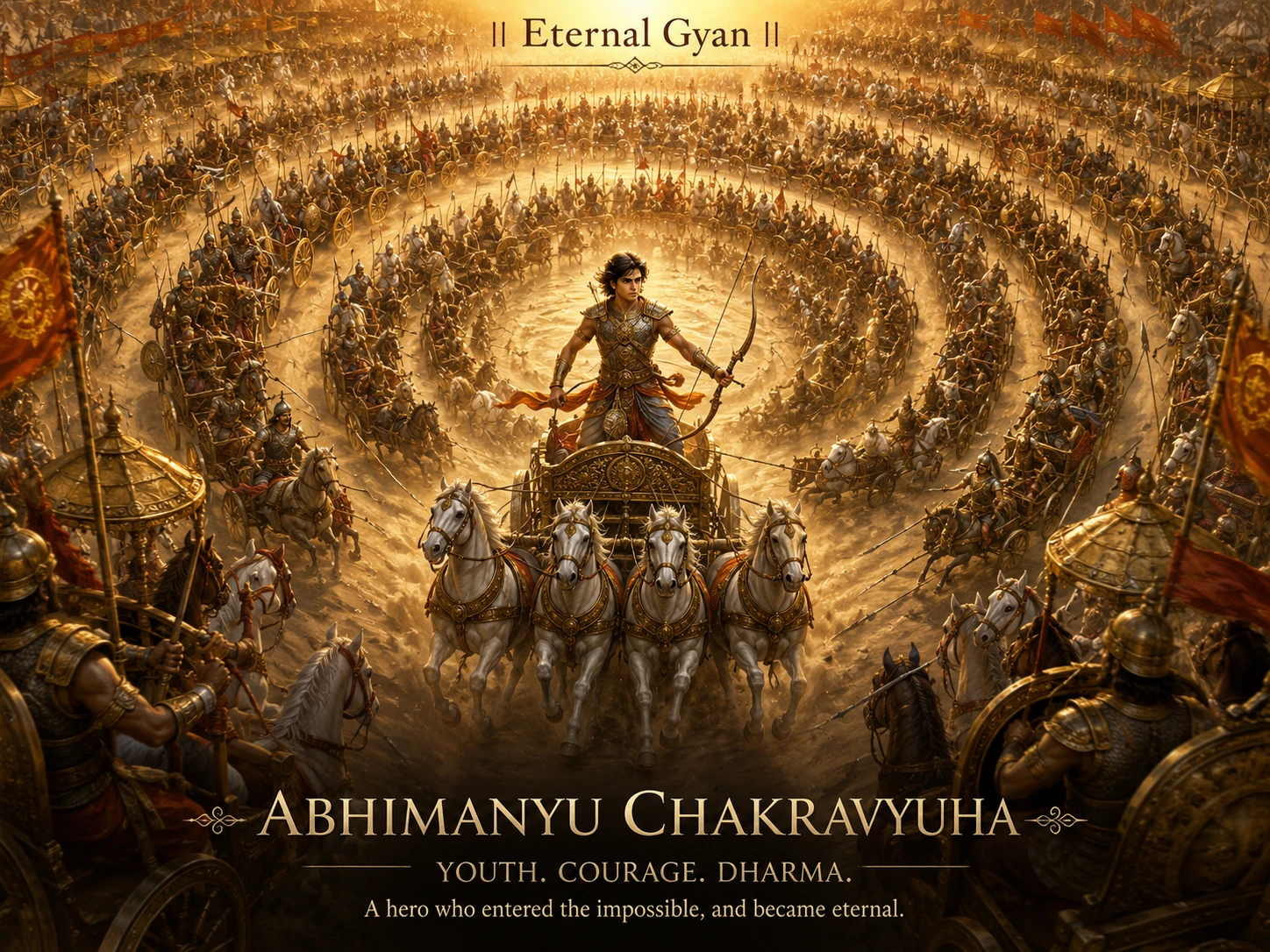
Abhimanyu and the Chakravyuha -- The Boy Who Knew How to Enter but Not How to Leave
14 min read
Adbhuta Ramayana -- The Ramayana Where Sita Becomes Kali
9 min read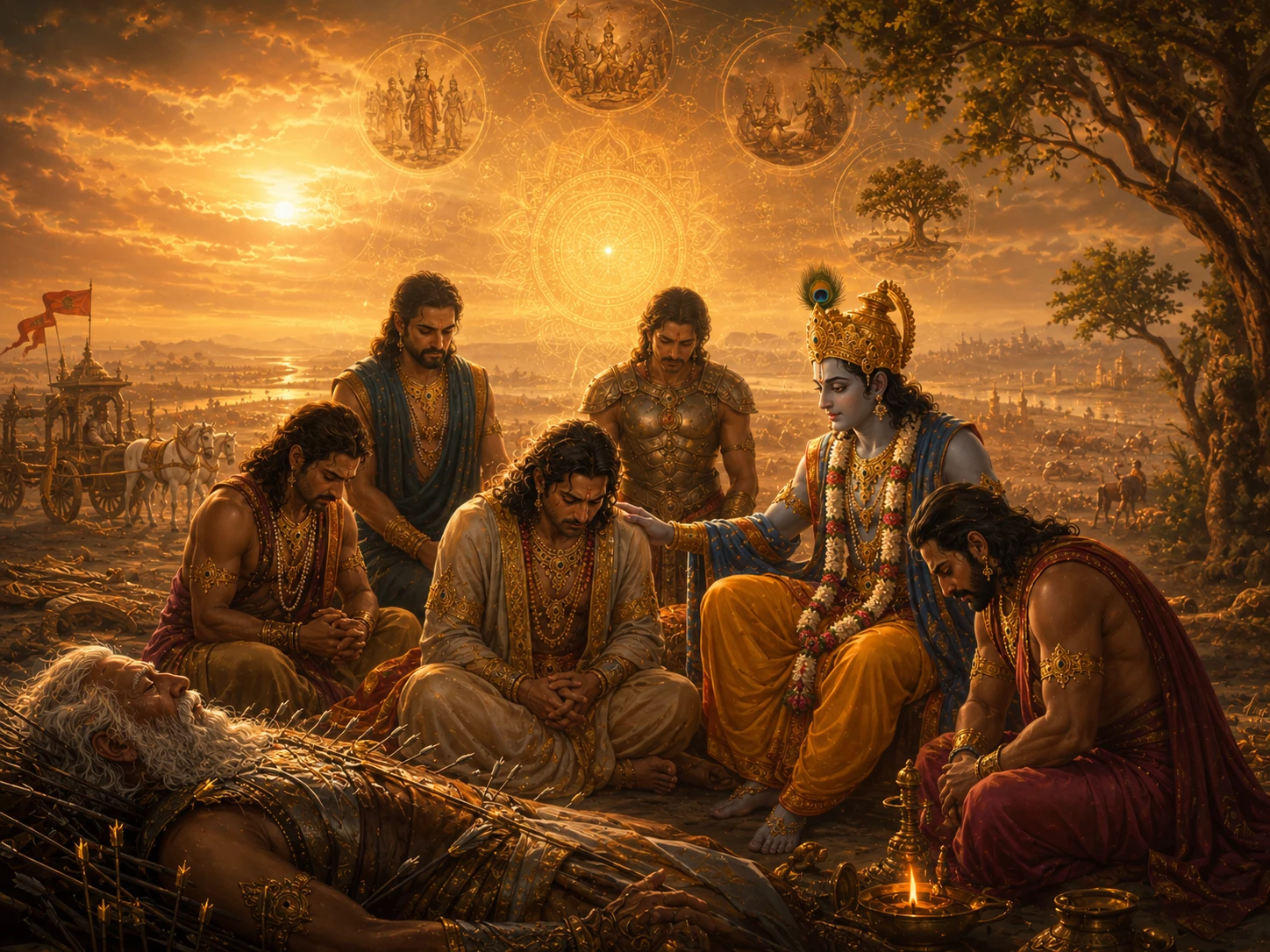
After Kurukshetra -- What Happened Next
14 min readThe same translation error that turned '33 Koti' into '33 crore' in Hinduism also happened in Buddhism. The Chinese translation of Buddhist texts rendered 'Sapta Koti Buddha' (7 Supreme Buddhas) as '7 Crore Buddhas.' The…
Deities AvatarsCommunity Reflections
🕉️
Be the first to share your reflection.